
WiFi 7 MLO Explicado: Operação Multi-Link para Roaming Contínuo
Este guia de referência técnica oferece uma análise aprofundada da Operação Multi-Link (MLO) do WiFi 7 para arquitetos de rede empresarial e líderes de TI. Ele desmistifica os três modos de operação MLO (eMLSR, NSTR e STR), explica como o MLO supera o band steering legado e fornece orientações de implantação acionáveis, apoiadas por dados de testes reais da Wireless Broadband Alliance. Operadores de locais em hospitalidade, varejo e grandes espaços públicos encontrarão estratégias de implementação concretas e evidências de ROI para apoiar decisões de investimento em WiFi 7.
Ouça este guia
Ver transcrição do podcast

Resumo Executivo
Para líderes de TI empresarial e arquitetos de rede, a transição para o IEEE 802.11be (WiFi 7) introduz uma mudança de paradigma na conectividade sem fio. A pedra angular deste padrão é a Operação Multi-Link (MLO), um recurso obrigatório para dispositivos Wi-Fi CERTIFIED 7 que altera fundamentalmente a forma como pontos de acesso e clientes interagem em todo o espectro de radiofrequência. Ao contrário do band steering legado, que depende de reassociacões impulsionadas pela rede que interrompem o tráfego, o MLO permite conexões multi-banda simultâneas e coordenadas pelo cliente.
Testes de campo empresariais recentes, conduzidos pela Wireless Broadband Alliance, demonstraram o profundo impacto do MLO em ambientes de alta densidade. Testes em ambientes de escritório reais revelaram uma melhoria de até 116% na taxa de transferência de uplink sob severa interferência de co-canal, juntamente com uma redução de 66% na latência de uplink. Para diretores de operações que gerenciam estádios, centros de conferências e grandes áreas de varejo, o MLO se traduz diretamente em conectividade resiliente para aplicações de missão crítica. Este guia desmistifica a arquitetura técnica do MLO, dissecando os três modos de operação primários e fornecendo estratégias de implementação acionáveis para implantações empresariais modernas.
Análise Técnica Aprofundada: A Arquitetura da Operação Multi-Link
A inovação fundamental do WiFi 7 MLO é a criação de uma arquitetura de Dispositivo Multi-Link (MLD) que abstrai os links de rádio físicos da conexão de rede lógica. Em gerações anteriores, incluindo o WiFi 6E, um dispositivo cliente só podia se associar a uma única banda (2.4 GHz, 5 GHz ou 6 GHz) a qualquer momento. Se a interferência degradava esse link, o cliente ou ponto de acesso tinha que iniciar uma reassociacão completa para uma banda diferente — um processo que tipicamente incorre em mais de 100 milissegundos de latência e perda inevitável de pacotes.
Com o 802.11be MLO, a camada MAC é bifurcada em um MAC Superior (U-MAC) e um MAC Inferior (L-MAC). O U-MAC lida com a associação de segurança geral, criptografia e numeração de sequência, enquanto o L-MAC gerencia o acesso ao canal físico e o beaconing para cada link de rádio individual. Esta arquitetura permite que uma única conexão lógica abranja múltiplas bandas físicas simultaneamente. O cliente e o ponto de acesso negociam essas capacidades durante a fase de associação inicial, estabelecendo um endereço MAC MLD primário juntamente com endereços MAC específicos por link.
Os Três Modos de MLO
Embora os materiais de marketing frequentemente apresentem o MLO como um recurso monolítico, o padrão IEEE 802.11be define três modos de operação distintos. Compreender esses modos é fundamental para arquitetos de rede que avaliam capacidades de hardware e planejam cronogramas de implantação.
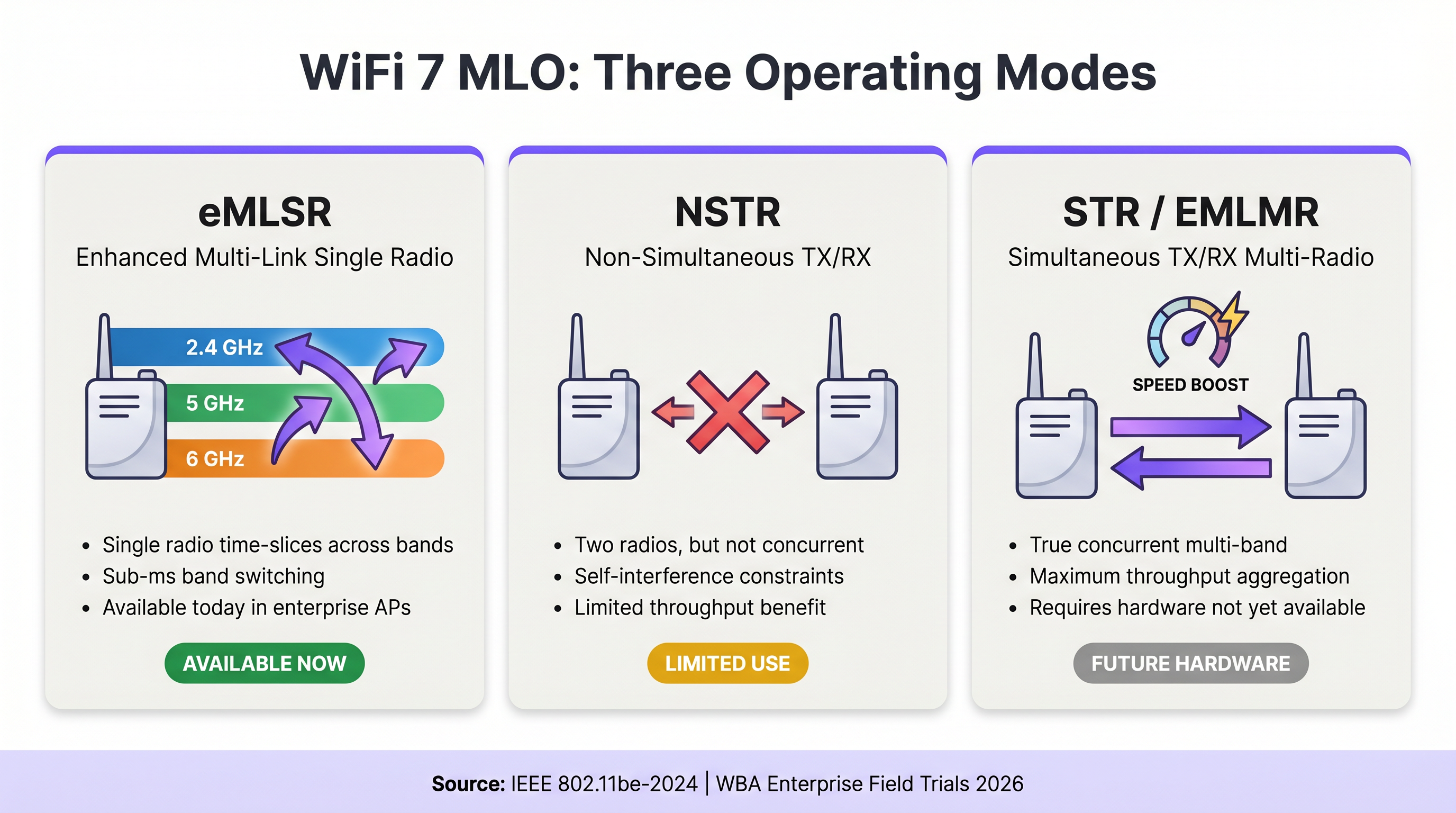
1. Rádio Único Multi-Link Aprimorado (eMLSR)
O Rádio Único Multi-Link Aprimorado é a implementação fundamental do MLO disponível nos atuais pontos de acesso empresariais e dispositivos cliente. Neste modo, o dispositivo cliente utiliza um único rádio que rapidamente divide o tempo entre múltiplas bandas. Crucialmente, o dispositivo mantém cadeias de recepção separadas, permitindo-lhe ouvir as bandas de 5 GHz e 6 GHz simultaneamente. Quando surge uma oportunidade de transmitir ou receber, ele alterna dinamicamente seu rádio principal para a banda ideal.
Embora o eMLSR não forneça transmissão e recepção simultâneas verdadeiras, ele oferece comutação de banda em sub-milissegundos. Isso representa um avanço massivo em relação ao band steering legado, proporcionando failover quase contínuo e reduzindo significativamente a latência em ambientes congestionados. Para implantações empresariais em 2025 e 2026, o eMLSR é a realidade prática que entrega a maior parte dos benefícios imediatos do MLO. Os testes de campo empresariais da Fase 2 da Wireless Broadband Alliance confirmaram que o eMLSR oferece uma melhoria de até 75% na taxa de transferência de downlink e 116% na de uplink sob interferência de co-canal, juntamente com uma redução de até 44% na latência de downlink para tráfego em tempo real.
2. Transmissão e Recepção Não Simultâneas (NSTR)
A Transmissão e Recepção Não Simultâneas utiliza múltiplos rádios físicos, mas os restringe de operar concomitantemente devido a restrições de autointerferência. Se um dispositivo transmite na banda de 5 GHz, o ruído de radiofrequência resultante o impede de receber dados de forma confiável na banda de 6 GHz simultaneamente. O NSTR é amplamente visto como um passo intermediário com utilidade limitada no mundo real em comparação com a agilidade dinâmica do eMLSR ou o objetivo final da verdadeira operação simultânea.
3. Transmissão e Recepção Simultâneas (STR / EMLMR)
O auge da especificação de Operação Multi-Link é a Transmissão e Recepção Simultâneas, que permite o Rádio Múltiplo Multi-Link Aprimorado (EMLMR). Este modo permite que um dispositivo transmita e receba dados em múltiplas bandas simultaneamente, agregando taxa de transferência e entregando o desempenho máximo teórico do WiFi 7. Alcançar o STR requer hardware altamente avançado capaz de alinhamento de tempo em sub-microssegundos e um sofisticado Agendamento de Recursos de Espectro (SRS) para mitigar a autointerferência. Até o início de 2026, nenhum hardware de consumo ou empresarial implementa totalmente o STR verdadeiro, tornando-o uma capacidade futura em vez de uma consideração de implantação atual.
Guia de Implementação: MLO vs. Band Steering Legado
Para engenheiros de rede que planejam implementações de WiFi 7, a mudança operacional mais imediata é a obsolescência do band steering tradicional.para forçar clientes dual-band para o espectro de 5 GHz menos congestionado, ignorando suas solicitações de sonda em 2.4 GHz. Essa abordagem centrada na rede era inerentemente disruptiva, pois o dispositivo cliente permanecia alheio à lógica de direcionamento e experimentava quedas de conexão durante a transição forçada.
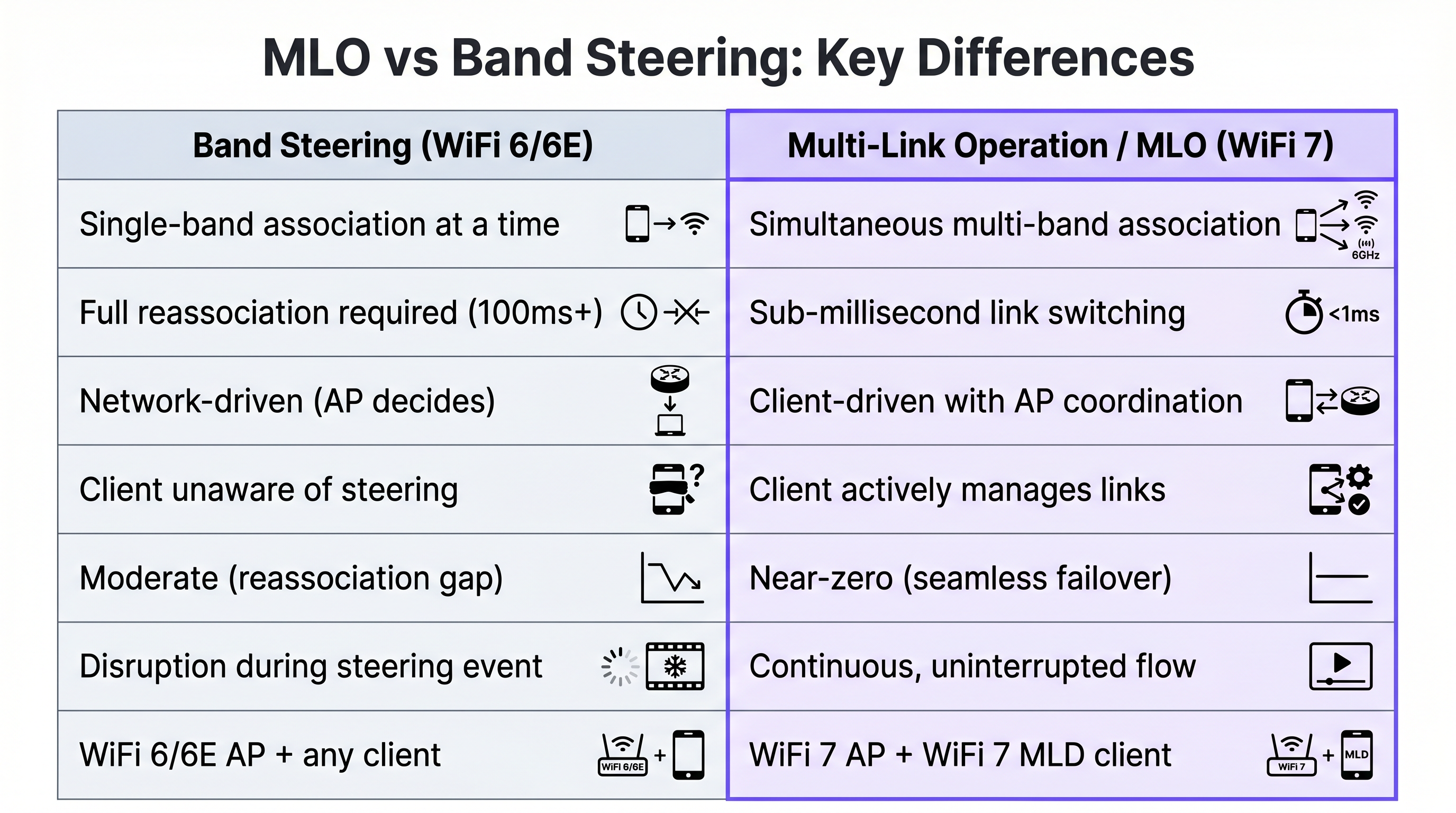
O MLO substitui esse paradigma por uma abordagem coordenada pelo AP e impulsionada pelo cliente. Como o cliente mantém a percepção simultânea de múltiplos links, ele pode alternar o tráfego de forma contínua com base nas condições do canal em tempo real, sem quebrar a conexão lógica subjacente. Isso é particularmente vital para implantações de Guest WiFi em locais de alta densidade onde o roaming e a interferência são desafios constantes. Para centros de Transporte como aeroportos e terminais ferroviários, onde os passageiros se movem rapidamente pelas zonas de cobertura, a eliminação dos atrasos de reassociação melhora diretamente a qualidade das aplicações de check-in móvel e de localização.
Prontidão de Implantação e Ecossistema
O sucesso de uma implantação de MLO depende inteiramente do ecossistema do cliente. Um ponto de acesso WiFi 7 só pode aproveitar o MLO ao se comunicar com um cliente WiFi 7 compatível com MLD. Dispositivos WiFi 6 e 6E legados se conectarão normalmente, mas não se beneficiarão dos recursos de multi-link.
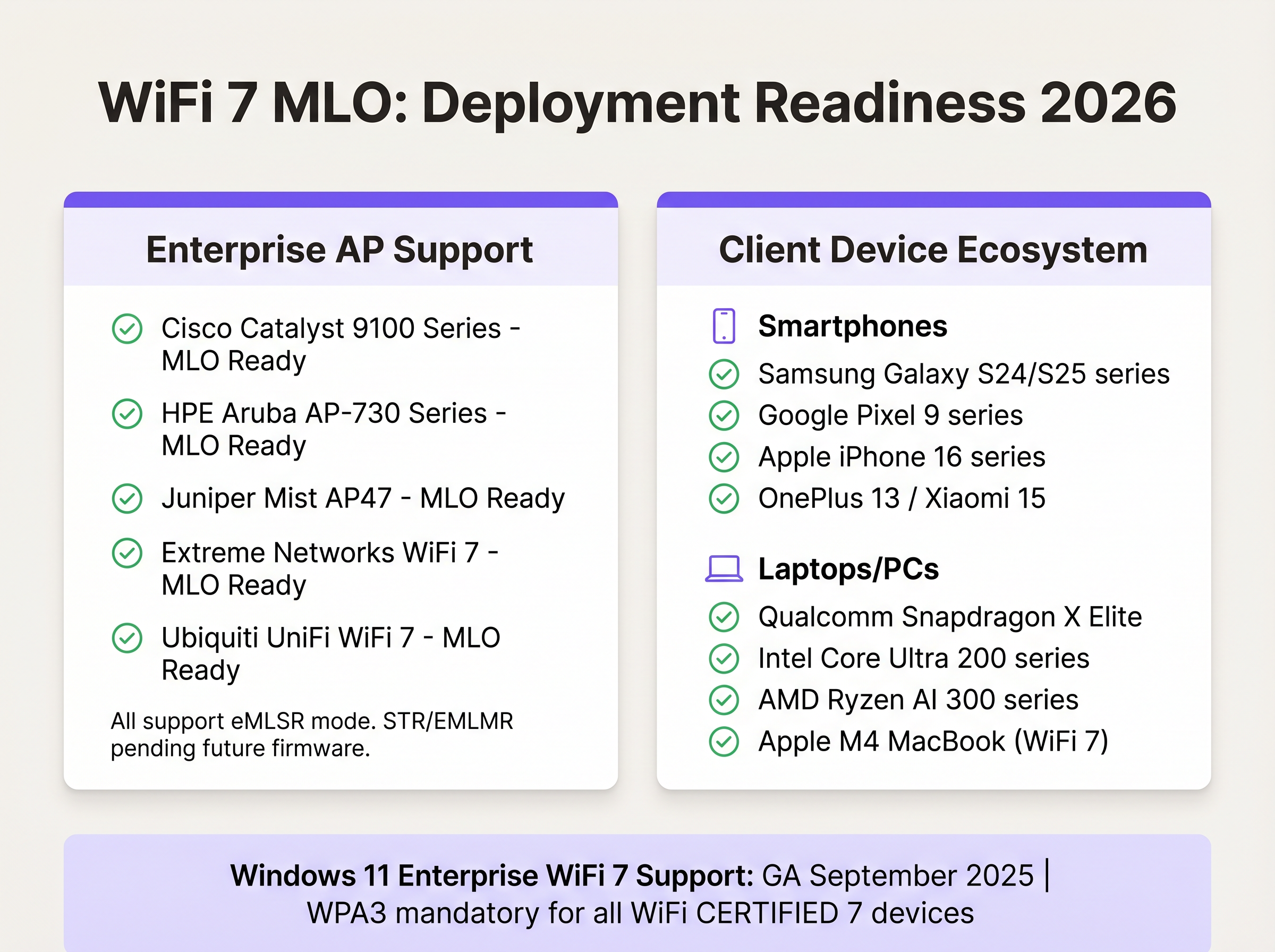
A partir de 2026, o ecossistema empresarial está amadurecendo rapidamente. Grandes fornecedores de pontos de acesso, incluindo Cisco, HPE Aruba e Juniper Mist, oferecem hardware WiFi 7 robusto com suporte a eMLSR. No lado do cliente, smartphones emblemáticos como as séries Samsung Galaxy S24/S25 e Apple iPhone 16, juntamente com laptops equipados com processadores Qualcomm Snapdragon X Elite e Intel Core Ultra, fornecem suporte nativo a MLO. Além disso, a disponibilidade geral do suporte a WiFi 7 no Windows 11 Enterprise em setembro de 2025 desbloqueou a adoção corporativa generalizada.
| Fornecedor | Plataforma | Modo MLO | Status |
|---|---|---|---|
| Cisco | Catalyst 9100 Series | eMLSR | Disponível |
| HPE Aruba | AP-730 Series | eMLSR | Disponível |
| Juniper Mist | AP47 | eMLSR | Disponível |
| Extreme Networks | APs WiFi 7 | eMLSR | Disponível |
| Ubiquiti | UniFi WiFi 7 | eMLSR | Disponível |
| Todos os fornecedores | STR / EMLMR | Simultâneo Verdadeiro | Firmware Futuro |
Melhores Práticas para Implementações Corporativas
Ao projetar uma rede WiFi 7, os arquitetos devem adaptar seu planejamento de RF para maximizar os benefícios do MLO. A abordagem tradicional de segregar agressivamente as bandas por SSID não é mais ideal e é ativamente prejudicial ao desempenho do MLO.
Configuração Unificada de SSID. Para habilitar o MLO, os pontos de acesso devem transmitir um SSID unificado em todas as bandas participantes (tipicamente 5 GHz e 6 GHz, e opcionalmente 2.4 GHz). Dividir os SSIDs por frequência (por exemplo, 'Corp-5G' e 'Corp-6G') quebra fundamentalmente a funcionalidade do MLO, pois o cliente deve perceber as bandas como uma única entidade lógica. Essa abordagem unificada se alinha bem com as arquiteturas modernas de Guest WiFi onde o onboarding contínuo é primordial.
Aplicação Obrigatória de WPA3. A Wi-Fi Alliance exige segurança WPA3 para todos os dispositivos Wi-Fi CERTIFIED 7. Além disso, o MLO requer Protected Management Frames (PMF) para proteger os complexos processos de negociação e gerenciamento de link. Os administradores de rede devem garantir que os servidores RADIUS e os provedores de identidade estejam totalmente em conformidade com os requisitos WPA3-Enterprise antes de iniciar uma migração para WiFi 7. Para estratégias detalhadas de conformidade, consulte nosso ISO 27001 Guest WiFi: Um Guia de Conformidade . Organizações operando sob obrigações PCI DSS ou GDPR devem notar que os requisitos criptográficos aprimorados do WPA3 (incluindo GCMP-256 e SAE-GDH) fornecem uma base de conformidade mais forte do que o WPA2.
Mapeamento de Identificador de Tráfego (TID). Implantações empresariais avançadas devem aproveitar o mapeamento de TID para link (T2LM). Este recurso permite que o ponto de acesso atribua categorias específicas de tráfego a links designados. Por exemplo, o tráfego de voz e vídeo sensível à latência pode ser mapeado exclusivamente para a banda limpa de 6 GHz, enquanto as transferências de dados em massa são relegadas à banda de 5 GHz. Esse controle granular é essencial para ambientes de Saúde onde os dados de telemetria devem ser priorizados sobre o tráfego de entretenimento do paciente. Em ambientes de Varejo , o tráfego de transações de ponto de venda pode ser isolado da navegação geral de convidados por razões de desempenho e segurança.
Integração de Filtragem DNS. Ao implantar SSIDs MLO unificados para acesso de convidados, a filtragem DNS se torna ainda mais crítica, pois um único SSID agora atende a uma gama mais ampla de dispositivos em todas as bandas. Consulte nosso guia sobre Filtragem DNS para Guest WiFi: Bloqueando Malware e Conteúdo Inapropriado para obter orientações de implementação que complementam uma implementação de WiFi 7.
Resolução de Problemas e Mitigação de Riscos
Apesar de suas vantagens, o MLO introduz novas complexidades na resolução de problemas de rede. O risco principal envolve a qualidade assimétrica do link, onde um cliente mantém uma conexão em uma banda severamente degradada porque a banda secundária parece superficialmente estável.
Níveis de Potência Assimétricos. Se a potência de transmissão do rádio de 6 GHz for significativamente menor do que a do rádio de 5 GHz, os clientes podem experimentar um comportamento 'pegajoso', recusando-se a utilizar o link de 6 GHz de forma eficaz. Os engenheiros de rede devem equilibrar cuidadosamente os tamanhos das células entre as bandas durante a fase de projeto de RF.
Privação de Clientes Legados. Em ambientes mistos, clientes WiFi 6 legados podem ter dificuldade em competir por tempo de antena contra clientes WiFi 7 MLD agressivos que podem saltar rapidamente entre as bandas. A implementação de políticas rigorosas de equidade de tempo de antena é crucial durante o período de transição. Esta é uma preocupação particularmente aguda em ambientes de Hospitalidade onde uma mistura de dispositivos de hóspedes abrange múltiplas gerações de WiFi.
Interrupções do Captive Portal. Em ambientes de Varejo e Hospitalidade , a troca agressiva de links pode, por vezes, desencadear falsas reautenticações em captive portals mal configurados. Garantir que a infraestrutura de rede resolva corretamente os ARPs usando o endereço MAC MLD em vez dos endereços MAC por link resolve este problema. A plataforma Guest WiFi da Purple lida com a abstração de MAC MLD nativamente, prevenindo esta classe de falha de integração.
Visibilidade de Análise. Plataformas tradicionais de WiFi Analytics que rastreiam clientes por endereço MAC podem encontrar desafios em ambientes MLO onde os endereços MAC por link diferem do MAC MLD. Garanta que sua infraestrutura de análise seja atualizada para correlacionar endereços MAC MLD para rastreamento preciso de clientes, análise de tempo de permanência e relatórios de fluxo de pessoas.
ROI e Impacto nos Negócios
O retorno sobre o investimento para uma migração para WiFi 7 é impulsionado pela eficiência operacional e experiência do usuário, em vez de velocidade bruta. Para um estádio ou centro de conferências, a capacidade de suportar milhares de conexões simultâneas sem picos catastróficos de latência impacta diretamente a geração de receita, desde pedidos de concessões móveis até experiências interativas para fãs.
Ao eliminar as reasociações disruptivas inerentes ao band steering, o MLO reduz drasticamente os tickets de helpdesk relacionados a 'conexões perdidas' ou 'roaming ruim'. Os testes de campo da Fase 2 da WBA demonstraram que o eMLSR mantém o desempenho quando ocorre interferência, evitando as quedas de desempenho observadas em dispositivos não-MLO — um diferencial crítico em ambientes de locais densos.
Além disso, a confiabilidade aprimorada da rede sem fio acelera a adoção da infraestrutura IoT, suportando iniciativas como Wayfinding e Sensores ambientais sem a necessidade de redes de sobreposição dedicadas. Conforme demonstrado em recentes implementações em larga escala, como o lançamento do estádio LAFC — o primeiro local da MLS a implantar WiFi 7 — o MLO fornece a base resiliente necessária para a próxima década de mobilidade empresarial.
Para arquitetos de SD-WAN que integram WiFi 7 como a camada de acesso de última milha, as melhorias de confiabilidade do MLO são diretamente complementares à redundância em nível de WAN discutida em Os Principais Benefícios do SD-WAN para Empresas Modernas . A combinação de WAN multi-caminho e WiFi multi-link cria uma arquitetura de ponta a ponta verdadeiramente resiliente.
| Métrica | WiFi 6 Legado (Band Steering) | WiFi 7 MLO (eMLSR) | Melhoria |
|---|---|---|---|
| Latência de troca de banda | 100–300 ms | < 1 ms | ~200x mais rápido |
| Throughput de uplink sob interferência | Linha de base | +116% | Teste de Campo WBA |
| Throughput de downlink sob interferência | Linha de base | +75% | Teste de Campo WBA |
| Latência de uplink (tráfego em tempo real) | Linha de base | -66% | Teste de Campo WBA |
| Perda de pacotes durante a troca de banda | Moderada | Quase zero | Failover contínuo |
Referências
[1] IEEE Standards Association. "IEEE 802.11be-2024: Taxa de Transferência Extremamente Alta (EHT)." 2024. [2] Wireless Broadband Alliance. "Relatório dos Testes de Campo Empresariais MLO Wi-Fi 7 Fase 2." Março de 2026. [3] HPE Aruba Networking. "Documentação Técnica de Recursos e Benefícios do Wi-Fi 7." Dezembro de 2025. [4] RTINGS. "A Verdade Decepcionante Sobre o Wi-Fi 7: O Sonho da Operação Multi-Link Ainda Não Chegou." Fevereiro de 2026. [5] Microsoft. "Apresentando o Wi-Fi 7 para conectividade empresarial — Blog Windows IT Pro." Setembro de 2025. [6] Forbes. "O Que Todo CIO Pode Aprender Com o Primeiro Estádio Wi-Fi 7 da MLS." Março de 2026.
Definições principais
Multi-Link Operation (MLO)
A mandatory WiFi 7 (IEEE 802.11be) feature enabling Multi-Link Devices to simultaneously associate and communicate across multiple frequency bands (2.4, 5, and 6 GHz) via a single logical connection, providing seamless failover and reduced latency.
The foundational technology that replaces legacy band steering. IT teams encounter this term when evaluating WiFi 7 hardware specifications and when planning SSID architecture for new deployments.
Multi-Link Device (MLD)
Any network node — client device or access point — capable of supporting Multi-Link Operation. An MLD abstracts multiple physical radios into a single MAC-layer entity with one MLD MAC address and multiple per-link MAC addresses.
When auditing network readiness for MLO, IT teams must verify that both the access points and the end-user endpoints are certified MLDs. Legacy WiFi 6 devices are not MLDs and cannot participate in MLO.
Enhanced Multi-Link Single Radio (eMLSR)
An MLO operating mode where a device maintains separate receive chains to listen to multiple bands simultaneously, then rapidly time-slices its single radio to transmit or receive on the optimal band. Switching occurs in sub-millisecond timeframes.
The primary MLO mode implemented in 2025/2026 enterprise hardware. Network architects should specify eMLSR support explicitly in procurement requirements.
Simultaneous Transmit and Receive (STR / EMLMR)
An advanced MLO mode enabling a device to transmit on one band while concurrently receiving on another, maximising aggregate throughput. Requires sub-microsecond hardware timing alignment not yet available in shipping enterprise equipment.
A future-state capability. IT leaders should be cautious of vendor marketing that implies STR is available today; it is not present in any shipping enterprise access point as of early 2026.
TID-to-Link Mapping (T2LM)
A WiFi 7 protocol feature allowing the network to assign specific Traffic Identifiers (TIDs) — such as voice, video, or background data — to dedicated physical frequency bands, enabling policy-driven traffic prioritisation.
Used by network architects to isolate mission-critical latency-sensitive applications from bulk data transfers. Particularly valuable in healthcare, industrial, and financial trading environments.
Upper MAC (U-MAC)
The logical portion of the MLD architecture responsible for overarching connection state, security association (PMKSA), encryption, and sequence numbering across all physical links.
Ensures that when a client switches between bands, it does not need to renegotiate security keys or restart the session, enabling truly seamless roaming.
Lower MAC (L-MAC)
The physical portion of the MLD architecture responsible for channel access, beaconing, RTS/CTS control frames, and hardware-level transmission for a specific frequency band.
Manages the raw radio frequency contention independently for each band, allowing the U-MAC to remain abstracted from localised interference events.
Protected Management Frames (PMF)
An IEEE 802.11w security mechanism that encrypts network management traffic, preventing deauthentication attacks, spoofing, and man-in-the-middle attacks on the management plane.
Mandatory for all WiFi 7 deployments and a prerequisite for MLO. Legacy clients lacking PMF support will be unable to join modern secure MLO networks, requiring careful transition planning.
Exemplos práticos
A 400-room luxury hotel is upgrading to WiFi 7 to support smart room IoT (lighting, HVAC) and high-bandwidth guest streaming. The current WiFi 6 network suffers from dropped VoIP calls when staff roam between floors, caused by aggressive band steering. How should the network architect configure the new WiFi 7 infrastructure to resolve this?
The architect should deploy WiFi 7 access points supporting eMLSR across all corridors and high-density areas, with particular attention to coverage overlap in stairwells and lift lobbies where roaming events are most frequent. The critical configuration change is consolidating all frequency bands under a single, unified SSID — for example, 'Hotel_Staff_Secure' — broadcasting on both 5 GHz and 6 GHz. Splitting SSIDs by frequency band must be explicitly avoided, as it prevents the client's Upper MAC from establishing a multi-link association and reverts the network to legacy single-band behaviour. WPA3-Enterprise with Protected Management Frames set to mandatory should be enforced. Finally, TID-to-link mapping should be configured on the wireless LAN controller to map voice traffic (TID 6 and 7) strictly to the 6 GHz band, ensuring pristine VoIP performance for staff devices while allowing guest streaming traffic to dynamically utilise either 5 GHz or 6 GHz based on real-time availability.
A large retail distribution warehouse is deploying autonomous guided vehicles (AGVs) that require sub-20ms latency to prevent safety shutdowns. The warehouse has significant metallic racking that causes severe multipath interference and rapid signal degradation. Why is WiFi 7 MLO a better solution than legacy WiFi 6 for this specific challenge, and what specific mode should be specified in the procurement requirements?
The procurement specification should require WiFi 7 access points and client modules supporting eMLSR mode. Legacy WiFi 6 relies on single-band association: when an AGV moves behind a metallic rack and loses its 5 GHz signal, it must initiate a full reassociation to the 2.4 GHz band. This process takes 100–300 milliseconds, exceeding the 20ms safety threshold and causing the AGV to trigger an emergency stop. With WiFi 7 MLO in eMLSR mode, the AGV client maintains simultaneous logical associations across multiple bands. It actively listens to both 5 GHz and 2.4 GHz concurrently. When the 5 GHz signal degrades due to the metallic racking, the AGV switches its transmission to the 2.4 GHz link in less than 1 millisecond — comfortably within the 20ms safety requirement. The procurement specification should also require TID-to-link mapping support to allow the safety-critical telemetry stream to be pinned to the most reliable available band at all times.
Questões práticas
Q1. Your university campus is migrating to WiFi 7. The current network uses separate SSIDs: 'Campus-Legacy' (2.4 GHz) and 'Campus-Fast' (5 GHz and 6 GHz). The IT director wants to maximise the benefits of Multi-Link Operation for new student laptops with WiFi 7 chipsets. How should you configure the SSIDs on the new WiFi 7 access points, and why?
Dica: Consider how MLO's Upper MAC abstracts physical links into a single logical connection, and what SSID configuration is required for that abstraction to function.
Ver resposta modelo
You must consolidate the networks into a single, unified SSID — for example, 'Campus-Secure' — broadcast across all available bands (2.4, 5, and 6 GHz). Splitting SSIDs by frequency prevents the client's Upper MAC from establishing a multi-link association, completely disabling MLO functionality and forcing the device back into legacy single-band operation. The unified SSID allows the client to negotiate multi-link capabilities with the AP during association, enabling seamless band switching and the full reliability benefits of eMLSR.
Q2. A hospital IT director is evaluating two WiFi 7 access points for a ward deployment. Vendor A heavily markets 'Simultaneous Transmit and Receive (STR) for maximum throughput.' Vendor B emphasises 'Optimised eMLSR for sub-millisecond failover and proven reliability.' The hospital's primary requirement is ensuring continuous, uninterrupted connectivity for mobile telemetry carts carrying patient monitoring equipment. Which vendor's approach is more relevant for a 2026 deployment, and what question should the IT director ask Vendor A?
Dica: Evaluate the current state of hardware capabilities versus marketing claims, and align the technology choice with the specific use case requirement.
Ver resposta modelo
Vendor B's focus on eMLSR is more relevant and realistic for a 2026 deployment. As of early 2026, true STR requires hardware synchronisation capabilities not yet available in shipping enterprise equipment. Furthermore, the hospital's primary need is reliability — continuous connectivity for telemetry — not raw throughput. eMLSR provides the rapid, sub-millisecond band switching necessary to maintain resilient connections as carts roam through wards. The IT director should ask Vendor A: 'Does your hardware implement EMLMR, SRS, and STR-MLMR as defined in IEEE 802.11be, and can you provide beacon frame captures confirming these capabilities are advertised to clients?' If the vendor cannot provide this evidence, the STR marketing claim is likely aspirational rather than functional.
Q3. During a pilot deployment of WiFi 7 in a retail environment, engineers notice that legacy WiFi 6 barcode scanners are experiencing increased latency and dropped packets, while new WiFi 7 tablets perform flawlessly. The WiFi 7 APs are configured correctly with unified SSIDs and WPA3. What is the likely cause of the legacy device degradation, and what configuration change should be implemented?
Dica: Consider how advanced clients utilising multiple bands and rapid link switching might impact the airtime available for older, single-band devices in a shared RF environment.
Ver resposta modelo
The likely cause is airtime starvation. WiFi 7 MLD clients using eMLSR can rapidly hop between bands to find clear spectrum, consuming available airtime aggressively. In a mixed environment, legacy WiFi 6 barcode scanners — which operate on a single band and use older contention mechanisms — struggle to compete for transmission opportunities. The solution is to implement strict airtime fairness policies on the wireless LAN controller. This ensures that legacy devices receive a guaranteed percentage of radio resources, preventing the WiFi 7 clients from monopolising the available airtime during the transition period. Long-term, the organisation should plan to replace the legacy scanners with WiFi 7 MLD-capable hardware.
Continue a ler esta série
Wi-Fi 7 (802.11be) Explicado: O Que Muda para o Enterprise WiFi
Este guia oferece uma referência técnica definitiva sobre Wi-Fi 7 (IEEE 802.11be) para gerentes de TI, arquitetos de rede e CTOs que planejam atualizações de infraestrutura em 2026–2027. Ele aborda os quatro avanços arquitetônicos principais — Multi-Link Operation (MLO), canais de 320 MHz, modulação 4K-QAM e Multi-RU — com uma comparação clara com o Wi-Fi 6E, cenários de implantação reais de hospitalidade e varejo, e uma avaliação honesta das atualizações de hardware e switching necessárias. A Purple é agnóstica em relação ao hardware e suporta qualquer implantação de Wi-Fi 7, tornando este guia um ponto de entrada natural para equipes que avaliam seu guest WiFi e pilha de análise juntamente com uma atualização de AP.
Wi-Fi 6E vs Wi-Fi 7: Você deve pular o 6E e ir direto para o 7?
Um guia de decisão abrangente para diretores de TI e arquitetos de rede que avaliam uma atualização de hardware wireless em 2026. Ele oferece uma comparação técnica de Wi-Fi 6E e Wi-Fi 7, uma matriz de preços de fornecedores atual e recomendações de implantação acionáveis para locais de alta densidade nos setores de hospitalidade, varejo e público — ajudando as equipes a determinar se o prêmio do Wi-Fi 7 é justificado para seus requisitos operacionais específicos.
Wi-Fi 7 para Locais de Alta Densidade: Estádios, Salas de Conferência e Terminais
Este guia de referência técnica fornece a líderes de TI e arquitetos de rede estratégias acionáveis para implantar Wi-Fi 7 em locais de alta densidade como estádios e terminais de transporte. Ele explora como a Operação Multi-Link (MLO), 4K-QAM e o design de APs sob os assentos melhoram drasticamente a capacidade, reduzem os requisitos de hardware e entregam um ROI mensurável.