
WiFi 7 MLO erklärt: Multi-Link Operation für nahtloses Roaming
Dieser technische Leitfaden bietet einen umfassenden Einblick in die WiFi 7 Multi-Link Operation (MLO) für Netzwerkarchitekten und IT-Führungskräfte in Unternehmen. Er entschlüsselt die drei MLO-Betriebsmodi (eMLSR, NSTR und STR), erklärt, wie MLO das herkömmliche Band Steering ablöst, und liefert umsetzbare Bereitstellungsempfehlungen, gestützt auf reale Testdaten der Wireless Broadband Alliance. Betreiber von Veranstaltungsorten im Gastgewerbe, im Einzelhandel und in großen öffentlichen Bereichen finden konkrete Implementierungsstrategien und ROI-Nachweise zur Unterstützung von WiFi 7-Investitionsentscheidungen.
Diesen Leitfaden anhören
Podcast-Transkript ansehen

Zusammenfassung für Führungskräfte
Für IT-Führungskräfte und Netzwerkarchitekten in Unternehmen stellt der Übergang zu IEEE 802.11be (WiFi 7) einen Paradigmenwechsel in der drahtlosen Konnektivität dar. Der Eckpfeiler dieses Standards ist die Multi-Link Operation (MLO), eine obligatorische Funktion für Wi-Fi CERTIFIED 7-Geräte, die die Interaktion von Access Points und Clients über das Funkfrequenzspektrum grundlegend verändert. Im Gegensatz zum herkömmlichen Band Steering, das auf netzwerkgesteuerte Reassoziationen angewiesen ist, die den Datenverkehr stören, ermöglicht MLO gleichzeitige, client-koordinierte Multiband-Verbindungen.
Jüngste Feldversuche in Unternehmen, die von der Wireless Broadband Alliance durchgeführt wurden, zeigten die tiefgreifenden Auswirkungen von MLO in Umgebungen mit hoher Dichte. Tests in realen Büroumgebungen ergaben eine Verbesserung des Uplink-Durchsatzes um bis zu 116 % unter starker Gleichkanalinterferenz sowie eine Reduzierung der Uplink-Latenz um 66 %. Für Betriebsleiter, die Stadien, Konferenzzentren und große Einzelhandelsflächen verwalten, bedeutet MLO direkt eine robuste Konnektivität für geschäftskritische Anwendungen. Dieser Leitfaden entschlüsselt die technische Architektur von MLO, analysiert die drei primären Betriebsmodi und bietet umsetzbare Implementierungsstrategien für moderne Unternehmensbereitstellungen.
Technischer Einblick: Die Architektur der Multi-Link Operation
Die grundlegende Innovation von WiFi 7 MLO ist die Schaffung einer Multi-Link Device (MLD)-Architektur, die die physischen Funkverbindungen von der logischen Netzwerkverbindung abstrahiert. In früheren Generationen, einschließlich WiFi 6E, konnte sich ein Client-Gerät zu jedem Zeitpunkt nur mit einem einzigen Band (2,4 GHz, 5 GHz oder 6 GHz) verbinden. Wenn Interferenzen diese Verbindung beeinträchtigten, mussten der Client oder der Access Point eine vollständige Reassoziation zu einem anderen Band initiieren – ein Prozess, der typischerweise über 100 Millisekunden Latenz und unvermeidlichen Paketverlust verursacht.
Mit 802.11be MLO ist die MAC-Schicht in einen Upper MAC (U-MAC) und einen Lower MAC (L-MAC) aufgeteilt. Der U-MAC verwaltet die übergeordnete Sicherheitsassoziation, Verschlüsselung und Sequenznummerierung, während der L-MAC den physischen Kanalzugriff und das Beaconing für jede einzelne Funkverbindung verwaltet. Diese Architektur ermöglicht es, dass eine einzige logische Verbindung gleichzeitig mehrere physische Bänder umspannt. Client und Access Point verhandeln diese Fähigkeiten während der anfänglichen Assoziationsphase und etablieren eine primäre MLD MAC-Adresse zusammen mit spezifischen MAC-Adressen pro Verbindung.
Die drei MLO-Modi
Während Marketingmaterialien MLO oft als monolithische Funktion darstellen, definiert der IEEE 802.11be-Standard drei verschiedene Betriebsmodi. Das Verständnis dieser Modi ist entscheidend für Netzwerkarchitekten, die Hardware-Fähigkeiten bewerten und Bereitstellungszeitpläne planen.
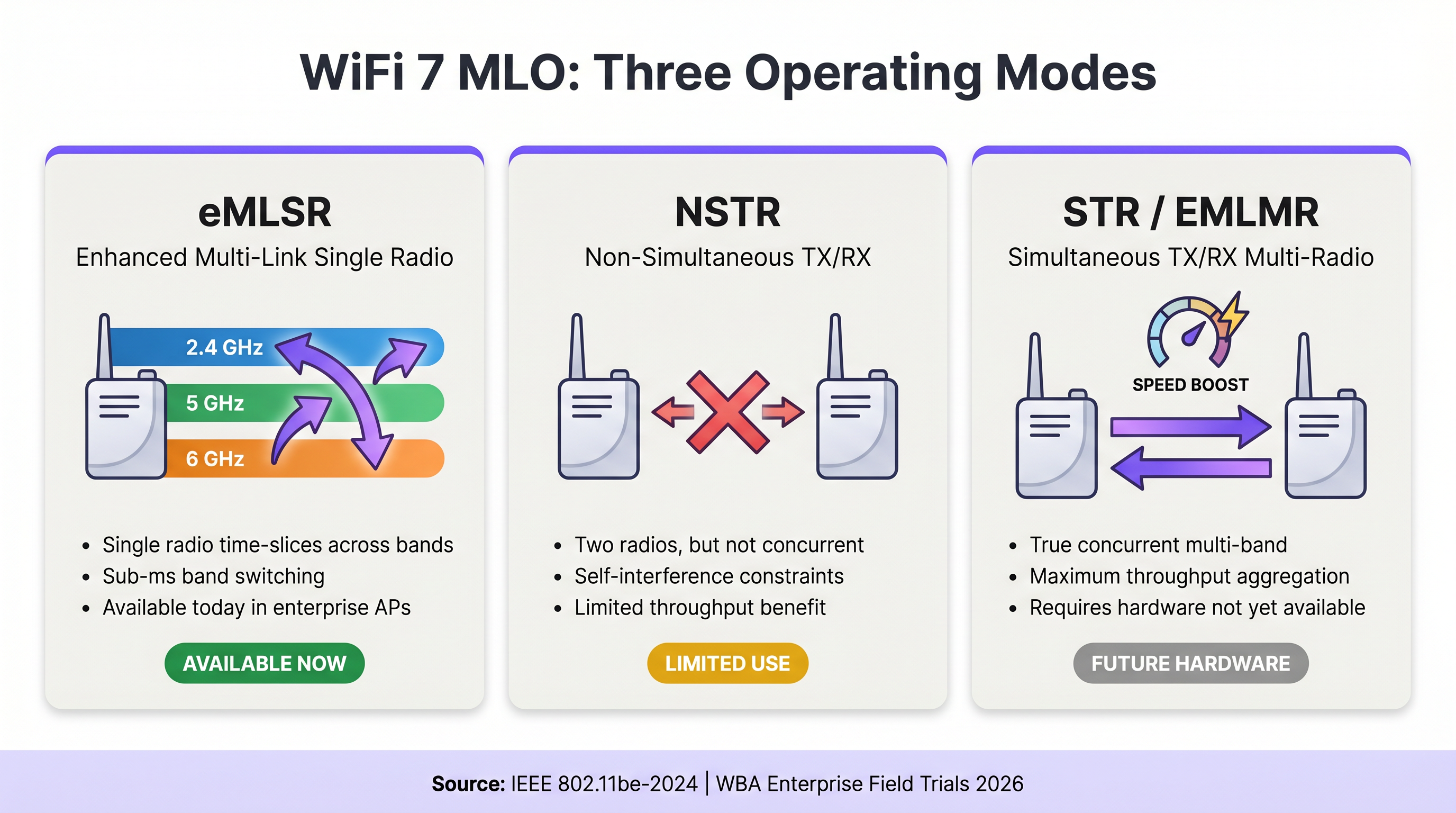
1. Enhanced Multi-Link Single Radio (eMLSR)
Enhanced Multi-Link Single Radio ist die grundlegende MLO-Implementierung, die in aktuellen Enterprise Access Points und Client-Geräten verfügbar ist. In diesem Modus verwendet das Client-Gerät ein einziges Funkmodul, das schnell über mehrere Bänder hinweg zeitlich aufgeteilt wird. Entscheidend ist, dass das Gerät separate Empfangsketten unterhält, die es ihm ermöglichen, gleichzeitig die 5-GHz- und 6-GHz-Bänder abzuhören. Wenn sich eine Gelegenheit zum Senden oder Empfangen ergibt, schaltet es sein primäres Funkmodul dynamisch auf das optimale Band um.
Obwohl eMLSR keine echte gleichzeitige Übertragung und Empfang bietet, ermöglicht es eine Bandumschaltung im Sub-Millisekundenbereich. Dies stellt einen massiven Fortschritt gegenüber dem herkömmlichen Band Steering dar, bietet nahezu nahtloses Failover und reduziert die Latenz in überlasteten Umgebungen erheblich. Für Unternehmensbereitstellungen in den Jahren 2025 und 2026 ist eMLSR die praktische Realität, die den Großteil der unmittelbaren Vorteile von MLO liefert. Die Phase-2-Feldversuche der Wireless Broadband Alliance in Unternehmen bestätigten, dass eMLSR eine Verbesserung des Downlink-Durchsatzes um bis zu 75 % und des Uplink-Durchsatzes um 116 % unter Gleichkanalinterferenz liefert, zusammen mit einer Reduzierung der Downlink-Latenz um bis zu 44 % für Echtzeitverkehr.
2. Non-Simultaneous Transmit and Receive (NSTR)
Non-Simultaneous Transmit and Receive verwendet mehrere physische Funkmodule, schränkt deren gleichzeitigen Betrieb jedoch aufgrund von Selbstinterferenzbeschränkungen ein. Wenn ein Gerät auf dem 5-GHz-Band sendet, verhindert das daraus resultierende Funkfrequenzrauschen, dass es gleichzeitig zuverlässig Daten auf dem 6-GHz-Band empfängt. NSTR wird weitgehend als Zwischenschritt mit begrenztem praktischem Nutzen im Vergleich zur dynamischen Agilität von eMLSR oder dem letztendlichen Ziel des echten gleichzeitigen Betriebs angesehen.
3. Simultaneous Transmit and Receive (STR / EMLMR)
Der Höhepunkt der Multi-Link Operation-Spezifikation ist Simultaneous Transmit and Receive, das Enhanced Multi-Link Multi-Radio (EMLMR) ermöglicht. Dieser Modus ermöglicht es einem Gerät, Daten über mehrere Bänder gleichzeitig zu senden und zu empfangen, wodurch der Durchsatz aggregiert und die theoretische maximale Leistung von WiFi 7 erreicht wird. Die Realisierung von STR erfordert hochmoderne Hardware, die eine Timing-Ausrichtung im Sub-Mikrosekundenbereich und eine ausgeklügelte Spectrum Resource Scheduling (SRS) zur Minderung von Selbstinterferenzen ermöglicht. Anfang 2026 implementiert noch keine Consumer- oder Enterprise-Hardware echtes STR vollständig, was es zu einer zukünftigen Fähigkeit und nicht zu einer aktuellen Bereitstellungsüberlegung macht.
Implementierungsleitfaden: MLO vs. herkömmliches Band Steering
Für Netzwerktechniker, die WiFi 7-Rollouts planen, ist die unmittelbarste betriebliche Änderung die Überholung des traditionellen Band Steering. Historisch gesehen verwendeten drahtlose LAN-Controller in Unternehmen Band Steering um Dual-Band-Clients auf das weniger ausgelastete 5-GHz-Spektrum zu zwingen, indem ihre Probe-Requests auf 2,4 GHz ignoriert werden. Dieser netzwerkzentrierte Ansatz war von Natur aus störend, da das Client-Gerät die Steuerungslogik nicht wahrnahm und während des erzwungenen Übergangs Verbindungsabbrüche erlitt.
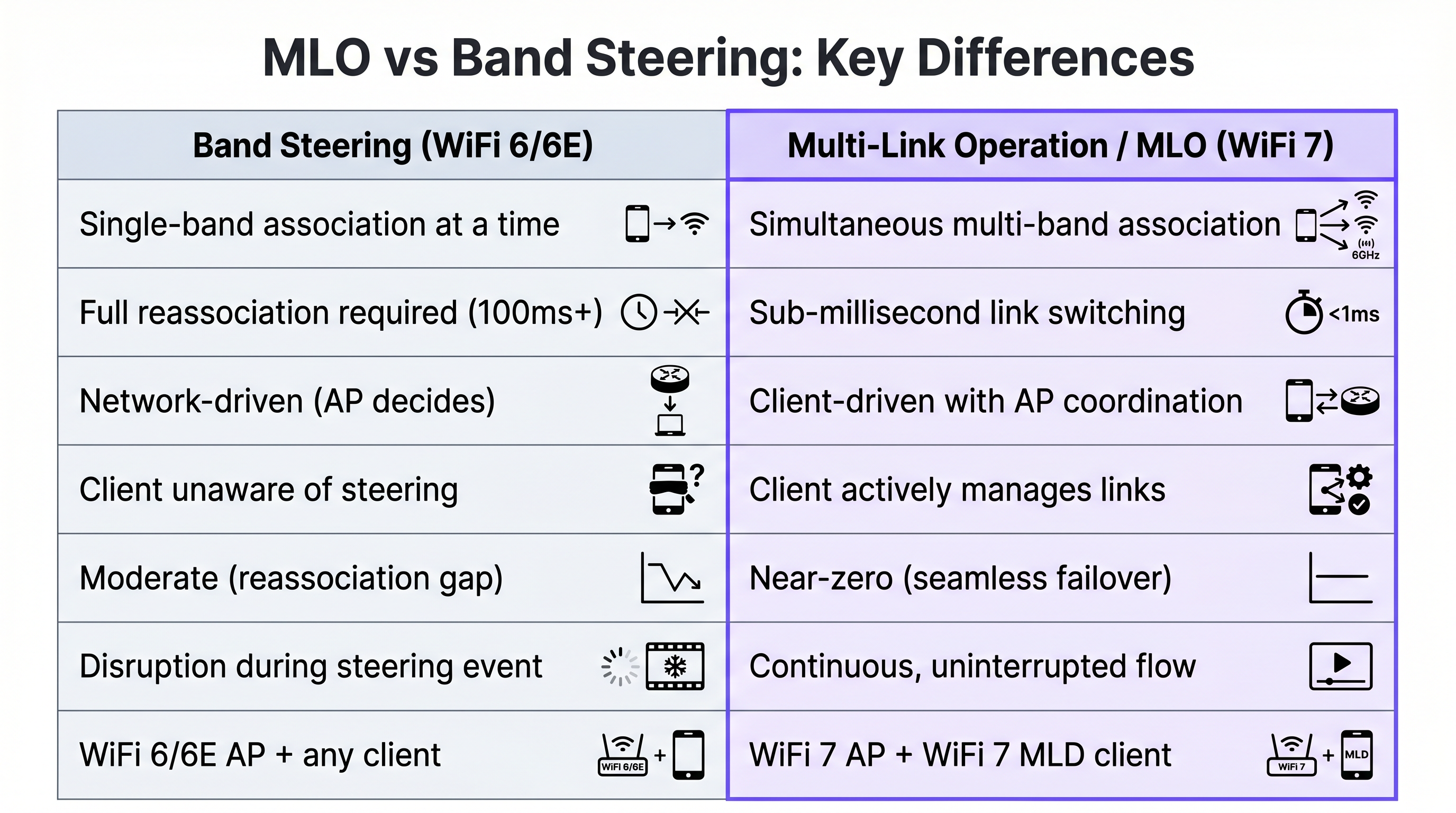
MLO ersetzt dieses Paradigma durch einen clientgesteuerten, AP-koordinierten Ansatz. Da der Client gleichzeitig mehrere Links wahrnimmt, kann er den Datenverkehr nahtlos basierend auf Echtzeit-Kanalbedingungen verschieben, ohne die zugrunde liegende logische Verbindung zu unterbrechen. Dies ist besonders wichtig für Guest WiFi -Bereitstellungen an Orten mit hoher Dichte, wo Roaming und Interferenzen ständige Herausforderungen darstellen. Für Transport -Drehkreuze wie Flughäfen und Bahnhöfe, wo sich Passagiere schnell durch Abdeckungszonen bewegen, verbessert die Eliminierung von Reassoziierungsverzögerungen direkt die Qualität von mobilen Check-in- und Wegfindungsanwendungen.
Bereitstellungsbereitschaft und Ökosystem
Der Erfolg einer MLO-Bereitstellung hängt vollständig vom Client-Ökosystem ab. Ein WiFi 7 Access Point kann MLO nur nutzen, wenn er mit einem WiFi 7 MLD-fähigen Client kommuniziert. Ältere WiFi 6 und 6E Geräte verbinden sich normal, profitieren aber nicht von den Multi-Link-Fähigkeiten.
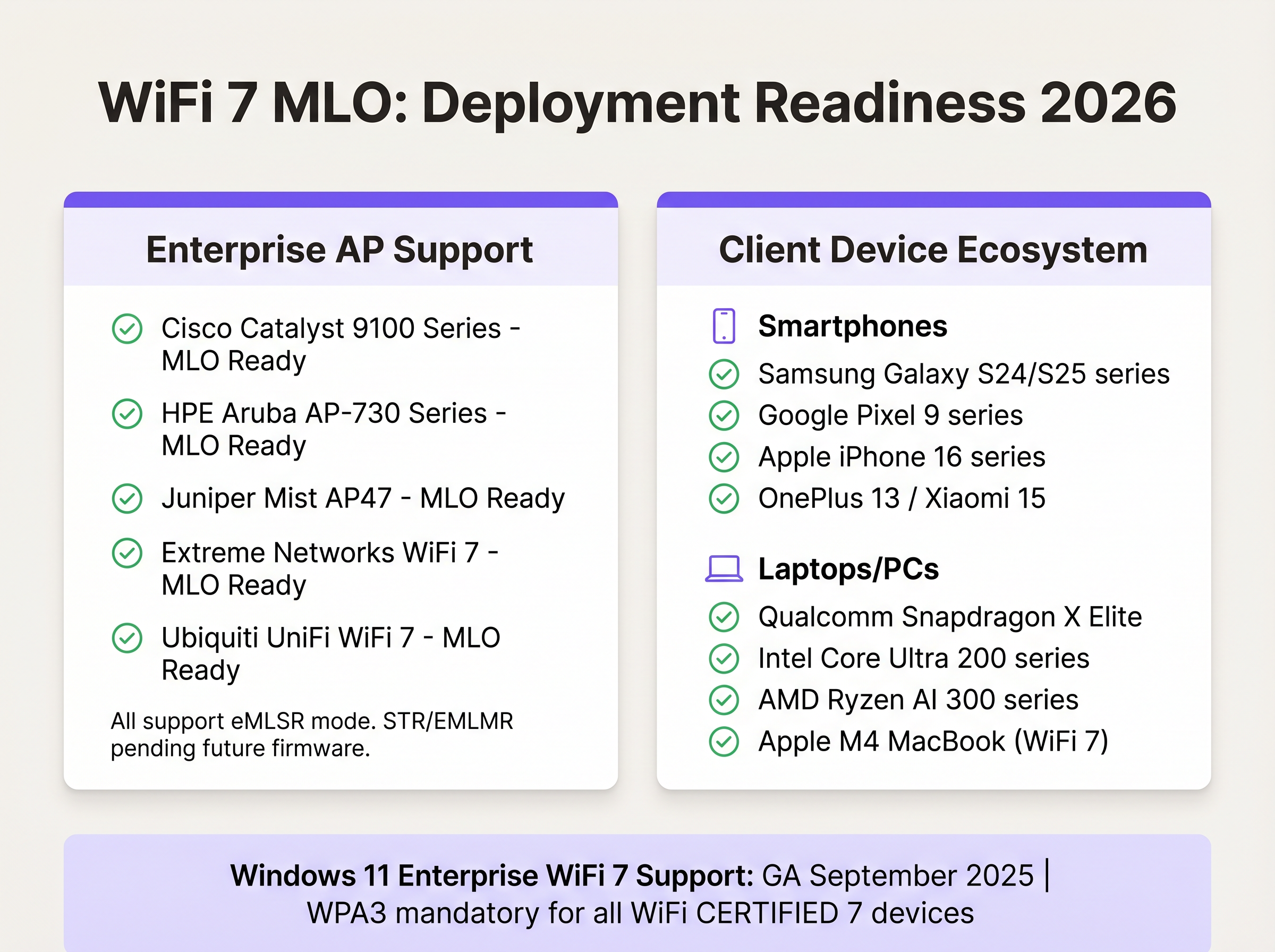
Stand 2026 reift das Unternehmensökosystem rapide heran. Große Access Point-Anbieter, darunter Cisco, HPE Aruba und Juniper Mist, bieten robuste WiFi 7 Hardware an, die eMLSR unterstützt. Auf der Client-Seite bieten Flaggschiff-Smartphones wie die Samsung Galaxy S24/S25-Serie und die Apple iPhone 16-Serie, zusammen mit Laptops, die von Qualcomm Snapdragon X Elite und Intel Core Ultra Prozessoren angetrieben werden, native MLO-Unterstützung. Darüber hinaus hat die allgemeine Verfügbarkeit der Windows 11 Enterprise WiFi 7 Unterstützung im September 2025 die weit verbreitete Unternehmensadoption ermöglicht.
| Anbieter | Plattform | MLO-Modus | Status |
|---|---|---|---|
| Cisco | Catalyst 9100 Serie | eMLSR | Verfügbar |
| HPE Aruba | AP-730 Serie | eMLSR | Verfügbar |
| Juniper Mist | AP47 | eMLSR | Verfügbar |
| Extreme Networks | WiFi 7 APs | eMLSR | Verfügbar |
| Ubiquiti | UniFi WiFi 7 | eMLSR | Verfügbar |
| Alle Anbieter | STR / EMLMR | Echtes Simultanes | Zukünftige Firmware |
Best Practices für Unternehmens-Rollouts
Beim Entwurf eines WiFi 7 Netzwerks müssen Architekten ihre RF-Planung anpassen, um die MLO-Vorteile zu maximieren. Der traditionelle Ansatz, Bänder aggressiv nach SSID zu trennen, ist nicht länger optimal und schadet der MLO-Leistung aktiv.
Einheitliche SSID-Konfiguration. Um MLO zu ermöglichen, müssen Access Points eine einheitliche SSID über alle teilnehmenden Bänder (typischerweise 5 GHz und 6 GHz, optional 2,4 GHz) senden. Das Aufteilen von SSIDs nach Frequenz (z.B. 'Corp-5G' und 'Corp-6G') unterbricht die MLO-Funktionalität grundlegend, da der Client die Bänder als eine einzige logische Einheit wahrnehmen muss. Dieser einheitliche Ansatz passt gut zu modernen Guest WiFi -Architekturen, bei denen ein nahtloses Onboarding von größter Bedeutung ist.
Obligatorische WPA3-Durchsetzung. Die Wi-Fi Alliance schreibt WPA3-Sicherheit für alle Wi-Fi CERTIFIED 7 Geräte vor. Darüber hinaus erfordert MLO Protected Management Frames (PMF), um die komplexen Verhandlungs- und Link-Management-Prozesse zu sichern. Netzwerkadministratoren müssen sicherstellen, dass RADIUS-Server und Identitätsanbieter die WPA3-Enterprise-Anforderungen vollständig erfüllen, bevor sie eine WiFi 7 Migration initiieren. Für detaillierte Compliance-Strategien verweisen wir auf unseren ISO 27001 Guest WiFi: Ein Compliance-Leitfaden . Organisationen, die unter PCI DSS- oder GDPR-Verpflichtungen arbeiten, sollten beachten, dass die verbesserten kryptografischen Anforderungen von WPA3 (einschließlich GCMP-256 und SAE-GDH) eine stärkere Compliance-Grundlage als WPA2 bieten.
Traffic Identifier (TID) Mapping. Fortgeschrittene Unternehmensbereitstellungen sollten TID-zu-Link-Mapping (T2LM) nutzen. Diese Funktion ermöglicht es dem Access Point, spezifische Verkehrskategorien bestimmten Links zuzuweisen. Zum Beispiel kann latenzsensibler Sprach- und Videoverkehr ausschließlich dem sauberen 6-GHz-Band zugeordnet werden, während Massendatenübertragungen dem 5-GHz-Band zugewiesen werden. Diese granulare Kontrolle ist unerlässlich für Healthcare -Umgebungen, in denen Telemetriedaten gegenüber Patientenunterhaltung priorisiert werden müssen. In Retail -Umgebungen kann der Point-of-Sale-Transaktionsverkehr aus Leistungs- und Sicherheitsgründen vom allgemeinen Gast-Browsing isoliert werden.
DNS-Filterintegration. Bei der Bereitstellung von einheitlichen MLO SSIDs für den Gastzugang wird DNS-Filterung noch kritischer, da eine einzige SSID nun eine breitere Palette von Geräten über alle Bänder hinweg bedient. Beachten Sie unseren Leitfaden zu DNS-Filterung für Guest WiFi: Blockieren von Malware und unangemessenen Inhalten für Implementierungsanleitungen, die einen WiFi 7 Rollout ergänzen.
Fehlerbehebung & Risikominderung
Trotz seiner Vorteile führt MLO neue Komplexitäten bei der Netzwerk-Fehlerbehebung ein. Das Hauptrisiko besteht in einer asymmetrischen Link-Qualität, bei der ein Client eine Verbindung auf einem stark verschlechterten Band aufrechterhält, weil das sekundäre Band oberflächlich stabil erscheint.
Asymmetrische Leistungspegel. Wenn die Sendeleistung des 6-GHz-Radios deutlich niedriger ist als die des 5-GHz-Radios, können Clients ein 'klebriges' Verhalten zeigen und sich weigern, den 6-GHz-Link effektiv zu nutzen. Netzwerktechniker müssen die Zellgrößen über die Bänder hinweg während der RF-Designphase sorgfältig ausbalancieren.
Verhungern von Legacy-Clients. In gemischten Umgebungen können ältere WiFi 6 Clients Schwierigkeiten haben, gegen aggressive WiFi 7 MLD Clients, die schnell zwischen den Bändern wechseln können, um Airtime zu konkurrieren. Die Implementierung strenger Airtime-Fairness-Richtlinien ist entscheidend während der Übergangszeit. Dies ist ein besonders akutes Problem in Gastgewerbe -Umgebungen, wo eine Mischung aus Gastgeräten mehrere WiFi-Generationen umfasst.
Captive Portal-Unterbrechungen. In Einzelhandels - und Gastgewerbe -Umgebungen kann aggressives Link-Switching manchmal falsche Re-Authentifizierungen auf schlecht konfigurierten Captive Portals auslösen. Die Sicherstellung, dass die Netzwerkinfrastruktur ARPs korrekt unter Verwendung der MLD MAC-Adresse anstatt der Pro-Link-MAC-Adressen auflöst, behebt dieses Problem. Die Guest WiFi -Plattform von Purple handhabt die MLD MAC-Abstraktion nativ und verhindert so diese Art von Onboarding-Fehlern.
Analyse-Sichtbarkeit. Traditionelle WiFi Analytics -Plattformen, die Clients anhand der MAC-Adresse verfolgen, können in MLO-Umgebungen, in denen sich die Pro-Link-MAC-Adressen von der MLD MAC unterscheiden, auf Herausforderungen stoßen. Stellen Sie sicher, dass Ihre Analyseinfrastruktur aktualisiert wird, um MLD MAC-Adressen für eine genaue Client-Verfolgung, Verweildaueranalyse und Besucherfrequenzberichterstattung zu korrelieren.
ROI & Geschäftsauswirkungen
Der Return on Investment für eine WiFi 7-Migration wird eher durch betriebliche Effizienz und Benutzererfahrung als durch reine Geschwindigkeit bestimmt. Für ein Stadion oder Konferenzzentrum wirkt sich die Fähigkeit, Tausende gleichzeitiger Verbindungen ohne katastrophale Latenzspitzen zu unterstützen, direkt auf die Umsatzgenerierung aus, von der mobilen Bestellung von Konzessionen bis hin zu interaktiven Fan-Erlebnissen.
Durch die Eliminierung der störenden Reassoziationen, die dem Band Steering eigen sind, reduziert MLO die Helpdesk-Tickets im Zusammenhang mit 'abgebrochenen Verbindungen' oder 'schlechtem Roaming' drastisch. Die WBA Phase 2 Feldversuche zeigten, dass eMLSR die Leistung bei Interferenzen aufrechterhält und die bei Nicht-MLO-Geräten beobachteten Leistungsabfälle vermeidet – ein entscheidendes Unterscheidungsmerkmal in Umgebungen mit hoher Dichte.
Darüber hinaus beschleunigt die verbesserte Zuverlässigkeit des drahtlosen Netzwerks die Einführung von IoT-Infrastrukturen und unterstützt Initiativen wie Wayfinding und Umgebungs- Sensoren , ohne dedizierte Overlay-Netzwerke zu erfordern. Wie bei jüngsten Großprojekten, wie dem LAFC-Stadion-Rollout – dem ersten MLS-Veranstaltungsort, der WiFi 7 einsetzte – gezeigt wurde, bietet MLO die widerstandsfähige Grundlage, die für das nächste Jahrzehnt der Unternehmensmobilität erforderlich ist.
Für SD-WAN-Architekten, die WiFi 7 als Last-Mile-Zugangsschicht integrieren, ergänzen die Zuverlässigkeitsverbesserungen von MLO direkt die WAN-Redundanz, die in Die zentralen SD-WAN-Vorteile für moderne Unternehmen erörtert wird. Die Kombination aus Multi-Path WAN und Multi-Link WiFi schafft eine wirklich widerstandsfähige End-to-End-Architektur.
| Metrik | Legacy WiFi 6 (Band Steering) | WiFi 7 MLO (eMLSR) | Verbesserung |
|---|---|---|---|
| Latenz beim Bandwechsel | 100–300 ms | < 1 ms | ~200x schneller |
| Uplink-Durchsatz unter Interferenzen | Baseline | +116% | WBA Feldversuch |
| Downlink-Durchsatz unter Interferenzen | Baseline | +75% | WBA Feldversuch |
| Uplink-Latenz (Echtzeit-Traffic) | Baseline | -66% | WBA Feldversuch |
| Paketverlust während des Bandwechsels | Moderat | Nahezu null | Nahtloses Failover |
Referenzen
[1] IEEE Standards Association. „IEEE 802.11be-2024: Extremely High Throughput (EHT).“ 2024. [2] Wireless Broadband Alliance. „Phase 2 Wi-Fi 7 MLO Enterprise Field Trials Report.“ März 2026. [3] HPE Aruba Networking. „Wi-Fi 7 Features and Benefits Technical Documentation.“ Dezember 2025. [4] RTINGS. „The Disappointing Truth About Wi-Fi 7: The Dream Of Multi-Link Operation Isn't Yet Here.“ Februar 2026. [5] Microsoft. „Introducing Wi-Fi 7 for enterprise connectivity — Windows IT Pro Blog.“ September 2025. [6] Forbes. „What Every CIO Can Learn From MLS's First Wi-Fi 7 Stadium.“ März 2026.
Schlüsseldefinitionen
Multi-Link Operation (MLO)
A mandatory WiFi 7 (IEEE 802.11be) feature enabling Multi-Link Devices to simultaneously associate and communicate across multiple frequency bands (2.4, 5, and 6 GHz) via a single logical connection, providing seamless failover and reduced latency.
The foundational technology that replaces legacy band steering. IT teams encounter this term when evaluating WiFi 7 hardware specifications and when planning SSID architecture for new deployments.
Multi-Link Device (MLD)
Any network node — client device or access point — capable of supporting Multi-Link Operation. An MLD abstracts multiple physical radios into a single MAC-layer entity with one MLD MAC address and multiple per-link MAC addresses.
When auditing network readiness for MLO, IT teams must verify that both the access points and the end-user endpoints are certified MLDs. Legacy WiFi 6 devices are not MLDs and cannot participate in MLO.
Enhanced Multi-Link Single Radio (eMLSR)
An MLO operating mode where a device maintains separate receive chains to listen to multiple bands simultaneously, then rapidly time-slices its single radio to transmit or receive on the optimal band. Switching occurs in sub-millisecond timeframes.
The primary MLO mode implemented in 2025/2026 enterprise hardware. Network architects should specify eMLSR support explicitly in procurement requirements.
Simultaneous Transmit and Receive (STR / EMLMR)
An advanced MLO mode enabling a device to transmit on one band while concurrently receiving on another, maximising aggregate throughput. Requires sub-microsecond hardware timing alignment not yet available in shipping enterprise equipment.
A future-state capability. IT leaders should be cautious of vendor marketing that implies STR is available today; it is not present in any shipping enterprise access point as of early 2026.
TID-to-Link Mapping (T2LM)
A WiFi 7 protocol feature allowing the network to assign specific Traffic Identifiers (TIDs) — such as voice, video, or background data — to dedicated physical frequency bands, enabling policy-driven traffic prioritisation.
Used by network architects to isolate mission-critical latency-sensitive applications from bulk data transfers. Particularly valuable in healthcare, industrial, and financial trading environments.
Upper MAC (U-MAC)
The logical portion of the MLD architecture responsible for overarching connection state, security association (PMKSA), encryption, and sequence numbering across all physical links.
Ensures that when a client switches between bands, it does not need to renegotiate security keys or restart the session, enabling truly seamless roaming.
Lower MAC (L-MAC)
The physical portion of the MLD architecture responsible for channel access, beaconing, RTS/CTS control frames, and hardware-level transmission for a specific frequency band.
Manages the raw radio frequency contention independently for each band, allowing the U-MAC to remain abstracted from localised interference events.
Protected Management Frames (PMF)
An IEEE 802.11w security mechanism that encrypts network management traffic, preventing deauthentication attacks, spoofing, and man-in-the-middle attacks on the management plane.
Mandatory for all WiFi 7 deployments and a prerequisite for MLO. Legacy clients lacking PMF support will be unable to join modern secure MLO networks, requiring careful transition planning.
Ausgearbeitete Beispiele
A 400-room luxury hotel is upgrading to WiFi 7 to support smart room IoT (lighting, HVAC) and high-bandwidth guest streaming. The current WiFi 6 network suffers from dropped VoIP calls when staff roam between floors, caused by aggressive band steering. How should the network architect configure the new WiFi 7 infrastructure to resolve this?
The architect should deploy WiFi 7 access points supporting eMLSR across all corridors and high-density areas, with particular attention to coverage overlap in stairwells and lift lobbies where roaming events are most frequent. The critical configuration change is consolidating all frequency bands under a single, unified SSID — for example, 'Hotel_Staff_Secure' — broadcasting on both 5 GHz and 6 GHz. Splitting SSIDs by frequency band must be explicitly avoided, as it prevents the client's Upper MAC from establishing a multi-link association and reverts the network to legacy single-band behaviour. WPA3-Enterprise with Protected Management Frames set to mandatory should be enforced. Finally, TID-to-link mapping should be configured on the wireless LAN controller to map voice traffic (TID 6 and 7) strictly to the 6 GHz band, ensuring pristine VoIP performance for staff devices while allowing guest streaming traffic to dynamically utilise either 5 GHz or 6 GHz based on real-time availability.
A large retail distribution warehouse is deploying autonomous guided vehicles (AGVs) that require sub-20ms latency to prevent safety shutdowns. The warehouse has significant metallic racking that causes severe multipath interference and rapid signal degradation. Why is WiFi 7 MLO a better solution than legacy WiFi 6 for this specific challenge, and what specific mode should be specified in the procurement requirements?
The procurement specification should require WiFi 7 access points and client modules supporting eMLSR mode. Legacy WiFi 6 relies on single-band association: when an AGV moves behind a metallic rack and loses its 5 GHz signal, it must initiate a full reassociation to the 2.4 GHz band. This process takes 100–300 milliseconds, exceeding the 20ms safety threshold and causing the AGV to trigger an emergency stop. With WiFi 7 MLO in eMLSR mode, the AGV client maintains simultaneous logical associations across multiple bands. It actively listens to both 5 GHz and 2.4 GHz concurrently. When the 5 GHz signal degrades due to the metallic racking, the AGV switches its transmission to the 2.4 GHz link in less than 1 millisecond — comfortably within the 20ms safety requirement. The procurement specification should also require TID-to-link mapping support to allow the safety-critical telemetry stream to be pinned to the most reliable available band at all times.
Übungsfragen
Q1. Your university campus is migrating to WiFi 7. The current network uses separate SSIDs: 'Campus-Legacy' (2.4 GHz) and 'Campus-Fast' (5 GHz and 6 GHz). The IT director wants to maximise the benefits of Multi-Link Operation for new student laptops with WiFi 7 chipsets. How should you configure the SSIDs on the new WiFi 7 access points, and why?
Hinweis: Consider how MLO's Upper MAC abstracts physical links into a single logical connection, and what SSID configuration is required for that abstraction to function.
Musterlösung anzeigen
You must consolidate the networks into a single, unified SSID — for example, 'Campus-Secure' — broadcast across all available bands (2.4, 5, and 6 GHz). Splitting SSIDs by frequency prevents the client's Upper MAC from establishing a multi-link association, completely disabling MLO functionality and forcing the device back into legacy single-band operation. The unified SSID allows the client to negotiate multi-link capabilities with the AP during association, enabling seamless band switching and the full reliability benefits of eMLSR.
Q2. A hospital IT director is evaluating two WiFi 7 access points for a ward deployment. Vendor A heavily markets 'Simultaneous Transmit and Receive (STR) for maximum throughput.' Vendor B emphasises 'Optimised eMLSR for sub-millisecond failover and proven reliability.' The hospital's primary requirement is ensuring continuous, uninterrupted connectivity for mobile telemetry carts carrying patient monitoring equipment. Which vendor's approach is more relevant for a 2026 deployment, and what question should the IT director ask Vendor A?
Hinweis: Evaluate the current state of hardware capabilities versus marketing claims, and align the technology choice with the specific use case requirement.
Musterlösung anzeigen
Vendor B's focus on eMLSR is more relevant and realistic for a 2026 deployment. As of early 2026, true STR requires hardware synchronisation capabilities not yet available in shipping enterprise equipment. Furthermore, the hospital's primary need is reliability — continuous connectivity for telemetry — not raw throughput. eMLSR provides the rapid, sub-millisecond band switching necessary to maintain resilient connections as carts roam through wards. The IT director should ask Vendor A: 'Does your hardware implement EMLMR, SRS, and STR-MLMR as defined in IEEE 802.11be, and can you provide beacon frame captures confirming these capabilities are advertised to clients?' If the vendor cannot provide this evidence, the STR marketing claim is likely aspirational rather than functional.
Q3. During a pilot deployment of WiFi 7 in a retail environment, engineers notice that legacy WiFi 6 barcode scanners are experiencing increased latency and dropped packets, while new WiFi 7 tablets perform flawlessly. The WiFi 7 APs are configured correctly with unified SSIDs and WPA3. What is the likely cause of the legacy device degradation, and what configuration change should be implemented?
Hinweis: Consider how advanced clients utilising multiple bands and rapid link switching might impact the airtime available for older, single-band devices in a shared RF environment.
Musterlösung anzeigen
The likely cause is airtime starvation. WiFi 7 MLD clients using eMLSR can rapidly hop between bands to find clear spectrum, consuming available airtime aggressively. In a mixed environment, legacy WiFi 6 barcode scanners — which operate on a single band and use older contention mechanisms — struggle to compete for transmission opportunities. The solution is to implement strict airtime fairness policies on the wireless LAN controller. This ensures that legacy devices receive a guaranteed percentage of radio resources, preventing the WiFi 7 clients from monopolising the available airtime during the transition period. Long-term, the organisation should plan to replace the legacy scanners with WiFi 7 MLD-capable hardware.
Weiterlesen in dieser Reihe
Wi-Fi 7 (802.11be) Erklärt: Was sich für Enterprise WiFi ändert
Dieser Leitfaden bietet eine umfassende technische Referenz zu Wi-Fi 7 (IEEE 802.11be) für IT-Manager, Netzwerkarchitekten und CTOs, die Infrastruktur-Upgrades in den Jahren 2026–2027 planen. Er behandelt die vier zentralen architektonischen Fortschritte – Multi-Link Operation (MLO), 320 MHz Kanäle, 4K-QAM-Modulation und Multi-RU – mit einem klaren Vergleich zu Wi-Fi 6E, realen Einsatzszenarien aus dem Gastgewerbe und Einzelhandel sowie einer ehrlichen Bewertung der erforderlichen Hardware- und Switching-Upgrades. Purple ist hardwareunabhängig und unterstützt jede Wi-Fi 7-Bereitstellung, was diesen Leitfaden zu einem natürlichen Einstiegspunkt für Teams macht, die ihr Guest WiFi und ihren Analyse-Stack parallel zu einem AP-Refresh bewerten.
Wi-Fi 6E vs Wi-Fi 7: Sollten Sie 6E überspringen und direkt zu 7 wechseln?
Ein umfassender Entscheidungsleitfaden für IT-Leiter und Netzwerkarchitekten, die eine Aktualisierung der drahtlosen Hardware im Jahr 2026 evaluieren. Er bietet einen technischen Vergleich von Wi-Fi 6E und Wi-Fi 7, eine aktuelle Anbieter-Preisübersicht und umsetzbare Bereitstellungsempfehlungen für Standorte mit hoher Dichte in den Bereichen Gastgewerbe, Einzelhandel und öffentlicher Sektor – um Teams dabei zu helfen, zu beurteilen, ob der Wi-Fi 7-Aufpreis für ihre spezifischen betrieblichen Anforderungen gerechtfertigt ist.
Wi-Fi 7 für Veranstaltungsorte mit hoher Dichte: Stadien, Konferenzhallen und Terminals
Dieser technische Leitfaden bietet IT-Führungskräften und Netzwerkarchitekten umsetzbare Strategien für die Bereitstellung von Wi-Fi 7 an Veranstaltungsorten mit hoher Dichte wie Stadien und Verkehrsterminals. Er untersucht, wie Multi-Link Operation (MLO), 4K-QAM und das Design von APs unter Sitzen die Kapazität drastisch verbessern, Hardwareanforderungen reduzieren und einen messbaren ROI liefern.