
WiFi 7 MLO Expliqué : Opération Multi-Lien pour un Roaming Transparent
Ce guide de référence technique offre une exploration approfondie de l'Opération Multi-Lien (MLO) du WiFi 7 pour les architectes réseau d'entreprise et les leaders IT. Il démystifie les trois modes de fonctionnement MLO (eMLSR, NSTR et STR), explique comment le MLO remplace l'orientation de bande (band steering) héritée, et fournit des conseils de déploiement exploitables, étayés par des données d'essais réels de la Wireless Broadband Alliance. Les exploitants de sites dans l'hôtellerie, le commerce de détail et les grands espaces publics y trouveront des stratégies de mise en œuvre concrètes et des preuves de ROI pour étayer leurs décisions d'investissement dans le WiFi 7.
Écouter ce guide
Voir la transcription du podcast

Résumé Exécutif
Pour les leaders IT d'entreprise et les architectes réseau, la transition vers l'IEEE 802.11be (WiFi 7) introduit un changement de paradigme dans la connectivité sans fil. La pierre angulaire de cette norme est l'Opération Multi-Lien (MLO), une fonctionnalité obligatoire pour les appareils Wi-Fi CERTIFIED 7 qui modifie fondamentalement la manière dont les points d'accès et les clients interagissent sur le spectre des fréquences radio. Contrairement à l'orientation de bande (band steering) héritée, qui repose sur des réassociations initiées par le réseau et perturbant le trafic, le MLO permet des connexions multi-bandes simultanées et coordonnées par le client.
De récents essais sur le terrain en entreprise, menés par la Wireless Broadband Alliance, ont démontré l'impact profond du MLO dans les environnements à haute densité. Des tests dans des environnements de bureau réels ont révélé une amélioration allant jusqu'à 116 % du débit en liaison montante en cas d'interférence co-canal sévère, ainsi qu'une réduction de 66 % de la latence en liaison montante. Pour les directeurs des opérations gérant des stades, des centres de conférence et de grandes surfaces de vente au détail, le MLO se traduit directement par une connectivité résiliente pour les applications critiques. Ce guide démystifie l'architecture technique du MLO, analyse les trois modes de fonctionnement principaux et fournit des stratégies de mise en œuvre exploitables pour les déploiements d'entreprise modernes.
Analyse Technique Approfondie : L'Architecture de l'Opération Multi-Lien
L'innovation fondamentale du WiFi 7 MLO est la création d'une architecture de Dispositif Multi-Lien (MLD) qui abstrait les liens radio physiques de la connexion réseau logique. Dans les générations précédentes, y compris le WiFi 6E, un appareil client ne pouvait s'associer qu'à une seule bande (2,4 GHz, 5 GHz ou 6 GHz) à un instant donné. Si des interférences dégradaient ce lien, le client ou le point d'accès devait initier une réassociation complète à une bande différente — un processus qui entraîne généralement plus de 100 millisecondes de latence et une perte de paquets inévitable.
Avec le 802.11be MLO, la couche MAC est bifurquée en un MAC Supérieur (U-MAC) et un MAC Inférieur (L-MAC). L'U-MAC gère l'association de sécurité globale, le chiffrement et la numérotation séquentielle, tandis que le L-MAC gère l'accès au canal physique et le balisage pour chaque lien radio individuel. Cette architecture permet à une seule connexion logique de s'étendre simultanément sur plusieurs bandes physiques. Le client et le point d'accès négocient ces capacités pendant la phase d'association initiale, établissant une adresse MAC MLD primaire ainsi que des adresses MAC spécifiques par lien.
Les Trois Modes du MLO
Alors que les supports marketing présentent souvent le MLO comme une fonctionnalité monolithique, la norme IEEE 802.11be définit trois modes de fonctionnement distincts. Comprendre ces modes est essentiel pour les architectes réseau qui évaluent les capacités matérielles et planifient les délais de déploiement.
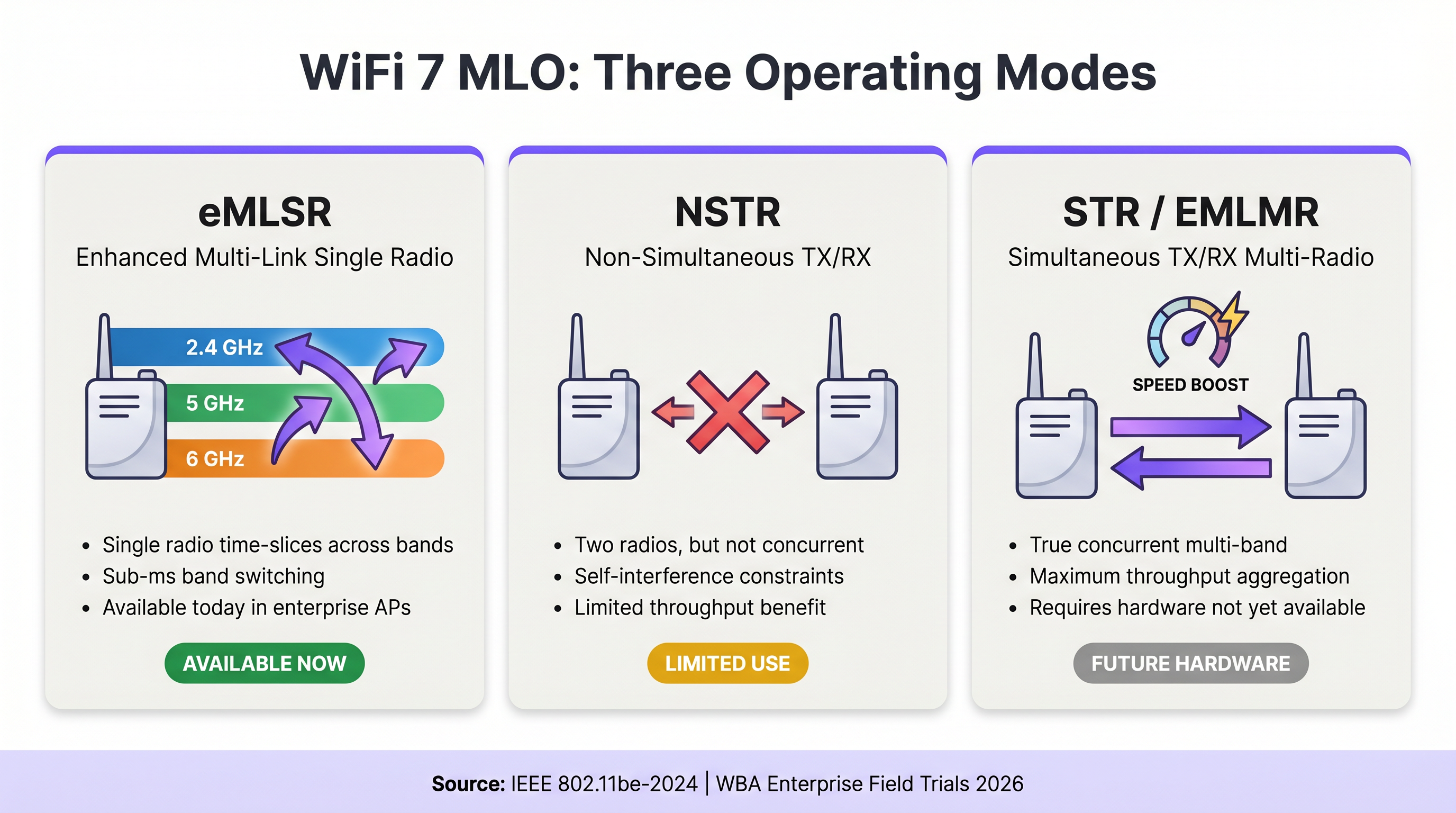
1. Radio Unique Multi-Lien Améliorée (eMLSR)
La Radio Unique Multi-Lien Améliorée est l'implémentation MLO fondamentale disponible dans les points d'accès d'entreprise et les appareils clients actuels. Dans ce mode, l'appareil client utilise une seule radio qui se partage rapidement le temps sur plusieurs bandes. De manière cruciale, l'appareil maintient des chaînes de réception séparées, lui permettant d'écouter simultanément les bandes 5 GHz et 6 GHz. Lorsqu'une opportunité de transmettre ou de recevoir se présente, il bascule dynamiquement sa radio principale vers la bande optimale.
Bien que l'eMLSR ne permette pas une véritable transmission et réception simultanées, il offre une commutation de bande en moins d'une milliseconde. Cela représente un bond en avant considérable par rapport à l'orientation de bande (band steering) héritée, offrant un basculement quasi transparent et réduisant significativement la latence dans les environnements encombrés. Pour les déploiements d'entreprise en 2025 et 2026, l'eMLSR est la réalité pratique qui apporte la majeure partie des avantages immédiats du MLO. Les essais sur le terrain en entreprise de la Phase 2 de la Wireless Broadband Alliance ont confirmé que l'eMLSR offre une amélioration du débit allant jusqu'à 75 % en liaison descendante et 116 % en liaison montante en cas d'interférence co-canal, ainsi qu'une réduction allant jusqu'à 44 % de la latence en liaison descendante pour le trafic en temps réel.
2. Transmission et Réception Non Simultanées (NSTR)
La Transmission et Réception Non Simultanées utilise plusieurs radios physiques mais les empêche de fonctionner simultanément en raison de contraintes d'auto-interférence. Si un appareil transmet sur la bande 5 GHz, le bruit de fréquence radio résultant l'empêche de recevoir de manière fiable des données sur la bande 6 GHz simultanément. Le NSTR est largement considéré comme une étape intermédiaire avec une utilité réelle limitée par rapport à l'agilité dynamique de l'eMLSR ou à l'objectif ultime d'une véritable opération simultanée.
3. Transmission et Réception Simultanées (STR / EMLMR)
Le summum de la spécification Opération Multi-Lien est la Transmission et Réception Simultanées, qui permet la Radio Multi-Lien Améliorée (EMLMR). Ce mode permet à un appareil de transmettre et de recevoir des données sur plusieurs bandes simultanément, agrégeant le débit et offrant la performance maximale théorique du WiFi 7. L'atteinte du STR nécessite un matériel très avancé capable d'un alignement temporel sub-microseconde et d'une planification sophistiquée des ressources spectrales (SRS) pour atténuer l'auto-interférence. Début 2026, aucun matériel grand public ou d'entreprise n'implémente entièrement le véritable STR, ce qui en fait une capacité future plutôt qu'une considération de déploiement actuelle.
Guide d'Implémentation : MLO vs. Orientation de Bande Héritée
Pour les ingénieurs réseau planifiant les déploiements WiFi 7, le changement opérationnel le plus immédiat est l'obsolescence de l'orientation de bande traditionnelle.
Historiquement, les contrôleurs de réseau local sans fil d'entreprise utilisaient l'orientation de bande pour forcer les clients bi-bande sur le spectre 5 GHz moins encombré en ignorant leurs requêtes de sondage sur 2,4 GHz. Cette approche centrée sur le réseau était intrinsèquement perturbatrice, car le périphérique client restait inconscient de la logique de direction et subissait des pertes de connexion pendant la transition forcée.
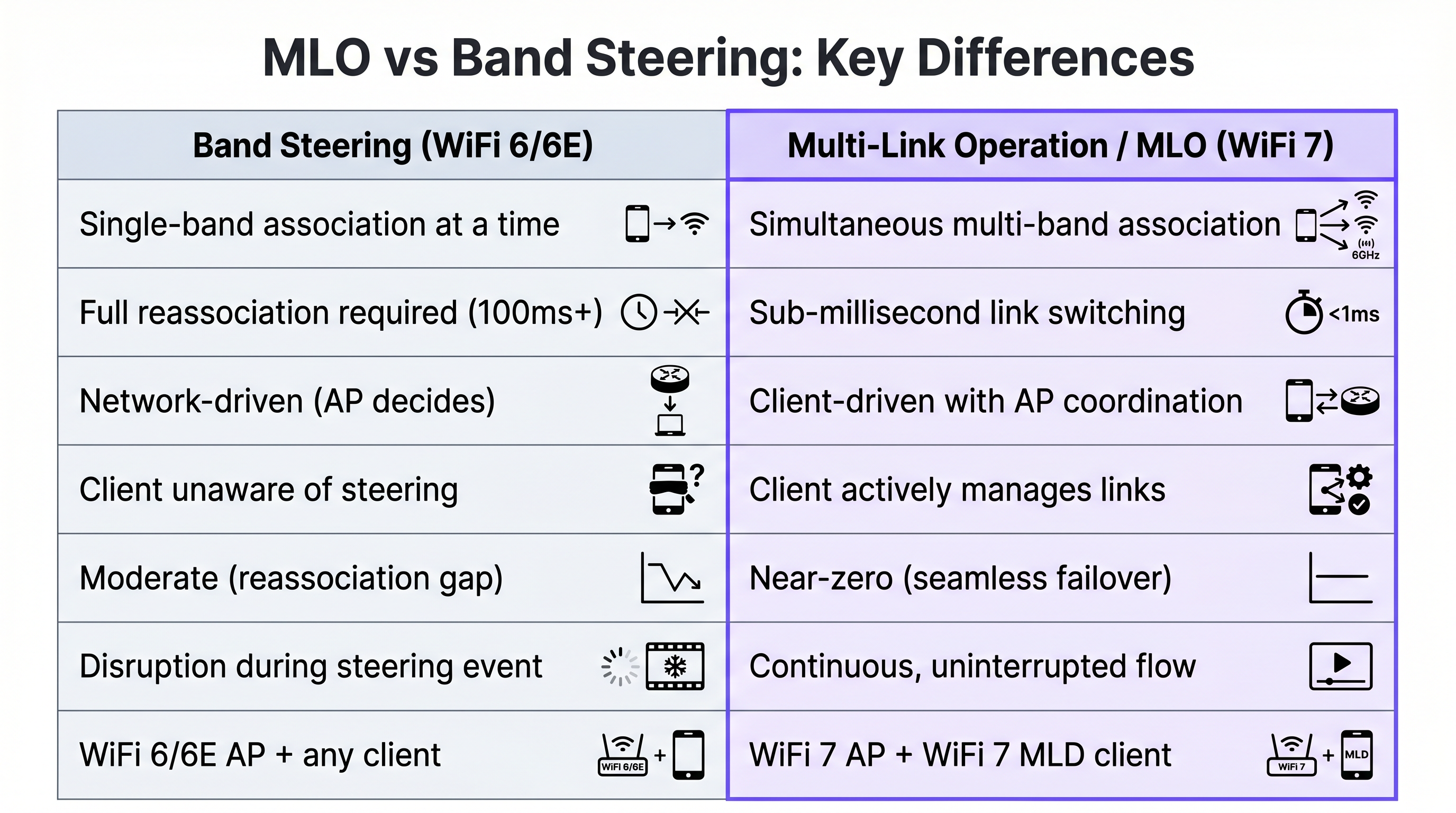
MLO remplace ce paradigme par une approche pilotée par le client et coordonnée par le point d'accès. Parce que le client maintient une connaissance simultanée de plusieurs liens, il peut basculer le trafic de manière transparente en fonction des conditions de canal en temps réel sans rompre la connexion logique sous-jacente. Ceci est particulièrement vital pour les déploiements de Guest WiFi dans les lieux à forte densité où l'itinérance et les interférences sont des défis constants. Pour les pôles de Transport tels que les aéroports et les gares ferroviaires, où les passagers se déplacent rapidement à travers les zones de couverture, l'élimination des délais de réassociation améliore directement la qualité des applications d'enregistrement mobile et d'orientation.
Préparation au déploiement et écosystème
Le succès d'un déploiement MLO dépend entièrement de l'écosystème client. Un point d'accès WiFi 7 ne peut exploiter MLO que lorsqu'il communique avec un client compatible MLD WiFi 7. Les appareils WiFi 6 et 6E existants se connecteront normalement mais ne bénéficieront pas des capacités multi-liens.
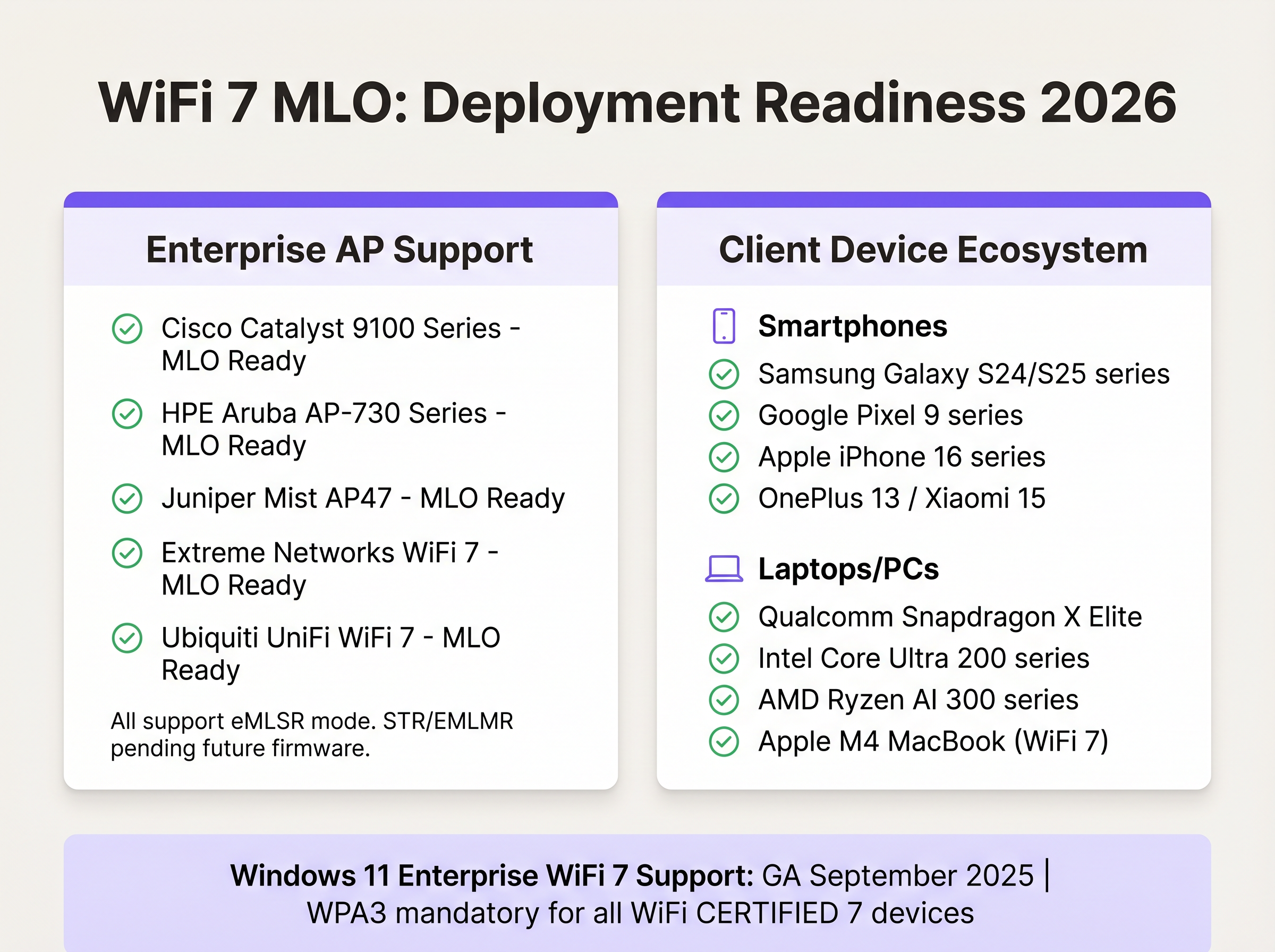
En 2026, l'écosystème d'entreprise arrive rapidement à maturité. Les principaux fournisseurs de points d'accès, notamment Cisco, HPE Aruba et Juniper Mist, proposent du matériel WiFi 7 robuste prenant en charge l'eMLSR. Côté client, les smartphones phares tels que les séries Samsung Galaxy S24/S25 et Apple iPhone 16, ainsi que les ordinateurs portables équipés des processeurs Qualcomm Snapdragon X Elite et Intel Core Ultra, offrent un support MLO natif. De plus, la disponibilité générale du support Windows 11 Enterprise WiFi 7 en septembre 2025 a débloqué une adoption généralisée en entreprise.
| Fournisseur | Plateforme | Mode MLO | Statut |
|---|---|---|---|
| Cisco | Catalyst 9100 Series | eMLSR | Disponible |
| HPE Aruba | AP-730 Series | eMLSR | Disponible |
| Juniper Mist | AP47 | eMLSR | Disponible |
| Extreme Networks | WiFi 7 APs | eMLSR | Disponible |
| Ubiquiti | UniFi WiFi 7 | eMLSR | Disponible |
| Tous les fournisseurs | STR / EMLMR | Véritable simultané | Futur Firmware |
Bonnes pratiques pour les déploiements en entreprise
Lors de la conception d'un réseau WiFi 7, les architectes doivent adapter leur planification RF pour maximiser les avantages de MLO. L'approche traditionnelle consistant à séparer agressivement les bandes par SSID n'est plus optimale et est activement nuisible aux performances MLO.
Configuration SSID unifiée. Pour activer MLO, les points d'accès doivent diffuser un SSID unifié sur toutes les bandes participantes (généralement 5 GHz et 6 GHz, et éventuellement 2,4 GHz). La division des SSID par fréquence (par exemple, 'Corp-5G' et 'Corp-6G') rompt fondamentalement la fonctionnalité MLO, car le client doit percevoir les bandes comme une seule entité logique. Cette approche unifiée s'aligne bien avec les architectures Guest WiFi modernes où l'intégration transparente est primordiale.
Application obligatoire de WPA3. La Wi-Fi Alliance impose la sécurité WPA3 pour tous les appareils Wi-Fi CERTIFIED 7. De plus, MLO nécessite des Protected Management Frames (PMF) pour sécuriser les processus complexes de négociation et de gestion des liens. Les administrateurs réseau doivent s'assurer que les serveurs RADIUS et les fournisseurs d'identité sont entièrement conformes aux exigences WPA3-Enterprise avant d'initier une migration WiFi 7. Pour des stratégies de conformité détaillées, consultez notre ISO 27001 Guest WiFi: A Compliance Primer . Les organisations soumises aux obligations PCI DSS ou GDPR doivent noter que les exigences cryptographiques améliorées de WPA3 (y compris GCMP-256 et SAE-GDH) offrent une base de conformité plus solide que WPA2.
Mappage d'identifiant de trafic (TID). Les déploiements d'entreprise avancés devraient tirer parti du mappage TID-vers-lien (T2LM). Cette fonctionnalité permet au point d'accès d'assigner des catégories spécifiques de trafic à des liens désignés. Par exemple, le trafic voix et vidéo sensible à la latence peut être mappé exclusivement à la bande propre de 6 GHz, tandis que les transferts de données en masse sont relégués à la bande de 5 GHz. Ce contrôle granulaire est essentiel pour les environnements de Healthcare où les données de télémétrie doivent être prioritaires par rapport au trafic de divertissement des patients. Dans les environnements de Retail , le trafic des transactions de point de vente peut être isolé de la navigation générale des invités pour des raisons de performance et de sécurité.
Intégration du filtrage DNS. Lors du déploiement de SSID MLO unifiés pour l'accès invité, le filtrage DNS devient encore plus critique car un seul SSID dessert désormais une gamme plus large d'appareils sur toutes les bandes. Consultez notre guide sur le Filtrage DNS pour le Guest WiFi : Blocage des logiciels malveillants et du contenu inapproprié pour des conseils de mise en œuvre qui complètent un déploiement WiFi 7.
Dépannage et atténuation des risques
Malgré ses avantages, MLO introduit de nouvelles complexités dans le dépannage réseau. Le risque principal concerne la qualité de liaison asymétrique, où un client maintient une connexion sur une bande gravement dégradée parce que la bande secondaire semble superficiellement stable.
Niveaux de puissance asymétriques. Si la puissance d'émission de la radio 6 GHz est significativement inférieure à celle de la radio 5 GHz, les clients peuvent rencontrer un comportement "collant", refusant d'utiliser efficacement la liaison 6 GHz. Les ingénieurs réseau doivent équilibrer soigneusement les tailles de cellule entre les bandes pendant la phase de conception RF.
Sous-alimentation des clients existants. Dans les environnements mixtes, les clients WiFi 6 existants peuvent avoir du mal à rivaliser pour le temps d'antenne avec les clients MLD WiFi 7 agressifs qui peuvent rapidement passer d'une bande à l'autre. La mise en œuvre de politiques strictes d'équité du temps d'antenne est crucial pendant la période de transition. C'est une préoccupation particulièrement aiguë dans les environnements d' hôtellerie où un mélange d'appareils invités couvre plusieurs générations de WiFi.
Interruptions du portail captif. Dans les environnements de commerce de détail et d' hôtellerie , la commutation agressive de liens peut parfois déclencher de fausses réauthentifications sur des Captive Portals mal configurés. S'assurer que l'infrastructure réseau résout correctement les ARPs en utilisant l'adresse MAC MLD plutôt que les adresses MAC par lien résout ce problème. La plateforme Guest WiFi de Purple gère l'abstraction MAC MLD nativement, prévenant ainsi ce type d'échec d'intégration.
Visibilité des analyses. Les plateformes traditionnelles d' analyse WiFi qui suivent les clients par adresse MAC peuvent rencontrer des difficultés dans les environnements MLO où les adresses MAC par lien diffèrent de l'adresse MAC MLD. Assurez-vous que votre infrastructure d'analyse est mise à jour pour corréler les adresses MAC MLD afin d'obtenir un suivi précis des clients, une analyse du temps de présence et des rapports de fréquentation.
ROI et impact commercial
Le retour sur investissement d'une migration vers le WiFi 7 est motivé par l'efficacité opérationnelle et l'expérience utilisateur plutôt que par la vitesse brute. Pour un stade ou un centre de conférence, la capacité à prendre en charge des milliers de connexions simultanées sans pics de latence catastrophiques a un impact direct sur la génération de revenus, de la commande de concessions mobiles aux expériences interactives pour les fans.
En éliminant les réassociations perturbatrices inhérentes au band steering, le MLO réduit considérablement les tickets d'assistance liés aux 'connexions perdues' ou au 'mauvais roaming'. Les essais sur le terrain de la phase 2 de la WBA ont démontré que l'eMLSR maintient les performances en cas d'interférence, évitant les baisses de performance observées sur les appareils non-MLO — un différenciateur critique dans les environnements de lieux denses.
De plus, la fiabilité améliorée du réseau sans fil accélère l'adoption de l'infrastructure IoT, prenant en charge des initiatives telles que l' orientation et les capteurs environnementaux sans nécessiter de réseaux superposés dédiés. Comme démontré lors de déploiements récents à grande échelle, tels que le déploiement du stade LAFC — le premier site MLS à déployer le WiFi 7 — le MLO fournit la base résiliente requise pour la prochaine décennie de mobilité d'entreprise.
Pour les architectes SD-WAN intégrant le WiFi 7 comme couche d'accès du dernier kilomètre, les améliorations de fiabilité du MLO sont directement complémentaires à la redondance au niveau WAN abordée dans Les avantages essentiels du SD-WAN pour les entreprises modernes . La combinaison du WAN multi-chemin et du WiFi multi-lien crée une architecture de bout en bout véritablement résiliente.
| Métrique | WiFi 6 Hérité (Band Steering) | WiFi 7 MLO (eMLSR) | Amélioration |
|---|---|---|---|
| Latence de commutation de bande | 100–300 ms | < 1 ms | ~200x plus rapide |
| Débit montant sous interférence | Référence | +116% | Essai sur le terrain WBA |
| Débit descendant sous interférence | Référence | +75% | Essai sur le terrain WBA |
| Latence montante (trafic en temps réel) | Référence | -66% | Essai sur le terrain WBA |
| Perte de paquets lors de la commutation de bande | Modérée | Quasi-nulle | Basculement transparent |
Références
[1] IEEE Standards Association. « IEEE 802.11be-2024 : Débit extrêmement élevé (EHT). » 2024. [2] Wireless Broadband Alliance. « Rapport des essais sur le terrain de la phase 2 du Wi-Fi 7 MLO en entreprise. » Mars 2026. [3] HPE Aruba Networking. « Documentation technique sur les fonctionnalités et avantages du Wi-Fi 7. » Décembre 2025. [4] RTINGS. « La vérité décevante sur le Wi-Fi 7 : Le rêve de l'opération multi-lien n'est pas encore là. » Février 2026. [5] Microsoft. « Présentation du Wi-Fi 7 pour la connectivité d'entreprise — Blog Windows IT Pro. » Septembre 2025. [6] Forbes. « Ce que chaque DSI peut apprendre du premier stade MLS doté du Wi-Fi 7. » Mars 2026.
Définitions clés
Multi-Link Operation (MLO)
A mandatory WiFi 7 (IEEE 802.11be) feature enabling Multi-Link Devices to simultaneously associate and communicate across multiple frequency bands (2.4, 5, and 6 GHz) via a single logical connection, providing seamless failover and reduced latency.
The foundational technology that replaces legacy band steering. IT teams encounter this term when evaluating WiFi 7 hardware specifications and when planning SSID architecture for new deployments.
Multi-Link Device (MLD)
Any network node — client device or access point — capable of supporting Multi-Link Operation. An MLD abstracts multiple physical radios into a single MAC-layer entity with one MLD MAC address and multiple per-link MAC addresses.
When auditing network readiness for MLO, IT teams must verify that both the access points and the end-user endpoints are certified MLDs. Legacy WiFi 6 devices are not MLDs and cannot participate in MLO.
Enhanced Multi-Link Single Radio (eMLSR)
An MLO operating mode where a device maintains separate receive chains to listen to multiple bands simultaneously, then rapidly time-slices its single radio to transmit or receive on the optimal band. Switching occurs in sub-millisecond timeframes.
The primary MLO mode implemented in 2025/2026 enterprise hardware. Network architects should specify eMLSR support explicitly in procurement requirements.
Simultaneous Transmit and Receive (STR / EMLMR)
An advanced MLO mode enabling a device to transmit on one band while concurrently receiving on another, maximising aggregate throughput. Requires sub-microsecond hardware timing alignment not yet available in shipping enterprise equipment.
A future-state capability. IT leaders should be cautious of vendor marketing that implies STR is available today; it is not present in any shipping enterprise access point as of early 2026.
TID-to-Link Mapping (T2LM)
A WiFi 7 protocol feature allowing the network to assign specific Traffic Identifiers (TIDs) — such as voice, video, or background data — to dedicated physical frequency bands, enabling policy-driven traffic prioritisation.
Used by network architects to isolate mission-critical latency-sensitive applications from bulk data transfers. Particularly valuable in healthcare, industrial, and financial trading environments.
Upper MAC (U-MAC)
The logical portion of the MLD architecture responsible for overarching connection state, security association (PMKSA), encryption, and sequence numbering across all physical links.
Ensures that when a client switches between bands, it does not need to renegotiate security keys or restart the session, enabling truly seamless roaming.
Lower MAC (L-MAC)
The physical portion of the MLD architecture responsible for channel access, beaconing, RTS/CTS control frames, and hardware-level transmission for a specific frequency band.
Manages the raw radio frequency contention independently for each band, allowing the U-MAC to remain abstracted from localised interference events.
Protected Management Frames (PMF)
An IEEE 802.11w security mechanism that encrypts network management traffic, preventing deauthentication attacks, spoofing, and man-in-the-middle attacks on the management plane.
Mandatory for all WiFi 7 deployments and a prerequisite for MLO. Legacy clients lacking PMF support will be unable to join modern secure MLO networks, requiring careful transition planning.
Exemples concrets
A 400-room luxury hotel is upgrading to WiFi 7 to support smart room IoT (lighting, HVAC) and high-bandwidth guest streaming. The current WiFi 6 network suffers from dropped VoIP calls when staff roam between floors, caused by aggressive band steering. How should the network architect configure the new WiFi 7 infrastructure to resolve this?
The architect should deploy WiFi 7 access points supporting eMLSR across all corridors and high-density areas, with particular attention to coverage overlap in stairwells and lift lobbies where roaming events are most frequent. The critical configuration change is consolidating all frequency bands under a single, unified SSID — for example, 'Hotel_Staff_Secure' — broadcasting on both 5 GHz and 6 GHz. Splitting SSIDs by frequency band must be explicitly avoided, as it prevents the client's Upper MAC from establishing a multi-link association and reverts the network to legacy single-band behaviour. WPA3-Enterprise with Protected Management Frames set to mandatory should be enforced. Finally, TID-to-link mapping should be configured on the wireless LAN controller to map voice traffic (TID 6 and 7) strictly to the 6 GHz band, ensuring pristine VoIP performance for staff devices while allowing guest streaming traffic to dynamically utilise either 5 GHz or 6 GHz based on real-time availability.
A large retail distribution warehouse is deploying autonomous guided vehicles (AGVs) that require sub-20ms latency to prevent safety shutdowns. The warehouse has significant metallic racking that causes severe multipath interference and rapid signal degradation. Why is WiFi 7 MLO a better solution than legacy WiFi 6 for this specific challenge, and what specific mode should be specified in the procurement requirements?
The procurement specification should require WiFi 7 access points and client modules supporting eMLSR mode. Legacy WiFi 6 relies on single-band association: when an AGV moves behind a metallic rack and loses its 5 GHz signal, it must initiate a full reassociation to the 2.4 GHz band. This process takes 100–300 milliseconds, exceeding the 20ms safety threshold and causing the AGV to trigger an emergency stop. With WiFi 7 MLO in eMLSR mode, the AGV client maintains simultaneous logical associations across multiple bands. It actively listens to both 5 GHz and 2.4 GHz concurrently. When the 5 GHz signal degrades due to the metallic racking, the AGV switches its transmission to the 2.4 GHz link in less than 1 millisecond — comfortably within the 20ms safety requirement. The procurement specification should also require TID-to-link mapping support to allow the safety-critical telemetry stream to be pinned to the most reliable available band at all times.
Questions d'entraînement
Q1. Your university campus is migrating to WiFi 7. The current network uses separate SSIDs: 'Campus-Legacy' (2.4 GHz) and 'Campus-Fast' (5 GHz and 6 GHz). The IT director wants to maximise the benefits of Multi-Link Operation for new student laptops with WiFi 7 chipsets. How should you configure the SSIDs on the new WiFi 7 access points, and why?
Conseil : Consider how MLO's Upper MAC abstracts physical links into a single logical connection, and what SSID configuration is required for that abstraction to function.
Voir la réponse type
You must consolidate the networks into a single, unified SSID — for example, 'Campus-Secure' — broadcast across all available bands (2.4, 5, and 6 GHz). Splitting SSIDs by frequency prevents the client's Upper MAC from establishing a multi-link association, completely disabling MLO functionality and forcing the device back into legacy single-band operation. The unified SSID allows the client to negotiate multi-link capabilities with the AP during association, enabling seamless band switching and the full reliability benefits of eMLSR.
Q2. A hospital IT director is evaluating two WiFi 7 access points for a ward deployment. Vendor A heavily markets 'Simultaneous Transmit and Receive (STR) for maximum throughput.' Vendor B emphasises 'Optimised eMLSR for sub-millisecond failover and proven reliability.' The hospital's primary requirement is ensuring continuous, uninterrupted connectivity for mobile telemetry carts carrying patient monitoring equipment. Which vendor's approach is more relevant for a 2026 deployment, and what question should the IT director ask Vendor A?
Conseil : Evaluate the current state of hardware capabilities versus marketing claims, and align the technology choice with the specific use case requirement.
Voir la réponse type
Vendor B's focus on eMLSR is more relevant and realistic for a 2026 deployment. As of early 2026, true STR requires hardware synchronisation capabilities not yet available in shipping enterprise equipment. Furthermore, the hospital's primary need is reliability — continuous connectivity for telemetry — not raw throughput. eMLSR provides the rapid, sub-millisecond band switching necessary to maintain resilient connections as carts roam through wards. The IT director should ask Vendor A: 'Does your hardware implement EMLMR, SRS, and STR-MLMR as defined in IEEE 802.11be, and can you provide beacon frame captures confirming these capabilities are advertised to clients?' If the vendor cannot provide this evidence, the STR marketing claim is likely aspirational rather than functional.
Q3. During a pilot deployment of WiFi 7 in a retail environment, engineers notice that legacy WiFi 6 barcode scanners are experiencing increased latency and dropped packets, while new WiFi 7 tablets perform flawlessly. The WiFi 7 APs are configured correctly with unified SSIDs and WPA3. What is the likely cause of the legacy device degradation, and what configuration change should be implemented?
Conseil : Consider how advanced clients utilising multiple bands and rapid link switching might impact the airtime available for older, single-band devices in a shared RF environment.
Voir la réponse type
The likely cause is airtime starvation. WiFi 7 MLD clients using eMLSR can rapidly hop between bands to find clear spectrum, consuming available airtime aggressively. In a mixed environment, legacy WiFi 6 barcode scanners — which operate on a single band and use older contention mechanisms — struggle to compete for transmission opportunities. The solution is to implement strict airtime fairness policies on the wireless LAN controller. This ensures that legacy devices receive a guaranteed percentage of radio resources, preventing the WiFi 7 clients from monopolising the available airtime during the transition period. Long-term, the organisation should plan to replace the legacy scanners with WiFi 7 MLD-capable hardware.
Continuer la lecture de cette série
Wi-Fi 7 (802.11be) expliqué : Ce qui change pour le WiFi d'entreprise
Ce guide fournit une référence technique définitive sur le Wi-Fi 7 (IEEE 802.11be) pour les responsables informatiques, les architectes réseau et les CTO qui planifient des mises à jour d'infrastructure en 2026-2027. Il couvre les quatre avancées architecturales fondamentales — Multi-Link Operation (MLO), canaux de 320 MHz, modulation 4K-QAM et Multi-RU — avec une comparaison lucide par rapport au Wi-Fi 6E, des scénarios de déploiement réels dans l'hôtellerie et le commerce de détail, et une évaluation franche des mises à niveau matérielles et de commutation requises. Purple est indépendant du matériel et prend en charge tout déploiement Wi-Fi 7, faisant de ce guide un point d'entrée naturel pour les équipes évaluant leur stack de Guest WiFi et d'analyse en parallèle d'une mise à jour des AP.
Wi-Fi 6E vs Wi-Fi 7 : Faut-il ignorer le 6E et passer directement au 7 ?
Un guide décisionnel complet pour les directeurs informatiques et les architectes réseau évaluant une mise à jour matérielle sans fil en 2026. Il propose une comparaison technique du Wi-Fi 6E et du Wi-Fi 7, une matrice de prix des fournisseurs actuelle et des recommandations de déploiement concrètes pour les sites à forte densité dans les secteurs de l'hôtellerie, du commerce de détail et public — aidant les équipes à déterminer si le surcoût du Wi-Fi 7 est justifié pour leurs exigences opérationnelles spécifiques.
Wi-Fi 7 pour les lieux à haute densité : Stades, salles de conférence et terminaux
Ce guide de référence technique fournit aux responsables informatiques et aux architectes réseau des stratégies concrètes pour le déploiement du Wi-Fi 7 dans des lieux à haute densité comme les stades et les terminaux de transport. Il explore comment l'opération multi-lien (MLO), le 4K-QAM et la conception d'AP sous les sièges améliorent considérablement la capacité, réduisent les exigences matérielles et génèrent un retour sur investissement mesurable.