
How to leverage SMS service marketing to increase return visits
This technical reference guide details how venue operators can architect and deploy an SMS service marketing strategy to drive measurable return visits. It covers data capture via Guest WiFi, compliance frameworks, automation logic, and attribution tracking to secure a return on investment of up to $41 per $1 spent.
Listen to this guide
View podcast transcript
Executive Summary
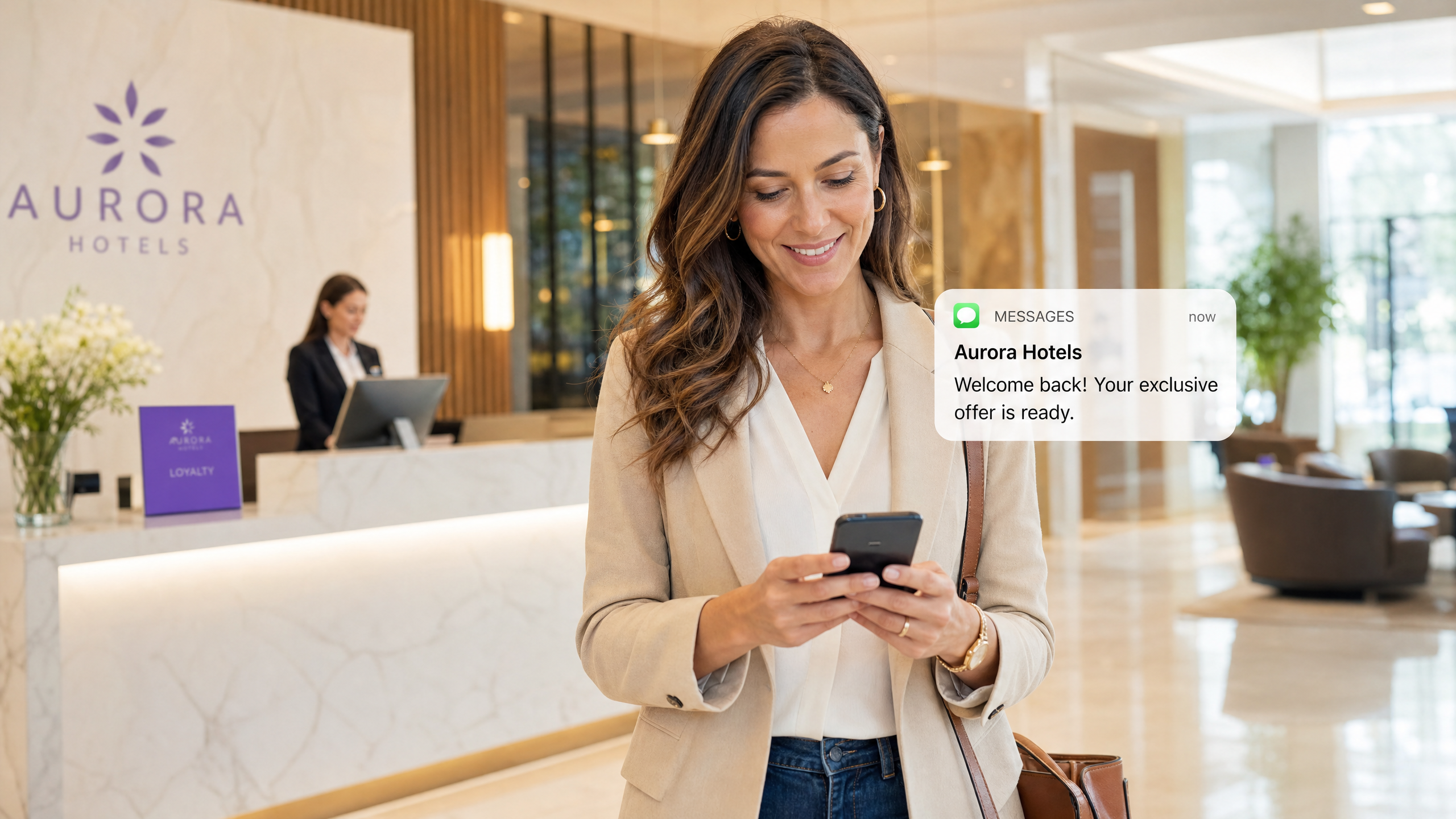
Venue operators face a persistent challenge: converting first-time visitors into repeat patrons. While email marketing remains standard, SMS service marketing delivers a 98% open rate compared to email's 21% [1]. This guide provides a technical blueprint for IT managers and venue operations directors to implement an SMS service marketing strategy. By capturing verified first-party data at the point of Guest WiFi authentication, operators can build a compliant, high-engagement communication channel. We detail the deployment architecture required to automate SMS campaigns based on visitor behaviour, ensuring compliance with GDPR and CCPA, and establishing clear attribution for return visits.
Technical Deep-Dive
The Data Capture Architecture
The foundation of an effective SMS service marketing programme is accurate, consented first-party data. Purchasing lists or scraping numbers yields low engagement and high compliance risk. Instead, venues must capture data when the user authenticates onto the network.
When a visitor connects to a venue's Guest WiFi, the access point (AP) intercepts the traffic and redirects the device to a captive portal. This portal, hosted by a cloud overlay like Purple Engage, presents a splash page where the visitor submits their profile information, including their mobile number.
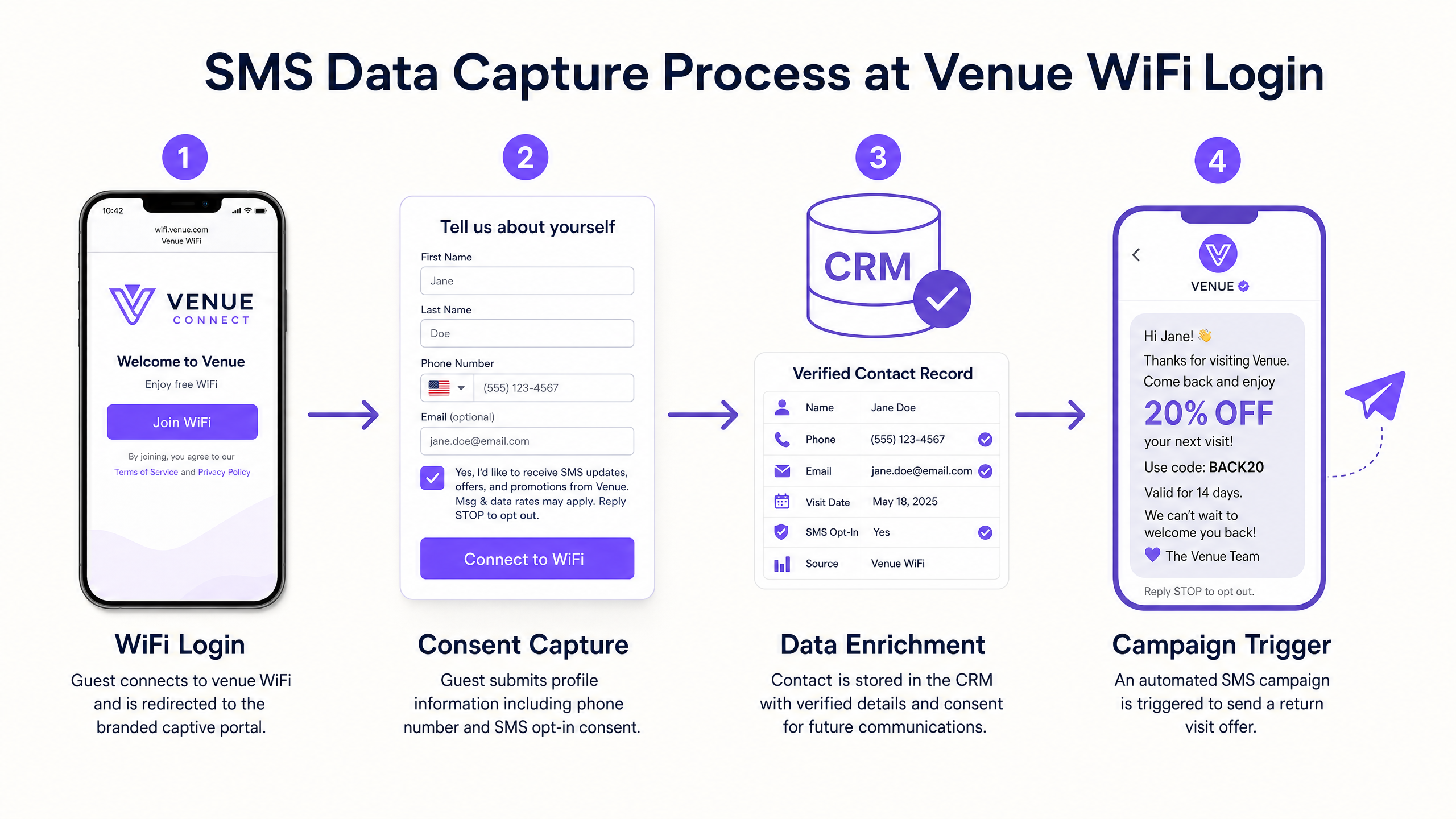
To ensure data accuracy, the system can employ SMS verification (sending a one-time password) during the login flow. This guarantees the number is active and belongs to the device owner. The captive portal must also handle the legal consent framework, presenting the SMS opt-in as a distinct, unbundled checkbox. The platform records the timestamp, IP address, MAC address, and the specific version of the terms accepted, creating an immutable audit trail.
Network and Hardware Integration
Implementing this strategy requires integration between the physical network infrastructure and the marketing automation layer. The cloud platform acts as a RADIUS server, authenticating the user and granting network access only after the data capture and consent process is complete. This architecture is hardware-agnostic but requires specific configuration on the WLAN controllers or cloud dashboards of vendors such as Cisco Meraki, HPE Aruba, Ruckus, Juniper Mist, Ubiquiti UniFi, Cambium, Extreme, or Fortinet.
Automation and Trigger Logic
Once the data is captured, it flows into a centralised CRM or WiFi Analytics dashboard. Here, IT and marketing teams define the trigger logic for SMS campaigns. Triggers are typically based on:
- Recency: Time since the last visit (e.g., 45 days ago).
- Frequency: Total number of visits within a specific window.
- Dwell Time: Duration of the current or previous visits.
The automation platform monitors the RADIUS accounting data (start and stop accounting packets) to determine when a device connects and disconnects. When a visitor's behaviour matches a predefined segment, the platform calls the API of an SMS gateway (such as Twilio or Infobip) to dispatch the message.
Implementation Guide
Step 1: Configure the Captive Portal
- Access your Purple dashboard and navigate to the captive portal editor.
- Add a 'Mobile Number' field to the login form. Ensure the field includes country code validation.
- Add a dedicated checkbox for SMS marketing consent. The label must be clear, for example: "I consent to receive promotional SMS messages from [Venue Name]."
- Do not pre-tick this box. Forced consent invalidates the opt-in under GDPR.
Step 2: Define Audience Segments
Create segments based on business objectives. For Retail environments, a 'Lapsed Shopper' segment might include visitors who have not connected to the network in 60 days. For Hospitality , a 'First-Time Guest' segment captures users 24 hours after their initial login.
Step 3: Build the Automation Flow
- Select the target segment.
- Define the trigger event (e.g., 'Disconnects from WiFi' or 'Time since last visit equals 30 days').
- Draft the SMS payload. Keep it under 160 characters to avoid multi-part message billing.
- Include a unique redemption code to track attribution.
- Append the mandatory opt-out instruction (e.g., "Reply STOP to opt out").
Step 4: Monitor and Refine
Deploy the campaign and monitor the delivery rates, opt-out rates, and return visit attribution within the analytics dashboard.
Best Practices
Compliance First
Adhere strictly to regional regulations. In Europe, GDPR Article 7 mandates that consent must be freely given, specific, informed, and unambiguous. In the United States, the Telephone Consumer Protection Act (TCPA) requires prior express written consent for promotional texts. Always provide a clear, functional opt-out mechanism and honour it immediately.
Frequency Management
Data indicates that 49% of subscribers prefer receiving promotional SMS messages about once every two weeks [2]. Exceeding this frequency without providing exceptional value will drive up your unsubscribe rate. Implement frequency capping at the platform level to prevent segment overlap from triggering multiple messages to the same user.
Value Exchange
An SMS is an interruption. It must offer immediate, tangible value. Do not send generic newsletters via text. Use SMS for time-sensitive offers, exclusive access, or critical updates relevant to the visitor's context.
Troubleshooting & Risk Mitigation
High Opt-Out Rates
If your opt-out rate exceeds 3% per campaign, your frequency is likely too high, or your content lacks value. Review your send schedule and ensure the offers are compelling. Check that your segments are tightly defined; sending a "welcome back" offer to someone who visits daily is irrelevant.
Low Opt-In Rates
If visitors are not providing their numbers, examine the captive portal. Is the value proposition clear? Ensure the splash page explains why they should opt in (e.g., "Get 10% off your next coffee"). Position the opt-in above the fold on mobile screens.
Attribution Failures
If you cannot prove ROI, the programme will lose funding. Never use generic discount codes (e.g., "SUMMER20"). Generate unique codes for every SMS sent. When that code is redeemed at the Point of Sale (POS), you can attribute the revenue directly to the specific SMS campaign and the specific network login event.
ROI & Business Impact
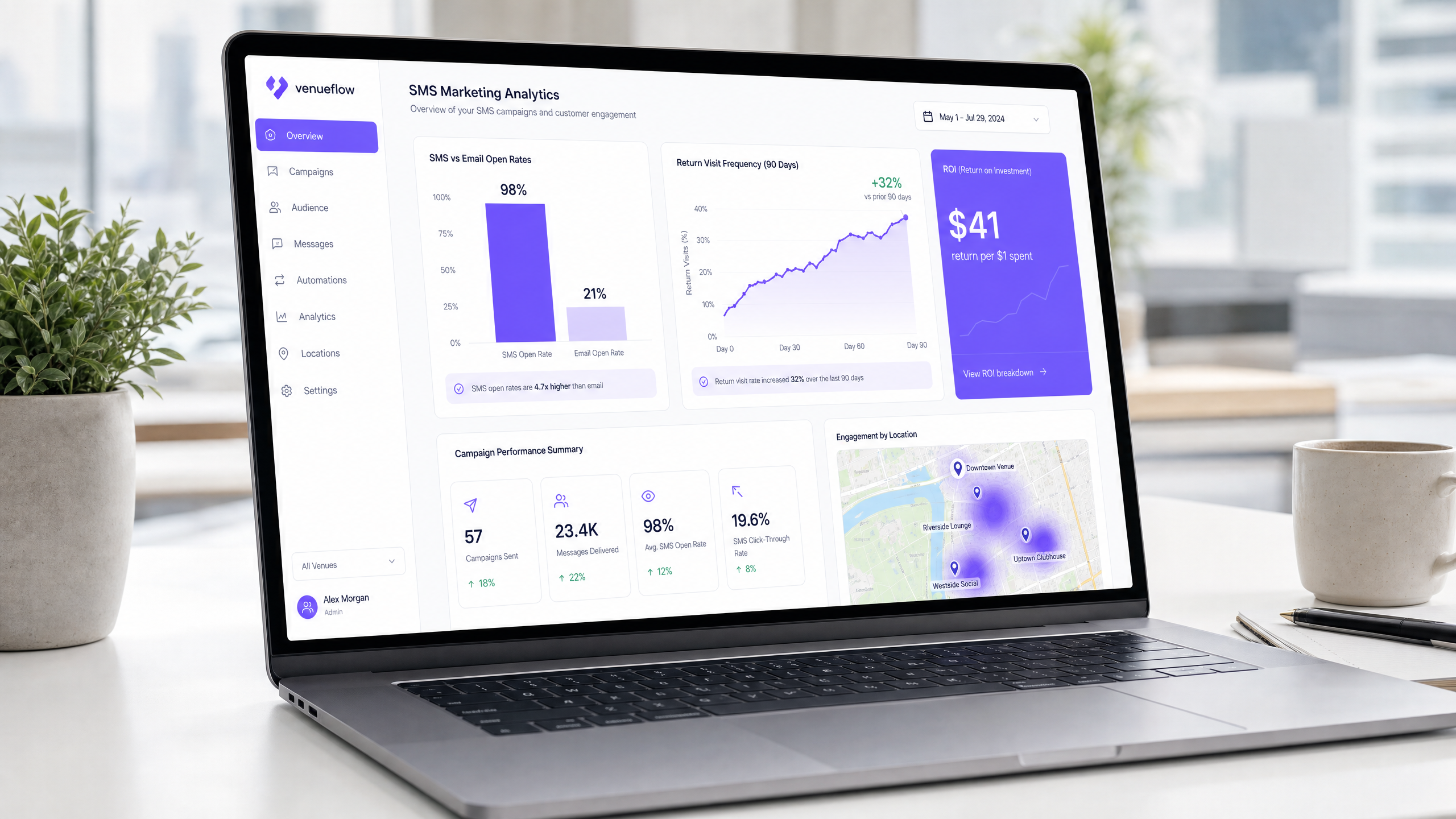
SMS service marketing requires investment in platform licensing and per-message gateway fees. However, the return on investment is substantial. Industry benchmarks show that well-optimised SMS campaigns can generate between $21 and $41 for every $1 spent [2].
Success is measured by tracking the uplift in return visit frequency among the opted-in cohort compared to a control group of anonymous or non-opted-in visitors. By leveraging WiFi Analytics , operators can definitively prove that a specific automated message resulted in a physical return visit, closing the loop between digital engagement and physical footfall.
Podcast Briefing
Listen to our senior consultant brief on deploying SMS marketing strategies for venue operators:
References
[1] Infobip. "SMS marketing statistics: Key figures for 2026." https://www.infobip.com/blog/sms-marketing-statistics [2] Sakari. "SMS Marketing Statistics: Data-Backed Insights for 2025–2026." https://sakari.io/blog/sms-marketing-statistics-data-backed-insights-for-2025-2026
Key Definitions
Captive Portal
A web page that a user of a public access network is obliged to view and interact with before access is granted. Used to capture guest data and consent.
This is the primary touchpoint for converting an anonymous device MAC address into a known customer profile.
First-Party Data
Information a company collects directly from its customers and owns entirely, rather than purchasing it from data brokers.
Capturing first-party data via Guest WiFi reduces reliance on third-party cookies and ensures higher quality, compliant contact lists.
RADIUS
Remote Authentication Dial-In User Service. A networking protocol that provides centralised Authentication, Authorisation, and Accounting management.
The cloud platform acts as a RADIUS server to authenticate the guest and track their connection time, which drives the SMS automation triggers.
Opt-In
The explicit, recorded consent given by a user to receive marketing communications.
Without a valid, timestamped opt-in record, sending promotional SMS messages violates GDPR and TCPA regulations.
Attribution
The process of identifying which marketing action resulted in a specific customer behaviour or sale.
IT and marketing teams must prove that the cost of the SMS gateway is justified by attributing physical return visits to specific campaigns.
Segment
A defined subset of the total guest database, grouped by shared characteristics such as visit frequency or recency.
Sending targeted messages to specific segments yields much higher ROI than sending generic blasts to the entire database.
SMS Gateway
A service that allows a computer to send or receive Short Message Service (SMS) transmissions to or from a telecommunications network.
The automation platform must integrate with a gateway via API to physically deliver the messages to the guests' handsets.
Dwell Time
The duration of time a device remains connected to or visible to the WiFi network during a single visit.
Dwell time can be used as a trigger; for example, sending a specific offer to a guest who has been in the venue for over two hours.
Worked Examples
A 200-room hotel needs to increase direct bookings from previous guests to reduce OTA commission fees.
The hotel deploys Purple Engage on their existing Cisco Meraki network. They configure the captive portal to capture mobile numbers with an explicit SMS opt-in offering 'Exclusive direct booking rates'. An automation rule is set: 21 days after a guest's first visit disconnect event, the system sends an SMS with a unique link to a discounted direct booking page. The message reads: 'Hi [Name], we loved having you. Book your next stay directly with us for 15% off: [Link]. Reply STOP to opt out.'
A retail shopping centre with 85 tenants wants to increase the frequency of visits from local residents.
The centre operator configures their HPE Aruba network to route Guest WiFi authentication through Purple. Shoppers opt into SMS marketing on the splash page. The operator creates a segment for 'Local Frequent Shoppers' (defined as users who visit more than twice a month). An automation triggers an SMS every second Thursday at 4 PM, highlighting a weekend event or a specific tenant offer. 'Weekend preview: Live music in the central atrium this Saturday, plus 20% off at [Tenant Name]. Show this text. Reply STOP to opt out.'
Practice Questions
Q1. Your marketing director wants to automatically text every guest who connects to the WiFi a 'Welcome' message. What is the compliance risk?
Hint: Consider how the phone number is obtained and what the user agreed to.
View model answer
You cannot send a promotional text simply because they connected to the WiFi. The user must explicitly opt-in to SMS marketing via a distinct, unbundled checkbox on the captive portal. Sending messages without this explicit consent violates GDPR and TCPA.
Q2. A stadium operator complains that their SMS campaigns have a 6% opt-out rate per send. They currently send a message every Friday afternoon.
Hint: Review the industry benchmarks for frequency tolerance.
View model answer
The frequency is too high. Data shows 49% of subscribers prefer messages no more than once a fortnight. The operator should implement frequency capping to restrict sends to a maximum of two per month, and ensure the content provides immediate value to the fan.
Q3. You need to prove the ROI of an SMS campaign aimed at lapsed retail shoppers. How do you structure the campaign to guarantee attribution?
Hint: How will the Point of Sale system know the customer received the text?
View model answer
The SMS payload must include a unique redemption code generated for each specific user. When the shopper returns and uses the code at the POS, the transaction can be definitively attributed to that exact SMS send, proving the return visit was driven by the campaign.