
Customer data platform example: a comprehensive guide for businesses
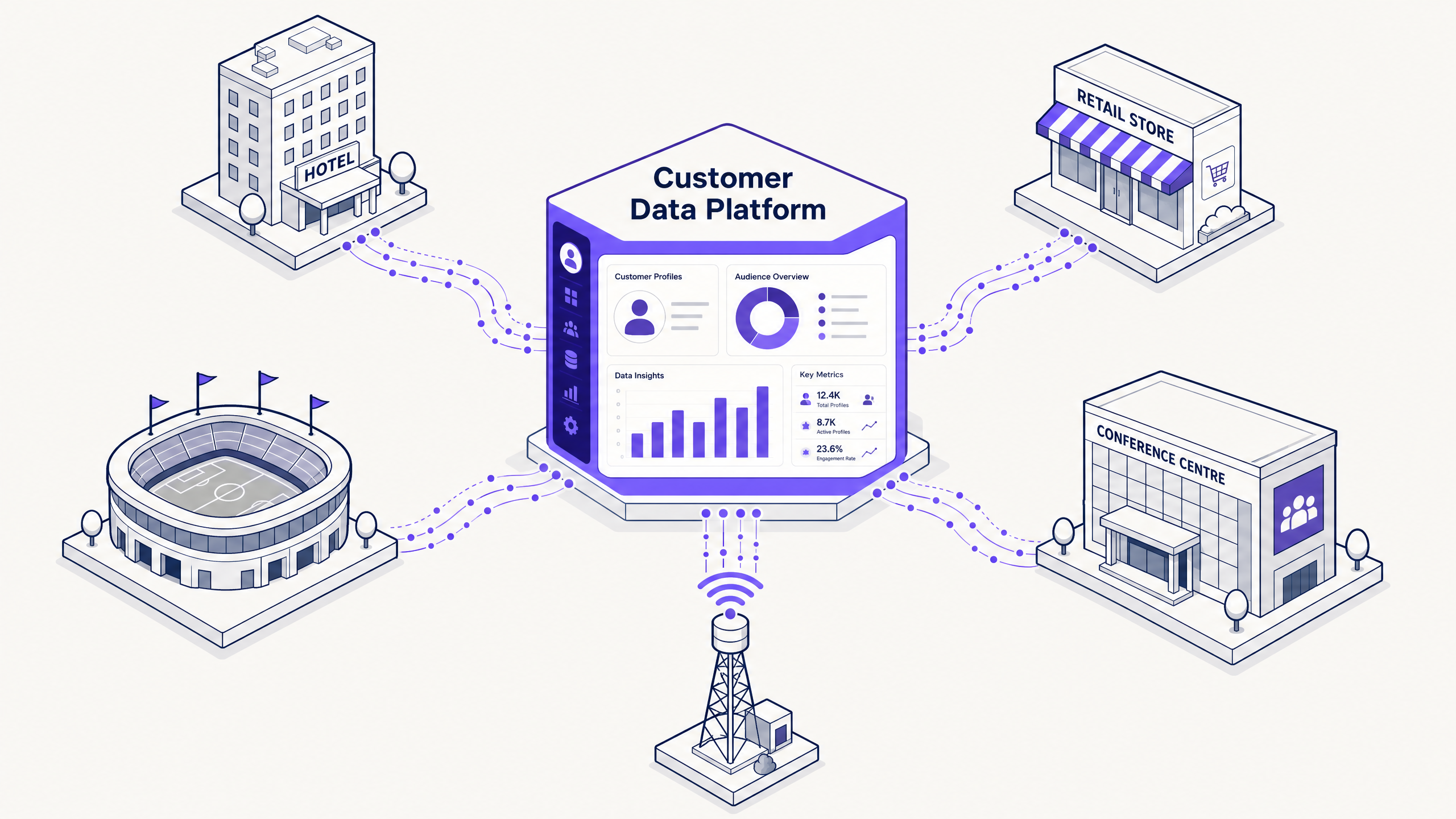
This guide explains what a customer data platform is and how physical venues - from hotels and retail chains to stadiums and conference centres - can deploy one to unify fragmented visitor data. It covers the three-layer CDP architecture, phased implementation strategy, and how Purple Engage captures first-party data at the WiFi login point to feed real-time segmentation and marketing automation. Marketing Directors, CRM Managers, and Retail Venue Operators will find concrete worked examples, ROI frameworks, and compliance guidance to act on this quarter.
Listen to this guide
View podcast transcript
Executive summary
For CTOs and IT directors managing physical venues, fragmented data is a structural liability. Your CRM holds email addresses. The point-of-sale (POS) system records transactions. Your WiFi infrastructure sees foot traffic. None of these systems share a common identity layer, which means every campaign runs on incomplete information and every marketing decision is slower than it needs to be.
A Customer Data Platform (CDP) resolves this fragmentation. It acts as the central architectural layer that ingests disparate data streams, performs identity resolution, and creates a unified customer profile available for real-time activation. This guide provides a practical customer data platform example for venue operators, covering deployment architecture, integration with hardware from Cisco Meraki, HPE Aruba, Ruckus, and Juniper Mist, and how Purple Engage captures verified first-party data at the network edge to feed the CDP directly.
Purple operates across 80,000+ live venues and has processed 440 million logins in 2024 (Purple internal data). The patterns we see consistently show that venues which unify their WiFi data with CRM and POS records achieve measurably better campaign performance than those running each system in isolation.
Technical deep-dive
What a CDP actually does
A CDP is not a CRM. A CRM stores records that sales and service teams manually maintain. A CDP is an automated data pipeline. It ingests events from multiple systems in real time, resolves those events to a persistent profile, and exposes that profile to downstream activation tools like email platforms, SMS gateways, and ad networks.
The CDP Institute defines a CDP as "packaged software that creates a persistent, unified customer database that is accessible to other systems." The key word is persistent. Unlike a data warehouse, which is optimised for batch analytics, a CDP maintains live profiles that update as new events arrive.
For a physical venue, the data sources feeding the CDP typically include:
| Data source | Data type | Update frequency |
|---|---|---|
| Guest WiFi login | Email, phone, opt-in consent | Real time |
| POS system | Transaction history, spend value | Near real time |
| CRM | Historical records, loyalty tier | Batch or webhook |
| Mobile app | In-app behaviour, push opt-in | Real time |
| Ticketing platform | Event attendance, seat location | Batch |
The three-layer architecture
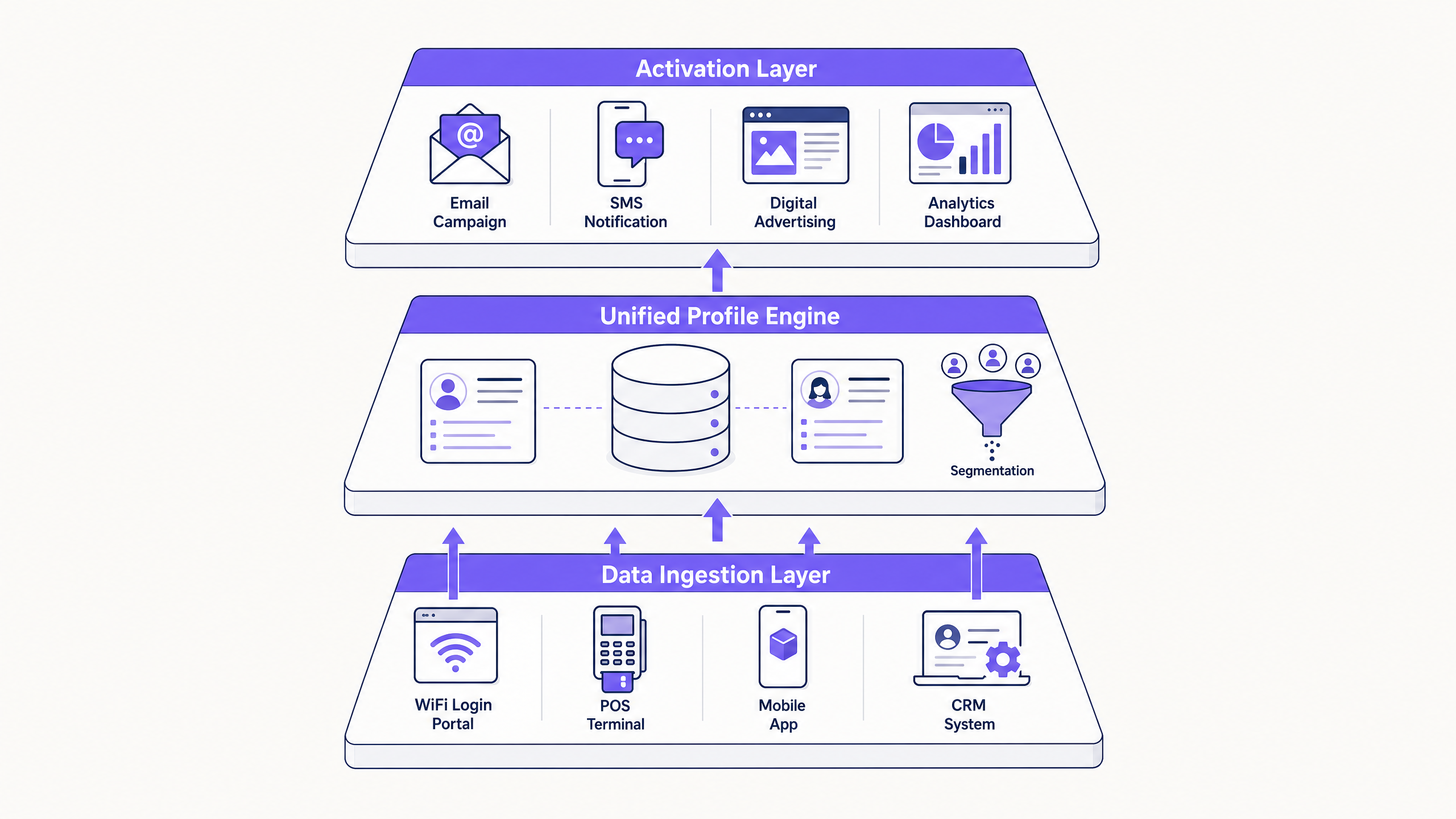
A well-designed CDP deployment has three layers.
Layer 1 - Data ingestion. This layer collects events from all connected sources. For physical venues, the WiFi login portal is the highest-quality ingestion point because it captures deterministic, consent-based data. Purple Engage collects verified guest email and phone number at the point of authentication. This data flows to the CDP via a secure API webhook, typically within seconds of the login event.
Layer 2 - Unified profile engine. This layer performs identity resolution. It takes the email address from the WiFi login and attempts to match it against existing records in the CRM. If a match exists, the CDP appends the new event to the existing profile. If no match exists, it creates a new profile. Progressive enrichment means each subsequent interaction - a POS transaction, an app session, a second WiFi login at a different venue - adds detail to the same profile.
Layer 3 - Activation. This layer exposes the unified profiles to downstream tools. Segments built in the CDP sync to email platforms, SMS gateways, and ad networks. A segment of "guests currently on-site who have visited more than three times" can trigger an automated campaign in Purple Engage without any manual intervention.
Overcoming MAC randomisation
Modern operating systems, including iOS 14 and later and Android 10 and later, use MAC randomisation. Each time a device scans for networks, it broadcasts a different hardware address. This breaks legacy analytics that relied on tracking MAC addresses to identify returning visitors.
Profile-based authentication solves this. Because Purple requires users to authenticate through a captive portal using an email address, social login, or phone number, the system captures a deterministic identity rather than a hardware address. The CDP profile is anchored to a verified email, which persists across devices and sessions. Foot traffic analytics built on MAC addresses become unreliable; profiles built on authenticated logins do not.
Consent and compliance
GDPR and CCPA require that consent be captured, stored, and honoured across every channel. A CDP must act as the central consent orchestration engine. When a user opts out via an email unsubscribe link, the CDP must instantly suppress that profile across all connected activation channels - SMS, push notifications, and custom audiences on ad platforms.
Purple is ISO 27001, GDPR, CCPA, and Cyber Essentials certified. Data captured at the network edge through Purple Engage includes explicit opt-in consent, which is stored as a timestamped record in the profile. This audit trail satisfies the GDPR requirement to demonstrate consent on request.
Implementation guide
Deploying a CDP is a phased programme, not a single project. Venues that attempt to integrate every data source simultaneously typically stall within the first 90 days due to schema conflicts, data quality issues, and competing IT priorities.
Phase 1 - Establish the data foundation (weeks 1-4)
Start with your highest-volume, highest-quality first-party data source. For physical venues, this is Guest WiFi. Connect your existing hardware - whether Cisco Meraki, HPE Aruba, Ruckus, Juniper Mist, Ubiquiti UniFi, Cambium, Extreme, or Fortinet - to Purple using the hardware-agnostic cloud overlay. Purple deploys on top of your existing access points without requiring hardware replacement.
Configure the captive portal to capture email and phone number with explicit opt-in consent. Set up the webhook to push login events to your CDP in real time. Validate the data flow by checking that profiles are being created and updated correctly.
Phase 2 - Define identity resolution rules (weeks 2-3)
Before connecting additional data sources, define the identity resolution logic. Decide which identifier acts as the primary key for merging profiles. Email address is typically the most reliable choice because it is deterministic and consistent across devices. Configure conflict resolution rules: if two profiles share the same email but different phone numbers, which record takes precedence?
Document these rules in writing. When the CRM team and the marketing team disagree about a data discrepancy six months later, the documented rules resolve the dispute.
Phase 3 - Execute a high-ROI use case (weeks 4-8)
Do not wait for the CDP to be fully populated before activating it. Implement audience suppression as the first use case. Sync the segment of "guests currently on-site" to your ad platforms and exclude them from digital acquisition campaigns. This delivers immediate, measurable ad spend efficiency.
According to Boston Consulting Group, brands using first-party data for marketing achieve up to 2.9 times revenue uplift and 1.5 times cost savings compared to those relying on third-party data. Audience suppression is the fastest way to demonstrate this to a CFO.
Phase 4 - Expand integrations (weeks 8 onwards)
Once the WiFi integration is stable and the first use case is delivering results, connect the POS system. Map transaction events to the existing profiles. This enables cross-sell and up-sell campaigns triggered by purchase behaviour. Connect the CRM to enrich profiles with historical loyalty data. Each additional source increases the precision of segmentation and the relevance of automated campaigns.
For guidance on SMS campaign automation once your CDP is populated, see our guide on how to leverage marketing SMS examples to increase return visits .
Best practices
Enforce consent at the data layer
Do not rely on individual marketing tools to manage opt-outs. A user who unsubscribes from an email campaign must be suppressed from SMS, push notifications, and ad platform custom audiences simultaneously. Configure the CDP to propagate consent changes to all connected systems within seconds. GDPR fines totalled 2.1 billion euros in 2023 (GDPR Enforcement Tracker). A structural consent management approach reduces this exposure.
Prioritise real-time activation for venue marketing
Batch processing is insufficient for venue marketing. The window of opportunity - the time between a guest arriving and leaving - is typically two to four hours. If your CDP processes data in nightly batches, you cannot trigger an offer while the guest is still on-site. Ensure your architecture supports real-time webhook delivery and sub-minute segment updates.
Standardise your data schema
Maintain strict data governance. Standardise event names and profile attributes across all ingested sources. If the POS system calls a transaction a "sale" and the CRM calls it a "purchase", the CDP will treat them as different event types. Define a canonical schema before connecting each new data source and enforce it at the ingestion layer.
Use WiFi as the identity anchor for physical venues
For venues where visitors do not log into a mobile app or loyalty programme, the WiFi login is the only reliable identity capture point. Treat it as your primary identity anchor. Every other data source enriches the profile that the WiFi login creates. See our guide on Guest WiFi for implementation detail on the login flow.
For a deeper look at how to structure your WiFi network across guest, staff, and IoT segments, read Three SSIDs to rule them all: guest, Passpoint, and IoT WiFi .
Troubleshooting and risk mitigation
Data latency
If campaigns are triggering after a visitor has left the venue, investigate the webhook payload delivery times between the WiFi platform and the CDP. Check whether API rate limits are causing queuing. Ensure the CDP segment refresh interval is set to real time or near real time, not hourly or daily.
Profile collapse
If distinct users are being merged into a single profile, review your identity resolution rules. Common causes include shared corporate email addresses (e.g., info@company.com ), shared devices in a family, or a misconfigured rule that merges profiles based on IP address rather than email. Add a minimum-confidence threshold to the merge logic: only merge profiles when two or more deterministic identifiers match.
Integration failures
Always test integrations in a staging environment before deploying to production. Verify that the CDP correctly parses the JSON payloads from the POS and WiFi systems. Check that field mappings are correct and that required fields are not null. Set up monitoring alerts for failed webhook deliveries so that data gaps are detected within minutes rather than days.
Consent propagation failures
Test your consent propagation by creating a test profile, opting out, and verifying that the suppression has been applied across all connected channels within the required timeframe. Under GDPR, opt-out requests must be honoured without undue delay. A 24-hour propagation lag is not compliant.
-
ROI and business impact
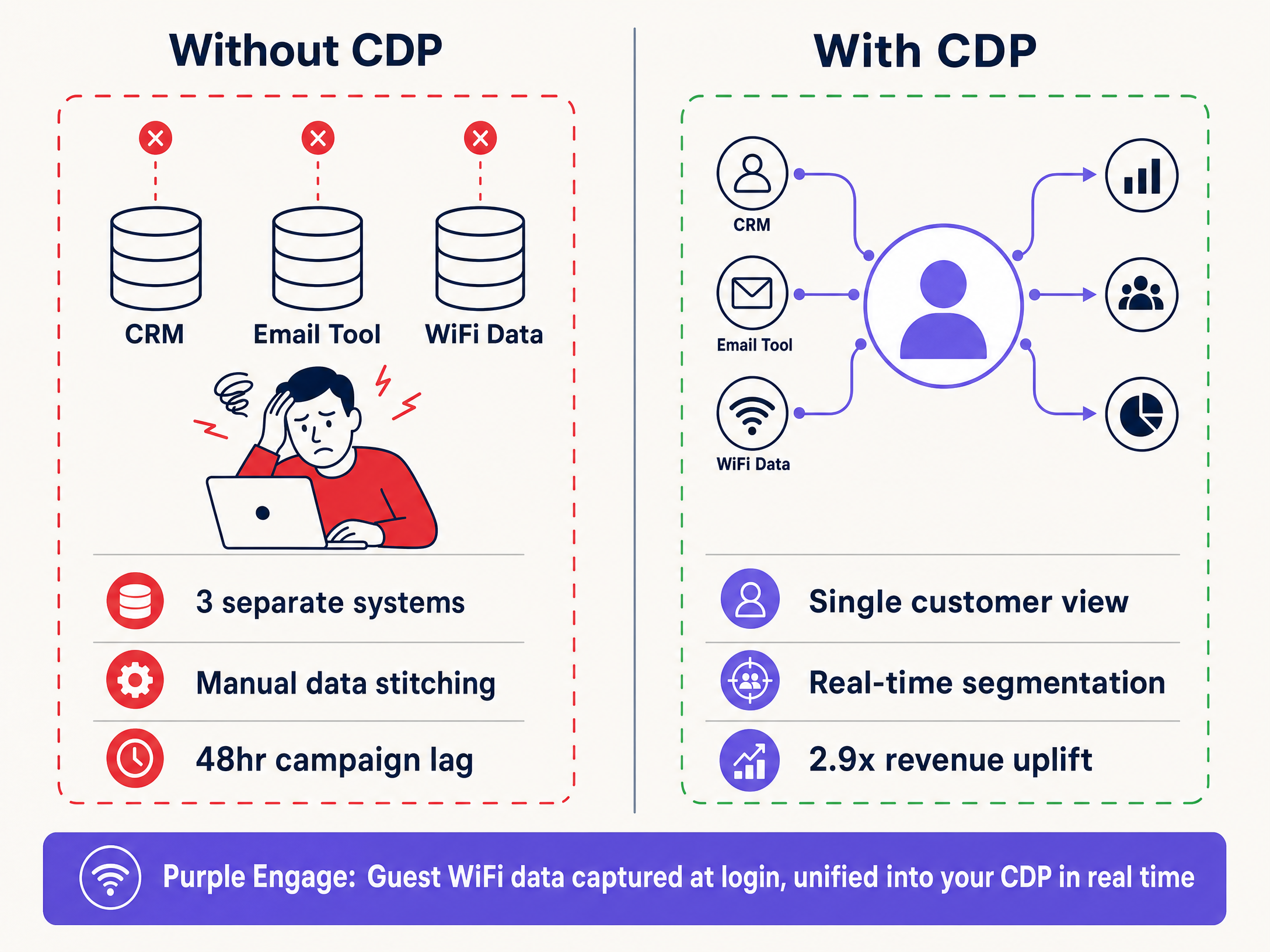
A properly implemented CDP delivers measurable outcomes across three primary levers.
Ad spend efficiency. By suppressing existing customers and activating first-party lookalike audiences on ad platforms, venues reduce wasted acquisition spend. Industry benchmarks suggest 10 to 20% of acquisition budgets are spent on already-converted customers (CDP Institute). Suppression eliminates this waste from the first week of activation.
Campaign revenue lift. Real-time segmentation enables contextually relevant offers delivered while the visitor is on-site. A hotel that triggers a dinner discount when a guest buys a morning coffee captures incremental revenue that would otherwise go to off-property competitors. A stadium that triggers a merchandise offer ten minutes before half-time captures the highest-footfall window of the event.
Operational efficiency. Automating data consolidation saves engineering and marketing teams hours of manual data stitching each week. The CDP Institute reports that automated identity resolution replaces 20 to 40 hours per week of manual data reconciliation work in organisations that previously relied on manual ETL processes.
For venues using Purple Engage, the data capture and activation loop is built into the platform. Purple has collected 29 billion data points across 80,000+ venues (Purple internal data). The WiFi Analytics platform surfaces this data in real time, giving marketing teams the segmentation inputs they need without requiring data engineering resources.
For hospitality venues specifically, the combination of property management system data and WiFi login data creates a complete picture of the guest stay - from arrival to checkout - that enables personalised post-stay campaigns and direct booking incentives that reduce OTA dependency.
For retail operators, the combination of WiFi footfall data and POS transaction data enables shopper segmentation by visit frequency, average basket size, and category preference - the same segmentation inputs that online retailers have used for years, now available for physical stores.
For a practical look at how your splash page design affects first-party data capture rates, read How to make a great first impression with your guest WiFi . For transport and travel hub deployments, see our Transport industry page.
Key Definitions
Customer Data Platform (CDP)
Packaged software that creates a persistent, unified customer database accessible to other systems. It ingests data from multiple sources, resolves identities, and exposes unified profiles for real-time activation.
IT teams deploy CDPs to eliminate data silos between CRM, POS, and WiFi systems. Marketing teams use the unified profiles for segmentation and campaign automation.
Identity resolution
The process of matching disparate data points - such as an email address from a WiFi login and a loyalty ID from a CRM record - to a single, persistent individual profile.
Critical for preventing duplicate records and ensuring that campaign targeting reflects a complete view of the customer rather than a partial one.
First-party data
Information collected directly from your audience through your own channels, such as WiFi login portals, mobile apps, or loyalty programme registrations. The data subject has a direct relationship with the collecting organisation.
As third-party cookies are deprecated across major browsers, first-party data becomes the primary asset for targeted marketing. Guest WiFi is one of the most reliable first-party data capture points for physical venues.
MAC randomisation
A privacy feature in modern operating systems (iOS 14+, Android 10+) that broadcasts a different hardware address each time a device scans for networks, preventing passive tracking.
Breaks legacy location analytics that relied on MAC address tracking. Resolved by requiring users to authenticate through a captive portal, capturing a deterministic identity instead.
Audience suppression
The practice of excluding specific customer segments from marketing campaigns. The most common use case is excluding existing customers from digital acquisition campaigns to avoid wasting ad spend.
Typically the first CDP use case deployed because the ROI is immediate and measurable. Requires the CDP to sync segments to ad platforms in real time or near real time.
Captive portal
A web page that users must interact with before accessing a public WiFi network. It is the primary mechanism for capturing first-party data and consent in physical venues.
The captive portal is the data capture point for Purple Engage. It presents the login form, displays the consent notice, and triggers the webhook to the CDP upon successful authentication.
Real-time activation
The ability to trigger marketing actions - such as sending an SMS or updating an ad audience - immediately based on a user's current behaviour or location, without batch processing delays.
Essential for venue marketing where the window of opportunity is limited to the duration of the visit. A campaign triggered after the guest has left the venue has zero conversion potential.
Progressive profile enrichment
The process of building richer customer profiles over time as new interactions add data to an existing record. Each WiFi login, POS transaction, or app session adds detail without requiring manual data entry.
Means that a new visitor's profile starts with just an email address and grows to include visit frequency, transaction history, and channel preferences over subsequent visits.
Consent orchestration
The centralised management of opt-in and opt-out preferences across all marketing channels, ensuring that a consent change in one channel is automatically applied to all others.
Required for GDPR and CCPA compliance. A CDP that enforces consent at the data layer prevents opted-out users from being included in any campaign, regardless of which tool executes it.
Worked Examples
A 200-room hotel wants to reduce OTA commission costs and increase on-site restaurant spend. The hotel runs HPE Aruba access points and uses a mid-market PMS. How should the CDP be deployed?
Step 1: Connect the HPE Aruba infrastructure to Purple Engage using the cloud overlay. Configure the captive portal to capture guest email and phone number with explicit opt-in consent. Set up a webhook to push login events to the CDP in real time.
Step 2: Configure the CDP identity resolution to use email address as the primary key. Map the PMS guest record to the CDP profile using the email address captured at check-in.
Step 3: Define two initial segments: 'Guest currently on-site' (active WiFi session in the last 4 hours) and 'Guest on-site who has made a POS purchase today'. When a guest connects to WiFi, the CDP creates a profile. When the guest buys a coffee at the restaurant, the POS webhook updates the profile. The CDP triggers an automated SMS via Purple Engage: 'Enjoy 10% off dinner tonight - show this message at the restaurant.' The offer is delivered while the guest is on-site and able to act on it.
Step 4: Post-stay, the CDP triggers a direct booking incentive email 48 hours after checkout, bypassing OTA channels entirely.
A stadium with 40,000 capacity wants to increase merchandise sales during halftime and improve post-event fan engagement. The venue runs Cisco Meraki WiFi and sells tickets through a third-party platform that shares anonymised demographic data but not personally identifiable information.
Step 1: Connect the Cisco Meraki infrastructure to Purple Engage. Configure the captive portal to capture fan email and phone number at WiFi login. This creates a first-party identity layer that the stadium owns, independent of the ticketing platform.
Step 2: Use the anonymised demographic data from the ticketing platform to enrich CDP segments with event type and general audience profile. This data does not contain PII, so it can be used for segmentation without triggering consent obligations under GDPR.
Step 3: Build a real-time segment: 'Fan currently in venue, connected to WiFi in the last 30 minutes'. Ten minutes before halftime, the CDP triggers a push notification via the stadium app: 'Skip the queue - collect your merchandise order from stand 12 using code FAN2024.' This reduces queue friction at the highest-footfall window of the event.
Step 4: Post-event, the CDP triggers a follow-up email within 24 hours with a personalised offer based on the fan's visit history. Fans who attended three or more events in the season receive a loyalty reward. Fans attending for the first time receive a 'next event' discount.
Practice Questions
Q1. Your retail chain wants to stop showing digital acquisition ads to shoppers who are currently in your stores. The stores run Ubiquiti UniFi access points and use a major CDP. Which capabilities are required, and what is the data flow?
Hint: Consider how the CDP identifies the shopper as currently on-site and how it communicates this to the ad platform.
View model answer
The required capabilities are: (1) real-time data ingestion from the WiFi login event to the CDP, (2) a segment definition for 'shopper currently on-site' based on an active WiFi session in the last N hours, and (3) a real-time audience sync from the CDP to the ad platform (e.g., Google Ads Customer Match or Meta Custom Audiences). The data flow is: shopper connects to WiFi via Purple Engage captive portal, login event is pushed to CDP via webhook, CDP updates the shopper's profile and adds them to the 'on-site' segment, CDP syncs the segment to the ad platform, ad platform excludes the shopper from acquisition campaigns. The key constraint is the sync frequency: if the ad platform only accepts audience updates every 24 hours, the suppression will not be effective for same-day visits. Ensure the CDP and ad platform integration supports near real-time or hourly syncs.
Q2. A user logs into the Guest WiFi using an email address that already exists in the CRM, but the CRM record has a different phone number. The CDP's identity resolution rules use email as the primary key. How should the CDP handle this conflict, and what are the compliance implications?
Hint: Think about which data source is more likely to be accurate and what GDPR says about data accuracy.
View model answer
The CDP should merge the profiles using the email address as the primary key, since both records share the same email. The phone number conflict should be resolved according to the pre-defined conflict resolution rules. If the WiFi login is more recent, the new phone number should be appended to the profile as an additional identifier, not used to overwrite the existing one without verification. Under UK GDPR Article 5(1)(d), personal data must be accurate and kept up to date. Overwriting an existing phone number with an unverified one from a new login event could introduce inaccuracy. The recommended approach is to store both phone numbers with timestamps and source attribution, and use the most recently verified one for outbound communications. Flag the conflict for a data quality review if the discrepancy is significant.
Q3. You are advising a conference centre that wants to deploy a CDP. The marketing team wants to integrate the CRM, ticketing system, mobile app, and Guest WiFi simultaneously to be ready for a major event in eight weeks. What is your recommendation, and what are the risks of the proposed approach?
Hint: Consider the phased deployment best practice and the consequences of a failed integration in a live event environment.
View model answer
Advise against the simultaneous integration. The risks are: (1) schema conflicts between four different data sources will require significant data engineering time to resolve, likely exceeding the eight-week window; (2) a misconfigured identity resolution rule could cause profile collapse or data loss across all four sources simultaneously; (3) if any integration fails during the event, the marketing team will have no fallback position. The recommended approach is to prioritise Guest WiFi integration in weeks one to three, since it is the highest-volume first-party data source and the fastest to deploy. Validate the data flow and build the first segment (attendees currently on-site) before the event. The CRM integration can follow in weeks four to six, and the ticketing and app integrations can be planned for the post-event period. This ensures the conference centre has a working CDP with at least one high-quality data source for the event, rather than a partially configured system with four unreliable ones.
Q4. A hotel group operates 50 properties across the UK and Europe. Each property has a different WiFi hardware vendor: some run Cisco Meraki, others run Ruckus, and a few run Fortinet. The CTO wants a unified CDP across all properties. Is this achievable, and what is the integration architecture?
Hint: Consider Purple's hardware-agnostic deployment model and how the CDP handles multi-venue profiles.
View model answer
This is achievable. Purple deploys as a hardware-agnostic cloud overlay, which means it can connect to Cisco Meraki, Ruckus, and Fortinet access points without requiring hardware standardisation. Each property's WiFi infrastructure connects to Purple independently. The captive portal is configured centrally and deployed across all 50 properties. Login events from all properties flow to the same CDP via the same webhook endpoint, with a venue identifier included in each event payload. The CDP uses the venue identifier to tag each login event with the property location. The identity resolution engine merges profiles across properties: a guest who stays at the London property and later stays at the Paris property is recognised as the same individual because they use the same email address. This creates a cross-property profile that enables the hotel group to personalise communications based on a guest's full stay history across the portfolio, not just their most recent visit.