
How to leverage bulk SMS marketing to increase return visits
This technical guide details how IT and operations leaders can implement bulk SMS marketing by capturing first-party data through Guest WiFi. It covers deployment architecture, GDPR-compliant consent workflows, audience segmentation strategies, and proven automation patterns to drive a measurable 24% increase in return visits across retail, hospitality, and public-sector venues. Purple Engage captures verified guest phone data at login and automates targeted campaigns without requiring custom mobile applications.
Listen to this guide
View podcast transcript
Executive summary
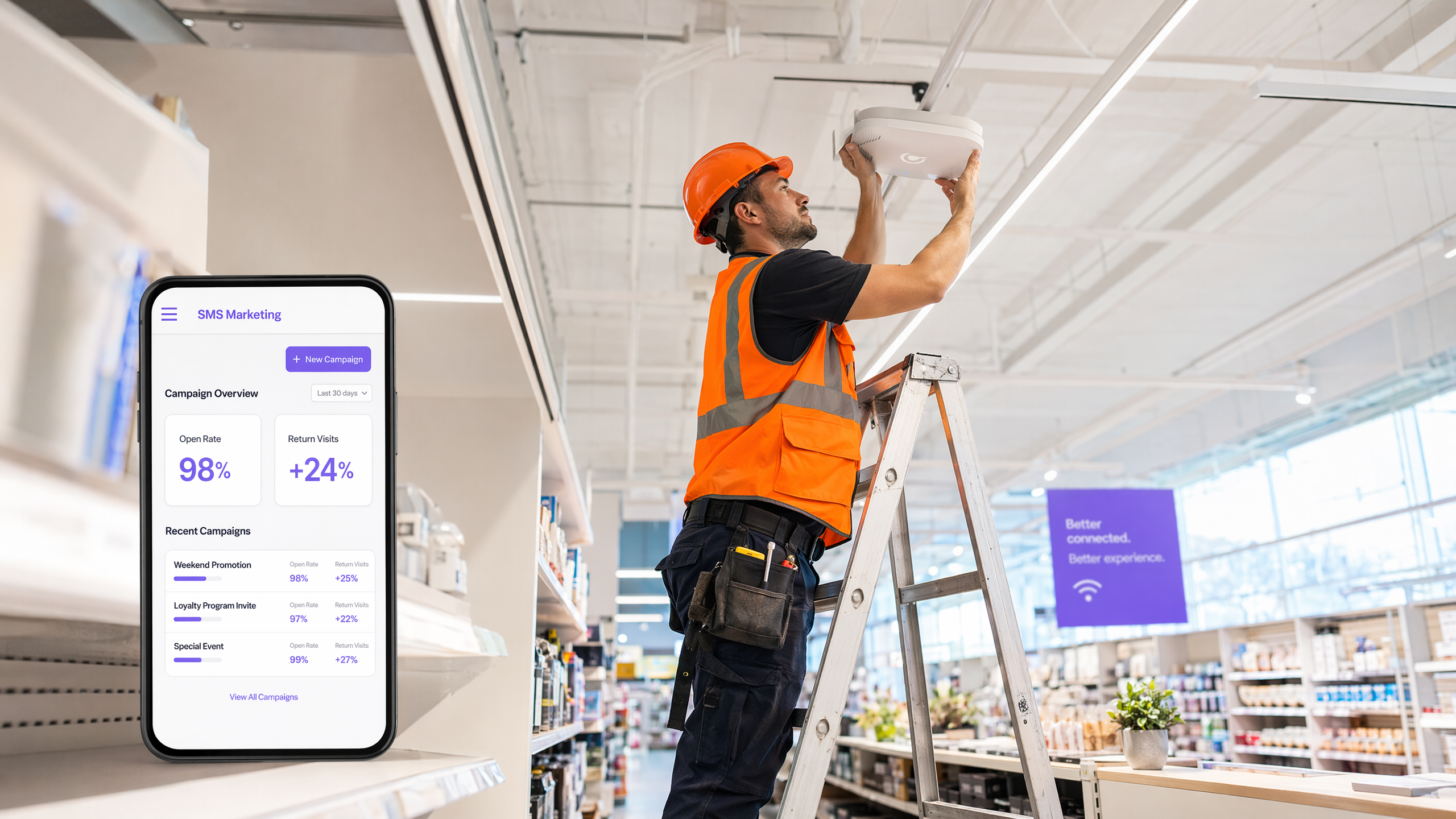
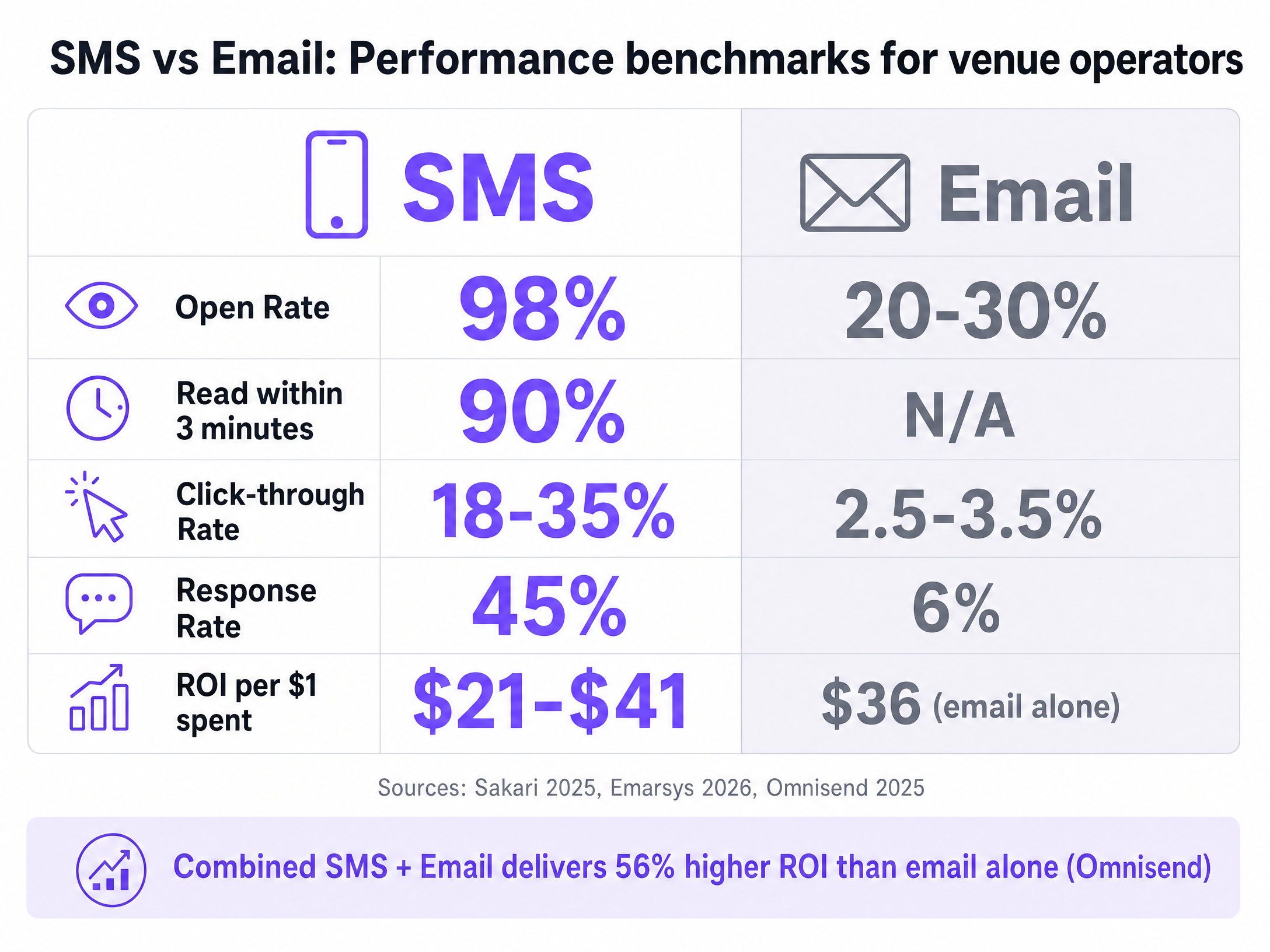
Guest WiFi is an underutilised asset in most physical venues. While IT teams deploy enterprise hardware from Cisco Meraki or HPE Aruba to provide connectivity, the commercial value of that infrastructure often remains untapped. This guide explains how to convert anonymous footfall into verified first-party data, enabling bulk SMS marketing campaigns that drive a 24% increase in return visits (Purple platform data). We detail the technical architecture required to capture phone numbers at the captive portal, manage consent under GDPR and TCPA, and automate targeted SMS dispatch using Purple Engage. For CTOs and venue operations directors, this approach provides a scalable, hardware-agnostic method to build a CRM database from scratch and generate measurable ROI without deploying custom mobile applications. SMS delivers a 98% open rate and returns between $21 and $41 for every $1 spent (Sakari, 2025), making it one of the highest-performing direct marketing channels available to physical venue operators today.
Technical deep-dive: architecture and data flow
Implementing a bulk SMS marketing strategy requires a secure, compliant data pipeline from the physical venue to the mobile device. The architecture relies on a cloud overlay that integrates with your existing wireless infrastructure - no hardware replacement required.
Captive portal integration
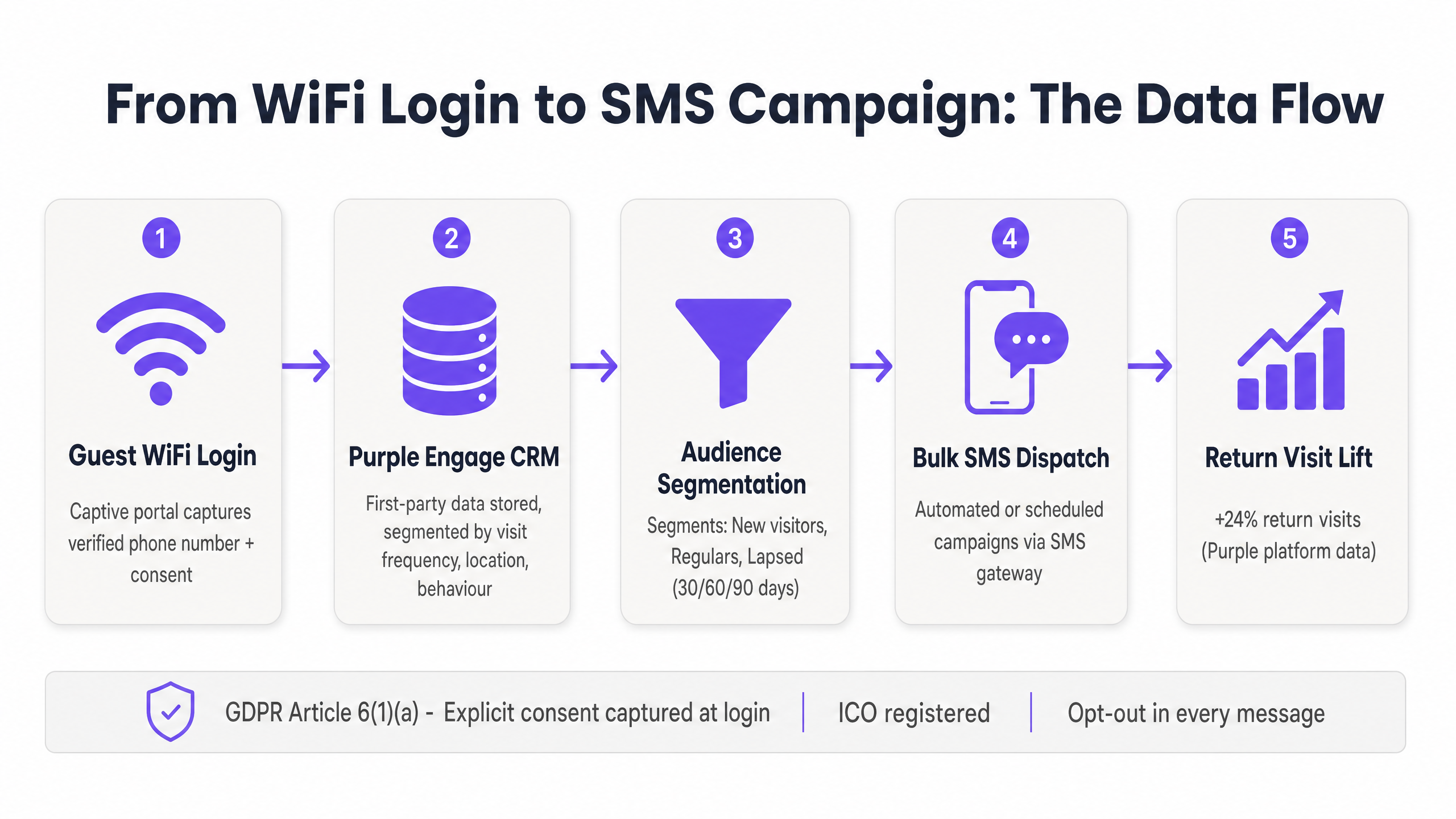
When a visitor connects to the Guest WiFi network, the wireless controller redirects their traffic to a captive portal hosted by Purple. This portal acts as the primary data ingestion point. Instead of open access, you require authentication via a phone number.
This process uses standard RADIUS (Remote Authentication Dial-In User Service) authentication. The hardware vendor - whether Cisco Meraki, HPE Aruba, Ruckus, Juniper Mist, Ubiquiti UniFi, Cambium, Extreme, or Fortinet - communicates with Purple's cloud RADIUS servers. Once the visitor provides their phone number and explicitly checks the opt-in box for SMS marketing, Purple authenticates the device MAC address and grants internet access. The phone number, device MAC address, timestamp, and venue location are securely transmitted to the Purple Engage CRM.
Identity resolution and segmentation
Purple acts as the central identity provider. It matches the device MAC address to the provided phone number. As the visitor returns to the venue - or visits other venues within your estate - the network detects the MAC address and logs the visit without requiring re-authentication. This passive tracking builds a detailed behavioural profile: frequency of visits, dwell time, and cross-venue movement.
Within Purple Engage, you segment this data. You isolate audiences based on specific criteria, such as visitors who have not returned in 60 days or frequent shoppers who visit weekly. This segmentation ensures that bulk SMS dispatch is targeted and relevant, avoiding the high opt-out rates associated with generic mass texting. According to WiFi Analytics data, segmented campaigns consistently outperform unsegmented broadcasts across all venue types.
Compliance and security standards
Data capture must align with international privacy standards. Purple maintains ISO 27001 certification and ensures compliance with GDPR and CCPA. Purple is also B Corp certified, reflecting a commitment to responsible data stewardship.
Consent for SMS marketing must be explicit under GDPR Article 6(1)(a). The captive portal must present a clear, unticked checkbox stating the frequency and nature of the messages. Purple Engage logs the timestamp and IP address of this consent event. Every dispatched SMS must include a clear opt-out mechanism (for example, "Reply STOP to cancel"), which the SMS gateway processes automatically to update the CRM and prevent future sends. In the US, campaigns must also comply with TCPA regulations and register with the A2P 10DLC (Application-to-Person 10-Digit Long Code) system to maintain carrier deliverability.
Implementation guide: deploying the solution
Deploying this system requires coordination between network engineering and marketing operations. The following steps apply across retail , hospitality , healthcare , and transport verticals.
Step 1: network configuration
Configure your wireless controllers to point to Purple's RADIUS servers. This process is hardware-agnostic and supports Cisco Meraki, HPE Aruba, Ruckus, Juniper Mist, Ubiquiti UniFi, Cambium, Extreme, and Fortinet. Configure the Walled Garden settings to allow traffic to the Purple captive portal before authentication. This ensures users can reach the login page without a full internet connection.
Step 2: portal design and consent optimisation
Design the captive portal to minimise friction while maximising opt-in rates. Use a clean, responsive layout. Clearly state the value exchange: free, secure WiFi access in return for a phone number and marketing consent.
Ensure the opt-in language is unambiguous. For example: "I consent to receive weekly promotional offers via SMS from [Brand Name]." Do not pre-tick the consent box. Purple's data indicates that transparent, conscious-choice opt-ins result in lower long-term unsubscribe rates, typically below 3.5% per send. For portal design best practices, see How to make a great first impression with your guest WiFi (and keep your brand consistent) .
Step 3: CRM integration and campaign setup
Once data flows into Purple Engage, configure your initial campaigns. Start with automated triggers rather than manual bulk broadcasts.
First, configure a Welcome Campaign. Send an immediate SMS upon first login, offering a discount valid for that specific visit - for example, 10% off at the cafe. Second, configure a Lapsed Visitor Campaign. Set a trigger to send an SMS to any visitor whose MAC address has not been seen on the network for 30 days, incentivising a return visit with a time-limited offer.
Step 4: testing and validation
Before full deployment, conduct a pilot at a single venue. Test the captive portal across iOS and Android devices. Verify that the SMS gateway successfully delivers messages and correctly processes opt-out requests. Monitor the RADIUS authentication logs to ensure traffic routes correctly without introducing latency to the login flow.
Best practices for venue operators
To maximise the effectiveness of your SMS marketing strategy, adhere to these proven industry practices.
Prioritise relevance over frequency
SMS is an intimate channel with a 98% open rate, and 90% of messages are read within three minutes (Emarsys, 2026). However, 53% of consumers cite over-frequency as the primary reason for opting out (Emarsys, 2026). Limit promotional broadcasts to once every two weeks unless the message is highly contextual - for example, an on-site offer triggered by a current visit.
Use first-party data for personalisation
Do not send generic blasts. Use the behavioural data captured by the WiFi network. If a shopper frequently visits your flagship store but has never visited your smaller outlets, tailor the SMS to highlight an event at the flagship location. Personalisation reduces opt-out rates and increases conversion.
Integrate with omnichannel strategies
SMS should complement, not replace, your email marketing. Use email for detailed newsletters and SMS for urgent, time-sensitive offers. Brands that integrate SMS into omnichannel workflows see a 47.7% lift in customer engagement (Omnisend, 2025). Combining SMS and email delivers 56% higher ROI than email alone (Omnisend, 2025). For network architecture considerations that support multi-channel data capture, see Three SSIDs to rule them all: guest, Passpoint, and IoT WiFi .
Troubleshooting and risk mitigation
Deploying a captive portal and SMS gateway introduces specific operational risks. Address these proactively to maintain network uptime and compliance.
Risk: low opt-in rates
If visitors connect to the Guest WiFi but do not opt into SMS marketing, your database will not grow.
Mitigation: review the Captive Portal design. Ensure the value proposition is clear. If the portal requires too many fields - name, email, phone, date of birth - visitors will abandon the process. Simplify the form to capture only the phone number and consent. A single-field portal consistently outperforms multi-field forms in opt-in conversion.
Risk: high unsubscribe rates
A spike in opt-outs indicates poor message relevance or excessive frequency.
Mitigation: immediately pause scheduled bulk broadcasts. Review the segmentation criteria in Purple Engage. Ensure you are not sending irrelevant offers to out-of-area visitors or to shoppers who have already redeemed the same offer. Implement stricter frequency caps and review message copy for relevance.
Risk: SMS delivery failures
Messages may fail to deliver due to invalid phone numbers or carrier filtering.
Mitigation: implement phone number validation at the Captive Portal, requiring a one-time password sent to the provided number before granting WiFi access. This eliminates fake numbers from the database. Monitor the SMS gateway logs for carrier rejection codes, which often indicate non-compliance with A2P 10DLC registration in the US or local equivalent regulations.
Risk: MAC address randomisation
Modern iOS and Android devices use private MAC addresses by default, which can disrupt passive visit tracking.
Mitigation: devices typically use a consistent private MAC address for a specific network SSID. As long as the user connects to the same Guest WiFi network, tracking remains consistent. Encourage users to save the network to their device to maintain SSID association.
ROI and business impact
Implementing bulk SMS marketing via Guest WiFi transforms a cost centre into a revenue-generating asset.
Measuring success
Track the following metrics within Purple Engage to quantify business impact.
| Metric | Description | Target benchmark |
|---|---|---|
| Opt-in conversion rate | Percentage of WiFi logins resulting in a valid SMS opt-in | 20-40% of logins |
| Return visit lift | Visit frequency increase for SMS recipients vs. control group | +24% (Purple platform data) |
| Campaign redemption rate | Percentage of SMS recipients who use the offer code | 15-30% for targeted segments |
| Opt-out rate per send | Percentage of recipients who unsubscribe after each send | Below 3.5% |
| Revenue per messaging contact | Direct revenue attributable to SMS-exclusive codes | Varies by venue type |
By using the hardware you already own, you eliminate the need for expensive third-party data acquisition. You build a proprietary database of verified, highly engaged visitors. Whether you operate a single stadium or a global retail chain, this approach provides a scalable mechanism to drive footfall and increase lifetime visitor value. For further implementation details, consult How to leverage lic marketing SMS to increase return visits and the Spanish-language equivalent at Cómo aprovechar el marketing por SMS con LIC para aumentar las visitas de retorno .
Key Definitions
Captive portal
A web page that a user of a public access network must view and interact with before internet access is granted. Purple hosts this portal to capture phone numbers and marketing consent at the point of WiFi login.
IT teams configure the wireless controller to redirect all unauthenticated traffic to this portal. It is the primary data ingestion point for the SMS marketing pipeline.
First-party data
Information a company collects directly from its own customers or visitors, without intermediaries. In this context, it is the phone numbers and visit histories captured via the Guest WiFi captive portal.
Venue operators use first-party data to reduce reliance on expensive third-party advertising platforms and to build proprietary marketing audiences they fully own and control.
RADIUS
Remote Authentication Dial-In User Service. A networking protocol that provides centralised Authentication, Authorisation, and Accounting management for users connecting to a network.
This is the protocol used to communicate between the venue's wireless hardware and Purple's cloud platform to authenticate the user's phone number and grant network access.
MAC address
Media Access Control address. A unique identifier assigned to a network interface controller, used as a network address when connecting to WiFi.
Purple uses the MAC address to passively track repeat visits after the initial phone number capture, enabling automated campaign triggers without requiring users to log in again.
Walled Garden
A restricted network environment that controls which web destinations a user can access before they have completed authentication.
Network engineers configure the Walled Garden to allow users to reach the Purple captive portal before they have full internet access, ensuring the data capture step cannot be bypassed.
Opt-in consent
An explicit, affirmative action taken by a user to agree to receive marketing communications. Required for GDPR Article 6(1)(a) and TCPA compliance.
Must be captured via an unticked checkbox on the captive portal. Pre-ticked boxes do not constitute valid consent under GDPR and expose the operator to regulatory risk.
A2P 10DLC
Application-to-Person 10-Digit Long Code. A US carrier system that allows businesses to send bulk SMS over standard 10-digit phone numbers with verified sender registration and high deliverability.
Venue operators in the US must register their brand and campaigns with the 10DLC registry before sending bulk SMS. Unregistered campaigns are filtered or blocked by major carriers.
Dwell time
The duration a device remains connected to or detected by the WiFi network during a single visit.
Used in Purple Engage to segment audiences. For example, targeting users who stayed longer than two hours with a loyalty offer, or excluding permanent staff who connect for six or more hours daily.
Bulk SMS marketing
The practice of sending a large volume of SMS messages simultaneously to a segmented list of opted-in recipients, typically via an SMS gateway integrated with a CRM platform.
When fuelled by first-party data from Guest WiFi, bulk SMS marketing becomes highly targeted rather than generic, driving measurably higher conversion rates and lower opt-out rates.
Worked Examples
A 200-site retail chain needs to increase footfall during off-peak weekday mornings. They currently offer free Guest WiFi on Cisco Meraki hardware but do not collect phone numbers. How should they deploy a bulk SMS strategy to target morning shoppers specifically?
- Configure the existing Cisco Meraki access points to route Guest WiFi authentication through the Purple captive portal via RADIUS.
- Update the portal to require a phone number and present an explicit, unticked SMS marketing opt-in checkbox.
- Wait 30 days to build an initial database of opted-in shoppers.
- Within Purple Engage, create an audience segment filtered by connection time: visitors who connect between 09:00 and 11:00 on any day.
- Schedule a targeted bulk SMS campaign to this segment every Monday morning, offering a 15% discount valid only before noon on weekdays.
- Track redemption using a unique discount code per campaign to measure direct ROI.
A large stadium operator wants to drive merchandise sales during halftime. They have 40,000 attendees connecting to the HPE Aruba WiFi simultaneously. How do they execute a localised bulk SMS campaign without overwhelming the retail stands or creating crowd management issues?
- Capture phone numbers and consent via the HPE Aruba network and Purple captive portal as fans arrive and log in before the event.
- In Purple Engage, segment the audience by the specific access point they connected to, which maps to their physical stand location (North Stand, South Stand, East Stand, West Stand).
- Five minutes before halftime, dispatch localised SMS offers simultaneously to each segment. North Stand attendees receive a discount code for the North Concourse merchandise store. South Stand attendees receive a code for the South Concourse store.
- Set the offer to expire 20 minutes after halftime to create urgency without extending queue times into the second half.
Practice Questions
Q1. A hotel general manager wants to send a bulk SMS to all previous guests offering a summer discount. However, the IT manager notes that the captive portal previously only captured email addresses, and phone numbers were collected at the physical check-in desk without explicit SMS marketing consent. Can they execute the campaign legally?
Hint: Consider GDPR Article 6(1)(a) and the requirement for explicit consent for the specific marketing channel, not just for data collection in general.
View model answer
No. Consent must be explicit for the specific channel. Because the phone numbers were collected at the check-in desk without a dedicated SMS marketing opt-in, sending a bulk text violates GDPR. The hotel must update the Purple captive portal to capture phone numbers with a dedicated SMS opt-in checkbox to build a compliant database. Existing phone numbers collected without SMS consent cannot be used for this purpose and should not be added to the SMS list.
Q2. A retail venue reports that their automated Welcome SMS is triggering 20 minutes after the shopper has already left the store, making the on-site discount code useless. What technical configuration should the network architect investigate first?
Hint: Look at the timing of data transmission between the wireless hardware and the Purple CRM, specifically the RADIUS accounting update frequency.
View model answer
The architect should investigate the RADIUS accounting update interval on the wireless controller. If the controller batches accounting data and sends the client-joined status to Purple on a delayed schedule rather than in real time, the CRM trigger will fire late. The fix is to enable real-time or high-frequency RADIUS accounting on the hardware - for example, setting the accounting update interval to 60 seconds or less on Cisco Meraki or HPE Aruba. This ensures Purple Engage receives the connection event promptly and can dispatch the Welcome SMS while the shopper is still on-site.
Q3. A multi-tenant office building uses Purple to provide WiFi to both permanent staff and occasional visitors. The operator wants to send a weekly SMS to occasional visitors but must exclude permanent staff to avoid spamming them. How do they configure the segmentation in Purple Engage without requiring staff to opt out manually?
Hint: Use passive tracking metrics to differentiate staff from visitors based on connection patterns rather than requiring any manual action.
View model answer
The operator should create an exclusion rule in Purple Engage based on visit frequency and dwell time. For example, exclude any MAC address that connects more than four days per week and stays connected for more than six hours per day. This pattern reliably identifies permanent staff without requiring them to take any action. The remaining audience - devices that connect less frequently or for shorter durations - represents genuine occasional visitors and can be targeted with the weekly SMS campaign. Review the exclusion rule monthly to account for new staff joining the building.