
How to leverage email and SMS marketing to increase return visits
This technical reference details how to architect and deploy a compliant, high-performing email and SMS marketing programme using existing Guest WiFi infrastructure. It provides actionable guidance for IT and marketing leaders to capture verified first-party data, segment audiences by behaviour, and automate campaigns that drive measurable return visits. Purple Engage captures verified guest email and phone data at login and automates the full campaign lifecycle.
Listen to this guide
View podcast transcript
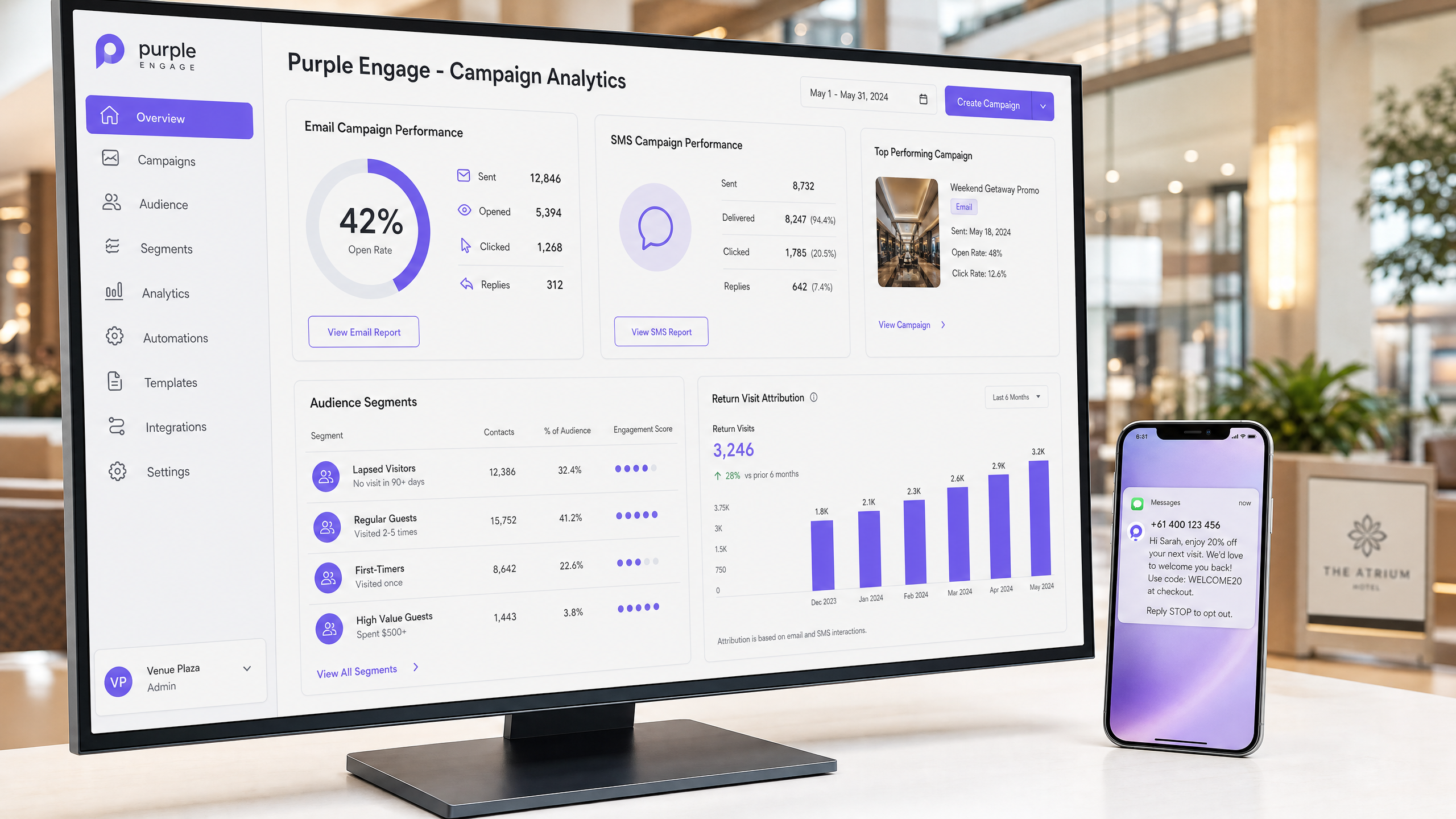
Executive summary
Email and SMS marketing represents the highest-engagement re-engagement channel available to venue operators today. SMS delivers a 98% open rate and 90% of messages are read within three minutes, outperforming email for time-sensitive, return-visit campaigns [Forbes / Infobip 2026 Messaging Trends]. The challenge for IT and marketing teams is acquiring verified, consented phone numbers and email addresses at scale without violating GDPR or TCPA requirements.
This guide details how to build a compliant, high-performing email and SMS marketing architecture using your existing Guest WiFi infrastructure. By deploying Purple's captive portal across hardware from Cisco Meraki, HPE Aruba, Ruckus, Juniper Mist, Ubiquiti UniFi, Cambium, Extreme, or Fortinet, you capture verified first-party data at the point of login. We cover the technical data flow, segmentation strategies in the WiFi Analytics platform, compliance protocols, and specific implementation scenarios for Retail and Hospitality environments.
Listen to our 10-minute technical briefing below.
Technical deep-dive: data capture architecture
The foundation of any email and SMS marketing programme is data quality. A guessed phone number or an outdated email address from a legacy loyalty database yields high bounce rates and damages sender reputation. You need a verified contact detail, attached to a real consent event, with a timestamp and a source you can prove to a regulator.
Guest WiFi solves this structural data problem. When a visitor connects to your network through a captive portal, Purple's Capture plan collects their email address and phone number as part of the login flow. The consent checkbox is displayed inline, the language is GDPR-compliant, and the timestamp is logged automatically. You now have a verified contact tied to a real venue visit.
This matters because contact details collected at the point of WiFi login carry a verification advantage that other channels cannot match. The visitor typed their number to receive a one-time passcode via SMS, or verified their email address to gain internet access. They proved they own the device. That is a quality of data signal that a static web form or a loyalty card sign-up cannot replicate.
The three-layer architecture
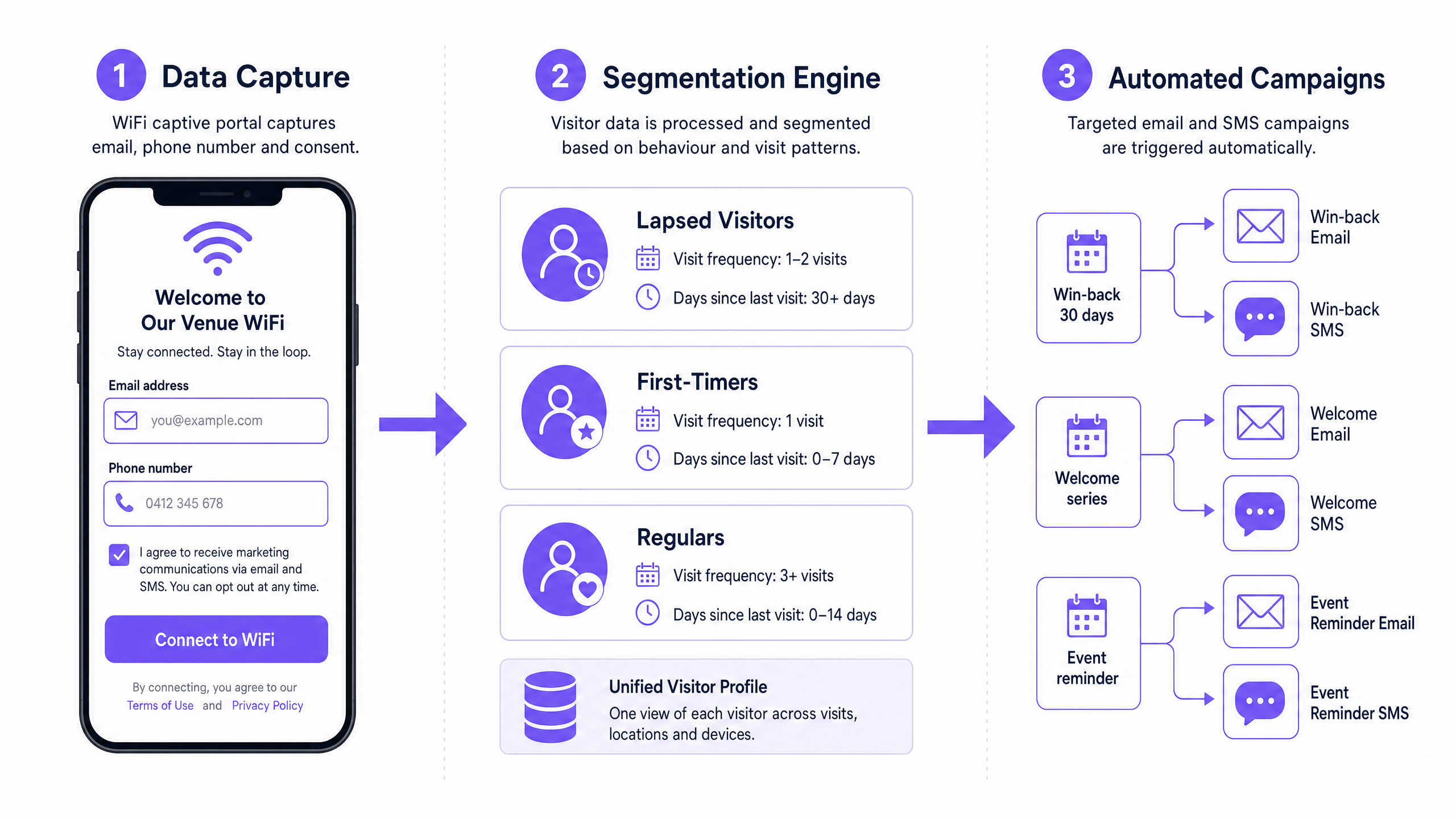
The architecture behind a well-run email and SMS programme at a venue consists of three distinct layers.
Layer 1: Data capture. Purple's captive portal, deployed as a cloud overlay on your existing access points, presents the login screen. The visitor enters their email and phone number and ticks the marketing consent box. Purple logs the consent event with a timestamp, the venue ID, and the visitor's profile. That data flows directly into the Purple Engage platform.
Layer 2: Behavioural segmentation. Purple's analytics engine segments your visitor database by behaviour - visit frequency, time since last visit, visit duration, and venue zone. You can build precise audiences: visitors who came once in the last 90 days and have not returned, or guests who visited three or more times in a quarter and then went quiet. These are your highest-value re-engagement targets.
Layer 3: Campaign automation. Purple Engage fires email and SMS campaigns based on triggers you define. A guest who has not visited in 30 days receives a win-back SMS. A guest who visited last week receives an event reminder email for the following weekend. None of this requires manual intervention once the rules are set.
Channel performance comparison
| Metric | SMS | Source | |
|---|---|---|---|
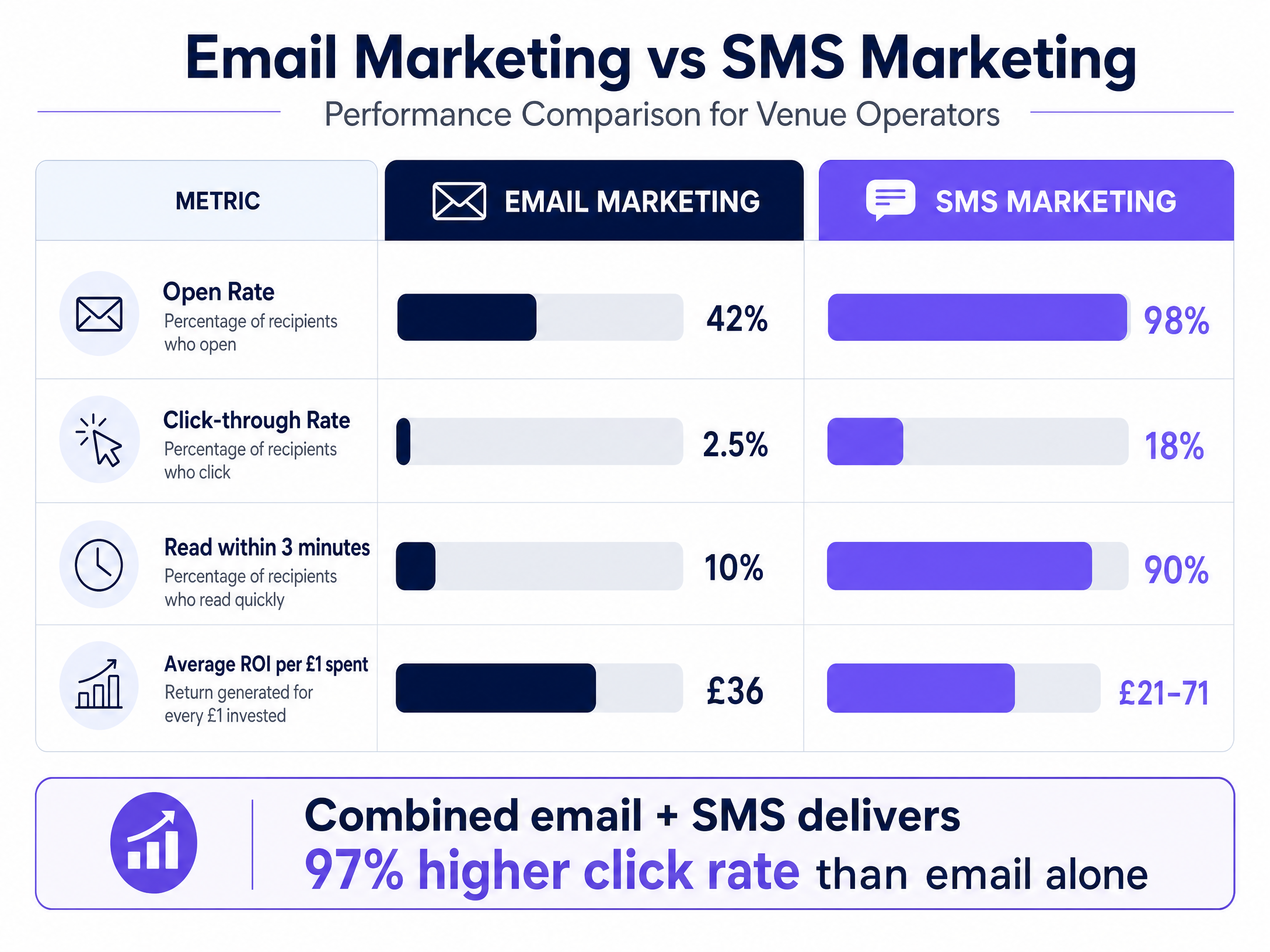
| Open rate | 42% | 98% | Infobip 2026 Messaging Trends |
| Click-through rate | 2.5% | 18% | Klaviyo 2024 SMS Benchmark Report |
| Read within 3 minutes | 10% | 90% | Forbes / Infobip 2026 |
| Average ROI per £1 spent | £36 | £21-71 | Mailchimp / MessageFlow 2026 |
Brands using both SMS and email see a 97% higher click rate than those using email alone [Mailchimp Combined Channel Data]. The two channels are complementary. Use email for rich content, event schedules, and newsletters. Use SMS for urgent, time-sensitive offers and immediate alerts.
Implementation guide
Implementing this architecture requires coordination between IT, marketing, and legal teams. Follow these steps to deploy effectively.
Step 1: Configure the captive portal for compliance
Compliance is non-negotiable. GDPR requires a lawful basis for processing personal data and explicit consent for direct marketing by electronic means. Pre-ticked boxes do not count. Bundled consent buried in terms and conditions does not count.
Purple's captive portal presents a standalone, clearly worded opt-in checkbox for email and SMS marketing, separate from the WiFi access terms. That is a conscious-choice opt-in. The consent record is stored with the visitor profile and is available for audit. Purple is ISO 27001, GDPR, CCPA, and Cyber Essentials certified.
For US venues operating under TCPA, you need prior express written consent for marketing messages, and A2P senders must complete 10DLC registration with US carriers. Purple's platform supports these compliance workflows.
Step 2: Define audience segments
Segment before you send. Sending the same message to your entire database is the fastest way to drive up unsubscribe rates. Use Purple Engage to define these core segments:
- First-Timers: Visitors with exactly one login. Target with welcome emails and introductory offers within 24 hours of first visit.
- Regulars: Visitors with three or more logins in 30 days. Target with loyalty rewards via SMS.
- Lapsed Visitors: Previous regulars who have not logged in for 60 days. Target with win-back offers across both channels.
Step 3: Set up automated triggers
Map your segments to automated campaigns. A standard deployment looks like this:
- Welcome Series (Email): Triggered 24 hours after first login. Introduces the brand and venue amenities.
- Win-Back (SMS): Triggered 45 days after last login for previously frequent visitors. Delivers a time-sensitive discount code.
- Event Reminder (Email + SMS): Scheduled broadcast to visitors who previously attended similar events.
Step 4: Configure return visit attribution
Set up attribution tracking in the Purple analytics dashboard before you send your first campaign. When a visitor who received your win-back message subsequently connects to your WiFi, Purple records that as a confirmed return visit attributed to the campaign. This closes the loop between marketing spend and physical footfall.
For further reading on splash page design and first impressions, see How to make a great first impression with your guest WiFi (and keep your brand consistent) .
Best practices for venue operators
To maximise return visits while protecting your brand, follow these industry-standard practices.
Time your sends correctly
SMS has a 98% open rate, but send time dictates conversion. Sends between 10:00 and 12:00, and between 17:00 and 19:00 on weekdays, consistently outperform other windows across Hospitality and Retail verticals [Klaviyo 2024 SMS Benchmark Report, covering over three billion messages]. Avoid sending after 21:00 or before 08:00. Aside from regulatory quiet hours requirements, it damages your brand perception.
Cap message frequency
No more than four SMS messages per month per subscriber as a starting point. Monitor your unsubscribe rate after each campaign. An unsubscribe rate above 3% on any single send signals that your segmentation or message relevance is off.
Protect your sender reputation
Never buy phone number lists. Purchased lists have no consent trail, they violate GDPR and TCPA, and they will get your sender ID flagged by carriers. Build your list through your own venue touchpoints - WiFi login, loyalty sign-up, event registration - and protect it.
Troubleshooting and risk mitigation
High unsubscribe rates. An unsubscribe rate above 3% on any single send signals that your segmentation or message relevance is off. Investigate the audience criteria and message content before sending again.
Carrier filtering. If SMS delivery rates drop, carriers may be filtering your messages as spam. Ensure you have completed 10DLC registration (for US markets), always include "Reply STOP to opt out", and never use purchased lists.
Incomplete data capture. If visitors bypass the captive portal, you capture no data. Ensure your network architecture requires portal authentication for internet access. For technical network design guidance, see Three SSIDs to rule them all: guest, Passpoint, and IoT WiFi .
MAC address randomisation. Modern smartphones randomise their MAC address to prevent passive tracking. This means you cannot rely on device fingerprinting to identify returning visitors. Authenticated captive portal logins - where the visitor provides their email or phone number - are the correct mechanism for building a persistent visitor profile.
ROI and business impact
The business impact of a properly executed email and SMS marketing strategy is significant. Across Purple's customer base, venues running triggered win-back campaigns see between 15% and 25% return visit uplift compared to non-messaged control groups. Premier Inn and Whitbread properties using Purple Engage have reported measurable increases in repeat booking rates through automated post-stay messaging.
For a retail estate with 50,000 monthly visitors, a 15% uplift in return visits from a lapsed segment translates directly to increased footfall and revenue. By using the existing Guest WiFi infrastructure, the customer acquisition cost is negligible, and the ROI scales with every login.
At a venue doing 500 WiFi logins per day with a 30% opt-in rate, you accumulate 150 new consented contacts daily. In 90 days, that is 13,500 contacts - a viable list for a first campaign.
For specific SMS-focused tactics, see How to leverage lic marketing SMS to increase return visits . For Transport and Healthcare verticals, the same architecture applies with vertical-specific segmentation criteria.
References
- Forbes / Infobip 2026 Messaging Trends Data
- Klaviyo 2024 SMS Benchmark Report (3 billion+ messages analysed)
- Mailchimp Combined Channel Data
- MessageFlow 2026 SMS Marketing Benchmarks
Key Definitions
Captive portal
A web page that a visitor must view and interact with before accessing a public WiFi network. Used to capture contact details and consent at the point of connection.
The primary data collection mechanism for venue operators. Purple's captive portal is deployed as a cloud overlay on hardware from Cisco Meraki, HPE Aruba, Ruckus, and others.
First-party data
Information a company collects directly from its own visitors and owns entirely, rather than purchasing from a third party or inferring from third-party cookies.
Guest WiFi login details are high-quality first-party data. They are verified, consented, and tied to a real physical visit.
Conscious-choice opt-in
A consent mechanism where the user must actively tick an unticked box to agree to marketing communications. Pre-ticked boxes are explicitly invalid under GDPR.
Required for GDPR compliance when collecting email addresses and phone numbers for marketing purposes.
10DLC
10-Digit Long Code. A system used by US telecom carriers to regulate application-to-person (A2P) SMS messaging from businesses to consumers.
Venues operating in the US must register their brand and campaigns via 10DLC to ensure SMS delivery and avoid carrier filtering.
Return visit attribution
The process of linking a physical venue visit - detected via WiFi login - back to a specific marketing campaign the visitor received.
This is the correct ROI metric for venue operators. It proves that a campaign drove actual footfall, not just digital engagement.
Win-back campaign
A targeted marketing effort aimed at re-engaging visitors who have not returned within a defined timeframe, typically 30 to 90 days.
Highly effective via SMS due to the immediate visibility of the offer. Purple Engage automates win-back triggers based on days since last WiFi login.
Cloud overlay
A software platform that integrates with existing hardware infrastructure without requiring physical changes or hardware replacement.
Purple operates as a cloud overlay on access points from Cisco Meraki, HPE Aruba, Ruckus, Juniper Mist, Ubiquiti UniFi, Cambium, Extreme, and Fortinet.
MAC address randomisation
A privacy feature on modern smartphones that changes the device's hardware address to prevent passive tracking across different networks.
Requires venues to rely on authenticated logins - such as captive portals with email or phone number capture - rather than passive device tracking to build persistent visitor profiles.
A2P SMS
Application-to-Person SMS. Messages sent from a software application or platform to a consumer's mobile device, as opposed to person-to-person messaging.
All venue marketing SMS campaigns are A2P. US A2P senders must complete 10DLC registration. UK and EU senders must comply with GDPR consent requirements.
Worked Examples
A 200-room hotel needs to increase repeat bookings from corporate guests who typically stay once a quarter. They currently have Cisco Meraki access points but no marketing automation in place.
Deploy Purple Guest WiFi as a cloud overlay on the existing Cisco Meraki hardware using Purple's hardware-agnostic integration. Configure the captive portal to require email address and phone number, with explicit GDPR-compliant opt-in checkboxes for marketing communications - separate from the WiFi access terms. In Purple Engage, create a 'Corporate Lapsed' segment targeting users who connected to the WiFi between Monday and Thursday (indicating business travel), but have not logged in for 75 days. Configure an automated SMS trigger to send a 15% direct-booking discount code on day 76 at 17:30. Set up a parallel email trigger at day 78 with a richer message including room upgrade details. Configure return visit attribution in the analytics dashboard to track subsequent WiFi logins from the send list.
A stadium operator wants to drive merchandise sales immediately after a match, but their previous email blasts had a 2% open rate during the event window.
Transition the post-match campaign from email to SMS. Use Purple Capture to collect phone numbers during pre-match WiFi login at the stadium. Create a segment in Purple Engage for 'Matchday Attendees' based on active connections during the match window. Schedule an SMS broadcast to fire 15 minutes before the final whistle, offering a 20% discount at the stadium megastore valid for 60 minutes only. Include a direct link to the merchandise page and a clear opt-out instruction. Set up attribution tracking to measure how many recipients visited the megastore WiFi zone after receiving the message.
Practice Questions
Q1. A retail chain wants to launch an SMS campaign using a list of 10,000 phone numbers they purchased from a third-party data broker. They plan to send a generic 10% discount code to the entire list on a Saturday morning. Identify the critical failures in this approach and describe the correct alternative.
Hint: Consider data source compliance, segmentation strategy, and carrier filtering risk.
View model answer
This approach fails on three fronts. First, using a purchased list violates GDPR and TCPA because there is no explicit, verifiable consent from the individuals to receive marketing from this specific brand. Second, sending a generic blast without segmentation will result in high unsubscribe rates and low relevance - a regular visitor needs a different message than someone who has never visited. Third, sending unsolicited bulk SMS to unverified numbers will likely trigger carrier spam filters, blocking the messages and potentially blacklisting the brand's sender ID. The correct approach is to build a first-party list via Guest WiFi logins using Purple Capture, segment the audience based on visit behaviour using Purple Engage, and send targeted, triggered messages to consented subscribers only.
Q2. You manage IT for a conference centre. The marketing team wants to email attendees about upcoming events, but the current WiFi system only captures MAC addresses, not email addresses. How do you resolve this?
Hint: Think about the network authentication method and the data collection mechanism.
View model answer
Deploy a captive portal via Purple as a cloud overlay on the existing wireless infrastructure. Configure the network to require visitors to authenticate through the portal to gain internet access. The portal must include fields for email address and phone number capture, with clear, conscious-choice opt-in checkboxes for marketing communications - separate from the WiFi access terms. This transitions the data collection from passive, anonymous MAC address tracking to active, consented first-party data capture. The consent events are logged with timestamps in Purple Engage, making them auditable for GDPR compliance.
Q3. A venue operator runs a win-back SMS campaign offering a free coffee to guests who have not visited in 30 days. They report that the campaign failed because the link in the SMS only had a 4% click-through rate. Why is this analysis flawed, and how should they measure success?
Hint: What is the actual goal of a venue marketing campaign?
View model answer
The analysis is flawed because it measures digital engagement (link clicks) rather than physical footfall (return visits). A visitor might read the SMS, see the offer for a free coffee, and walk into the venue without ever clicking the link. The correct metric is return visit attribution: using the WiFi analytics platform to track how many devices associated with the SMS send list subsequently connected to the venue's network within a defined attribution window after the message was sent. Purple's analytics platform automates this matching. A 4% click-through rate combined with a 20% return visit rate would indicate a highly successful campaign.
Q4. A hotel group wants to run email and SMS campaigns across 50 properties, each with different WiFi hardware vendors (some Cisco Meraki, some HPE Aruba, some Ruckus). How does Purple's architecture support this?
Hint: Consider Purple's hardware-agnostic cloud overlay model.
View model answer
Purple operates as a hardware-agnostic cloud overlay, which means it integrates with Cisco Meraki, HPE Aruba, and Ruckus access points without requiring hardware replacement or a single-vendor estate. Each property's captive portal feeds visitor data into a unified Purple Engage platform. The marketing team can manage all 50 properties from a single dashboard, build cross-property audience segments, and run centralised campaigns while maintaining property-level attribution. The hotel group captures verified first-party data across the entire estate regardless of the underlying hardware vendor.