
How to leverage examples of SMS marketing to increase return visits
This technical reference guide details how venue operators can implement SMS marketing using Guest WiFi data capture to drive measurable return visits. It covers deployment architecture, GDPR/TCPA compliance frameworks, and practical segmentation strategies for hospitality, retail, and event environments.
Listen to this guide
View podcast transcript
Executive Summary
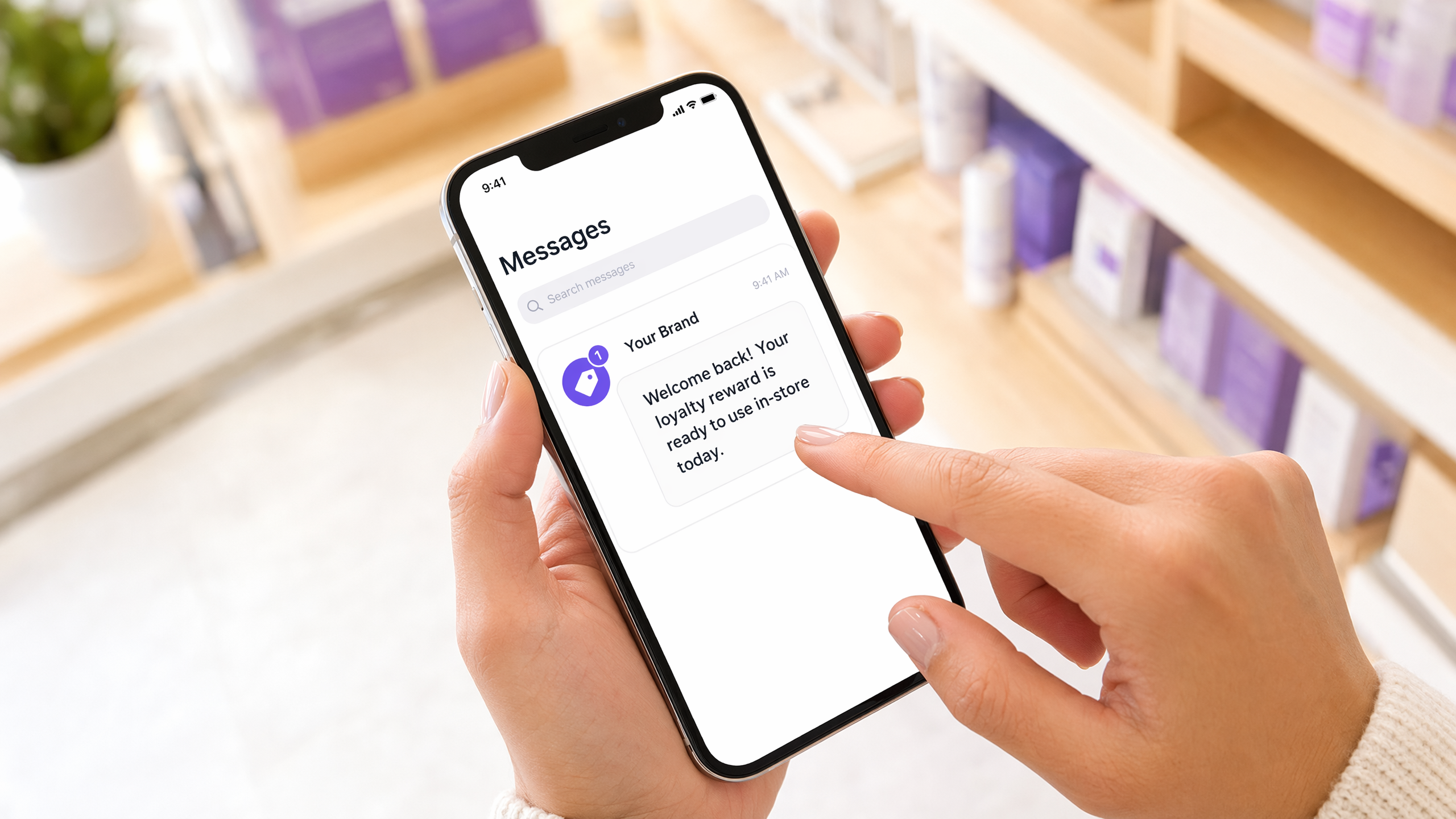
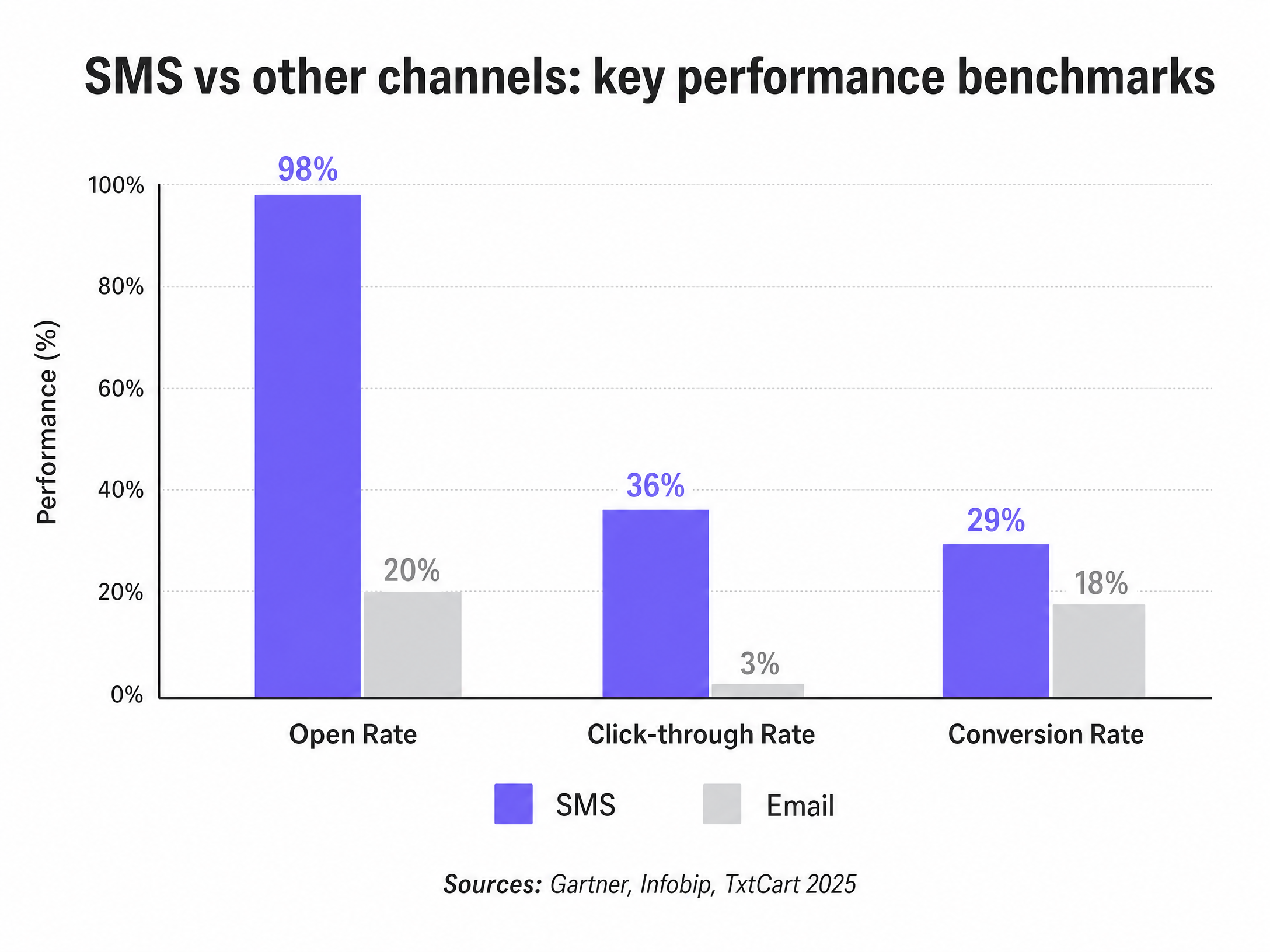
For venue operators managing retail, hospitality, or large-scale event spaces, the challenge of increasing return visits often stalls at the data capture layer. Traditional marketing channels like email average a 20% open rate, meaning 80% of your audience never sees the message. SMS marketing flips this dynamic, achieving a 98% open rate with messages typically read within three minutes of delivery.
However, SMS marketing requires a pristine, consented dataset to function legally and effectively. This guide explains how to leverage Guest WiFi as your primary data capture mechanism, using the captive portal to secure verified phone numbers and explicit marketing consent. We detail the technical architecture required to integrate this data into WiFi Analytics platforms like Purple Engage, and provide practical implementation steps to launch behaviour-triggered SMS campaigns that drive measurable return visits.
Technical Deep-Dive: Architecture and Data Capture
The foundation of any SMS campaign is the quality of the phone number data. Bad data damages sender reputation, triggers carrier filtering, and exposes the venue to regulatory risk. The technical solution is to intercept the guest at a high-intent digital touchpoint: the WiFi login.
The Captive Portal Authentication Flow
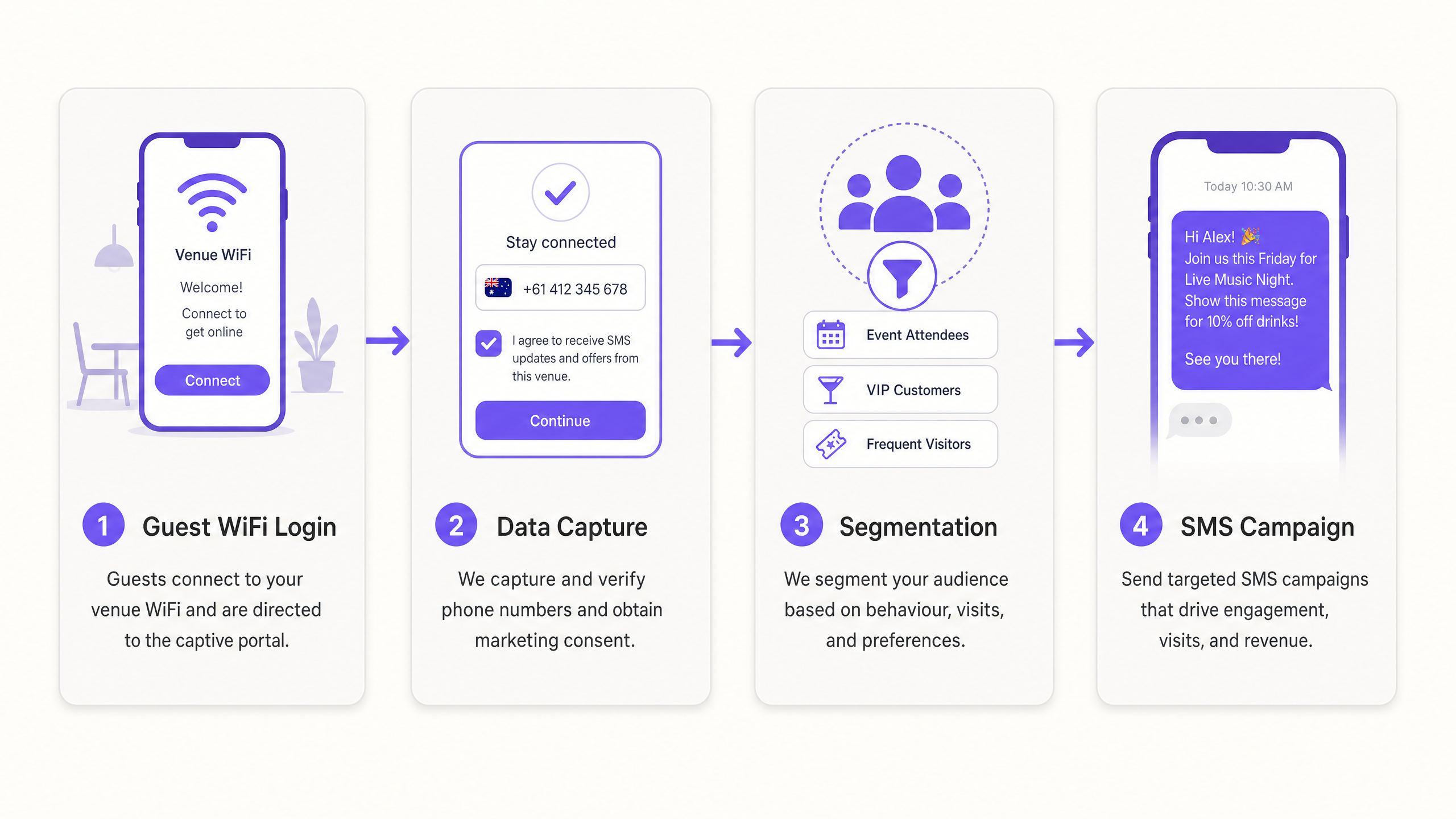
When a visitor attempts to access the venue network, the hardware controller (whether Cisco Meraki, HPE Aruba, Ruckus, or Juniper Mist) intercepts the request and redirects the user to a captive portal. This is where the data exchange occurs.
To build a compliant SMS list, the authentication flow must enforce a double opt-in mechanism:
- Initial Entry: The user inputs their mobile number on the splash page.
- Verification: The system sends a one-time password (OTP) via SMS to verify the number is active and belongs to the user.
- Consent: The user inputs the OTP and explicitly checks a consent box for marketing communications.
This process converts an anonymous MAC address into a verified, first-party data record tied to a specific individual and device.
Cloud Overlay and Data Routing
Purple operates as a cloud overlay, integrating with the venue's existing hardware via RADIUS or native API. Once the guest authenticates, Purple logs the connection event, associating the verified phone number with spatial and temporal data: venue location, entry time, and dwell time.
This data is stored in Purple's ISO 27001 certified environment. From here, Purple Engage acts as the trigger engine, evaluating visitor behaviour against predefined campaign rules. When a condition is met (e.g., "Guest has not visited in 60 days"), the platform pushes the payload via API to the SMS aggregator or directly to a CRM system for dispatch.
Implementation Guide: Building the Campaign
Deploying an SMS marketing programme requires a sequenced approach. Launching campaigns before the data is mature is the most common failure mode.
Step 1: Deploy the Capture Mechanism
Configure your captive portal to prioritise phone number capture over email or social login. The splash page must load in under two seconds on a standard 4G connection. Ensure the consent language is unambiguous and specific to SMS marketing.
Step 2: List Maturation
Allow the system to run for a minimum of 30 days before sending the first campaign. In a typical Retail environment, this builds a statistically significant baseline of verified contacts. Sending campaigns to lists smaller than 500 contacts yields unreliable performance data.
Step 3: Segmentation Logic
Do not use batch-and-blast tactics. Segment your audience using the spatial data captured by the network. Key segmentation vectors include:
- Visit Frequency: Distinguish between first-time visitors, loyal customers, and lapsed visitors.
- Dwell Time: A shopper who spends 45 minutes in a store demonstrates higher intent than one who stays for five minutes.
- Venue Location: Tailor offers to the specific property or region the guest visited.
Step 4: Campaign Execution
A standard win-back campaign for Hospitality targets guests who have not connected to the network in 60 days. The SMS payload should be concise, include a clear call to action, and provide an opt-out mechanism.
> "Hi Sarah, we miss you at Premier Inn Manchester. Book your next stay this weekend and save 15%. Reply STOP to opt out."
Best Practices and Compliance
Regulatory compliance is the primary constraint in SMS marketing. The penalties for violation are severe.
GDPR Framework
Under the General Data Protection Regulation (GDPR), the lawful basis for processing personal data for direct marketing via SMS is explicit consent (Article 7). The captive portal must present an unchecked consent box. Pre-ticked boxes are invalid. The system must log the timestamp of the consent and the specific language displayed to the user. Purple handles this logging natively.
TCPA Framework
For venues operating in the United States, the Telephone Consumer Protection Act (TCPA) requires "prior express written consent" for marketing text messages. The double opt-in verification flow on the captive portal satisfies this requirement by proving the user actively engaged with the system to confirm their number.
Delivery Optimisation
Carrier filtering can block messages that appear to be spam. Avoid using excessive capitalisation, multiple exclamation marks, or trigger words like "FREE" or "WINNER". Maintain a consistent sender ID and enforce frequency caps. A standard best practice is a maximum of two marketing messages per contact per week.
ROI and Business Impact
The business case for SMS marketing is built on conversion rate and return visit attribution.
Industry benchmarks indicate SMS achieves an average conversion rate of 29%, significantly outperforming email at 18%. For a venue operator, a conversion is defined as a return visit.
To measure ROI accurately, establish a control group. Compare the return visit rate of contacts who received the SMS campaign against a cohort of similar visitors who did not. This isolates the impact of the SMS channel from organic return visits. Venues implementing this methodology with Purple have demonstrated substantial ROI, with operators like Avanti West Coast in the Transport sector proving a 463% ROI on their WiFi marketing programmes.
By leveraging verified first-party data captured through the network, venue operators can deploy SMS marketing as a precision tool to increase return visits and drive measurable revenue.
Key Definitions
Captive Portal
A web page that a user of a public access network is obliged to view and interact with before access is granted.
This is the primary touchpoint for capturing guest data and securing marketing consent.
Double Opt-In
A process requiring a user to confirm their subscription to a marketing list, typically by entering a verification code sent to their device.
Essential for verifying phone numbers and establishing a clear audit trail for GDPR and TCPA compliance.
First-Party Data
Information a company collects directly from its customers and owns entirely.
Guest WiFi captures first-party data, reducing reliance on third-party advertising networks and improving targeting accuracy.
Carrier Filtering
The process by which mobile network operators block SMS messages they identify as spam or non-compliant.
Poor data quality or spam-like message content triggers filtering, reducing delivery rates and damaging sender reputation.
Dwell Time
The duration a visitor spends connected to the venue network or detected within the venue premises.
A critical metric for segmentation; longer dwell times indicate higher engagement and inform different SMS campaign strategies.
Control Group
A segment of the target audience that is deliberately excluded from a marketing campaign to serve as a baseline for comparison.
Necessary for accurately measuring the incremental return visits driven specifically by the SMS campaign.
MAC Address
A unique identifier assigned to a network interface controller for use as a network address in communications within a network segment.
The underlying device identifier that Purple associates with a verified phone number to track physical return visits.
RADIUS
Remote Authentication Dial-In User Service; a networking protocol that provides centralised authentication, authorisation, and accounting management.
The standard protocol used by Purple to integrate with enterprise network hardware like Cisco Meraki and HPE Aruba.
Worked Examples
A 150-room hotel wants to increase direct bookings from previous guests. They currently collect email addresses at check-in but see low engagement. How should they implement an SMS strategy to drive return visits?
- Configure the guest WiFi captive portal to require a mobile number and OTP verification for access.
- Include an unchecked marketing consent box on the splash page.
- Allow the system to capture data for 45 days to build a baseline list of verified contacts.
- In Purple Engage, create a segment targeting guests whose last network connection was between 60 and 90 days ago.
- Configure an automated SMS trigger: 'Hi [First Name], book direct for your next stay with us and receive complimentary breakfast. Link: [URL]. Reply STOP to opt out.'
- Measure the return visit rate of this segment against a control group of guests who did not receive the message.
A retail chain with 50 locations wants to drive footfall during slow afternoon periods. How can they use SMS marketing to achieve this?
- Use Purple Analytics to identify customers who frequently visit between 12:00 PM and 4:00 PM.
- Create a segment in Purple Engage for these 'Afternoon Shoppers'.
- Schedule an SMS campaign to send at 11:30 AM on a Tuesday: 'Beat the rush! Show this text in-store today between 12-4pm for 10% off your purchase. Reply STOP to opt out.'
- Track redemptions at the point of sale and cross-reference with WiFi connection data during the target window.
Practice Questions
Q1. Your venue has captured 10,000 email addresses over the past year, but only 400 verified phone numbers. The Marketing Director wants to send an SMS campaign tomorrow to promote a weekend event. What is the recommended course of action?
Hint: Consider the minimum viable list size for statistical significance and the risks of sending to unverified numbers.
View model answer
Advise against sending the campaign tomorrow. A list of 400 numbers is below the recommended threshold of 500 for meaningful statistical analysis. More importantly, you cannot legally or safely send SMS messages to phone numbers appended from an email database without explicit SMS marketing consent. The correct approach is to configure the captive portal to prioritise phone number capture, build the consented list for 30 days, and plan a campaign for the following month.
Q2. A retail client complains that their SMS delivery rates have dropped from 95% to 60% over the last two campaigns. They are sending three messages a week using the copy: 'FREE GIFT! Claim your prize NOW before it's gone!'. Diagnose the issue.
Hint: Evaluate the message content and the sending frequency against carrier filtering rules.
View model answer
The client is experiencing carrier filtering. Mobile network operators are blocking the messages because they exhibit classic spam characteristics: excessive capitalisation ('FREE GIFT!', 'NOW'), trigger words ('prize', 'claim'), and a high sending frequency (three times a week exceeds the recommended maximum of two). The solution is to rewrite the copy to be professional and conversational, remove the spam triggers, and reduce the frequency to one or two targeted messages per week.
Q3. You are deploying Purple across a university campus (Higher Education). The IT Director is concerned about GDPR compliance regarding student data capture on the Guest WiFi network. How do you address this?
Hint: Explain the specific mechanisms within the captive portal flow that satisfy Article 7 of GDPR.
View model answer
Explain that Purple's captive portal flow is built specifically to handle GDPR requirements. The lawful basis for marketing is explicit consent. We address this by presenting a pre-unchecked consent box on the splash page. The student must actively tick the box after verifying their number via OTP. Purple logs the timestamp and the exact consent language shown. Furthermore, if a student requests data deletion, Purple's platform provides the tools to execute this right to erasure across the system.