
How to leverage examples of SMS marketing to increase return visits
This technical reference guide explains how IT and operations leaders can deploy SMS marketing via Guest WiFi to drive measurable return visits. It covers deployment architecture, GDPR/CCPA consent frameworks, and real-world examples from hospitality and retail.
Listen to this guide
View podcast transcript
Executive Summary
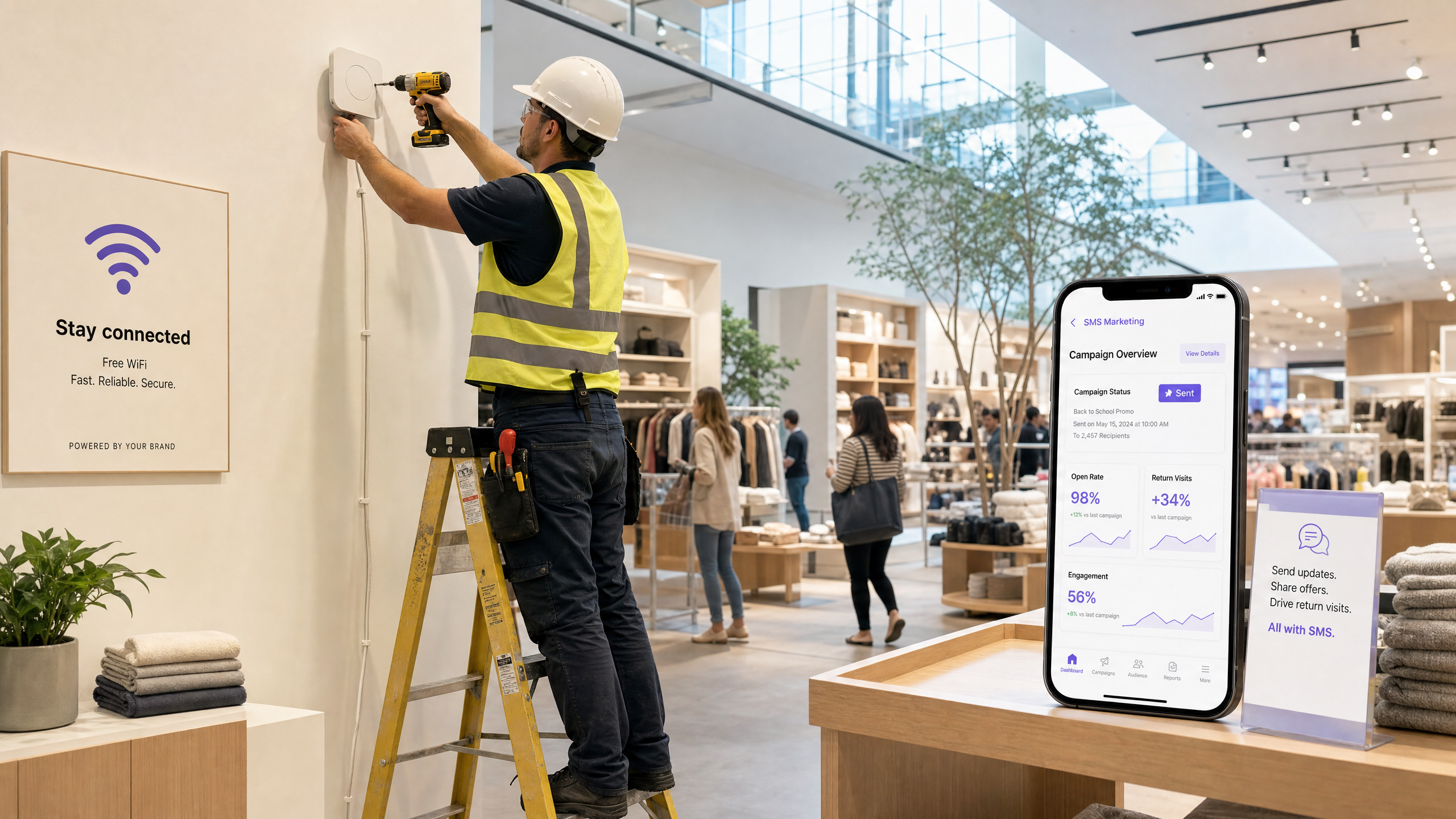
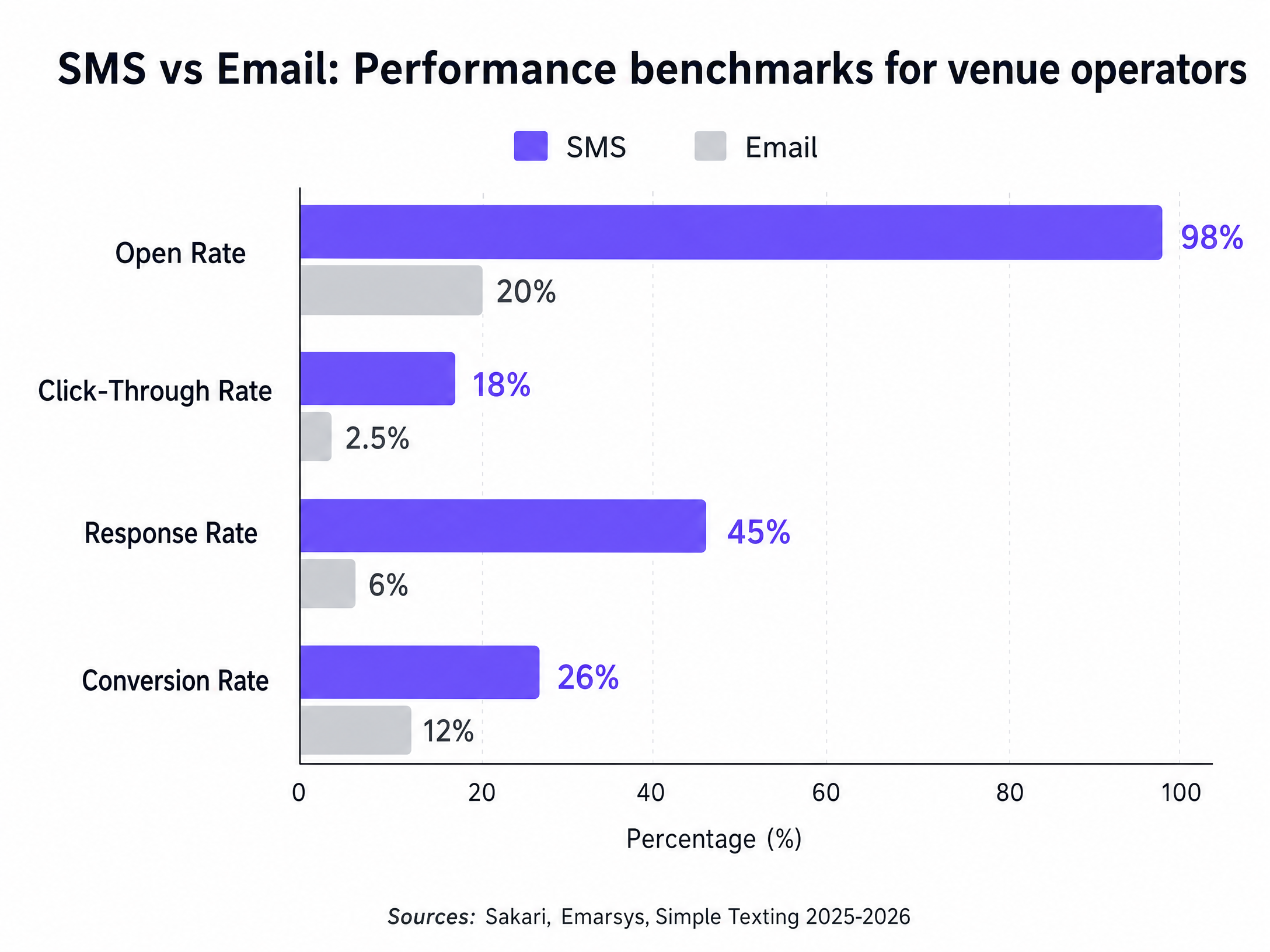
SMS marketing is no longer a tactical add-on; it is a core revenue driver. While email open rates hover around 20%, SMS consistently achieves 98% visibility, with 90% of messages read within three minutes [1]. For venue operators - from hoteliers to stadium directors - the challenge is not whether to use SMS, but how to build a compliant, high-quality subscriber list. Third-party data is expensive and increasingly restricted by privacy regulations. The most effective solution is to capture verified, first-party phone numbers directly through your existing Guest WiFi network. By integrating Guest WiFi with an automated marketing platform like Purple Engage, you can convert physical footfall into a persistent digital connection. This guide details the technical architecture, consent frameworks, and implementation strategies required to deploy SMS automation and drive measurable return visits.
Technical Deep-Dive
The Data Capture Architecture
The foundation of effective SMS marketing is clean data. When a visitor connects to a venue's network, the captive portal serves as the primary data ingestion point. This process operates as a hardware-agnostic cloud overlay, compatible with Cisco Meraki, HPE Aruba, Ruckus, Juniper Mist, Ubiquiti UniFi, Cambium, Extreme, and Fortinet.
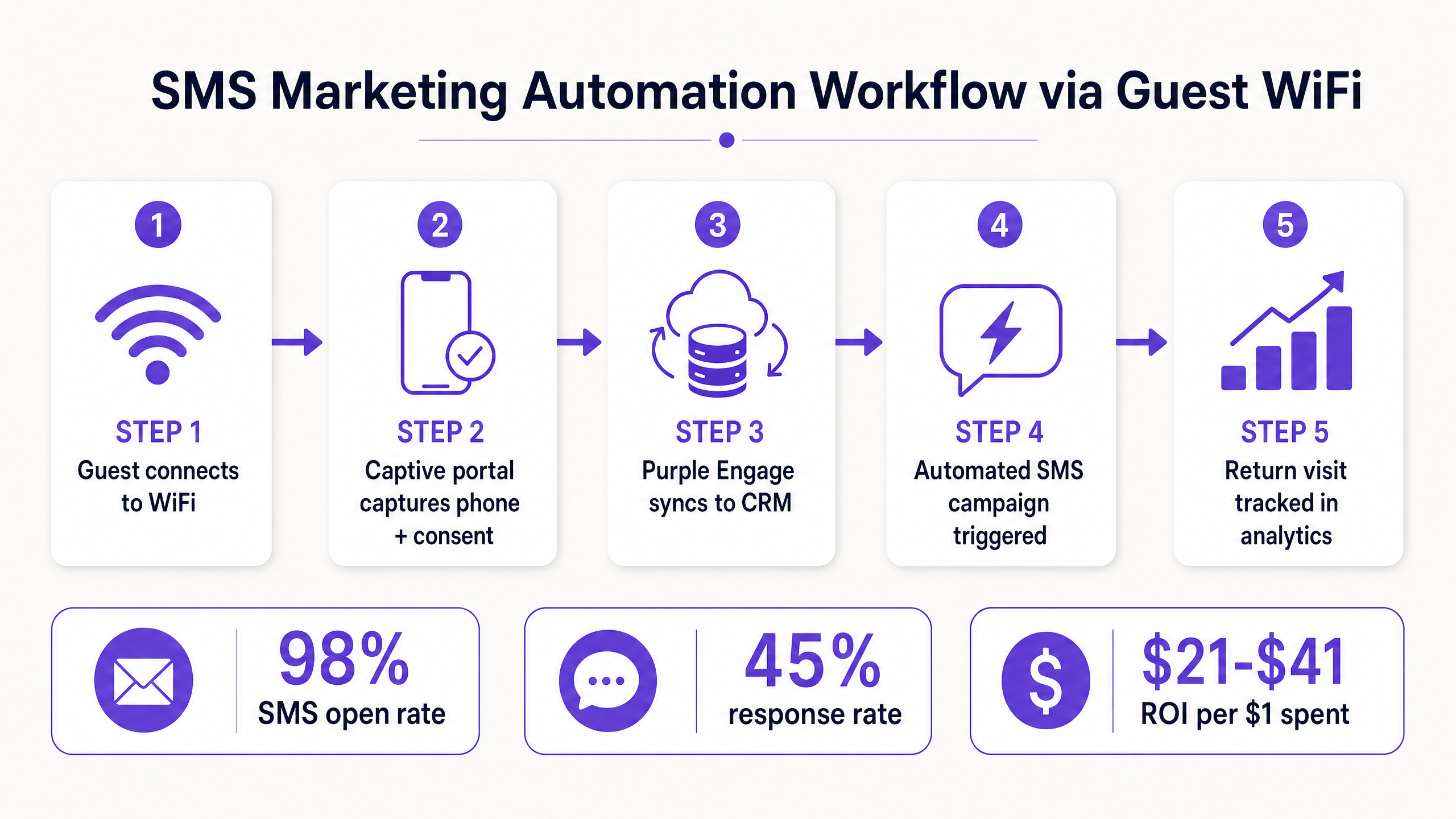
- Authentication: The user selects the Guest WiFi SSID and is redirected to a branded captive portal.
- Data Ingestion: The portal requests a phone number and presents explicit opt-in checkboxes for SMS marketing.
- Identity Resolution: The system verifies the number format and creates a unique customer profile, linking the MAC address to the phone number.
- Data Synchronisation: Purple Engage syncs this identity data to your CRM (e.g., Salesforce, HubSpot) via API.
Consent and Compliance Frameworks
Regulatory compliance (GDPR, CCPA) is non-negotiable. Consent must be explicit, informed, and freely given. The captive portal must present a clear, unchecked box stating the frequency and nature of the SMS messages. Purple records the timestamp, IP address, and exact consent language displayed to the user, creating an auditable trail. Furthermore, every SMS must include a clear opt-out mechanism (e.g., "Reply STOP to cancel"), which automatically updates the central database and ceases future transmissions.
Implementation Guide
Deploying an SMS strategy requires alignment between IT and marketing. Follow these steps to ensure a stable rollout.
1. Configure the Captive Portal
Design the portal to minimise friction while maximising data quality. Do not ask for excessive information. Request the phone number and perhaps a first name. Ensure the SMS opt-in checkbox is highly visible but not pre-ticked.
2. Define the Automation Logic
Avoid batch-and-blast campaigns. Use the WiFi Analytics engine to trigger messages based on physical behaviour:
- Welcome Flow: Triggered 15 minutes after a first-time connection. Example: "Welcome to [Venue]. Show this text for 10% off your first coffee."
- Re-engagement Flow: Triggered after 30 or 60 days of inactivity. Example: "We miss you at [Venue]. Here is a code for your next visit."
- Contextual Offers: Triggered when a user connects at a specific zone within the venue.
3. Set Frequency Caps
Research indicates that 49% of subscribers prefer receiving promotional SMS roughly once every two weeks [2]. Configure your system to cap messages at two per month per user to prevent list fatigue and high opt-out rates.
Best Practices
- Personalisation over Volume: Use the data captured at login to personalise the message. A message addressing the user by name and referencing their specific location performs significantly better than a generic broadcast.
- Clear Value Exchange: Users only provide their phone number if they perceive value. Ensure the WiFi access is fast and reliable, and that the SMS offers are genuinely exclusive.
- Omnichannel Integration: Do not run SMS in isolation. Coordinate SMS with email marketing. Use SMS for urgent, time-sensitive offers and email for longer-form content.
Troubleshooting & Risk Mitigation
High Opt-Out Rates
If your unsubscribe rate exceeds 3%, you are likely sending too many messages or irrelevant content. Review your frequency caps and segment your audience more granularly. Ensure you are not sending promotional messages to staff or contractors by using MAC address filtering or a separate Staff WiFi SSID.
Poor Data Quality
If users are entering fake numbers, your portal may be too demanding. Consider implementing a one-time password (OTP) verification step during login, where the user must enter a code sent via SMS to access the internet. This guarantees 100% verified numbers.
Attribution Failures
If you cannot prove that an SMS caused a return visit, the channel will lose funding. Ensure your marketing platform and WiFi analytics share a common identifier. When a user receives an SMS and subsequently connects to the WiFi within a defined attribution window (e.g., 7 days), the system must log this as a successful conversion.
ROI & Business Impact
SMS marketing requires investment in software and messaging credits, but the returns are highly measurable. A typical deployment sees an ROI of $21 to $41 per dollar spent [2]. Success is measured not just by open rates, but by the measurable increase in physical return visits tracked through the WiFi network. For a Retail environment, a 5% increase in return visit frequency can translate to millions in additional annual revenue. For Hospitality , driving direct repeat bookings via SMS saves significant OTA commission fees.
Listen to the Briefing
For a deeper dive into these strategies, listen to our 10-minute technical briefing podcast below.
References
[1] Validity. "The State of SMS Marketing in 2023." [2] Sakari. "SMS Marketing Statistics: Data-Backed Insights for 2025–2026."
Key Definitions
Captive Portal
A web page that a user is forced to view and interact with before access is granted to a public WiFi network.
This is the primary data ingestion point for venue operators to collect phone numbers and consent.
First-Party Data
Information a company collects directly from its customers and owns entirely.
Crucial for modern marketing as third-party cookies and data brokers face increasing regulatory restrictions.
MAC Address
A unique identifier assigned to a network interface controller for use as a network address in communications within a network segment.
Used by WiFi analytics platforms to identify returning devices and measure physical footfall.
Opt-In Consent
The explicit, affirmative action taken by a user to agree to receive marketing communications.
Required under GDPR and CCPA. Failure to secure this before sending SMS messages carries severe legal and financial penalties.
Attribution Window
The period of time after a marketing message is sent during which a subsequent action (like a return visit) is credited to that message.
IT and marketing must agree on this window (e.g., 7 days or 30 days) to accurately measure SMS ROI.
Hardware-Agnostic
Software that is compatible with various hardware platforms without requiring specific vendor equipment.
Purple's cloud overlay is hardware-agnostic, meaning venues do not need to replace their existing Cisco or Aruba access points to deploy SMS capture.
Click-Through Rate (CTR)
The percentage of individuals viewing a message who click on a specific link contained within it.
While SMS open rates are high, the CTR indicates how compelling the actual offer or call to action is.
Identity Resolution
The process of connecting disparate data points to a single, unified customer profile.
Linking a device's MAC address to a user's phone number allows the venue to track physical behaviour against digital marketing engagement.
Worked Examples
A 200-room hotel needs to increase direct repeat bookings to reduce reliance on online travel agencies (OTAs). They currently collect email addresses at check-in but see low engagement.
- Configure the Guest WiFi captive portal to request a phone number and explicit SMS opt-in.
- Integrate the WiFi platform with the hotel's CRM.
- Set up an automated SMS trigger to fire 3 days after the guest disconnects from the WiFi (indicating checkout).
- The SMS includes a personalised link offering a 15% discount on their next direct booking.
- Track conversions by matching the SMS campaign ID with the returning MAC address on their next visit.
A stadium operations director wants to drive footfall to underperforming food and beverage concessions during half-time.
- Deploy a location-aware captive portal that captures phone numbers when fans connect to the stadium WiFi.
- Create a segment of users connected to access points near the underperforming concessions.
- Five minutes before half-time, trigger a location-specific SMS: 'Beat the queue! Show this text at Kiosk 4 for a pie and pint combo for £8.'
- Monitor redemption rates at the point of sale and correlate with WiFi connection data in that zone.
Practice Questions
Q1. A retail chain wants to start an SMS campaign immediately using a list of 10,000 phone numbers they purchased from a data broker last year. As the IT Director, how do you advise them?
Hint: Consider the regulatory requirements for consent under GDPR and CCPA.
View model answer
You must strongly advise against this. Sending marketing SMS to purchased lists without explicit, first-party opt-in consent violates GDPR and CCPA and risks severe fines. The correct approach is to implement a captive portal on the in-store Guest WiFi to begin building a compliant, first-party database of verified numbers from actual shoppers.
Q2. Your venue has captured 5,000 phone numbers via WiFi over the last month. The marketing team wants to send a weekly SMS blast with general updates. What technical controls should you implement?
Hint: Consider the impact of high-frequency messaging on subscriber retention.
View model answer
You should implement a strict frequency cap in the marketing automation platform, limiting promotional messages to a maximum of two per month per user. Furthermore, you should advise the team to use the WiFi analytics data to segment the audience, ensuring messages are triggered by behaviour (e.g., a welcome message for new visitors) rather than sending generic weekly blasts to the entire list.
Q3. After deploying an SMS campaign offering a free coffee, the marketing team reports they cannot prove it drove any return visits, despite high open rates. What architectural component is missing?
Hint: How does the system know when a specific person has physically returned to the venue?
View model answer
The system lacks the attribution loop linking the SMS platform to the WiFi analytics platform. To fix this, you must ensure that the user's MAC address (captured at the initial WiFi login) is tied to their phone number in the central CRM. When the device connects to the network again, the analytics platform can log the return visit and attribute it to the recent SMS campaign.