
How to leverage Klaviyo SMS marketing to increase return visits
This guide details how venue operators and IT teams can use Purple Engage to capture verified phone numbers and explicit SMS consent at the guest WiFi login, then integrate that first-party data with Klaviyo to automate high-conversion SMS flows. It covers the full architecture from network hardware configuration through to Klaviyo flow design, compliance requirements, and measurable return-visit outcomes across hospitality, retail, and events environments.
Listen to this guide
View podcast transcript
Executive summary
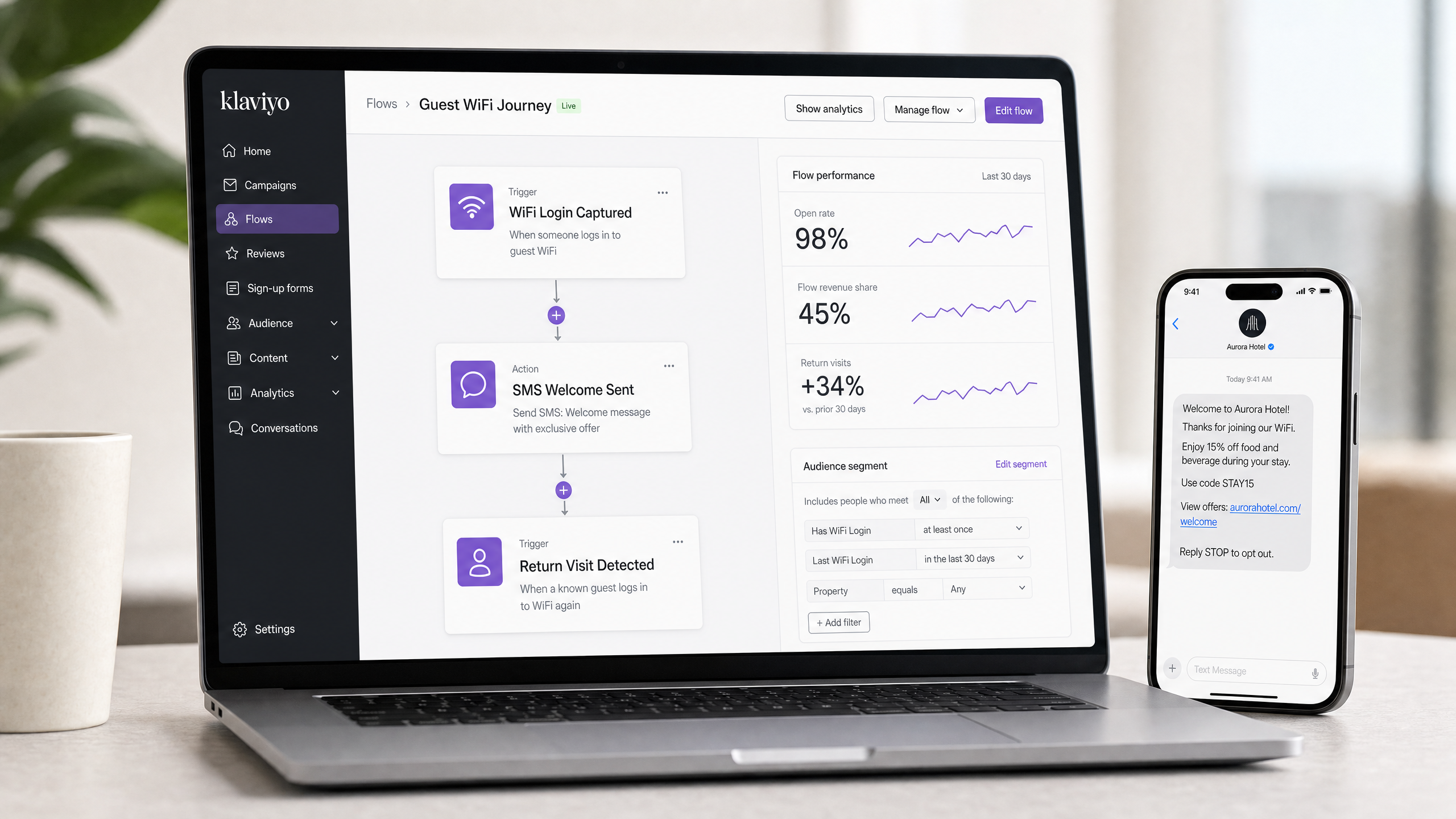
Venue operators face a persistent challenge: converting anonymous foot traffic into known, returning visitors. Email marketing yields open rates of around 20%, limiting its impact on immediate re-engagement. SMS marketing delivers a 98% open rate and drives rapid action [Infobip, 2026]. The technical barrier has historically been capturing verified phone numbers and explicit consent at scale without adding friction to the venue experience.
Purple Engage solves this by transforming the Guest WiFi login into a compliant data-capture mechanism. By integrating Purple Engage with Klaviyo via API webhooks, IT and marketing teams can automate SMS flows triggered by physical venue presence. This guide details the architecture, implementation steps, and business impact of deploying a Klaviyo SMS marketing strategy to increase return visits across hospitality , retail , and public-sector environments. We operate across 80,000+ live venues and have processed 440 million logins in 2024, giving us a clear view of what works at scale.
Technical deep-dive
The integration between Purple Engage and Klaviyo relies on a secure, automated data pipeline. When a visitor connects to the venue WiFi, the Captive Portal prompts them for authentication. This is where the initial data exchange occurs, and where the quality of your downstream SMS programme is determined.
Data capture and consent architecture
The Captive Portal serves as the primary data collection point. Visitors authenticate using their phone number or a social login method. During this process, Purple Engage presents clear, GDPR-compliant and CCPA-compliant opt-in tickboxes for SMS marketing. This ensures explicit consent is recorded alongside the verified phone number - a conscious-choice opt-in, not a pre-ticked box.
Purple Engage acts as the central profile enrichment engine. It aggregates demographic data, dwell time, visit frequency, and location data. This enriched profile is then synchronised with Klaviyo using the Purple Connectors library, which supports over 400 integrations. The integration uses RESTful APIs and webhooks to pass data in real-time, ensuring Klaviyo always has the most current venue presence data.
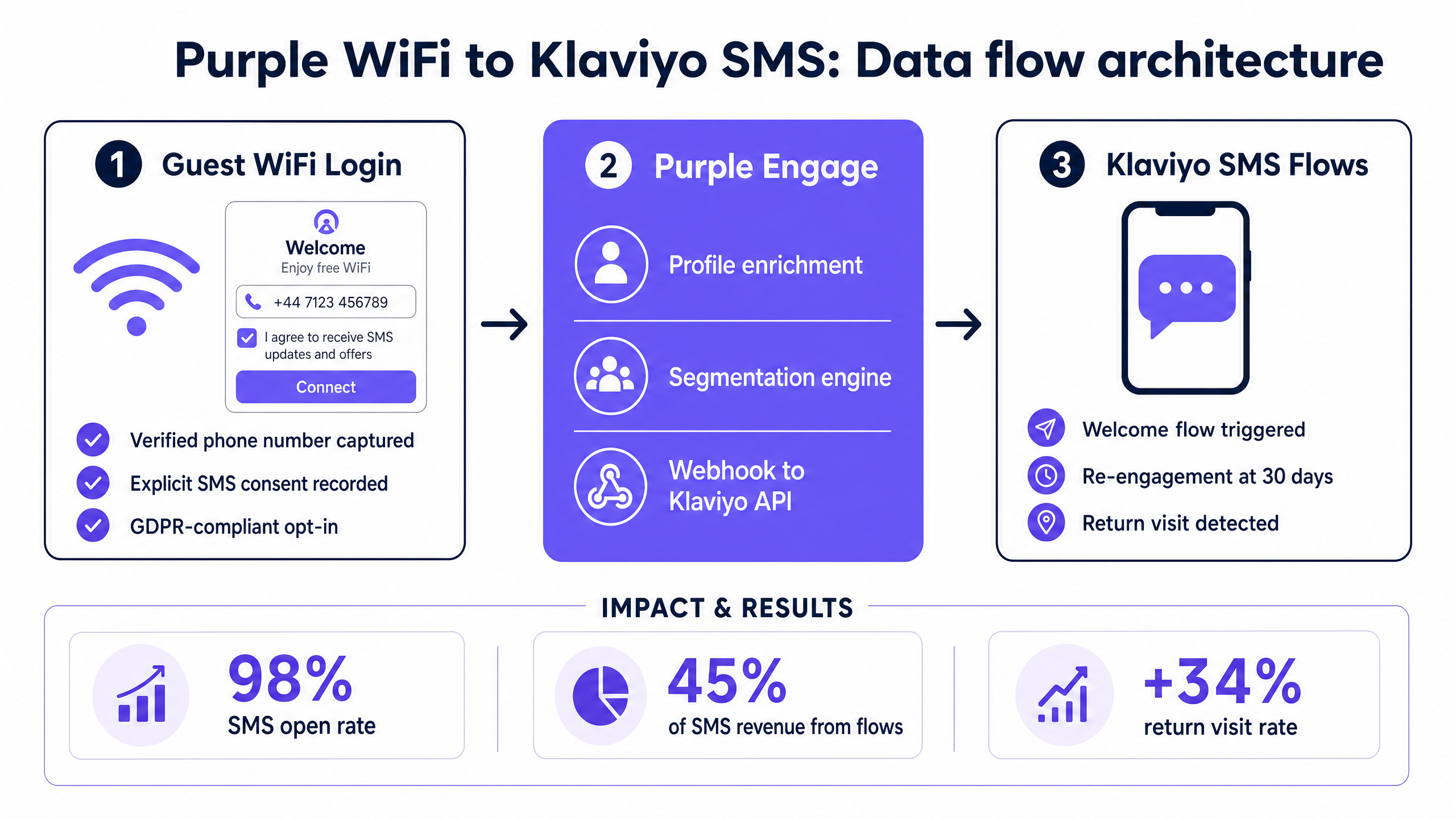
The data model that flows from Purple to Klaviyo includes the following key fields:
| Purple field | Klaviyo property | SMS use case |
|---|---|---|
| Phone number (verified) | Phone number | Primary send address |
| SMS consent status | SMS consent | Compliance gate |
| First visit date | Custom property | Welcome flow trigger |
| Last visit date | Custom property | Lapsed visit trigger |
| Total visit count | Custom property | Loyalty tier segmentation |
| Average dwell time | Custom property | Engagement scoring |
| Venue location | Custom property | Location-specific offers |
Triggering Klaviyo flows
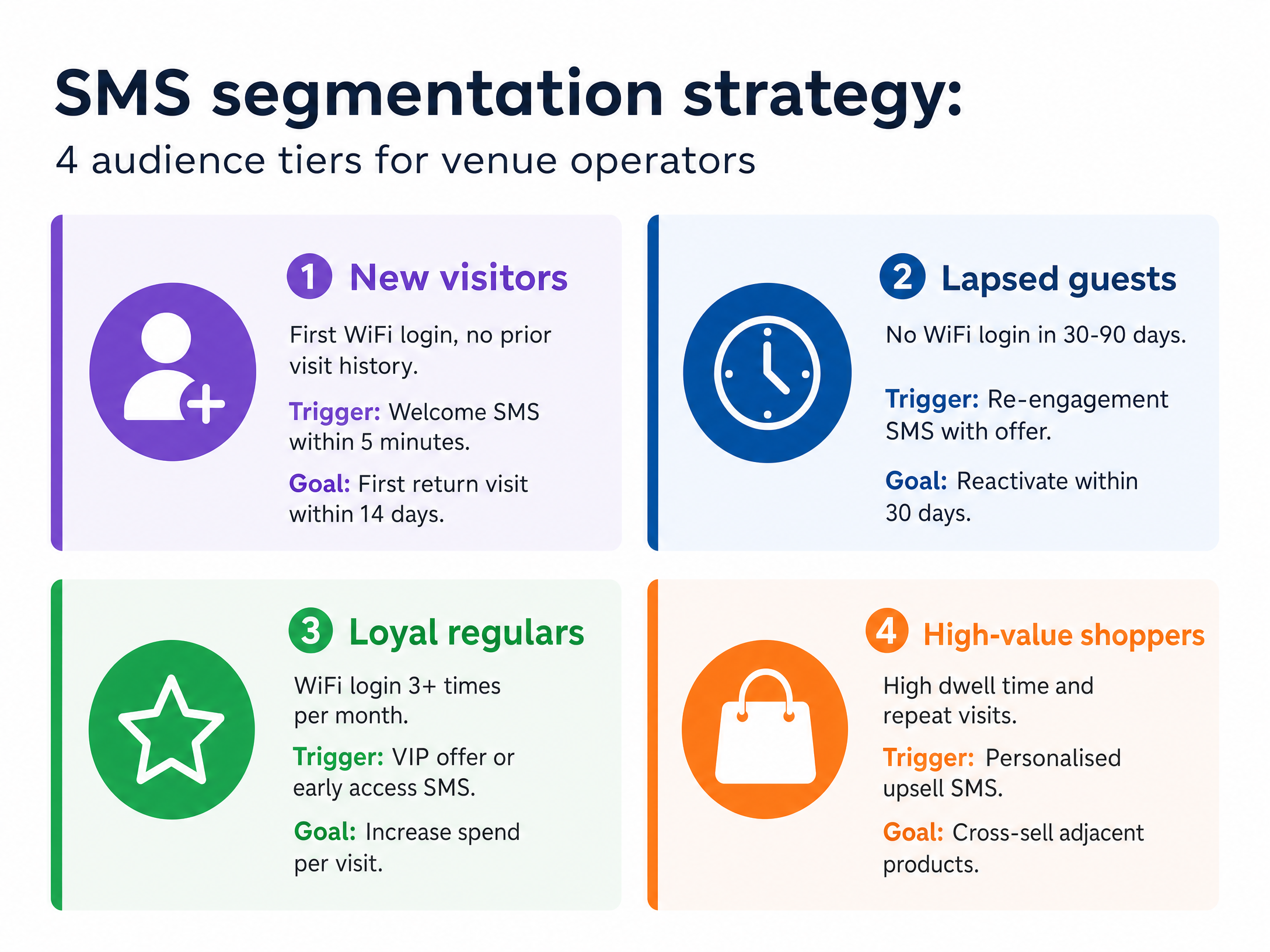
Klaviyo uses this real-time data to trigger specific SMS flows. The architecture supports several key triggers based on venue behaviour. A first login triggers a welcome SMS with an immediate incentive to encourage a second visit. A return visit triggers a loyalty acknowledgement or VIP offer when a known device connects to the network. A lapsed visit triggers a re-engagement SMS when a device has not connected for a specified period, typically 30 days.
These flows account for just 7.6% of total SMS sends but drive 45.2% of total SMS revenue, demonstrating the power of intent-based, real-time messaging [Klaviyo SMS Benchmarks, 2026].
Flow-based SMS messages achieve click rates nearing 10% on average, almost double campaign performance, while top performers exceed 16% [Klaviyo SMS Benchmarks, 2026]. This is the core argument for building an architecture around automated flows rather than broadcast campaigns.
Implementation guide
Deploying this architecture requires coordination between IT and marketing teams. The process involves configuring the network hardware, setting up the Purple captive portal, and building the automated flows in Klaviyo.
Step 1: Network configuration
Ensure your enterprise hardware is configured to route guest traffic through the Purple cloud overlay. Purple supports Cisco Meraki, HPE Aruba, Ruckus, Juniper Mist, Ubiquiti UniFi, Cambium, Extreme, and Fortinet. This hardware-agnostic approach means you do not need to replace existing infrastructure.
Configure the RADIUS servers to point to Purple's infrastructure. This allows Purple to manage authentication and apply bandwidth controls while capturing the necessary device MAC addresses and user data. For venues already running 802.1X authentication on staff networks, the guest SSID should be kept separate - see our guide on three SSIDs to rule them all: guest, Passpoint, and IoT WiFi for the recommended network architecture.
Step 2: Captive portal setup
In the Purple portal, design a branded splash page. The critical technical requirement here is configuring the authentication methods to require a phone number and including the explicit SMS opt-in checkbox. Purple supports splash pages in over 25 languages, which matters for international venues.
Do not use pre-checked boxes; consent must be a conscious choice to comply with GDPR and CCPA. Link directly to your privacy policy, explicitly stating how phone numbers will be used for SMS marketing. The splash page is also your first brand impression - read our guide on how to make a great first impression with your guest WiFi for design best practices.
Step 3: Klaviyo integration
Navigate to the Connectors library in the Purple portal and select Klaviyo. Authenticate using your Klaviyo private API key. Map the data fields between Purple and Klaviyo, ensuring that phone numbers, consent status, and visit metrics sync correctly. Test the connection by logging into the WiFi on a test device and confirming the profile appears in Klaviyo within 60 seconds.
Step 4: Building SMS flows in Klaviyo
Within Klaviyo, build the automated flows based on the synced data. Start with a Welcome Flow triggered by the 'First WiFi Login' metric. Ensure every SMS message includes your brand name, a clear call to action, and mandatory STOP instructions for opting out.
For the Lapsed Visit Flow, set the trigger to fire when 'Last WiFi Login' exceeds 30 days and 'SMS Consent' is true. For the Return Visit Flow, trigger on any subsequent 'WiFi Login' event where 'Total Visits' is greater than one.
Best practices
To maximise the effectiveness of this integration, adhere to these technical and strategic best practices.
Double opt-in. Implement a double opt-in process. When a user connects to the WiFi and provides their number, Klaviyo should immediately send a confirmation text requiring a 'YES' reply. This verifies the number and solidifies consent. Klaviyo's Smart Opt-in feature handles this automatically.
Flow prioritisation. Focus on automated flows rather than bulk campaigns. Flow-based SMS messages achieve click rates nearing 10% on average, almost double campaign performance [Klaviyo SMS Benchmarks, 2026]. The top 10% of SMS flows achieve revenue per recipient above $5, proving that segmentation and personalised content outperform high send volume [Klaviyo SMS Benchmarks, 2026].
Quiet hours. Configure Klaviyo to respect quiet hours. Do not send SMS messages late at night or early in the morning, regardless of when the network trigger occurred. Klaviyo's quiet hours setting applies globally to all flows.
Data minimisation. Only collect the data necessary for the SMS strategy. Avoid adding unnecessary fields to the captive portal, which increases friction and reduces login completion rates. Every additional field on the splash page reduces conversion.
Frequency capping. Set a maximum send frequency per profile. Sending more than four SMS messages per month to the same person risks elevated unsubscribe rates. Klaviyo's frequency capping applies across all flows and campaigns simultaneously.
Troubleshooting and risk mitigation
Deploying SMS automation tied to physical presence introduces specific technical risks. Address these proactively to ensure system stability.
MAC address randomisation
Modern smartphones use MAC address randomisation to protect privacy. This can cause a single returning visitor to appear as multiple new visitors. Purple mitigates this by linking the authenticated phone number or email to the new MAC address upon subsequent logins. Ensure your captive portal requires authentication for returning devices if the MAC address has changed. Without this, your 'Total Visits' metric will be inaccurate and your Return Visit flows will not fire correctly.
API rate limiting
High-traffic venues, such as stadiums or transport hubs, can generate massive spikes in concurrent logins. This can trigger API rate limits when syncing data to Klaviyo. Purple's infrastructure queues these webhooks to manage the flow of data, but IT teams should monitor API usage during peak events to ensure no data is dropped. For venues expecting more than 10,000 concurrent logins, contact Purple's technical team to review your webhook configuration before the event.
Compliance failures
Failing to record explicit consent or honour opt-out requests carries severe financial penalties under GDPR and CCPA. The integration between Purple and Klaviyo automatically syncs opt-out status. If a user replies 'STOP' to a Klaviyo SMS, Klaviyo updates the profile, and Purple respects this status on subsequent logins. Test this flow end-to-end before going live. Purple is ISO 27001, GDPR, CCPA, and Cyber Essentials certified, providing a documented compliance baseline.
Flow trigger failures
If a flow is not triggering, the most common cause is a misconfigured webhook. Confirm that the Purple connector is set to push an event to Klaviyo on every login, not just the first. Check the Klaviyo activity feed for the test profile to confirm events are arriving. If events appear in Klaviyo but the flow does not trigger, check the flow filter conditions against the actual property values on the profile.
ROI and business impact
The primary business impact of this architecture is the measurable increase in return visits. By shifting from broad email campaigns to highly targeted, location-triggered SMS flows, venues see immediate results.
86% of consumers made two or more purchases in the last year resulting from SMS messages, up from 55% in 2022 [Klaviyo Consumer SMS Report, 2024]. SMS flows generate approximately eight times higher revenue per recipient than standard campaigns [Klaviyo SMS Benchmarks, 2026].
Avanti West Coast, a Purple customer, achieved 3,744 purchases and a 463% ROI by actively promoting upsells throughout the WiFi journey. Harrods drove over 4,400 sign-ups through Guest WiFi alone by integrating Purple with their loyalty scheme. McDonald's Belgium collected over 2.5 million unique visitor records using Purple to improve their customer experience and drive digital transformation.
For a retail venue capturing 1,000 verified phone numbers per month and converting 15% of those into return visits via an automated SMS flow, the return on the WiFi infrastructure investment is measurable within the first quarter. The WiFi Analytics dashboard in Purple Engage tracks return visit rates directly, giving you the data to report on programme performance.
For a deeper look at how SMS fits into a broader re-engagement strategy, see our related guide: How to leverage SMS marketing services to increase return visits .
References
[Klaviyo SMS Benchmarks, 2026] https://www.klaviyo.com/products/sms-marketing/benchmarks
[Klaviyo Consumer SMS Report, 2024] https://www.klaviyo.com/blog/sms-marketing-strategies
[Infobip, 2026] https://www.infobip.com/blog/sms-marketing-statistics
Key Definitions
Captive portal
A web page that a user of a public-access network is required to view and interact with before network access is granted. Purple uses the captive portal to capture data and consent at the point of WiFi login.
The primary interface where venues convert anonymous devices into known customer profiles. The design and copy of the captive portal directly determines opt-in rates.
MAC address randomisation
A privacy feature in modern iOS and Android devices that generates a temporary, randomised hardware address when scanning for or connecting to WiFi networks.
IT teams must account for this by relying on authenticated user profiles (phone number or email) rather than static device MAC addresses to track return visits and prevent duplicate profiles.
Webhook
A method of sending real-time data from one application to another via an HTTP POST request, triggered by a specific event. Purple uses webhooks to notify Klaviyo when a guest connects to the WiFi.
The technical mechanism that ensures Klaviyo knows exactly when a guest connects to the venue WiFi, enabling real-time flow triggers.
Double opt-in
A two-step consent process where a user signs up for a communication list and then confirms their subscription by replying to an initial message, typically with 'YES'.
The gold standard for SMS compliance. It verifies the phone number is valid and active, and provides a second, unambiguous record of consent.
First-party data
Information a company collects directly from its own customers or visitors, with their knowledge and consent. In this context, the verified phone numbers and visit history collected via Purple Engage.
Highly valuable because the venue owns it outright, it is accurate (verified at login), and it does not depend on third-party advertising networks or cookies.
Dwell time
The duration a device remains connected to or visible on the venue's WiFi network, used as a proxy for how long a visitor spends in the venue.
A key metric used to trigger time-sensitive SMS flows, such as sending a restaurant offer after a guest has been in the hotel for two hours.
API rate limiting
A control mechanism that restricts the number of API requests an application can make within a given time window, preventing server overload.
A technical constraint IT teams must monitor when thousands of guests log in simultaneously during large events. Purple queues webhooks natively, but high-volume venues should review configuration before peak events.
Cloud overlay
A software-defined layer that sits on top of existing physical network infrastructure, providing additional management, analytics, and marketing capabilities without requiring hardware replacement.
Purple operates as a cloud overlay, which is why it supports Cisco Meraki, HPE Aruba, Ruckus, Juniper Mist, Ubiquiti UniFi, Cambium, Extreme, and Fortinet without requiring a forklift upgrade.
Conscious-choice opt-in
An opt-in mechanism where the user must actively select a checkbox or confirm their consent, as opposed to a pre-checked box that requires the user to opt out.
Required by GDPR for marketing communications. Purple's captive portal enforces this by design.
Klaviyo flow
An automated sequence of messages in Klaviyo triggered by a specific event or condition, such as a first purchase, a profile property change, or a custom metric like a WiFi login.
The core mechanism for delivering timely, contextual SMS messages based on venue presence data. Flows outperform broadcast campaigns by approximately 8x on revenue per recipient.
Worked Examples
A 200-room hotel wants to increase food and beverage revenue from guests who have already checked in. They have Cisco Meraki hardware and want to use SMS to drive traffic to the hotel restaurant during the evening service.
Configure the Meraki hardware to route guest traffic to the Purple captive portal. Design the splash page to capture phone numbers and explicit SMS consent during the initial login. Integrate Purple Engage with Klaviyo via the Connectors library, mapping the 'First WiFi Login' event and 'Dwell Time' metric. In Klaviyo, build a 'Dwell Time' flow with the following logic: Trigger - Guest connects to WiFi. Delay - 2 hours. Condition - Time is between 17:00 and 20:00 local time. Action - Send SMS: 'Hi [first name], enjoy 15% off dinner at [Restaurant Name] tonight. Show this text at the bar. Reply STOP to opt out.' Set a frequency cap of one message per stay to avoid repetition for multi-night guests.
A regional shopping centre wants to reactivate shoppers who have not visited in the last 60 days. They use HPE Aruba access points and have been collecting WiFi logins for six months.
Verify that the Aruba APs are routing guest traffic through Purple Engage and that the captive portal is collecting SMS opt-ins with explicit consent. In Klaviyo, create a segment titled 'Lapsed Shoppers' with the criteria: 'Last WiFi Login date' is more than 60 days ago AND 'SMS Consent' equals true. Create a campaign targeting this segment with a specific incentive, such as a code for free parking or a 10% discount at a named anchor store. Schedule the campaign for a Tuesday or Wednesday morning, when retail foot traffic is typically lower and the offer has more impact. After the campaign, monitor the segment size to see how many lapsed shoppers return within 14 days, and track the reduction in the 60-day lapsed segment over subsequent months.
A stadium operator wants to build a post-match re-engagement programme for fans who attended a game. They have Ruckus access points and want to drive ticket sales for the next home fixture.
Configure Ruckus APs to route through Purple Engage. After each match, Purple will have a record of every fan who connected to the stadium WiFi, along with their verified phone number and SMS consent status. In Klaviyo, build a 'Post-Event' flow triggered by the 'WiFi Login' event with the venue tag matching the stadium. Set a delay of 48 hours post-event. Send an SMS: 'Thanks for coming to [Match Name]. Early bird tickets for [Next Match] are now on sale - save 10% until [Date]. [Link]. Reply STOP to opt out.' Segment the audience by visit frequency: fans who have attended three or more games in the season receive a different message with a loyalty reward.
Practice Questions
Q1. Your retail venue captures 5,000 WiFi logins a week, but your Klaviyo SMS welcome flow is only triggering for 200 people. The webhook is confirmed as working and profiles are appearing in Klaviyo. What is the most likely technical failure point?
Hint: Consider the difference between a WiFi login and explicit SMS consent.
View model answer
The most likely issue is the opt-in rate on the captive portal, not the technical integration. While 5,000 people are logging in, only 200 are providing their phone number and checking the SMS consent box. This is a splash page design problem. Review the captive portal UI to ensure the value proposition for opting in is clear, the phone number field is prominent, and the consent checkbox is visible. Test different incentive copy. The technical integration is working correctly; the conversion rate on the portal is the constraint.
Q2. A stadium IT director wants to send an SMS to all fans at half-time offering a merchandise discount. They plan to use a Klaviyo broadcast campaign targeting everyone who logged into the stadium WiFi in the last three hours. Why is this approach risky, and what is the better architectural solution?
Hint: Think about network capacity, API limits, and message relevance.
View model answer
Sending a bulk campaign to 50,000 fans simultaneously creates three risks. First, the local cellular network may be overwhelmed, causing messages to arrive late or not at all - defeating the purpose of a half-time offer. Second, syncing 50,000 concurrent WiFi logins to Klaviyo in real-time may hit API rate limits, causing data loss. Third, a bulk campaign feels impersonal compared to a triggered flow. The better solution is an automated flow triggered by individual dwell time: fire the SMS 45 minutes after each fan's login. This staggers delivery naturally, reduces network load, and the message arrives at a personally relevant moment for each fan rather than at a single broadcast moment.
Q3. A hotel has deployed the Purple-Klaviyo integration and built a Return Visit flow. The welcome flow fires correctly for new guests, but the return visit flow never triggers, even for guests who have stayed multiple times. What is the most likely configuration error?
Hint: How does Klaviyo know a guest has returned to the venue?
View model answer
The webhook or data sync between Purple and Klaviyo is likely configured to push an event only during the initial captive portal registration, not on every subsequent login. Purple must be set to push a 'WiFi Login' event to Klaviyo every time a device reconnects, including seamless MAC authentication on return visits. Check the Purple connector settings to confirm that repeat login events are being sent. Then check the Klaviyo activity feed for a known returning guest profile to confirm the events are arriving. If events are not appearing, the connector is the problem. If events are appearing but the flow is not triggering, check the flow filter conditions against the actual property values on the profile.
Q4. You are advising a multi-site retail chain with 50 stores across the UK. They want to use Purple and Klaviyo to send location-specific SMS offers. A guest who shops at the Manchester store should receive Manchester-specific offers, not London ones. How do you architect this?
Hint: Consider how venue location data flows from Purple to Klaviyo.
View model answer
Configure Purple to pass the venue location as a custom property in the Klaviyo profile update webhook. Map the Purple 'Venue Name' or 'Venue ID' field to a Klaviyo custom property called 'Last Store Visited'. In Klaviyo, build a single Return Visit flow with conditional splits based on the 'Last Store Visited' property. Each branch sends a store-specific SMS with the relevant offer and store details. Alternatively, use Klaviyo's dynamic content blocks within a single SMS template, populating the store name and offer from the profile property. This avoids maintaining 50 separate flows and ensures the architecture scales as new stores are added.