
How to leverage SMS marketing program to increase return visits
This guide details how venue operators can deploy an SMS marketing program using existing Guest WiFi infrastructure to drive measurable return visits. It covers data capture architecture, GDPR-compliant consent flows, segmentation strategy, and integration with Purple Engage. Marketing directors, CRM managers, and retail venue operators will find actionable implementation steps and clear ROI frameworks.
Listen to this guide
View podcast transcript

Executive summary
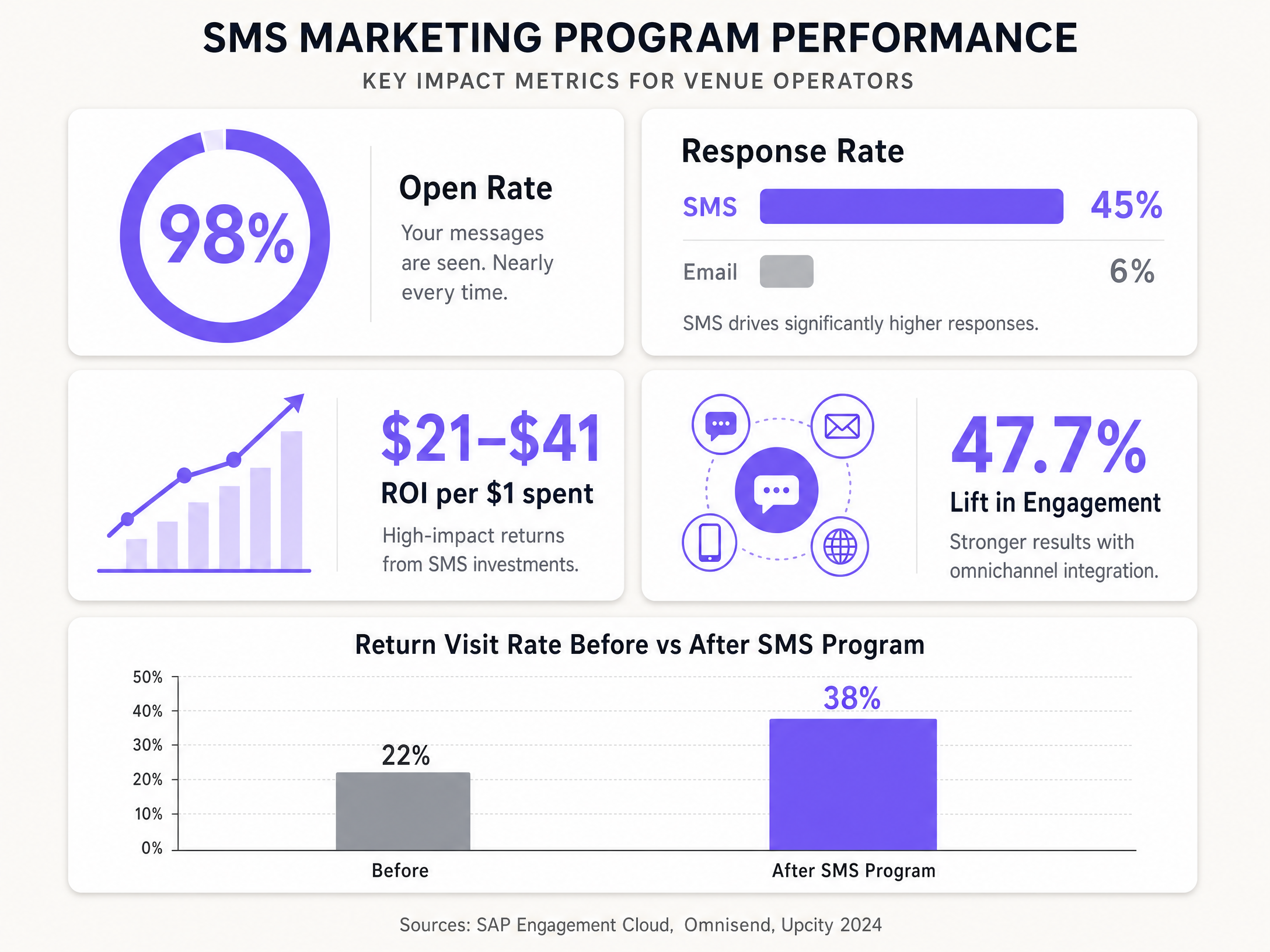
SMS marketing delivers a 98% open rate and a 45% response rate, outperforming email by a factor of seven [SAP Engagement Cloud, 2026]. For venue operators, the challenge is not the channel itself - it is capturing verified, consented phone numbers at scale. Your Guest WiFi infrastructure is the answer. When a shopper, guest, or fan connects to your network, the captive portal becomes a data capture engine. Purple Engage captures verified phone numbers at login, links them to a device MAC address, and automates SMS campaigns triggered by specific visit behaviours. The result is a closed-loop attribution system: you send an SMS, the device returns to the venue, and the network confirms the visit. This guide walks you through the architecture, the compliance requirements, the deployment steps, and the business case.
Technical deep-dive
The data capture problem
Most venue operators have a significant gap between the number of visitors they receive and the number of verified contacts in their CRM. Anonymous footfall generates no revenue after the visit ends. The only way to close that gap in a physical space is to capture data at the point of connection.
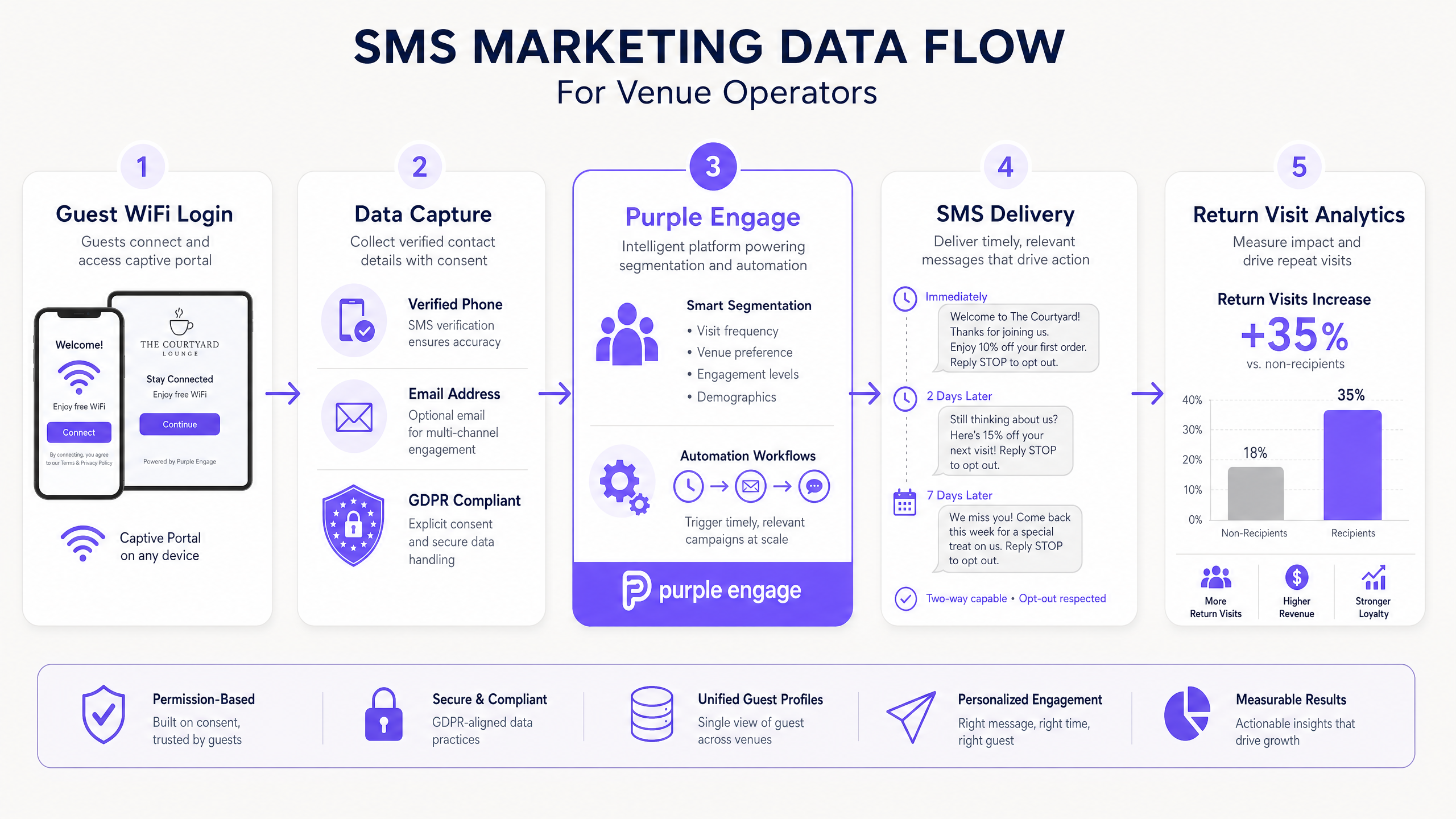
The captive portal (a web page that users must interact with before accessing a public WiFi network) is the most effective tool for this. When a visitor connects to your SSID, the network controller redirects all HTTP traffic to the Purple splash page. Here, you request a phone number and present an explicit SMS marketing opt-in. This conscious-choice opt-in - where the checkbox is unticked by default - is a strict requirement under GDPR Article 7 and CCPA Section 1798.100.
Purple operates as a hardware-agnostic cloud overlay, integrating directly with Cisco Meraki, HPE Aruba, Ruckus, Juniper Mist, Ubiquiti UniFi, Cambium, Extreme Networks, and Fortinet. Regardless of your underlying hardware, the data capture process is consistent across your entire estate.
Authentication and verification architecture
The authentication flow relies on RADIUS (Remote Authentication Dial-In User Service), the networking protocol that provides centralised authentication. When a device associates with the SSID, the access point sends an authentication request to the RADIUS server. Purple acts as the identity layer, processing the request and returning an accept or reject signal.
To prevent database degradation from fake numbers, Purple enforces SMS verification during the login process. The platform sends a one-time passcode to the provided number. The user must enter the code to gain internet access. This step eliminates inaccurate data at the source and ensures that every phone number in your Purple Engage database is verified and reachable.
Once authenticated, Purple stores the verified phone number alongside the device MAC address (the unique identifier assigned to a network interface controller). This pairing is the foundation of deterministic tracking - the ability to attribute physical visits to specific marketing campaigns based on definitive identifiers rather than probabilistic models.
Segmentation and automation
Raw data is not a marketing programme. The value comes from segmentation and automation within Purple Engage. The platform allows you to build audience segments based on visit frequency, dwell time, last visit date, and venue location. You can then configure automation rules that trigger SMS messages when a visitor meets specific criteria.
For example, a shopper who visited a Retail location three weeks ago but has not returned can be placed in a "lapsed visitor" segment. Purple Engage automatically sends an SMS with a time-limited offer when the lapse period is reached. The message includes a trackable link, and when the device MAC address is detected at the venue again, the return visit is logged and attributed to that specific campaign.
This integration with WiFi Analytics closes the attribution loop that digital advertising cannot. You are not measuring clicks - you are measuring physical footfall.
Implementation guide
Deploying an SMS marketing programme requires four coordinated steps.
Step 1: Configure the captive portal. In the Purple dashboard, set up your splash page to request a mobile number. Ensure the SMS opt-in checkbox is unticked by default. Add clear, plain-language consent text that explains what the visitor is agreeing to. This text must be specific: state the type of messages they will receive and how frequently.
Step 2: Enforce SMS verification. Enable the one-time passcode flow in Purple Engage. This is non-negotiable. Without verification, users will enter fake numbers to access the WiFi, and your database will be worthless within months.
Step 3: Define your automation triggers. Map out the key visitor behaviours you want to respond to. Common triggers include: first visit (welcome message with a discount), lapsed visit after 14 days (re-engagement offer), and high-frequency visitor (loyalty reward). Configure these rules in Purple Engage before you go live.
Step 4: Segment before you send. Never send a broadcast message to your entire database. Use Purple Engage's segmentation tools to target specific groups. A first-time visitor at a Hospitality venue needs a different message than a guest who has stayed five times.
Best practices
The following principles are drawn from deployment data across Purple's 80,000+ live venues.
Respect frequency limits. Data from SAP Engagement Cloud shows that 53% of consumers opt out due to over-frequency. Limit promotional SMS messages to a maximum of once every 14 days per user. Use Purple Engage's frequency capping to enforce this automatically.
Provide immediate value. Consumers opt into text messages for specific, practical reasons: exclusive discounts (58%), early access to deals (45%), and appointment reminders (76%) [Sakari, 2025]. Every SMS you send must offer tangible value. If it does not, cut it.
Integrate channels. Brands that integrate SMS into their omnichannel strategies see a 47.7% lift in customer engagement [Omnisend]. Use email for detailed content and newsletters. Reserve SMS for urgent, time-sensitive offers where the 98% open rate and 90-second read time work in your favour. For more on this, see How to leverage SMS marketing softwares to increase return visits .
Time your messages correctly. SMS is an immediate channel. A message sent at 7am on a Sunday will generate opt-outs. For retail, Thursday afternoon sends targeting weekend shoppers consistently outperform other timing windows. For Transport hubs, post-journey messages sent within 30 minutes of departure perform well.
Test message copy. Short, direct messages outperform long ones. A message under 160 characters (one SMS segment) avoids carrier splitting and reduces cost. Include a clear call to action and a trackable link. A/B test your copy in Purple Engage using small audience splits before rolling out to the full segment.
Troubleshooting and risk mitigation
High opt-out rates. The primary cause is over-frequency. If your opt-out rate exceeds 3.5% per send, reduce frequency immediately and review your segmentation. Ensure you are not sending SMS and email on the same day to the same user.
High bounceback rates. This indicates fake or inactive numbers in your database. The fix is to enforce SMS verification at the Captive Portal. If you have an existing database without verification, run a re-engagement campaign and remove all numbers that do not respond within 30 days.
GDPR compliance failures. The most common failure is an ambiguous consent mechanism - for example, a pre-ticked opt-in box. Purple's captive portal templates are designed with GDPR-compliant, unticked checkboxes by default. Do not modify this behaviour. Retain consent records, including the timestamp and the exact consent text shown, for a minimum of three years.
Low delivery rates. If your delivery rate drops below 90%, check your sender ID registration. In the UK and EU, unregistered sender IDs are increasingly filtered by mobile carriers. Register a named sender ID (for example, "PremierInn" rather than a random short code) to improve deliverability.
Attribution gaps. If you cannot reconcile SMS sends with return visits, check that MAC address logging is enabled in your Purple network configuration. Some enterprise hardware vendors disable MAC address randomisation detection by default. Verify this setting on Cisco Meraki, HPE Aruba, and Ruckus deployments specifically.
ROI and business impact
SMS marketing delivers between $21 and $41 ROI for every $1 spent under conservative estimates [Upcity, 2024]. Some seasonal campaigns report returns up to $71 per dollar [Attentive, 2024]. For venue operators, the more relevant metric is incremental return visit rate.
Purple's deterministic tracking allows you to calculate this directly. If you send a targeted SMS to 1,000 lapsed visitors and 150 return within seven days, you can calculate the exact revenue generated against the cost of the SMS segment. This is far superior to probabilistic ad attribution, which relies on modelled estimates.
A typical 200-site retail chain deploying Purple Engage across its estate can expect to build a verified SMS database of 15,000 to 50,000 contacts within the first six months, depending on daily footfall and portal conversion rates. A well-segmented re-engagement campaign to lapsed visitors typically achieves a 12% to 18% return visit rate within seven days of send.
Brands that integrate SMS into omnichannel workflows alongside email see a 47.7% lift in customer engagement [Omnisend]. SMS plus email produces approximately 56% higher ROI than email alone [Sakari, 2025]. The channels amplify each other: email handles depth, SMS handles urgency.
References
[1] SAP Engagement Cloud. "Customer Loyalty Index 2025." 2026. [2] Sakari. "SMS Marketing Statistics: Data-Backed Insights for 2025-2026." 2025. [3] Upcity. "SMS Marketing Survey." 2024. [4] Attentive. "2024 Consumer Trends Report." 2024. [5] Omnisend. "Omnichannel Marketing Statistics." 2024.
Key Definitions
Captive portal
A web page that users must view and interact with before gaining access to a public WiFi network. It intercepts all HTTP traffic from an unauthenticated device and redirects it to the portal URL.
This is the primary data capture point for venue operators. Purple's captive portal templates are pre-configured with GDPR-compliant consent mechanisms.
MAC address
A unique identifier assigned to a network interface controller, used as a network address at the data link layer. Format: six groups of two hexadecimal digits (e.g., 00:1A:2B:3C:4D:5E).
Purple uses MAC addresses to recognise returning devices and attribute physical venue visits to specific SMS campaigns, enabling deterministic ROI measurement.
First-party data
Information a company collects directly from its own customers or visitors, with explicit consent, and owns entirely. It is not purchased from or shared by third parties.
Capturing phone numbers via Guest WiFi builds a first-party data asset that is unaffected by third-party cookie deprecation or platform algorithm changes.
Deterministic tracking
Attributing a specific action (such as a venue visit) to a specific user based on definitive identifiers (such as a MAC address), rather than probabilistic models or statistical inference.
Purple's MAC address logging allows venue operators to prove exactly which SMS recipients physically returned to the location, rather than relying on click-through estimates.
Hardware-agnostic
Software that is compatible with various types of hardware without requiring modifications to the software itself. The platform sits above the hardware layer.
Purple operates as a hardware-agnostic cloud overlay, working across Cisco Meraki, HPE Aruba, Ruckus, Juniper Mist, Ubiquiti UniFi, Cambium, Extreme, and Fortinet without requiring hardware replacement.
Conscious-choice opt-in
A consent mechanism where the user must actively take a positive action - such as ticking an unticked checkbox - to agree to marketing communications. Pre-ticked boxes do not constitute valid consent under GDPR.
This is a strict legal requirement for collecting phone numbers for SMS marketing in the UK and EU. Purple's portal templates enforce this by default.
RADIUS
Remote Authentication Dial-In User Service. A networking protocol that provides centralised authentication, authorisation, and accounting management for users who connect to a network service.
RADIUS underpins the communication between your local WiFi hardware and the Purple cloud platform during the user login process. It is the standard protocol used by Cisco Meraki, HPE Aruba, and other enterprise access points.
SMS verification (one-time passcode)
A process where a platform sends a unique, time-limited numeric code to a user's mobile number. The user must enter the code to complete an action, confirming they own the number provided.
Enforcing SMS verification at the captive portal is the single most important step in maintaining database quality. It prevents fake numbers from entering Purple Engage and ensures every contact is reachable.
Omnichannel integration
A marketing strategy that coordinates communication across multiple channels - such as SMS, email, and in-venue WiFi - to create a consistent and contextually relevant visitor experience.
Brands that integrate SMS into omnichannel workflows see a 47.7% lift in customer engagement [Omnisend]. Purple Engage supports this by combining SMS and email automation in a single platform.
Worked Examples
A 200-site retail chain wants to increase return visits from weekend shoppers. They currently collect email addresses via Guest WiFi but see low open rates on promotional emails.
The IT team updates the Purple captive portal to request mobile numbers with SMS verification enabled. The marketing team configures Purple Engage with two automation rules: (1) a welcome SMS sent immediately after first connection, offering 10% off the next visit; (2) a re-engagement SMS triggered 21 days after the last visit, offering a time-limited weekend discount. The system uses MAC address recognition to track exactly how many SMS recipients return to a store within seven days. The IT team exports a weekly attribution report from the WiFi Analytics dashboard, showing return visit rate by campaign.
A large stadium wants to drive merchandise sales after matches. Their current app push notifications have low opt-in rates, and they have no verified phone number database.
The venue deploys Purple Guest WiFi across all concourses and configures the captive portal to request phone numbers with SMS opt-in. Fans authenticate using their phone numbers to access high-speed internet during the match. Purple Engage is configured to trigger an SMS 15 minutes after the final whistle, offering a 10% discount at the club shop with a unique trackable link. A second automation rule sends a re-engagement SMS three weeks later, ahead of the next home fixture, with an early-access ticket offer. The venue tracks both online redemptions via the trackable link and physical return visits via MAC address detection at the stadium WiFi.
Practice Questions
Q1. Your marketing director wants to send a promotional SMS to the entire database every Friday afternoon. As the IT manager responsible for the Purple Engage platform, how do you respond?
Hint: Consider the primary reason users opt out of SMS programs and the impact on long-term database health.
View model answer
Push back on the weekly broadcast. Data shows 53% of users opt out due to over-frequency [SAP Engagement Cloud, 2026]. A weekly send to the full database will degrade the list within months. Recommend segmenting the audience in Purple Engage and limiting messages to a maximum of once every 14 days per user, triggered by specific visit behaviours such as lapse periods or first-visit welcome flows, rather than a blanket calendar send.
Q2. The venue is experiencing a high volume of SMS bouncebacks, with delivery rates dropping below 70%. The database was built over the past 12 months without SMS verification. What is the immediate technical fix, and what is the longer-term remediation?
Hint: Look at the captive portal configuration and consider both the immediate fix and the existing dirty data.
View model answer
Immediate fix: enable SMS verification on the captive portal in Purple Engage. This stops fake numbers entering the database going forward. Longer-term remediation: run a re-engagement campaign to the existing database, asking recipients to confirm their number by clicking a link. Remove all numbers that do not respond within 30 days. Accept that the usable database is smaller than the raw count, but the remaining contacts are verified and deliverable.
Q3. The operations director asks for proof that the new SMS campaign actually drove footfall, rather than relying on click-through rates alone. How do you provide this evidence?
Hint: Use the network infrastructure to track physical presence, not just digital engagement.
View model answer
Use Purple's deterministic tracking. The platform logs the MAC address of each device when the user first authenticates at the captive portal. When that device returns to the venue after receiving the SMS, the access point detects the MAC address and logs a return visit in the WiFi Analytics dashboard. Export a campaign attribution report from Purple Engage that shows the number of SMS recipients whose device was detected at the venue within seven days of the send. This provides physical footfall attribution, not a digital click estimate.
Q4. You are deploying Purple Engage across a 50-hotel estate. The legal team flags that the current splash page consent text is too vague to satisfy GDPR Article 7. What specific changes do you make?
Hint: GDPR Article 7 requires consent to be specific, informed, and unambiguous. Review the consent text and the checkbox state.
View model answer
Make three changes: (1) ensure the SMS marketing opt-in checkbox is unticked by default - a pre-ticked box does not constitute valid consent under GDPR; (2) update the consent text to be specific, stating the exact type of messages the guest will receive (for example, 'promotional offers and return visit incentives from [Hotel Name]') and the approximate frequency; (3) configure Purple Engage to log the consent timestamp and the exact consent text version shown at the time of opt-in, retaining this record for a minimum of three years. Consult your data protection officer to confirm the updated text meets the standard before deploying across the estate.