
How to leverage SMS messaging marketing to increase return visits
This guide details how venue operators can leverage their existing Guest WiFi infrastructure to build a compliant, high-performing SMS marketing database. It covers data capture architecture, behavioural segmentation, compliance protocols (GDPR/TCPA), and strategies for driving measurable return visits.
Listen to this guide
View podcast transcript
Executive Summary
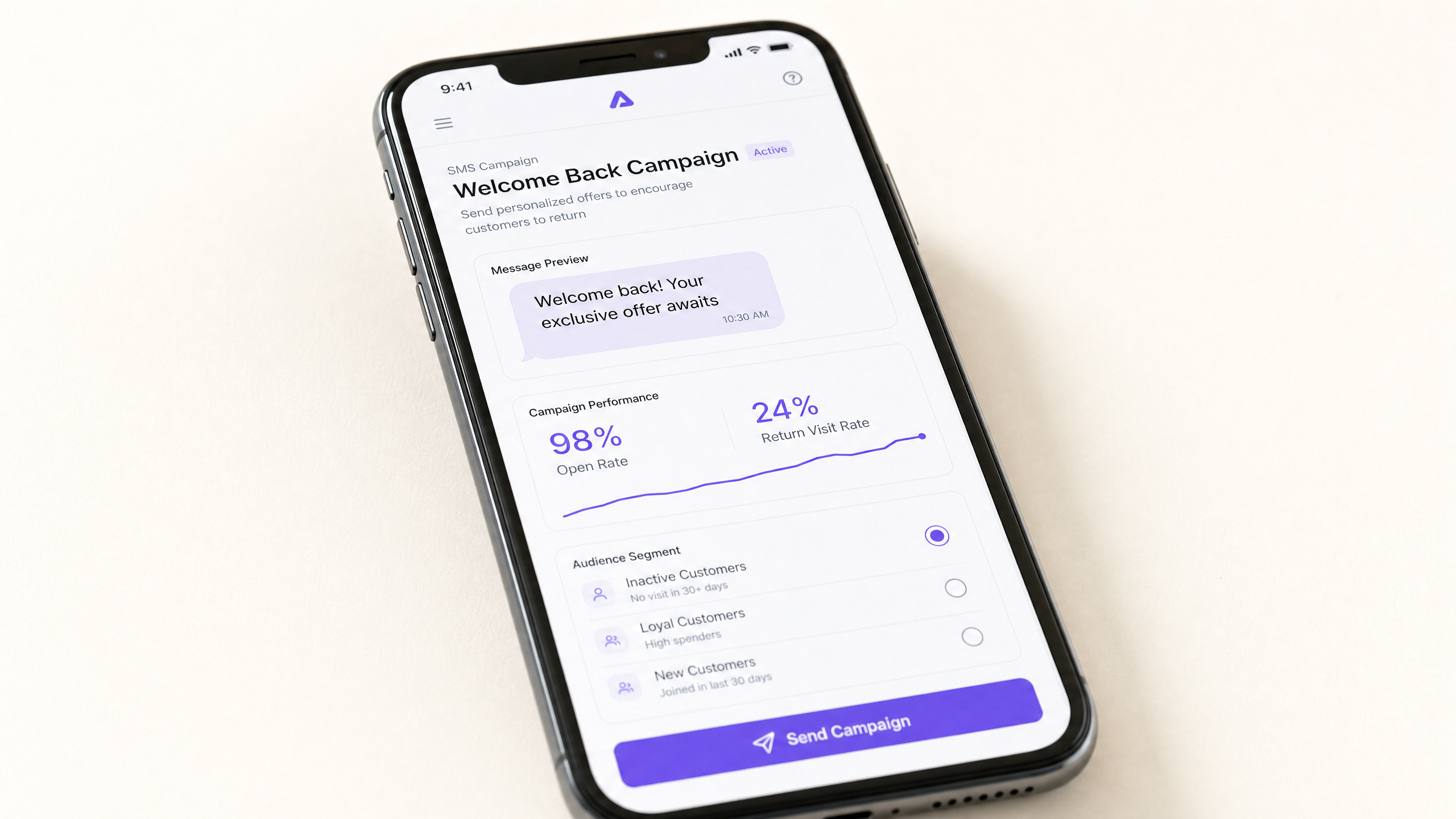
SMS messaging marketing represents the highest-engagement re-engagement channel available to venue operators today. With a 98% open rate and 90% of messages read within three minutes, SMS outperforms email significantly for time-sensitive, return-visit campaigns [1]. The challenge for IT and marketing teams is acquiring verified, consented phone numbers at scale without violating GDPR or TCPA requirements.
This guide details how to build a compliant, high-performing SMS marketing architecture using your existing Guest WiFi infrastructure. By deploying Purple's captive portal across hardware from Cisco Meraki, HPE Aruba, Ruckus, Juniper Mist, Ubiquiti UniFi, Cambium, Extreme, or Fortinet, you capture verified first-party data at the point of login. We cover the technical data flow, segmentation strategies in the WiFi Analytics platform, compliance protocols, and specific implementation scenarios for Retail and Hospitality environments.
Listen to our 10-minute technical briefing below for an overview of the strategy.
Technical Deep-Dive: Data Capture Architecture
The foundation of any SMS marketing programme is the data capture mechanism. A guessed number or a stale loyalty database entry will result in high bounce rates and potential compliance violations. You need verified data tied to a specific, timestamped venue visit.
The Captive Portal Data Flow
When a visitor connects to your venue's network, the hardware access point intercepts the traffic and redirects the device to the Purple captive portal. This cloud overlay operates independently of your underlying hardware vendor.
- Authentication request: The user selects the Guest WiFi SSID.
- Portal presentation: The Purple captive portal displays the login options.
- Data entry: The user inputs their phone number to receive a one-time passcode via SMS. This step verifies device ownership and number accuracy.
- Consent capture: The portal presents a distinct, unticked checkbox for SMS marketing consent.
- Data transmission: Purple logs the phone number, the consent boolean, the timestamp, the venue ID, and the MAC address.
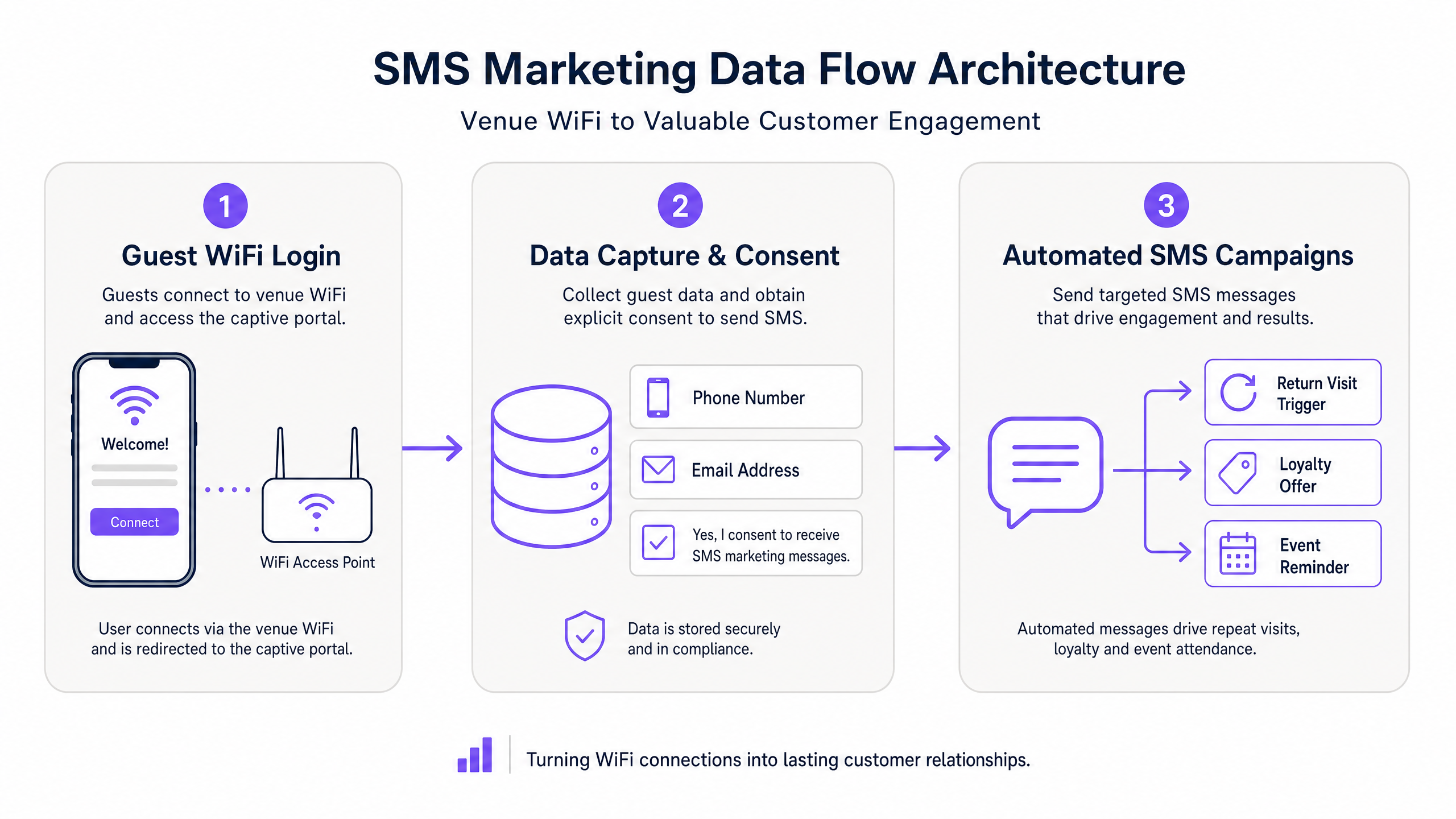
This architecture guarantees that every phone number in your database belongs to a real person who visited your physical location and explicitly opted in to receive messages.
Identity-Based Networks and First-Party Data
We refer to this approach as building Identity-Based Networks. Instead of tracking anonymous MAC addresses, you associate network activity with verified identities. This transition is critical because it allows you to build a unified view of the visitor. When a shopper logs into the WiFi at a Retail location in London and then visits a branch in Manchester three weeks later, Purple recognises the device and updates the visitor profile.
You use this profile data - visit frequency, dwell time, and location history - to segment your SMS campaigns.
Implementation Guide: Segmentation and Automation
Capturing the data is step one. Step two is using it to trigger automated messages that drive return visits. Sending bulk messages to your entire database will spike your unsubscribe rate. You must segment.
Defining High-Value Audiences
Purple Engage allows you to build dynamic audiences based on network behaviour. Consider these three core segments:
- Lapsed loyalists: Visitors who connected to the network three or more times in a 90-day period, but have not connected in the last 30 days.
- First-time visitors: Guests who connected for the first time within the last 24 hours.
- Event attendees: Fans who connected to the network during a specific time window corresponding to a stadium fixture or conference.
Triggering the Campaign
Once you define the audience, you configure the trigger in Purple Engage. The trigger automates the message delivery based on the visitor entering or exiting the segment criteria.
For example, you configure a "Win-Back" campaign targeting the lapsed loyalist segment. When a visitor profile reaches 31 days without a network connection, Purple Engage automatically fires an SMS: "We miss you at [Venue Name]. Show this text for 15% off your next visit."
When the visitor returns and connects to the WiFi, Purple logs the connection and attributes the return visit to the SMS campaign. This closed-loop attribution proves the ROI of the channel.
Best Practices for Venue Operators
Deploying SMS marketing requires discipline. Follow these vendor-neutral best practices to protect your database and maximise engagement.
Timing and Frequency
Timing dictates performance. According to industry benchmarks covering over three billion messages, sends between 10:00 and 12:00, and between 17:00 and 19:00 on weekdays yield the highest engagement rates [2]. Avoid sending messages before 08:00 or after 21:00.
Cap your message frequency. We recommend a maximum of four SMS messages per subscriber per month. Monitor your unsubscribe rate closely; an unsubscribe rate exceeding 3% on a single campaign indicates poor segmentation or excessive frequency.
Message Construction
Keep messages concise. You have 160 characters per standard SMS segment. Lead with the value proposition, include a clear call to action, and always provide an opt-out mechanism.
For example: "Hi [Name], enjoy a complimentary coffee on us today at [Venue Name]. Valid until 4PM. Reply STOP to opt out."
For more guidance on messaging strategy, read our guide on How to leverage SMS in marketing to increase return visits .
Compliance, Troubleshooting, and Risk Mitigation
Compliance is the primary risk vector in SMS marketing. You must adhere to the regulations governing your operating regions, specifically GDPR in the UK and Europe, and TCPA in the United States.
Consent Management
Under GDPR, you need a lawful basis for processing personal data and explicit consent for electronic direct marketing. Bundled consent - where the user must agree to marketing to access the WiFi - is invalid. Purple's captive portal presents a standalone opt-in checkbox, ensuring conscious-choice opt-ins.
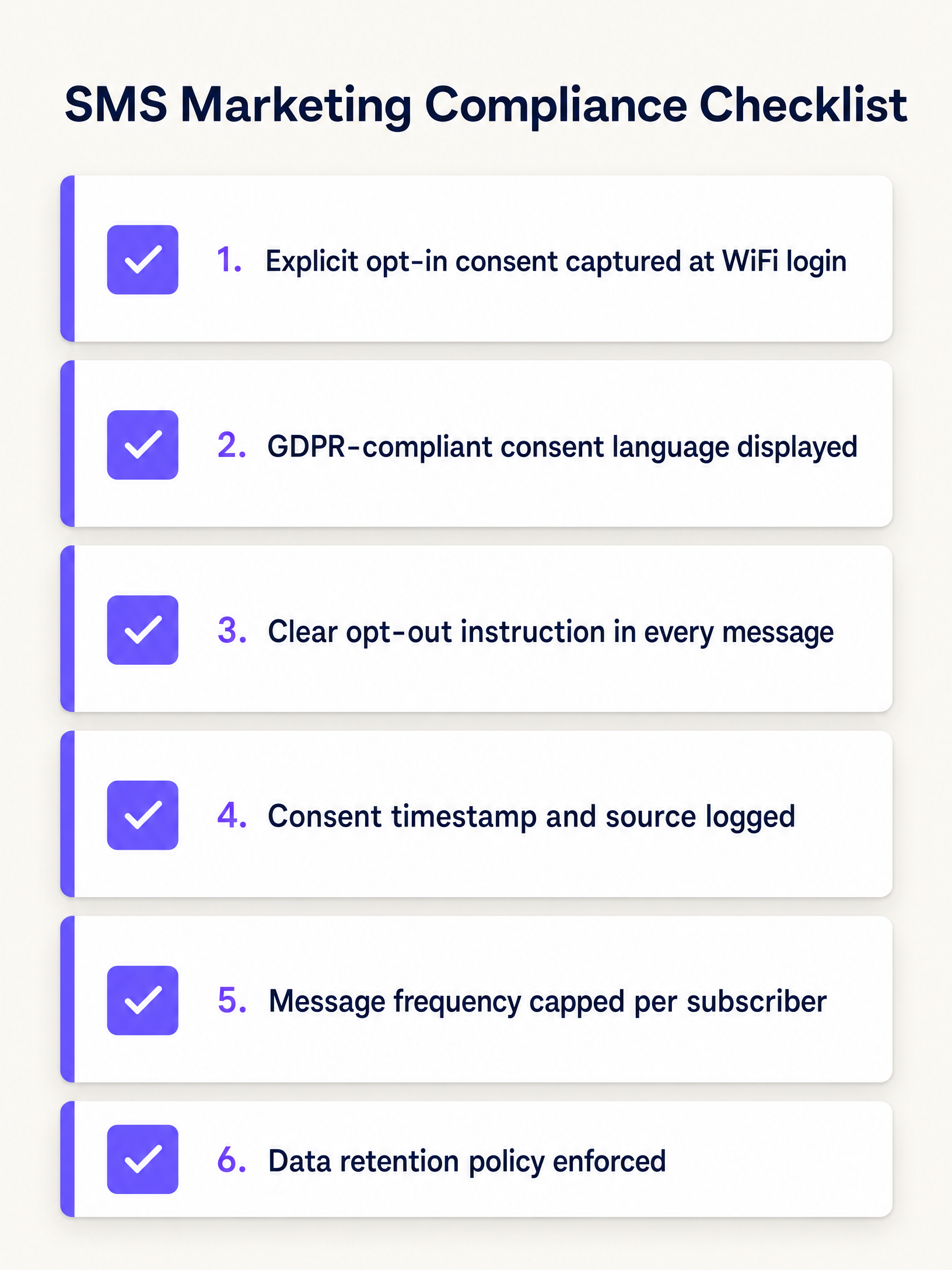
Under TCPA, you require prior express written consent for promotional texts. You must also manage 10DLC (10-Digit Long Code) registration with US carriers to ensure deliverability and avoid carrier filtering.
Handling Opt-Outs
Every SMS must include clear opt-out instructions, typically "Reply STOP to unsubscribe". When a user replies STOP, your system must immediately suppress their number from future sends. Purple Engage processes these requests automatically, updating the visitor profile to reflect the revoked consent.
ROI and Business Impact
The business impact of a segmented SMS strategy is measurable through return visit attribution. You do not need to rely on click-through rates or promo code redemptions.
Measuring Success
Purple matches subsequent WiFi connections against your SMS send logs. If you send 1,000 win-back messages and 150 of those recipients connect to your network within seven days, you have a 15% return visit rate directly attributable to the campaign.
Across the Purple network of 80,000+ venues, operators running targeted SMS campaigns consistently see return visit uplifts of 15% to 25% compared to control groups. When you calculate the lifetime value of a return visit in a Hospitality or retail setting, the ROI of the SMS channel frequently exceeds 2,000% [3].
References
[1] Infobip. "SMS marketing statistics: Key figures for 2026." Infobip Blog. [2] Klaviyo. "SMS marketing benchmarks and statistics by industry 2024." Klaviyo Resources. [3] MessageFlow. "How to Justify an Investment in SMS Marketing: ROI, Data, And a Pilot Template." MessageFlow Blog.
Key Definitions
Captive Portal
A web page that a user must view and interact with before accessing a public WiFi network.
This is the primary data capture mechanism for venue operators, serving as the digital front door to the physical space.
First-Party Data
Information a company collects directly from its customers or visitors.
Unlike third-party data purchased from brokers, first-party data captured via WiFi is highly accurate, legally compliant, and unique to the venue.
Conscious-Choice Opt-In
A consent mechanism requiring the user to take a deliberate action (like ticking an empty box) to agree to marketing communications.
Essential for GDPR compliance, ensuring the venue can prove the user actively wanted to receive SMS messages.
10DLC (10-Digit Long Code)
A standard US phone number sanctioned by mobile carriers for Application-to-Person (A2P) messaging.
Venues operating in the US must register their 10DLC numbers and campaigns to ensure their SMS messages are not blocked by carrier spam filters.
Identity-Based Networks
A network architecture that associates connections and behaviour with a verified user profile rather than an anonymous device MAC address.
This allows Purple to track a single visitor across multiple venues and visits, enabling sophisticated SMS segmentation.
Closed-Loop Attribution
The ability to track a marketing action (sending an SMS) directly to a physical outcome (the user returning and connecting to the WiFi).
This provides venue operators with hard ROI data rather than proxy metrics like open rates.
TCPA
Telephone Consumer Protection Act; US legislation restricting telemarketing calls and the use of automated SMS systems.
Requires US venues to obtain prior express written consent before sending promotional text messages.
One-Time Passcode (OTP)
A randomly generated numeric code sent via SMS to verify a user's phone number during login.
Ensures the phone number entered in the captive portal is accurate and belongs to the person connecting to the network.
Worked Examples
A 150-site retail chain needs to drive footfall during mid-week afternoon slumps. They currently collect email addresses via WiFi but see low open rates on time-sensitive offers.
- Update the captive portal to require phone number authentication via OTP. 2. Add an explicit SMS marketing opt-in checkbox. 3. Build an audience segment in Purple Engage for 'Shoppers who typically visit on weekends'. 4. Schedule an automated SMS campaign to trigger on Tuesdays at 11:00 AM offering a time-limited discount valid only between 14:00 and 16:00 on Tuesday and Wednesday. 5. Measure success by tracking the number of targeted devices that connect to the WiFi during the specified window.
A stadium operator wants to increase merchandise sales post-match but is concerned about violating GDPR by texting fans who only wanted WiFi access.
- Deploy Purple's captive portal with a decoupled consent architecture. 2. The terms of service checkbox is mandatory for WiFi access. 3. The SMS marketing checkbox is unticked by default and clearly states 'I consent to receive exclusive merchandise offers via SMS'. 4. Post-match, query the database for users who connected to the network during the match window AND have the SMS consent boolean set to true. 5. Send the merchandise offer only to this segmented, consented list.
Practice Questions
Q1. You operate a chain of 50 pubs. Your marketing director wants to text the entire WiFi database a '2-for-1' drinks offer at 20:00 on a Friday night to drive immediate traffic. Evaluate this request.
Hint: Consider both industry best practices for send times and the impact of zero segmentation on database health.
View model answer
This request should be rejected and modified. First, sending at 20:00 violates best practice; late-evening texts are intrusive and damage brand perception. The send should be moved to 17:00. Second, blasting the entire database will cause a spike in unsubscribes. The list must be segmented - for example, targeting only visitors who have previously connected on a Friday or Saturday, excluding those who are currently in the venue.
Q2. During an audit, your legal team asks for proof that you have consent to text a specific customer who complained about receiving a promotional message. How do you respond using Purple's architecture?
Hint: Recall the specific data points captured and logged by the captive portal during the login flow.
View model answer
Access the Purple portal and search for the user's profile using their phone number or MAC address. Provide the legal team with the specific consent log, which includes the timestamp of the opt-in, the specific venue where the connection occurred, the MAC address of the device used, and the exact GDPR-compliant language displayed on the captive portal at the time of that specific login.
Q3. Your venue has collected 10,000 phone numbers over two years via a paper feedback form on tables. The marketing team wants to upload these to Purple Engage and start an SMS campaign. What is the correct technical and compliance response?
Hint: Consider the verification status of the numbers and the auditability of the consent.
View model answer
Do not upload the list. Paper forms lack verification (users often write fake numbers) and do not provide an auditable digital trail of explicit consent required by GDPR or TCPA. Uploading unverified, unconsented lists will result in high bounce rates, carrier filtering, and severe regulatory risk. You must build the list organically through the verified Guest WiFi captive portal flow.