
How to leverage SMS text messaging marketing to increase return visits
This technical reference guide details how venue operators can leverage their existing Guest WiFi infrastructure to deploy automated, GDPR-compliant SMS text messaging marketing campaigns. It covers data capture architecture, behavioural segmentation strategies, and real-world implementation scenarios that drive measurable increases in return visits.
Listen to this guide
View podcast transcript
Executive Summary
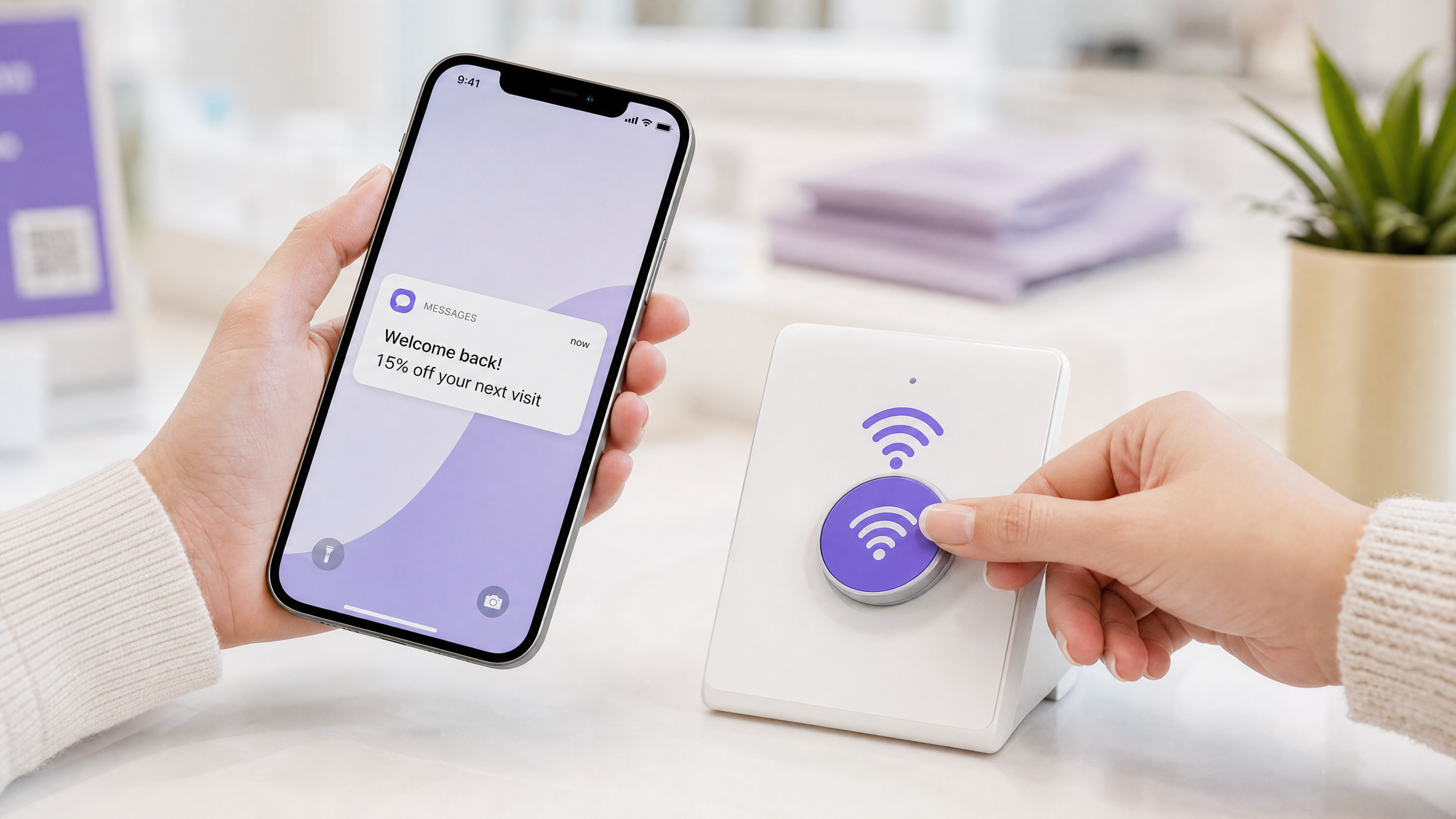
For IT directors and venue operations leaders in Hospitality , Retail , and Transport , the challenge of visitor retention is fundamentally a data capture problem. The average venue loses approximately 60% of its visitors after their first visit, largely due to a lack of actionable follow-up data. While email marketing remains a standard communication channel, SMS text messaging marketing delivers a 98% open rate and conversion rates up to 32% [1].
However, deploying SMS at scale requires verified phone numbers and explicit, timestamped consent to meet UK GDPR and PECR requirements. This guide details how to use your existing wireless infrastructure to build a compliant, automated SMS marketing engine. By using a Guest WiFi Captive Portal to authenticate users, venues capture verified first-party data, enrich it with behavioural signals like dwell time and visit frequency via the WiFi Analytics platform, and trigger automated SMS campaigns through Purple Engage. This approach transforms a cost-centre amenity into a measurable revenue driver.
Technical Deep-Dive
The foundation of an effective SMS marketing strategy is the data capture architecture. The process relies on turning anonymous MAC addresses into known visitor profiles using a cloud overlay on your existing hardware.
The Data Flow Architecture
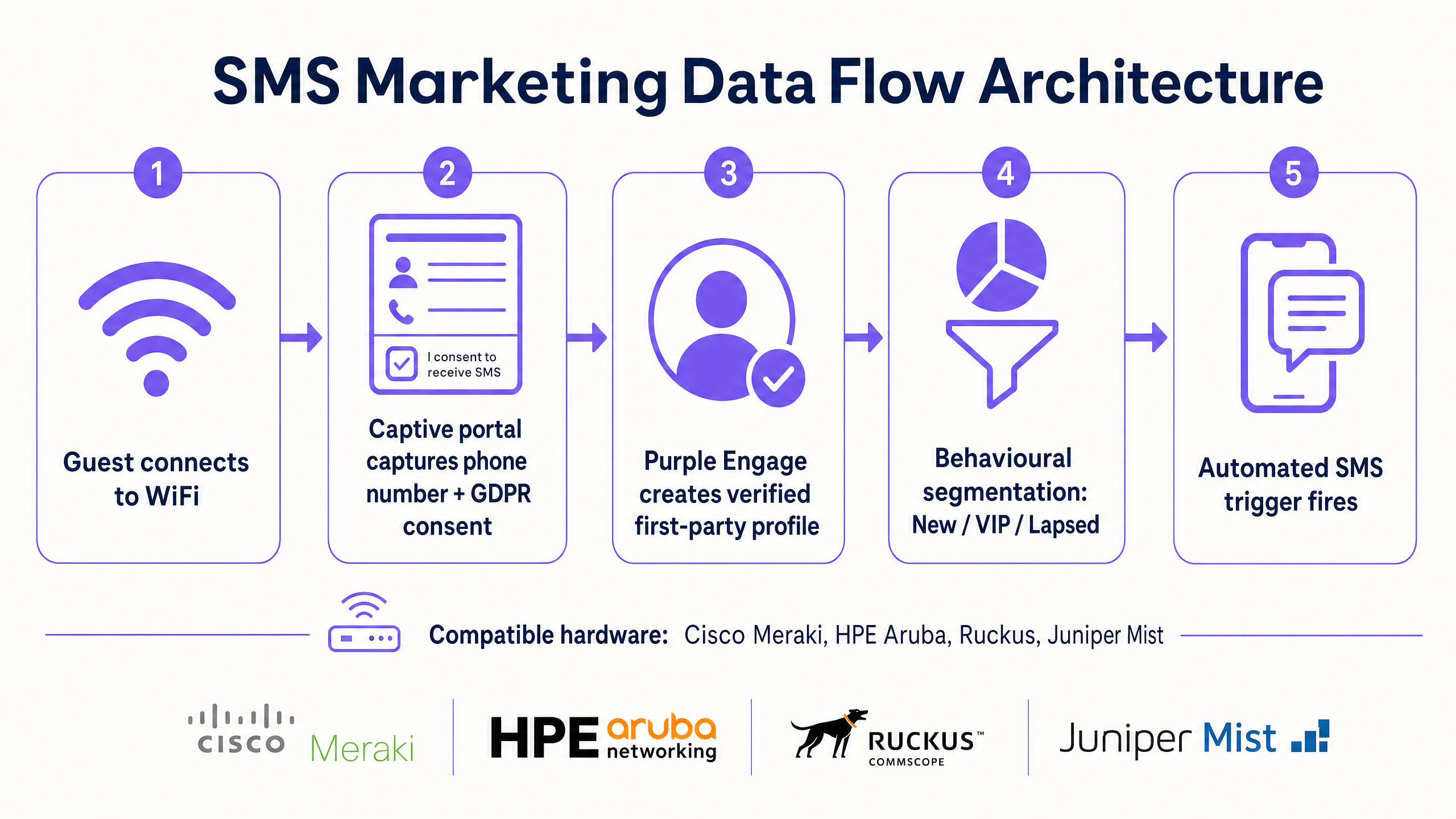
The typical deployment follows a five-stage data flow:
- Authentication Request: A visitor connects to the SSID on supported hardware (Cisco Meraki, HPE Aruba, Ruckus, Juniper Mist, Ubiquiti UniFi, Cambium, Extreme, Fortinet). The controller redirects the user to the Purple Captive Portal via RADIUS.
- Data Capture and Consent: The splash page requires the visitor to input their name, email, and mobile phone number. To ensure compliance, the page includes an unticked checkbox for explicit SMS marketing consent.
- Profile Creation: Purple ingests the data, verifies the phone number via a one-time passcode (OTP), and creates a first-party profile. This profile is enriched with subsequent session data.
- Behavioural Segmentation: The Engage platform automatically assigns the visitor to a segment based on visit frequency, recency, and dwell time.
- Automated Trigger: When a visitor meets the criteria for a specific segment, an automated rule triggers an SMS dispatch via the native Engage platform.
Consent and Compliance (UK GDPR & PECR)
Under UK GDPR and the Privacy and Electronic Communications Regulations (PECR), you cannot send marketing SMS messages without explicit, informed consent.
The captive portal splash page must include a clearly labelled, unticked checkbox. Pre-ticked boxes are not valid consent under GDPR. The consent record must be stored with a timestamp and the exact wording shown to the visitor. Purple stores this automatically and ties it to the visitor profile. Every SMS campaign you send through Engage only reaches visitors who have given valid consent. The platform also handles opt-out requests in real time; when a visitor replies STOP, Purple revokes access to that contact for future marketing dispatches immediately.
Implementation Guide
Deploying an SMS text messaging marketing strategy requires alignment between IT and marketing teams. Follow these implementation steps:
Step 1: Configure the Captive Portal
Design the splash page to prioritise phone number capture. Implement OTP verification to ensure data quality. A phone number collected at WiFi login is verified because the visitor typed it in to receive the access code. Do not mix this clean data with unverified numbers from paper sign-up forms or third-party lists. See our related guide on How to make a great first impression with your guest WiFi (and keep your brand consistent) for UI best practices.
Step 2: Define Behavioural Segments
Segmentation is where operators extract value. Purple Engage lets you build audience segments based on WiFi session behaviour.
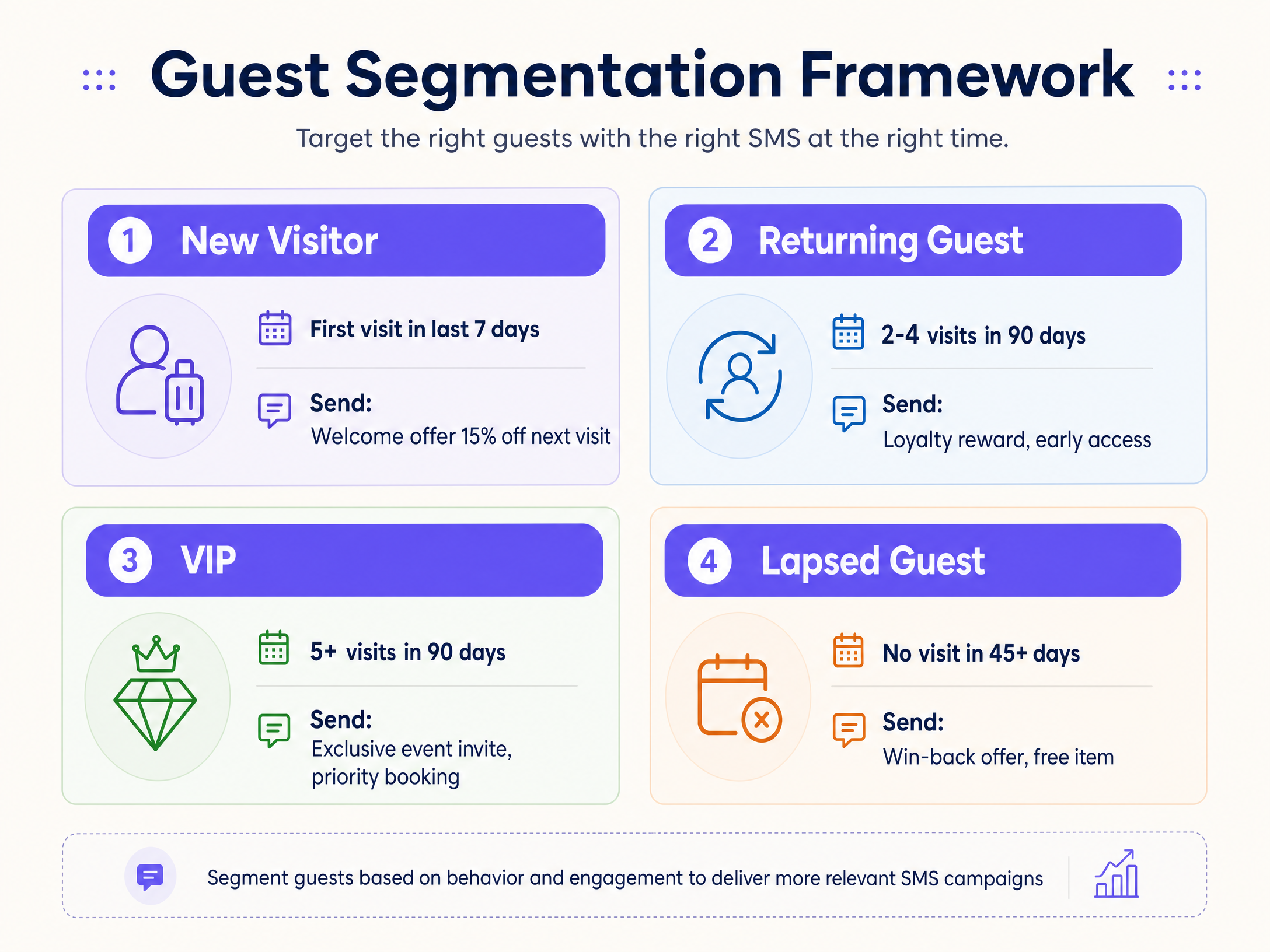
- New Visitor: First visit in the last 7 days. Send a welcome offer (e.g., 15% off next visit within 14 days).
- Returning Visitor: 2-4 visits in 90 days. Send a loyalty reward to encourage habit formation.
- VIP: 5+ visits in 90 days. Send exclusive event invitations or early access to new services.
- Lapsed Visitor: No visit in 45+ days. Send a win-back offer to re-engage.
Step 3: Automate Triggers and Send Windows
SMS works because it is immediate. A win-back message sent at 11:00 AM on a Tuesday, when your target shopper is likely planning their lunch break, outperforms the same message sent at 9:00 PM. Configure send windows by segment and by day of week within Purple Engage.
Best Practices
- Maintain Frequency Limits: One to two messages per week is the ceiling for most audiences. Above that, unsubscribe rates climb. Start at one message per week per segment and adjust based on your opt-out data.
- Ensure Network Separation: Isolate guest traffic from corporate networks. Read Three SSIDs to rule them all: guest, Passpoint, and IoT WiFi for network design recommendations.
- Provide Clear Value: Visitors opt into SMS because they expect value - discounts, early access, or practical updates. Pure promotional blasts without clear value drive unsubscribes.
Troubleshooting & Risk Mitigation
- High Bounce Rates: Usually caused by capturing unverified numbers. Fix: Enable OTP verification on the Captive Portal so visitors must enter a valid number to connect.
- Low Opt-in Rates: Often the result of a confusing splash page or lack of incentive. Fix: Clearly state the value proposition of opting in (e.g., "Opt-in for exclusive in-store discounts").
- Spiking Unsubscribe Rates: Indicates over-communication or irrelevant content. Fix: Reduce send frequency and refine your behavioural segments to ensure messages match visitor intent.
ROI & Business Impact
The business impact of SMS text messaging marketing is measurable and significant. SMS marketing delivers an average ROI between $21 and $41 for every £1 spent [2].
By leveraging the Purple cloud overlay on your existing hardware, you eliminate the need for a separate third-party SMS gateway. The infrastructure to capture verified data, manage consent, segment audiences, and trigger campaigns is unified. Venues using targeted SMS see return visit rates increase by 10% to 25% [3].
Listen to the Audio Briefing
References: [1] Gartner, Digital Marketing Benchmarks, 2022. [2] Upcity, SMS Marketing ROI Statistics, 2023. [3] Libro, Restaurant Retention Analysis, 2024.
Key Definitions
Captive Portal
A web page that a user of a public-access network is obliged to view and interact with before access is granted.
This is the primary surface for capturing visitor phone numbers and securing marketing consent.
OTP (One-Time Passcode)
An automatically generated numeric or alphanumeric string of characters that authenticates a user for a single transaction or login session.
Used during WiFi login to verify that the phone number provided by the visitor is accurate and belongs to them.
First-Party Data
Information a company collects directly from its customers or visitors.
Guest WiFi captures first-party data, which is more reliable and compliant than third-party lists purchased from brokers.
PECR
The Privacy and Electronic Communications Regulations, which sit alongside the UK GDPR.
PECR sets out the specific rules regarding marketing calls, emails, texts, and faxes, requiring explicit consent for SMS marketing.
Behavioural Segmentation
The process of dividing an audience into smaller groups based on their actions and interactions.
In Purple Engage, visitors are segmented based on WiFi session data such as visit frequency, recency, and dwell time.
MAC Address
A unique identifier assigned to a network interface controller for use as a network address in communications within a network segment.
Purple uses the MAC address to recognise returning devices and tie subsequent visits to the verified visitor profile.
Cloud Overlay
A software layer that sits on top of existing physical network infrastructure to provide additional services.
Purple operates as a cloud overlay, meaning venues do not need to replace their existing Cisco, Aruba, or Ruckus hardware to deploy SMS marketing.
RADIUS
Remote Authentication Dial-In User Service, a networking protocol that provides centralised Authentication, Authorisation, and Accounting management.
The protocol used by the venue's access points to communicate with Purple's servers to authenticate the visitor's WiFi session.
Worked Examples
A 12-site casual dining chain running on HPE Aruba hardware needs to increase return visits from guests who have not dined with them in over a month.
The chain deployed Purple Engage across all sites. Within 90 days, they built a consented SMS list of 28,000 guests. They configured a 'Lapsed Guest' segment targeting anyone who had not visited in 45 days. An automated trigger sent an SMS offering a free starter with their next main course. The campaign reached 4,200 guests. 840 redeemed the offer, representing a 20% redemption rate. With an average spend per cover of £32, the campaign generated £26,880 in incremental revenue. The cost of the SMS dispatch was under £200.
A stadium food and beverage operation wants to increase concession sales during match days without deploying a new mobile app.
The venue used Purple's WiFi Analytics to identify fans who visited the concessions area during matches but had not engaged with any loyalty programme. They set up an automated SMS trigger to dispatch 30 minutes after the final whistle, offering a 15% discount on food and beverage for the next home game. Redemption on the subsequent match day reached 18%.
Practice Questions
Q1. A retail venue wants to start SMS marketing and plans to pre-tick the consent box on their WiFi splash page to maximise opt-ins. What is the correct advice to give the IT director?
Hint: Consider UK GDPR and PECR requirements for explicit consent.
View model answer
Advise the IT director that pre-ticked boxes are not valid consent under UK GDPR and PECR. The venue must use an unticked checkbox to capture explicit, informed consent. Failing to do so risks significant compliance penalties and invalidates the entire marketing database.
Q2. A hotel operator complains that their SMS campaigns have a 15% bounce rate. They are currently collecting phone numbers via a paper form at check-in and manually uploading them to a third-party gateway. How should they re-architect this process?
Hint: Focus on data verification at the point of capture.
View model answer
The operator should shift data capture to the Guest WiFi captive portal and mandate OTP (One-Time Passcode) verification. This ensures the visitor must enter a valid, active mobile number to access the network, eliminating transcription errors and fake numbers, thereby reducing the bounce rate to near zero.
Q3. A stadium is sending the same promotional SMS to its entire database of 50,000 verified contacts every Friday at 5:00 PM. Unsubscribe rates are climbing rapidly. What strategy should the CRM manager implement using Purple Engage?
Hint: Consider how visit frequency should dictate the message content.
View model answer
The CRM manager must implement behavioural segmentation. Instead of a generic blast, they should segment the audience based on WiFi session data (e.g., New, VIP, Lapsed). They should then tailor the message to the behaviour - sending win-back offers only to lapsed fans and exclusive rewards to VIPs - and adjust the send windows to align with optimal engagement times.