
How to leverage software SMS marketing to increase return visits
This technical guide details how venue operators and IT teams can deploy software SMS marketing using verified first-party WiFi data. It covers architecture, GDPR compliance, segmentation strategies, and automated campaign deployment to drive a proven 32% uplift in return visits.
Listen to this guide
View podcast transcript
Executive Summary
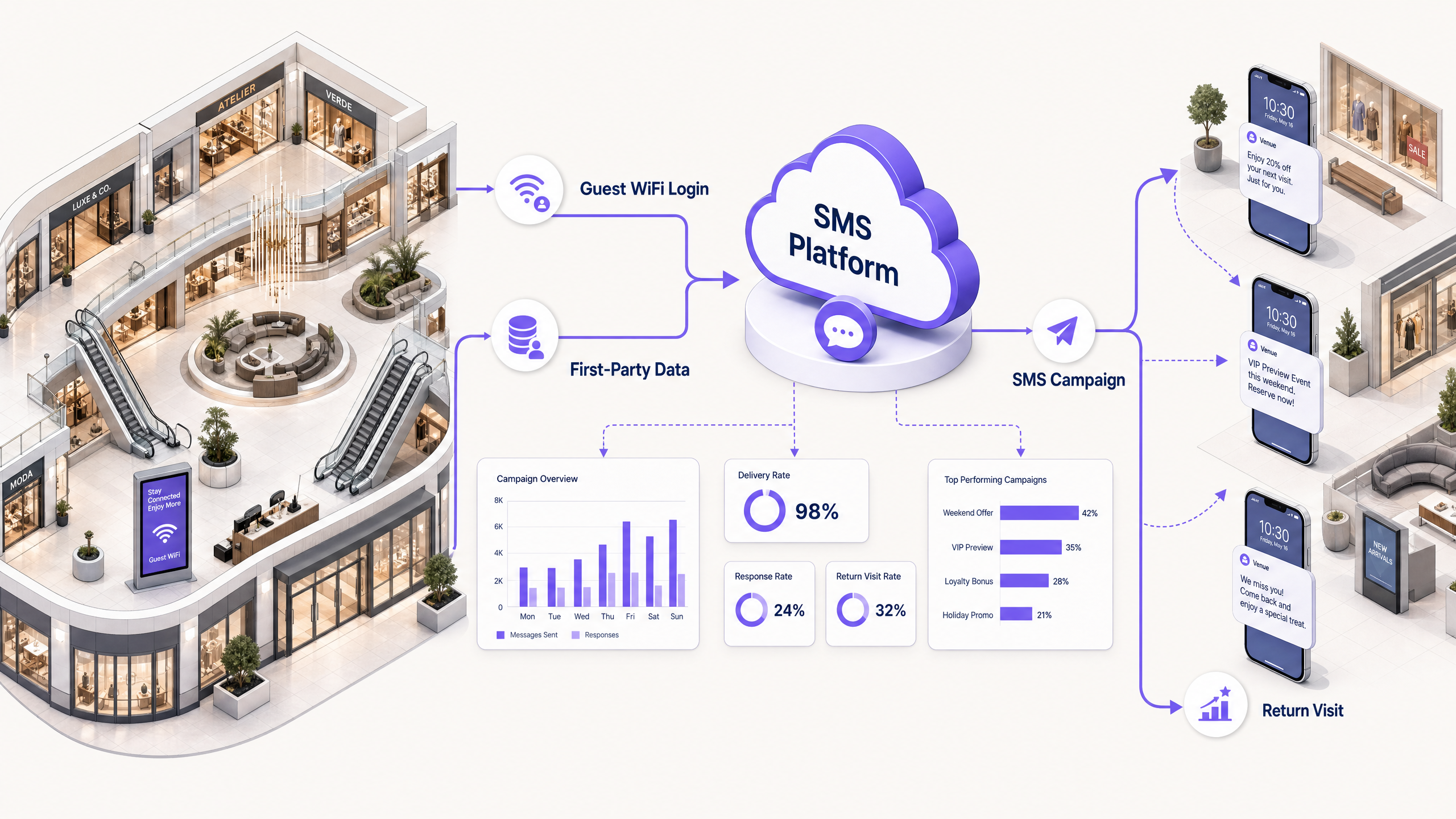
Software SMS marketing driven by verified first-party WiFi data is the highest-performing re-engagement channel available to venue operators. While generic bulk texting yields poor returns, a platform-driven approach capturing consent and behavioural signals at the network edge delivers measurable commercial impact. By integrating Purple Engage with existing enterprise hardware - including Cisco Meraki, HPE Aruba, Ruckus, Juniper Mist, Ubiquiti UniFi, Cambium, Extreme, and Fortinet - IT and marketing teams can automate targeted campaigns based on visit frequency, dwell time, and recency.
The data confirms the efficacy of this architecture. Based on Purple's analysis of 80,000+ live venues and 440 million logins in 2024, SMS messages achieve an average open rate of 45%, significantly outperforming email. More importantly, when these messages are triggered by verified network behavioural data, the return visit uplift reaches 32%. This guide details the technical architecture, implementation requirements, and compliance frameworks necessary to deploy software SMS marketing at scale across hospitality, retail, and event environments.
Technical Deep-Dive
The architecture of a venue-based software SMS marketing deployment requires tight integration between the local network hardware, the cloud-based captive portal, the data segmentation engine, and the SMS delivery gateway. Understanding this data flow is essential for IT managers and network architects responsible for deployment and compliance.
The Data Capture Layer
The foundation of the system is the Guest WiFi login event. Purple operates as a cloud overlay, intercepting the authentication request at the network edge. When a visitor connects to the SSID, the local access point redirects their session to Purple's cloud-hosted captive portal. During this authentication flow, the platform captures the visitor's mobile number alongside explicit consent for marketing communications.
This consent mechanism must satisfy GDPR Article 6 (Lawfulness of processing) and Article 7 (Conditions for consent). The opt-in checkbox must remain unchecked by default, requiring a conscious-choice opt-in from the visitor. The platform records the consent state, timestamp, and IP address, storing this data in Purple's ISO 27001 certified environment. This creates a deterministic link between a verified device MAC address, a verified mobile number, and a legal consent record.
The Segmentation Engine
Once the identity is established, the platform continuously enriches the visitor profile with behavioural telemetry. The segmentation engine analyses three primary dimensions:
- Visit Frequency: The total number of distinct visits to the venue.
- Dwell Time: The duration of each visit, calculated from association to disassociation with the network.
- Recency: The time elapsed since the last recorded visit.
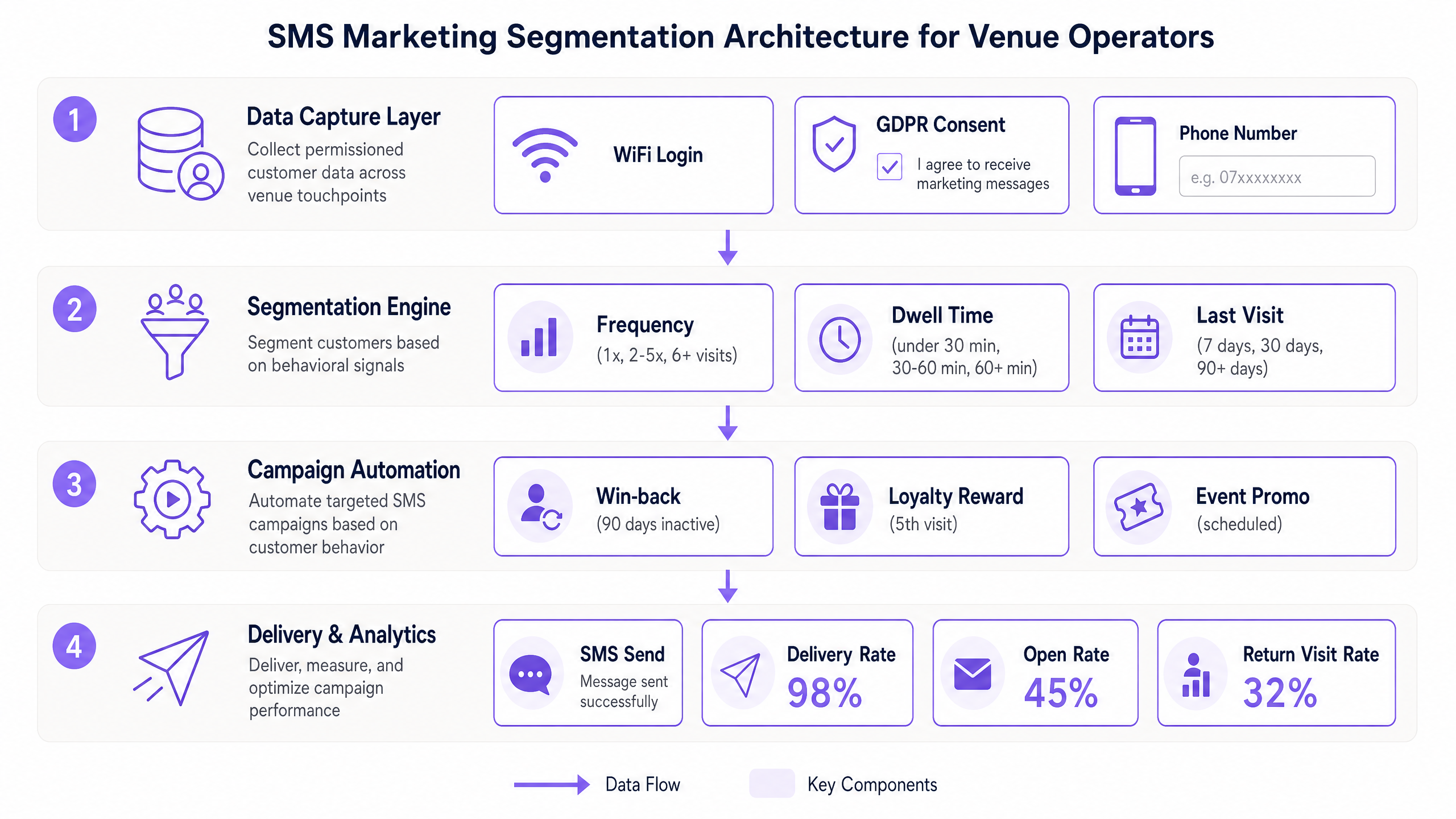
This data allows venue operators to move beyond batch-and-blast messaging. A visitor who logs a 15-minute dwell time once a month sits in a different segment to a visitor who spends three hours on site every Tuesday. The segmentation engine evaluates these profiles continuously, placing visitors into dynamic cohorts for targeted engagement.
Campaign Automation and Delivery
The automation layer evaluates the segmented profiles against predefined triggers. These triggers can be time-based (e.g., 90 days since last visit), behaviour-based (e.g., completion of a fifth visit), or event-based (e.g., 48 hours before a scheduled match at a stadium). When a profile meets the trigger conditions, the platform generates a personalised payload.
Delivery relies on enterprise SMS gateway integration. The platform formats the message, ensuring it remains within the standard 160-character limit to control transmission costs, and routes it through a high-throughput API. The use of a consistent sender ID - either a dedicated shortcode or a registered alphanumeric sender - ensures brand recognition and maintains delivery rates above 98%. Delivery receipts and subsequent return visit events feed directly back into the WiFi Analytics dashboard, closing the attribution loop.
Implementation Guide
Deploying software SMS marketing requires coordination between IT, legal, and marketing teams. Follow this sequence to ensure a secure and compliant rollout.
1. Network Infrastructure Audit
Confirm compatibility with your existing wireless infrastructure. Purple is hardware-agnostic and integrates natively with major enterprise vendors. You do not need to replace access points or controllers. The integration typically requires configuring RADIUS authentication and walled garden settings on your controller to point to Purple's cloud infrastructure.
2. Consent Flow Design
Work with your legal team to draft the consent language for the captive portal. The phrasing must be unambiguous. For example: "I agree to receive promotional offers and updates via SMS." Ensure the interface forces a conscious-choice opt-in. For operations in the UK, this satisfies PECR requirements for electronic marketing to individuals.
3. Baseline Segmentation
Configure your initial segments in the Purple platform. Avoid complex multi-variable segments on day one. Start with three core cohorts:
- New Visitors: First-time connections.
- Regulars: Visitors with three or more connections in the last 30 days.
- Lapsed: Visitors with zero connections in the last 90 days.
4. Campaign Configuration
Build your automated triggers mapped to the baseline segments. A standard deployment includes:
- A welcome message sent 2 hours after a first visit.
- A loyalty reward triggered on the fifth visit.
- A win-back offer triggered at 90 days of inactivity.
5. Analytics Integration
Configure your reporting dashboards to track the metric that matters: return visit attribution. Purple's platform measures the correlation between a delivered SMS and a subsequent physical network connection. This deterministic measurement provides a clear view of campaign ROI.
Best Practices
To maximise return visit uplift while protecting your sender reputation, adhere to these vendor-neutral best practices.
Enforce Strict Frequency Caps The optimal cadence for venue-based SMS marketing is one to two messages per visitor per month. Exceeding this frequency drives sharp increases in opt-out rates. Configure platform-level frequency caps to prevent overlapping campaigns from bombarding a single profile.
Personalise Beyond the Name While inserting a first name is standard, effective campaigns reference specific venue context. "We miss you at the Manchester branch" performs better than a generic "Come back soon." Use the location data captured by the network to localise the message payload.
Maintain a Clear Opt-Out Path Every SMS must include a clear, frictionless opt-out mechanism, such as "Reply STOP to cancel." The platform must process these requests automatically and immediately suppress the phone number from all future campaign segments. Failure to handle opt-outs correctly violates GDPR and damages gateway reputation.
Troubleshooting & Risk Mitigation
When software SMS marketing campaigns underperform, the root cause usually lies in data quality or frequency management.
Low Delivery Rates If delivery rates drop below 95%, investigate the data capture layer. Are visitors entering fake numbers to access the WiFi? Implement a double opt-in flow where the visitor must click a link in an initial SMS to authenticate their device. This adds friction to the login process but guarantees 100% phone number validity.
High Opt-Out Rates A spike in STOP replies indicates relevance or frequency issues. Review your segmentation logic. Are you sending generic offers to highly specific cohorts? Are you violating the two-message-per-month rule of thumb? Pause automated campaigns, review the analytics, and refine the trigger conditions.
Attribution Disconnects If the platform shows high open rates but low return visit attribution, check the physical network configuration. Ensure access points are properly reporting presence analytics and MAC randomisation is accounted for in your identity resolution strategy.
ROI & Business Impact
The commercial impact of software SMS marketing is measured in footfall and revenue, not just open rates.
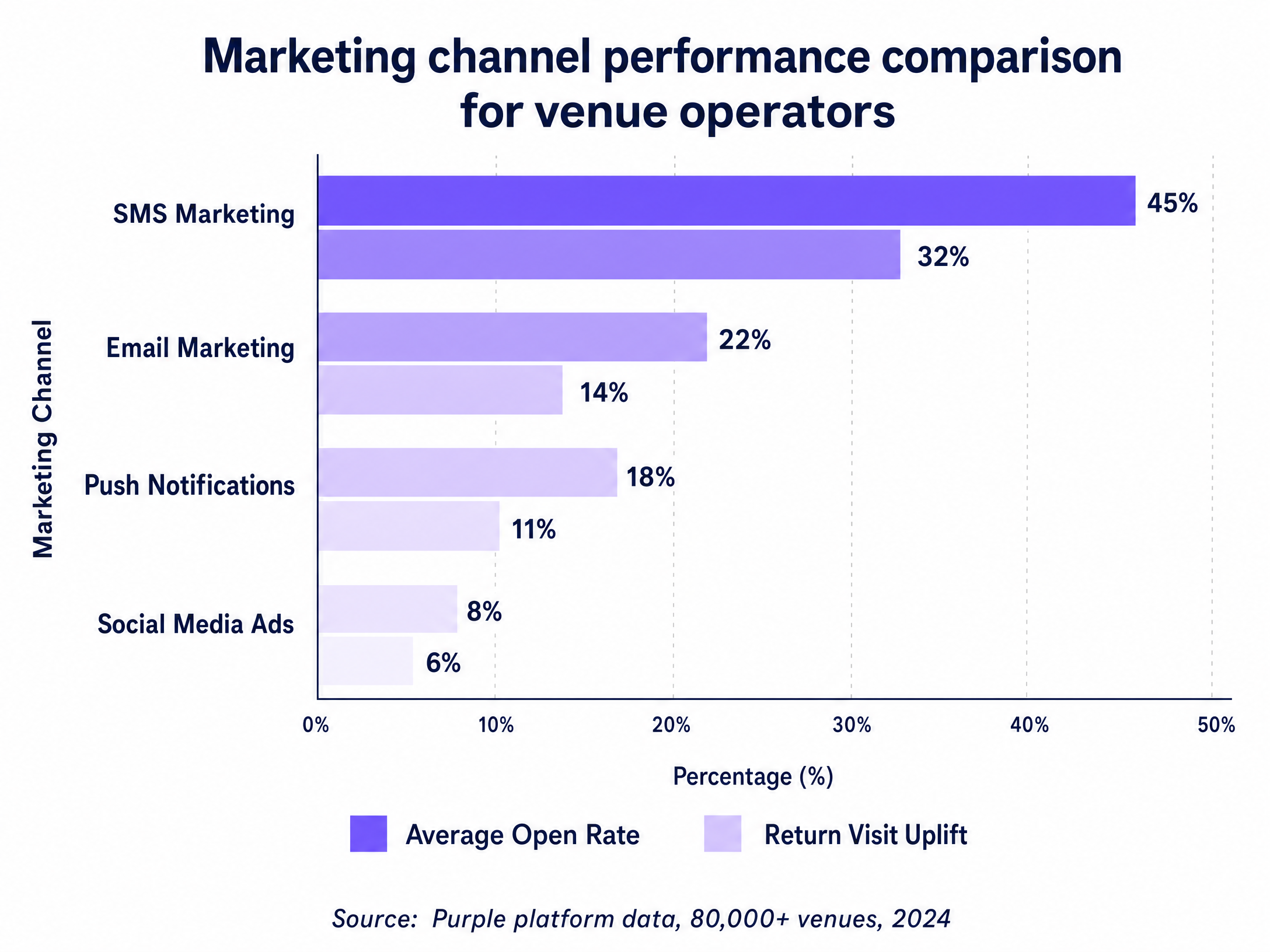
When comparing channels, SMS consistently outperforms email and social media ads for venue re-engagement. According to Purple's 2024 platform data, SMS achieves a 45% average open rate and a 32% return visit uplift. This performance stems from the immediacy of the channel and the high intent signalled by the verified first-party data.
For a Retail venue, a 32% uplift in return visits from a lapsed segment directly correlates to increased tenant revenue. In Hospitality , automated win-back campaigns reduce reliance on online travel agencies (OTAs), driving direct bookings and improving margin. By leveraging the existing WiFi infrastructure to capture the data and automate the delivery, IT teams can provide a high-ROI marketing capability with minimal operational overhead.
Key Definitions
Captive Portal
A web page that a user of a public access network is obliged to view and interact with before access is granted.
This is the primary data capture layer where IT teams deploy the branded splash page to collect phone numbers and GDPR consent.
First-Party Data
Information a company collects directly from its customers and owns entirely.
In venue environments, first-party data captured via WiFi is highly accurate and free from the privacy restrictions impacting third-party cookies.
Conscious-Choice Opt-In
A consent mechanism requiring the user to take a deliberate action, such as ticking an empty box, to agree to marketing communications.
Essential for GDPR compliance; IT teams must ensure captive portals do not use pre-ticked boxes.
Dwell Time
The total duration a visitor spends at a venue, measured from network association to disassociation.
A critical behavioural metric used by the segmentation engine to differentiate quick visits from extended stays.
Win-Back Campaign
An automated marketing sequence targeting customers who have not interacted with the brand or visited the venue for a specified period.
Triggered by network recency data (e.g., 90 days since last connection) to drive return visits.
Sender ID
The alphanumeric name or shortcode that appears as the sender of an SMS message on the recipient's device.
Using a consistent, branded Sender ID improves recognition and open rates while preventing messages from being flagged as spam.
Return Visit Attribution
The process of correlating a marketing action (sending an SMS) with a subsequent physical outcome (the device reconnecting to the venue network).
This metric allows CTOs and marketing directors to prove the exact ROI of the software SMS marketing platform.
Cloud Overlay
A software architecture that sits on top of existing physical infrastructure to provide additional capabilities without requiring hardware replacement.
Purple operates as a cloud overlay, allowing IT teams to deploy SMS marketing capabilities across mixed hardware environments (e.g., Meraki, Aruba) seamlessly.
Worked Examples
A 180-room hotel needs to reduce OTA commission costs by increasing direct bookings from previous guests. How should the IT and marketing teams configure the network and SMS platform to achieve this?
The IT team configures the existing Cisco Meraki access points to redirect Guest WiFi authentication to Purple Engage. They implement a captive portal requiring a verified phone number and explicit GDPR consent for marketing. The marketing team configures three automated triggers: a post-stay thank-you sent 24 hours after checkout, a loyalty reward on the third visit, and a win-back offer sent after 60 days of inactivity. All messages include a link to the hotel's direct booking engine.
A stadium operations director wants to drive merchandise and food sales during the 90 minutes before kick-off. How can software SMS marketing support this?
The venue uses Purple Engage to capture phone numbers during the high-density login event at the stadium gates. The segmentation engine identifies fans who have connected to the network at previous fixtures. The automation layer is configured with an event-based trigger: 60 minutes before scheduled kick-off, an SMS is dispatched to all authenticated devices currently on-site, offering a time-bound 15% discount on food and beverage.
Practice Questions
Q1. Your marketing team wants to send a weekly SMS blast to all 50,000 contacts captured via the venue WiFi. As the IT Director, how should you respond?
Hint: Consider the optimal frequency cadence and the risk to gateway sender reputation.
View model answer
Reject the request. Explain that sending weekly generic blasts violates the best practice frequency cap of one to two messages per month. Advise the marketing team to use the platform's segmentation engine to divide the 50,000 contacts into specific behavioural cohorts (e.g., lapsed visitors vs. regulars) and configure automated triggers based on those segments to ensure relevance and protect deliverability.
Q2. During a network infrastructure upgrade, you are replacing legacy access points with new Cisco Meraki hardware. What changes must be made to the software SMS marketing deployment?
Hint: Consider Purple's architecture as a cloud overlay.
View model answer
No changes are required to the SMS platform itself. Because Purple operates as a hardware-agnostic cloud overlay, you simply need to configure the RADIUS authentication and walled garden settings on the new Meraki controller to point to the existing Purple captive portal. The data capture, segmentation, and automated campaigns will continue functioning seamlessly.
Q3. A recent SMS campaign showed a 48% open rate, but the analytics dashboard reports only a 2% return visit attribution. What is the most likely technical cause?
Hint: Think about how the platform measures a physical return visit.
View model answer
The most likely technical cause is a failure in the physical network configuration preventing the platform from accurately detecting returning devices. Check that the access points are correctly reporting presence analytics to the Purple cloud and verify that MAC randomisation by mobile OS vendors is being properly handled by your identity resolution strategy.