

Why Use WiFi Marketing? The Business Case With Real Data
This technical reference guide outlines the evidence-based business case for WiFi marketing. It provides IT leaders and venue operators with actionable data on ROI, dwell time, and repeat visit metrics derived from real-world deployments.
🎧 Listen to this Guide
View Transcript
Executive Summary
For IT directors, CTOs, and venue operations managers, the question of why use WiFi marketing is no longer theoretical. The infrastructure required—access points, controllers, and switching hardware—is likely already deployed across your estate. However, without an intelligence layer, this infrastructure functions solely as a cost centre rather than a revenue-generating asset. This guide examines the technical architecture and business case for converting guest WiFi networks into structured data capture and audience engagement platforms. By leveraging platforms like Guest WiFi and WiFi Analytics , organisations in Retail , Hospitality , Healthcare , and Transport can transition from providing a basic amenity to driving measurable ROI through increased dwell time, higher repeat visit rates, and direct WiFi advertising revenue.
Technical Deep-Dive: Architecture and Data Capture
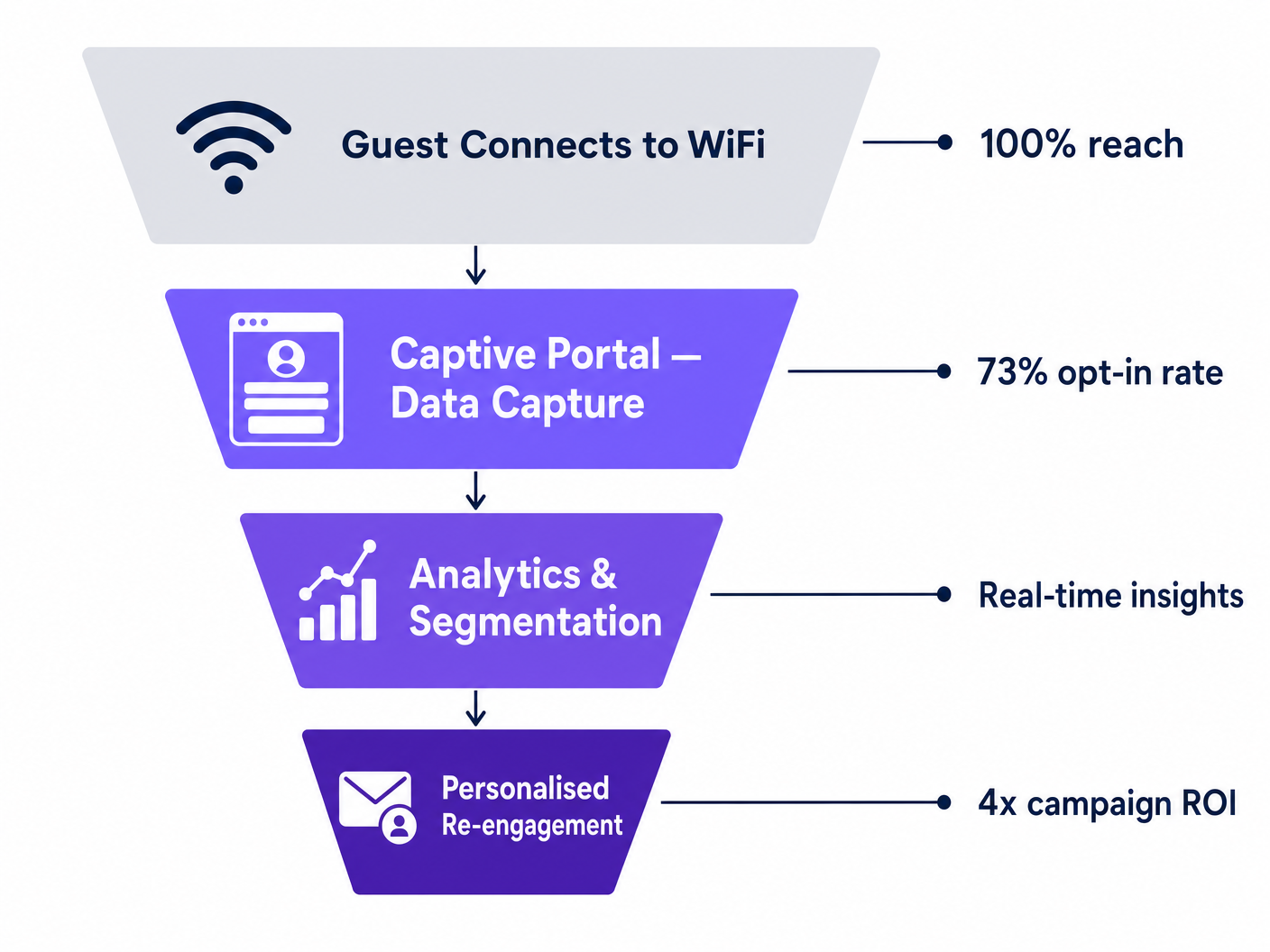
The foundation of WiFi marketing relies on the authentication layer, specifically the captive portal, acting as a gateway for structured data capture. When a user associates with an 802.11ac or 802.11ax network, the captive portal controller intercepts the unauthenticated session and redirects the client to a splash page. This interaction is the critical juncture where anonymous MAC addresses are mapped to verified identity signals (e.g., email, name, social login tokens).
The Data Hierarchy
- Passive Analytics: Before authentication, mature platforms ingest probe request data. This provides a baseline footfall metric, capturing devices that enter the venue but do not connect.
- Active Authentication: Upon connection, the captive portal captures consented, first-party data. This is crucial in a landscape where third-party cookies are being deprecated. The consent mechanism must align with GDPR Article 7 requirements, ensuring data is freely given and unambiguously recorded.
- Behavioural Telemetry: Post-authentication, the network continuously generates telemetry. Metrics such as dwell time and zone flow are calculated by triangulating device signals across multiple access points. For deeper insights into location tracking, refer to our Indoor Positioning System: UWB, BLE, & WiFi Guide .
Implementation Guide: From Infrastructure to Intelligence
Deploying a WiFi marketing solution requires careful coordination between network engineering and marketing operations. The deployment must bridge the gap between network hardware (e.g., Cisco Meraki, Aruba) and the CRM or marketing automation stack.
Step-by-Step Deployment
- Network Segmentation: Guest traffic must be isolated on a dedicated VLAN. This is a fundamental security requirement and a strict compliance mandate under PCI DSS if point-of-sale systems operate on the same physical infrastructure.
- Captive Portal Configuration: Implement progressive profiling on the splash page. Requesting excessive data points (name, email, phone, date of birth) on the initial connection drives abandonment rates above 60%. Instead, capture the email address and consent initially, then enrich the profile during subsequent visits.
- Data Integration: Establish API or webhook integrations between the WiFi analytics platform and the venue's CRM. A data lake without an outlet provides zero ROI. The captured identity signals must flow seamlessly into platforms like Salesforce or HubSpot to trigger automated re-engagement campaigns.
Best Practices for Venue Operators
To maximise the value of the deployment, adhere to the following industry-standard practices:
- Prioritise First-Party Data: Use the captive portal to build a robust, GDPR-compliant database. This reduces reliance on expensive third-party acquisition channels.
- Leverage Profile-Based Authentication: Transition towards seamless, secure authentication models. Purple's role as an identity provider for services like OpenRoaming facilitates frictionless connectivity while maintaining data visibility.
- Contextual Engagement: Utilise the data to drive operational decisions. If analytics reveal a significant drop in dwell time in a specific retail zone, operations teams can investigate layout or staffing issues. For strategies on leveraging this engagement, see Social WiFi: What It Is and How It Drives Customer Engagement (or the French equivalent: Social WiFi : Ce que c'est et comment il stimule l'engagement client ).
Troubleshooting & Risk Mitigation
Common failure modes in WiFi marketing deployments often stem from misaligned objectives or technical oversights.
| Failure Mode | Root Cause | Mitigation Strategy |
|---|---|---|
| High Portal Abandonment | Overly complex data capture forms. | Implement progressive profiling; limit initial requests to email and consent. |
| Data Silos | Failure to integrate WiFi analytics with the CRM. | Define data flows pre-deployment; utilise native API integrations. |
| Inaccurate Analytics | Insufficient access point density for triangulation. | Conduct a thorough site survey; ensure a minimum of 3-4 APs per floor for location analytics. |
| Security/Compliance Breaches | Guest traffic on the corporate VLAN; poor consent logging. | Enforce strict VLAN segmentation; utilise a platform built to ICO/GDPR standards. |
For specialised environments like healthcare, where security is paramount, consult our guide on WiFi in Hospitals: A Guide to Secure Clinical Networks .
ROI & Business Impact: The Evidence
The business case for WiFi marketing is validated by empirical data across multiple verticals. When evaluating is wifi business profitable, the metrics demonstrate significant returns.
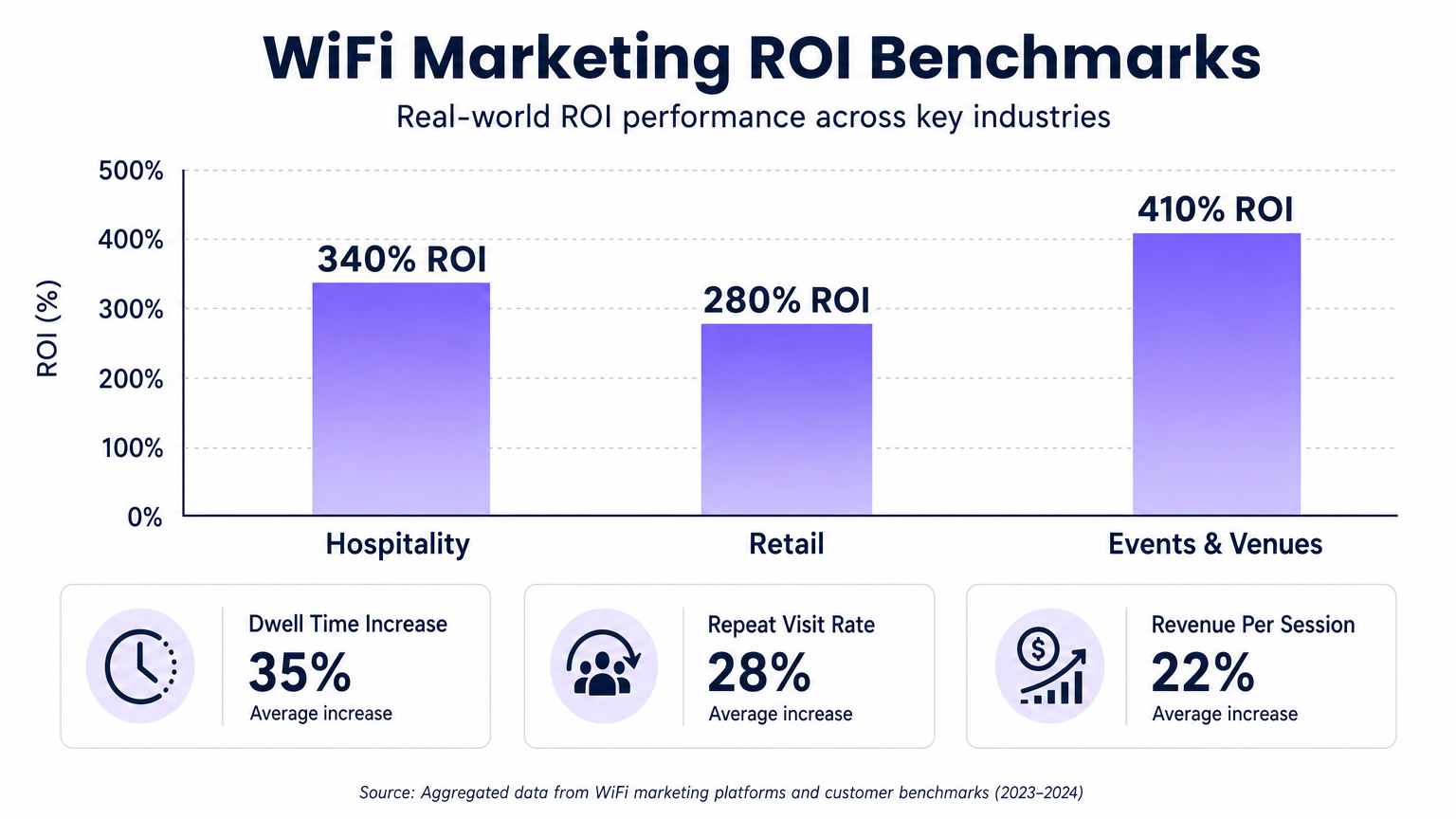
- Hospitality: Venues leveraging WiFi data for targeted re-engagement see an average 28% increase in repeat visit rates within six months. This directly impacts occupancy and reduces reliance on Online Travel Agencies (OTAs), which typically charge 15-25% commission.
- Retail: By analysing dwell time and zone flow, retailers optimise store layouts and staffing. Furthermore, targeted offers delivered via the captive portal yield conversion rates 4x higher than untargeted broadcast campaigns.
- Transport & Venues: Large-scale venues generate direct wifi advertising revenue by monetising the captive portal real estate. Contextually relevant retail media can offset the platform's cost entirely within 12 to 18 months. For insights into connectivity on the move, see Your Guide to Enterprise In Car Wi Fi Solutions .
In conclusion, understanding how wifi analytics can help businesses transforms the network from a passive utility into an active driver of revenue and operational intelligence.
Key Terms & Definitions
Captive Portal
A web page that a user of a public-access network is obliged to view and interact with before access is granted.
This is the primary mechanism for capturing first-party data and securing user consent in a WiFi marketing deployment.
Dwell Time
The duration a unique device remains associated with or in proximity to the WiFi network within a specific zone.
A critical operational metric used by retail and hospitality to gauge customer engagement and optimise staffing or layout.
Probe Request
A frame sent by a client device (like a smartphone) to discover available 802.11 networks in its vicinity.
Used by analytics platforms to measure total venue footfall and capture data from devices that do not actively connect to the network.
Progressive Profiling
The practice of gradually gathering user information over multiple interactions rather than demanding all data upfront.
Essential for maintaining high opt-in rates on captive portals by reducing user friction during the initial connection.
First-Party Data
Information a company collects directly from its customers and owns entirely.
Highly valuable for targeted marketing, especially as third-party cookies are phased out. WiFi marketing is a primary source of this data.
VLAN Segmentation
The practice of dividing a physical network into multiple logical networks to isolate traffic.
A mandatory security requirement to ensure guest WiFi traffic cannot access corporate systems or point-of-sale hardware.
Identity Resolution
The process of connecting various identifiers across devices and touchpoints to a single, unified customer profile.
Crucial for tracking repeat visits and attributing offline behaviour (venue visits) to online marketing campaigns.
Retail Media Monetisation
The strategy of selling advertising space on owned digital assets (like a WiFi splash page) to third-party brands.
A direct revenue stream that can offset the cost of the WiFi infrastructure, generating direct ROI for large venues.
Case Studies
A 200-room hotel currently offers open, unauthenticated guest WiFi. They want to implement WiFi marketing to increase direct bookings and reduce OTA commissions, but are concerned about user friction.
- Deploy a captive portal integrated with the existing network infrastructure (e.g., Meraki or Aruba).
- Configure the splash page for progressive profiling: ask only for an email address and GDPR consent on the first visit.
- Integrate the WiFi platform via API with the hotel's CRM.
- Set up an automated workflow: 48 hours after a guest disconnects, trigger an email offering a 10% discount on their next direct booking.
A large retail chain wants to understand why footfall in a specific department is high, but sales are low. They have existing WiFi infrastructure but no analytics layer.
- Implement a WiFi analytics platform that ingests probe request data from the existing access points.
- Map the physical store layout within the platform to define specific zones (e.g., 'Menswear', 'Electronics').
- Analyse the dwell time metrics specifically for the underperforming department compared to high-performing areas.
- Correlate the WiFi dwell time data with Point of Sale (POS) transaction data.
Scenario Analysis
Q1. A stadium CTO is planning a new WiFi deployment and wants to offset the infrastructure cost within 18 months. They have high footfall but low direct engagement. What is the most effective architectural approach?
💡 Hint:Consider how large venues with high throughput can generate direct revenue from digital real estate.
Show Recommended Approach
The CTO should implement a captive portal configured for Retail Media Monetisation. By serving contextually relevant, segmented third-party advertising on the splash page during the authentication flow, the stadium can generate direct 'wifi advertising revenue' per session. This approach leverages the high footfall to create a new digital ad inventory that offsets the hardware and platform costs.
Q2. An IT Manager at a retail chain notices that while the captive portal captures 10,000 emails a month, the marketing team reports zero increase in campaign ROI. What is the most likely technical failure?
💡 Hint:Data capture is only the first step; consider the flow of data post-authentication.
Show Recommended Approach
The most likely failure is a lack of integration between the WiFi analytics platform and the marketing CRM (Data Silos). The IT Manager needs to configure API or webhook integrations to ensure the captured identity signals and behavioural data automatically flow into the marketing automation stack, enabling triggered re-engagement campaigns.
Q3. A hospital IT director needs to deploy patient/guest WiFi but must ensure strict compliance with health data security standards. How should the network be architected?
💡 Hint:Focus on network isolation and data residency.
Show Recommended Approach
The architecture must enforce strict VLAN segmentation, physically or logically isolating the guest WiFi traffic from the clinical and corporate networks. Additionally, the captive portal must be configured to comply with GDPR/HIPAA, ensuring explicit consent is logged and data residency controls are in place to prevent unauthorised access to potentially sensitive location data.




