
Shopping-center visits in the UK fell 3.3% in December 2024 compared with December 2023, and total UK foot traffic ended 2024 down 2.2% year on year, according to British Retail Consortium and Sensormatic figures. Those numbers usually get quoted as evidence that physical retail is fading. They work better as evidence of something narrower: in a market where traffic is contracting month to month, a center can no longer judge itself on how many people walked past. It has to know who came back, where they stopped, and what they did.
That's the case for treating shopping center WiFi as infrastructure rather than a free perk. It's also an argument that needs qualification. The hard limits on center WiFi aren't coverage or dwell-time dashboards. They're whether a visitor can tell your network from a spoofed one, and whether the data you collect is governed well enough to defend in front of a tenant, a regulator or a journalist. This guide works through both halves.
Why shopping center WiFi is now infrastructure
Month-to-month figures mislead unless you know the calendar. The same National Retail Federation and Sensormatic release recorded a 6.1% fall in shopping center foot traffic in November 2024, followed by a smaller December decline, and the swing was partly mechanics: in 2024 Black Friday fell in December rather than November, reversing the calendar effect seen a year earlier. Across the full holiday shopping period, defined as the three months to December, US foot traffic was down 2.5% year on year. That is the number to plan a year against, not the monthly headlines.
The national spread is wider than the average. December footfall fell 2.1% in England, 1.5% in Scotland, 2.6% in Wales and 5.8% in Northern Ireland, a gap wide enough to change how a center in Belfast or Swansea budgets for a refit. A single national percentage hides the only number a property director controls.
The infrastructure test: if nobody notices it while it works, and its failure stops people doing what they came to do, it's infrastructure. A center's elevators and parking lot lighting pass that test. Guest WiFi passed it years ago, and most centers still budget for it as marketing.
Treat the guest network the way you treat the lighting. You don't ask the lighting budget to prove a marketing return, and you don't let a lighting failure run for a week because the ticket sits with the agency. The same discipline applies here: the network has to be owned, monitored and funded as part of the building.
What WiFi adds that counters can't is identity. Anonymous footfall sensors tell you a body crossed a line. An authenticated session, with proper consent, tells you a device returned three times this quarter, spent eighteen minutes near a particular mall zone, and accepted an offer. When overall traffic is shrinking, that distinction between pass-through and intent is the whole game.
The rest of this guide covers network design, signal targets, capacity engineering, visitor security, measurement, deployment patterns and a design brief you can send to tender.
How the four networks divide a center
A shopping center's WiFi can share physical access points while separating traffic into distinct networks. The division matters: visitors, retail staff, tenants and building systems have different access needs, and a fault or change should be traceable to the right network owner.
| Network | Main users | How devices join | Isolation rule |
|---|---|---|---|
| Guest network | Visitors and shoppers | Captive portal, Passpoint or the center app | Isolated from tenant and operations traffic |
| Staff network | Center management and retailer employees | 802.1X or certificate-based login | Separate network, with logins recorded by user, device, time and location |
| Tenant network | Individual stores and kiosks | Per-tenant SSID or per-device pre-shared key | Private to each tenant, with no access to other tenants |
| Operational network | Security, lighting, signage and building sensors | Wired connection or dedicated SSID | Separate network, with firewall rules restricting access |
The rule that most designs get wrong
Define an owner and an authentication method for each network, then separate its traffic. A shared staff password, passed between center and shop employees, makes it harder to identify who had access or trace a change. If a card terminal loses connectivity, knowing which network it uses and who manages that segment gives support teams a clear starting point.
Devices such as vending machines, parcel lockers and queue sensors may not support a browser-based login. They need a suitable connection method and a clear owner for their credentials. The practical considerations for connected equipment are discussed in vending machine telemetry explained.
Tenant separation also affects day-to-day operations. With a private network for each resident or tenant, staff can manage access for one party without handing around a shared password. Purple's multi-tenant WiFi guide explains a private-network approach that can provide each resident with a separate network across their devices.
Set out the center's network requirements before selecting access points. Adding a network after handover can require changes to VLANs, firewall rules and switches, as well as coordination between the teams responsible for those systems.
Signal, capacity and testing at peak footfall
FCC indoor signal thresholds are a starting point for shopping center design, not a guarantee of usable service. Its modeling assumes an average 10 dB signal loss between an outdoor prediction pixel and a building interior. The Ofcom Connected Nations modelling for England sets out these thresholds:
| Threshold | Level | Use in a shopping center |
|---|---|---|
| Limited indoor signal | -92 dBm | Basic connectivity only, unsuitable for point-of-sale or calls |
| Variable indoor signal | -82 dBm | Browsing may work in hallways, but performance can drop at peak |
| Good indoor signal | -74 dBm | A useful design target for anchor stores, food courts and atria |
| Outdoor-to-indoor loss assumed | 10 dB | Included in Ofcom's modeling; mall materials can add more |
These are prediction values, not results from a building survey. Reinforced concrete, metal structures, escalators, glass façades and storefront partitions all affect propagation. So does occupancy: a corner unit may meet a modeled threshold and still have weak service during a busy afternoon.
Mobile coverage does not remove the need to test inside the center. Ofcom's Connected Nations 2025 report estimates indoor 4G coverage at 94% to 97% of UK premises overall and 97% to 99% in urban areas. Those figures are predictions based on operator data, not measurements of capacity in a crowded atrium. Ofcom identifies WiFi calling and broadband-based communications as alternatives where indoor mobile coverage is poor or unreliable.
Seven steps from survey to sign-off
- Survey the whole environment. Anchor interiors, food courts, basement parking lots and event spaces have different coverage conditions. Measure each rather than extrapolating from one area.
- Model concurrent clients, airtime use and peak application demand. Capacity depends on radio time as well as floor area.
- Use 5 GHz and 6 GHz where the devices support them. Retain 2.4 GHz for older cell phones and building equipment.
- Size wired backhaul for aggregate access-point demand. A shared 10 Gbps uplink serving forty access points can become a bottleneck at peak.
- Separate guest, tenant, operational and building-management traffic using VLANs, firewall policy and rate controls.
- Prioritize traffic with operational consequences. Give WiFi calling, authentication and point-of-sale traffic priority over bulk downloads and staff streaming. Include payment endpoints in the segmented network design, and consider device compatibility when tenants are choosing a card reader for clinics.
- Walk-test during peak occupancy. A predictive heat map cannot show how the network behaves under real load.
Channel power also affects performance. Excessive transmit power can enlarge cells and increase co-channel contention. Too little can leave devices attached to distant access points instead of roaming promptly.
What a passed walk test looks like
A green heat map is not enough. A useful pass means stable roaming along the busiest corridor and no degraded point-of-sale service during the busiest hour. Record results at busy periods as median and worst-case figures.
Measure throughput, latency, packet loss, DNS response time and authentication completion time. A strong signal indicator can coexist with poor service when airtime use, backhaul congestion or interference rises. For visitors, that gap is a WiFi connection that does not work.
An empty-building survey on a Tuesday morning cannot establish peak performance. Sign-off should reflect the conditions the network is designed to handle.
Making visitor Access simple and secure
Picture a shopper in the atrium, phone in hand, offered two network names that look almost identical. She's being asked to make a security judgment that many shoppers aren't equipped to make.
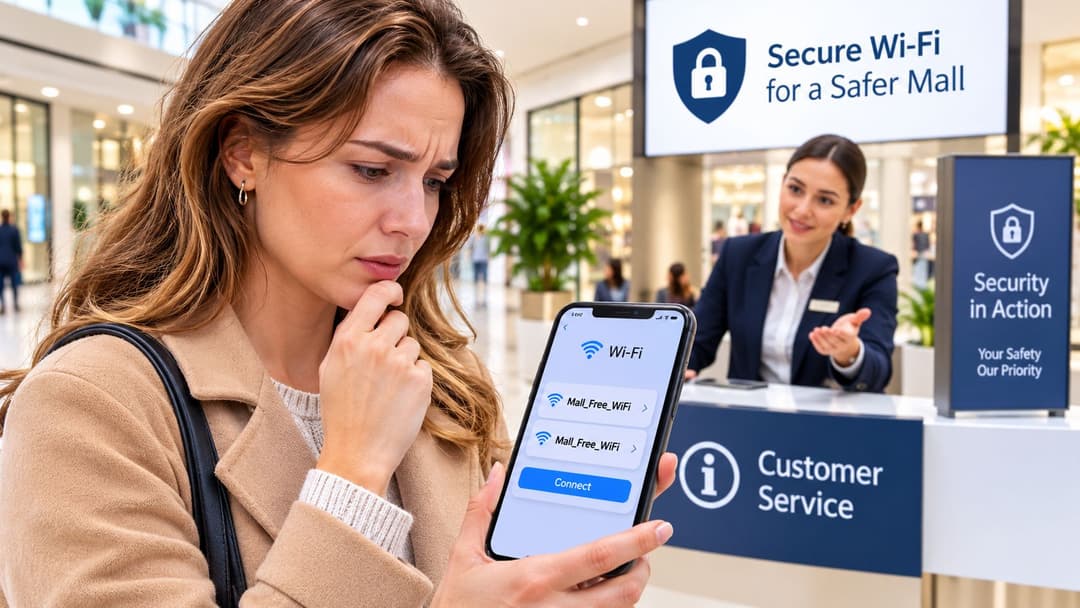
The evidence backs that picture. A nationally representative survey of 3,000 US adults found 32% were not confident they could distinguish a legitimate public WiFi network from a spoofed one, rising to 39% among people aged 55 and over. One in five took no precautions before joining public WiFi, and 16% didn't know what signs indicated a suspicious network, as ISPReview reported.
Adding a password doesn't fix that, and an over-complicated captive portal makes it worse by training people to give details to any page that asks. The design answer is to authenticate visitors without shared passwords, encrypt traffic from the first connection, keep guest devices off tenant and operational segments, and separate connectivity consent from marketing consent.
Then answer the questions visitors ask, in the places they ask them.
- "How do I know this is the official network?" Put the exact SSID on signage at every entrance and in the elevators, and say plainly that staff will never ask for a password.
- "Why is an email required?" One line, above the field: access is free, the address is used for the session and for marketing only if you check the box.
- "Can I opt out of marketing but still connect?" Yes, and the portal should make that the visible default rather than a hidden alternative.
- "What should I do if my phone auto-joins a fake network?" Forget the network, turn off auto-join for open networks, and report the name to the service desk.
A well-built captive portal can carry all of that in under thirty seconds of reading. The contrarian point stands: adoption depends less on free access than on a security model a non-technical visitor can understand at a glance.
Measuring value without covert surveillance
The pressure to prove value is real. Shopping-center foot traffic fell 2.3% year on year in May 2025, while overall US retail foot traffic declined 1.7%, as Retail Systems reported. When traffic is falling, a marketing team gets asked what the WiFi is for.
Part of the answer is that single months prove nothing either way. Shopping-center foot traffic rose 7.4% year on year in January 2025, and in April 2025 it rose 5.6%, yet with March and April combined to neutralize Easter's calendar position, shopping-center foot traffic was down 0.7% against the same two months of 2024, per the British Retail Consortium's spring footfall release. A promotion that lands in a rebound month will look like a triumph. Continuous measurement across seasons is the only honest way to attribute anything.
| Metric | What it shows | Main limitation |
|---|---|---|
| Connection rate | Share of visitors who join the network | Misses visitors who never open the portal |
| Authenticated repeat visits | Returning consented devices over time | One device is not necessarily one person |
| Dwell-time bands | Time spent in zones, grouped into ranges | Location is approximate and walkways distort it |
| Tenant-area engagement | Sessions or visits within a tenant zone | Depends on clear tenant signage and opt-in |
| Consented CRM outcomes | Offer redemptions linked to opted-in visitors | Covers only visitors who consented |
State the limitation next to the number, every time. A dwell-time chart that implies precision it doesn't have is worse than no chart, because someone will base a rent review on it.
Consent is not a switch you flip once
Connectivity consent is not consent for behavioral marketing. A visitor who accepted terms to get online has agreed to a connection, not to a profile built from their movement between zones, parking lots and walkways. Analytics covering people who never entered a store, or whose devices were picked up passively while walking past, need especially clear notice and, in practice, a defensible reason to exist.
The governance rule that survives scrutiny: report at center, zone or event level, publish your retention periods, and check every WiFi-derived figure against an independent anonymous footfall counter before it leaves the building.
Set retention periods deliberately, write them into the privacy notice, and honor them technically rather than by policy alone. A WiFi analytics guide helps here only if you read it as a specification for what to switch off, not just what to switch on.
The most credible return-on-investment case comes from fewer, better-governed metrics, reported with their limits attached, rather than from collecting every location signal the hardware can hear.
Operating, monitoring and renewing the network
Handover is the midpoint, not the finish. What keeps the network working is a short list of recurring jobs with a named owner for each.
- Watch a daily dashboard covering per-zone throughput, client counts, authentication failures and airtime utilization, in a format the center team can read without an engineer on the call.
- Set alert thresholds tied to point-of-sale health and to the consented metrics you report on, so a failing corridor surfaces before a tenant calls the manager.
- Schedule firmware updates outside business hours and roll them out one zone at a time, so a bad release costs one mall rather than the center.
- Name an owner for each of the four networks and route tenant support tickets through a defined path, with response targets written into the lease agreement.
- Repeat the peak-occupancy walk test annually and after any storefront change, buildout or new construction barrier that alters signal paths.
- Review retention periods and consent wording each year against current rules, and record that you did it.
The common slip is treating the network as finished at handover. Fit-outs then add interference, nobody owns the complaint, and the first anyone hears about it is a tweet from a shopper standing by the elevators.
Keep an incident log with cause, zone and time. Repeat faults show up in it within a quarter, and it gives you the evidence to replace an access point instead of arguing about whether it's needed.
Three center types and a design brief
Three patterns cover most US centers, and each has one design decision that matters more than the rest, plus one failure that turns up again and again.
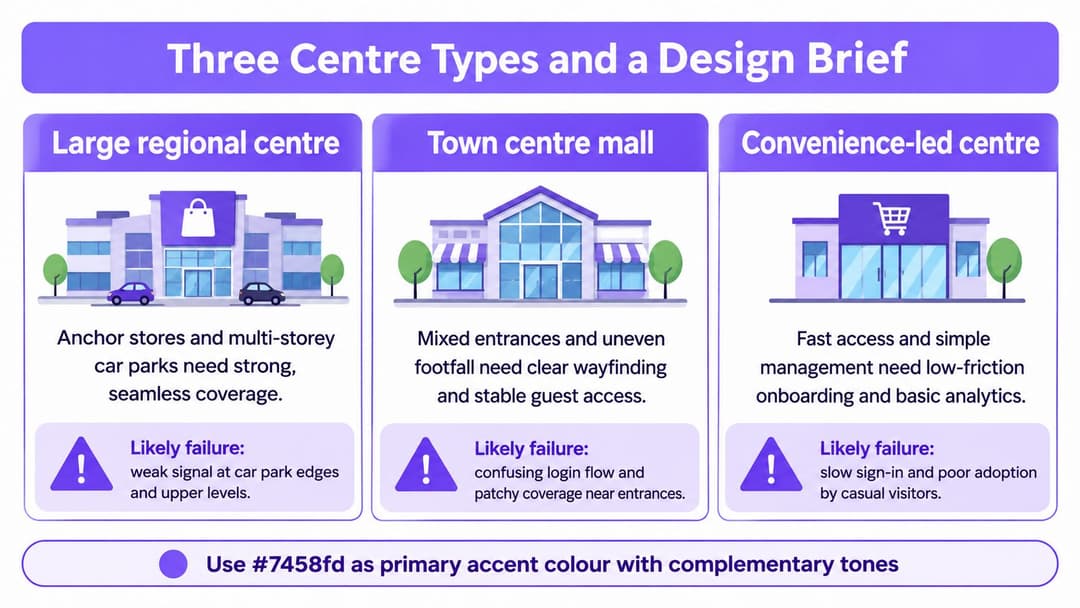
Large regional center with anchor stores and multi-story parking garages. The decision is wired backhaul to the anchor corridors and a properly isolated operational network for lighting and CCTV, because those systems sit furthest from the comms room and are the last to be fixed. The likely failure is parking lot signal left at variable level, so a shopper who wants to pay for parking on the app can't.
Downtown center linked to a train station. The decision is passwordless access for returning visitors plus dwell measured by zone, since a large share of traffic arrives with an existing device profile. The likely failure is a commuter peak overwhelming a network sized for average load.
Outlet or leisure center hosting events. The decision is temporary capacity provisioned before each event, with a stricter portal and event-specific terms. The likely failure is a peak arriving before the capacity does. If the parking lot has EV charging bays, those units belong on the operational segment with fixed keys and their own monitoring, and the range of home and workplace wallbox hardware now available means the electrical and network plans have to be agreed together rather than sequentially.
Complete this brief before any tender goes out.
- Name an owner for each of the four networks.
- Set the signal target per zone, with good indoor signal as the default for anchor stores, food courts and atriums.
- State peak occupancy and the concurrent-client figure you expect at it.
- Agree backhaul size and quality-of-service priorities for WiFi calling, authentication and point-of-sale traffic.
- Define the consented metrics and a retention period for each.
- List the access points the center already owns, and ask each vendor whether it supports that hardware.
That last question saves the most money. Staff access can run on the access points a business already owns with no PKI to build, and the vendor list is broad: Purple has provided guest, staff and multi-tenant WiFi to retailers, transit hubs and downtown districts since 2012, and supports Cisco Meraki, HPE Aruba, Ruckus, Juniper Mist, Ubiquiti UniFi, Cambium, Extreme and Fortinet. Take the network split from the second section, the signal target from the third and the consent wording from the fourth, then send the brief to two or three providers and compare their answers line by line.
If you're writing that brief this quarter, Purple's guest access connects visitors with passwordless email or Passpoint authentication and encrypted connectivity from the first packet, while the analytics layer reports repeat visits, dwell bands and tenant activity at the level your consent notice supports. Start with the Purple platform and map your four networks onto it before you commit to hardware.