
How to leverage SMS marketing restaurants to increase return visits
This guide details how restaurant operators can use guest WiFi to capture consented first-party data and drive repeat visits through automated SMS marketing. It covers technical architecture, compliance requirements, segmentation strategies, and real-world implementation scenarios.
Listen to this guide
View podcast transcript
Executive Summary
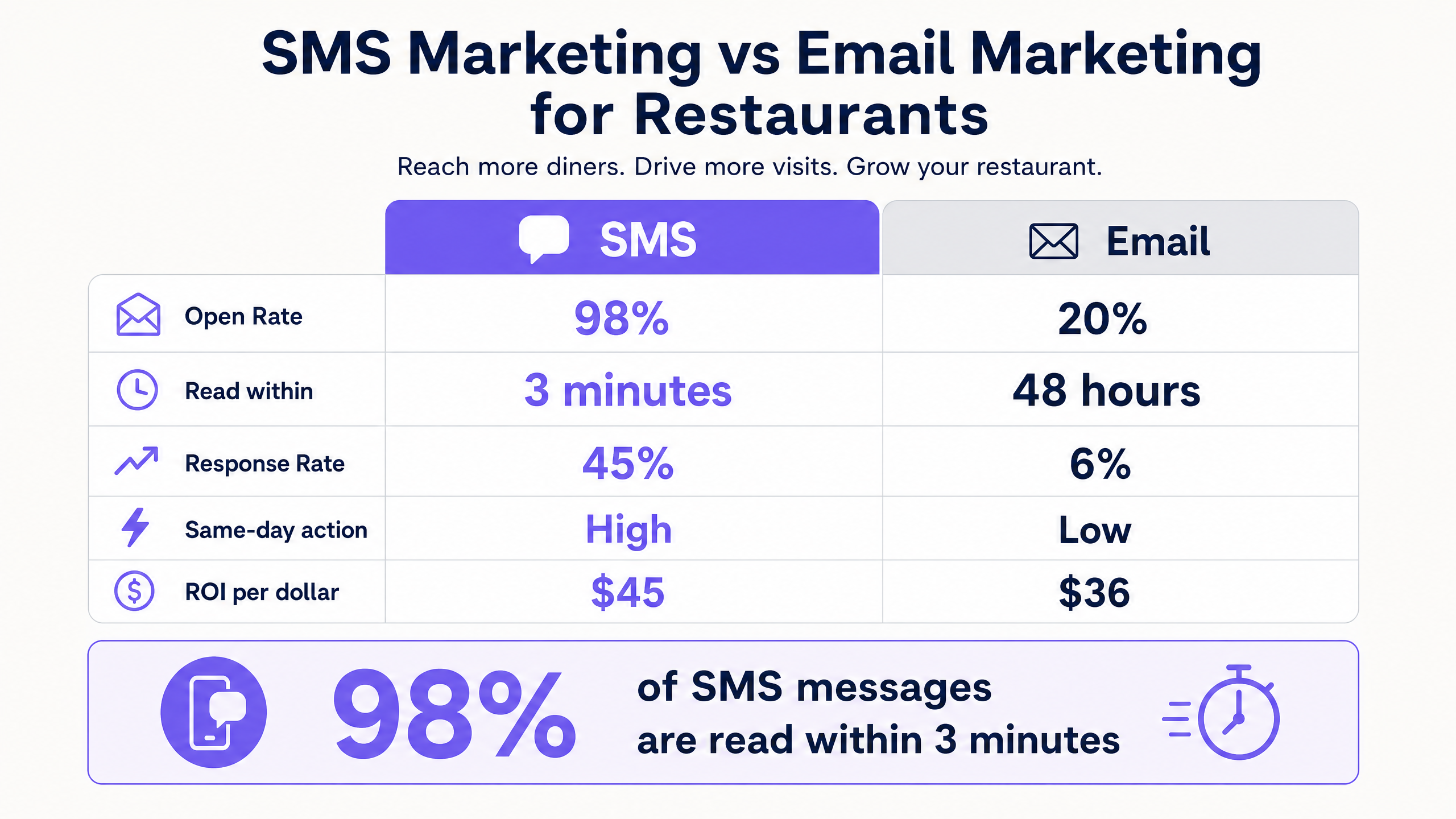
Restaurant operators face a structural challenge: third-party delivery platforms own the guest relationship, organic social reach is negligible, and hospitality email open rates sit around 20% [1]. To drive return visits predictably, operators need a direct, high-engagement channel. SMS marketing delivers a 98% open rate, with most messages read within three minutes [1] [2]. However, the success of an SMS programme depends entirely on the quality of the data feeding it. This guide explains how to use your existing guest WiFi infrastructure to build a compliant, first-party data pipeline, and how to automate SMS campaigns that generate measurable revenue uplift.
Technical Deep-Dive
The Data Capture Architecture
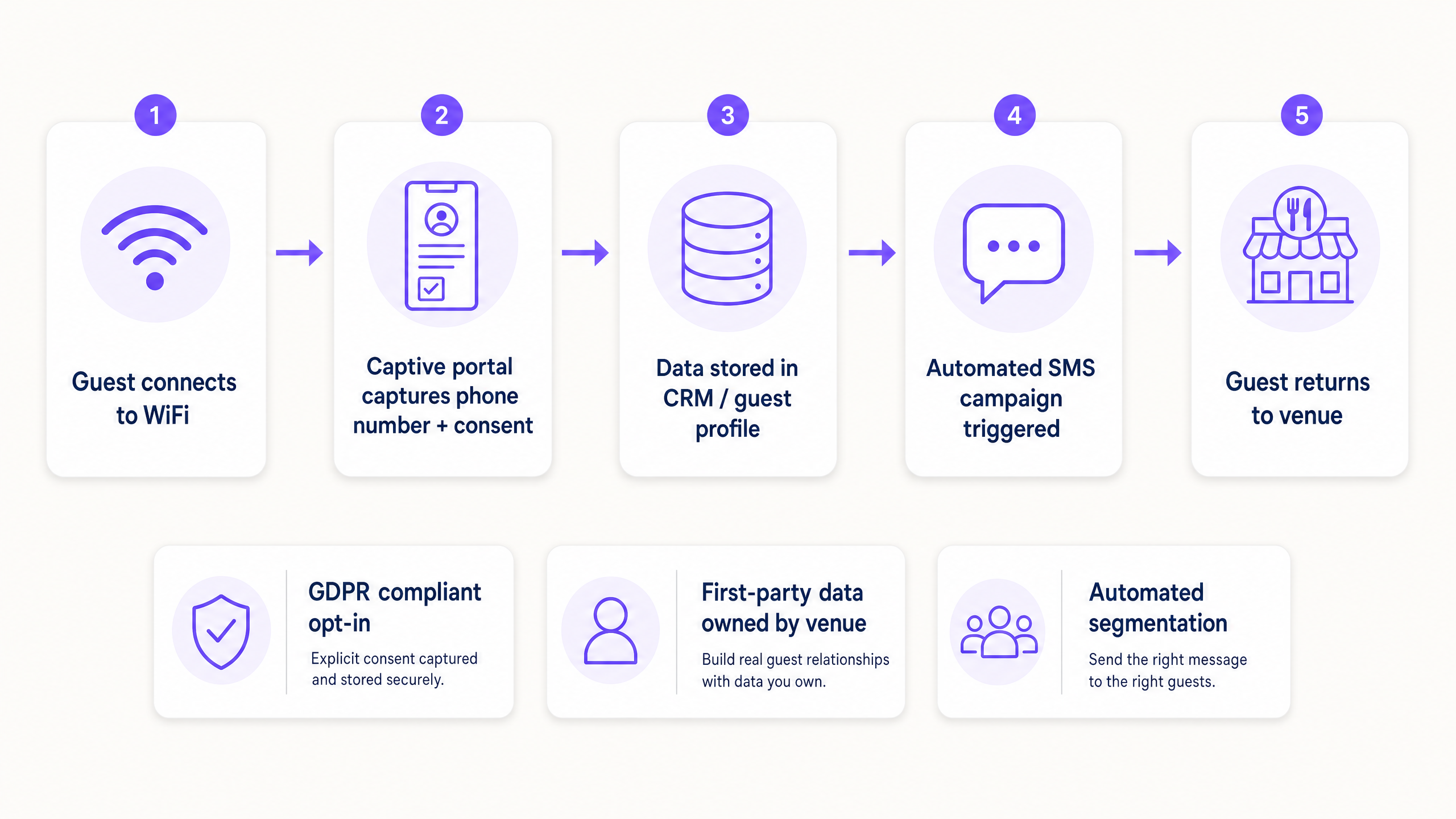
The foundation of restaurant SMS marketing is the data capture layer. Relying on staff to manually collect phone numbers at the point of sale is slow, prone to error, and difficult to scale. The most reliable method is to integrate data capture into the guest WiFi authentication flow.
When a diner connects to the venue's network, the traffic is routed to a captive portal. Purple's architecture handles this authentication process. The guest is presented with a branded login screen requiring their phone number. Crucially, the portal must separate network access from marketing consent to comply with GDPR and PECR regulations. The guest must actively opt in to receive SMS marketing; access to the WiFi cannot be conditional on this consent [3].
Once authenticated, the guest's phone number, consent record, and device MAC address are stored in the Purple CRM. This creates a unified guest profile. Every subsequent visit by that device is logged automatically, enriching the profile with behavioural data including visit frequency and dwell time.
Integration and Automation
The guest profile data is then synced with an SMS marketing platform or CRM. Purple's Engage plan facilitates this via native connectors or webhooks. The integration must be bidirectional: when a guest replies 'STOP' to an SMS, the opt-out must immediately update the central guest profile to prevent further sends and ensure compliance.
Implementation Guide
1. Configure the Captive Portal
Deploy the Purple captive portal across your hardware estate (e.g., Cisco Meraki, HPE Aruba). Configure the login options to prioritise phone number capture. Ensure the marketing consent checkbox is unticked by default and clearly states what the guest is opting into.
2. Define the Segmentation Logic
Do not send broadcast messages to your entire list. Use the visit data captured by the WiFi network to segment your audience into four tiers:
- New Guests: 1 visit in the last 30 days.
- Returning Guests: 2-4 visits in the last 90 days.
- Regulars: 5+ visits in the last 90 days.
- Lapsed Guests: 0 visits in the last 60 days.
3. Build the Automated Journeys
Configure automated triggers based on these segments:
- The Welcome Sequence: Trigger an SMS 24-48 hours after a new guest's first visit. Offer a modest incentive (e.g., a free side dish) to drive the crucial second visit.
- The Milestone Trigger: Acknowledge loyalty without discounting. When a guest logs their 5th or 10th visit, trigger a thank-you message.
- The Slow-Shift Promo: Target the 'Returning Guests' segment. Send a same-day offer (e.g., 20% off food) at 10:00 AM on traditionally quiet days like Tuesday or Wednesday [1].
- The Win-Back Campaign: Trigger a message when a guest enters the 'Lapsed' segment (60 days since last visit). Provide a strong, time-limited offer to break their inertia.
Best Practices
- Frequency Limits: Cap SMS sends at 2-4 messages per month per guest. Exceeding this drives high unsubscribe rates.
- Timing: Send messages when guests are making dining decisions. Mid-morning (10:00 AM - 11:00 AM) works well for lunch or same-day dinner offers. Avoid sending messages before 9:00 AM or after 9:00 PM.
- List Hygiene: Scrub your list quarterly. Remove contacts who have not engaged (visited or clicked a link) in six months to protect your sender reputation.
Troubleshooting & Risk Mitigation
Compliance Failures
Risk: Fines under GDPR or TCPA for sending unsolicited messages. Mitigation: Maintain a strict separation between WiFi terms of service and marketing consent on the captive portal. Store the timestamp and exact wording of the consent agreement in the guest profile. Implement automated opt-out processing.
High Unsubscribe Rates
Risk: Rapid list decay due to irrelevant messaging. Mitigation: Review your segmentation. If you are sending a 'Free Dessert for your Birthday' message to a guest who visited once three years ago, they will unsubscribe. Ensure offers match the guest's relationship tier.
ROI & Business Impact
To measure the success of an SMS programme, track the Return Visit Rate and Incremental Revenue, not just open rates.
For example, if a slow-shift promo is sent to 3,000 returning guests, and 100 of those guests visit that evening (tracked via WiFi authentication or POS integration), you can calculate the exact revenue generated by that campaign. At an average spend of £25 per cover, that single automated message generates £2,500 in incremental revenue.
References
[1] Message IQ. SMS Marketing for Restaurants: Complete Guide (2026). Available at: https://messageiq.io/blogs/sms-marketing-for-restaurants/ [2] Olo. Why Every Restaurant Brand Should Use SMS Marketing. Available at: https://www.olo.com/blog/why-sms-marketing-matters-for-restaurants [3] MyWiFi Networks. GDPR & WiFi Data Collection: 2026 Compliance Checklist. Available at: https://www.mywifinetworks.com/blog/gdpr-wifi-data-collection-guide
Podcast Briefing
Listen to our senior consultant discuss the strategy and implementation of SMS marketing for restaurants.
Key Definitions
Captive Portal
A web page that users must interact with before being granted access to a public WiFi network. It is the primary data capture mechanism for venue operators.
IT teams configure captive portals to authenticate users, present terms of service, and capture first-party data and marketing consent.
First-Party Data
Information collected directly from your customers with their explicit consent, such as phone numbers gathered via a guest WiFi login.
Unlike third-party data bought from brokers, first-party data is highly accurate and owned entirely by the venue, making it the foundation of effective CRM strategies.
Opt-In Consent
The explicit, unambiguous agreement by a user to receive marketing communications.
Under GDPR, pre-ticked boxes or bundled consent (e.g., agreeing to marketing to get WiFi access) are invalid. Consent must be an active, separate choice.
Dwell Time
The duration a guest's device remains connected to or detected by the venue's WiFi network during a single visit.
Operations directors use dwell time analytics to measure table turn rates, identify service bottlenecks, and segment guests based on their typical visit length.
List Decay
The natural degradation of a marketing database over time as people change phone numbers or lose interest in the brand.
Marketing managers must regularly scrub their SMS lists to remove inactive contacts, which protects sender reputation and reduces messaging costs.
Bidirectional Sync
An integration architecture where data flows seamlessly in both directions between two systems (e.g., Purple CRM and an SMS platform).
If a guest replies 'STOP' to an SMS, bidirectional sync ensures that opt-out is immediately reflected in the central guest profile, preventing compliance breaches.
Transactional Message
An SMS sent to facilitate an agreed-upon transaction, such as a reservation confirmation or a receipt.
Transactional messages do not require explicit marketing consent, but they must not contain promotional content.
Win-Back Campaign
An automated marketing sequence designed to re-engage guests who have not visited the venue for a specified period (e.g., 60 days).
CRM managers use win-back campaigns to identify lapsed guests and present them with compelling offers to break their inertia and return to the venue.
Worked Examples
A 15-site casual dining group wants to drive traffic on Tuesday evenings. They have a database of 20,000 contacts collected via their guest WiFi.
The IT and Marketing teams configure a 'Slow-Shift Promo' automated journey. They segment the database to target only 'Returning Guests' (2-4 visits in the last 90 days) who live within a 5-mile radius of a venue. At 10:30 AM on Tuesday, they trigger an SMS offering a complimentary starter with any main course, valid only for that evening. The message includes a unique trackable link to the reservation platform.
A quick-service restaurant (QSR) chain notices a high drop-off rate after a customer's first visit. They need to increase the frequency of second visits.
The chain implements a 'Welcome Sequence'. When a device connects to the guest WiFi for the first time and the user opts into marketing, the Purple platform logs the visit. 48 hours later, an automated SMS is triggered: 'Thanks for visiting us! Show this text on your next visit within 14 days for a free coffee on us.'
Practice Questions
Q1. Your marketing team wants to increase the size of the SMS database quickly. They propose changing the captive portal configuration so that guests must check the marketing opt-in box to access the free WiFi. As the IT Director, do you approve this change?
Hint: Consider the GDPR requirements for consent.
View model answer
No. Under GDPR, consent must be freely given. Making WiFi access conditional on marketing consent constitutes 'bundled consent', which is invalid. The captive portal must separate network access from marketing opt-in to remain compliant.
Q2. A casual dining chain is seeing a high unsubscribe rate from their SMS campaigns. They currently send one message per week to their entire database of 50,000 contacts, usually offering 10% off. What architectural or strategic change should they implement?
Hint: Think about how WiFi data can improve relevance.
View model answer
They need to implement segmentation based on visit behaviour. Sending a generic broadcast message to the entire list causes fatigue. They should use the visit frequency data captured by the WiFi network to segment the list into New, Returning, Regular, and Lapsed guests, and tailor the message cadence and offer to each specific group.
Q3. You are deploying a new SMS marketing platform that will integrate with Purple. A guest receives a promotional text and replies 'STOP'. What must happen next at the system architecture level?
Hint: Consider data synchronisation between platforms.
View model answer
The SMS platform must process the opt-out and immediately push that status update back to the central guest profile in the Purple CRM via a bidirectional sync (e.g., webhook or API). This ensures the guest is suppressed from all future marketing lists and maintains compliance.