
How to leverage SMS marketing statistics to increase return visits
This technical reference guide details how venue operators can leverage SMS marketing statistics to drive measurable return visits. It covers the architectural implementation of Guest WiFi data capture, audience segmentation, and GDPR-compliant automated messaging.
Listen to this guide
View podcast transcript
Executive Summary
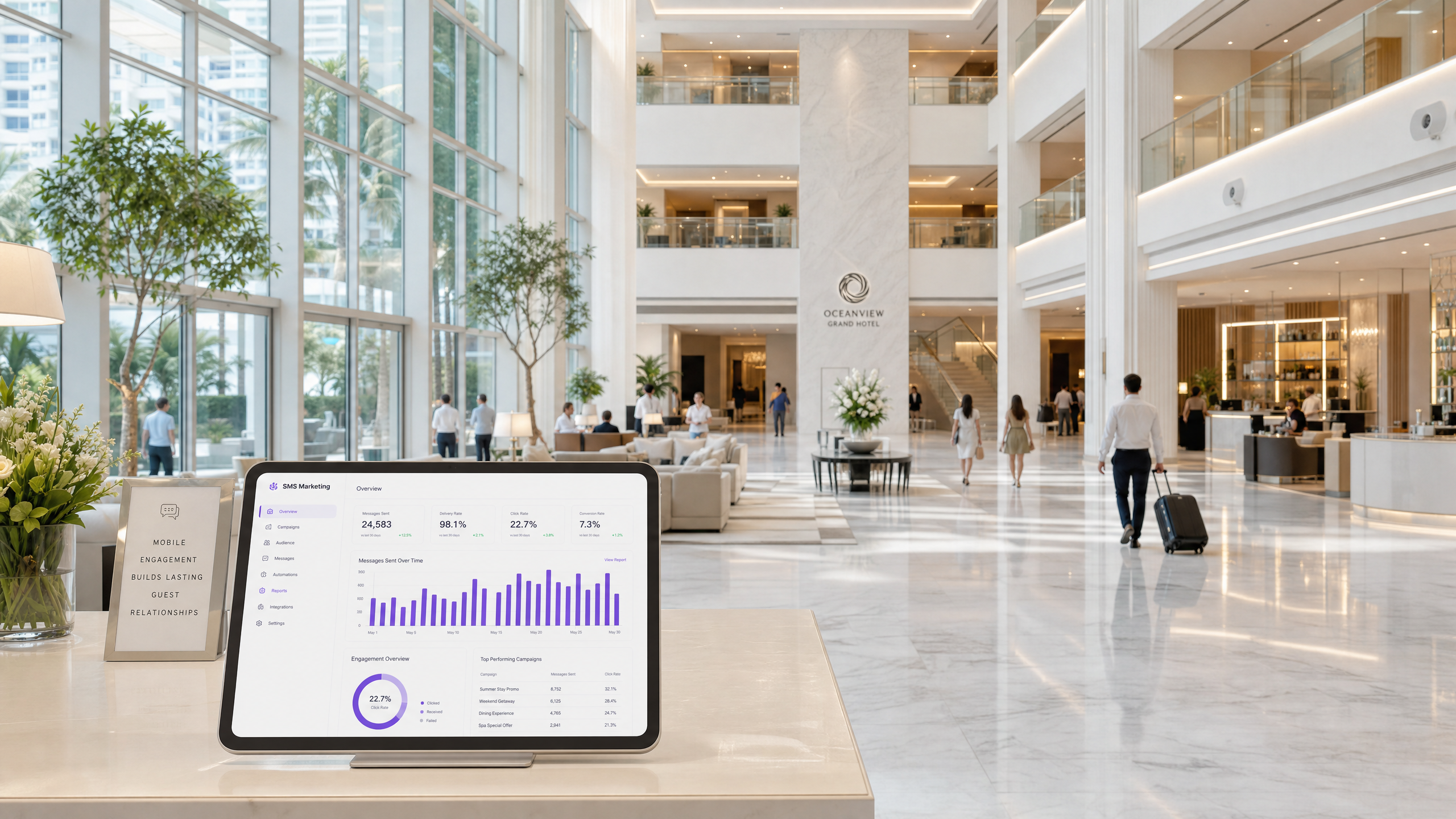
SMS marketing statistics demonstrate a clear operational advantage over traditional channels. With a 98% open rate and 90% of messages read within three minutes [1], SMS is the most direct method to drive return visits. However, the bottleneck for most venues is data acquisition. This guide outlines how to use existing Guest WiFi infrastructure to capture verified mobile numbers, deploy automated SMS campaigns, and achieve the 42:1 average ROI [2] seen in high-performing retail and hospitality environments. We will cover the technical architecture, segmentation strategies, and compliance requirements necessary to build a high-converting SMS engine.
Listen to the companion podcast for an audio briefing on these concepts:
Technical Deep-Dive
The Data Acquisition Architecture
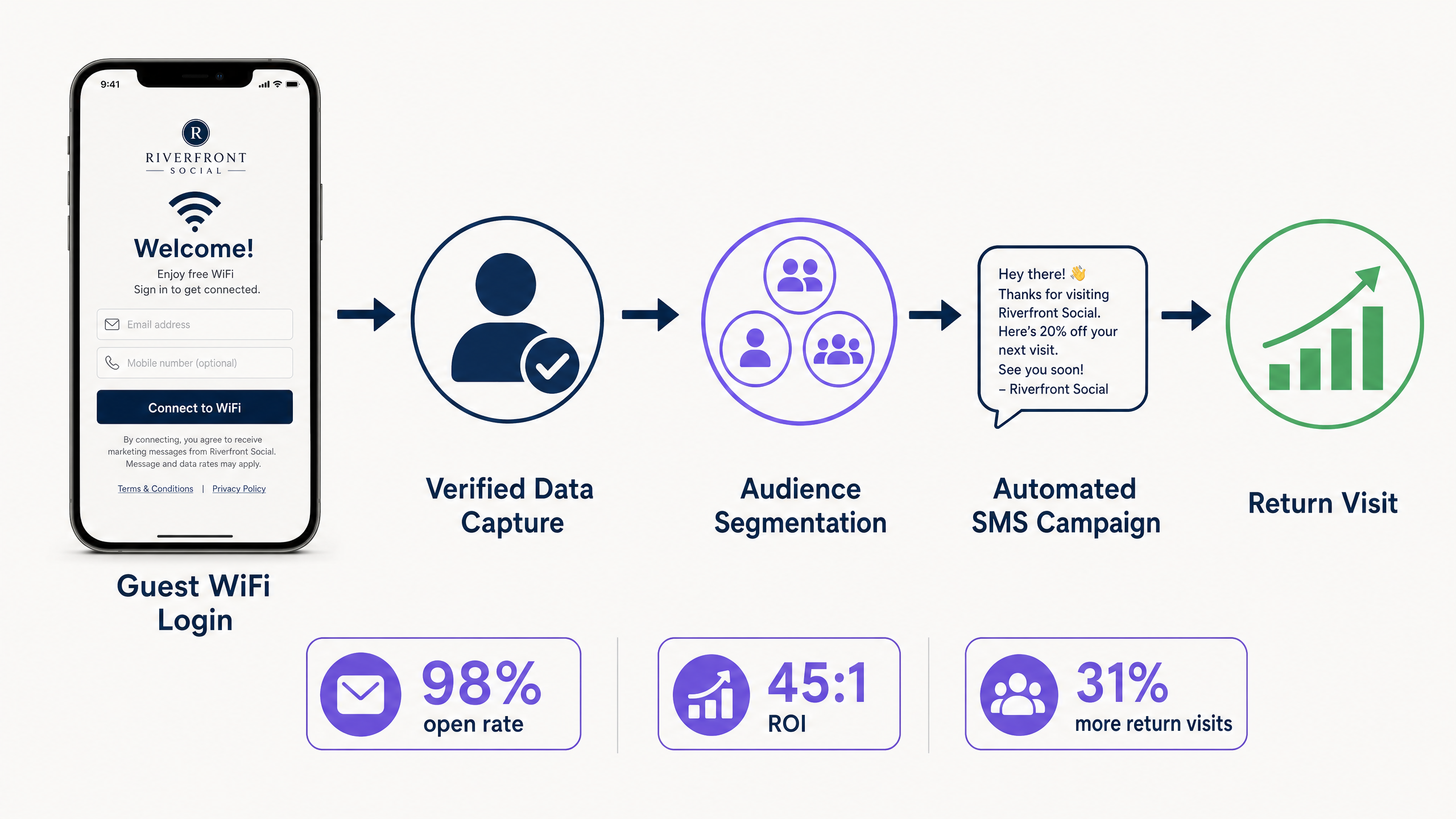
The foundation of effective SMS marketing is a verified, consented database of mobile numbers. Relying on point-of-sale data collection is slow and prone to human error. Instead, venue operators should use their existing wireless network as the primary data capture mechanism.
When a visitor connects to your Guest WiFi , they are presented with a captive portal. This portal acts as the identity verification layer. By configuring the portal to request a mobile number alongside an email address, you create a direct link between a physical visit and a digital identifier.
Purple operates as a cloud overlay, integrating directly with enterprise hardware including Cisco Meraki, HPE Aruba, Ruckus, Juniper Mist, and Ubiquiti UniFi. This hardware-agnostic approach means you can deploy the data capture layer without replacing your access points.
Consent and Compliance (GDPR and PECR)
Capturing the data is only the first step; capturing the consent is the critical compliance requirement. Under GDPR Article 7, consent must be freely given, specific, informed, and unambiguous.
When deploying a captive portal for SMS data capture:
- Explicit Opt-In: The portal must include an unticked checkbox specifically for SMS marketing consent.
- Clear Language: State exactly what the visitor is opting into (e.g., "Tick here to receive exclusive offers and updates via text message").
- Audit Trail: The system must record the timestamp, IP address, and MAC address of the device at the moment of consent. Purple logs this data automatically, providing a defensible audit trail for Subject Access Requests.
Leveraging the Statistics for Campaign Design
Understanding the statistics allows you to architect campaigns that align with consumer behaviour.
- Timing: DMText platform analytics show that the 5pm to 8pm window delivers a 28.6% click-through rate, the highest of any time slot [2]. Configure your automated sends to trigger during this window.
- Message Length: Keep payloads between 80 and 120 characters. This length achieves a peak 26.8% click-through rate while remaining within a single SMS segment [2], optimising your cost-per-send.
- Personalisation: Campaigns using multiple personalisation fields (e.g., first name, venue location) see a 119% lift in conversion rates compared to unpersonalised broadcasts [2].
Implementation Guide
To move from data capture to automated return visits, follow this deployment sequence:
Step 1: Configure the Captive Portal
Deploy the Purple cloud overlay onto your existing network hardware. Design the captive portal splash page to request the visitor's mobile number. Ensure the SMS opt-in checkbox is prominent but unticked by default to maintain compliance.
Step 2: Establish Audience Segmentation
Do not send flat broadcasts. Use your WiFi Analytics to build dynamic segments based on physical behaviour.
- New Visitors: Devices seen for the first time.
- Lapsed Loyal: Devices previously seen 3+ times, but not seen in the last 30 days.
- High Dwell Time: Visitors who spend more than two hours in the venue.
Step 3: Deploy Automated Triggers
Configure automated campaigns in Purple Engage based on the segments above.
- Set a Welcome Automation to trigger 24 hours after a first visit.
- Set a Re-engagement Automation to trigger when a visitor enters the 'Lapsed Loyal' segment.
Best Practices
- Frequency Capping: Validity Research indicates that 49% of consumers unsubscribe due to overly frequent messaging [3]. Implement a hard cap of no more than four messages per month per user, with a minimum seven-day gap between sends.
- Vertical-Specific Messaging: In Retail , focus on flash sales and digital coupons. In Hospitality , focus on post-stay re-engagement and on-property upsells (e.g., spa bookings).
- Clear Opt-Out: Every message must include a simple opt-out mechanism (e.g., "Reply STOP to cancel"). This is a strict requirement under the Privacy and Electronic Communications Regulations (PECR).
Troubleshooting & Risk Mitigation
High Opt-Out Rates If your opt-out rate exceeds 3% per campaign, your messaging is either too frequent or irrelevant. Review your segmentation logic. Ensure you are not sending generic offers to highly specific visitor profiles.
Low Delivery Rates If delivery rates drop below 95%, you have a list hygiene issue. Implement number validation at the captive portal stage to ensure visitors are inputting correctly formatted mobile numbers before they gain network access.
ROI & Business Impact
The business case for SMS marketing is driven by its high conversion rate and low marginal cost.
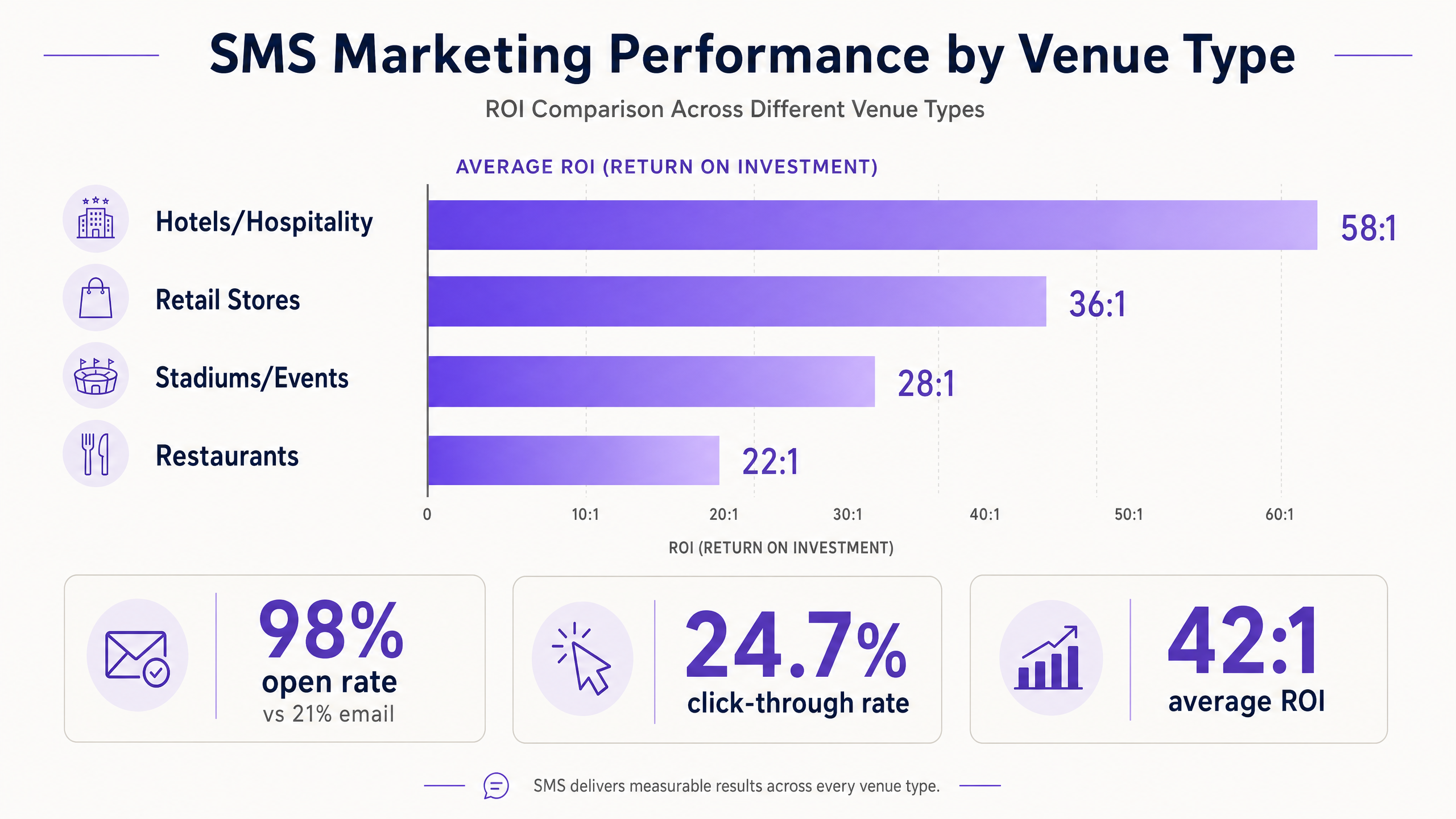
According to industry data, retail venues see an average ROI of 42:1, while restaurants can achieve up to 51:1 [2]. This is because a single text message costs pence, but drives a return visit worth significantly more. By automating this process through Guest WiFi data capture, you eliminate the manual effort of list building and campaign execution, creating a scalable engine for footfall generation.
References
[1] Infobip, SMS marketing benchmarks, 2024. [2] DMText, SMS Marketing Benchmarks, 2025. [3] Validity, The State of SMS Marketing, 2023.
Key Definitions
Captive Portal
A web page that a user must view and interact with before access is granted to a public WiFi network.
This is the primary mechanism for capturing verified mobile numbers and explicit marketing consent from venue visitors.
First-Party Data
Information a company collects directly from its customers or visitors.
Data captured via Guest WiFi is highly valuable first-party data because it is verified and tied directly to a physical venue visit.
Click-Through Rate (CTR)
The percentage of recipients who click on a link contained within an SMS message.
A key metric for measuring campaign effectiveness. SMS typically achieves a CTR of 19-36%, significantly higher than email.
Cloud Overlay
A software architecture that integrates with existing hardware infrastructure without requiring physical replacement.
Purple operates as a cloud overlay, allowing IT teams to deploy data capture capabilities on existing Cisco Meraki or HPE Aruba networks.
Frequency Capping
A system limit placed on the number of marketing messages a single user can receive within a specific timeframe.
Crucial for preventing database churn. Sending too many SMS messages is the primary cause of high opt-out rates.
GDPR Article 7
The section of the General Data Protection Regulation that outlines the conditions for valid consent.
Venue operators must ensure their captive portal opt-in mechanisms meet these conditions to legally process mobile numbers for marketing.
Lapsed Loyal
A behavioural segment of visitors who previously visited frequently but have not returned within a specified recent timeframe.
This is often the highest-ROI segment to target with automated SMS re-engagement campaigns.
PECR
The Privacy and Electronic Communications Regulations, which sit alongside the Data Protection Act in the UK.
PECR specifically governs electronic marketing, making explicit consent mandatory for SMS campaigns and requiring a clear opt-out mechanism.
Worked Examples
A 200-room hotel needs to increase direct bookings from past guests. They currently rely on email marketing but are seeing open rates below 15%. They use Cisco Meraki access points.
- Deploy Purple as a cloud overlay on the Meraki hardware.
- Update the captive portal to capture mobile numbers with a clear GDPR-compliant opt-in for marketing.
- Create a 'Lapsed Guest' segment in Purple Engage for visitors not seen on the network in 90 days.
- Configure an automated SMS trigger offering a 15% discount on direct bookings, sent at 5:30 PM on a Thursday to maximise the 28.6% peak engagement window.
A national retail chain with 50 locations wants to drive weekend footfall. They have a database of 100,000 mobile numbers but are experiencing a 5% opt-out rate per campaign.
- Implement frequency capping to restrict sends to a maximum of two per month per user.
- Stop broadcasting national offers to the entire list.
- Use WiFi analytics to segment the audience by their primary venue location.
- Send location-specific SMS offers (e.g., 'Show this text at our Manchester store this Saturday for 10% off').
Practice Questions
Q1. A stadium IT director wants to collect mobile numbers for SMS marketing during match days. They propose automatically opting in everyone who accepts the WiFi terms and conditions. Why is this problematic?
Hint: Consider the specific requirements for consent under GDPR and PECR.
View model answer
This approach violates GDPR and PECR requirements. Consent for electronic marketing must be explicit, specific, and unbundled from general terms and conditions. The captive portal must feature a separate, unticked checkbox specifically for SMS marketing consent. Bundled or inferred consent is not legally valid.
Q2. A retail marketing manager is planning a flash sale SMS campaign to a list of 50,000 verified numbers. They plan to send the message at 9:00 AM on a Monday. Based on industry statistics, what adjustment should they make?
Hint: Review the optimal timing statistics for SMS engagement.
View model answer
They should adjust the send time to the 5:00 PM to 8:00 PM window. Data shows this evening window delivers the highest click-through rates (up to 28.6%), as consumers are more likely to engage with promotional content outside of core working hours.
Q3. A hospitality group is experiencing a 6% opt-out rate on their weekly SMS broadcasts. They are sending the same generic dining offer to their entire database of past hotel guests. What architectural change should they implement?
Hint: Consider how WiFi analytics can be used to improve message relevance.
View model answer
They must implement audience segmentation. Broadcasting generic offers causes list fatigue. They should use their WiFi analytics to segment the audience by behaviour (e.g., guests who frequently visit the restaurant vs. guests who only use the conference facilities) and send targeted, relevant offers to those specific segments. They should also reduce frequency to prevent fatigue.