
How to leverage SMS marketing agency to increase return visits
This technical guide explains how venue operators can leverage their existing guest WiFi infrastructure to capture verified phone numbers and consent, and integrate this data with an SMS marketing agency to drive return visits. It covers deployment architecture, GDPR/CCPA compliance, and campaign attribution.
Listen to this guide
View podcast transcript
Executive Summary
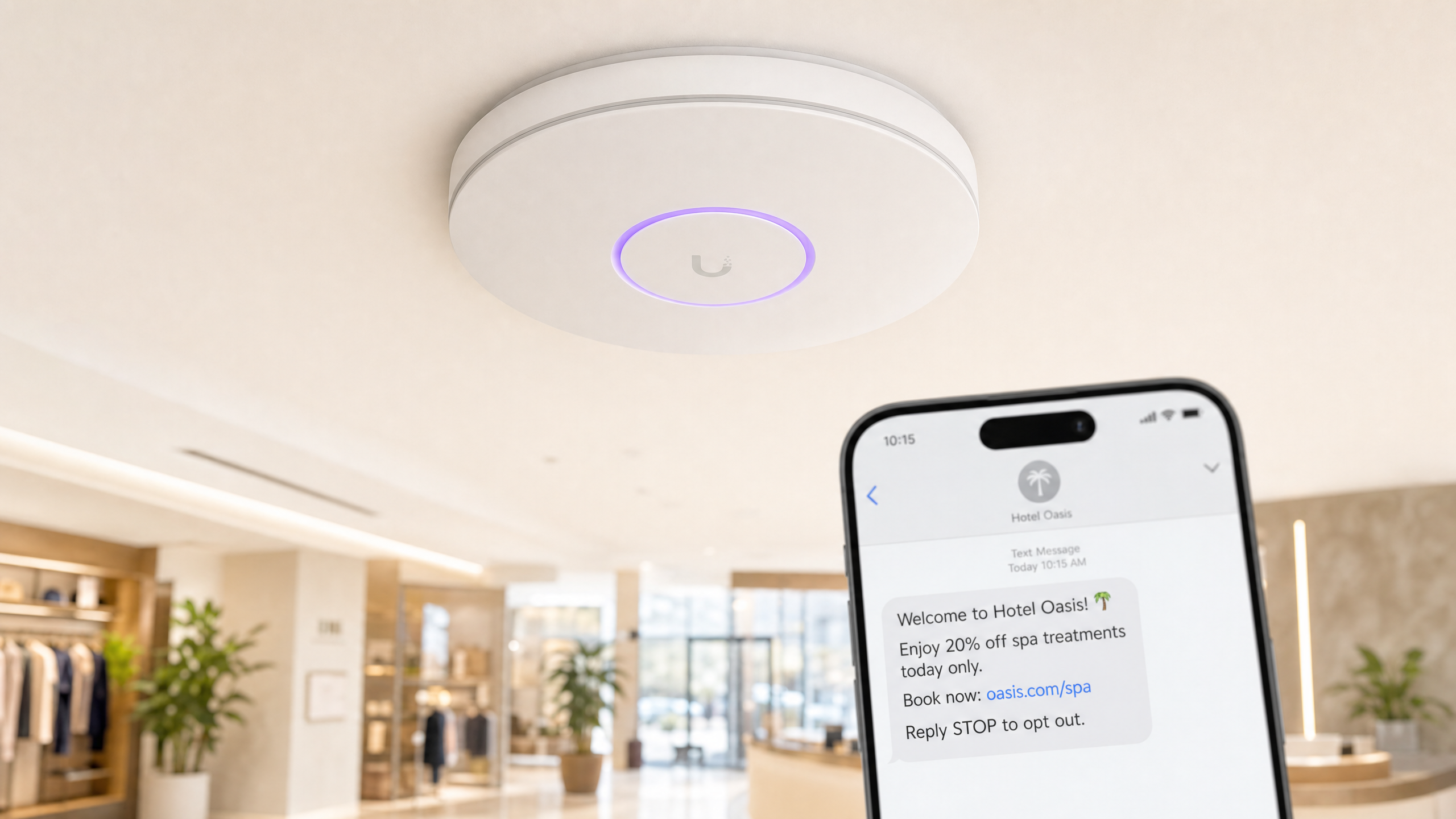
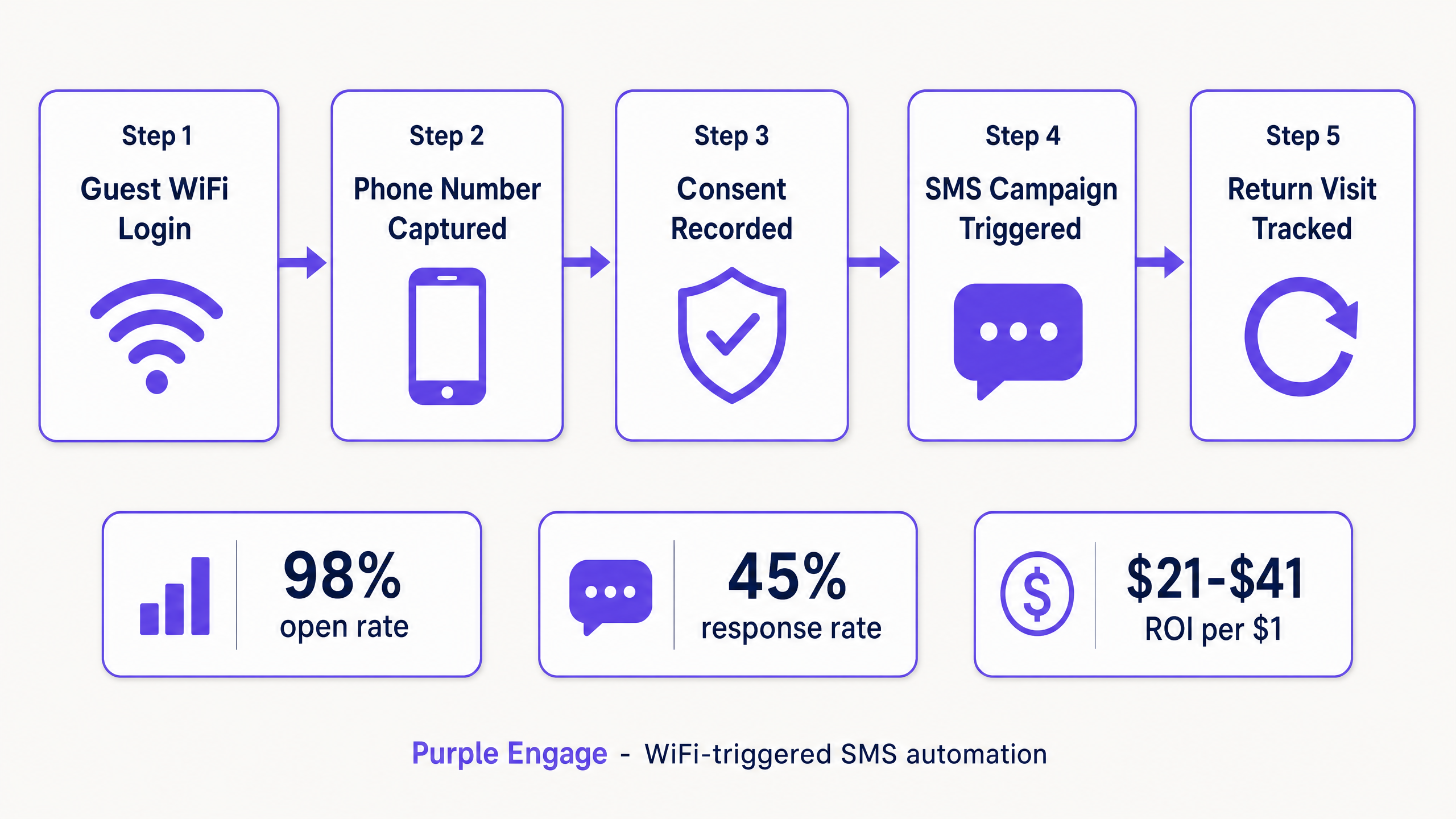
Venue operators sit on a goldmine of unactivated data. Every day, guests connect to your WiFi network. While most venues capture email addresses, few successfully build a verified, consented database of mobile phone numbers. This represents a significant missed opportunity. SMS marketing delivers a 98% open rate and a 45% response rate, vastly outperforming email.
This guide details how to use your existing guest WiFi infrastructure to capture phone numbers compliantly, and how to integrate that data with an SMS marketing agency to drive measurable return visits. We cover the technical architecture of the Purple Engage platform, the mechanics of consent under GDPR and CCPA, and real-world implementation case studies from the hospitality and retail sectors. For IT managers and marketing directors looking to increase revenue from existing footfall, this is the technical playbook.
Technical Deep-Dive: The Data Capture Engine
The foundation of any successful SMS marketing programme is a clean, verified, and consented list of phone numbers. Purchasing third-party lists is ineffective and often non-compliant. The most reliable method for a physical venue to build a first-party database is through the guest WiFi login process.
The Captive Portal Architecture
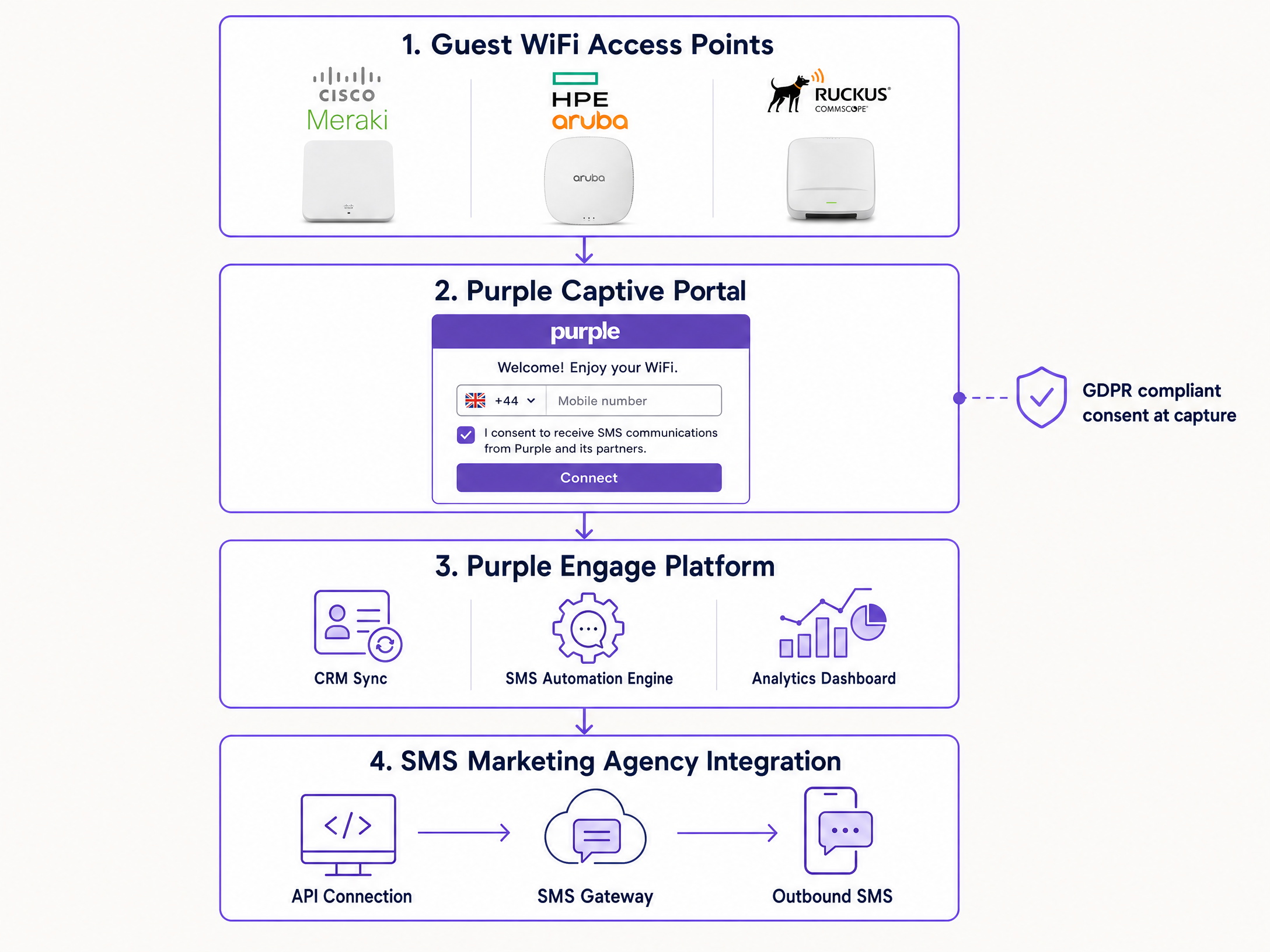
When a visitor connects to your network, they are intercepted by a captive portal before gaining internet access. Purple provides a hardware-agnostic cloud overlay that integrates directly with your existing infrastructure. We support Cisco Meraki, HPE Aruba, Ruckus, Juniper Mist, Ubiquiti UniFi, Cambium, Extreme, and Fortinet.
The captive portal handles the authentication and data capture. To build an SMS database, you configure the portal to require a mobile phone number as part of the login flow.
Consent and Compliance (GDPR & CCPA)
Capturing the number is only the first step; capturing the consent is where many venues fail. Under GDPR, CCPA, and PECR, you must obtain explicit, freely given consent to send marketing messages.
You cannot bundle marketing consent into the general WiFi terms and conditions. The Information Commissioner's Office (ICO) in the UK has explicitly stated that making marketing consent a condition of accessing a service (like free WiFi) invalidates the consent.
Purple handles this by presenting a distinct, un-ticked checkbox for SMS marketing consent on the splash page. When a guest ticks this box, Purple records the timestamp, the specific wording of the consent statement, and the IP address, creating an auditable compliance trail.
Data Flow and Integration
Once the phone number and consent are captured, the data must move to your SMS marketing agency. Purple Engage provides a robust API and a library of over 400 connectors to sync this data automatically with your CRM or marketing automation platform.
The data payload includes the verified phone number, the consent flag, demographic data (if collected), and presence analytics (time of visit, dwell time, venue location). Your SMS marketing agency receives a continuously updated, highly segmented list of warm leads.
Implementation Guide: Executing the Campaign
With the data flowing from your access points to your SMS agency, you can begin executing campaigns designed to increase return visits.
Step 1: Segmentation
Do not send batch-and-blast messages to your entire database. Work with your SMS marketing agency to segment the data based on the presence analytics captured by Purple. Key segments include:
- First-time visitors: Send a welcome message with an incentive to return within 14 days.
- Loyal customers: Send exclusive early-access offers or VIP event invitations.
- Lapsed visitors: Target guests who have not connected to the WiFi in over 60 days with a strong re-engagement offer.
Step 2: Triggered Automations
Set up automated journeys based on guest behaviour. For example, if a guest connects to the WiFi at a stadium, trigger an SMS two hours later offering a discount on merchandise. Purple Engage allows you to build these automated logic flows directly within the platform.
Step 3: Attribution and Measurement
To prove ROI, you must measure how many SMS recipients actually return to the venue. Your SMS marketing agency should use unique, trackable discount codes in their campaigns. Furthermore, you can cross-reference the SMS campaign send list with Purple's WiFi reconnection data. If a guest receives a text on Wednesday and their device authenticates on the network on Friday, you have a verified return visit attributable to the campaign.
Best Practices
When deploying SMS marketing via guest WiFi, adhere to these industry-standard recommendations:
- Prioritise Value Over Volume: SMS is an intimate channel. Only send messages that offer clear, immediate value to the recipient. A flash sale or a relevant operational update (e.g., "Your table is ready") works well. Generic newsletters do not.
- Respect the Frequency Cap: Limit promotional SMS messages to two to four per month per subscriber. Exceeding this cap is the primary driver of high opt-out rates.
- Verify the Number: Use SMS verification (sending a one-time passcode) during the WiFi login process to ensure the phone numbers you collect are accurate and active.
- Provide a Clear Opt-Out: Every marketing SMS must include a simple opt-out mechanism, typically "Reply STOP to unsubscribe". Ensure your SMS gateway automatically processes these requests and syncs the updated consent status back to your CRM.
Troubleshooting & Risk Mitigation
| Failure Mode | Root Cause | Mitigation Strategy |
|---|---|---|
| High Unsubscribe Rate | Messaging frequency is too high, or content lacks relevance. | Implement a strict frequency cap (max 4/month). Segment the audience to ensure offers are highly relevant to their visit history. |
| Low Opt-In Rate at Portal | The consent checkbox is hidden, or the value exchange is unclear. | Make the opt-in prominent. Clearly state what the guest will receive in exchange for their number (e.g., "Get 10% off your next coffee"). |
| Poor Attribution | Inability to link a return visit to a specific SMS campaign. | Use unique promo codes. Cross-reference SMS send logs with Purple's MAC address reconnection data to track physical return visits. |
| Compliance Breach | Bundled consent or failure to process opt-outs. | Use Purple's separated consent architecture. Ensure bi-directional sync between your SMS platform and CRM so opt-outs are universally applied. |
ROI & Business Impact
The business case for integrating guest WiFi data with an SMS marketing agency is compelling.
- Cost Acquisition: Capturing first-party data via your existing WiFi infrastructure reduces your Customer Acquisition Cost (CAC) to near zero. You are leveraging an asset you already own.
- Engagement Metrics: SMS campaigns routinely achieve a 98% open rate, compared to 20% for email.
- Financial Return: Industry benchmarks show an ROI of $21 to $41 for every $1 spent on SMS marketing.
By converting anonymous footfall into a consented, contactable audience, venue operators can drive measurable increases in visit frequency and customer lifetime value.
Key Definitions
Captive Portal
The branded web page that users must view and interact with before gaining access to a public WiFi network. Used to capture data and enforce policies.
This is the primary interception point where venues collect guest phone numbers and marketing consent.
First-Party Data
Information a company collects directly from its customers and owns entirely, rather than purchasing it from external sources.
Guest WiFi is a powerful engine for generating high-quality first-party data, reducing reliance on expensive third-party lists.
MAC Address
Media Access Control address; a unique identifier assigned to a network interface controller for use as a network address in communications within a network segment.
Purple uses hashed MAC addresses to track device presence and return visits without identifying the individual user, ensuring privacy.
Opt-In
The process where a user explicitly agrees to receive marketing communications, typically by ticking a box or replying to a message.
Crucial for GDPR and CCPA compliance. Consent must be freely given and cannot be a condition of accessing the WiFi.
Presence Analytics
Data derived from tracking the physical location and movement of devices within a venue using WiFi access points.
Allows venues to segment their SMS audience based on dwell time, visit frequency, and specific zones visited.
API
Application Programming Interface; a set of rules that allows different software applications to communicate with each other.
Purple uses APIs to automatically sync captured phone numbers and consent data with external SMS marketing platforms.
SSID
Service Set Identifier; the public name of a wireless network.
Venues often broadcast a dedicated 'Guest WiFi' SSID to separate public traffic from internal operational networks.
Frequency Cap
A limit placed on the number of marketing messages sent to an individual user within a specific timeframe.
Essential in SMS marketing to prevent subscriber fatigue and high opt-out rates.
Worked Examples
A mid-scale hotel group with 12 properties wants to drive direct bookings and reduce OTA commissions. They have 8,000 consented mobile numbers captured via Purple Engage. How should they structure their SMS campaign?
The hotel should brief their SMS marketing agency to run a segmented re-engagement campaign. Target guests who stayed more than 60 days ago. Send a personalised SMS offering a 15% discount for booking direct over the weekend. Use a unique tracking link in the SMS to measure conversions.
A fashion retailer with 40 stores wants to increase footfall during a new collection launch. They capture shopper phone numbers at WiFi login. What is the most effective SMS strategy?
The retailer's SMS agency should use geo-targeting. Send an SMS to subscribed shoppers when they are within a five-mile radius of a store during the launch weekend. Include a unique, trackable discount code in the message.
Practice Questions
Q1. Your venue's legal team is concerned about GDPR compliance when capturing phone numbers for SMS marketing via the guest WiFi. They suggest adding a clause to the standard WiFi Terms and Conditions stating that by connecting, the user agrees to receive marketing texts. Is this approach compliant?
Hint: Consider the ICO's guidance on 'freely given' consent.
View model answer
No, this approach is not compliant. Under GDPR, consent must be freely given, specific, informed, and unambiguous. Making marketing consent a condition of accessing the WiFi service invalidates the consent. The correct approach is to present a separate, un-ticked checkbox on the captive portal specifically for marketing opt-in.
Q2. You have successfully captured 5,000 consented mobile numbers over the last three months. Your SMS marketing agency proposes sending a weekly promotional text to the entire list to maximise reach. Should you approve this strategy?
Hint: Consider the impact of message frequency on subscriber retention.
View model answer
No, you should not approve this strategy. Sending a weekly 'batch-and-blast' message to the entire list will likely lead to subscriber fatigue and a high opt-out rate. Instead, implement a frequency cap (e.g., maximum 2-4 messages per month) and segment the audience based on presence analytics to ensure the messages are highly relevant to specific user groups.
Q3. Your CEO wants to know the exact ROI of the new SMS marketing programme. How can you definitively prove that an SMS campaign drove a return visit to the venue?
Hint: Think about how Purple tracks devices and how SMS agencies track conversions.
View model answer
You can prove ROI using a two-pronged approach. First, instruct the SMS agency to include unique, trackable discount codes in the messages to measure direct redemptions. Second, cross-reference the SMS send log with Purple's WiFi reconnection data. If a device MAC address associated with a targeted phone number authenticates on the network shortly after the SMS was sent, it counts as a measurable return visit.
Continue reading in this series
How to leverage SMS marketing for restaurants to increase return visits
This technical guide explains how venue operators and IT teams can implement SMS marketing using existing guest WiFi infrastructure to drive return visits. It covers the data capture architecture, GDPR compliance requirements, and behavioural segmentation strategies that deliver measurable ROI for restaurants.
How to leverage SMS marketing solutions to increase return visits
This guide details how to architect and deploy SMS marketing solutions using the Purple Engage platform to drive return visits at hotels, retail venues, stadiums, and public-sector sites. It covers captive portal configuration, verified phone number capture via SMS OTP, GDPR-compliant consent architecture, and trigger-based campaign automation using existing wireless infrastructure from Cisco Meraki, HPE Aruba, and other supported vendors.
How to leverage SMS text marketing to increase return visits
This guide details how venue operators can use SMS text marketing to drive measurable return visits by capturing verified first-party phone data through Guest WiFi. It covers the full technical architecture from captive portal authentication to RADIUS integration, the compliance requirements under GDPR and TCPA, and the automated campaign triggers that deliver consistent ROI across hospitality, retail, and transport environments.