
How to leverage SMS marketing agencies to increase return visits
This technical guide explains how IT and venue operations teams can integrate SMS marketing agencies with Purple's Guest WiFi platform to capture verified first-party data and automate campaigns that drive return visits. It covers deployment architecture, compliance requirements, and measurable business outcomes for enterprise environments in retail, hospitality, and events.
Listen to this guide
View podcast transcript
Executive summary
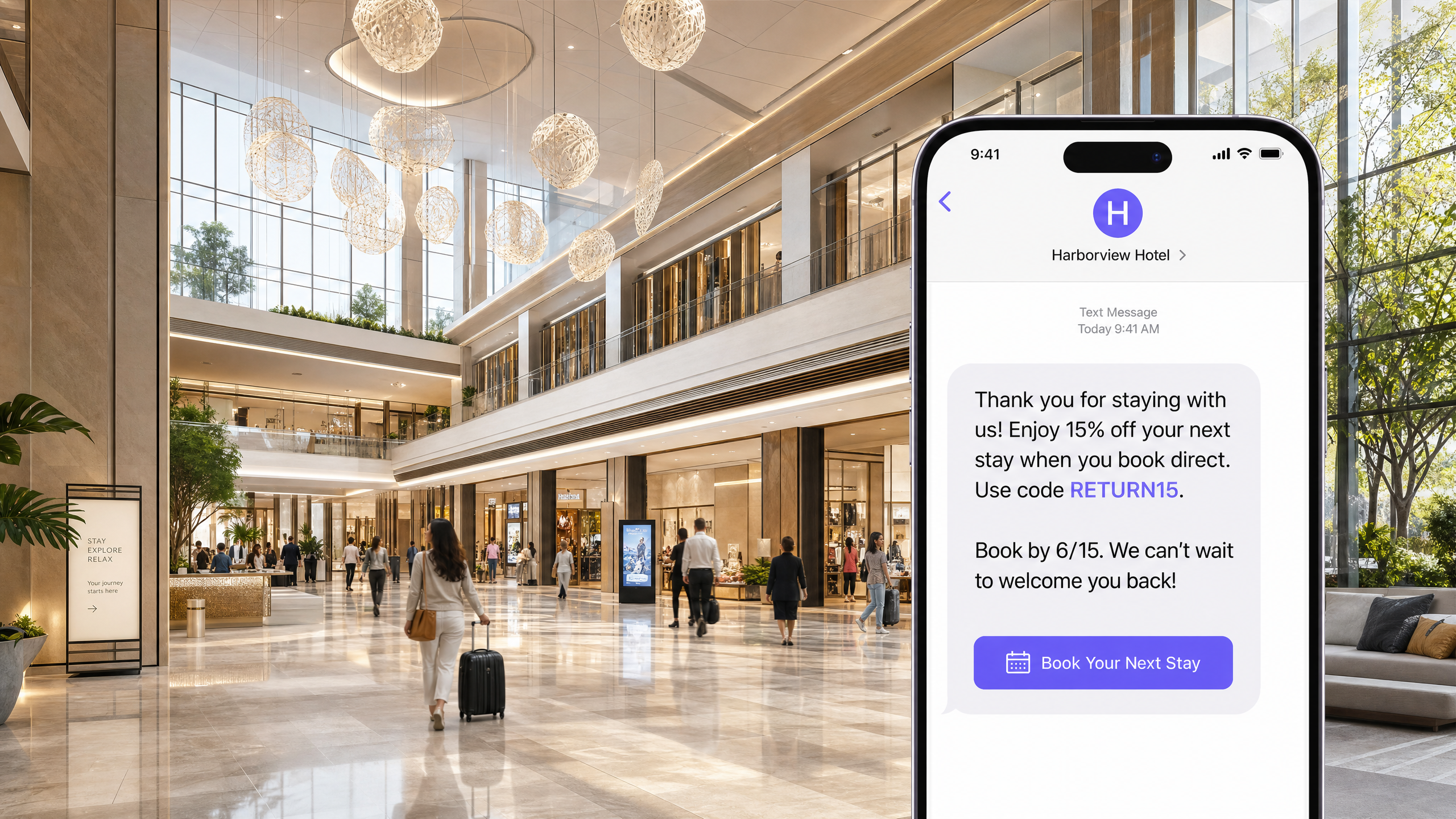
Venue operators face a persistent challenge: converting one-time visitors into loyal, returning patrons. While email marketing remains a standard channel, SMS delivers a 98% open rate - often within three minutes of receipt (Source: GSMA Intelligence, 2024). To capitalise on this, venues need accurate phone numbers and explicit consent at scale. Purple solves this at the network edge. When a visitor connects to your Guest WiFi , Purple captures their verified mobile number and GDPR-compliant consent, then routes this first-party data to your chosen SMS marketing agencies via API. Across 80,000+ live venues and 440 million logins in 2024, we have seen this architecture consistently drive return visits. This guide covers the technical integration, deployment steps, compliance requirements, and ROI measurement for IT and marketing teams ready to act this quarter.
Technical deep-dive
How the data capture layer works
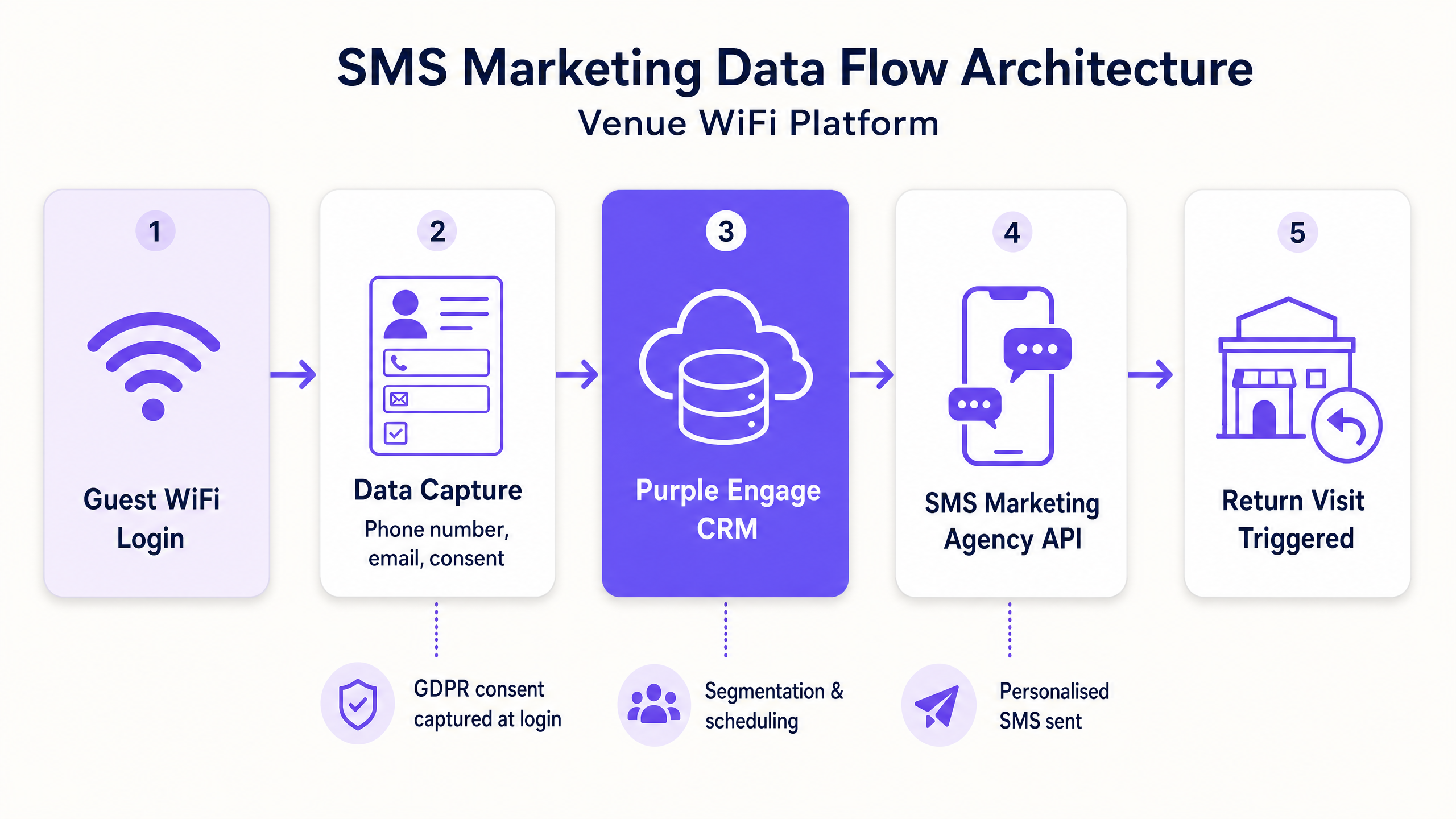
Purple operates as a cloud overlay on your existing enterprise hardware. We integrate natively with Cisco Meraki, HPE Aruba, Ruckus, Juniper Mist, Ubiquiti UniFi, Cambium, Extreme, and Fortinet. When a visitor connects to the Guest WiFi SSID, the network redirects them to a Purple captive portal. Here, Purple authenticates the user and captures their mobile number alongside explicit, conscious-choice opt-ins for marketing communications.
This process is hardware-agnostic. Whether your estate runs Cisco Meraki in your retail stores and HPE Aruba in your head office, Purple presents a unified data model to the downstream SMS marketing agencies. You do not need to rearchitect your network to benefit.
Identity-Based Networks and the MAC randomisation problem
Modern operating systems - iOS 14 and above, Android 10 and above - randomise the device MAC address to protect user privacy. This creates a significant problem for any venue trying to measure return visits at the hardware layer: every visit from the same person can appear as a new unique device. Passive device tracking is, for practical purposes, broken.
Purple's Identity-Based Networks resolve this by shifting the tracking anchor from the device to the authenticated user. Once a visitor logs in via the captive portal and provides a verified phone number, their session is tied to that identity. When they return and authenticate again, Purple matches the record. The result is a deterministic dataset of real people and real visit histories - exactly what SMS marketing agencies need to trigger accurate, timely campaigns.
With 29 billion data points collected across our network, this identity layer is the most valuable asset Purple provides to your marketing stack.
The API integration architecture
Data flows from Purple Engage to your SMS marketing agencies via two primary mechanisms:
| Method | Best for | Latency | Complexity |
|---|---|---|---|
| Webhooks | Real-time triggers (welcome messages, event broadcasts) | Near-zero | Low - configure endpoint URL in Purple portal |
| Scheduled API export | Re-engagement campaigns, batch processing | Minutes to hours | Medium - requires middleware or agency-side ingestion |
Both methods use token-based authentication. Purple handles deduplication at the export stage, so the same user logging in three times in one day does not generate three records in your SMS agency's CRM.
Implementation guide
Deploying an SMS integration requires coordination between network engineering, marketing, and legal teams. These four steps cover the full deployment.
Step 1: Configure the captive portal for SMS capture
Within the Purple portal, navigate to the splash page builder. Enable the mobile number field and set it as mandatory. Crucially, activate SMS OTP (One-Time Password) verification. This sends a four-digit code to the number the visitor enters, confirming it is valid before granting WiFi access. Invalid numbers inflate your database and waste SMS API credits. OTP verification eliminates this at source.
For guidance on designing an effective splash page that maintains brand consistency while maximising data capture, see how to make a great first impression with your guest WiFi .
Step 2: Establish your compliance baseline
Update your terms and conditions to explicitly name the SMS marketing agencies you share data with. The consent checkbox must be un-ticked by default to meet GDPR Article 7 requirements. Purple logs the exact timestamp, IP address, and consent text version for every opt-in event. This audit trail is your evidence of lawful processing under GDPR and CCPA.
For venues operating across multiple territories, Purple is ISO 27001, GDPR, CCPA, and Cyber Essentials certified. The compliance framework is built in, not bolted on.
Step 3: Configure the API integration
Generate an API key within Purple Engage under Settings > Integrations. Configure your SMS marketing platform to receive data via webhook, or schedule a daily export. Map the fields correctly:
user.phoneto the destination phone number fielduser.marketing_opt_inboolean to the agency's consent flagsession.venue_idto segment by location in multi-site deploymentssession.first_seenandsession.last_seento calculate visit frequency and recency
Ensure the marketing_opt_in boolean is respected at every stage. Do not pass records where this is false.
Step 4: Define trigger rules with your SMS marketing agencies
Work with your SMS marketing agencies to define the automation logic before go-live. Common triggers that drive return visits include:
- Welcome message: Sent 15 minutes after the first login, offering a discount on the current visit.
- Re-engagement campaign: Sent 30 days after the last recorded visit to prompt a return.
- Win-back campaign: Sent 90 days after the last visit with a higher-value incentive.
- Event broadcast: Sent to all users currently connected during a stadium event or conference.
- Loyalty milestone: Sent when a user reaches their fifth visit, triggered by Purple's visit count data.
Best practices
Prioritise data quality over quantity
Do not bypass SMS OTP verification to speed up the login process. A database of 10,000 verified numbers outperforms 50,000 unverified entries in every metric: delivery rate, open rate, and conversion rate. Purple processes over 440 million logins annually (Purple internal data, 2024). Our data shows that OTP verification reduces SMS bounce rates to near zero.
Segment by vertical and behaviour
Tailor your messaging to the specific vertical. A retail shopper expects different communication than a hotel guest. Use WiFi Analytics to segment audiences based on dwell time, visit frequency, and recency. A visitor who stays for three hours is more invested than someone who connects for five minutes while walking past. Pass these behavioural segments to your SMS marketing agencies as distinct audience lists.
For retail deployments, see our retail industry guide for vertical-specific segmentation strategies. For hospitality, see the hospitality guide .
Respect the medium
SMS is an intimate channel. Overuse drives opt-outs, which permanently removes users from your database. Limit promotional messages to two per month per user. Every message must offer tangible, immediate value - a discount, an event notification, or exclusive access. Generic brand messages do not perform on SMS.
Maintain bidirectional consent sync
When a user replies STOP to an SMS, the agency must process this opt-out immediately and sync it back to Purple Engage. Configure this bidirectional sync before go-live. Failure to reflect opt-outs in Purple means future data exports may include users who have withdrawn consent - a GDPR breach.
Troubleshooting & risk mitigation
MAC randomisation causing duplicate records
If you observe inflated unique visitor counts in your analytics, the likely cause is MAC randomisation creating multiple device records for the same user. Resolve this by ensuring all return visit measurement relies on the authenticated user identity from Purple Engage, not the device count from the hardware controller. Purple's Identity-Based Network layer is the correct source of truth.
API rate limiting during high-footfall events
During high-density events - a stadium match, a conference opening, a retail sale day - the volume of simultaneous logins can overwhelm the receiving API of your SMS marketing agencies. Implement exponential backoff and retry logic in your middleware. For events where you anticipate more than 1,000 logins in a 10-minute window, switch from real-time webhooks to a batch export scheduled for five minutes after the peak period.
Consent revocation not syncing
If opt-out rates are rising but your database size is not shrinking, the bidirectional sync between your SMS agency and Purple Engage has likely broken. Check the webhook endpoint configuration in the agency platform and verify that the unsubscribe event is mapped to the correct Purple API endpoint. Test this manually before every major campaign.
Low opt-in rates at the captive portal
If fewer than 30% of visitors are providing their phone number, review the splash page design. The value exchange must be explicit: state clearly what the visitor receives in return for their number. A/B test the copy and the placement of the consent checkbox. For guidance, see how to make a great first impression with your guest WiFi .
ROI & business impact
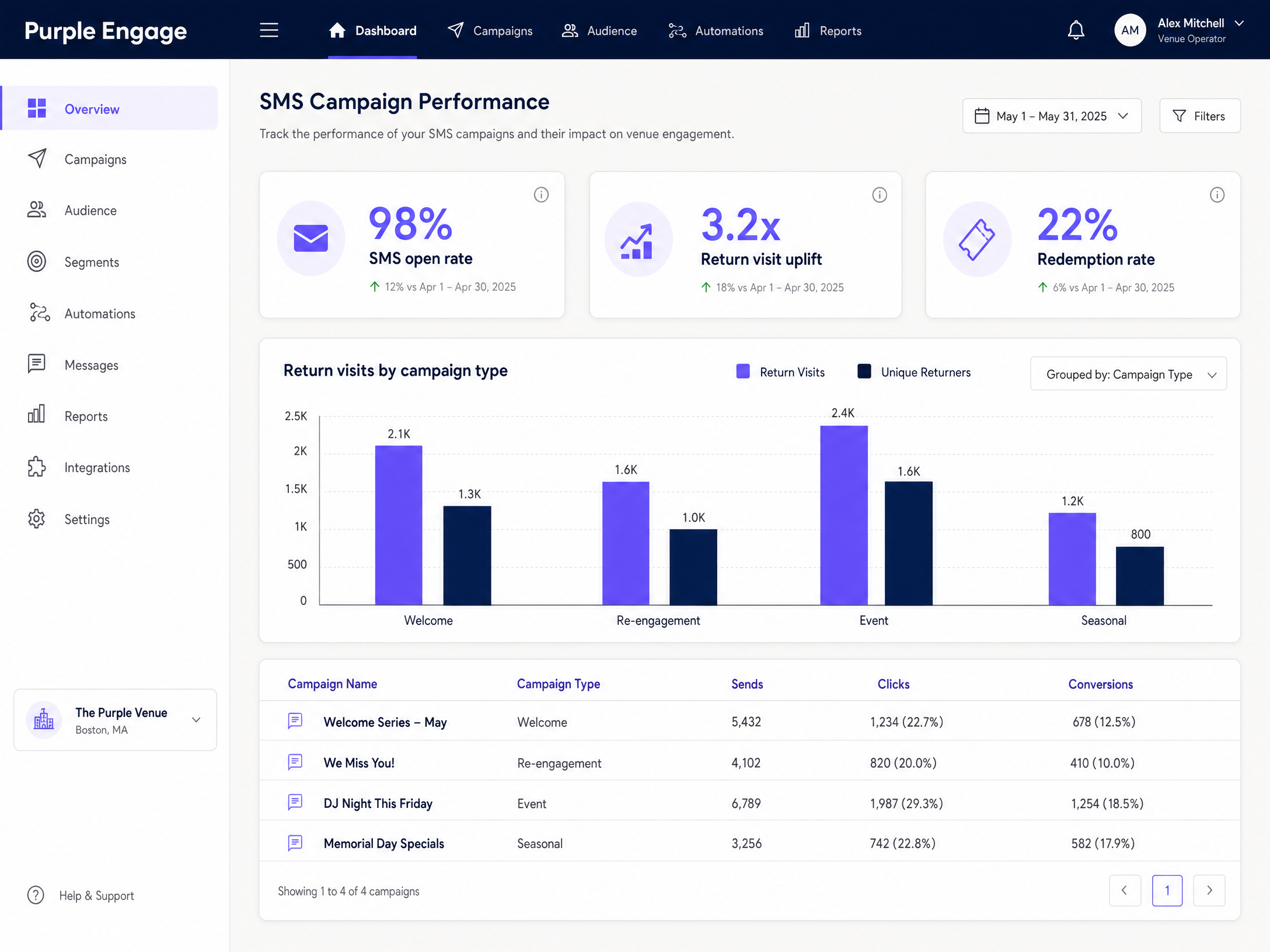
Measure the ROI of your SMS marketing integration by tracking three metrics:
| Metric | How to measure | Target benchmark |
|---|---|---|
| Return visit uplift | Compare return rate of SMS recipients vs. non-recipients over 90 days | 10-15% uplift (Purple venue data) |
| SMS redemption rate | Discount codes redeemed / SMS messages sent | 15-25% for well-segmented campaigns |
| Cost per return visit | Total SMS spend / incremental return visits attributed | Varies by vertical; target below the cost of a paid acquisition |
A national restaurant chain deploying this architecture saw a 12% increase in return visits within 90 days, directly attributable to re-engagement SMS campaigns triggered by Purple's presence data. The campaigns targeted guests with no recorded visit in 60 days, using a 20% discount offer. The cost per return visit was 34% lower than their paid social acquisition cost for the same period.
For transport operators, see the transport industry guide for passenger-specific return visit metrics. For healthcare environments, the healthcare guide covers visitor engagement within regulatory constraints.
The Purple Engage plan covers the data capture, segmentation, and API integration capabilities described in this guide. Purple Connect captures the verified identity data at login. Together, these two plans provide the complete data pipeline your SMS marketing agencies need to drive measurable return visits at scale.
Key Definitions
First-party data
Information collected directly from your audience, such as the verified phone numbers and email addresses captured via the Purple captive portal at the point of WiFi login.
With third-party cookies deprecated, first-party data is the primary input for SMS marketing agencies. Its value depends entirely on the accuracy and consent status of each record.
Captive portal
A web page that a user of a public access network must view and interact with before network access is granted. Purple's captive portal is the primary interface for data capture and consent collection.
Every SMS marketing integration starts here. The design and copy of the captive portal directly determines opt-in rates and data quality.
MAC randomisation
A privacy feature in iOS 14+ and Android 10+ that periodically changes the device's hardware MAC address to prevent passive tracking across networks.
Forces venues to rely on user authentication (Identity-Based Networks) rather than passive device tracking to measure return visits accurately.
Webhook
An HTTP callback triggered by a specific event - in this context, a user login - that pushes data from Purple to an external system such as an SMS marketing agency in near real-time.
Used for time-sensitive triggers like welcome messages. Requires the receiving API to handle the expected volume, particularly during high-footfall events.
Identity-Based Network
A network architecture where access policies and data tracking are tied to the authenticated user rather than the hardware device. Purple's core architecture.
Resolves the MAC randomisation problem and provides SMS marketing agencies with accurate, person-level visit data rather than noisy device-level data.
SMS OTP (One-Time Password)
A security mechanism where a unique numeric code is sent via SMS to verify the user's phone number during the captive portal login process.
Essential for ensuring the database used by SMS marketing agencies contains only valid, reachable numbers. Eliminates bounce rates and wasted campaign spend.
Dwell time
The duration a user's device remains connected to or in proximity of the venue's WiFi network during a single visit.
A key segmentation variable. Users with high dwell time are more engaged and typically respond better to SMS campaigns than brief passers-by.
API rate limiting
A control mechanism applied by API providers that restricts the number of requests a client can make within a defined time window.
A critical risk during high-footfall events. If Purple fires webhooks faster than the SMS agency's API can accept them, payloads are dropped and users miss campaigns.
Bidirectional consent sync
A data integration pattern where opt-out events (such as a STOP reply to an SMS) are propagated back from the SMS agency to the source CRM - in this case, Purple Engage.
Required for GDPR compliance. Without it, users who have withdrawn consent may continue to receive data exports to the SMS agency.
Worked Examples
A 500-site retail chain needs to implement an SMS re-engagement campaign for shoppers who have not visited in 60 days. They use Cisco Meraki hardware and a third-party SMS marketing agency. How should the IT team architect this solution?
- Integrate Purple with the Cisco Meraki controllers via the Purple cloud overlay - no changes to the Meraki configuration are required beyond pointing the guest SSID splash page to the Purple captive portal URL. 2. Configure the Purple captive portal to mandate SMS OTP verification and capture GDPR-compliant marketing consent with an un-ticked opt-in checkbox. 3. Set up a daily scheduled export from Purple Engage to the SMS agency's API, filtering for users where
last_seen > 60 daysandmarketing_consent = true. 4. The SMS agency triggers a personalised re-engagement message with a 20% discount code. 5. When the shopper returns and authenticates on the network, Purple logs the visit. The marketing team attributes the return to the SMS campaign by matching the redemption timestamp against the SMS send timestamp in the agency's reporting.
A stadium operator wants to send a welcome SMS containing a link to the food and beverage ordering app exactly 10 minutes after a fan connects to the Guest WiFi during a match. How is this configured?
- The fan connects to the Guest WiFi and authenticates via the Purple portal, providing their mobile number and marketing consent. 2. Purple Engage registers the login event and fires a webhook immediately to the SMS agency's API endpoint, sending the user payload including phone number, venue ID, and login timestamp. 3. The SMS agency's automation engine receives the webhook and starts a 10-minute delay step. 4. After 10 minutes, the agency dispatches the pre-configured welcome message with the ordering app deep link. 5. Delivery and click-through data is available in the agency's reporting dashboard within minutes of send.
Practice Questions
Q1. A hospitality client reports that their SMS marketing campaigns have a 40% bounce rate. They currently capture phone numbers via a standard text input field on the captive portal with no verification step. What is the recommended architectural change, and what secondary benefit does it deliver beyond reducing bounces?
Hint: Consider how you validate data at the point of entry before it reaches the CRM. Also consider what the verification step proves about the user.
View model answer
Implement SMS OTP verification on the Purple captive portal. This forces the user to receive and enter a code to gain WiFi access, guaranteeing that only valid, active phone numbers are passed to the SMS marketing agency - eliminating the 40% bounce rate. The secondary benefit is that OTP verification also confirms the user physically possesses the device associated with that number, strengthening the identity record and improving the accuracy of return visit attribution.
Q2. A venue operator wants to track return visits accurately but notices that the unique device count reported by their Cisco Meraki dashboard is three times higher than the authenticated user count in Purple Engage. Which metric should the SMS marketing agency use, and why?
Hint: Consider modern mobile OS privacy features and their effect on device-level tracking.
View model answer
The SMS marketing agency must use the authenticated user count from Purple Engage exclusively. The discrepancy is caused by MAC randomisation, where iOS and Android devices rotate their hardware addresses, inflating the unique device count in the Meraki dashboard. Purple's Identity-Based Network layer ties each visit to a verified phone number, bypassing hardware obfuscation and providing an accurate, person-level dataset. Using the Meraki device count would result in duplicate records and inaccurate return visit attribution.
Q3. During a major conference, 6,000 attendees log in to the WiFi within a 20-minute window. The webhook pushing data to the SMS marketing agency fails for approximately 25% of the payloads, and those attendees do not receive the welcome message. What is the likely cause, and what are two mitigation strategies?
Hint: Consider the capacity of the receiving system and the timing of the data transfer.
View model answer
The SMS marketing agency's API has applied rate limiting due to the sudden spike in webhook volume - approximately 300 requests per minute in this scenario, which exceeds most standard API rate limits. Mitigation strategy one: implement a queuing layer with exponential backoff between Purple and the agency's API, so failed requests are retried automatically without overwhelming the endpoint. Mitigation strategy two: for high-density events, switch from real-time webhooks to a batch export scheduled five minutes after the anticipated peak login window, reducing the instantaneous request volume to a manageable level.