
How to leverage lic marketing SMS to increase return visits
This technical reference guide details how venue operators and IT managers can implement Login Identity Capture (LIC) via Guest WiFi to drive high-converting SMS marketing campaigns. It covers deployment architecture, GDPR/TCPA compliance frameworks, and real-world implementation strategies to increase return visits.
Listen to this guide
View podcast transcript
Executive Summary
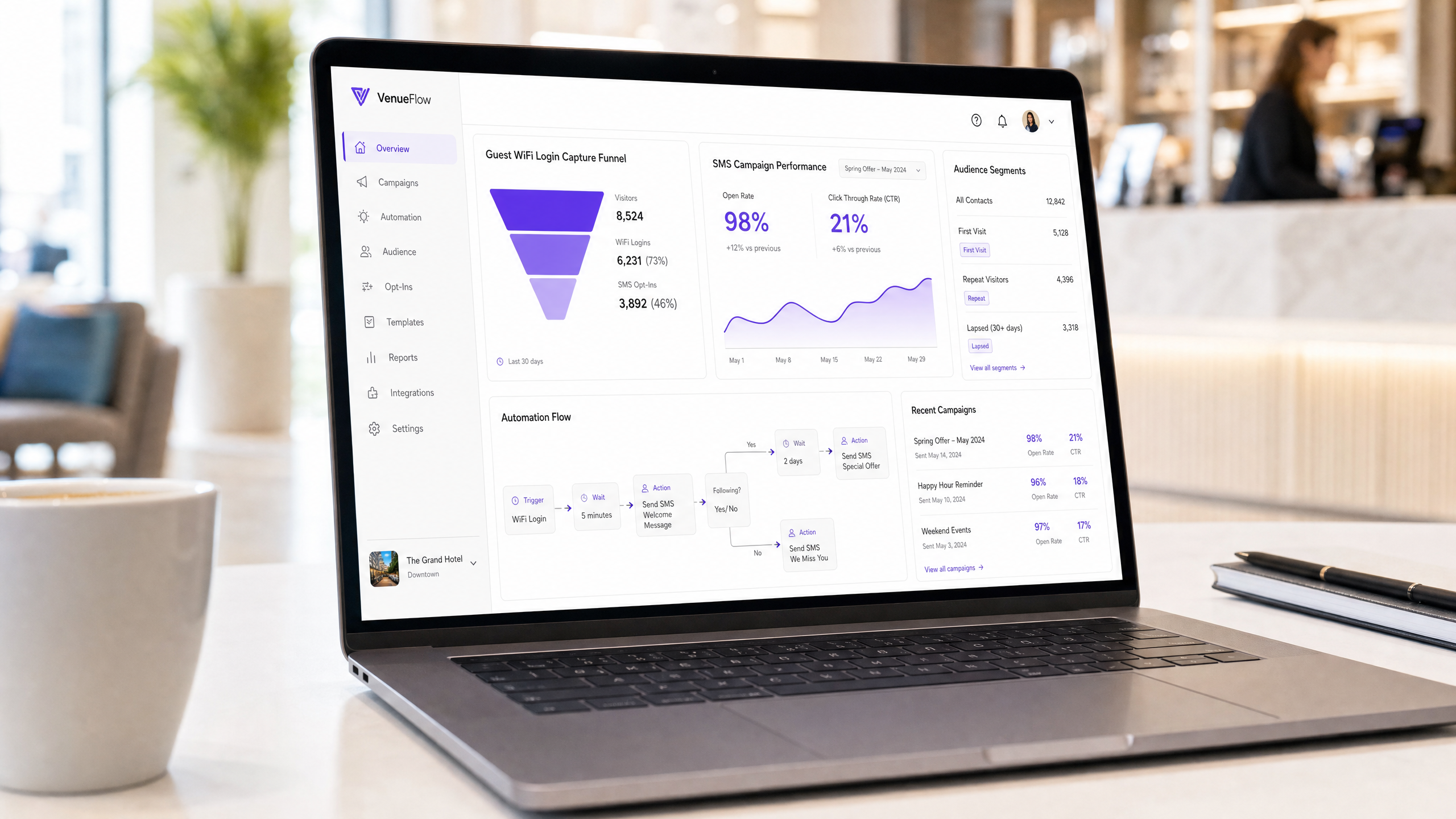
SMS marketing delivers a 98% open rate, with 90% of messages read within three minutes of delivery. For venue operators running Guest WiFi across hotels, retail estates, or stadiums, the data capture infrastructure already exists. The missing step is converting that anonymous network traffic into a verified, consented SMS subscriber list. Purple Engage captures phone numbers at the captive portal, enforces a double opt-in verification flow, and automates campaign dispatch based on physical presence analytics. The result: conversion rates between 21% and 30%, and an ROI of £21 to £71 for every £1 spent on SMS. This guide covers the end-to-end architecture, from access point to SMS gateway, the compliance requirements under GDPR and TCPA, and the segmentation strategies that separate relevant offers from spam.
Technical Deep-Dive: Architecture and Integration
The data pipeline for an SMS marketing service begins at the wireless controller. Whether you deploy Cisco Meraki, HPE Aruba, Ruckus, Juniper Mist, Ubiquiti UniFi, Cambium, Extreme, or Fortinet access points, the mechanism is consistent: the controller intercepts unauthenticated HTTP traffic and redirects the device to the captive portal hosted by Purple. Purple operates as a cloud overlay on top of your existing hardware, meaning no firmware changes are required. You configure the captive portal redirect at the wireless controller level using standard RADIUS change of authorisation (CoA) messages.
The Double Opt-In Verification Flow
To build an SMS subscriber list, you configure the Guest WiFi portal to present a phone number field alongside the standard email or social login options. A single opt-in is insufficient. It allows users to enter fictitious numbers, polluting your CRM, and it does not satisfy the "prior express written consent" standard required by the TCPA for US venues, nor the "unambiguous indication" standard under GDPR for UK and European venues.
The double opt-in flow resolves both problems:
- The visitor enters their mobile number and selects the SMS marketing opt-in checkbox (unchecked by default).
- Purple Engage triggers a POST request to the SMS gateway API.
- The gateway sends a one-time password (OTP) to the device via SMS.
- The visitor enters the OTP on the portal. A successful entry confirms the device is in the visitor's possession.
- Purple logs the consent record, including the timestamp, IP address, portal version, and the exact consent text displayed.
- The RADIUS server authenticates the session and grants network access.
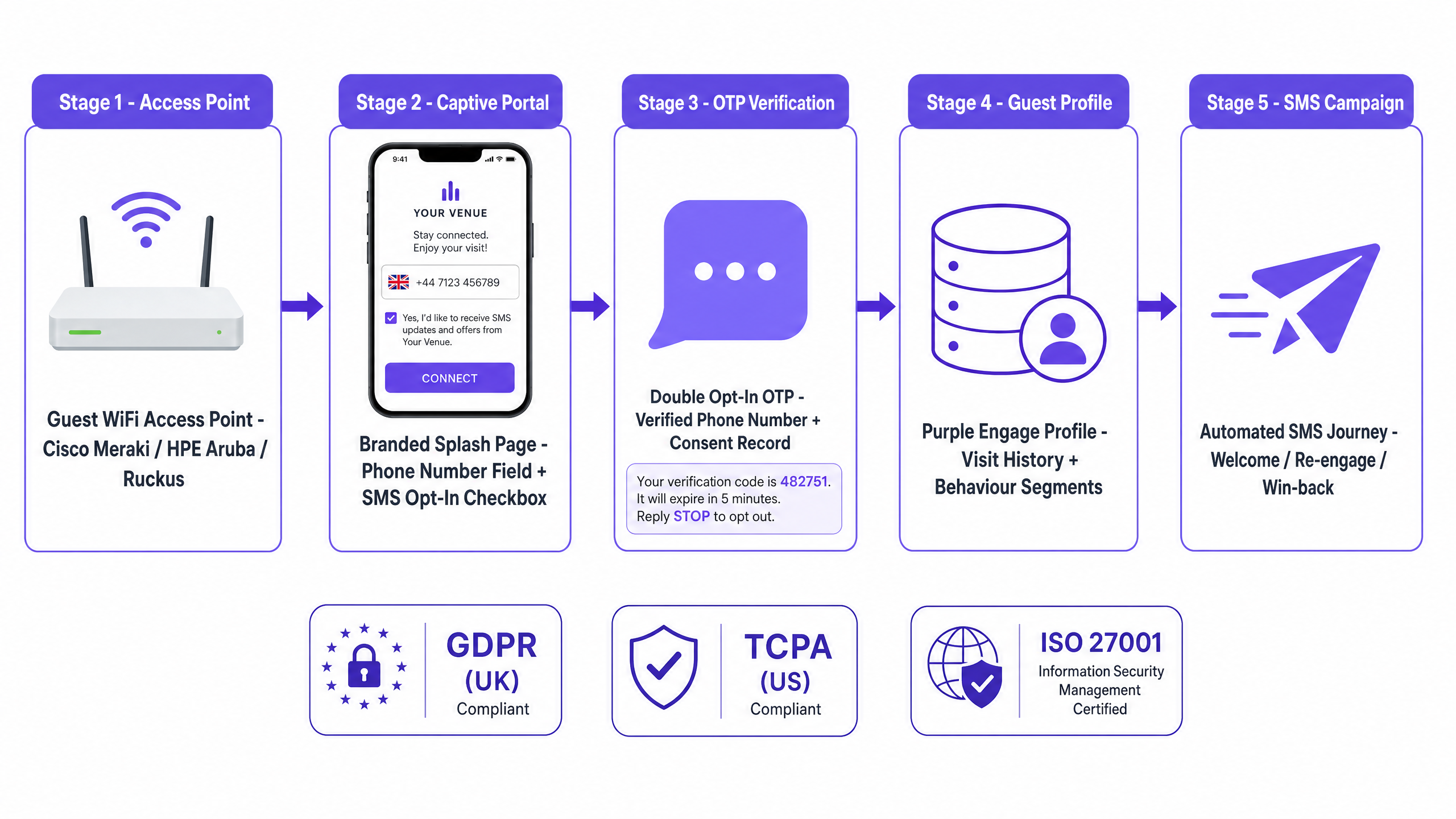
This flow ensures every phone number in your database is reachable, verified, and accompanied by an auditable consent record.
Implementation Guide: Segmentation and Automation
Once the capture architecture is running, the focus shifts to WiFi Analytics . Purple Engage builds a unified guest profile from every WiFi login. Over time, you accumulate behavioural signals - first-time visitor, repeat visitor, lapsed visitor - that drive segmentation.
Define Your Segments
Segment your audience based on their physical behaviour. Because Purple tracks device MAC addresses, you know exactly how many times a user has visited, how long they stayed, and which zones they spent time in. Use this data. If a guest visits your hotel restaurant three times but has never booked a room, send them an SMS offer for a discounted weekend stay. If a shopper spends 45 minutes in the sports section of your Retail store, send them a 10% discount code for athletic wear.
Automate the Journeys
In Purple Engage, you build automated journeys using visit behaviour as triggers. A typical starting configuration is:
- Welcome message: Sent 24 hours after first connection.
- Follow-up offer: Sent at seven days.
- Re-engagement message: Sent at 30 to 60 days to lapsed visitors.
Keep message frequency to two or three per month maximum. Higher frequency drives unsubscribe rates up sharply.
Best Practices and Compliance
Running an SMS marketing service without a well-structured compliance architecture exposes your organisation to substantial fines. The Information Commissioner's Office (ICO) can issue fines of up to £17.5 million or 4% of global annual turnover under UK GDPR. In the US, TCPA violations carry statutory damages of $500 to $1,500 per unsolicited text.
Under GDPR, consent for SMS marketing must be freely given, specific, informed, and unambiguous. The opt-in cannot be a condition of accessing the WiFi. The checkbox must be optional and un-ticked by default.
Every SMS campaign must honour opt-outs instantly. If a guest replies STOP and receives another message, you are in breach of TCPA. Purple Engage manages suppression lists automatically, ensuring compliance.
Troubleshooting & Risk Mitigation
Failure Mode: High Unsubscribe Rates
The fastest way to destroy an SMS list is to send too many messages. Two to three per month is the industry standard. More than that and unsubscribe rates climb sharply. An opt-out rate above 2% per campaign is a reliable signal that frequency is too high or the segment is too broad; diagnose before sending the next campaign.
Failure Mode: Poor List Quality
Monitor your delivery rate. Anything below 95% signals a list quality problem, often caused by failing to implement double opt-in verification. Purple's analytics dashboard surfaces delivery metrics in real time.
ROI & Business Impact
Industry benchmarks show a return of £21 to £71 for every £1 spent on SMS marketing. When you use first-party data captured via WiFi, the acquisition cost is near zero, pushing the ROI even higher.
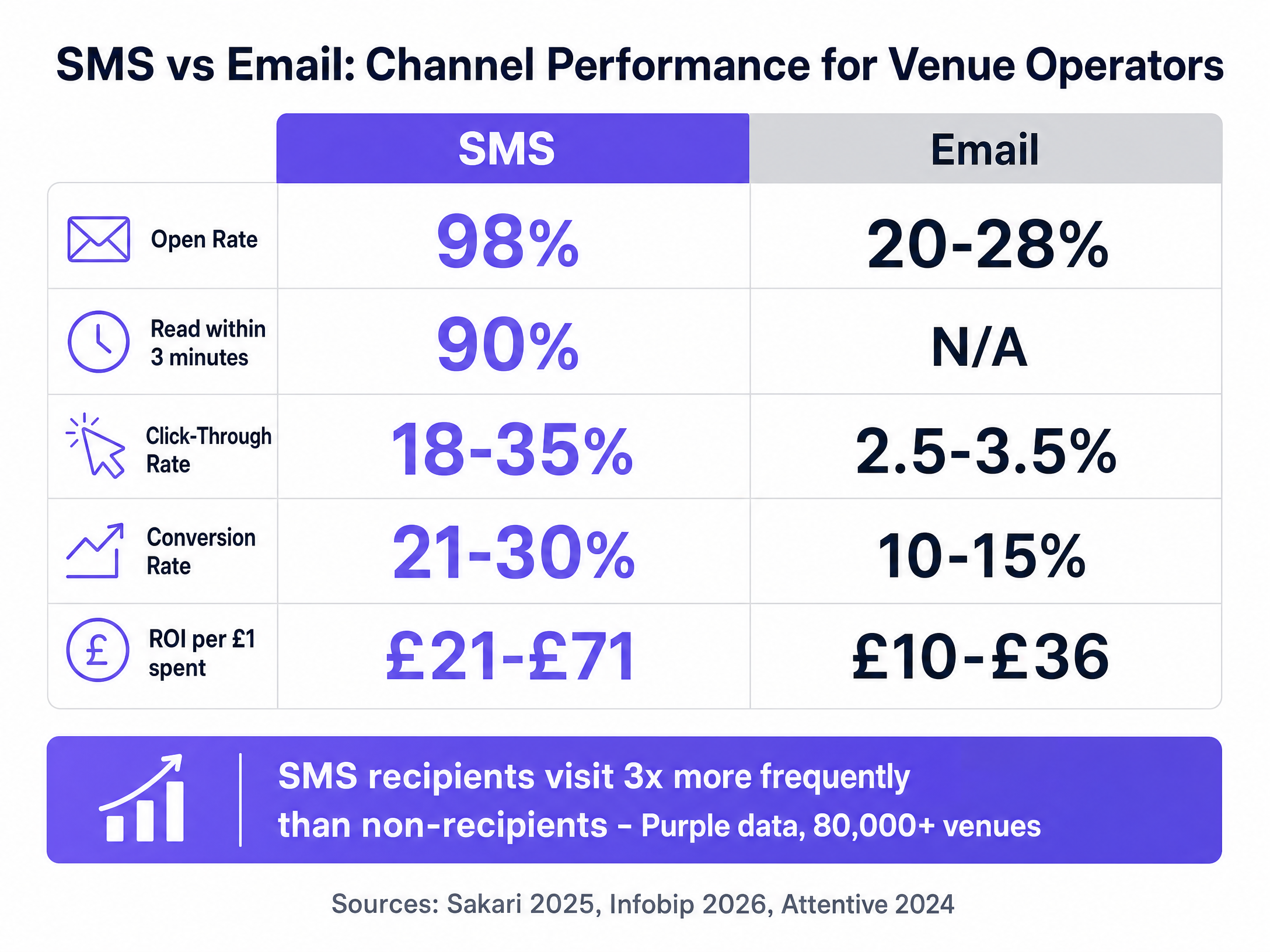
To prove ROI, you must connect an SMS send to a return visit. Purple's WiFi Analytics platform tracks return visit rates for SMS recipients versus non-recipients. Set this attribution model up before your first campaign, not after.
Listen to the Briefing
Key Definitions
Login Identity Capture (LIC)
The process of collecting verified user data (like a phone number) at the point of authentication, typically via a Guest WiFi captive portal.
This is the foundational step for building a first-party database without relying on third-party cookies or paid acquisition.
Double Opt-In Verification
A two-step consent process where a user submits their phone number and must then verify it by entering a One-Time Password (OTP) sent to that device.
Essential for maintaining database hygiene and proving 'prior express written consent' under TCPA regulations.
Captive Portal
A web page that a user of a public access network is obliged to view and interact with before access is granted.
The primary interface where venue operators capture visitor data and secure marketing consent.
RADIUS CoA (Change of Authorisation)
A mechanism that allows a RADIUS server to dynamically change the access permissions of an active client session.
Used by Purple to move a device from the restricted captive portal VLAN to the internet-access VLAN once the OTP is verified.
TCPA (Telephone Consumer Protection Act)
US legislation restricting telemarketing calls and the use of automated telephone equipment, including SMS text messages.
Requires businesses to obtain prior express written consent before sending marketing texts; failure to comply results in severe financial penalties.
First-Party Data
Information a company collects directly from its customers and owns entirely.
Phone numbers captured via Guest WiFi are high-value first-party data, reducing reliance on expensive third-party ad networks.
Suppression List
A database of contacts who have opted out of receiving communications (e.g., by replying STOP).
Real-time synchronisation of the suppression list between the WiFi platform and the SMS gateway is legally mandatory.
Dwell Time
The duration a visitor spends connected to the network within a specific physical zone.
A key behavioural metric used to segment audiences; e.g., targeting shoppers who dwell for over 45 minutes in a specific retail department.
Worked Examples
A national transport operator needs to increase ancillary revenue across its network of 40 stations while complying with strict UK GDPR regulations.
The operator deployed Purple Engage across their train network's existing hardware. They configured the captive portal with a standalone, un-ticked SMS opt-in checkbox and implemented a double opt-in OTP flow to verify numbers. They then built automated journeys triggered by presence on the network, rather than generic broadcast schedules. For example, surfacing upsell offers to passengers waiting in the station.
A fast-food retail chain wants to build a database of customer phone numbers to drive repeat visits, but is concerned about fake numbers polluting their CRM.
The retail chain implemented Login Identity Capture (LIC) via their Guest WiFi. Crucially, they enforced OTP verification via SMS before granting network access. Once verified, they collected over 2.5 million unique visitor records. They then segmented this audience based on visit frequency to deliver targeted SMS campaigns.
Practice Questions
Q1. Your marketing team wants to increase the SMS subscriber list quickly. They propose making the SMS opt-in checkbox pre-ticked on the Guest WiFi captive portal. Do you approve this change?
Hint: Consider the GDPR requirements for valid consent.
View model answer
No. Under GDPR, consent must be an 'unambiguous indication' and an active, conscious choice. Pre-ticked boxes are explicitly invalid. Implementing this would expose the venue to substantial ICO fines.
Q2. A stadium venue experiences a 4% unsubscribe rate following a recent SMS campaign. The campaign was sent to all 50,000 verified contacts in the database. What is the most likely cause, and how should you adjust the strategy?
Hint: An opt-out rate above 2% indicates a structural problem with the campaign.
View model answer
The most likely cause is a lack of segmentation; sending a generic broadcast to the entire database means the offer was irrelevant to many recipients. The strategy should be adjusted to trigger smaller, targeted campaigns based on visit history (e.g., targeting only fans who attended the previous match).
Q3. You are deploying Purple Engage across a hotel chain using Cisco Meraki access points. The IT Director asks if they need to schedule downtime to upgrade the AP firmware to support the new SMS OTP flow. What is your response?
Hint: Consider how Purple integrates with existing enterprise hardware.
View model answer
No downtime or firmware upgrades are required. Purple operates as a cloud overlay. The integration is handled at the wireless controller level by configuring a dedicated SSID to redirect to the Purple captive portal, using standard RADIUS CoA messages.