
How to leverage SMS marketing gr to increase return visits
This technical guide explains how venue operators can leverage existing Guest WiFi infrastructure to capture verified mobile numbers compliantly and execute automated SMS marketing campaigns. It covers the technical architecture, GDPR compliance, segmentation strategies, and implementation steps required to drive measurable return visits.
Listen to this guide
View podcast transcript
Executive Summary
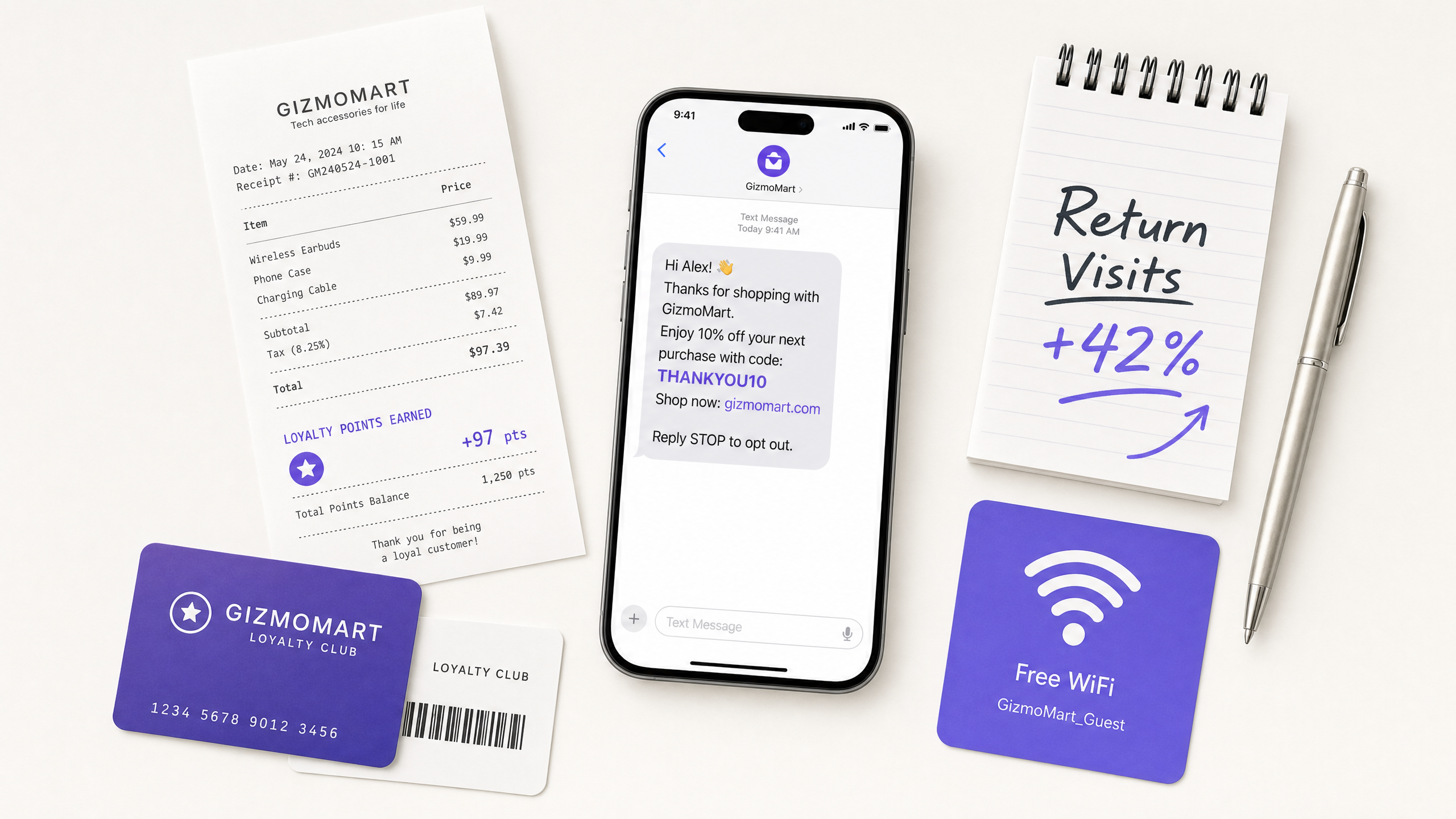
Venue operators face a persistent challenge: acquiring first-time visitors is expensive, but driving return visits is where profitability lies. This guide details how IT and marketing teams can use existing Guest WiFi infrastructure to capture verified mobile numbers and deploy compliant, automated SMS marketing campaigns that drive measurable return visits.
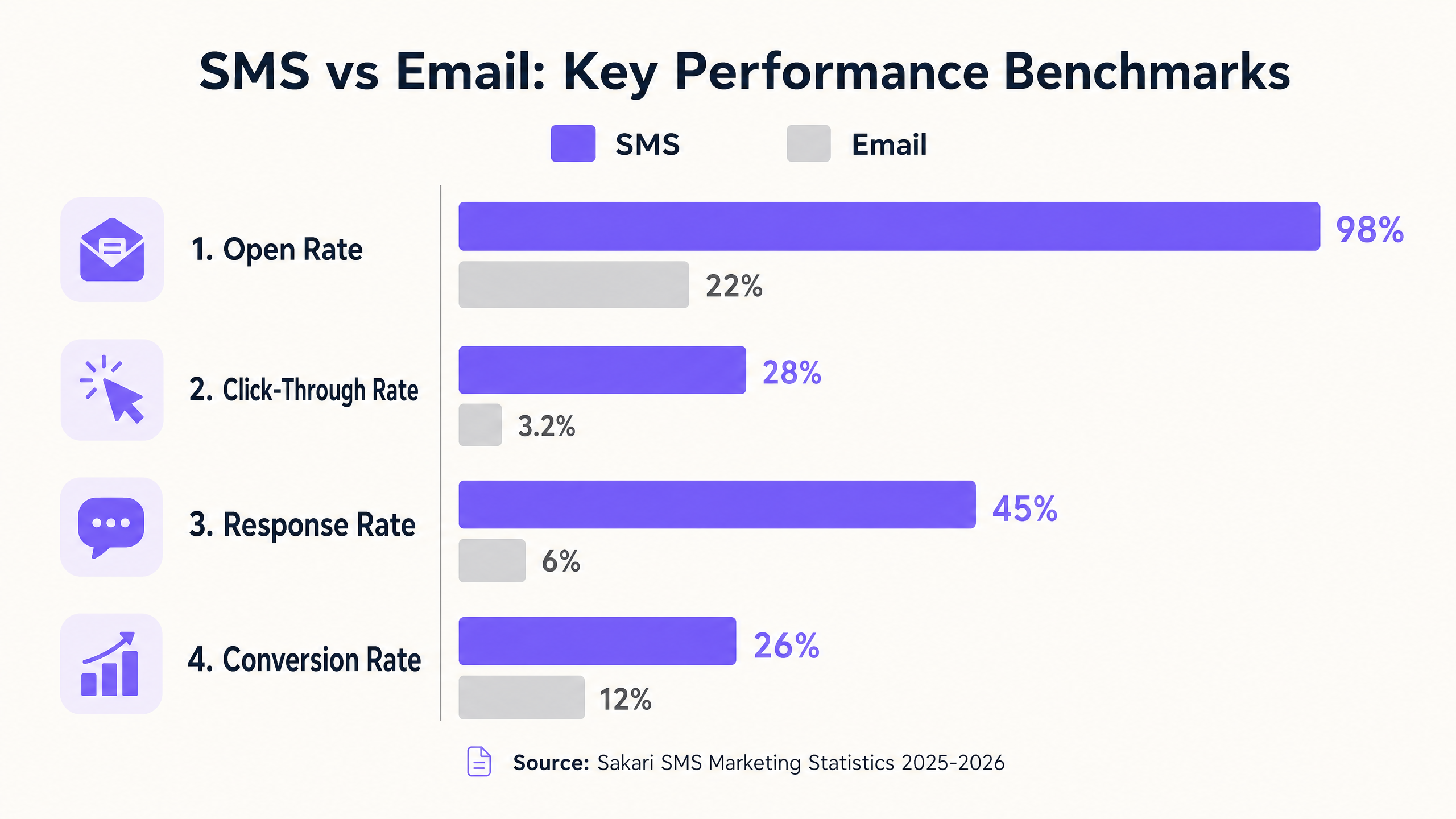
By integrating a captive portal with identity-based networking, venues can build a high-value, first-party database. SMS marketing consistently achieves 98% open rates and 45% response rates, significantly outperforming email [1]. However, execution requires strict adherence to GDPR and local data protection laws, specifically regarding conscious-choice opt-ins.
This reference covers the technical architecture required to capture data compliantly, the segmentation strategies that prevent database churn, and the implementation steps necessary to turn a cost-centre network into a revenue-generating asset.
Technical Deep-Dive
SMS marketing in a physical venue is fundamentally a data architecture challenge. Before a single message can be sent, the venue must establish a compliant, frictionless method for capturing phone numbers and consent. The most effective mechanism is the captive portal, deployed as a cloud overlay on top of existing enterprise hardware.
Architecture and Data Flow
The architecture relies on intercepting the guest connection attempt before internet access is granted. When a device associates with the Guest WiFi SSID, the network controller redirects the user's browser to a captive portal hosted by Purple.
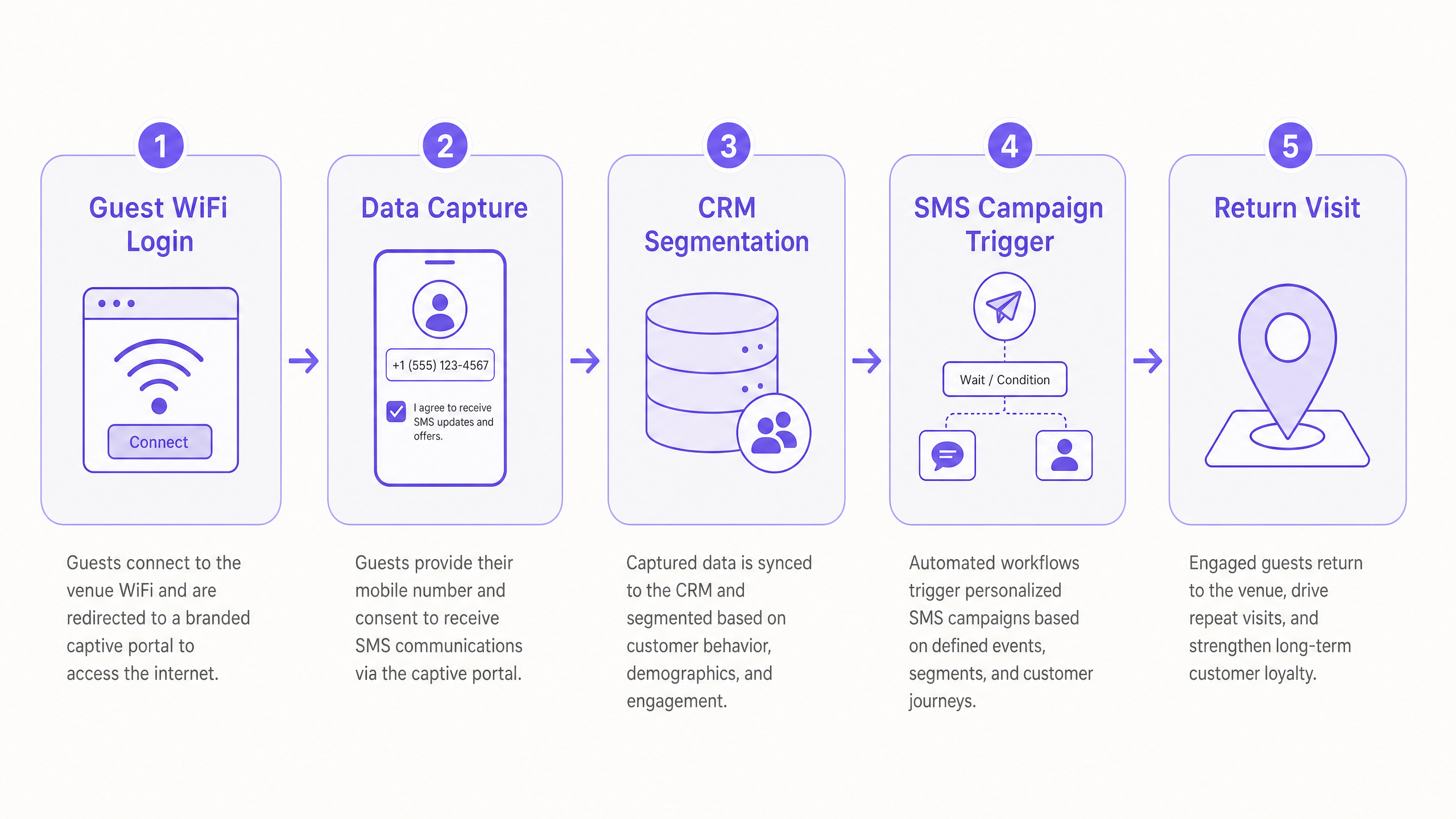
- Association: The guest device connects to the access point (e.g., Cisco Meraki, HPE Aruba, Ruckus, Juniper Mist, Ubiquiti UniFi, Cambium, Extreme, Fortinet).
- Redirection: The local hardware intercepts HTTP/HTTPS requests and redirects the user to the Purple-hosted captive portal.
- Authentication: The guest selects SMS authentication or provides a mobile number alongside another login method (like email or social login).
- Consent Capture: A standalone, unticked checkbox requests explicit consent for SMS marketing. This action is logged with a timestamp and IP address to satisfy GDPR requirements.
- Session Authorisation: Purple communicates with the local hardware via RADIUS to authorise the MAC address and grant internet access.
- Data Synchronisation: The guest profile, including the verified phone number and consent status, is synced to the Purple data layer and any integrated CRM systems.
Compliance and Regulatory Standards
Operating SMS marketing in Europe requires strict adherence to the General Data Protection Regulation (GDPR) and the ePrivacy Directive. In Greece, national implementing legislation (Law 4624/2019) adds specific supplementary rules.
The core requirement is explicit, informed consent. Article 7 of the GDPR mandates that consent must be freely given, specific, informed, and unambiguous. In practice, this means:
- No Pre-ticked Boxes: The SMS marketing opt-in must be an active choice.
- Granular Consent: SMS consent must be separate from terms and conditions or email marketing consent.
- Proof of Consent: The system must log the exact time, date, and mechanism of consent. Purple handles this automatically.
- Right to Withdraw: Every SMS message must include a clear opt-out mechanism (e.g., "Reply STOP").
Failure to implement these standards risks substantial regulatory fines and immediate carrier blocking.
Implementation Guide
Deploying a successful SMS marketing programme requires coordination between IT (for network configuration) and Marketing (for campaign logic). Follow these vendor-neutral steps to establish the foundation.
Step 1: Captive Portal Configuration
The captive portal is the engine for your database. Configure your network hardware to point to the Purple cloud radius servers. Within the Purple portal designer, enable mobile number capture.
Ensure the opt-in language is explicit. Use phrasing like: "I agree to receive promotional SMS messages from [Venue Name]." Do not use vague terms like "communications" or "updates."
Step 2: Data Integration
A standalone SMS database is a liability. Integrate Purple with your existing systems using native integrations or the REST API. If you operate a hotel, sync data with your Property Management System (PMS). For retail, connect to your loyalty platform or CRM.
This integration ensures that SMS campaigns are informed by comprehensive guest profiles, preventing scenarios where a re-engagement message is sent to a guest who already has a future booking.
Step 3: Audience Segmentation
Never launch an SMS programme with a single, undifferentiated broadcast list. Broadcasts drive high opt-out rates (53% of opt-outs are caused by over-messaging) [2].
Segment your audience based on behavioural data captured by the WiFi network:
- Recency: Time since last visit.
- Frequency: Total number of visits.
- Location: Specific venues visited within a multi-site estate.
Step 4: Campaign Automation
Use Purple Engage to build triggered workflows. The most effective campaigns operate automatically based on predefined rules.
Configure a lapsed-guest trigger: "If a guest has exactly one visit, and 14 days have passed since that visit, send SMS Template A." This approach ensures messages are highly relevant and delivered at the optimal moment in the guest lifecycle.
Best Practices
To maximise the impact of your SMS marketing while protecting your sender reputation, adhere to these industry standards.
Personalisation and Context
SMS is an intimate channel. Messages must feel relevant. Use dynamic fields to insert the guest's first name and reference their specific venue location.
- Poor: "Come back for 10% off your next visit. Click here."
- Effective: "Hi Sarah, we miss you at our Manchester store. Enjoy 10% off your next coffee this week. Show this text. Opt-out: reply STOP."
Timing and Frequency
The optimal re-engagement window varies by vertical. For hospitality, triggered messages sent 7 to 14 days after the last visit perform best. For retail, a shorter window of 3 to 7 days is often more effective.
Limit frequency to one or two promotional messages per month per guest. Respecting this limit is the single most effective way to maintain a low unsubscribe rate (industry average is 0% to 3.5%) [2].
The 160-Character Rule
A standard SMS segment is 160 characters. Exceeding this limit splits the message into multiple segments, doubling your cost and potentially disrupting the user experience. Keep copy concise. Include a single, clear call to action and a shortened URL.
Troubleshooting & Risk Mitigation
Even well-planned SMS campaigns encounter issues. Here are common failure modes and how to avoid them.
High Opt-Out Rates
If your unsubscribe rate exceeds 3.5% per campaign, you are likely over-messaging or sending irrelevant content. Mitigation: Immediately halt broadcast messages. Review your segmentation logic. Ensure campaigns are triggered by specific behaviours rather than calendar dates.
Carrier Filtering
Mobile network operators actively filter messages that appear to be spam. Mitigation: Avoid excessive use of capital letters, exclamation marks, and spam trigger words (e.g., "FREE", "URGENT"). Ensure every message includes a compliant opt-out instruction. For volumes exceeding 10,000 messages per month, consider provisioning a dedicated short code to improve deliverability.
Data Silos
When WiFi data does not sync with the CRM, guests receive conflicting communications. Mitigation: Audit your API connections or native integrations weekly. Ensure that an opt-out registered in your SMS platform automatically updates the master record in your CRM.
ROI & Business Impact
The business case for SMS marketing via Guest WiFi is compelling when measured correctly. The primary metric is attributed return visits.
Measuring Success
To accurately measure ROI, establish a baseline return rate for guests who do not receive SMS marketing. Compare this against the return rate of the segmented SMS audience.
Purple's analytics dashboard tracks foot traffic and dwell time, allowing you to correlate an SMS send with a physical return visit.
Expected Outcomes
According to industry benchmarks, SMS marketing delivers an ROI between $21 and $41 for every $1 spent [2]. With open rates near 98% and conversion rates between 21% and 30%, SMS significantly outperforms email across all key metrics.
By leveraging existing network infrastructure to capture the data, the cost of acquisition is minimal, making the marginal revenue generated from return visits highly profitable.
References: [1] Boudinet, T. (2024). The stats around SMS marketing are insane. LinkedIn. [2] Sakari. (2025). SMS Marketing Statistics: Data-Backed Insights for 2025-2026.
Key Definitions
Captive Portal
A web page that a user of a public access network is obliged to view and interact with before access is granted.
This is the primary data collection engine for venue operators, transforming anonymous WiFi users into known customer profiles.
Identity-Based Network
A network architecture that controls access and policies based on the user's identity rather than just the device's IP or MAC address.
Purple uses this approach to link physical foot traffic data to a specific, verified mobile number.
Conscious-Choice Opt-In
A consent mechanism requiring the user to take a specific, affirmative action (like ticking an empty box) to agree to marketing.
Mandatory for GDPR compliance when collecting phone numbers for SMS marketing.
Short Code
A 5 or 6 digit phone number used by businesses to send and receive high volumes of SMS messages.
Necessary for large venues (like stadiums) sending over 10,000 messages per month to avoid carrier filtering.
Triggered Campaign
An automated message sent when a user meets specific behavioural criteria (e.g., 14 days since last visit).
The opposite of a broadcast campaign; triggered campaigns drive higher ROI and lower unsubscribe rates.
Carrier Filtering
The practice by mobile network operators of blocking SMS messages that appear to be spam or violate compliance rules.
A major risk for venues that use poor opt-in practices or send high volumes from unverified long numbers.
First-Party Data
Information a company collects directly from its customers and owns entirely.
Guest WiFi allows venues to build their own first-party database rather than relying on third-party advertising platforms.
MAC Address
A unique identifier assigned to a network interface controller for use as a network address in communications.
Used by the network hardware to recognise returning devices, which Purple then links to the guest's profile to track return visits.
Worked Examples
A 150-site retail chain needs to increase repeat footfall. They currently offer free Guest WiFi but do not collect phone numbers. How should they architect their data capture and SMS strategy?
- Deploy a Purple cloud overlay across their existing Cisco Meraki access points.
- Configure the captive portal to require a mobile number and present a standalone, unticked SMS consent checkbox.
- Integrate the Purple data layer with their central CRM via REST API.
- Build an automated segment for 'Lapsed Shoppers' (1 visit, >14 days ago).
- Trigger a location-specific SMS offer (e.g., '10% off at our Leeds store') automatically when a guest enters the lapsed segment.
A stadium IT director needs to implement SMS marketing for fans but is concerned about GDPR compliance and carrier filtering during high-volume event days.
- Implement strict conscious-choice opt-in on the captive portal; no pre-ticked boxes.
- Provision a dedicated short code for the venue to handle high-volume bursts without triggering carrier spam filters.
- Create specific segments based on the zone or gate the fan connected to.
- Limit promotional messages to event days only, sending contextual offers (e.g., merchandise discounts) 2 hours before kickoff.
Practice Questions
Q1. Your marketing team wants to send a single SMS blast to the entire database of 50,000 guests promoting a weekend sale. As the IT Director, what is your recommendation?
Hint: Consider the impact of over-messaging on database health and opt-out rates.
View model answer
Advise against a single broadcast. Recommend segmenting the list based on recency and location. Sending a broadcast to 50,000 guests, many of whom may not have visited recently or live near the relevant venue, will result in a spike in opt-outs and potential carrier filtering. Instead, target guests who have visited the specific location within the last 30 days.
Q2. A hotel general manager notes that the SMS database is growing slowly. They suggest pre-ticking the SMS consent box on the captive portal to accelerate growth. How do you respond?
Hint: Consider GDPR Article 7 requirements for explicit consent.
View model answer
Reject the proposal. Pre-ticked boxes violate GDPR requirements for explicit, conscious-choice consent. Implementing this would expose the venue to significant regulatory fines and invalidate the entire database collected under those terms. Instead, recommend optimising the portal design to better communicate the value of opting in (e.g., 'Opt-in for exclusive room upgrades').
Q3. You are configuring a triggered campaign for a restaurant chain. The trigger is set to fire 2 hours after a guest's first visit. Is this optimal?
Hint: Consider the optimal re-engagement window for hospitality venues.
View model answer
No, this is not optimal. Sending a re-engagement SMS 2 hours after a visit is too soon and feels intrusive. Industry data shows the optimal window for hospitality is between 7 and 14 days after the visit. Adjust the trigger to fire after 7 days to maximise the likelihood of driving a return visit.