
How to leverage what is SMS marketing to increase return visits
This guide details how venue operators and IT teams can implement an SMS marketing architecture using Guest WiFi data. It covers secure phone number capture, GDPR compliance, and automated campaign triggers to drive measurable return visits.
Listen to this guide
View podcast transcript
Executive Summary
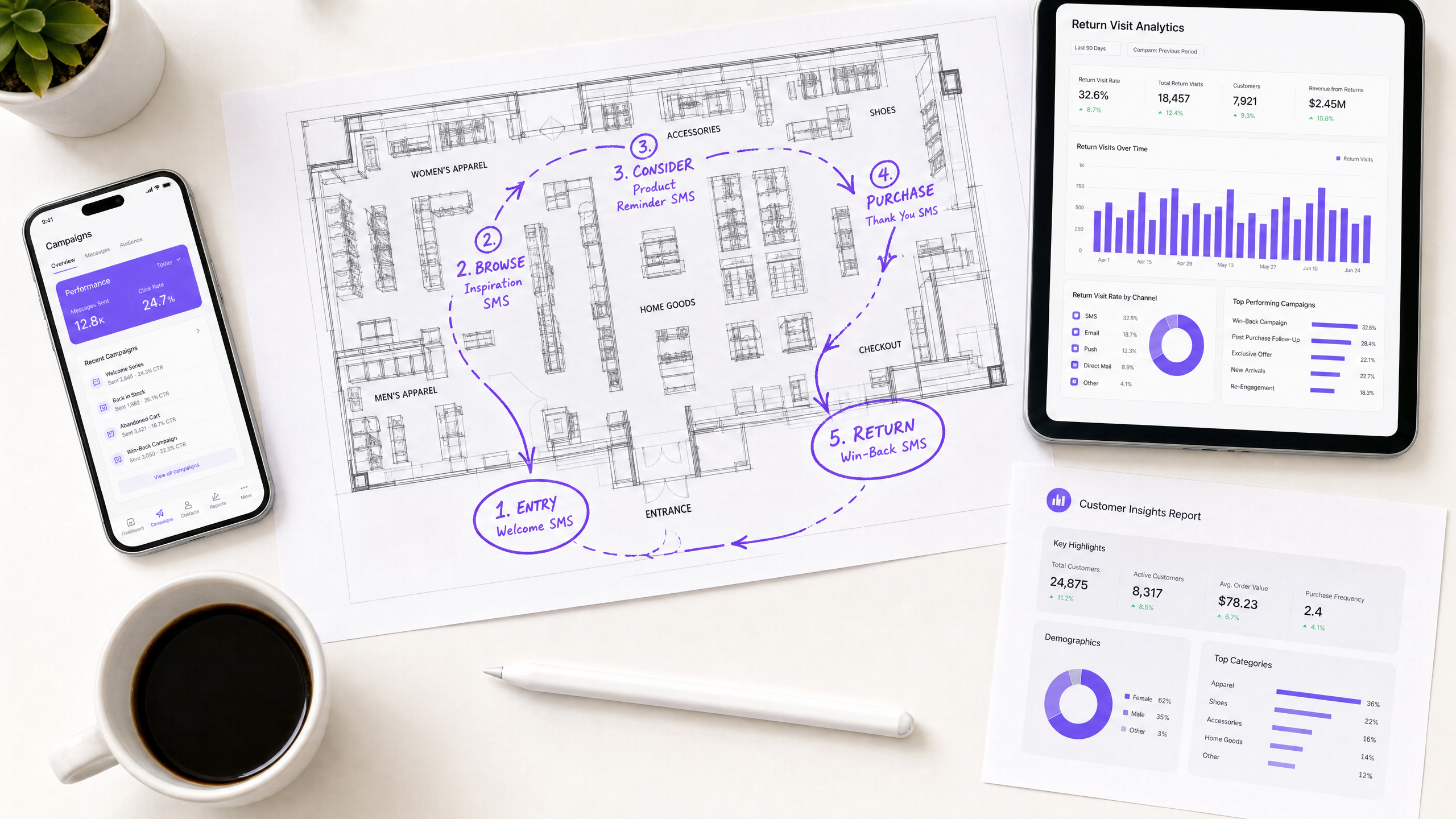
SMS marketing for physical venues operates on a simple premise with complex technical execution: capture visitor phone data securely at the network edge, build a first-party profile, and automate targeted text messages to drive return visits. For IT managers and venue operations directors, the shift from email-centric to SMS-first marketing requires re-evaluating how Guest WiFi infrastructure handles data capture and consent.
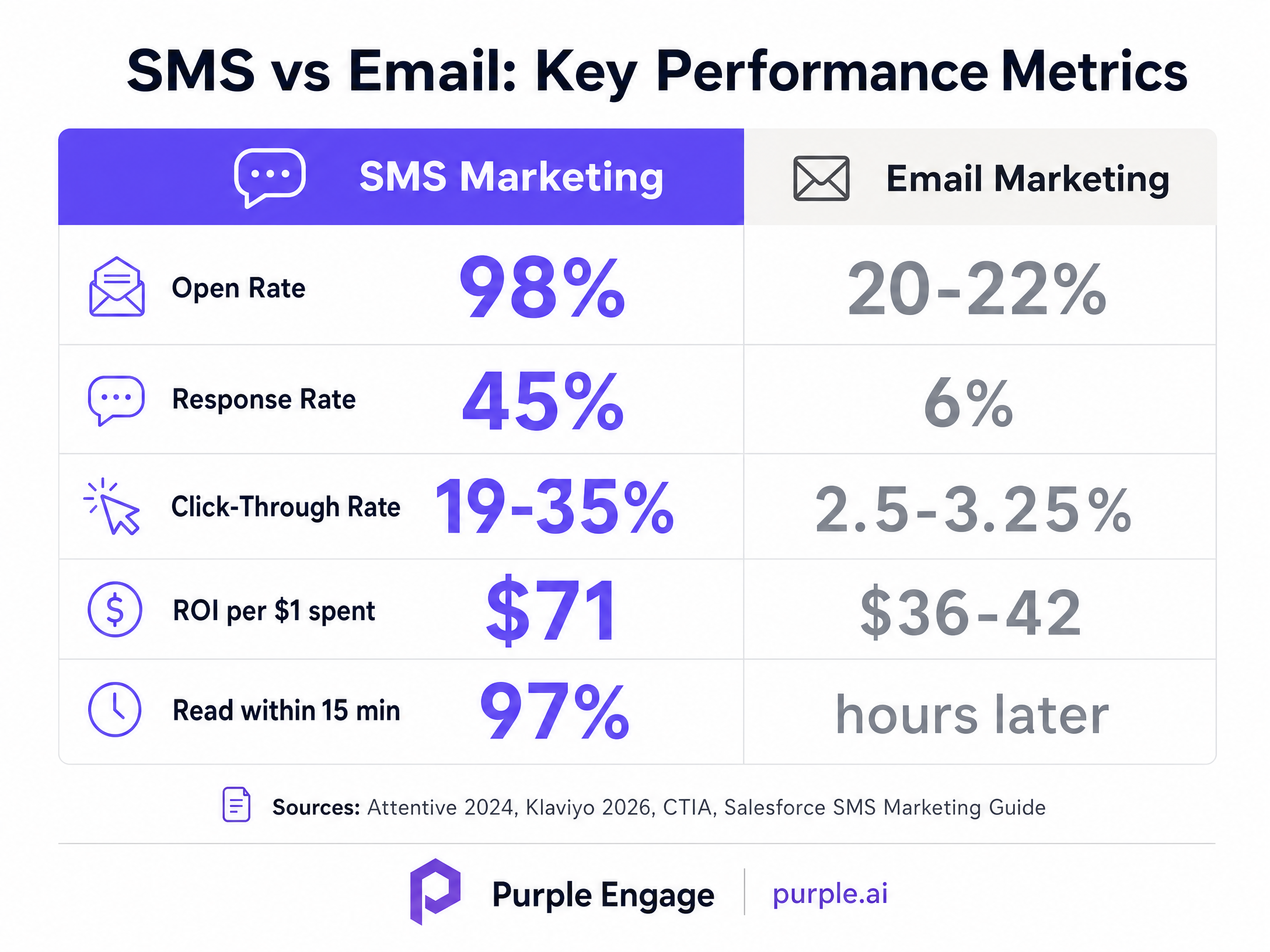
The performance gap between the channels justifies the infrastructure shift. SMS delivers a 98% open rate compared to email's 20%, and 97% of those messages are read within 15 minutes. More importantly, automated SMS campaigns return an average of $71 for every $1 spent. This guide details how to implement an SMS marketing architecture that captures verified phone data through Purple Engage, maintains GDPR and PECR compliance, and integrates with existing network hardware to generate measurable return visits across hospitality, retail, and public-sector environments.
Technical Deep-Dive: The SMS Marketing Architecture
At the core of an effective SMS strategy is the data capture mechanism. You cannot automate campaigns without verified, opted-in phone numbers. The most efficient point of capture is the Guest WiFi login sequence.
Data Capture and Identity Verification
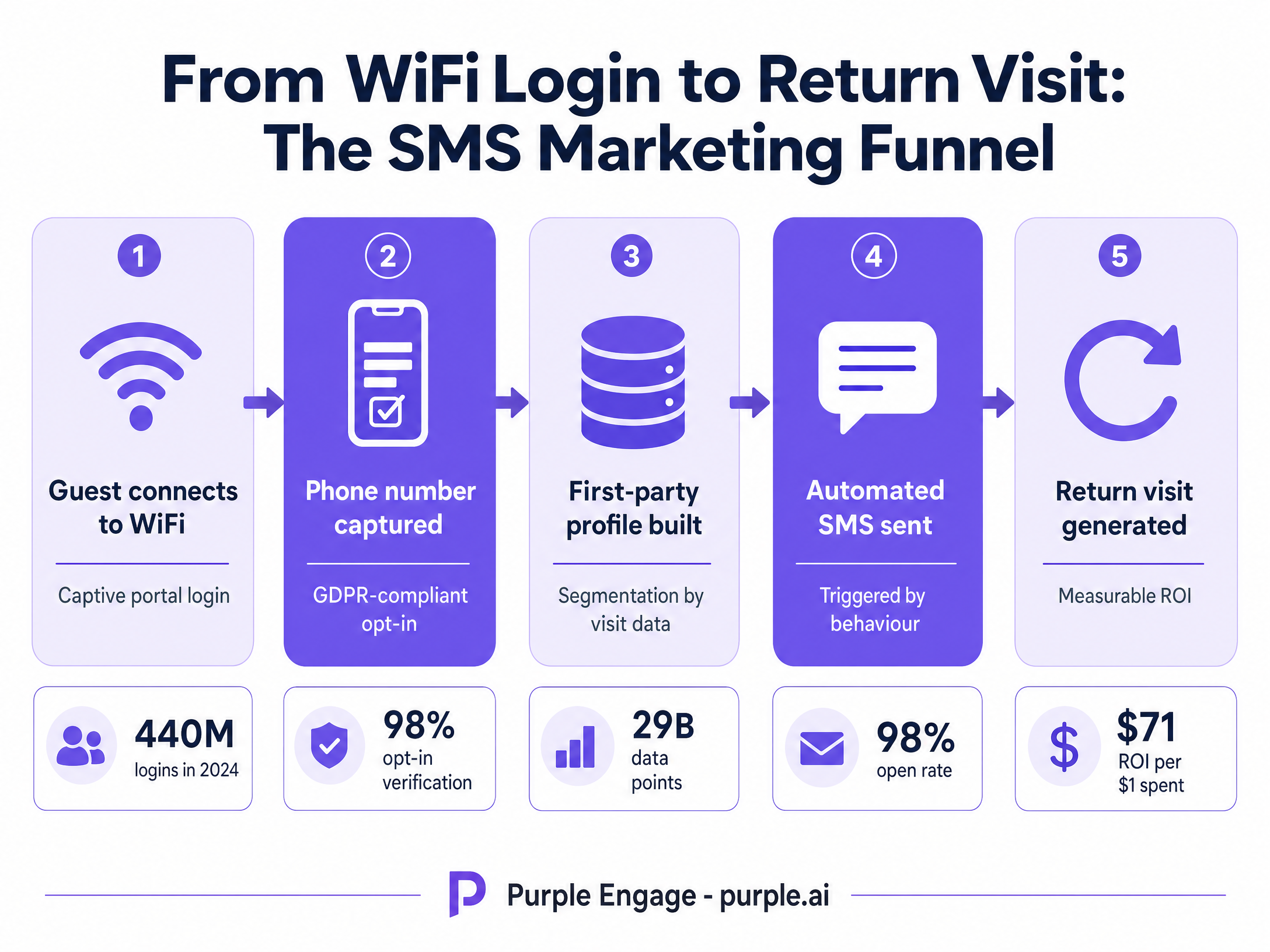
When a visitor connects to a venue's SSID, the network redirects them to a captive portal. This portal, served by the Purple cloud overlay, acts as the identity verification layer. Instead of relying on legacy MAC address tracking, the portal requires the visitor to authenticate.
For SMS marketing, the optimal authentication method is phone number verification. The visitor enters their number, and the system sends a one-time passcode (OTP) via SMS. This process achieves two critical objectives simultaneously: it verifies that the phone number is active and belongs to the device user, and it presents a clear, auditable opt-in mechanism for marketing communications.
Consent Management and Compliance
Compliance is the primary risk factor in SMS marketing. Under GDPR in the UK and EU, and specifically under the Privacy and Electronic Communications Regulations (PECR), you must obtain express, freely given consent before sending marketing text messages.
The captive portal handles this by presenting a distinct, unticked checkbox for marketing communications. The consent record is timestamped and stored in the Purple Engage platform alongside the user's profile. This creates a secure first-party data asset. When a user replies "STOP" to any SMS message, the platform automatically updates their consent status, revoking marketing access and ensuring compliance without manual intervention.
Behavioural Data Integration
Once the identity is verified and consent is recorded, the network infrastructure begins enriching the profile. As the device moves through the venue, access points track its location and dwell time. Purple Engage aggregates this telemetry data - visit frequency, zone preferences, and connection duration - and attaches it to the visitor's profile. This transforms a static phone number into a dynamic behavioural record.
Implementation Guide
Deploying an SMS marketing architecture requires coordination between network infrastructure and the marketing automation platform. The process follows a structured sequence.
Step 1: Network Integration
The foundation is your existing wireless hardware. Purple operates as a cloud overlay, integrating directly with enterprise access points. The canonical hardware list includes Cisco Meraki, HPE Aruba, Ruckus, Juniper Mist, Ubiquiti UniFi, Cambium, Extreme, and Fortinet. You configure the hardware to point Guest WiFi traffic to the Purple RADIUS servers and captive portal.
Step 2: Captive Portal Configuration
Design the captive portal to prioritise phone number capture. While you can offer alternative identity providers like Microsoft Entra ID or Google Workspace, the primary call to action should be mobile authentication. Ensure the opt-in language explicitly mentions SMS marketing and links to your privacy policy.
Step 3: Segment Definition
Do not broadcast messages to your entire database. Use Purple Engage to define specific visitor segments based on network behaviour. For example, create a segment for "First-time visitors who dwelled for over 60 minutes" or "Lapsed visitors who have not connected to the network in 45 days."
Step 4: Campaign Automation
Configure automated triggers based on the defined segments. The platform monitors network activity and executes the SMS send when a visitor meets the criteria. For instance, a post-visit campaign triggers exactly two hours after the device disconnects from the network.
Best Practices for Venue Operators
The technical capability to send SMS messages must be governed by operational discipline. The channel's high engagement rate degrades rapidly if abused.
Control Message Frequency The primary cause of SMS list churn is over-messaging. 61% of consumers unsubscribe because they receive too many texts. Limit promotional messages to two to four per month per user.
Optimise Send Timing Data from Attentive indicates that 45% of SMS purchases occur in the evening. Schedule promotional campaigns for the 6pm to 8pm window. Ensure all automated triggers respect local quiet hours, typically halting sends between 9pm and 8am to comply with regional regulations.
Leverage Contextual Relevance Use the location data gathered by the WiFi network. If a visitor consistently connects to the network in the restaurant zone of a hotel, tailor the SMS offer to dining rather than spa services.
Troubleshooting & Risk Mitigation
When implementing SMS marketing, IT and operations teams must monitor specific failure modes.
| Risk Factor | Technical Cause | Mitigation Strategy |
|---|---|---|
| High Bounce Rates | Invalid phone numbers entered at captive portal | Implement OTP verification during the WiFi login process to ensure number validity. |
| Compliance Breaches | Failure to record explicit consent or process opt-outs | Use a centralised platform like Purple Engage to automate timestamped consent logs and handle "STOP" replies instantly. |
| List Exhaustion | Broadcasting identical messages to the entire database | Implement strict segmentation rules based on visit frequency and dwell time to ensure relevance. |
ROI & Business Impact
The business case for SMS marketing rests on direct attribution. Because the system controls both the message delivery and the network authentication, you can measure exact return visits.
When a visitor receives a promotional SMS and subsequently returns to the venue, their device reconnects to the Guest WiFi network. Purple Engage logs this reconnection, closing the attribution loop. You can calculate the exact cost per acquisition and the total revenue generated by the campaign. With an average return of $71 per $1 spent, the shift to SMS-first marketing, powered by secure network data capture, represents one of the highest-yield investments available to venue operators.
Key Definitions
Captive Portal
A web page that a user of a public access network is obliged to view and interact with before access is granted.
This is the primary data capture point where visitors provide their phone number and consent to SMS marketing.
First-Party Data
Information a company collects directly from its customers and owns entirely.
Phone numbers captured via Guest WiFi are first-party data, insulating the venue from third-party cookie deprecation.
PECR
Privacy and Electronic Communications Regulations, the UK law governing electronic marketing.
IT and marketing teams must ensure their SMS opt-in flows comply with PECR to avoid significant regulatory fines.
Cloud Overlay
A software layer that sits on top of existing network hardware to provide additional functionality.
Purple operates as a cloud overlay, meaning venues do not need to rip and replace their Cisco Meraki or HPE Aruba access points.
Telemetry Data
Automated communications processes by which measurements and other data are collected at remote points and transmitted to receiving equipment.
The WiFi network provides telemetry data like dwell time and visit frequency, which is used to trigger targeted SMS campaigns.
OTP Verification
One-Time Passcode verification, where a temporary code is sent to a user's device to confirm identity.
Using OTP during WiFi login ensures the captured phone numbers are valid, reducing SMS bounce rates.
SSID
Service Set Identifier, the public name of a wireless network.
When a visitor selects the venue's Guest WiFi SSID, the data capture journey begins.
Attribution Loop
The process of tracking a marketing action through to a measurable business outcome.
When a visitor receives an SMS and subsequently reconnects to the venue's WiFi, the attribution loop is closed.
Worked Examples
A 200-room hotel needs to increase direct bookings from previous guests without relying on expensive OTA channels. They currently use email marketing but see open rates below 15%.
The hotel deploys Purple Engage across their Cisco Meraki access points. They configure the captive portal to require phone number authentication with a clear SMS marketing opt-in. The system builds a segment of guests who stayed for two or more nights. 14 days after checkout, the platform automatically triggers an SMS containing a direct booking link and a 10% discount. The message is scheduled for 6pm.
A retail chain with 40 stores wants to re-engage shoppers who have not visited a location in the last 45 days. They need a system that does not require store staff intervention.
The IT team integrates Purple's cloud overlay with their existing HPE Aruba infrastructure. Shopper phone numbers are captured at login. The marketing team creates a 'Lapsed Shopper' segment in Purple Engage for devices that have not authenticated in 45 days. The system automatically sends a time-limited promotional SMS to this segment.
Practice Questions
Q1. Your venue's marketing team wants to upload a list of 10,000 phone numbers from an old CRM system into Purple Engage to send a broadcast SMS offer. As the IT manager, what is your primary concern?
Hint: Consider the regulatory requirements for electronic marketing in the UK.
View model answer
The primary concern is compliance with PECR and GDPR. You must verify that explicit consent for SMS marketing was captured and recorded for every number on that list. If the data was collected for a different purpose (e.g., booking confirmations), it cannot be used for promotional SMS without fresh consent. Proceeding without this audit exposes the organisation to significant regulatory fines.
Q2. A stadium operator is seeing a 40% bounce rate on their SMS campaigns. They currently ask users to type their phone number into a standard web form on the captive portal to access the WiFi. How should the architecture be modified to resolve this?
Hint: How can the network verify the data at the point of entry?
View model answer
The architecture should be modified to include OTP (One-Time Passcode) verification. When the user enters their number, the system sends an SMS with a code that must be entered to gain network access. This ensures the number is valid, active, and belongs to the device user, eliminating the bounce rate issue at the source.
Q3. The commercial director wants to send a promotional SMS to every guest who visited the hotel in the last year. Based on industry benchmarks, why is this a flawed strategy and what is the recommended alternative?
Hint: Look at the data regarding SMS revenue generation and unsubscribe rates.
View model answer
Broadcasting to the entire list is flawed because 61% of unsubscribes are caused by receiving too many or irrelevant messages. Furthermore, data shows that automated, triggered flows generate 45.2% of revenue from just 7.6% of sends. The recommended alternative is to use Purple Engage to segment the audience based on behaviour (e.g., visit frequency) and trigger relevant, automated messages based on specific criteria.