
How to leverage SMS marketing for businesses to increase return visits
This guide details how to use SMS marketing for businesses to increase return visits by integrating Guest WiFi infrastructure with automated data capture and campaign delivery. It covers the full technical architecture - from captive portal OTP verification to network-event-triggered SMS campaigns - alongside GDPR compliance requirements and closed-loop attribution. Venue operators in hospitality, retail, and events will find actionable deployment steps and measurable ROI frameworks.
Listen to this guide
View podcast transcript
Executive summary
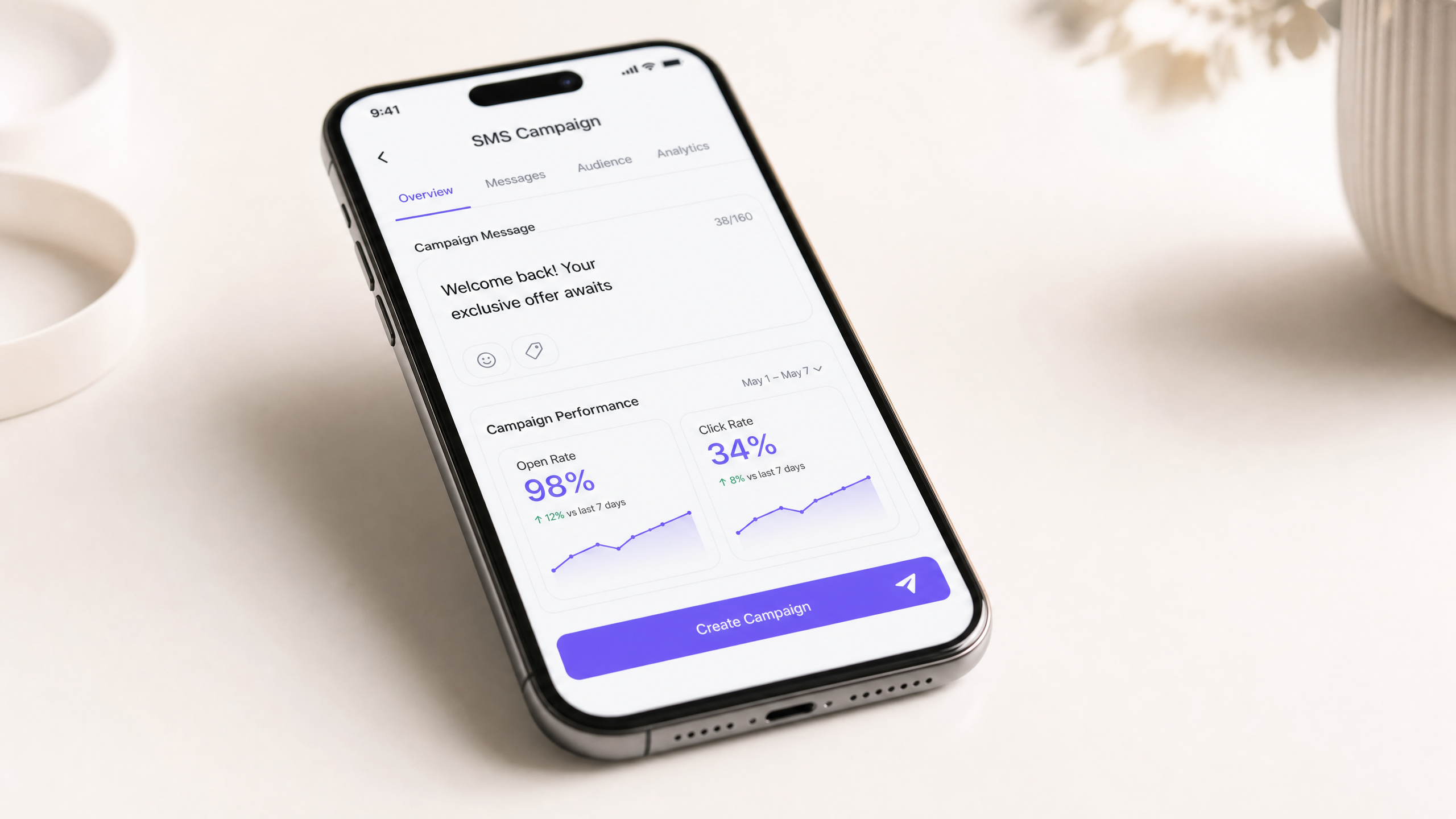
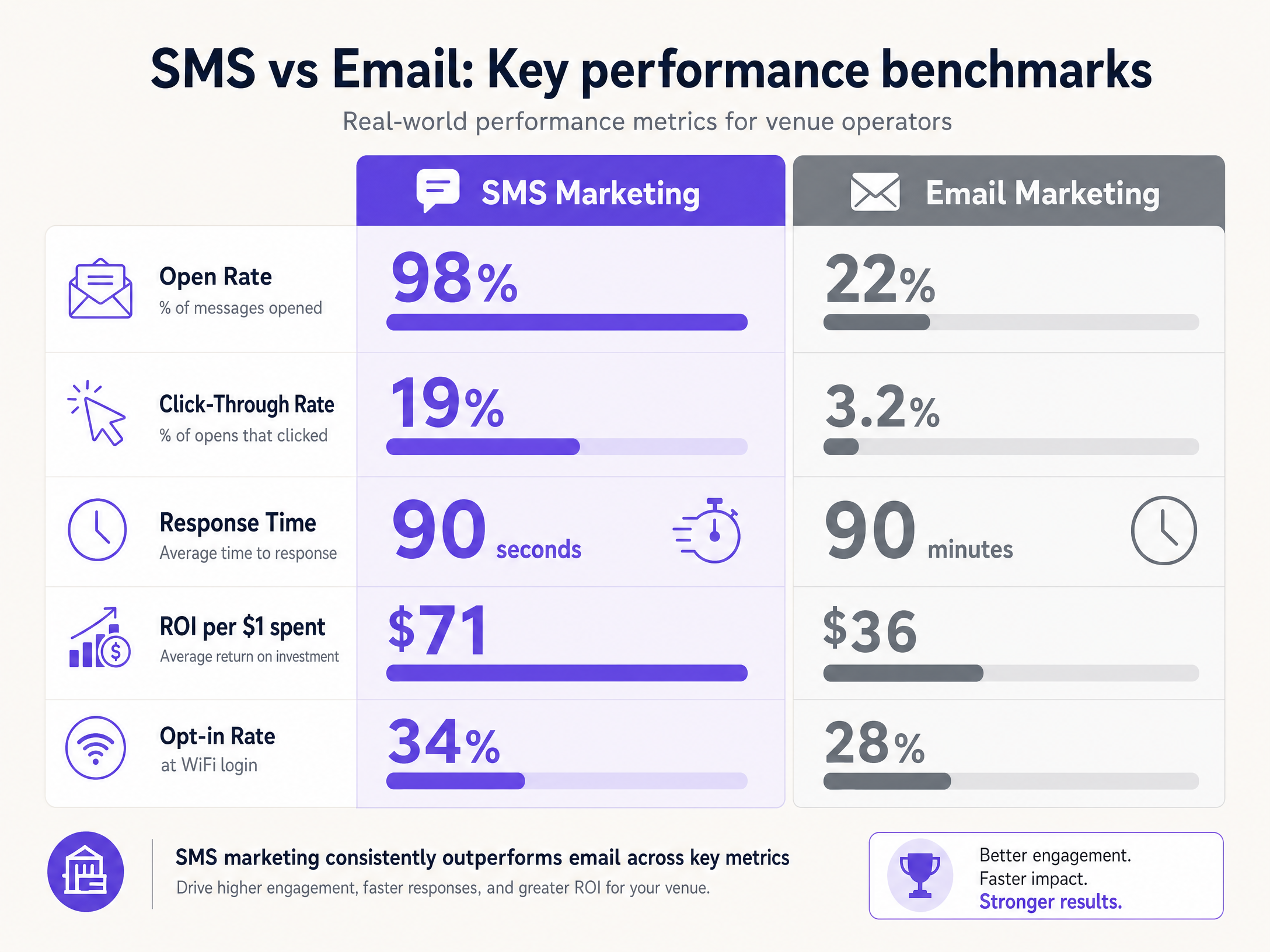
For enterprise venue operators, the gap between network infrastructure and marketing revenue is closing. SMS marketing for businesses is no longer a separate silo; it is a direct output of your existing network hardware. With 98% open rates and a $71 return for every $1 spent [Infobip, 2026], SMS marketing consistently outperforms email. Yet, many venues fail to capture the verified mobile numbers required to run these campaigns.
This guide explains how to use SMS marketing for businesses to increase return visits by integrating your Guest WiFi infrastructure with the Purple Engage platform. By configuring your captive portal to capture phone numbers and verify them via OTP (One-Time Password), you transform an IT cost centre into a measurable revenue driver. We cover the technical architecture, hardware integration, and compliance requirements needed to deploy this at scale across retail, hospitality, and transport environments.
Purple operates across 80,000+ live venues and processed 440 million logins in 2024. The data capture infrastructure is already in place. This guide shows you how to activate it.
Technical deep-dive
The foundation of effective SMS marketing for businesses is verified, first-party data. Buying lists or relying on manual in-store signups is inefficient and often non-compliant. Instead, the network itself must act as the data capture mechanism.
The data capture architecture
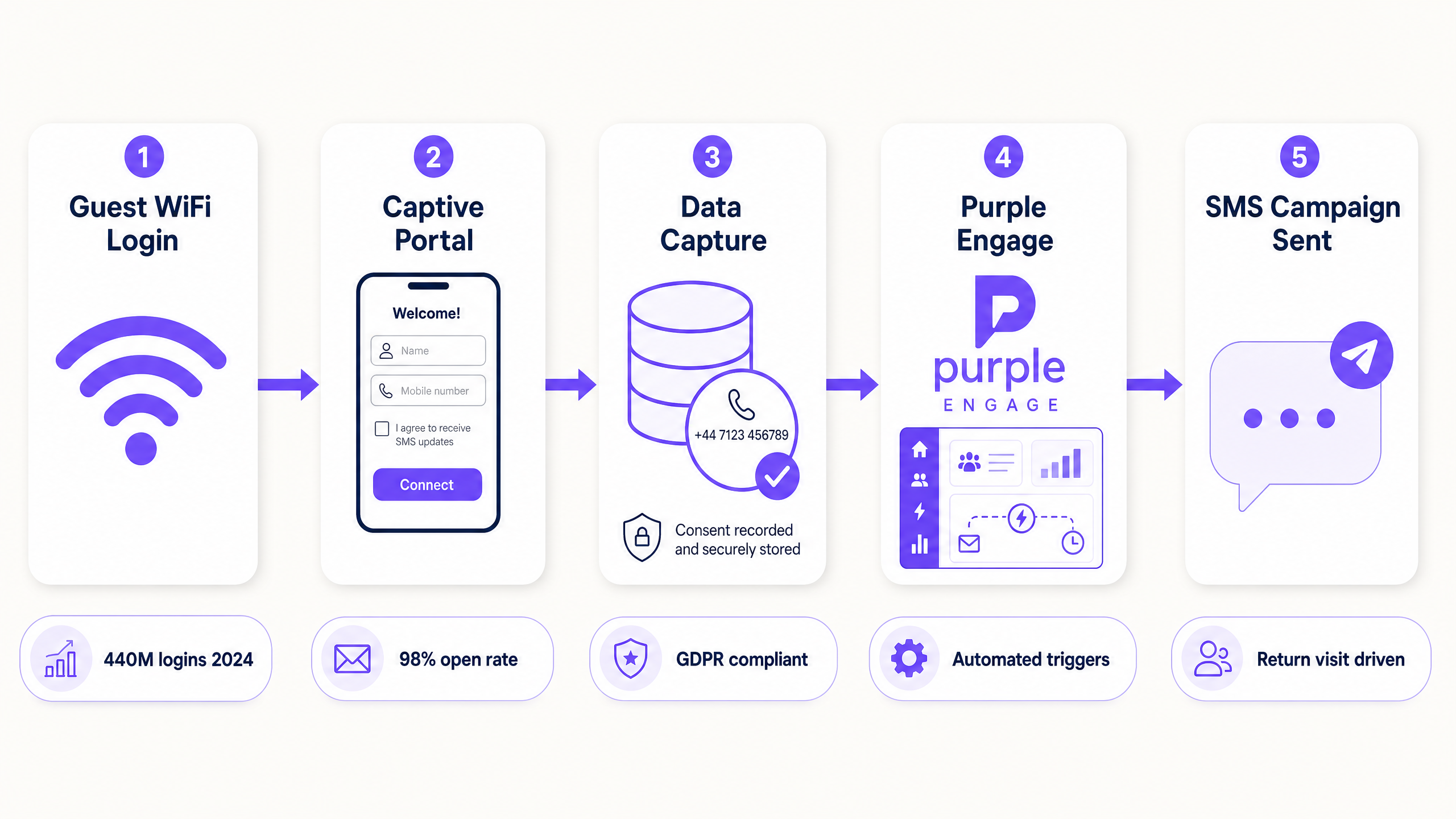
When a guest connects to your network, the hardware - whether Cisco Meraki, HPE Aruba, Ruckus, Juniper Mist, Ubiquiti UniFi, Cambium, Extreme, or Fortinet - redirects unauthenticated HTTP traffic to the Purple cloud overlay via a RADIUS-based captive portal redirect. The splash page presents the login screen. To enable SMS marketing, the portal is configured to request a mobile number alongside explicit marketing consent.
To ensure data hygiene, the system triggers an OTP via SMS. The user must enter this code to gain internet access. This technical step guarantees that the phone number is active, belongs to the user, and can receive SMS messages. It also creates a verified audit trail for GDPR compliance.
OTP verification: the critical step
The OTP flow works as follows. The user submits their mobile number on the captive portal. Purple's platform calls the configured SMS gateway API, which delivers a six-digit code via SMS. The user enters the code on the portal. Purple validates the code against its session store. On success, the RADIUS server issues an Access-Accept to the wireless LAN controller (WLC), and the guest is placed on the internet-facing VLAN.
For this to work, the WLC's walled garden must allow outbound traffic to the SMS gateway provider's IP ranges before authentication is complete. This is the single most common misconfiguration during deployment.
Compliance and identity management
Capturing mobile numbers requires strict adherence to regional regulations. In the UK and Europe, GDPR and the Privacy and Electronic Communications Regulations (PECR) govern this. The captive portal must display clear, unticked opt-in checkboxes for marketing communications. Purple records the timestamp, IP address, MAC address, and the exact consent language agreed to, storing this in a centralised CRM with a full audit trail.
For enterprise deployments, Purple integrates with identity providers including Microsoft Entra ID, Okta, and Google Workspace to manage Staff WiFi, keeping guest data isolated on a separate VLAN. This segmentation is essential for PCI DSS compliance in retail environments where payment terminals share the same physical network infrastructure.
MAC randomisation and profile-based authentication
Modern iOS and Android devices use randomised MAC addresses to protect user privacy. If your marketing automation relies solely on MAC addresses to identify returning visitors, it will fail silently. Purple uses profile-based authentication to tie the device session to the verified user profile upon subsequent logins, ensuring marketing triggers remain accurate even when the device rotates its hardware identifier. This is the correct technical approach for any venue running return-visit campaigns.
Implementation guide
Deploying SMS marketing for businesses requires coordination between IT and marketing teams. Follow this vendor-neutral deployment sequence.
Step 1: Network configuration
Configure your WLC or cloud dashboard to point to Purple's RADIUS servers. Set up a dedicated SSID for Guest WiFi, isolated on its own VLAN. Ensure your walled garden includes the IP ranges or domains required by the SMS gateway to deliver the OTP before the user is fully authenticated. Test OTP delivery from within the pre-authentication state before going live.
Step 2: Captive portal design
Design the splash page to minimise friction while maximising data capture. Request First Name, Last Name, and Mobile Number. Include a clear value exchange: "Join our Guest WiFi and receive 10% off your next visit via text." The opt-in checkbox for SMS marketing must be unticked by default. The consent language must clearly state what the user is signing up for, link to your Privacy Policy, and explain how to opt out. See the guide on first impressions with guest WiFi for design best practices.
Step 3: Automation configuration
Connect the Purple WiFi Analytics dashboard to your marketing stack. Purple Engage handles automated triggers natively. Set up Logic Flows based on network events:
- First visit: Send a welcome SMS with a discount code immediately after login.
- 30-day absence: Send a re-engagement SMS when a verified MAC address has not appeared on the network for 30 days.
- Current presence: Send a time-sensitive offer to users currently connected to the network.
Step 4: Compliance and testing
Before launch, verify that quiet hours are enforced. In the UK, SMS marketing cannot be sent before 09:00 or after 20:00 [Klaviyo, 2024]. Purple Engage enforces these windows automatically. Test the opt-out flow by replying STOP to a test message and confirming the user profile is updated across all channels.
Best practices
To use SMS marketing for businesses to increase return visits effectively, adhere to these technical and operational standards.
Use verified data only. Never send SMS marketing to unverified numbers. The OTP process at login is mandatory to prevent bounce rates and carrier blocking. Unverified lists damage sender reputation and can result in carrier-level blocks that affect your entire sending domain.
Segment by behaviour, not by batch. Do not send batch-and-blast messages. Use the location and visit-frequency data from your access points to segment users. Send different messages to a shopper who visits weekly versus a shopper who visits annually. Purple's WiFi Analytics platform provides the dwell time, visit frequency, and location data needed to build these segments.
Respect quiet hours. Programme your SMS gateway to respect local regulations. In the UK, do not send marketing messages before 09:00 or after 20:00 [Klaviyo, 2024]. Purple Engage enforces these time windows automatically.
Provide clear opt-outs. Every SMS must include a clear opt-out mechanism, such as "Reply STOP to unsubscribe". Purple Engage automatically processes these requests and updates the user profile in real time, ensuring no further messages are sent.
Align IT and marketing on the data model. The IT team owns the network configuration and walled garden. The marketing team owns the campaign logic. Both must agree on the data schema - specifically, how a verified mobile number maps to a CRM contact - before deployment begins.
Troubleshooting and risk mitigation
When implementing SMS marketing for businesses, IT teams encounter specific failure modes. Here are the most common, and how to resolve them.
OTP delivery failures. If guests do not receive the OTP, the most likely cause is a misconfigured walled garden. The network must allow traffic to the SMS gateway provider before full authentication is granted. Check the WLC's walled garden rules and add the gateway's IP ranges or domain names. Test from a device in the pre-authentication state, not from a fully authenticated session.
Consent sync issues. If a user opts out via SMS but continues to receive emails, the CRM integration is not bi-directional. Purple Engage handles this natively, but third-party integrations via webhooks must be configured to update the master record across all channels. Audit your webhook payloads to confirm opt-out events are propagating correctly.
MAC randomisation causing false triggers. If re-engagement campaigns fire for users currently sitting in the venue, MAC randomisation is the likely cause. Enable profile-based authentication so the system ties the session to the verified user profile, rather than relying solely on the hardware MAC address.
Carrier blocking. If delivery rates drop suddenly, your sending domain may have been flagged for spam. This typically happens when unverified numbers are used, resulting in high bounce rates. Audit your contact list for unverified entries and remove them. Review your opt-in records to confirm all contacts gave explicit consent.
GDPR audit requests. If a regulator or data subject requests proof of consent, Purple's platform provides a full audit log including the timestamp, IP address, MAC address, and the exact consent language the user agreed to. Ensure your data retention policy aligns with GDPR's storage limitation principle.
ROI and business impact
SMS marketing for businesses delivers measurable financial impact when tied to network data.
In retail environments, operators track 'Return Visit Rate' - the percentage of users who return to the venue after receiving an SMS. Because the network logs the device's presence, you can attribute a physical visit directly to a specific text message, providing closed-loop attribution that email cannot match.
For hospitality venues, automated SMS campaigns drive direct bookings and food and beverage upsells. A text sent 24 hours after check-out offering a discount on a future stay capitalises on the 98% open rate of SMS, directly increasing lifetime value. Premier Inn and Whitbread operate at the scale where even a 1% improvement in return visit rate across their estate represents significant incremental revenue.
For transport hubs and stadiums, the time-sensitivity of SMS is the key differentiator. Manchester Airports Group (MAG) and AGS Airports operate venues where passengers are physically present for a defined window. An SMS offer sent to a currently connected device has a 90-second average response time, compared to 90 minutes for email [Infobip, 2026]. That difference determines whether a retail offer converts or misses the window entirely.
The measurement framework is straightforward. Track three metrics: opt-in rate at the captive portal (target: above 30%), SMS-attributed return visit rate (compare visit frequency before and after campaign launch), and revenue per SMS sent (divide total campaign-attributed revenue by messages sent). Purple's analytics dashboard surfaces all three natively.
References
[Infobip, 2026] Infobip. "SMS marketing statistics: Key figures for 2026". https://www.infobip.com/blog/sms-marketing-statistics
[Klaviyo, 2024] Klaviyo. "Your simplified guide to SMS regulations and compliance in the UK". https://www.klaviyo.com/uk/blog/uk-sms-regulations-and-compliance
Key Definitions
Captive portal
A web page that a user of a public access network must view and interact with before internet access is granted. It is the primary mechanism for capturing guest data and obtaining marketing consent.
IT teams configure the WLC to redirect HTTP traffic to the captive portal URL. The portal must be accessible within the walled garden before authentication is complete.
OTP (One-Time Password)
A dynamically generated numeric code, valid for a single login session or transaction, delivered via SMS to verify that a mobile number is active and belongs to the user.
Used during WiFi login to verify the mobile number provided. Without OTP verification, the captured number may be fake, inactive, or belong to a different person.
Walled garden
A restricted network environment that allows access to a limited set of IP addresses or domains before a user completes authentication.
Must be configured by IT to allow traffic to the SMS gateway provider so the OTP can be delivered while the user is in the pre-authentication state.
First-party data
Information collected directly from users by the venue that owns the interaction, with explicit consent. The venue owns this data entirely.
Guest WiFi is the most scalable mechanism for collecting first-party data at physical venues. It is insulated from changes to third-party cookies and app tracking restrictions.
VLAN (Virtual Local Area Network)
A logical network segment created within a physical network infrastructure to isolate traffic between different user groups.
Guest WiFi must be isolated on its own VLAN, separate from Staff WiFi and corporate systems. This is required for PCI DSS compliance and prevents guests from accessing internal resources.
MAC randomisation
A privacy feature in modern mobile operating systems that assigns a temporary, randomised MAC address to each network connection, preventing persistent device tracking.
Requires profile-based authentication to accurately track returning visitors. Venues relying solely on MAC addresses for return-visit triggers will see false positives and missed campaigns.
Closed-loop attribution
The ability to tie a specific marketing action directly to a measurable physical business outcome, with no gaps in the data chain.
Achieved when a user receives an SMS and their device is subsequently detected on the venue's WiFi network. This is the primary ROI measurement method for SMS marketing in physical venues.
GDPR (General Data Protection Regulation)
EU and UK data protection legislation that governs how personal data, including mobile phone numbers, is collected, stored, and used for marketing purposes.
Requires explicit, freely given, specific, and informed consent before sending SMS marketing. Consent records must be auditable, and opt-out requests must be processed promptly.
PECR (Privacy and Electronic Communications Regulations)
UK regulations that specifically govern electronic marketing communications, including SMS, email, and automated calls.
Works alongside GDPR in the UK. Requires prior consent for SMS marketing to individuals. Enforced by the Information Commissioner's Office (ICO).
Logic Flow
An automated marketing workflow in Purple Engage that triggers a communication action when a defined network event or data condition is met.
Used to automate SMS campaigns based on events such as first login, 30-day absence, or current network presence, without manual scheduling.
Worked Examples
A 200-room hotel currently offers open Guest WiFi with a simple click-to-connect portal. The marketing director wants to increase direct bookings and reduce commission paid to online travel agencies. The IT team has HPE Aruba access points already deployed. How should they configure the network and marketing automation to drive return visits via SMS?
The IT team reconfigures the HPE Aruba controllers to redirect unauthenticated traffic to Purple via RADIUS. They update the captive portal to request a mobile number and display an unticked opt-in checkbox for SMS marketing. OTP verification is enabled. The walled garden is updated to allow outbound traffic to the SMS gateway provider before authentication. The marketing team builds a Logic Flow in Purple Engage: when a device disconnects from the network and does not reconnect within 48 hours (indicating check-out), the system sends an automated SMS: 'Thank you for staying with us. Book directly at [URL] and save 15% on your next visit. Reply STOP to opt out.' The campaign runs within compliant quiet hours (09:00 to 20:00). Return visit rate is tracked by monitoring whether the verified device reconnects to the network within 90 days of the SMS being sent.
A stadium with 40,000 capacity wants to drive merchandise sales during half-time. Their current email campaigns have a 90-minute average response time, which misses the 15-minute half-time window entirely. They have Cisco Meraki access points deployed throughout the concourses. How should they configure an SMS campaign to capture this revenue window?
The venue uses Purple to capture mobile numbers at login via the captive portal. They build a segment in Purple Engage targeting users currently connected to the network - specifically those authenticated within the last four hours, confirming physical presence. Five minutes before half-time, Purple Engage sends an automated SMS to this segment: 'Half-time offer: 20% off in the team store for the next 30 minutes. Show this message at the till. Reply STOP to opt out.' The offer window is deliberately short to create urgency. Post-match analytics compare the redemption rate of SMS-attributed purchases against baseline merchandise revenue from non-SMS matches.
Practice Questions
Q1. You are deploying a new Guest WiFi network across 50 retail stores. The marketing director wants to use SMS to drive return visits. During testing, users enter their phone number but the OTP SMS never arrives, so they cannot get online. What is the most likely technical cause, and how do you resolve it?
Hint: Consider what network restrictions apply before a user is fully authenticated on the captive portal.
View model answer
The walled garden on the WLC is misconfigured. It is blocking outbound traffic to the SMS gateway provider. Because the user is in a pre-authentication state when they submit their phone number, the network only allows traffic to whitelisted destinations. The SMS gateway's IP ranges or domain names must be added to the walled garden rules so the OTP can be delivered before full authentication is granted. Test by attempting to reach the SMS gateway from a device that has not yet authenticated.
Q2. A hospitality venue has a database of 10,000 phone numbers collected manually via paper forms at reception over the last two years. They want to upload this list to Purple Engage and send a bulk SMS offer. Should you advise them to proceed? What are the risks?
Hint: Consider data hygiene, verification status, and GDPR consent requirements.
View model answer
No. Advise against this. The numbers are unverified, meaning a significant proportion will be inactive or incorrect, resulting in high bounce rates that damage sender reputation and risk carrier-level blocking. More critically, paper forms often lack the clear, auditable, specific consent records required by GDPR and PECR. If the consent language did not explicitly mention SMS marketing, sending to this list is non-compliant and could result in ICO enforcement action. The correct approach is to use the Guest WiFi captive portal to build a new, verified, and fully compliant first-party database from current visitors.
Q3. Your venue's re-engagement SMS campaign is configured to send when a verified user has not been seen on the network for 30 days. Analytics show the campaign is firing for users who are currently sitting in the venue and connected to the WiFi. What is causing this logic failure, and how do you fix it?
Hint: Think about how modern mobile operating systems handle device identifiers on each new network connection.
View model answer
MAC randomisation is the cause. The user's device is rotating its MAC address on each connection, so the network sees them as a new, unrecognised device rather than the returning visitor. The 30-day absence trigger fires because no matching MAC address has been seen for 30 days, even though the user has been visiting regularly. The fix is to enable profile-based authentication in Purple, which ties each session to the verified user profile rather than the hardware MAC address. Once enabled, the system correctly identifies the returning user and suppresses the re-engagement campaign.
Q4. A retail chain wants to send SMS campaigns to shoppers in different regions. Their legal team flags that some regions have different quiet hours regulations. How should the IT and marketing teams configure Purple Engage to handle this automatically?
Hint: Consider how venue-level configuration can enforce regional compliance without manual campaign scheduling.
View model answer
Configure quiet hours at the venue level in Purple Engage, not at the campaign level. Each venue is assigned to a regional timezone and regulatory profile. When a campaign is scheduled, Purple Engage checks the quiet hours rule for each recipient's home venue and queues messages to send within the compliant window. In the UK, this means no messages before 09:00 or after 20:00. For venues in other jurisdictions, the relevant local rules apply. This approach removes the risk of human error in campaign scheduling and ensures compliance scales automatically as the venue estate grows.