
How to leverage SMS marketing softwares to increase return visits
This technical guide details how venue operators and IT managers can deploy SMS marketing software integrated with Guest WiFi to drive measurable return visits. It covers data capture architecture, GDPR compliance, segmentation strategies, and real-world deployment scenarios.
Listen to this guide
View podcast transcript
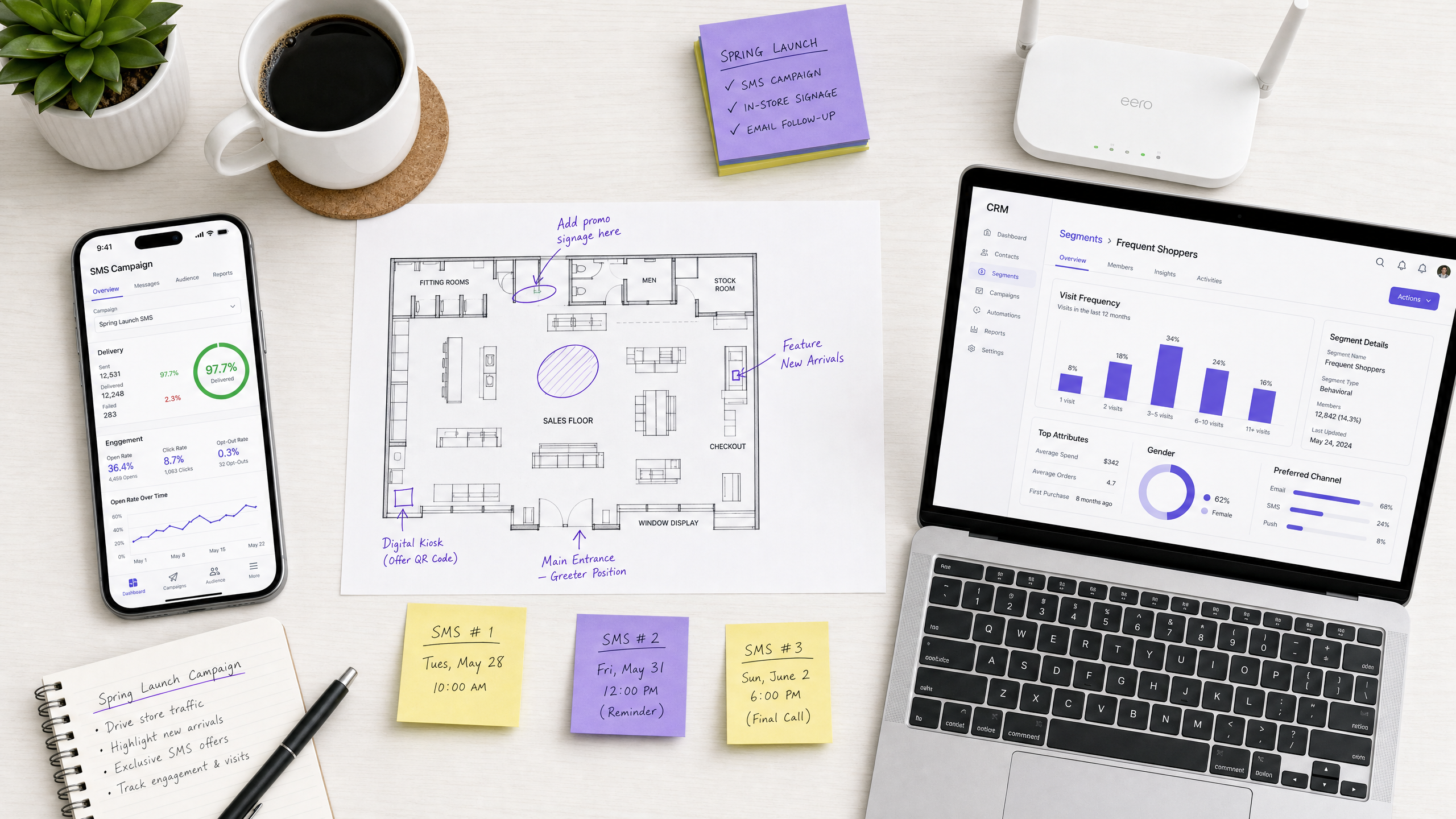
Executive Summary
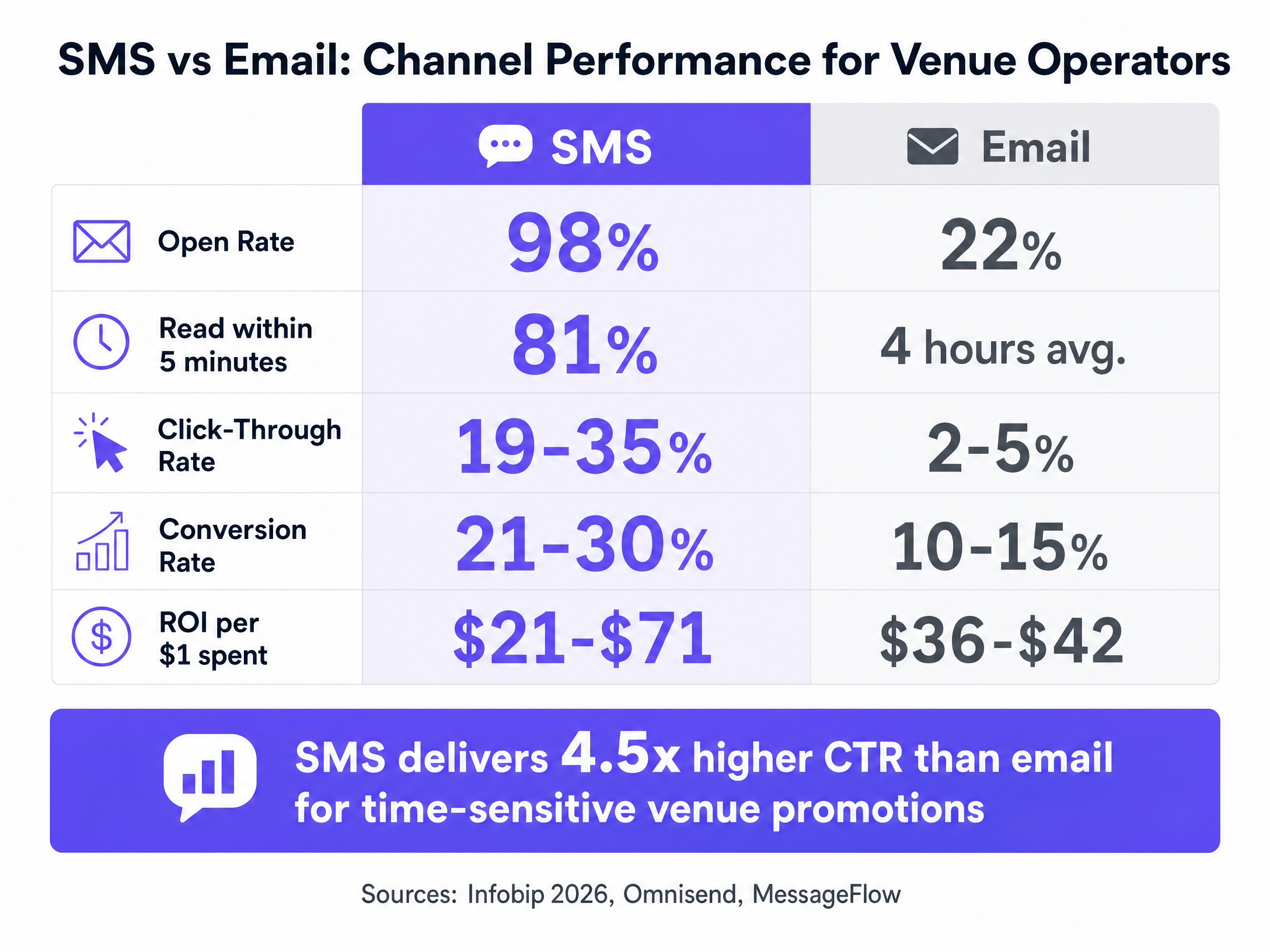
Most venues collect guest data at the point of WiFi login and then do nothing with it. The phone number sits in a database, the visit timestamp goes unread, and the guest walks out the door. That is a significant missed opportunity. SMS marketing software delivers a 98% open rate, with 81% of recipients reading the message within five minutes. Compare that to email, which averages a 20-28% open rate and a read time measured in hours. For time-sensitive venue promotions, that difference is decisive.
This guide details how to integrate your Guest WiFi infrastructure with enterprise SMS marketing platforms to automate re-engagement campaigns. You will learn how to capture verified first-party phone data, ensure GDPR compliance at the captive portal, and build triggered segments based on visit frequency, dwell time, and location zones. By moving from generic broadcast messaging to behaviour-triggered SMS, venue operators typically see return visit rates increase by up to 23%.
Technical Deep-Dive
The foundation of any effective SMS marketing strategy is accurate, verified data capture at the network edge. When a visitor connects to your Guest WiFi network, you have a consent-driven moment to capture their phone number. Purple Engage handles this at the captive portal, presenting a clear opt-in for marketing communications in line with GDPR and PECR requirements. The consent is explicit, the data is verified via OTP if required, and it is tied to a real visit timestamp.
Once the data is captured, the architecture relies on continuous synchronisation between the WiFi analytics engine and the SMS marketing platform. The integration is typically handled via webhook or API. Purple pushes four critical data signals to the SMS platform:
- Visit frequency: The total number of times the device MAC address has connected to the network.
- Recency: The timestamp of the last recorded session.
- Dwell time: The duration of the session, calculated from initial association to disassociation.
- Location zone: The specific access points or zones the device lingered near.
These signals allow you to build audience segments that are genuinely useful, rather than relying on blunt demographic buckets. A triggered SMS campaign sent in response to a specific visitor behaviour consistently outperforms broadcast campaigns.
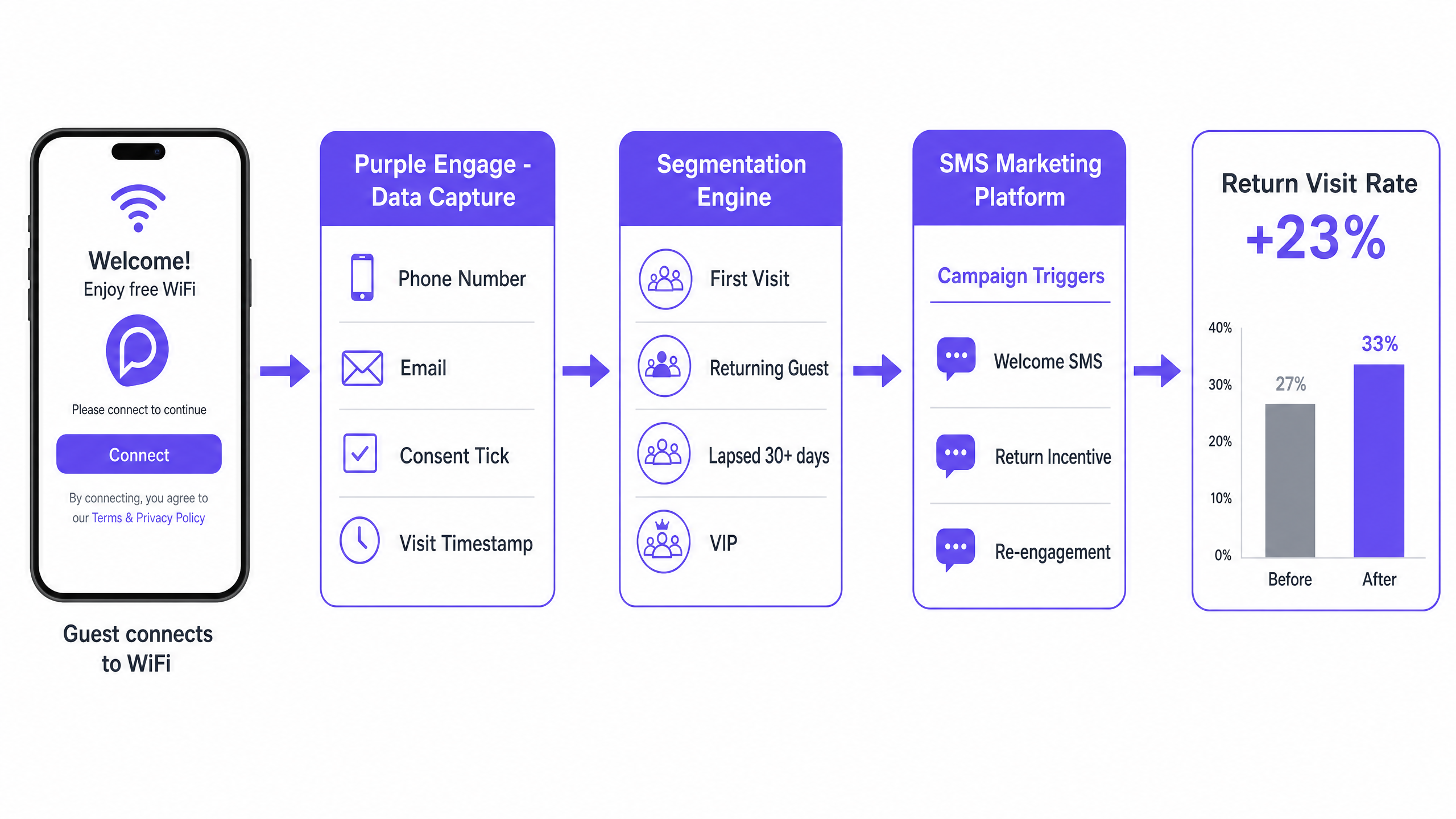
Integration Architecture
The data flow from network access to SMS delivery follows a standard path:
- Device Association: The guest device associates with an access point (e.g., Cisco Meraki, HPE Aruba, Ruckus, Juniper Mist).
- Captive Portal: The device is redirected to the Purple captive portal.
- Authentication & Consent: The guest enters their phone number and explicitly ticks the SMS marketing consent box.
- Session Tracking: Purple tracks the session duration and location via the network infrastructure.
- Data Export: Upon session end, or at defined intervals, Purple pushes the guest profile and visit data to the SMS platform via API.
- Trigger Evaluation: The SMS platform evaluates the new data against defined campaign triggers (e.g., "First visit completed").
- Message Delivery: If the criteria are met, the SMS is queued and sent via an aggregator (e.g., Twilio).
Implementation Guide
Deploying SMS marketing software requires coordination between IT and marketing teams. Follow these steps to ensure a secure, compliant, and effective rollout.
Step 1: Audit Data Capture and Compliance
Check that your WiFi login flow is collecting phone numbers with explicit SMS marketing consent. If you are running Purple Engage, this capability is built in. If you are using a legacy captive portal, you must update the consent language to meet current GDPR standards. The consent must be granular, meaning a separate tick box for SMS versus email. You cannot use a single blanket opt-in.
Step 2: Select and Integrate the SMS Platform
Choose an enterprise SMS platform that aligns with your existing stack. Twilio offers the most flexibility for custom builds. Klaviyo is the path of least resistance if you already use it for email. Attentive provides advanced segmentation features specifically for SMS. Configure the API integration between Purple and your chosen platform to ensure real-time data flow.
Step 3: Define Audience Segments
Define your segments before you build any campaigns. The four segments that consistently drive return visits in Hospitality and Retail environments are:
- New visitors within 30 days.
- Lapsed visitors between 31 and 90 days.
- Lapsed visitors over 90 days.
- High-frequency VIP visitors.
Step 4: Configure Automated Triggers
Set your triggers based on the visit data flowing from Purple. The most effective triggers for venue operators are:
- First visit completion (send welcome message 24 hours later).
- 28-day no-return (send re-engagement offer before the 30-day lapse threshold).
- Seasonal reactivation (send targeted offers based on previous visit dates).
Best Practices
To maximise the impact of your SMS marketing software, adhere to these industry-standard recommendations.
Segment properly. Sending a generic discount to your entire database is SMS broadcasting, not SMS marketing. The channel's performance advantage disappears when messages are not contextually relevant. Use the data from your WiFi Analytics platform to tailor the message.
Control frequency. 61% of SMS unsubscribes happen because the recipient felt they were receiving too many messages. For most venue operators, two to four messages per month per subscriber is the optimal cadence.
Maintain compliance. GDPR requires that SMS marketing consent is freely given, specific, informed, and unambiguous. Every SMS you send must include a clear opt-out mechanism, typically a reply STOP instruction. If you are operating in the US, ensure strict adherence to TCPA guidelines.
Include clear calls to action. Every SMS should have a single, clear objective. Use shortened, UTM-tagged links to track click-through rates accurately.
Troubleshooting & Risk Mitigation
When deploying SMS marketing campaigns, IT teams must monitor for common failure modes.
Low Delivery Rates: A delivery rate below 95% indicates list quality problems. This is often caused by invalid numbers or formatting errors. Implement phone number validation at the captive portal to prevent bad data from entering the system.
High Unsubscribe Rates: If your unsubscribe rate climbs above 1.5% per send, you have a frequency or relevance problem. Review your segmentation logic and ensure you are not over-messaging specific cohorts.
Integration Failures: API rate limits or webhook delivery failures can cause data sync issues between Purple and the SMS platform. Implement robust error handling and retry logic in your middleware, and monitor API error logs daily.
ROI & Business Impact
The business impact of a well-executed SMS marketing strategy is measurable and significant. Average SMS ROI sits between $21 and $71 for every $1 spent. The cost per message is typically between $0.02 and $0.04, making the barrier to entry low.
Success should be measured by tracking the conversion rate of specific segments. For example, monitor the percentage of the "28-day lapsed" segment that returns to the venue within seven days of receiving the SMS. A hotel using Purple Engage reported a 23% increase in return bookings from their SMS-targeted cohort versus a control group. By leveraging the first-party data captured via WiFi, venue operators can turn anonymous footfall into a measurable revenue stream.
Key Definitions
Captive Portal
A web page that the user of a public-access network is obliged to view and interact with before access is granted.
This is the primary data capture point where venue operators collect phone numbers and marketing consent.
First-Party Data
Information a company collects directly from its customers and owns.
Phone numbers captured via Purple Engage are first-party data, making them highly valuable for targeted SMS marketing.
Webhook
A method of augmenting or altering the behaviour of a web page or web application with custom callbacks.
Webhooks are used to push real-time visit data from Purple to the SMS marketing platform the moment a guest connects to the WiFi.
Segmentation
The process of dividing a broad consumer or business market into sub-groups of consumers based on some type of shared characteristics.
In SMS marketing, segmentation based on WiFi visit frequency and dwell time ensures messages are highly relevant.
Click-Through Rate (CTR)
The ratio of users who click on a specific link to the number of total users who view a page, email, or advertisement.
CTR is the most reliable engagement signal for SMS campaigns, typically benchmarking between 19% and 35%.
Dwell Time
The length of time a visitor spends in a specific area or venue.
Calculated by the WiFi network, dwell time is a strong indicator of intent and a key variable for SMS segmentation.
GDPR
General Data Protection Regulation; a regulation in EU law on data protection and privacy.
Dictates that SMS marketing consent must be explicit, informed, and easily revocable.
API Rate Limit
A limit on the number of requests a client can make to an API within a specific timeframe.
IT teams must manage rate limits when syncing large volumes of guest data between the WiFi platform and the SMS provider.
Worked Examples
A 200-room hotel wants to increase direct return bookings from guests who previously stayed at the property but haven't returned in the last 11 months.
The IT team configures Purple Engage to push guest visit data to their SMS platform (e.g., Twilio). The marketing team creates a segment for guests whose last visit timestamp is between 330 and 345 days ago. They configure an automated trigger to send an SMS at day 335: 'Hi [Name], it's been almost a year since your last stay with us. Book direct this week for a complimentary room upgrade.' The SMS includes a UTM-tagged link to the direct booking engine.
A multi-site fashion retailer running Purple across 40 stores needs to re-engage shoppers who visited the new arrivals section but did not make a purchase.
The network architect configures location analytics to track dwell time in specific store zones. Purple pushes this zone data to the CRM. The marketing team builds a segment for shoppers who dwelled in the 'New Arrivals' zone for more than 5 minutes. They configure a trigger to send an SMS 48 hours later: 'Still thinking about our new arrivals? Shop the collection online with free shipping.'
Practice Questions
Q1. Your marketing team wants to send a single SMS broadcast to all 50,000 contacts captured via the Guest WiFi over the last two years to announce a new menu. What is the recommended approach?
Hint: Consider the impact of frequency and relevance on unsubscribe rates.
View model answer
Do not send a single broadcast to the entire database. This will result in a high unsubscribe rate and poor ROI. Instead, segment the list based on recency and frequency. Send the message only to guests who have visited in the last 6 months, and tailor the copy based on whether they are a frequent visitor or a one-time guest.
Q2. A venue operator is migrating from a legacy captive portal to Purple Engage. They have 10,000 phone numbers in their old database, but the previous portal only had a single 'I agree to marketing' tick box. Can they import these numbers into their new SMS platform?
Hint: Review the GDPR requirements for granular consent.
View model answer
No, they cannot legally send SMS marketing to those contacts under GDPR because the original consent was not granular. They must run a re-permission campaign (typically via email, if email consent was validly obtained) to ask those contacts to explicitly opt in to SMS communications.
Q3. The IT team notices that the delivery rate for the automated '28-day re-engagement' SMS has dropped to 82%. What is the most likely cause and how should it be resolved?
Hint: A delivery rate below 95% indicates an issue with the data itself, not the network.
View model answer
The drop in delivery rate is likely caused by guests entering invalid or fake phone numbers at the captive portal. The IT team should implement phone number validation (such as an OTP or regex format check) on the Purple Engage login page to ensure only valid numbers are passed to the SMS platform.