
How to leverage SMS marketing market to increase return visits
This guide explains how IT and marketing teams at enterprise venues can deploy SMS marketing campaigns through Guest WiFi infrastructure to drive measurable return visits. It covers the technical architecture of captive portal data capture, audience segmentation based on physical behaviour, and automated campaign triggers. Venue operators in retail, hospitality, and events will find actionable deployment steps, compliance guidance, and ROI benchmarks to justify investment.
Listen to this guide
View podcast transcript
Executive summary
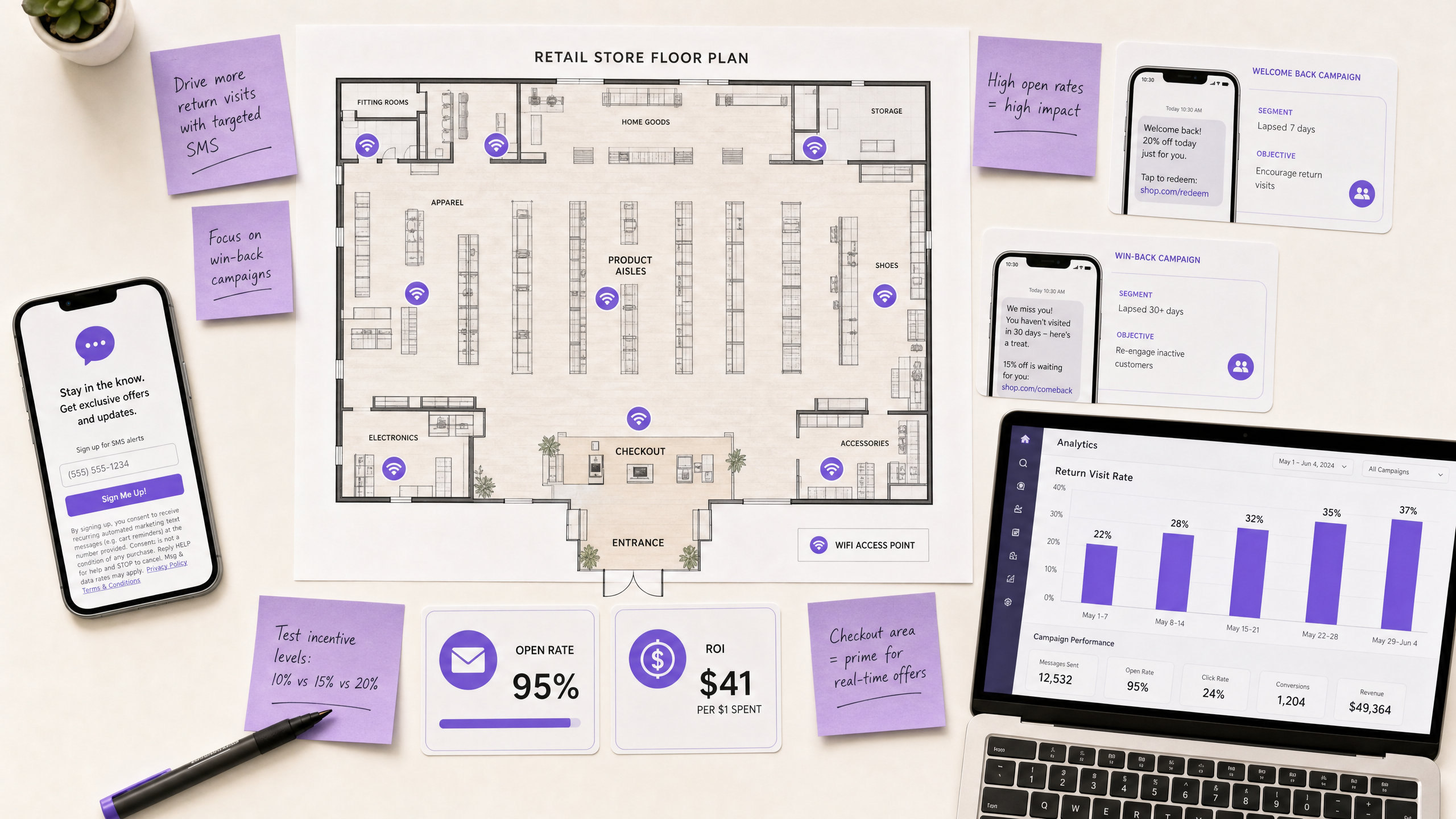
The SMS marketing market is expanding at pace, with the U.S. market projected to reach $28.19 billion by 2030 at a compound annual growth rate of 20.8% [1]. For venue operators, SMS delivers engagement that no other channel matches: open rates of 90% to 98%, with 80% of messages read within five minutes [2]. The challenge is not the channel itself - it is building a compliant, verified database of mobile numbers at scale.
Guest WiFi solves this. When a visitor logs into your network, the captive portal captures their phone number via OTP verification and records explicit marketing consent. Purple Engage then automates segmented campaigns based on visit frequency and recency, triggering win-back offers, loyalty rewards, and time-sensitive promotions without any manual effort from your marketing team. Across 80,000+ live venues and 440 million logins in 2024, Purple has proven this pipeline at scale. This guide details the architecture, implementation steps, and business outcomes you should expect.
Technical deep-dive
The data capture architecture
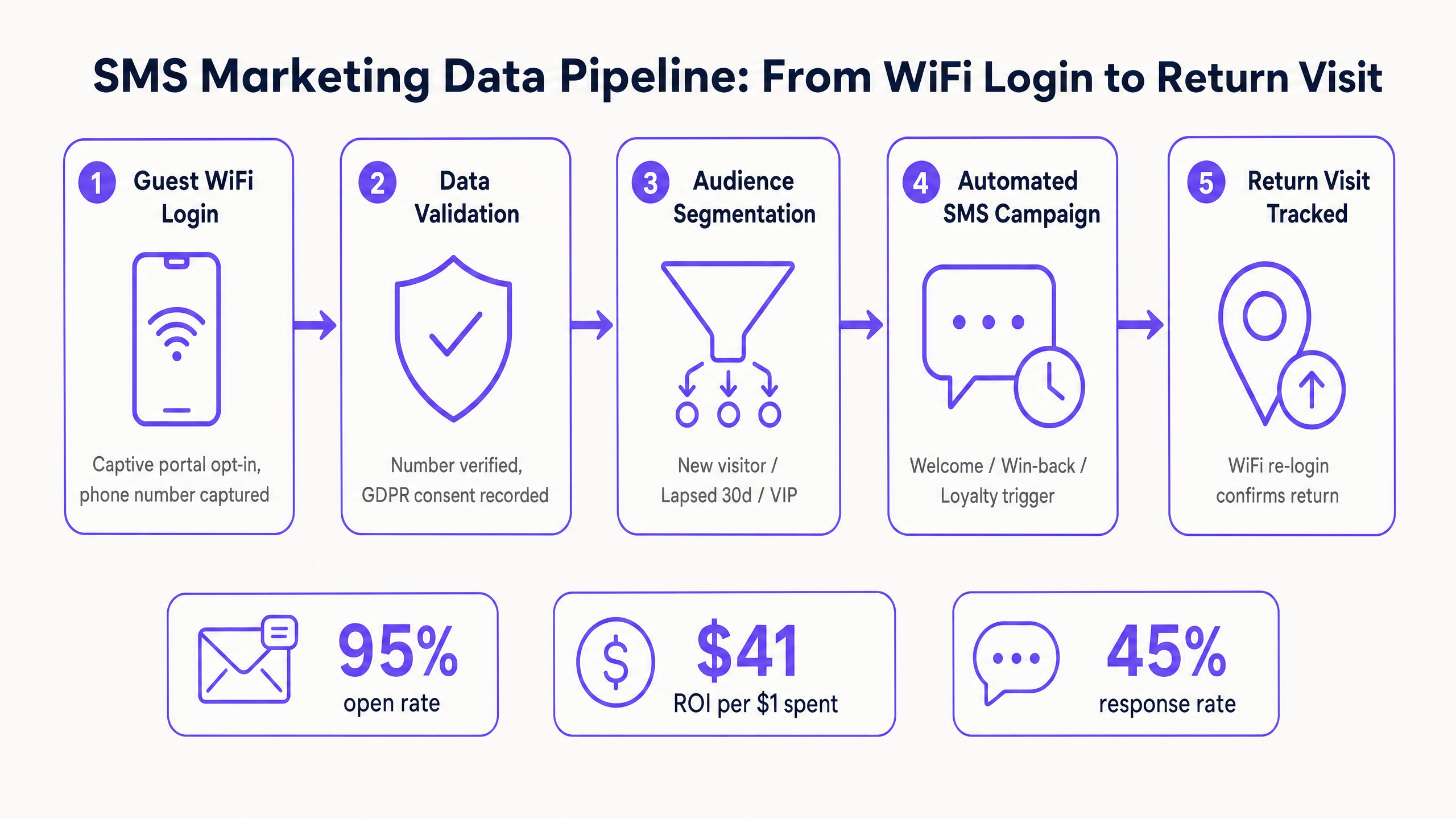
Traditional SMS list building relies on point-of-sale requests or manual sign-up forms, which scale poorly and introduce data quality problems. Integrating data capture into the WiFi authentication flow automates the process and guarantees number accuracy.
The architecture has three core components: the access point layer, the cloud-based captive portal, and the marketing automation engine.
When a visitor connects to the Guest WiFi SSID, the network controller redirects their HTTP traffic to a hosted captive portal. Purple is hardware-agnostic and integrates natively with Cisco Meraki, HPE Aruba, Ruckus, Juniper Mist, Ubiquiti UniFi, Cambium, Extreme, and Fortinet. The portal presents a branded login screen requiring a mobile phone number for authentication. The system immediately sends a one-time password (OTP) via SMS. The visitor enters the OTP to gain internet access, verifying the number in real-time and eliminating fake entries.
During this flow, the portal presents a clear, conscious-choice opt-in for marketing communications. This is a separate, unticked checkbox - not bundled into the terms of service. This distinction is a hard requirement under GDPR Article 7 and TCPA regulations. The captured first-party data syncs to the Purple platform, creating a unified visitor profile that records dwell time, visit frequency, and return intervals.
Presence analytics and return visit tracking
Once a device has authenticated through the captive portal, Purple uses MAC address recognition to track subsequent visits silently. When the visitor returns and their device reconnects to the network, the system logs the return visit and updates the profile - no second login required. This is MAC auth bypass in practice.
This presence data is the engine of your segmentation. You are not relying on stated preferences or survey responses. You are segmenting based on actual physical behaviour: who visited, when, and how often.
Audience segmentation and campaign triggers
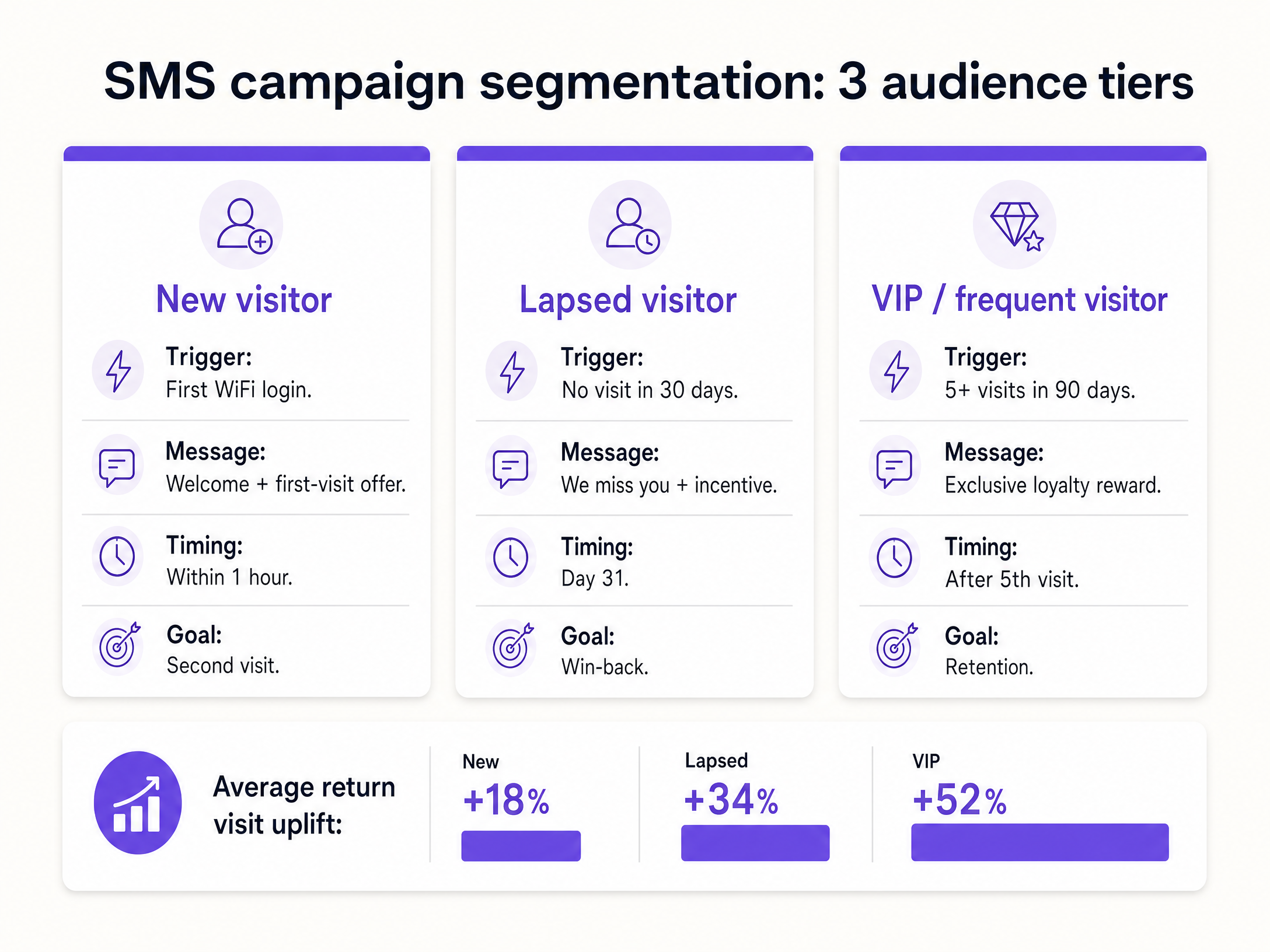
Effective SMS marketing requires precise segmentation. Batch-and-blast campaigns produce high opt-out rates and risk carrier filtering, which can suppress your entire sending domain. Purple Engage uses network analytics to segment audiences based on physical behaviour.
We define three primary segments for return-visit campaigns:
| Segment | Trigger | Message type | Timing | Goal |
|---|---|---|---|---|
| New visitor | First WiFi login | Welcome + first-visit offer | Within 24 hours | Drive second visit |
| Lapsed visitor | No visit for 30 days | Win-back + incentive | Day 31 | Re-engage |
| VIP / frequent visitor | 5+ visits in 90 days | Loyalty reward or exclusive access | After qualifying visit | Retain |
Implementation guide
Deploying an SMS marketing pipeline via Guest WiFi requires coordination between your network engineering and marketing teams. These steps establish a secure, compliant, and high-performing system.
Step 1: Configure the network infrastructure
Ensure your hardware supports external captive portal redirection. Configure the Guest WiFi SSID to use MAC auth bypass after the initial login. Set a minimum dwell time threshold of five minutes before logging a visit - this filters out passersby who connect briefly without entering the venue.
For multi-site deployments, centralise the captive portal configuration in the Purple cloud dashboard. This ensures consistent branding and data capture logic across all locations without requiring site-by-site configuration.
Step 2: Design the captive portal
Build the login flow to balance data capture with user experience. Require the mobile phone number as the primary identifier. Implement OTP verification to prevent fake data entry.
Separate the terms of service acceptance from the marketing opt-in. Pre-ticked boxes violate GDPR and degrade list quality. Use clear, specific language explaining what the visitor will receive - for example, 'Get exclusive offers and event updates from us via text message.' Vague consent language creates compliance risk and reduces trust.
For hospitality venues such as Premier Inn or Whitbread properties, consider adding a brief value statement above the opt-in: 'Join 50,000+ guests who get early access to our best rates.'
Step 3: Define campaign logic and CRM integration
Map out your automated campaigns in Purple Engage. Define the specific dwell time and visit count thresholds for each segment. If you use an external CRM or customer data platform (CDP), configure webhooks or API integrations to sync the captured phone numbers and presence data in real-time.
For a deeper understanding of how this data layer operates, see our guide on what is a customer data platform .
Step 4: Register for compliant sending
In the United States, register your campaigns via 10DLC (10-Digit Long Code) before sending at volume. In the UK and EU, ensure your sending platform is registered with the relevant mobile network operators and that your opt-in records are stored with timestamps and IP addresses for audit purposes.
Best practices
To maximise the return on your SMS marketing investment, follow these operational standards.
Respect frequency limits. Limit promotional SMS messages to two to four times per month per subscriber. Over-messaging is the primary driver of opt-outs, cited by 53% of unsubscribers [2]. Transactional messages (booking confirmations, access codes) do not count against this limit.
Provide immediate value. Every message must offer tangible utility - a discount, a service update, or exclusive access. Generic messages without a clear call to action produce low click-through rates and high opt-outs.
Maintain a suppression list. Automate opt-out processing. When a subscriber replies STOP, remove them from all marketing sends within 24 hours. Failure to do so violates TCPA and exposes you to significant financial penalties.
Personalise content. Use the data captured at login to tailor messages. Reference the specific venue location and, where possible, the visitor's name. A message reading 'Welcome back to our Manchester store, James - here is 15% off today' outperforms a generic broadcast.
Test and iterate. Run A/B tests on incentive levels (10% vs 15% vs 20% off), send times (morning vs evening), and message length (under 160 characters vs two segments). Use Purple's WiFi Analytics to correlate SMS send events with actual return visit data.
For guidance on presenting your Guest WiFi portal in a way that maximises opt-in rates, see how to make a great first impression with your guest WiFi .
Case studies
Retail chain: driving weekend return visits
A 150-site retail chain deployed Purple across its estate using existing Cisco Meraki hardware. The captive portal required a mobile number and OTP verification for access, with a clear marketing opt-in. The marketing team configured an automated SMS campaign in Purple Engage targeting visitors who logged in on a Saturday or Sunday. If the visitor did not return within 14 days, the system triggered an SMS offering a 15% discount valid only on their next weekend visit.
Within three months, the campaign produced a 22% increase in weekend return visits from the lapsed segment. The cost per re-engaged visitor was 94% lower than equivalent paid social retargeting campaigns.
Stadium operator: in-game merchandise sales
A stadium operator found that email campaigns sent during matches had a 3% open rate - too slow to influence behaviour during a 15-minute halftime window. The team transitioned to SMS using the stadium's HPE Aruba network to capture mobile numbers via Guest WiFi as fans arrived.
A scheduled SMS campaign triggered 10 minutes before halftime, sending a text with a link to an indoor map showing the nearest merchandise stand and a 10% discount code. With 80% of texts read within five minutes, the message reached fans while they were still in their seats deciding whether to move. Merchandise revenue during halftime increased by 31% in the first season.
Troubleshooting & risk mitigation
Low opt-in rates
If visitors authenticate but decline the marketing opt-in, review the captive portal design. Ensure the value proposition is clear and specific. Test offering a small, immediate incentive for opting in - a discount code delivered via the first SMS. Venues that offer an immediate reward at opt-in typically see opt-in rates 40% higher than those that do not.
Carrier filtering
Mobile carriers filter traffic that resembles spam. To avoid filtering: register via 10DLC in the US; use a branded sender ID where supported; avoid excessive capitalisation, multiple exclamation marks, or suspicious shortened links. Monitor your delivery rate in Purple Engage. A delivery rate below 90% signals a filtering problem that requires investigation.
Data stagnation
If the database grows but return visits remain flat, your segmentation is likely too broad. Refine your triggers. Instead of a generic 30-day win-back, create campaigns based on the specific day of the week or time of day that matches the visitor's historical visit patterns. A shopper who always visits on Saturday mornings responds better to a Saturday-morning trigger than a generic midweek message.
GDPR and TCPA compliance failures
The most common compliance failure is bundling marketing consent into the terms of service acceptance. Audit your captive portal to ensure the marketing opt-in is a separate, unticked checkbox with clear language. Store consent records with timestamps. If you cannot produce a timestamped consent record for a given subscriber, you cannot legally send to them.
ROI & business impact
An optimised SMS marketing strategy delivers substantial, measurable business value. Industry benchmarks place ROI at $21 to $41 for every $1 spent, with peak seasonal campaigns reporting up to $71 per dollar [2]. At a cost of $0.02 to $0.04 per message, the barrier to entry is low.
By capturing first-party data through Guest WiFi, you eliminate the acquisition costs associated with paid social or search advertising. You own the channel and the audience. There are no ongoing platform fees for reaching your own subscribers.
The return visit metric is directly measurable. When a visitor who received an SMS re-authenticates on your Guest WiFi, Purple logs the return. You can calculate the exact revenue attributable to each campaign by correlating SMS send events with return visit timestamps and transaction data from your POS system.
For venues already running Guest WiFi through Purple, the SMS marketing layer requires no additional hardware investment. The data capture infrastructure is already in place. Activating Purple Engage's SMS campaigns is a configuration change, not a deployment project.
For retail operators, see our retail industry page for sector-specific benchmarks. For hospitality venues, visit our hospitality page for hotel and pub estate case studies.
References
[1] Mordor Intelligence. (2025). United States SMS Marketing Market Size, Share and 2030 Growth. https://www.mordorintelligence.com/industry-reports/united-states-sms-marketing-market
[2] Sakari. (2025). SMS Marketing Statistics: Data-Backed Insights for 2025-2026. https://sakari.io/blog/sms-marketing-statistics-data-backed-insights-for-2025-2026
Key Definitions
First-party data
Information a company collects directly from its customers or visitors, rather than purchasing it from external data brokers or receiving it from third-party platforms.
Guest WiFi is a primary engine for capturing first-party data in physical venues. It is more accurate and legally cleaner than third-party data because the visitor provided it directly.
Captive portal
A web page that a user must view and interact with before gaining access to a public WiFi network. Typically used to present terms of service, collect contact details, and display advertising.
The primary interface for capturing phone numbers and marketing consent from venue visitors. Design and copy on the captive portal directly affect opt-in rates.
MAC auth bypass
A network configuration that authenticates devices based on their MAC (Media Access Control) address, allowing returning users to connect without seeing the captive portal again.
Essential for tracking return visits seamlessly. Without MAC auth bypass, every visit requires a new login, degrading the user experience and breaking the return visit measurement.
10DLC
10-Digit Long Code. A U.S. system that requires businesses to register their local phone numbers used for A2P (application-to-person) SMS marketing to improve deliverability and reduce spam.
IT and marketing teams must complete 10DLC registration before sending high-volume SMS campaigns in the United States. Unregistered campaigns face carrier filtering and potential blocking.
OTP
One-Time Password. A unique numeric or alphanumeric code generated automatically and sent via SMS to verify that a user controls the phone number they have provided.
Used during the WiFi login process to ensure the captured phone data is accurate and belongs to the visitor. Eliminates fake entries and improves CRM data quality.
Dwell time
The amount of time a connected device remains within range of the venue's WiFi network, used as a proxy for the duration of a physical visit.
Used to filter out passersby from genuine visitors. Setting a minimum dwell time threshold (e.g., five minutes) before logging a visit prevents inflated visit counts and irrelevant marketing triggers.
Conscious-choice opt-in
A consent mechanism where the user must actively select an unticked checkbox to agree to marketing communications, rather than having the option pre-selected or bundled into another agreement.
A strict requirement for GDPR compliance under Article 7. Also produces higher-quality subscriber lists because only genuinely interested visitors opt in, improving engagement rates.
Carrier filtering
The practice by mobile network operators of blocking or delaying SMS messages that their algorithms identify as spam, non-compliant, or originating from unregistered senders.
A major operational risk for SMS campaigns. Mitigated by 10DLC registration, branded sender IDs, clean data practices, and avoiding spam-like language patterns.
Win-back campaign
An automated marketing message sent to a previously active customer or visitor who has not engaged or visited for a defined period, with the goal of re-establishing the relationship.
One of the highest-ROI SMS campaign types for venue operators. Triggered by absence rather than presence, making it entirely dependent on accurate visit tracking data from the WiFi network.
Worked Examples
A 150-site retail chain needs to increase return visits from weekend shoppers but currently has no reliable way to contact them after they leave the store. The chain already runs Cisco Meraki hardware across all sites.
Deploy Purple Guest WiFi across all 150 locations using the existing Cisco Meraki hardware. Configure the captive portal to require a mobile number and OTP verification for access. Implement a separate, unticked marketing opt-in checkbox with the text: 'Get exclusive weekend offers via text message.' In Purple Engage, define a visit segment for users who authenticate on a Saturday or Sunday. Set a 14-day absence trigger: if the visitor does not return within 14 days of their last weekend visit, the system automatically sends an SMS with a 15% discount code valid only on their next weekend visit. Configure MAC auth bypass so that returning visitors connect silently and the return visit is logged without requiring a second portal interaction.
A stadium operator wants to drive merchandise sales during halftime but finds that email campaigns sent during the game have a 3% open rate and arrive too late to influence behaviour.
Transition the in-game communication strategy from email to SMS. Use the stadium's HPE Aruba network to capture mobile numbers via the Guest WiFi portal as fans arrive before kick-off. In Purple Engage, create a scheduled SMS campaign that triggers 10 minutes before halftime. The message includes a link to an indoor map showing the shortest route to the nearest merchandise stand, along with a 10% discount code valid only during halftime. Set the campaign to fire only to fans who have been connected to the network for at least 30 minutes - confirming they are inside the venue, not outside.
Practice Questions
Q1. Your marketing team wants to send a weekly SMS blast to the entire Guest WiFi database of 45,000 contacts, promoting upcoming events. As the IT manager, what concerns should you raise and what alternative would you recommend?
Hint: Consider the impact of message frequency on subscriber retention, carrier filtering thresholds, and the difference between behavioural segmentation and broadcast messaging.
View model answer
Raise three concerns. First, frequency: weekly messages to an undifferentiated list will drive opt-out rates above the 3.5% benchmark, eroding the database faster than it grows. Second, carrier filtering: identical bulk messages sent at high volume trigger spam detection algorithms, potentially suppressing your entire sending domain. Third, relevance: a single message about an upcoming event is irrelevant to the majority of your database at any given time. Recommend replacing the broadcast with segmented, triggered campaigns in Purple Engage. Visitors who attended a similar event in the past 90 days receive the event promotion. Visitors who have not been to the venue in 30 days receive a win-back offer. Frequent visitors receive early access or a loyalty incentive. This approach sends fewer messages overall but to the right people at the right time, producing higher conversion rates and lower opt-out rates.
Q2. A hotel operator notices that 18% of phone numbers in their CRM from the Guest WiFi portal are invalid (e.g., sequential digits, repeated numbers). How do you resolve this and prevent it recurring?
Hint: Look at the authentication process before network access is granted. Consider what incentive a visitor has to enter a real number.
View model answer
The root cause is that the captive portal grants internet access before verifying the phone number. Implement OTP verification: when a guest enters their mobile number, the system sends a unique code via SMS. The guest must enter this code to gain internet access. This creates a direct incentive to provide a real, active number. For the existing invalid records, run a number validation pass using a lookup API to identify and suppress non-dialable numbers before your next campaign send. Going forward, monitor the OTP completion rate in Purple Engage as a data quality indicator - a completion rate below 85% suggests friction in the login flow that may need UX review.
Q3. You are deploying Guest WiFi across a university campus with 12 buildings. Students complain that they have to log in again every time they move between buildings. How do you resolve this while maintaining the ability to track movement between zones?
Hint: Consider how the network controller identifies returning devices and how presence data is collected after the initial authentication event.
View model answer
Configure MAC auth bypass across all 12 access points in the same Purple venue configuration. After a student authenticates once through the captive portal, their device's MAC address is registered. As they move between buildings, the network controllers (e.g., Juniper Mist or Cisco Meraki) recognise the MAC address and authenticate the device silently in the background. The student experiences seamless connectivity. Purple continues to log which access points the device associates with, providing zone-level movement data across the campus without requiring repeat logins. For the student SMS marketing use case, this means you can trigger location-specific messages - for example, a notification about a library event when a student's device associates with the library access point.