
Customer data platform examples: a comprehensive guide for businesses
This guide details how IT managers and venue operations directors can deploy a customer data platform to convert guest WiFi infrastructure into a first-party data asset. It covers technical architecture, GDPR-compliant data capture, identity resolution, audience segmentation, and activation strategies with measurable ROI benchmarks.
Listen to this guide
View podcast transcript

Executive Summary
Your guest WiFi network already generates two types of data: anonymous presence data from device probe requests, and identified engagement data from captive portal authentications. A customer data platform sits at the intersection of these two streams, resolving identities, building unified customer profiles, and activating those profiles across email, SMS, and paid media channels. For IT managers and venue operations directors, this means the network infrastructure you have already deployed can become the primary engine for first-party data capture. Purple Engage captures verified guest email and phone data at login and automates marketing campaigns, integrating with hardware from Cisco Meraki, HPE Aruba, Ruckus, Juniper Mist, Ubiquiti UniFi, Cambium, Extreme, and Fortinet without requiring a hardware replacement. Harrods achieved a 57x return on investment by marketing to customers acquired through their guest WiFi network. This guide provides the technical architecture, implementation steps, and compliance framework to replicate that outcome at your venue.
Technical Deep-Dive
What a CDP actually does
A customer data platform is a centralised system that ingests data from multiple sources, resolves identities, and builds persistent unified customer profiles that marketing and operations teams can activate. In a physical venue, the primary ingestion point is the Guest WiFi network.

The architecture has five functional layers:
| Layer | Function | Venue context |
|---|---|---|
| Data ingestion | Pulls data from WiFi, CRM, POS, mobile app | Captive portal authentication events |
| Identity resolution | Links MAC address, email, CRM ID to one profile | Returning guest recognised across visits |
| Profile unification | Merges all attributes into a single record | Visit history, dwell time, spend data |
| Audience segmentation | Builds cohorts from profile attributes | "Visited 3x in 30 days, dwell > 20 min" |
| Activation | Syncs segments to email, SMS, ad platforms | Automated re-engagement campaign |
The data capture layer: guest WiFi as the ingestion point
When a device enters your venue with its WiFi radio active, it broadcasts probe requests - the device asking the network whether a known access point is nearby. Every access point in range picks up the probe request, recording the device MAC address and signal strength. This is the foundation of presence analytics: anonymous footfall counting and dwell time calculation.
The complication is MAC randomisation. Since iOS 14 and Android 10, mobile devices rotate through temporary MAC addresses for probe requests. Platforms that do not correct for this overstate visitor counts significantly. Purple applies statistical correction models calibrated against camera ground truth, maintaining accuracy within 3% to 7%.
Engagement data begins when the user connects through the captive portal. The captive portal is the authentication gateway and the primary mechanism for capturing first-party data. The user provides a verified email address or phone number. The CDP links this identifier to the device session and, via identity resolution, to any existing CRM record.
Identity resolution in practice
Identity resolution is the process of linking multiple identifiers - MAC address, email, CRM ID, loyalty number - to a single individual. When a shopper authenticates via WiFi at your Manchester store, then purchases through your mobile app two days later, the CDP recognises both interactions as the same person. It merges the records and updates the unified profile in real time.
Implementation Guide
Step 1: Configure the captive portal for conversion
The most common point of failure in CDP deployments is the captive portal design. If your portal asks for too much information, users abandon the login process. Keep the flow to three steps or fewer. Ask for the minimum viable data: email address and marketing consent. Use a tool like Purple Verify to validate email addresses at the point of capture. Invalid emails in your CDP degrade every downstream campaign.
Step 2: Establish the consent architecture
GDPR requires explicit, freely given consent for marketing communications. Your captive portal must present marketing opt-in as a separate, unticked checkbox - not bundled with the terms of service. The CDP manages this consent state and ensures it is respected across all activation channels. If a user opts out via an email link, the CDP updates their profile and suppresses them from future SMS and paid media campaigns automatically.
Step 3: Design for access point density
If you want accurate location analytics to enrich your CDP profiles, you must design your network for density, not just coverage. Place access points on zone boundaries to enable signal triangulation. The rule of thumb is one access point per 150 to 200 square metres in open-plan environments.
Step 4: Integrate operational workflows
Data sitting in a dashboard generates no value. You must configure the API integrations to push data into your CRM and marketing automation platforms. This requires coordination between IT and marketing teams. Prioritise this work early. Purple integrates with over 400 connectors including HubSpot, Salesforce, Marketo, and Klaviyo.
Best Practices
Audience suppression
Audience suppression is the highest-ROI CDP use case. It involves automatically excluding existing customers, recent purchasers, or active subscribers from paid acquisition campaigns. Industry benchmarks suggest 10% to 20% of acquisition budgets are wasted on already-converted customers. Suppression eliminates this waste from week one.
First-party audience activation
Syncing CDP segments to ad platforms for targeting replaces deprecated third-party cookies with deterministic first-party data. First-party data-based campaigns deliver 2x or higher improvement in incremental revenue versus third-party audiences.
Churn prevention
Acquiring a new customer costs 5x to 7x more than retaining an existing one. CDPs make churn prevention proactive rather than reactive. AI models analyse declining engagement signals - fewer logins, reduced purchase frequency - to score each customer's churn probability. Marketers can intervene before the customer leaves.
Troubleshooting & Risk Mitigation
MAC randomisation impacts
MAC randomisation affects anonymous presence analytics, but once a user authenticates through the captive portal, the CDP links their session to their verified identity, bypassing the randomisation issue entirely.
Compliance failures
Failing to complete a Data Protection Impact Assessment (DPIA) before deploying presence analytics is a major risk. Under GDPR, processing location data from device probe requests may require a DPIA, even if the data is anonymised at the point of storage. Complete this before go-live.
Siloed deployment
Treating the CDP as a marketing tool rather than an infrastructure asset leads to failure. The IT team owns the network. The marketing team owns the campaigns. The CDP sits at the intersection. If you do not establish clear ownership and a shared data governance policy from the start, the integration stalls.
ROI & Business Impact
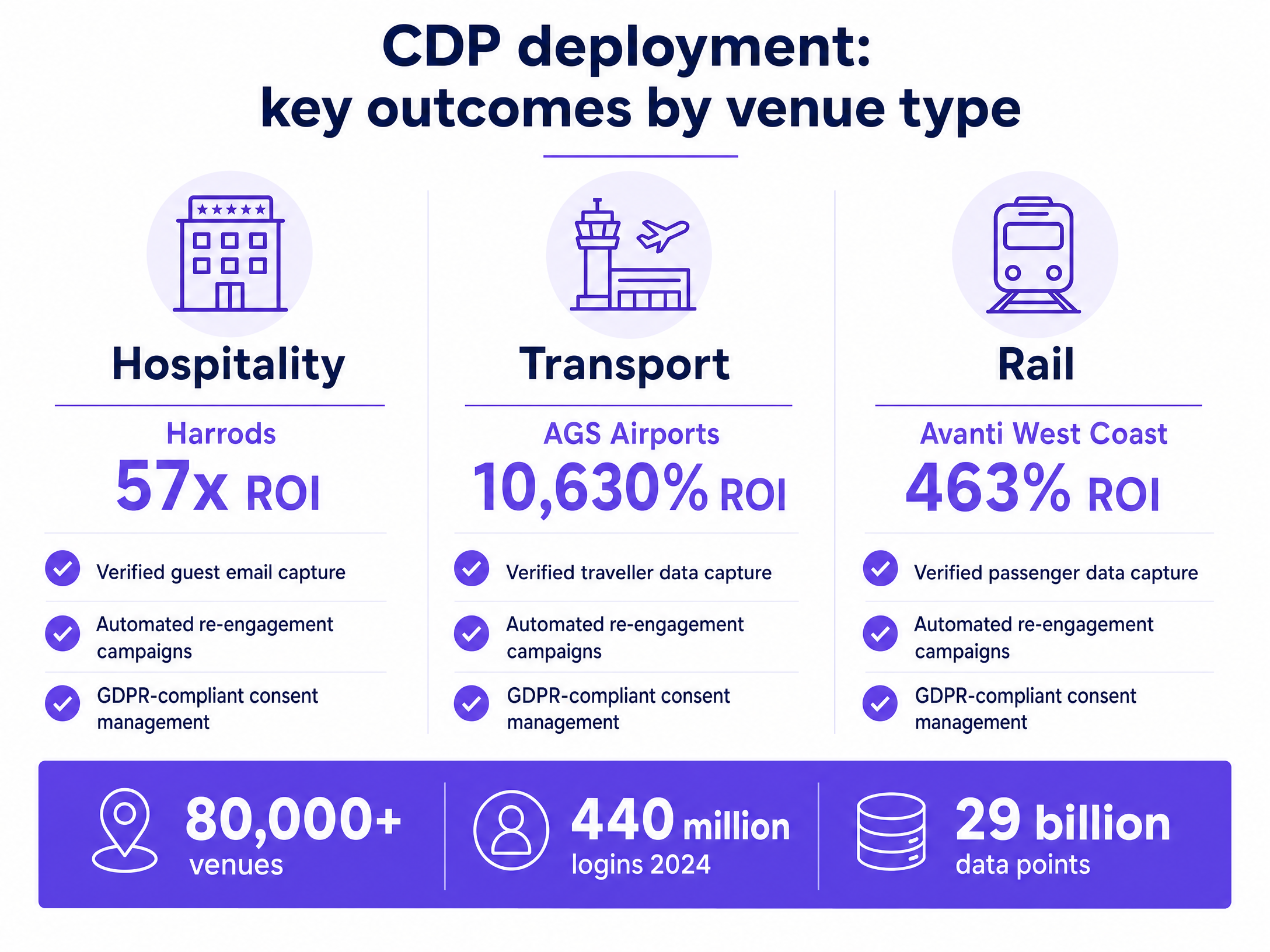
The organisations seeing the highest return on investment share three characteristics. They captured verified first-party data at the point of WiFi login. They integrated that data with their marketing automation workflows. And they activated it with campaigns targeted to specific behavioural segments.
In the Hospitality sector, Harrods achieved a 57x return on investment by marketing to customers acquired through their guest WiFi network. In Transport , AGS Airports achieved a 10,630% ROI. And in Rail, Avanti West Coast drove a 463% return on investment.
The WiFi login is a natural, high-intent moment. Passengers and shoppers are already engaged with their journey or visit. Capturing their data at that moment, with explicit consent, gives you a first-party data asset that no third-party cookie could replicate. Purple runs across 80,000+ live venues and processed 440 million logins in 2024. The platform is ISO 27001 certified and GDPR compliant.
Listen to the full briefing here:
Key Definitions
Customer Data Platform (CDP)
A centralised system that ingests data from multiple sources, resolves identities, and builds persistent unified customer profiles accessible to other systems.
The engine that converts anonymous footfall and WiFi authentications into a structured, compliant first-party data asset.
Identity Resolution
The process of linking multiple identifiers (MAC address, email, CRM ID) to a single individual to create a unified profile.
Essential for recognising returning guests across different visits, channels, and devices.
Captive Portal
The authentication gateway presented to users when they connect to a guest WiFi network.
The primary mechanism for capturing verified first-party data and marketing consent in physical venues.
MAC Randomisation
A privacy feature where mobile devices rotate through temporary MAC addresses when broadcasting probe requests.
Complicates anonymous presence analytics, requiring statistical correction models, but is bypassed once a user authenticates.
First-Party Data
Data collected directly from your audience or customers, with their explicit consent.
The most valuable data asset for targeted marketing, especially as third-party cookies are deprecated.
Audience Suppression
The practice of excluding existing customers or active subscribers from paid acquisition campaigns.
The highest-ROI CDP use case, eliminating wasted ad spend immediately.
Data Protection Impact Assessment (DPIA)
A process designed to help organisations systematically analyse, identify, and minimise the data protection risks of a project.
A mandatory compliance step under GDPR before deploying presence analytics based on device probe requests.
Cloud Overlay
A software architecture that sits on top of existing hardware infrastructure, providing new capabilities without requiring physical replacements.
How Purple integrates with enterprise access points (Cisco Meraki, HPE Aruba, etc.) to deliver CDP functionality.
Worked Examples
A 200-room hotel needs to capture verified guest data to reduce reliance on Online Travel Agencies (OTAs) and drive direct bookings.
Deploy Purple Engage on existing Cisco Meraki access points. Configure the captive portal to offer tiered bandwidth: standard free access, or premium high-speed access in exchange for joining the loyalty programme. Implement Purple Verify to validate email addresses in real time. Set up a webhook integration to push authenticated guest profiles into the hotel's CRM (e.g., Salesforce). Build an automated post-stay email campaign targeting guests who booked via OTAs, offering a 10% discount for their next direct booking.
A stadium operator needs to understand fan movement and reduce congestion at concession stands during half-time.
Audit the existing access point placement and densify the network, aiming for one access point per 150 square metres in concourse areas. Enable presence analytics in the Purple platform to track device probe requests. Complete a DPIA to ensure GDPR compliance. Use the Purple spatial analytics dashboard to map zone-level dwell times and identify bottlenecks. Integrate the real-time occupancy data with the stadium app to push notifications to fans, directing them to less crowded concession stands.
Practice Questions
Q1. Your marketing team wants to add five demographic questions to the WiFi login portal to enrich their CDP profiles. How do you respond?
Hint: Consider the impact on the conversion rate at the ingestion point.
View model answer
Advise against it. The primary goal of the captive portal is conversion. Keep the login flow to three steps or fewer (e.g., email and consent). Capture the minimum viable data first, then use progressive profiling in subsequent visits or email campaigns to gather demographic data.
Q2. The venue operations director complains that the visitor counts in the analytics dashboard seem higher than the actual footfall. What is the likely technical cause?
Hint: Think about how modern mobile operating systems handle device identifiers.
View model answer
The likely cause is MAC randomisation. Devices running iOS 14+ and Android 10+ rotate temporary MAC addresses, causing a single device to appear as multiple unique visitors in raw probe data. Ensure the analytics platform applies statistical correction models to account for this.
Q3. You are deploying a CDP across a retail chain. The IT team wants to handle the deployment independently, viewing it purely as a network upgrade. What is the risk?
Hint: Consider what happens to the data after it is captured.
View model answer
The risk is a siloed deployment where data sits in a dashboard and generates no value. A CDP sits at the intersection of IT and marketing. You must establish shared ownership and integrate the CDP with operational workflows (CRM, marketing automation) from day one to activate the data.