
Alta Labs Integration with Purple WiFi: Setup and Captive Portal Configuration
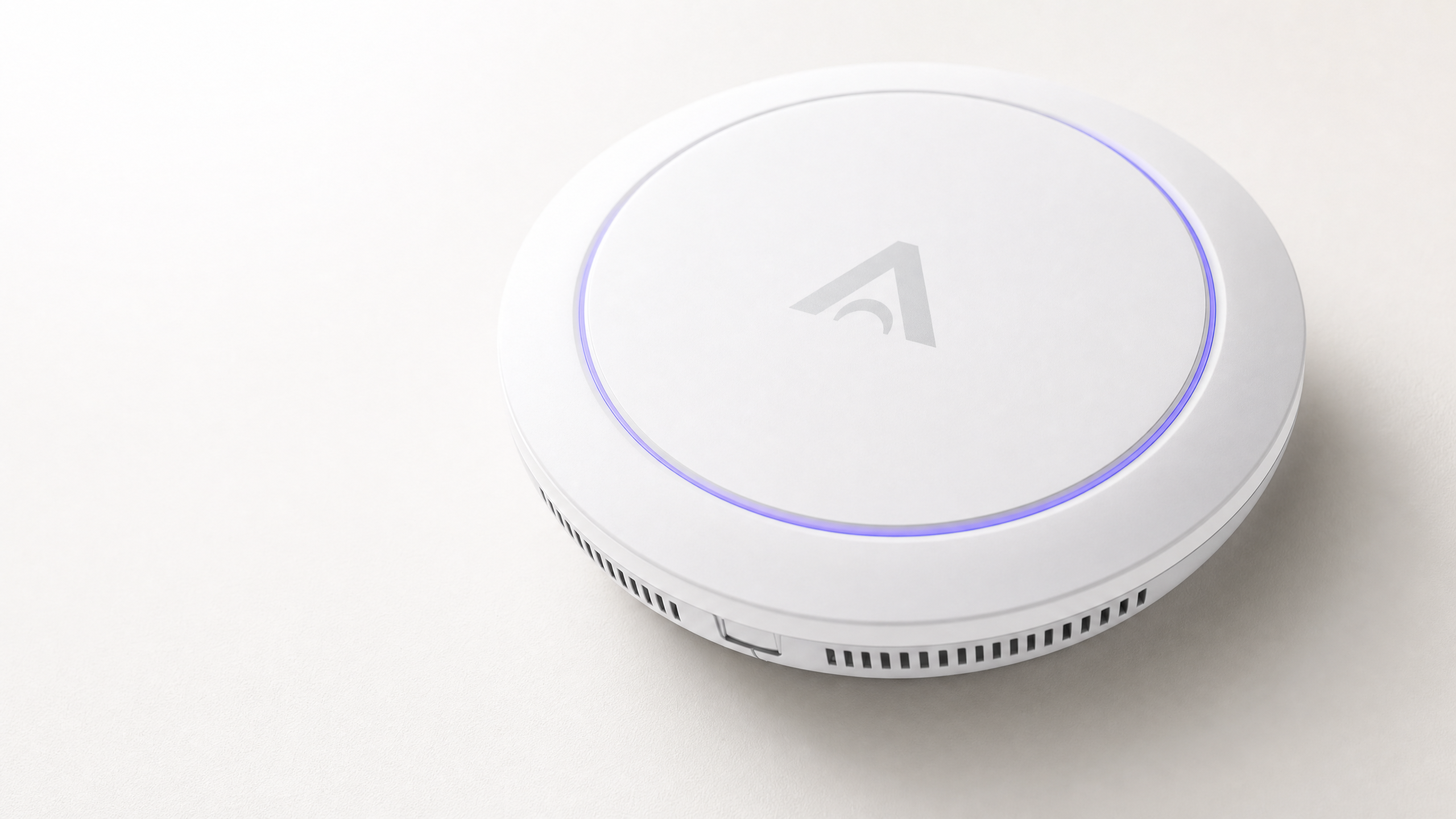
This technical reference guide covers the end-to-end integration of Alta Labs AP6 and AP6 Pro access points with Purple's cloud-hosted captive portal. It details external redirect configuration, RADIUS authentication, walled garden requirements, and multi-tenant segmentation using AltaPass Private Pre-Shared Keys. Venue operators and IT teams will leave with a repeatable deployment playbook for hospitality, retail, and smart office environments.
Listen to this guide
View podcast transcript
Executive summary
Alta Labs AP6 and AP6 Pro access points integrate with Purple's cloud captive portal using standard RADIUS authentication and HTTP redirection. The AP intercepts unauthenticated guest traffic, redirects it to your Purple splash page, and grants access once Purple's RADIUS server returns an Access-Accept. For multi-tenant environments, Alta Labs' AltaPass technology assigns each connecting device to a unique VLAN and bandwidth policy based on the password used - no additional SSIDs required. This guide gives you the exact configuration steps, walled garden domain lists, and RADIUS parameters to deploy the integration from scratch. Purple operates across 80,000+ live venues and processed 440 million logins in 2024 (Purple internal data). Alta Labs hardware is a strong fit for MSPs and smart office installers who need enterprise-grade segmentation at a competitive price point.
Technical architecture
The integration sits across three layers: the Alta Labs cloud management platform, the AP6 or AP6 Pro hardware at the edge, and Purple's cloud infrastructure handling authentication and analytics.
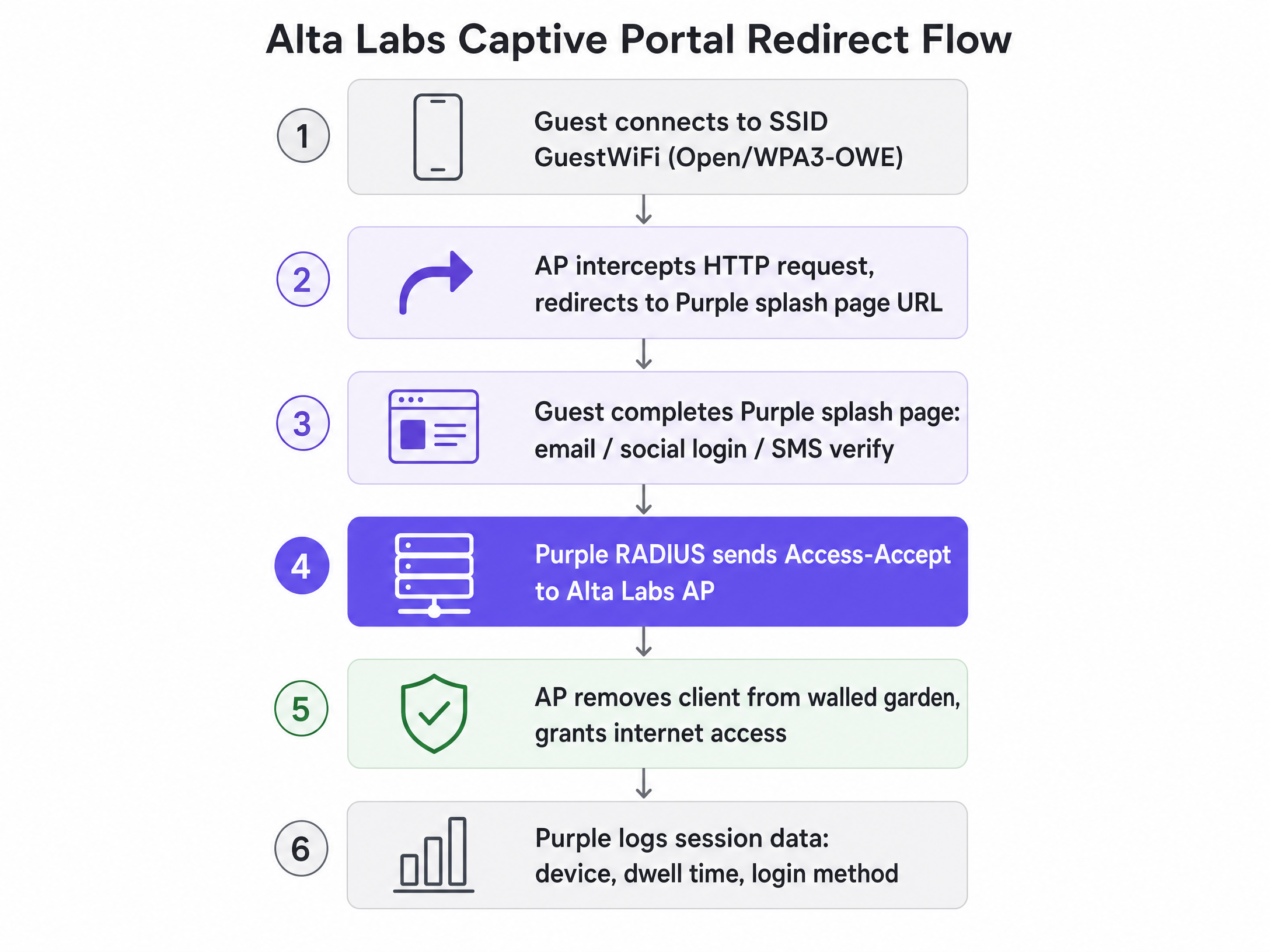
When a guest connects to the open or WPA3-OWE SSID, the AP places the device in a restricted pre-authentication state. All outbound HTTP traffic is intercepted and redirected to the Purple splash page URL. The device can only reach domains explicitly listed in the walled garden until authentication completes. Once the guest submits their credentials on the Purple splash page, Purple's RADIUS server sends an Access-Accept to the AP, which removes the restriction and grants full internet access. Purple logs the session data - device type, dwell time, login method - and makes it available in the WiFi Analytics dashboard.
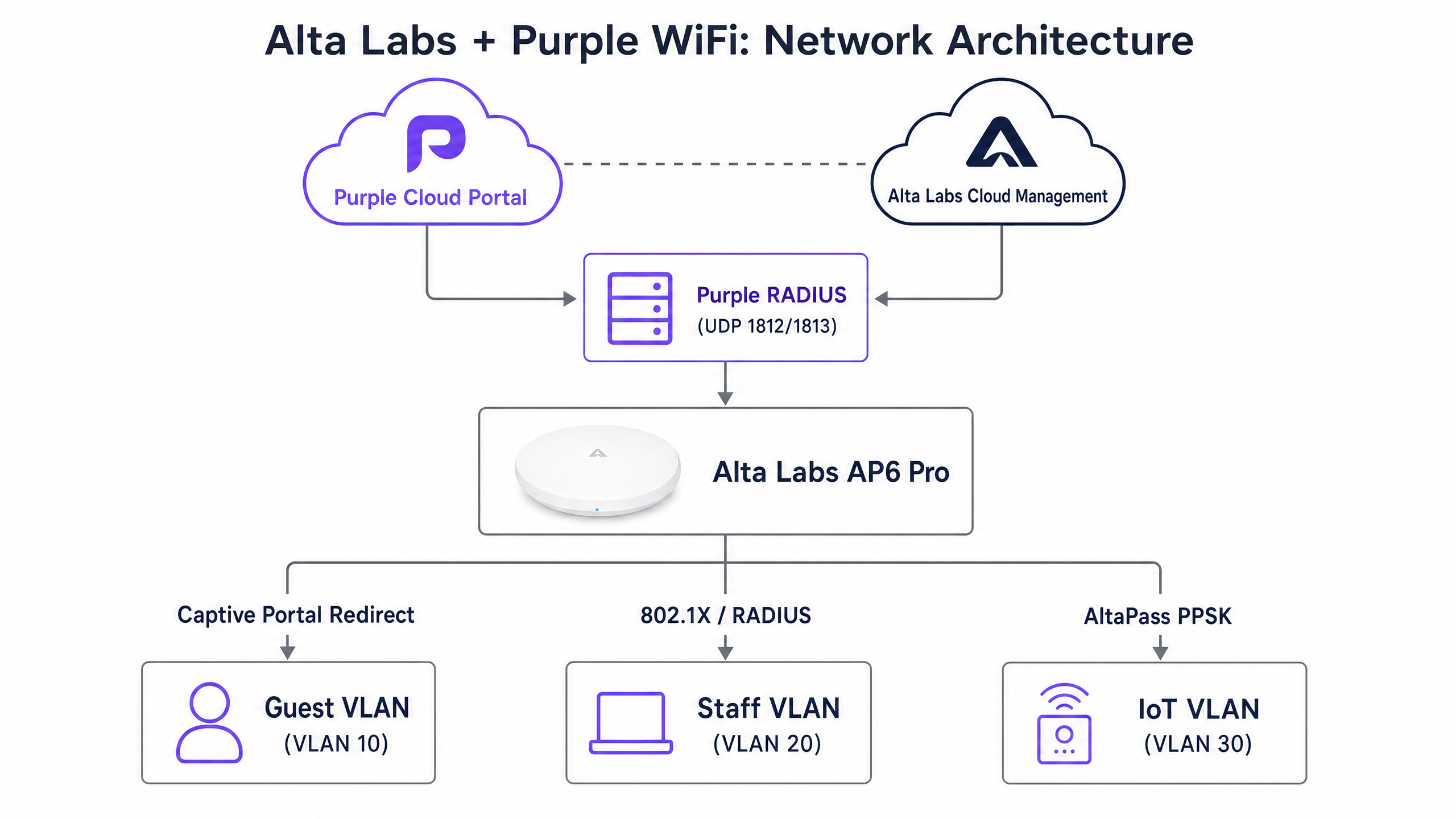
For staff and back-of-house networks, the same AP hardware handles WPA2/WPA3-Enterprise (IEEE 802.1X) authentication. The AP acts as the RADIUS client, forwarding authentication requests to Purple's SecurePass infrastructure, which in turn validates credentials against Microsoft Entra ID, Okta, or Google Workspace. The RADIUS Access-Accept response carries the Tunnel-Private-Group-Id attribute, which the AP uses to place the device on the correct VLAN dynamically.
Implementation guide
Step 1: Add the venue and hardware in Purple
Before touching the Alta Labs controller, register the deployment in Purple.
- Log in to the Purple management portal and navigate to Management > Locations.
- Select Venues and Groups > Add venue and complete the venue wizard.
- From your venue, select Hardware > Add hardware > Add new hardware.
- Set the hardware type to WiFi AP and select the appropriate AP type.
- Enter the MAC address of each Alta Labs AP6 or AP6 Pro unit.
- Click View Manual Online to retrieve the RADIUS server IP addresses, ports, and shared secret for this venue. Record these values - you will need them in Step 3.
Step 2: Configure the guest SSID in Alta Labs
Log in to the Alta Labs Cloud Management platform at manage.alta.inc.
- Navigate to Settings > WiFi and select the SSID intended for guest access.
- In Advanced Settings, set the network type to Guest. This enforces client isolation automatically.
- Scroll to the Hotspot section and select External.
- In the Redirect URL field, paste the Purple splash page URL provided in your venue hardware settings (e.g.,
https://region1.purpleportal.net/access/). - Enter the Authorisation Secret (RADIUS shared secret) from your Purple venue settings.
- Click Save.
Step 3: Configure RADIUS authentication
With the external redirect in place, configure the RADIUS settings so the AP can communicate with Purple's authentication infrastructure.
| Parameter | Value |
|---|---|
| Primary auth server IP | Provided by Purple venue settings |
| Authentication port | UDP 1812 |
| Primary accounting server IP | Provided by Purple venue settings |
| Accounting port | UDP 1813 |
| Shared secret | Provided by Purple venue settings |
For high-availability deployments, configure the secondary RADIUS server using the backup IP address provided by Purple.
Step 4: Define the walled garden
The walled garden permits specific domains before authentication completes. Missing entries will break the captive portal flow or prevent social logins from loading. Enter the following domains in the Additional Authorised Hosts / IPs field in the Alta Labs Hotspot configuration.
Purple infrastructure (required)
| Domain | Purpose |
|---|---|
region1.purpleportal.net |
Splash page hosting |
venuewifi.com |
Purple redirect infrastructure |
cloudfront.net |
CDN for portal assets |
OS captive portal probes (required)
| Domain | OS |
|---|---|
captive.apple.com |
iOS / macOS |
connectivitycheck.gstatic.com |
Android |
msftconnecttest.com |
Windows |
Social login (add per provider enabled)
| Provider | Domains |
|---|---|
accounts.google.com, oauth2.googleapis.com, apis.google.com, gstatic.com |
|
facebook.com, graph.facebook.com, connect.facebook.net, *.fbcdn.net |
|
| Apple | appleid.apple.com, idmsa.apple.com, *.apple.com |
AltaPass PPSK and multi-tenant segmentation
AltaPass is Alta Labs' patent-pending implementation of Private Pre-Shared Keys (PPSK). It allows a single SSID to carry multiple unique passwords, with each password mapping to a distinct VLAN, bandwidth limit, schedule, and hotspot bypass rule. This eliminates the need to broadcast separate SSIDs for each tenant, staff group, or device category.
Configuring AltaPass in the Alta Labs dashboard
- Select your SSID and navigate to the password management section.
- Click the purple network type button to the left of each password entry.
- Assign a VLAN ID to the password. Clients connecting with this password will be placed on the specified VLAN subnet.
- Set bandwidth limits (upload and download) per password as required.
- Enable or disable hotspot bypass per password. IoT devices and POS terminals typically bypass the captive portal.
- Apply schedule restrictions if required (e.g., restrict internet access for certain devices outside business hours).
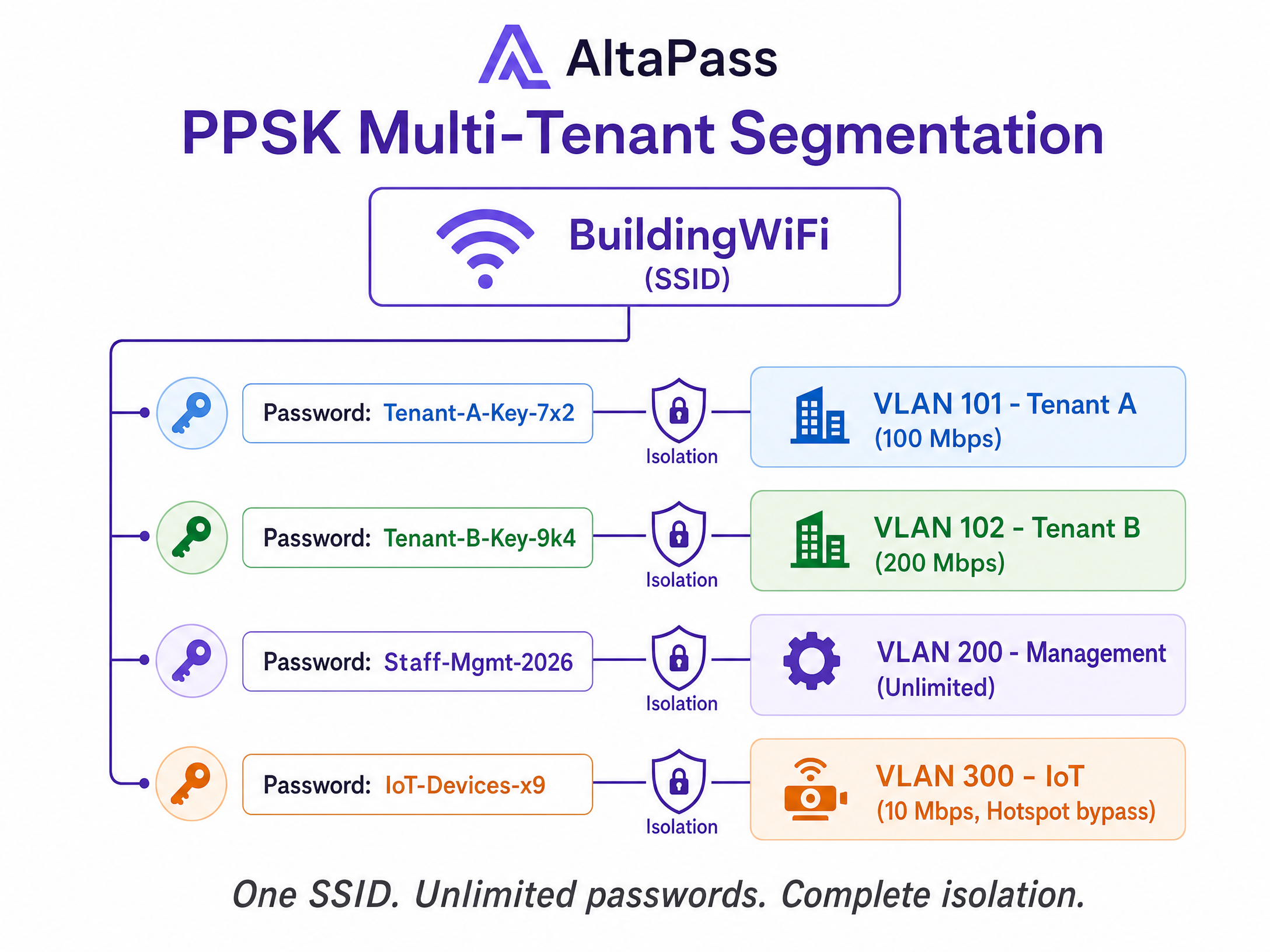
For a 72-unit residential building, this means one SSID and 72+ unique passwords - one per unit, one for management, one for the building automation system. Each password maps to an isolated VLAN and subnet. Residents on the standard tier receive 100 Mbps. Premium residents receive 300 Mbps. The building management team is unrestricted. IoT devices are isolated on a dedicated VLAN with deep packet inspection enabled. This is the deployment model that reduces SSID count from 72 to one.
Dynamic VLAN assignment via RADIUS
For 802.1X staff networks, VLAN assignment works through RADIUS attributes rather than PPSK. The RADIUS Access-Accept response must include:
| Attribute | Value |
|---|---|
Tunnel-Type |
13 (VLAN) |
Tunnel-Medium-Type |
6 (IEEE-802) |
Tunnel-Private-Group-Id |
Target VLAN ID (e.g., "20") |
Important: set the default VLAN on the SSID to VLAN 1 (or leave it untagged) when using RADIUS-assigned VLANs. If the default VLAN is set to a specific value, the AP may override the RADIUS assignment with the configured default. This is a known behaviour in the current Alta Labs firmware.
Best practices
The following recommendations apply to any Alta Labs deployment with Purple, regardless of venue type.
Use dynamic DNS resolution for walled garden entries. OAuth providers and CDNs rotate IP addresses frequently. A static IP whitelist will degrade over time. Configure the Alta Labs controller to resolve walled garden domains dynamically, and set a DNS TTL no lower than 30 seconds to avoid excessive query load.
Scope the walled garden precisely. Whitelist only the domains required for the authentication flow. Over-whitelisting - particularly adding wildcard entries for large domains - creates a bypass vector that undermines the purpose of the captive portal.
Test with unauthenticated devices before go-live. Use a device that has never connected to the network. Previously authenticated devices may have cached MAC authorisations or DNS entries that mask walled garden failures. Walk through every login method you intend to offer.
Review walled garden domains quarterly. Apple, Google, and Meta update their OAuth domain structures periodically. Build a quarterly review into your operational calendar to catch drift before it affects users.
Segment IoT devices from the outset. Use AltaPass to assign IoT devices to a dedicated VLAN with hotspot bypass enabled. Mixing IoT traffic with guest or staff traffic creates unnecessary risk and complicates incident response.
For a broader view of enterprise WiFi security architecture, see our guide on Enterprise WiFi Security: A Complete Guide for 2026 .
Troubleshooting and risk mitigation
Splash page fails to appear on iOS. The most common cause is a missing captive.apple.com entry in the walled garden. iOS uses this domain to detect captive portals. If the probe is blocked, the Captive Network Assistant never launches and the user sees a generic connectivity error.
Social login returns a blank screen or CORS error. Check the walled garden for missing CDN or API subdomains. Facebook's *.fbcdn.net and Google's gstatic.com are the most frequently omitted entries. Use browser developer tools in an unauthenticated session to identify which domain requests are failing.
VLAN assignment fails with AltaPass. Verify that the upstream switch port connecting to the AP is configured as a trunk port and allows the tagged VLANs. An access-mode switch port will drop tagged frames silently, leaving the client without an IP address.
RADIUS authentication times out. Confirm that UDP ports 1812 and 1813 are open outbound on the edge firewall. Check that the shared secret in the Alta Labs configuration exactly matches the value in the Purple venue settings - a single character mismatch will cause all authentication requests to fail.
Dynamic VLAN assignment places users on the wrong VLAN. Set the default VLAN on the 802.1X SSID to VLAN 1. If the default VLAN is set to a specific value, the AP may override the RADIUS-assigned VLAN. This is a firmware-level behaviour confirmed in the Alta Labs community forum.
ROI and business impact
Deploying Alta Labs hardware with Purple Guest WiFi delivers measurable returns across three dimensions: operational efficiency, data capture, and security posture.
On the operational side, consolidating multiple SSIDs into a single AltaPass-managed network reduces management overhead and improves wireless performance. Fewer SSIDs mean less beacon frame overhead, which translates directly to higher throughput for all connected devices.
On the data side, Purple's captive portal captures verified first-party data at every login. Venues using Purple's Capture and Engage plans report a 40% increase in marketing database opt-ins compared to unmanaged guest WiFi (Purple internal data). That data feeds directly into WiFi Analytics , giving marketing teams visibility into footfall patterns, dwell time, and repeat visit rates.
On the security side, dynamic VLAN assignment isolates guest, staff, and IoT traffic at the edge. Combined with Purple's ISO 27001-certified infrastructure and GDPR-compliant data handling, this architecture meets the requirements of PCI DSS network segmentation for venues processing card payments.
For hospitality deployments specifically, the combination of branded splash pages, loyalty programme integrations, and per-device bandwidth controls creates a differentiated guest experience without adding complexity to the network operations team.
For retail environments, the ability to segment POS terminals from guest WiFi on the same physical infrastructure - using AltaPass bypass rules - eliminates the need for separate cabling or hardware, reducing both capital and operational expenditure.
Related guides: Arista Cognitive Wi-Fi Integration with Purple WiFi | Walled Garden Configuration for Guest WiFi
Key Definitions
Captive portal
A web page that intercepts unauthenticated network traffic and requires the user to interact - log in, accept terms, or pay - before granting internet access. Purple hosts the splash page in the cloud; the Alta Labs AP handles the redirect.
The primary mechanism for guest data capture in hospitality, retail, and public-sector WiFi deployments.
Walled garden
A defined list of domains and IP addresses that a client device can access before completing captive portal authentication. Everything outside the list is blocked until the user logs in.
Critical for allowing social login APIs, OS detection probes, and portal CDN assets to function before authentication completes.
PPSK (Private Pre-Shared Key)
A security method where multiple unique passwords can be used on a single SSID, with each password assigning the connecting device to a specific VLAN, bandwidth policy, and access schedule.
Alta Labs implements this as AltaPass. Used in MDUs, smart offices, and stadiums to provide isolated access without SSID proliferation.
RADIUS
Remote Authentication Dial-In User Service. A networking protocol that provides centralised authentication, authorisation, and accounting (AAA) management. Purple acts as the RADIUS server; the Alta Labs AP acts as the RADIUS client.
The mechanism that tells the AP a guest has successfully authenticated and should be granted internet access.
Identity-Based Networking
A network architecture where access rights, VLANs, and bandwidth limits are applied based on the authenticated identity of the user or device, rather than the physical port or SSID they connect to.
Purple's term for the combination of RADIUS, PPSK, and VLAN assignment that enables consistent policies across a distributed estate.
Dynamic VLAN assignment
The process of placing a client device onto a specific Virtual Local Area Network based on authentication credentials returned by a RADIUS server, rather than a static SSID-to-VLAN mapping.
Essential for isolating staff, guest, and IoT traffic on shared wireless infrastructure. Requires correct RADIUS attributes: Tunnel-Type, Tunnel-Medium-Type, and Tunnel-Private-Group-Id.
Captive Network Assistant (CNA)
The built-in OS mechanism on iOS, Android, and Windows that detects a captive portal by probing a known URL. If the probe is redirected, the OS launches a pseudo-browser for the user to log in.
If the CNA probe domains are blocked in the walled garden, the user never sees the splash page. This is the most common captive portal failure mode.
WPA3-OWE
Wi-Fi Protected Access 3 - Opportunistic Wireless Encryption. A standard that encrypts data in transit on open networks without requiring a password, protecting guest privacy while still allowing captive portal redirection.
The recommended security mode for guest SSIDs in 2026. Provides encryption without the friction of a pre-shared key.
AltaPass
Alta Labs' patent-pending implementation of multi-password SSID technology. Allows a single SSID to carry unlimited unique passwords, each with its own VLAN, bandwidth limit, schedule, and hotspot bypass setting.
The primary tool for multi-tenant segmentation on Alta Labs hardware. Replaces the need for multiple SSIDs in residential, hospitality, and smart office deployments.
Worked Examples
A 200-room hotel needs to provide tiered WiFi access: a free basic tier (10 Mbps) for standard guests, a premium paid tier (50 Mbps) for loyalty members, and a secure network for housekeeping staff. They want to avoid broadcasting multiple SSIDs to maintain RF performance across 40 Alta Labs AP6 Pro units.
Deploy a single SSID named 'Hotel Guest WiFi' with AltaPass enabled. Create three password profiles in the Alta Labs dashboard: (1) a standard guest password assigned to VLAN 10 with a 10 Mbps download limit and external hotspot redirect to the Purple splash page; (2) a loyalty member password assigned to VLAN 20 with a 50 Mbps limit - Purple can distribute this password post-authentication via its marketing automation; (3) a housekeeping staff password assigned to VLAN 30 with no bandwidth limit, hotspot bypass enabled, and client isolation disabled so staff devices can communicate with back-of-house systems. Configure the switch uplinks as trunks allowing VLANs 10, 20, and 30. The guest and loyalty VLANs route to the internet via NAT. The staff VLAN routes to the property management system subnet.
A retail chain is deploying Purple Guest WiFi across 50 stores using Alta Labs hardware. During testing, the splash page loads correctly on Android devices, but Apple iOS devices show a generic 'No Internet Connection' error and do not display the login screen. The walled garden includes the Purple portal domain and Google OAuth entries.
Add captive.apple.com to the walled garden in the Alta Labs Hotspot configuration. iOS uses this domain as its Captive Network Assistant probe. When the device connects to a new network, iOS sends an HTTP request to captive.apple.com. If it receives the expected response, it assumes the network is open. If it receives a redirect, it launches the pseudo-browser. If the domain is blocked entirely, iOS cannot detect the captive portal and displays a connectivity error. Once the domain is whitelisted, iOS devices will detect the redirect and launch the login screen automatically.
Practice Questions
Q1. You are deploying Alta Labs AP6 Pro access points in a conference centre. The client requires a captive portal for attendees, but also needs point-of-sale terminals to connect securely to the same access points without seeing the splash page. Both device types should use the same SSID to simplify signage. How do you configure this?
Hint: AltaPass allows per-password hotspot bypass settings on the same SSID.
View model answer
Enable AltaPass on the single SSID. Create one password for POS terminals that assigns them to a secure VLAN (e.g., VLAN 50) with hotspot bypass enabled - these devices connect directly to the network without seeing the captive portal. Create a separate password (or use an open connection) for attendees that triggers the external redirect to the Purple splash page on VLAN 10. Both device types connect to the same SSID but receive different network policies based on their password.
Q2. After configuring the Purple captive portal on an Alta Labs network, Android devices successfully display the splash page, but Apple iOS devices show a generic 'No Internet Connection' error and do not open the login screen. The walled garden includes the Purple portal domain and Google OAuth entries. What is the most likely cause and fix?
Hint: iOS uses a specific domain to detect captive portals. If it cannot reach that domain, it assumes the network has no internet access.
View model answer
The walled garden is missing captive.apple.com. iOS sends an HTTP probe to this domain when connecting to a new network. If the probe is blocked, iOS cannot detect the captive portal and displays a connectivity error instead of launching the Captive Network Assistant. Add captive.apple.com to the walled garden in the Alta Labs Hotspot configuration. Also add connectivitycheck.gstatic.com for Android and msftconnecttest.com for Windows to ensure cross-platform compatibility.
Q3. A stadium IT director has configured RADIUS-assigned VLANs on an Alta Labs 802.1X staff network. The RADIUS server is sending the correct Tunnel-Private-Group-Id attribute (VLAN 20), but all staff devices are landing on VLAN 5, which is the default VLAN configured on the SSID. What is causing this and how do you resolve it?
Hint: There is a known behaviour in Alta Labs firmware related to the interaction between the SSID default VLAN and RADIUS-assigned VLANs.
View model answer
The Alta Labs AP is overriding the RADIUS-assigned VLAN with the SSID default VLAN value. This is a known firmware behaviour: when the default VLAN on the SSID is set to a specific value (VLAN 5 in this case), the AP uses that value instead of the RADIUS-returned VLAN. The fix is to set the default VLAN on the 802.1X SSID to VLAN 1 (or leave it untagged). With the default set to VLAN 1, the AP correctly defers to the RADIUS-assigned VLAN for each authenticated user.
Continue reading in this series
DrayTek Vigor Routers and Access Points Integration with Purple WiFi
This guide provides step-by-step technical instructions for integrating DrayTek Vigor routers and VigorAP access points with Purple's cloud platform. It covers DrayTek captive portal configuration for Guest WiFi, 802.1X authentication for secure Staff WiFi, Walled Garden setup, and DrayTek Multiple PSK (PPSK) configuration for Multi-Tenant network segmentation with dynamic VLAN assignment. Designed for IT installers and SMB network administrators deploying Purple across hospitality, retail, and multi-tenant venues.
DrayTek Vigor Routers and Access Points Integration with Purple WiFi
This guide provides step-by-step technical instructions for integrating DrayTek Vigor routers and VigorAP access points with Purple's cloud platform. It covers DrayTek captive portal configuration for Guest WiFi, 802.1X authentication for secure Staff WiFi, Walled Garden setup, and DrayTek Multiple PSK (PPSK) configuration for Multi-Tenant network segmentation with dynamic VLAN assignment. Designed for IT installers and SMB network administrators deploying Purple across hospitality, retail, and multi-tenant venues.
SonicWall TZ and SonicWave Integration with Purple WiFi
This technical reference details the integration of SonicWall TZ firewalls and SonicWave APs with the Purple WiFi platform. It provides actionable configuration steps for captive portal redirection, walled garden exceptions, 802.1X authentication, and dynamic VLAN steering using Private Pre-Shared Keys (PPSK).