
Huawei AirEngine and CloudCampus Integration with Purple WiFi
This guide provides step-by-step instructions for integrating Huawei AirEngine access points and iMaster NCE-Campus with Purple WiFi. It covers captive portal configuration, 802.1X staff authentication, and PPSK dynamic VLAN steering for enterprise networks.
Listen to this guide
View podcast transcript

Executive Summary
Enterprise networking demands reliable hardware paired with intelligent identity management. Huawei AirEngine access points and the iMaster NCE-Campus controller deliver high-density connectivity, while Purple provides the cloud overlay for authentication, analytics, and policy enforcement. This guide details the integration architecture required to deploy Guest WiFi , secure Staff WiFi, and Multi-Tenant WiFi using a single Huawei controller.
By integrating Huawei CloudCampus with Purple, you replace disparate authentication silos with a unified Identity-Based Network. We operate across 80,000+ live venues and processed 440 million logins in 2024. Our hardware-agnostic platform integrates natively with Huawei via standard RADIUS and captive portal protocols. This integration enables conscious-choice opt-ins for visitors, 802.1X certificate validation for employees, and dynamic VLAN steering via Private Pre-Shared Keys (PPSK) for tenants.
Whether you manage a stadium, a university campus, or a retail chain, this document provides the exact configuration steps, RADIUS attributes, and access control lists required to secure your wireless edge and capture first-party data at scale.
Listen to the technical briefing podcast:
Technical Deep-Dive
The integration relies on standard protocols: RADIUS (UDP 1812/1813) for authentication and accounting, and HTTPS (TCP 443) for captive portal redirection. iMaster NCE-Campus acts as the network access server (NAS) and RADIUS relay, forwarding requests from the AirEngine access points to Purple's cloud RADIUS infrastructure.
Architecture Overview
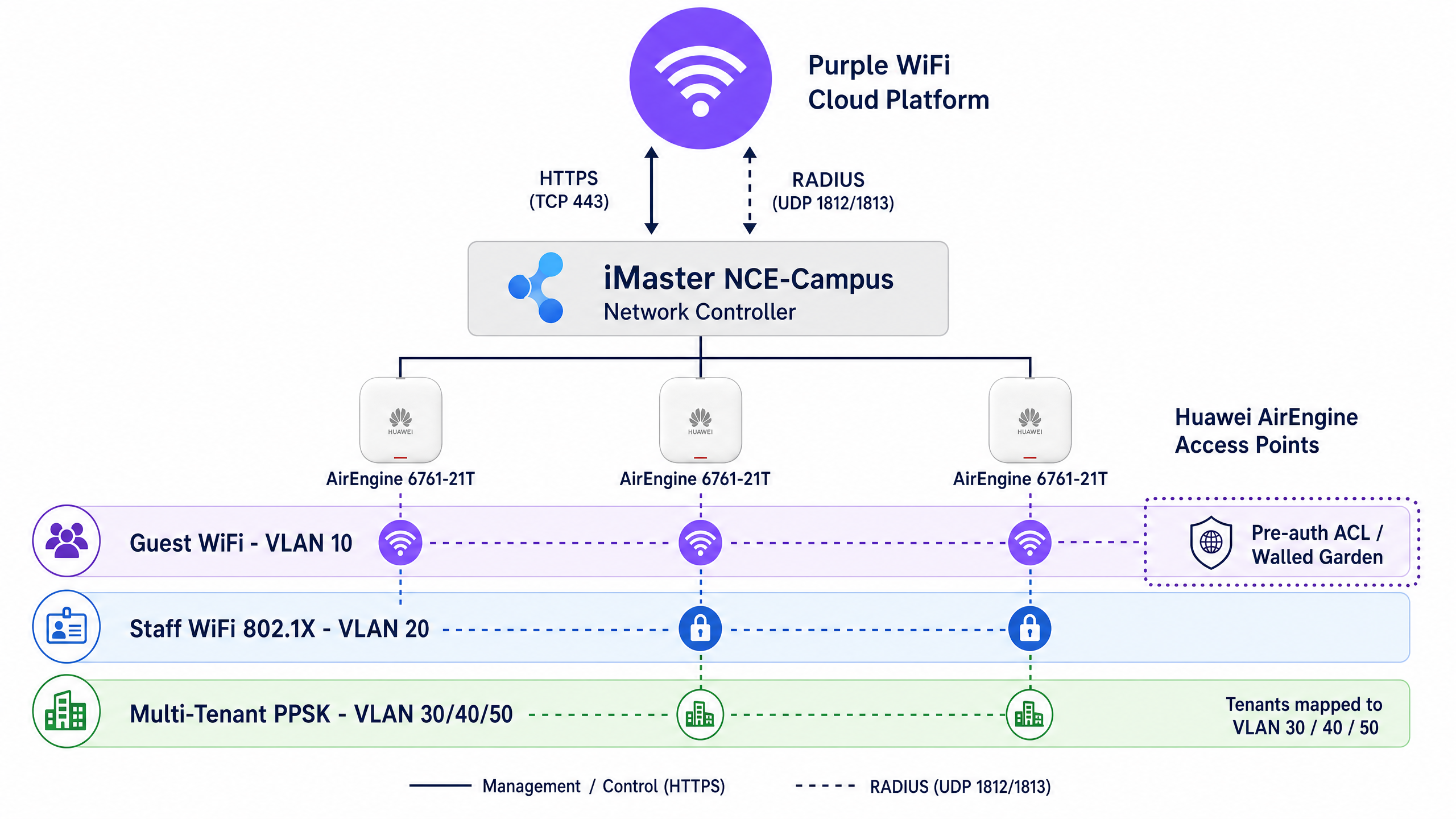
Purple supports three primary authentication models on Huawei hardware:
- Guest WiFi (Captive Portal): Unauthenticated traffic is intercepted by the Huawei controller and redirected to Purple's splash page. Pre-authentication access is restricted by a Walled Garden ACL. Upon successful login, Purple sends a RADIUS Access-Accept, granting the client full network access.
- Staff WiFi (802.1X): Employees authenticate using corporate credentials via EAP-PEAP or EAP-TLS. Purple validates these credentials against identity providers like Microsoft Entra ID, Okta, or Google Workspace.
- Multi-Tenant WiFi (PPSK): Tenants connect to a single shared SSID using unique passphrases. Purple validates the passphrase and returns specific RADIUS attributes to dynamically steer the tenant into their isolated VLAN.
Walled Garden and Pre-Authentication ACLs
A captive portal requires a Walled Garden - an Access Control List (ACL) that permits traffic to essential services before the user authenticates. If the Walled Garden is incomplete, the splash page will fail to load, resulting in a poor visitor experience.
For Huawei iMaster NCE-Campus, the pre-authentication ACL must permit:
- DNS resolution (UDP 53)
- Purple's captive portal domains (
*.purpleportal.net,*.purple.ai) - Content Delivery Networks (CDNs) hosting splash page assets
- Identity provider domains if social login (Apple, Google, Facebook) is enabled
All other traffic must be denied until Purple returns the RADIUS Access-Accept.
Dynamic VLAN Steering and RADIUS Attributes
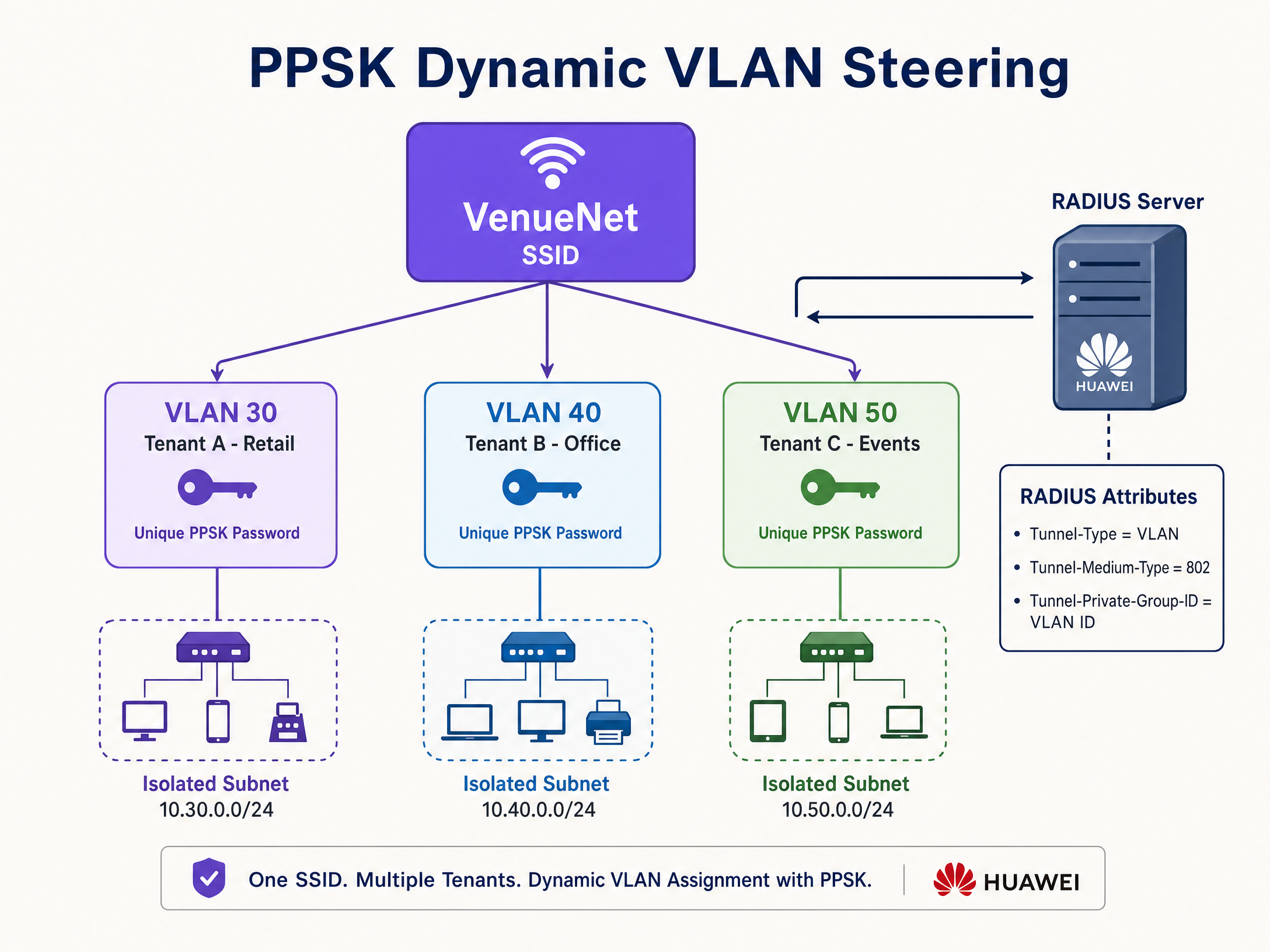
To isolate network traffic, Purple uses dynamic VLAN assignment. Instead of broadcasting multiple SSIDs, you broadcast one SSID and assign the VLAN dynamically based on the user's identity.
When Purple authenticates a user (via 802.1X or PPSK), it returns an Access-Accept packet containing three mandatory IETF standard RADIUS attributes:
Tunnel-Type=VLAN(or 13)Tunnel-Medium-Type=802(or 6)Tunnel-Private-Group-ID=[VLAN ID]
The Huawei controller receives these attributes and instructs the AirEngine access point to tag the client's traffic with the specified VLAN ID.
Implementation Guide
This section covers the exact steps to configure iMaster NCE-Campus for Purple integration.
Step 1: Configure the RADIUS Relay Server
First, define Purple as the external authentication server.
- In iMaster NCE-Campus, navigate to Design > Network Design > Template Management.
- Select RADIUS Server and click Create.
- Set the Authentication service to Portal authentication.
- Enter Purple's primary and secondary RADIUS IP addresses (available in your Purple dashboard).
- Set the authentication port to 1812 and the accounting port to 1813.
- Enter the RADIUS Shared Secret provided by Purple.
- Set the NAS identifier to Device MAC.
Step 2: Build the Walled Garden ACL
Create the ACL to allow pre-authentication traffic.
- Navigate to Design > Network Design > Template Management > ACL.
- Create a new ACL named
Purple_Walled_Garden. - Set the ACL Type to User.
- Add permit rules for DNS and Purple's required domains (e.g.,
*.purpleportal.net). - Save the ACL template.
Step 3: Configure the Captive Portal URL Template
Huawei requires a URL template to map standard redirect parameters to Purple's required format.
- Navigate to Design > Network Design > Template Management > URL Template.
- Create a new template named
Purple_URL_Template. - Set the Template Type to Cloud platform-based relay authentication.
- Configure the parameter mapping exactly as follows:
redirect-urlmaps toredirect-urlloginurlmaps tologin-urldevice-macmaps toap-macuser-ipmaps touaddressuser-macmaps toumacssidmaps tossid
Step 4: Provision the Guest SSID
Bind the RADIUS server, ACL, and URL template to the SSID.
- Navigate to Provision > Device Configuration > Site Configuration.
- Select AP and create a new SSID.
- Set the Network Type to Open.
- Select Open+Portal authentication.
- Set the authentication type to Relay authentication by cloud platform.
- Set the interconnection mode to RADIUS relay.
- Select the
Purple_URL_Templatecreated earlier. - In the third-party authentication URL field, paste your unique Purple splash page URL.
- Select the Purple RADIUS server template.
- Select the
Purple_Walled_GardenACL for the default permit rule. - Save and deploy the configuration to the AirEngine access points.
Best Practices
To ensure a secure and reliable deployment, follow these vendor-neutral best practices:
- Implement 802.1X for Employees: Never use shared PSKs for staff networks. Deploy 802.1X with EAP-TLS using Purple's SecurePass add-on to issue client certificates. This eliminates password-based phishing vectors and aligns with ISO 27001 requirements.
- Consolidate SSIDs: Broadcasting too many SSIDs degrades airtime efficiency due to management frame overhead. Use PPSK and dynamic VLAN steering to consolidate multi-tenant networks into a single SSID.
- Verify Trunk Configurations: Dynamic VLAN assignment fails silently if the assigned VLAN is not permitted on the switch trunk port connecting the access point. Always audit switchport configurations before testing RADIUS steering.
- Monitor RADIUS Latency: Authentication timeouts often stem from WAN latency. Ensure your iMaster NCE-Campus controller has a low-latency path to Purple's regional RADIUS infrastructure.
Troubleshooting & Risk Mitigation
When integrating cloud RADIUS with enterprise controllers, issues typically isolate to three areas: the Walled Garden, the RADIUS shared secret, or VLAN trunking.
Splash Page Fails to Load
Symptom: A device connects to the Guest WiFi, but the browser displays a timeout error instead of the Purple splash page.
Root Cause: The Walled Garden ACL is incomplete, blocking access to Purple's portal domains or required CDNs.
Mitigation: Connect a test device to the SSID. Attempt to ping purpleportal.net. If the ping fails, review the iMaster NCE-Campus ACL configuration and ensure it is applied to the pre-authentication state of the SSID.
Silent Authentication Failures
Symptom: A user enters valid credentials, but the connection drops without an error message. Root Cause: A mismatch in the RADIUS shared secret between iMaster NCE-Campus and Purple. Mitigation: Copy the shared secret directly from the Purple dashboard and paste it into the Huawei RADIUS server template. A single trailing space will break the MD5 hash used in RADIUS packets.
DHCP Timeout After Authentication
Symptom: A staff member authenticates successfully via 802.1X, but the device receives a 169.254.x.x APIPA address instead of a valid IP.
Root Cause: Purple successfully assigned a dynamic VLAN via RADIUS, but that VLAN is not trunked to the AirEngine access point.
Mitigation: Log into the access switch and verify that the port trunk allow-pass vlan command includes the target VLAN ID on the interface connected to the AP.
ROI & Business Impact
Deploying Huawei AirEngine with Purple transforms a standard network infrastructure into a measurable business asset.
For Retail operators, this integration captures first-party data from shoppers, enabling targeted marketing campaigns that drive footfall and increase average transaction value. Purple's WiFi Analytics dashboard provides heatmaps and dwell-time metrics, allowing venue managers to optimise store layouts based on actual visitor behaviour.
In Hospitality environments, automated authentication via OpenRoaming or Passpoint eliminates the friction of manual logins, increasing guest satisfaction scores. For multi-tenant buildings, PPSK dynamic VLAN steering reduces IT overhead by eliminating the need to manually provision and manage separate SSIDs for every new tenant.
By unifying guest engagement, staff security, and tenant isolation on a single hardware footprint, organisations maximise the return on their Huawei CloudCampus investment.
Key Definitions
iMaster NCE-Campus
Huawei's cloud-based or on-premises network automation and management platform.
IT teams use this as the central controller to configure SSIDs, push policies to AirEngine APs, and set up RADIUS relay to Purple.
PPSK (Private Pre-Shared Key)
A security feature that allows multiple unique passwords to be used on a single SSID, with each password tying the user to a specific network policy or VLAN.
Essential for multi-tenant environments (like coworking spaces or retail parks) where tenants need isolated networks without broadcasting dozens of SSIDs.
Dynamic VLAN Steering
The process of assigning a device to a specific Virtual Local Area Network based on its authenticated identity, rather than the SSID it connected to.
Used by Purple to ensure that a manager, a cashier, and a guest connecting to the same physical access point are placed on completely separate, secure network segments.
Walled Garden
An Access Control List (ACL) applied to unauthenticated users, permitting access only to specific IP addresses or domains required to complete the login process.
If the Walled Garden is misconfigured, guests will see a blank screen or a timeout error instead of the Purple splash page.
RADIUS Relay
A configuration where the local network controller forwards authentication requests from access points to an external RADIUS server.
Huawei iMaster NCE-Campus acts as the relay, securely passing credentials from the venue to Purple's cloud infrastructure for validation.
802.1X
An IEEE standard for port-based network access control that provides an authentication mechanism to devices wishing to attach to a LAN or WLAN.
The enterprise standard for Staff WiFi. It replaces shared passwords with individual user credentials or digital certificates.
EAP-TLS
Extensible Authentication Protocol - Transport Layer Security. An 802.1X authentication method that relies on client and server certificates rather than passwords.
The most secure authentication method available. Purple's SecurePass issues these certificates to employee devices to eliminate phishing risks.
Captive Portal
A web page that a user of a public-access network is obliged to view and interact with before access is granted.
The primary mechanism Purple uses to capture first-party data and consent from venue visitors.
Worked Examples
A 200-room hotel needs to provide secure, isolated WiFi for guests, staff, and a third-party coffee shop operating in the lobby, using only two SSIDs to preserve airtime.
Deploy one SSID named 'Hotel_Guest' configured with an Open+Portal authentication policy pointing to Purple's captive portal. Deploy a second SSID named 'Hotel_Secure' configured with WPA3-Enterprise and 802.1X authentication. Staff authenticate via EAP-TLS, and Purple returns a RADIUS attribute assigning them to VLAN 20. The coffee shop uses PPSK on the same 'Hotel_Secure' SSID; they enter a unique passphrase, and Purple returns a RADIUS attribute assigning them to VLAN 30.
A large retail chain is migrating to Huawei AirEngine and needs to ensure their existing Purple splash page loads correctly across all stores without triggering security warnings on modern smartphones.
Configure the iMaster NCE-Campus URL template to map the required parameters (ap-mac, uaddress, umac, ssid, redirect-url) precisely. Build a comprehensive Walled Garden ACL that permits DNS (UDP 53) and HTTPS (TCP 443) traffic to Purple's domains and any required social login APIs. Ensure the controller intercepts HTTP traffic and redirects it to the HTTPS splash page.
Practice Questions
Q1. You have configured the Guest SSID and the Walled Garden ACL on iMaster NCE-Campus. When you test the connection, your phone detects the captive portal, but the screen remains blank. What is the most likely cause?
Hint: Consider what the device needs to load a modern web page hosted on a cloud platform.
View model answer
The Walled Garden ACL is likely missing permit rules for required domains. Specifically, DNS (UDP 53) must be permitted, along with HTTPS access to Purple's portal domains and any Content Delivery Networks (CDNs) hosting the page assets. If social login is enabled, those specific API endpoints must also be permitted pre-authentication.
Q2. A tenant using your PPSK network complains they cannot reach the internet. You check the iMaster NCE-Campus logs and see that Purple returned a RADIUS Access-Accept with Tunnel-Private-Group-ID set to 40. However, the client device has an IP address of 169.254.x.x. What is the configuration error?
Hint: Authentication succeeded, but network routing failed at the edge.
View model answer
The switchport connecting the Huawei AirEngine access point to the network is not configured to trunk VLAN 40. While Purple successfully authorised the user and the controller instructed the AP to tag traffic with VLAN 40, the upstream switch dropped the packets because the VLAN is not permitted on the trunk. You must add VLAN 40 to the trunk allow-pass list on the access switch.
Q3. You are migrating from a legacy controller to Huawei iMaster NCE-Campus. You configure the RADIUS server template exactly as it was on the old system, but all authentication requests fail silently. What should you check first?
Hint: Silent failures in RADIUS usually indicate a cryptographic mismatch.
View model answer
Verify the RADIUS Shared Secret. If the secret configured in iMaster NCE-Campus does not perfectly match the secret in the Purple dashboard, the RADIUS packets cannot be decrypted, resulting in silent failures or Access-Reject messages without clear error codes. Ensure there are no trailing spaces when copying the secret.
Continue reading in this series
OpenWrt Custom Firmware Integration with Purple WiFi
This guide provides the complete integration playbook for deploying OpenWrt custom firmware with Purple WiFi. It covers CoovaChilli captive portal configuration, iptables walled garden management, 802.1X secure staff WiFi with hostapd, and multi-tenant PPSK segmentation with dynamic VLAN assignment - giving IT teams the exact configuration steps needed to build an Identity-Based Network on any OpenWrt-capable hardware.
OpenWrt Custom Firmware Integration with Purple WiFi
This guide provides the complete integration playbook for deploying OpenWrt custom firmware with Purple WiFi. It covers CoovaChilli captive portal configuration, iptables walled garden management, 802.1X secure staff WiFi with hostapd, and multi-tenant PPSK segmentation with dynamic VLAN assignment - giving IT teams the exact configuration steps needed to build an Identity-Based Network on any OpenWrt-capable hardware.
EnGenius Cloud Access Points Integration with Purple WiFi
This technical reference details the step-by-step integration of EnGenius Cloud Access Points and ECS switches with Purple's guest WiFi platform. It covers guest captive portal redirection via an external splash page, Walled Garden configuration, secure staff WiFi using IEEE 802.1X, and multi-tenant network isolation using EnGenius MyPSK with dynamic VLAN assignment. IT installers and network architects will find actionable configuration sequences, real-world case studies, and a troubleshooting framework for deploying Purple across EnGenius hardware estates.