
Integrating WeChat Authentication with Guest WiFi Captive Portals
This guide explains how to integrate WeChat OAuth 2.0 authentication into enterprise guest WiFi captive portals. It covers the dual-platform registration requirements, scope selection for first-party data capture, network enforcement via RADIUS Change of Authorization, and compliance with GDPR and China's PIPL. Venue operators in hospitality, retail, and events will find concrete implementation steps, real-world case studies, and security hardening guidance to deploy WeChat login guest wifi at scale.
Listen to this guide
View podcast transcript
摘要
当中国访客连接到您的企业网络并遇到一个仅提供电子邮件、Facebook或凭证代码的 Captive Portal 时,您会立即产生摩擦。根据腾讯2024年的数据,微信拥有13.8亿月活跃用户。集成微信登录 guest wifi 功能并不是一种款待便利,而是在没有摩擦的情况下捕获该人群第一方数据的技术要求。
本指南详细介绍了将微信 OAuth 2.0 身份验证集成到 captive portals 的技术架构。它解释了支持标准移动浏览器和微信应用内浏览器所需的双平台注册,评估了用于数据收集的 snsapi_base 和 snsapi_userinfo 作用域之间的权衡,并概述了如何使用 RADIUS 授权变更 (CoA) 或 MAC 身份验证旁路来强制网络访问。它还涵盖了在 Cisco Meraki、HPE Aruba、Ruckus、Juniper Mist、Ubiquiti UniFi、Cambium、Extreme 和 Fortinet 基础设施中大规模部署此功能所需的安全配置和合规性指令——GDPR 和中国《个人信息保护法》(PIPL)。
技术深度剖析:微信 OAuth 2.0 架构
Captive Portal 会拦截来自未验证设备的 HTTP 流量,并将其重定向到托管在门户服务器上的登录页面。添加微信身份验证会使用 OAuth 2.0 协议将第三方身份验证提供商插入到此流程中,该协议与 Google、Microsoft Entra ID 和 Okta 用于联合身份验证的标准相同。
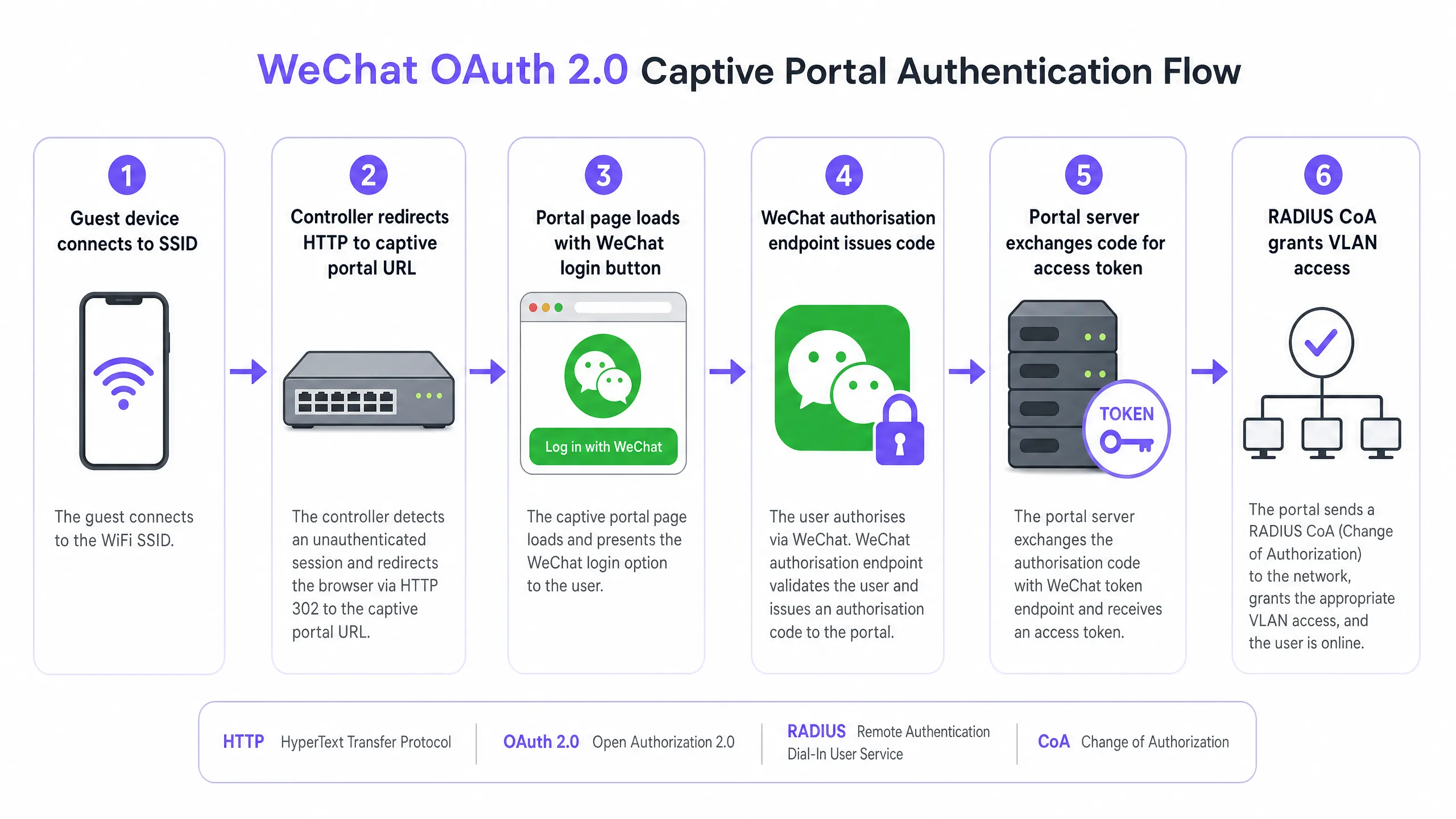
认证流程的操作如下:访客连接到 SSID。接入点或无线控制器检测到未认证的会话,并将 HTTP 流量重定向到 Captive Portal URL。访客在 Portal 页面上选择微信登录。Portal 服务器将浏览器重定向到 open.weixin.qq.com 的微信授权端点,并传递 AppID、重定向 URI、code 的响应类型以及请求的 Scope。微信在其自己的服务器上处理认证。如果访客在微信内置浏览器中使用 snsapi_base Scope,则认证是无感知的——不会出现授权同意提示。如果使用 snsapi_userinfo,微信会显示一个授权同意页面。随后,微信将带着临时授权码重定向回 Portal 的重定向 URI。Portal 服务器通过调用 api.weixin.qq.com/sns/oauth2/access_token 并传递 AppID、AppSecret、该授权码以及 authorization_code 的授权类型,来将此授权码交换为 Access Token。微信将返回 Access Token、Refresh Token、用户的 OpenID 以及已授予的 Scope。如果授予了 snsapi_userinfo,服务器会发起第二次 API 调用,以获取用户的昵称、头像、性别和城市。
双平台注册要求
大多数实施方案都在注册阶段失败。微信运营着两个独立的开发者平台,而企业级部署通常两者都需要。
| 平台 | URL | 所需账号类型 | 支持的 Scope | 浏览器环境 |
|---|---|---|---|---|
| 公众平台 | mp.weixin.qq.com | 服务号 | snsapi_base, snsapi_userinfo | 微信内置浏览器 |
| 开放平台 | open.weixin.qq.com | 网站应用 | snsapi_login | 标准移动浏览器 |
对于在微信内置浏览器内访问 Portal 的访客,您需要在公众平台上拥有一个服务号。订阅号将无法工作——它缺少 OAuth 网页授权权限。对于从 Android 上的 Chrome 或 iOS 上的 Safari 访问 Portal 的访客,您需要在开放平台上拥有一个网站应用,该应用使用 snsapi_login Scope 并显示一个二维码供用户扫描。
在实际操作中,大多数场所部署都会同时使用两者。酒店的访客可能会在 Chrome 中打开 Portal,看到一个二维码,用微信扫描它并进行认证。或者他们可能会直接点击微信内的链接,进入内置浏览器,并通过 snsapi_base 进行无感知认证。
Scope 选择:数据获取 vs. 用户摩擦
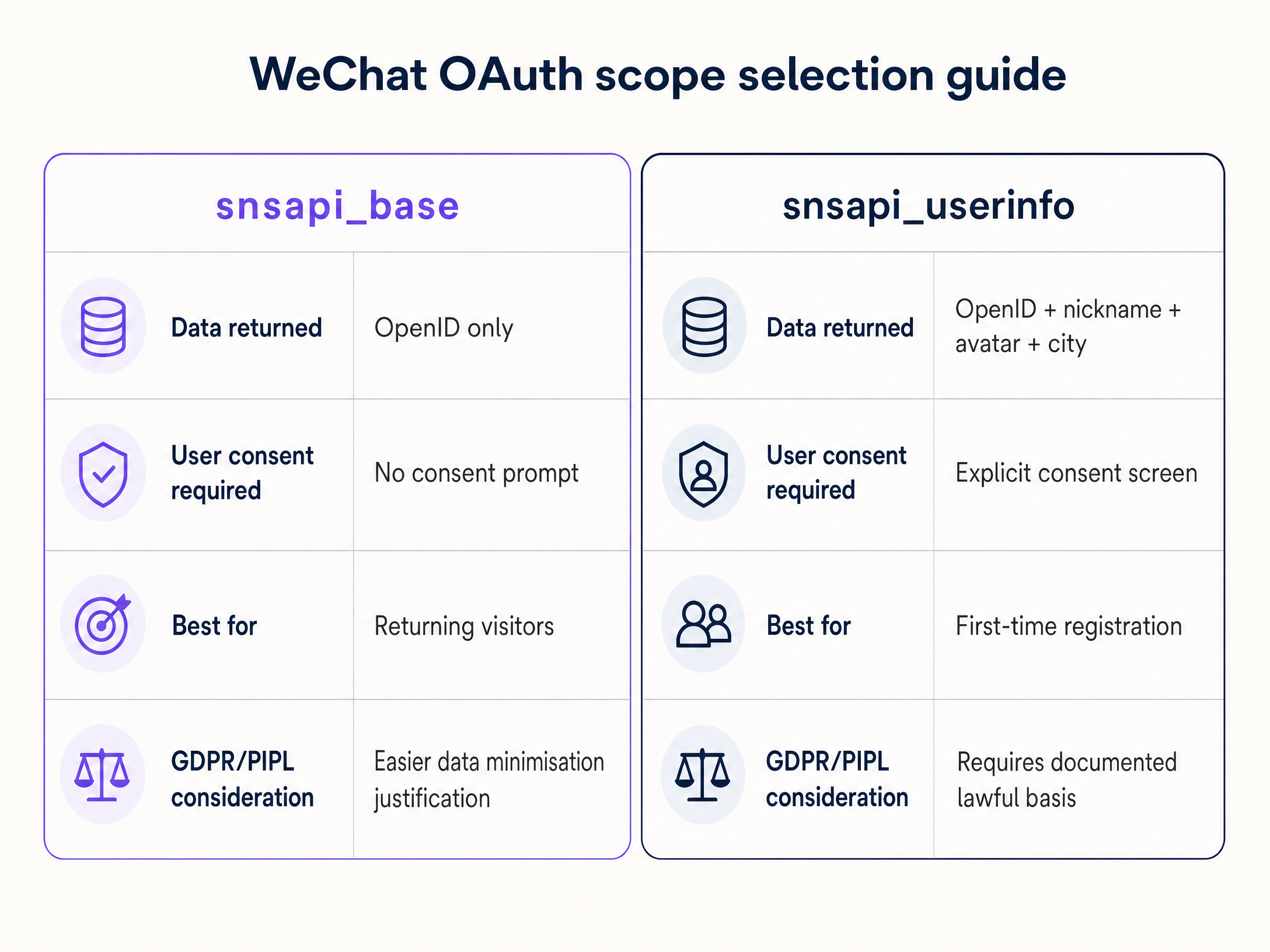
您请求的 Scope 决定了您收集的数据以及访客体验到的摩擦。这是一个涉及合规性影响的实际决策点。
snsapi_base 仅返回 OpenID——即该用户在您公众号内的唯一标识符。它不需要用户同意授权提示。身份验证对访客是无感知的。适用于您已拥有其个人资料的返店访客,或者在您优先考虑无摩擦接入的场景。在 GDPR 和 PIPL 数据最小化原则下,snsapi_base 更容易证明其合理性。
snsapi_userinfo 返回 OpenID 以及用户的昵称、头像、性别和城市。它需要一个明确的授权同意页面。适用于需要建立个人资料的首次访客注册,并配合您 Portal 页面上符合合规要求的授权同意层。
跨门店部署的 UnionID
OpenID 针对用户与特定公众号的组合是唯一的。一家拥有 20 家门店且每家门店都有自己公众号的酒店集团,对于同一位访客会看到 20 个不同的 OpenID。UnionID 解决了这个问题。它是一个单一标识符,代表同一开放平台账号下链接的所有公众号和应用中的用户。将您的公众号链接到您的开放平台账号,OAuth 响应中就会返回 UnionID。这是跨门店访客识别的基础。
实施指南
网络强制执行机制
获取 OAuth 令牌仅能证明身份,并不能打开网络。您必须向控制器发送信号以允许流量通过。
RADIUS 授权变更 (CoA)(在 RFC 3576 中定义)是推荐的企业级方法。OAuth 验证成功后,Portal 服务器向网络控制器发送 CoA 请求。控制器将设备从认证前 VLAN 移动到访客 VLAN。这适用于 Cisco Meraki、HPE Aruba、Ruckus、Juniper Mist、Ubiquiti UniFi、Cambium、Extreme 和 Fortinet。
MAC 认证绕过 (MAB) 将设备的 MAC 地址作为已授权客户端注册到 RADIUS 数据库中。控制器根据该 MAC 允许访问。MAB 较易实施,但并不可靠:现代 iOS 和 Android 设备默认会随机化 MAC 地址,从而在重新连接时中断会话关联。
Purple 的 Guest WiFi 平台可自动完成此转换。微信 OAuth 完成后,Purple 的云端覆盖网络向底层硬件发送相应的 CoA 或 MAB 信号,从而免去了手动配置 VLAN 的麻烦。
安全配置
以下三项配置是不容妥协的。
- 保护 AppSecret。
AppSecret绝不能出现在客户端 JavaScript 中。它必须保留在您的服务器上。如果泄露,攻击者可以冒充您的应用程序并代表您调用微信 API。 - 实施 CSRF 防护。 生成一个加密随机的
state值,将其存储在用户会话中,并在微信重定向返回时进行验证。这可以防止 RFC 6749 中定义的跨站请求伪造攻击。 - 注册所有重定向 URI 变体。 微信会根据您注册的域名验证重定向 URI。请注册您使用的每一个子域名和路径变体(包括暂存环境),以防止出现 40029 错误(无效的代码)。
应用内浏览器检测
微信的应用内浏览器会设置包含 MicroMessenger 的用户代理(user agent)字符串。您的 Captive Portal 必须检测此字符串并进行相应路由:应用内浏览器使用公众号流程,标准浏览器使用开放平台二维码流程。如果未能检测到该字符串,会导致体验中断或身份验证错误。
最佳实践与合规性
GDPR 合规性
如果您服务于欧洲访客或在欧洲运营,GDPR 适用于您通过微信 OAuth 收集的数据。您必须确定合规的处理依据——通常是征得同意或合法利益。在进行身份验证之前,您必须在 Captive Portal 上提供清晰的隐私声明。您必须响应主体访问请求和删除请求。有关详细的合规框架,请参阅 合规手册:GDPR 与访客 WiFi 数据隐私 。
PIPL 合规性
当您处理中国公民的个人数据时,中国《个人信息保护法》(PIPL)适用。与 GDPR 类似,PIPL 要求明确的目的限制、数据最小化以及书面的合法依据。在数据最小化原则下,snsapi_base 比 snsapi_userinfo 更容易证明其合理性。无论您收集什么数据,请在上线前记录您的法律依据和保存期限。
网络隔离
使用 VLAN 隔离将访客 WiFi 流量与您的企业网络隔离开来。通过微信验证的访客应接入专用的访客 VLAN,且仅能访问互联网——无法访问内部系统。这符合 PCI DSS 对持卡人数据环境隔离的要求以及一般的企业安全实践。有关隔离架构的更多信息,请参阅 带宽管理:2026年实用指南 。
备用身份验证
如果微信的 API 不可用,您的门户必须重定向到替代的登录方式。不要让访客面对空白屏幕。提供电子邮箱或短信的备用方案可确保连贯性。这对于 交通运输 和 医疗保健 环境中的场所尤为重要,在这些环境中,网络连接是一项服务义务。
真实案例研究
酒店业:奢华酒店集团
伦敦的一家拥有 400 间客房的奢华酒店接待了大量来自中国大陆的宾客。他们原有的 Captive Portal 要求提供电子邮件地址和短信验证。中国手机号码经常无法收到来自欧洲运营商的短信,而且许多宾客的设备上没有配置本地电子邮箱。这导致 Portal 的流失率高达 60%。
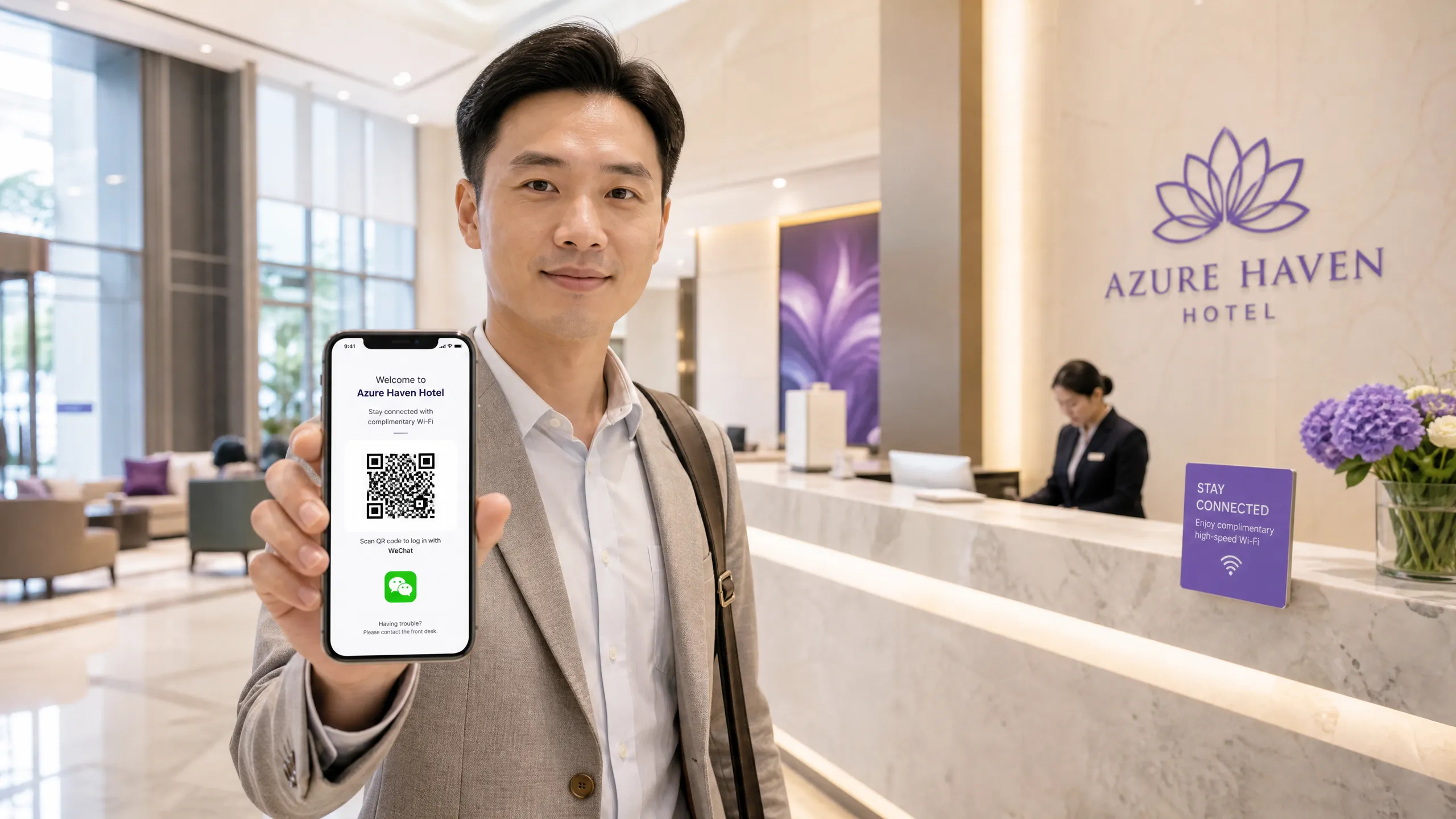
该酒店在公众号平台注册了服务号,并在开放平台注册了网站应用。Portal 检测到 MicroMessenger 用户代理,并为应用内浏览器用户触发 snsapi_base——在不到三秒的时间内将他们连接,且无需授权提示页面。通过 Chrome 或 Safari 访问的宾客则会看到一个二维码。在后续入住时,系统会识别出相同的 OpenID,并对宾客进行静默免密认证。酒店的 CRM 系统会记录该宾客的再次到访,从而实现有针对性的入店前沟通。有关在酒店环境中部署 WiFi 的更多信息,请参阅 酒店行业 。
零售:购物中心分析
一家大型购物中心希望获取中国消费者的受众特征数据,以辅助招商组合和营销决策。他们需要了解客源城市、性别和到访频率。此时仅靠 snsapi_base 远远不够——他们需要 snsapi_userinfo。Portal 会请求完整的 userinfo 作用域。宾客会看到微信授权提示页面,并点击允许。该购物中心与 Purple 的 WiFi Analytics 集成的分析平台接收到了经过验证的受众特征数据流。在周六下午,40% 的 WiFi 用户来自特定区域。该数据直接决定了应该接洽哪些品牌来举办快闪活动。有关零售 WiFi 部署的更多信息,请参阅 零售行业 。
故障排查与风险规避
微信 OAuth Captive Portal 部署中最常见的五种故障模式如下:
重定向 URI 不匹配(错误码 40029)。 微信会根据已注册的域名验证重定向 URI。任何子域名、路径或协议的不匹配都会导致 code 交换失败。请注册所有变体,包括暂存(staging)环境。
AppSecret 泄露。 将 AppSecret 嵌入在客户端代码中是最严重的安全错误。请将所有 token 交换逻辑转移到服务器端。
缺少 CSRF 保护。 忽略 state 参数验证会使 Portal 易受跨站请求伪造攻击。请为每个会话生成一个加密的随机值,并在回调时进行验证。
应用内浏览器检测失败。 未能在用户代理中检测到 MicroMessenger 意味着应用内浏览器用户将被提供错误的 OAuth 流程,从而导致报错。
MAC地址随机化破坏MAB会话。 现代移动操作系统会随机化MAC地址。使用基于MAB强制执行的访客在重新连接时将丢失其会话。升级到RADIUS CoA以实现可靠的会话管理。有关安全WiFi配置的指导,请参阅 什么是安全WiFi:2026年企业基本指南 。
投资回报率(ROI)与业务影响
部署微信登录访客WiFi功能具有三个可衡量的影响。
提高身份验证率。 消除短信验证失败点和电子邮件输入要求,可以提高成功连接的中国访客比例。对于不支持微信的Captive Portal,60%的流失率是一个现实的基准线。
第一方数据质量。 经微信验证的个人资料包括一个经过验证的OpenID,并且通过 snsapi_userinfo,可以直接获取来自该社交平台的受众特征属性。这些数据可以注入分析平台,以推动定向营销,而无需依赖第三方Cookie。
减少支持开销。 无缝登录减少了前台和IT支持人员处理国际访客连接故障排除的呼叫量。
Purple在超过80,000个场所中运营,并在2024年处理了4.4亿次登录(Purple内部数据)。该平台已通过ISO 27001认证,符合GDPR和CCPA,并保持99.999%的在线率。对于 零售 和 酒店餐饮 行业的场所,微信身份验证将网络从成本中心转变为可靠的第一方数据采集渠道。
Key Definitions
Captive portal
A web page that intercepts HTTP traffic from an unauthenticated device and requires the user to interact with it before network access is granted.
The primary interface where the WeChat login option is presented to the guest. The portal server hosts this page and orchestrates the OAuth flow.
OAuth 2.0
An industry-standard authorisation protocol (RFC 6749) that allows a third-party application to obtain limited access to an HTTP service on behalf of a user.
The underlying protocol WeChat uses to pass authentication tokens to the portal server without exposing user credentials. The same protocol used by Microsoft Entra ID, Okta, and Google Workspace.
OpenID
A unique alphanumeric identifier assigned to a specific WeChat user for a specific Official Account.
Used as the primary key to identify returning guests in the WiFi analytics database. Changes per Official Account - use UnionID for cross-property recognition.
UnionID
A single WeChat identifier representing a user across all Official Accounts and apps linked to the same Open Platform account.
Essential for hotel groups, retail chains, and stadium operators with multiple venues who need to recognise the same guest across their entire estate.
RADIUS CoA (Change of Authorization)
An extension to the RADIUS protocol (RFC 3576) that allows a RADIUS server to dynamically change the authorisation attributes of an active session.
The secure method used to move a guest device from an isolated pre-authentication VLAN to the active internet VLAN after successful WeChat login. Supported by Cisco Meraki, HPE Aruba, Ruckus, Juniper Mist, Ubiquiti UniFi, Cambium, Extreme, and Fortinet.
snsapi_base
A WeChat OAuth scope that returns only the user's OpenID and requires no consent prompt from the user.
The recommended scope for returning guest re-authentication. Easier to justify under GDPR and PIPL data minimisation principles.
snsapi_userinfo
A WeChat OAuth scope that returns the user's OpenID, nickname, avatar, gender, and city, and requires an explicit consent screen.
Used for first-time guest registration where demographic data is required for analytics. Requires documented lawful basis under GDPR and PIPL.
PIPL (Personal Information Protection Law)
China's comprehensive data privacy legislation, effective November 2021, regulating the processing of personal information of natural persons located in China.
Applies when venues process data from Chinese citizens via WeChat OAuth. Requires clear consent, purpose limitation, data minimisation, and a deletion mechanism.
AppSecret
A confidential cryptographic key issued by WeChat during application registration, used to authenticate API calls from the portal server.
Must be stored exclusively on the server side. Exposure in client-side JavaScript allows attackers to impersonate the application and call WeChat APIs maliciously.
Worked Examples
A 400-room luxury hotel in London has a 60% portal drop-off rate among guests from mainland China. The current portal requires email and SMS verification. The IT Director needs to implement WeChat authentication while maintaining GDPR compliance and network security.
Step 1: Register a Service Account on the WeChat Official Accounts Platform (mp.weixin.qq.com) and a Website Application on the WeChat Open Platform (open.weixin.qq.com). Step 2: Configure the portal to detect the MicroMessenger user agent string. If detected, trigger the snsapi_base OAuth flow for silent authentication. If not detected, present the QR code flow. Step 3: Add a GDPR-compliant privacy notice and consent checkbox to the portal page before the WeChat login button becomes active. The notice must state: data collected (OpenID only), purpose (guest WiFi access and return visit recognition), and retention period. Step 4: After successful OAuth token exchange, the portal server issues a RADIUS CoA request to the Cisco Meraki controller, moving the guest device from the pre-auth VLAN to the segmented guest VLAN. Step 5: Store the OpenID against the device MAC address in the guest database. On subsequent visits, the returning OpenID triggers silent re-authentication.
A retail mall wants to capture gender and city data from Chinese shoppers via guest WiFi to feed into their analytics platform. They currently use MAC Authentication Bypass for their existing portal running on HPE Aruba hardware.
Step 1: Register a Service Account on the WeChat Official Accounts Platform. Step 2: Configure the portal to use snsapi_userinfo scope to retrieve gender and city. Step 3: Add a clear consent screen explaining the value exchange: free WiFi in return for profile data access. The consent must be explicit and granular under both GDPR and PIPL. Step 4: After authentication, the portal server registers the device's MAC address in the RADIUS database. The HPE Aruba controller permits access via MAB. Step 5: Document the lawful basis (consent), purpose (venue analytics and marketing), and retention period (24 months) in a data processing register. Provide a data deletion mechanism.
Practice Questions
Q1. You are deploying a captive portal at a stadium. You want returning season ticket holders who have previously authenticated to connect automatically without seeing a login screen on subsequent visits. Which WeChat OAuth scope should you implement for the re-authentication flow, and why?
Hint: Consider which scope allows for silent authentication without prompting the user for consent on each visit.
View model answer
Use snsapi_base. This scope returns only the user's OpenID and requires no consent prompt, enabling silent re-authentication. On the first visit, you store the OpenID against the fan's profile. On subsequent visits, the portal detects the returning OpenID via snsapi_base, confirms the match, and issues a RADIUS CoA to grant access - all without the fan seeing a login screen. This also aligns with GDPR data minimisation principles, as you are not collecting additional data beyond what is needed for the authentication function.
Q2. During testing, your portal successfully redirects to WeChat, the user grants consent, and WeChat redirects back to your portal. However, the portal server logs show OAuth error 40029 (invalid code). What is the most likely configuration error, and how do you resolve it?
Hint: WeChat strictly validates the destination it sends the authorisation code to against a registered list.
View model answer
The most likely cause is a redirect URI mismatch. WeChat validates the redirect URI in the OAuth request against the authorised domain registered on the platform. If the portal server uses a different subdomain, a different path, or HTTP instead of HTTPS, the code exchange fails with error 40029. Resolution: log into the WeChat developer platform, navigate to your Service Account or Website Application settings, and add every redirect URI variant you use - including staging subdomains, different paths, and HTTPS versions. Ensure the redirect_uri parameter in your OAuth request exactly matches one of the registered URIs, including URL encoding.
Q3. An IT manager proposes embedding the WeChat AppSecret in the captive portal's front-end JavaScript to speed up the token exchange process directly from the client browser. Why must you reject this proposal, and what is the correct architecture?
Hint: Consider the security implications of exposing cryptographic keys in publicly accessible code.
View model answer
Reject this proposal. The AppSecret is a confidential cryptographic key. Embedding it in client-side JavaScript exposes it to anyone who views the page source or intercepts network traffic. An attacker can extract the AppSecret and impersonate the application, calling WeChat APIs on the venue's behalf, accessing user data, and potentially compromising the entire Official Account. The correct architecture: the client-side portal page receives the authorisation code from WeChat and forwards it to the portal server via a server-side API call. The portal server holds the AppSecret in a secure environment variable and performs the token exchange with WeChat's API. The AppSecret never leaves the server.
Q4. A hotel group with 15 properties across Europe wants to build a unified guest profile that recognises when the same Chinese guest stays at different properties. Each property has its own WeChat Official Account. What WeChat identifier should they use, and what configuration is required?
Hint: The OpenID is account-specific. There is a different identifier designed for cross-account recognition.
View model answer
Use the UnionID. The OpenID changes per Official Account, so the same guest will have 15 different OpenIDs across 15 accounts. The UnionID is a stable identifier representing a user across all Official Accounts and apps linked to the same Open Platform account. Configuration required: link all 15 Official Accounts to a single WeChat Open Platform account. Once linked, the UnionID is returned in the OAuth response when the user has authorised at least one of the linked accounts. Use the UnionID as the primary key in the guest CRM to build cross-property profiles and recognise returning guests regardless of which property they visit.
Continue reading in this series
Designing B2B Captive Portals: Collecting Registered Name and Company Data
This guide provides IT managers and venue operators with a vendor-neutral technical framework for designing B2B captive portals. It details how to structure registration fields to capture registered name and company data, ensuring high completion rates while maintaining GDPR compliance and building account-level intelligence.
Designing B2B Captive Portals: Collecting Registered Name and Company Data
This guide provides IT managers and venue operators with a vendor-neutral technical framework for designing B2B captive portals. It details how to structure registration fields to capture registered name and company data, ensuring high completion rates while maintaining GDPR compliance and building account-level intelligence.
Captive Portal Architecture: Security, Redirection, and Best Practices
A definitive technical reference on enterprise captive portal architecture. This guide unpacks network isolation, DNS redirection, RADIUS authentication, and security compliance for IT leaders deploying secure, data-rich guest WiFi networks.