
The Compliance Playbook: GDPR and Guest WiFi Data Privacy
This comprehensive guide provides IT managers and venue operators with a technical framework for architecting GDPR-compliant guest WiFi networks. It details consent mechanics, network segmentation, automated data retention, and how to transform compliance from a regulatory liability into a defensible first-party data asset.
Listen to this guide
View podcast transcript
Executive Summary
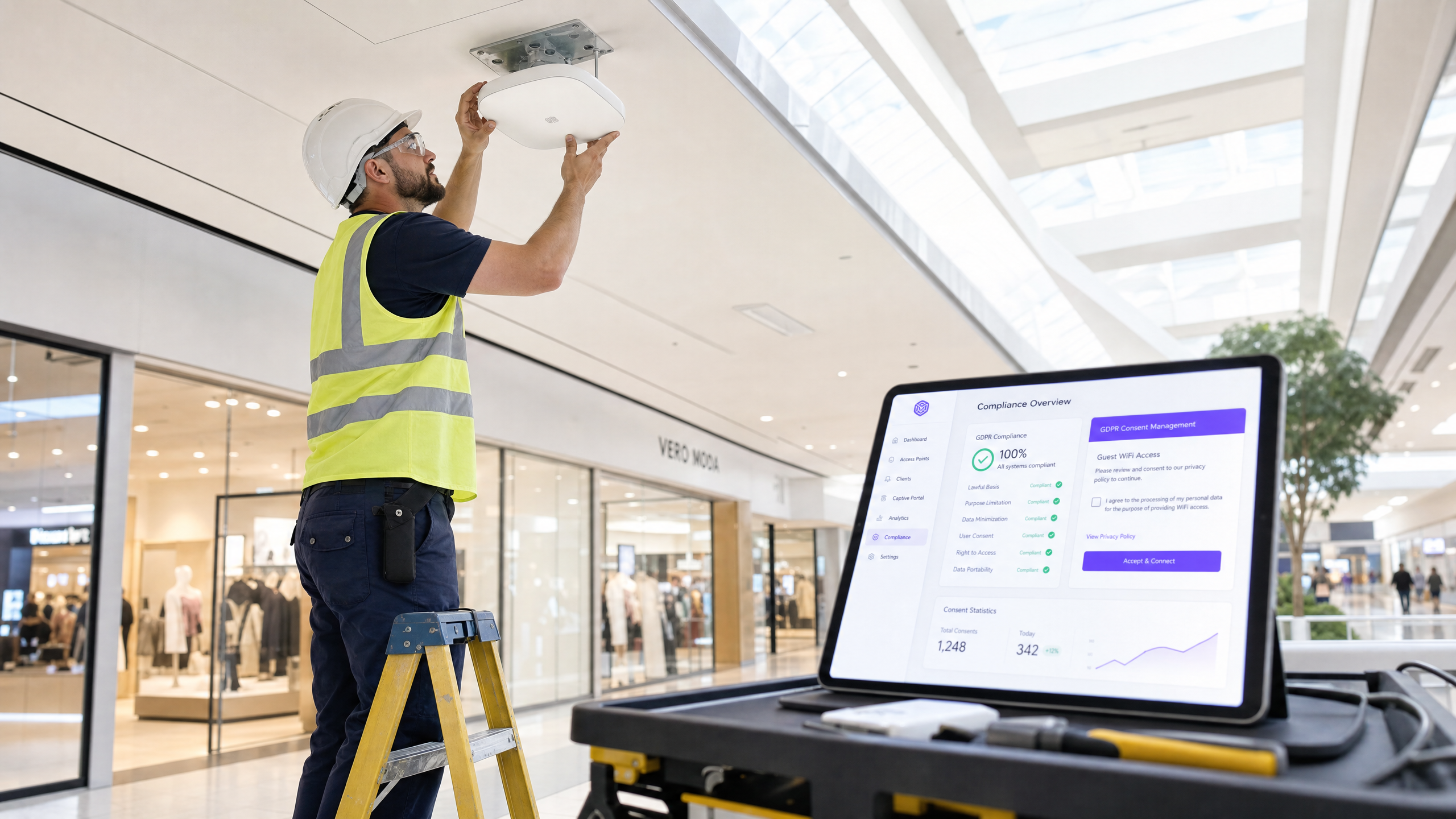
Guest WiFi is a regulated data collection endpoint. Every hotel, retail chain, stadium, and conference centre that provides public network access becomes a Data Controller under the General Data Protection Regulation (GDPR) the moment a guest connects. The Information Commissioner's Office (ICO) can impose fines of up to €20 million or 4% of global annual turnover for non-compliance.
This guide provides IT managers, network architects, and Operations Directors with a practical, actionable framework for ensuring their guest WiFi services are fully compliant. We explore the specific types of data collected through guest WiFi, the legal requirements for consent and data handling, and vendor-neutral best practices for implementing a compliant solution.
You will learn how to mitigate legal and financial risks associated with non-compliance by architecting a secure system, from the design of the captive portal to the automation of data retention policies. By following these principles, organisations can transform their guest WiFi from a potential compliance liability into a strategic asset that drives business growth while respecting user privacy.
Technical Deep-Dive
Understanding GDPR compliance for guest WiFi begins with a clear assessment of the data being processed. Under the regulation, personal data is defined broadly as any information relating to an identified or identifiable natural person. In the context of a guest WiFi network, this encompasses a wider range of data points than many organisations assume. A failure to correctly classify this data is a foundational error in compliance strategy.
Data Categories in Guest WiFi
The data collected via a guest WiFi network can be segmented into four primary categories. Each has distinct implications for GDPR compliance, particularly concerning the legal basis for processing and the required retention period.
- Registration Data: Name, email address, phone number, and social media profile data. This is the explicit information guests provide on your captive portal. The primary legal basis is consent, and it must be freely given, specific, informed, and unambiguous.
- Device and Session Data: MAC addresses, IP addresses, connection timestamps, and session duration. This is collected automatically. The legal basis is typically legitimate interest for network management and security, provided you have conducted a Legitimate Interest Assessment.
- Location Data: Physical location coordinates, dwell time, and movement paths derived from WiFi access point triangulation. This is processed by WiFi Analytics systems. Because location tracking can be intrusive, it requires explicit disclosure and often explicit consent, particularly if used for profiling.
- Usage Data: Application usage, browsing behaviour, and bandwidth consumption. If you are inspecting traffic content, you need a very clear lawful basis. For guidance on managing this traffic securely, review our Bandwidth Management: A Practical Guide for 2026 .
Captive Portal Compliance Architecture
The captive portal is your primary compliance interface. It is where you establish the legal basis for data processing.
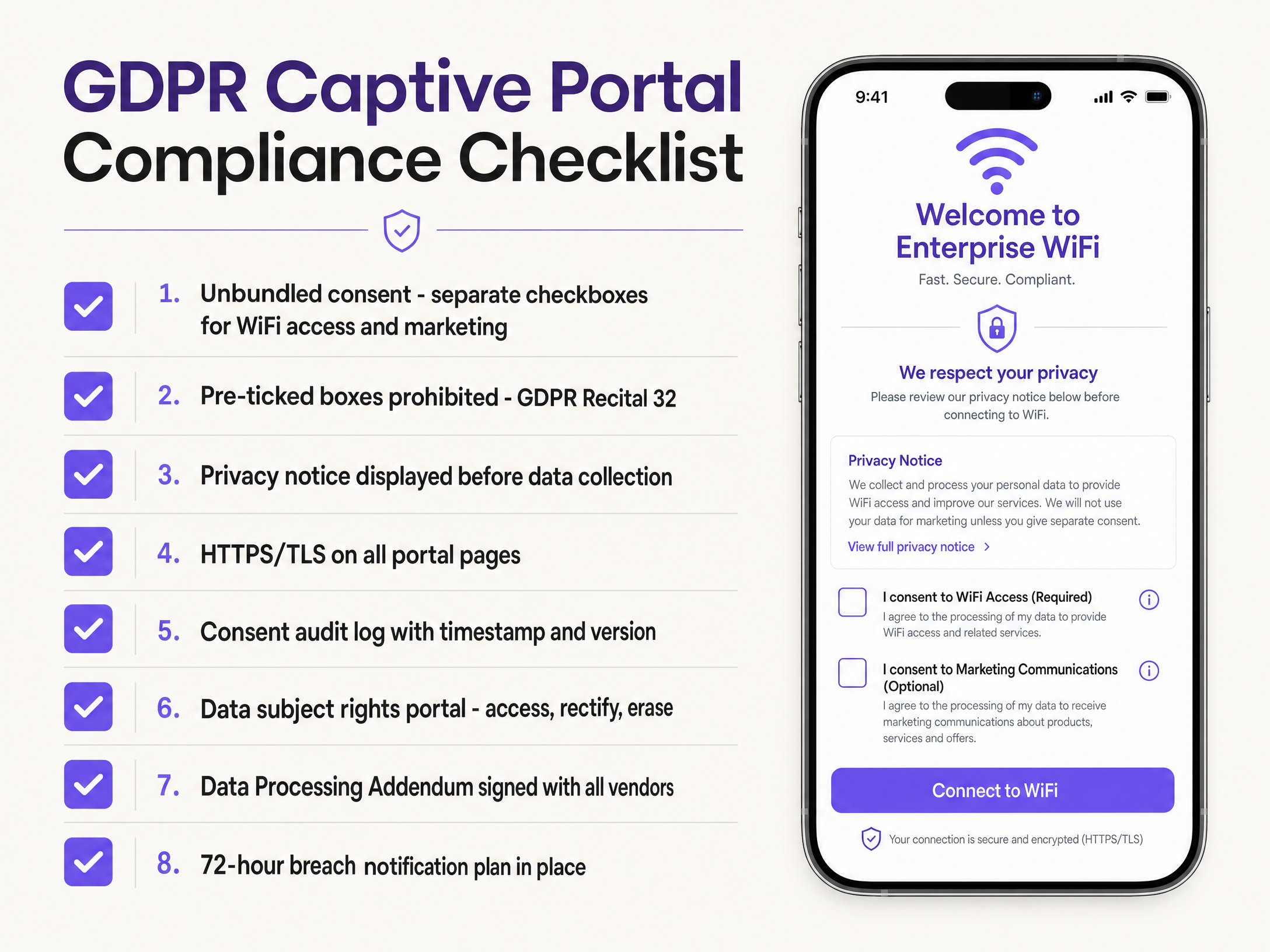
The most common architectural failure is bundling. If you require a guest to accept marketing emails to access the network, that consent is not freely given and is invalid under GDPR Article 7. You must implement unbundled consent.
Your captive portal must present at minimum two separate consent elements:
- A mandatory checkbox for acceptance of terms of service for network access.
- An optional, unticked checkbox for marketing communications consent.
GDPR Recital 32 explicitly prohibits pre-ticked boxes. Furthermore, your portal must serve a clear privacy notice before the user submits any data, in accordance with Article 13. This notice must explain what data you collect, why, how long you keep it, and who you share it with.
Crucially, your system must maintain a consent audit log. This log must record who consented, when they consented, what they consented to, and the exact version of the privacy notice they viewed. This is your proof of compliance.
Network Segmentation and Security
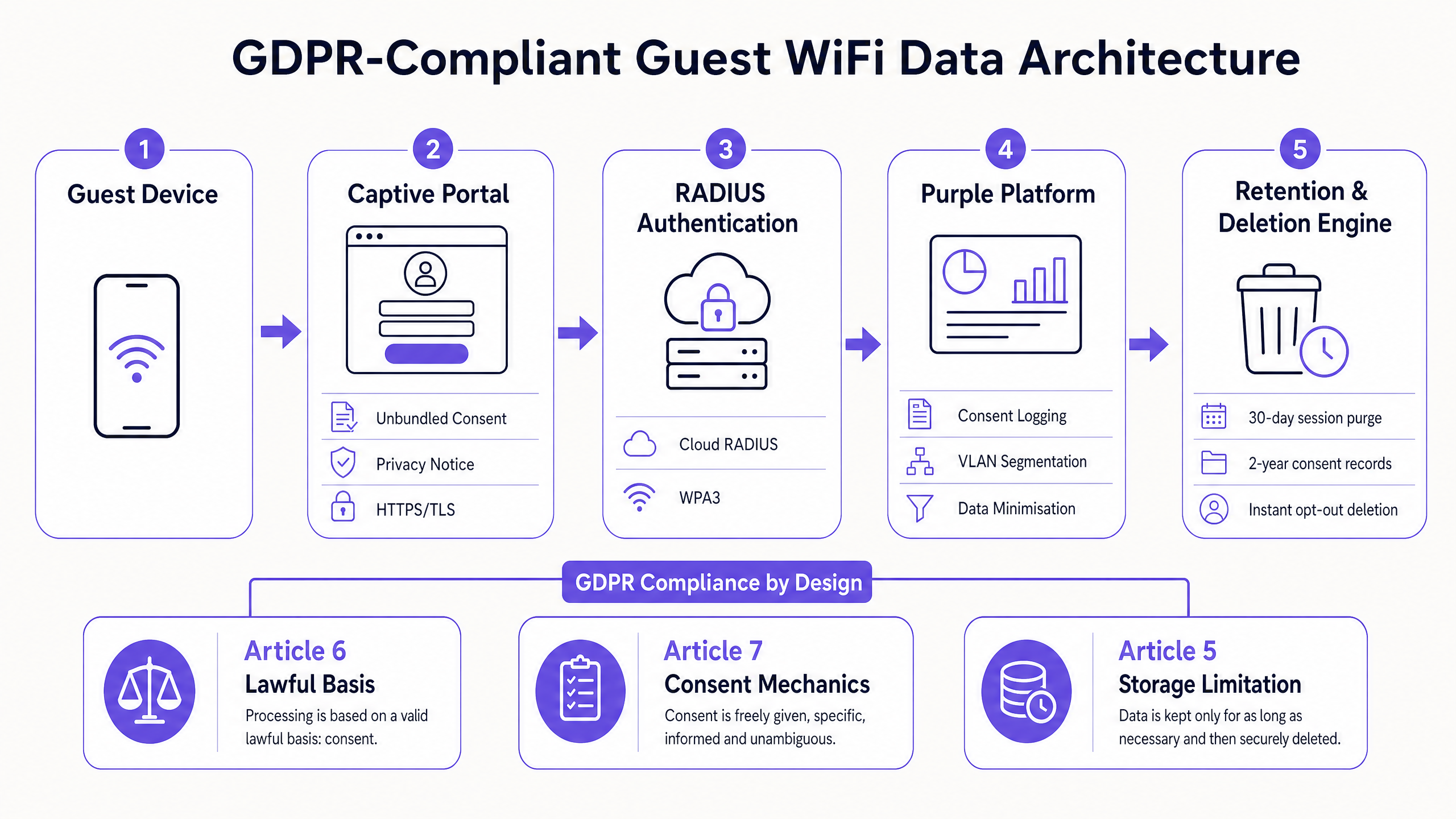
From a network architecture perspective, segmentation is non-negotiable. Your guest WiFi traffic must be isolated on a dedicated VLAN (Virtual Local Area Network), completely separate from your corporate network. Use access control lists to block guest devices from accessing internal subnets, and enable client isolation so guest devices cannot communicate with each other. This protects both the guests and your corporate assets. For a deeper dive into these principles, see What Is Secure WiFi: Essential Guide for Business 2026 .
For authentication, integrate your wireless LAN controller with a cloud RADIUS server. When a user completes the captive portal flow, the platform sends a RADIUS Access-Accept message to the controller, granting access. This creates a clean separation between the authentication layer and the data collection layer.
On encryption, your guest SSID should use WPA3 where your hardware supports it. At a minimum, enforce WPA2 with AES encryption. And your captive portal must be served over HTTPS with a valid TLS certificate. Serving a form that collects personal data over HTTP is a critical security failure.
Implementation Guide
Deploying a compliant guest WiFi network requires a structured approach across hardware, software, and policy layers.
- Hardware Selection: Ensure your access points support VLAN tagging, client isolation, and WPA3. Purple's platform is hardware-agnostic, integrating seamlessly with Cisco Meraki, HPE Aruba, Ruckus, Juniper Mist, Ubiquiti UniFi, Cambium, Extreme, and Fortinet. Do not use consumer-grade hardware; see Why Consumer WiFi Gear Doesn't Belong on Your Guest Network .
- Captive Portal Design: Build a splash page with unbundled consent. Ensure the privacy notice is accessible before any data is submitted. If you operate in regions requiring specific social logins, ensure the data exchange is transparent. For example, see our guide on Integrating WeChat WiFi Authentication: Captive Portal Onboarding for APAC Customers .
- Data Retention Automation: Configure your platform to automatically purge data according to your retention policy. Manual deletion is not viable at scale.
- Vendor Agreements: Ensure you have a signed Data Processing Addendum (DPA) with your guest WiFi provider, CRM vendor, and any other third party processing this data.
Best Practices
To maintain compliance and build trust, adhere to these industry-standard best practices:
- Data Minimisation: Only collect the data you strictly need. If you do not have a defined business use case for a phone number, do not ask for it on the captive portal.
- Automated Storage Limitation: Implement strict data retention periods. Session logs should be purged after 30 days. Consent records should be kept for the duration of the service relationship plus two years. Marketing profiles must be deleted immediately upon consent withdrawal.
- Enable Data Subject Rights: Provide a self-service preference centre where guests can manage their consent, request access to their data, or request deletion (the right to be forgotten). This dramatically reduces the operational burden of handling Data Subject Access Requests (DSARs).
- Conduct a DPIA: A Data Protection Impact Assessment is legally mandatory under GDPR Article 35 if your deployment involves large-scale location tracking or behavioural profiling.
Troubleshooting & Risk Mitigation
Even with a strong architecture, risks remain. Address these common failure modes proactively:
- Consent Fatigue: If your portal is overly complex, users will abandon the connection or blindly click through. Keep the value exchange clear: fast, free WiFi in exchange for an email address and optional marketing.
- Unsigned DPAs: Your guest WiFi platform provider is a Data Processor. If you share personal data with them without a signed DPA, you are in breach. Ensure contracts are in place before any data flows.
- Delayed Breach Notification: Under GDPR Article 33, you have 72 hours to notify the ICO of a personal data breach from the moment you become aware of it. Build this timeline into your incident response plan; do not wait for the investigation to conclude before notifying.
ROI & Business Impact
Compliance is not just a regulatory hurdle; it is a strategic enabler. A GDPR-compliant Guest WiFi platform protects you from fines of up to 4% of global turnover, but it also delivers measurable ROI.
By implementing unbundled, conscious-choice opt-ins, you build a high-quality database of first-party data. While the raw volume of marketing opt-ins may be lower than with a non-compliant bundled approach, the engagement rates (open rates, click-through rates, and conversion) are significantly higher because the audience actively chose to hear from you.
Furthermore, a compliant platform provides ethically sourced business intelligence. In industries like Retail and Hospitality , this data drives operational improvements, from optimising staff levels based on footfall to personalising the guest experience. Purple's platform, certified to ISO 27001 standards, has processed 440 million logins and collected 29 billion data points, demonstrating that scale and strict compliance can coexist profitably.
Key Definitions
Data Controller
The entity that determines the purposes and means of processing personal data. When a venue offers guest WiFi, it acts as the Data Controller and holds the primary legal responsibility.
IT managers must understand that outsourcing the WiFi platform does not outsource the legal liability.
Data Processor
An entity that processes personal data on behalf of the Data Controller. Purple, as the WiFi platform provider, acts as a Data Processor.
Requires a formal Data Processing Addendum (DPA) to legally handle the venue's guest data.
Captive Portal
The splash page or web page that a user must view and interact with before being granted access to a public network.
This is the primary interface where venues present privacy notices and capture lawful consent.
Unbundled Consent
The practice of separating requests for consent from other terms and conditions. Marketing consent cannot be a condition of service.
Essential for captive portal design to ensure consent is deemed 'freely given' under GDPR.
MAC Address
Media Access Control address; a unique identifier assigned to a network interface controller. Under GDPR, this is considered personal data when linked to a user.
Even if a user does not provide an email, logging their MAC address constitutes processing personal data.
VLAN Segmentation
Dividing a physical network into multiple logical networks. Guest WiFi traffic must be isolated from corporate traffic.
A foundational security control to prevent guest devices from accessing internal company assets.
RADIUS
Remote Authentication Dial-In User Service; a networking protocol that provides centralized Authentication, Authorization, and Accounting management.
Used to securely authenticate users who have completed the captive portal flow before granting network access.
DSAR
Data Subject Access Request; a mechanism for individuals to request a copy of their personal data, or ask for it to be rectified or erased.
Venues must have a process to handle these within 30 days. Self-service preference centres automate this burden.
Worked Examples
A 200-room hotel wants to collect guest emails to drive loyalty programme sign-ups. Their current system requires guests to accept marketing emails as a condition of getting online.
The hotel must deploy a compliant captive portal with unbundled consent. They must implement two separate checkboxes: a mandatory one for accepting the terms of service for network access, and an optional, unticked checkbox for marketing consent. The privacy notice must be clearly linked before the data submission button.
A stadium IT team wants to use WiFi analytics to monitor crowd density and manage safety at events. The legal team is concerned that tracking device locations without explicit consent violates GDPR.
The solution is two-fold. First, the captive portal privacy notice must be updated to explicitly disclose that location data is processed for crowd management and safety purposes under legitimate interest. Second, the IT team must implement MAC address pseudonymisation at the edge (on the access points) before the data reaches the cloud analytics platform.
Practice Questions
Q1. Your marketing team wants to increase the size of their email database. They propose making the marketing opt-in checkbox on the guest WiFi captive portal pre-ticked by default to increase conversion. How do you advise them?
Hint: Consider the GDPR definition of unambiguous consent and Recital 32.
View model answer
You must reject this proposal. GDPR Recital 32 explicitly states that silence, pre-ticked boxes, or inactivity does not constitute consent. Consent must require a clear affirmative action. Implementing pre-ticked boxes invalidates the consent and exposes the organisation to regulatory fines.
Q2. A guest connects to your WiFi but does not provide an email address, logging in via a 'skip' option. Your system logs their device MAC address, connection time, and the access point they connected to. Are you processing personal data?
Hint: Consider the ICO's guidance on identifiers and the potential to single out an individual.
View model answer
Yes. Even without a name or email, a MAC address combined with location and time data can be used to single out an individual device and track its movements over time. The ICO considers this personal data. You must ensure you have a lawful basis (typically legitimate interest for basic network logging) and transparently disclose this processing in your privacy notice.
Q3. During a routine audit, you discover that your guest WiFi platform has been retaining detailed session logs (IP addresses, MAC addresses, connection times) for the past four years. What action should you take?
Hint: Refer to the GDPR principle of storage limitation (Article 5).
View model answer
You must immediately implement an automated data deletion policy. Under the storage limitation principle, data must be kept no longer than necessary. Four years of session logs is excessive for network troubleshooting. You should purge historical session data older than 30 days and configure the platform to automatically delete future session logs at the 30-day mark.
Continue reading in this series
Integrating WeChat Authentication with Guest WiFi Captive Portals
This guide explains how to integrate WeChat OAuth 2.0 authentication into enterprise guest WiFi captive portals. It covers the dual-platform registration requirements, scope selection for first-party data capture, network enforcement via RADIUS Change of Authorisation, and compliance with GDPR and China's PIPL. Venue operators in hospitality, retail, and events will find concrete implementation steps, real-world case studies, and security hardening guidance to deploy WeChat login guest wifi at scale.
Integrating WeChat Authentication with Guest WiFi Captive Portals
This guide explains how to integrate WeChat OAuth 2.0 authentication into enterprise guest WiFi captive portals. It covers the dual-platform registration requirements, scope selection for first-party data capture, network enforcement via RADIUS Change of Authorization, and compliance with GDPR and China's PIPL. Venue operators in hospitality, retail, and events will find concrete implementation steps, real-world case studies, and security hardening guidance to deploy WeChat login guest wifi at scale.
Understanding Cisco SUDI: Hardware-Based Device Identity in Network Access Control
This guide details the technical architecture of Cisco SUDI, explaining how hardware-anchored identity secures network access control. It provides actionable implementation steps for IT leaders to deploy 802.1X EAP-TLS authentication and automate Zero Touch Provisioning across enterprise venues.