
Measuring ROI on Guest WiFi: A Framework for CMOs
This comprehensive technical guide provides a robust framework for calculating the return on investment from enterprise guest WiFi deployments. It details the methodologies for attributing revenue across data capture, marketing automation, dwell time uplift, and customer retention, offering actionable benchmarks for IT and marketing leaders.
Listen to this guide
View podcast transcript

Executive Summary
For modern physical venues - from expansive retail floors and high-density stadiums to multi-property hospitality groups - guest WiFi is no longer just a pure utility cost. It is a critical data acquisition and engagement engine. However, calculating the return on investment (ROI) for these deployments often proves challenging because its value is distributed across multiple operational and marketing channels. This guide provides Chief Marketing Officers (CMOs) and their technical counterparts with a definitive framework to measure, attribute, and maximize the ROI of guest WiFi investments. By breaking down the financial impact into four core pillars - first-party data capture, marketing automation revenue, dwell time uplift, and customer retention - we provide a vendor-neutral, technically grounded approach to building a robust business case.
Technical Deep-Dive: The Four Pillars of Guest WiFi ROI
Understanding the ROI of Guest WiFi deployments requires moving beyond traditional network cost-center accounting. Modern approaches treat the network edge as a revenue-generating asset. This architecture relies on seamless integration between wireless LAN controllers, Captive Portal authentication servers (often using RADIUS/802.1X for secure onboarding), and the organization's Customer Relationship Management (CRM) or marketing automation platforms.
Pillar 1: First-Party Data Capture
The most immediate and quantifiable return from a guest WiFi platform is the acquisition of first-party data. When a user connects to the network via a Captive Portal, they provide verifiable contact information - typically an email address or mobile number - in exchange for internet access. This transaction is governed by strict compliance frameworks, particularly the General Data Protection Regulation (GDPR) in Europe and the California Consumer Privacy Act (CCPA) in the US.
The technical mechanism involves a walled garden approach where unauthenticated traffic is intercepted and redirected to a secure, branded portal. Upon successful authentication (e.g., via SMS or email verification), the user's MAC address is linked to their identity profile. The ROI calculation here is straightforward: it is the cost avoidance of acquiring a net-new, verified contact through paid media channels. To dive deeper into authentication methods, see our guide on SMS vs Email Verification for Guest WiFi: Which to Choose .
Pillar 2: Marketing Automation Revenue Attribution
Capturing data is only the first step; subsequent value is realized through targeted marketing automation. Once a user profile is created, the WiFi platform pushes this data to the CRM via APIs or webhooks. This integration is critical for attributing downstream revenue back to the initial WiFi connection.
Technical implementation requires robust tagging and tracking. Post-connection redirect URLs should include UTM parameters to track immediate conversions. Additionally, the CRM should tag the contact source as "In-Venue WiFi". When marketing campaigns are run against these segments, the resulting revenue can be directly attributed to the WiFi infrastructure. This closed-loop reporting is essential for demonstrating the platform's value to the broader business.
Pillar 3: Dwell Time and Footfall Analytics
Beyond explicit data capture, the network infrastructure generates passive value through WiFi Analytics . By analyzing probe requests and association events from mobile devices, the system can calculate accurate footfall, dwell time, and movement patterns across the venue.
This spatial intelligence is highly valuable for operational optimization. In Retail environments, understanding the correlation between specific store layouts and increased dwell time can directly inform merchandising strategies. For Transport hubs, it assists in crowd management and optimizing tenant lease valuations based on verified traffic flows. The ROI is calculated by correlating these operational improvements with corresponding increases in transaction volume or operational efficiency.
Pillar 4: Customer Retention and Lifetime Value
The final pillar focuses on the long-term impact of guest WiFi on customer loyalty. By providing a seamless, high-quality connection experience - often facilitated by technologies like Passpoint/OpenRoaming that enable automatic, secure reconnection - venues can significantly enhance the guest experience.
The financial model for this pillar relies on calculating the conversion rate of WiFi users into formal loyalty program members. The incremental Customer Lifetime Value (CLV) of these members compared to non-members represents the retention value generated by the network.
Implementation Guide: Building an ROI Model
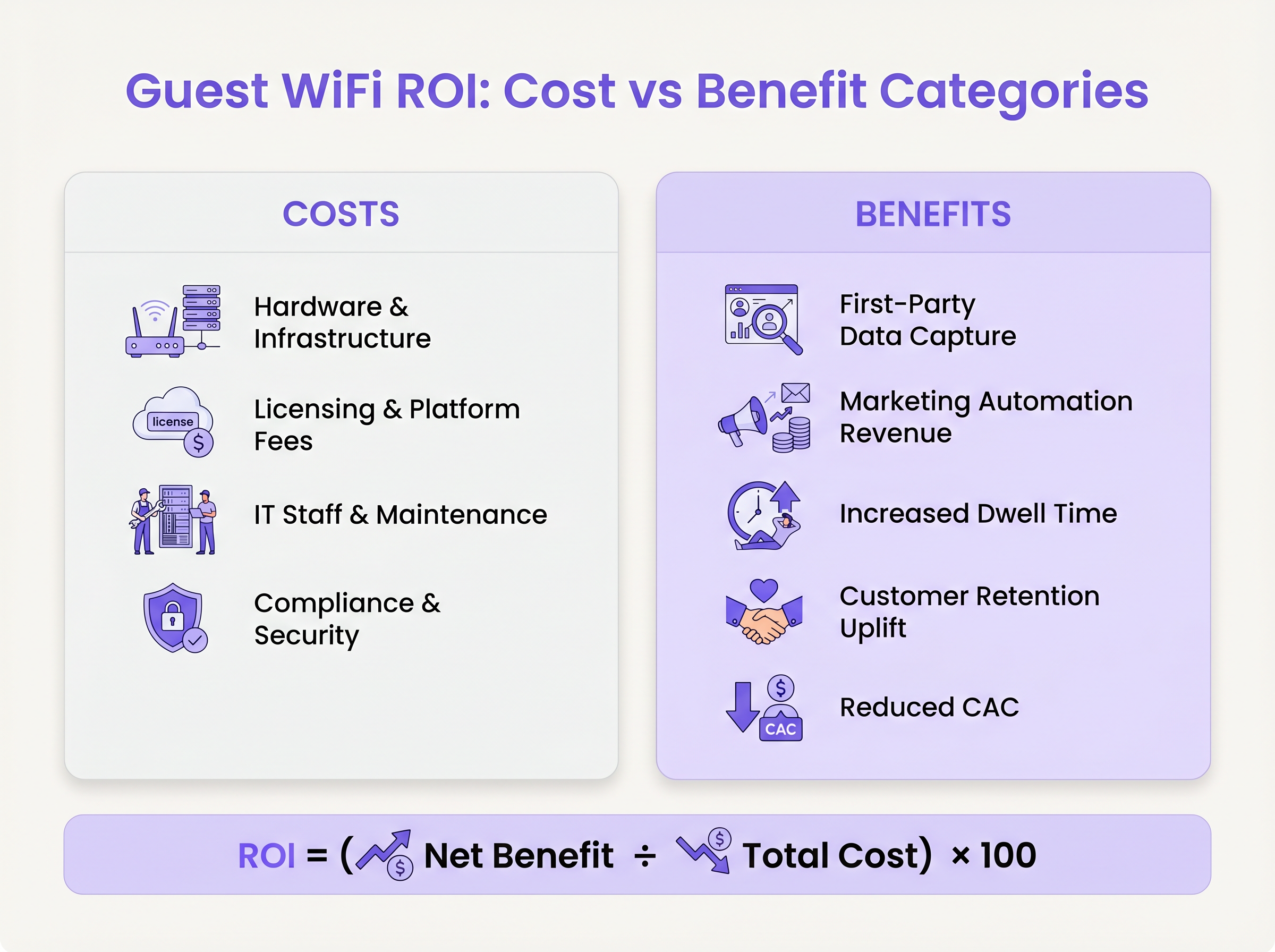
To build a defensible ROI model, organizations must accurately capture both the Total Cost of Ownership (TCO) and projected benefit streams.
- Define TCO: This includes capital expenditures (CapEx) for hardware (access points, switches, cabling), operational expenditures (OpEx) for platform licensing, and internal IT resources required for deployment and ongoing maintenance.
- Quantify Data Capture Value: Multiply the projected number of new, verified contacts captured monthly by your organization's average Cost Per Acquisition (CPA) for leads of similar quality.
- Model Marketing Revenue: Estimate the conversion rate and average order value for marketing campaigns targeting WiFi-sourced segments.
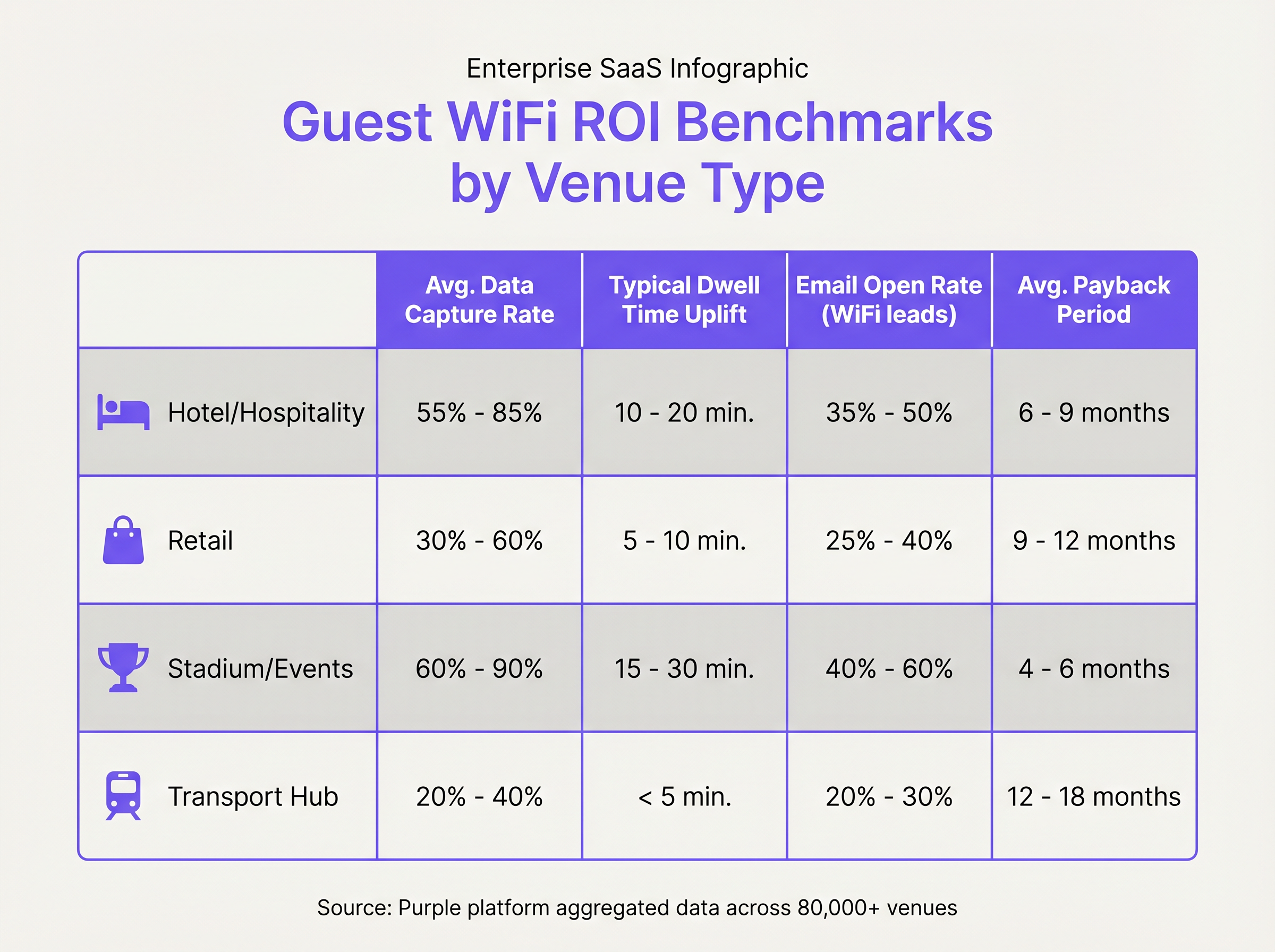
- Estimate Dwell Time Uplift: Use industry benchmarks or pilot data to project the revenue impact of increased dwell time (e.g., a 5% increase in dwell time leading to a 2% increase in average basket size).
- Calculate Retention Uplift: Estimate the number of users converting to the loyalty program and multiply by the incremental CLV.
Best Practices and Industry Standards
Successful deployments adhere to stringent technical and operational standards.
- Security and Compliance: Ensure that the Captive Portal and underlying databases comply with PCI DSS (if indirectly handling payment data) and GDPR. Implement robust data retention policies, automatically deleting inactive profiles in accordance with local regulations.
- Network Design: For high-capacity venues, adequate RF planning is non-negotiable. To ensure the infrastructure can support projected concurrent user loads without degrading performance, see our comprehensive guide on High-Density WiFi Design: Stadium and Arena Best Practices .
- Seamless Authentication: Minimize friction in the onboarding process. Consider implementing profile-based authentication methods to facilitate automatic reconnection on subsequent visits, improving user experience and increasing data capture rates.
- API-First Architecture: Select platforms with robust, well-documented APIs to ensure seamless data flow between the WiFi analytics engine and the broader marketing technology stack.
Troubleshooting and Risk Mitigation
Even meticulously planned deployments can encounter challenges that degrade ROI.
- Low Data Capture Rates: This often stems from poorly designed Captive Portals or overly complex authentication flows. Mitigation: A/B test portal designs, simplify data entry requirements, and clearly articulate the value exchange (e.g., "Sign in for 10% off your next purchase").
- Integration Failures: If the API connection between the WiFi platform and the CRM fails, the attribution chain breaks. Mitigation: Implement automated alerting for API timeouts or data sync failures. Regularly audit data flows to ensure integrity.
- Poor Network Performance: If the underlying infrastructure is inadequate, users will abandon the connection process. Mitigation: Conduct regular site surveys and capacity planning exercises, especially prior to major events or peak seasons. For insights into modern network architectures that support these deployments, see The Core SD WAN Benefits for Modern Businesses .
ROI and Business Impact: Measuring Success
The ultimate measure of success is a positive, demonstrable ROI. A well-executed guest WiFi strategy should transform the network from a cost center into a profit center.
By meticulously tracking the metrics outlined in this framework - Cost Per Acquisition, marketing attribution, dwell time impact, and loyalty conversion - IT and marketing leaders can build a compelling, data-driven narrative for ongoing investment in the venue's digital infrastructure. The integration of Sensors and Wayfinding technologies can further enrich this dataset, providing an even more nuanced understanding of visitor behavior and driving additional operational efficiencies.
> [!TIP] > To simplify the business case for your leadership team, use our WiFi Marketing ROI Calculator to estimate campaign revenue and database value based on your venue's size.
Key Definitions
Captive Portal
A web page that the user of a public-access network is obliged to view and interact with before access is granted. It is the primary mechanism for first-party data capture.
Critical for IT teams to configure securely, ensuring seamless authentication while complying with data privacy regulations.
First-Party Data
Information a company collects directly from its customers and owns entirely, such as email addresses captured via a WiFi login.
Highly valuable for marketing teams as it reduces reliance on third-party cookies and paid advertising channels.
Probe Request
A frame sent by a client device (like a smartphone) to discover available 802.11 networks within its proximity.
Used by WiFi analytics engines to track footfall and device movement, even if the device does not fully authenticate to the network.
MAC Address Randomization
A privacy feature in modern mobile operating systems that periodically changes the device's MAC address to prevent persistent tracking.
IT teams must account for this when designing analytics solutions, often requiring authenticated sessions (profile-based authentication) to accurately track returning visitors over time.
Total Cost of Ownership (TCO)
The comprehensive assessment of all costs associated with deploying and maintaining the WiFi infrastructure, including CapEx (hardware) and OpEx (licensing, support).
Essential for finance and IT leaders to calculate accurately to determine the true ROI of the platform.
Customer Lifetime Value (CLV)
A prediction of the net profit attributed to the entire future relationship with a customer.
Used to model the long-term ROI of converting WiFi guests into loyalty program members.
UTM Parameters
Tags added to a URL that allow marketing teams to track the effectiveness of campaigns and identify the source of traffic.
Crucial for tracking post-connection redirects and attributing downstream revenue to the initial WiFi login event.
Passpoint / OpenRoaming
Protocols that enable seamless, secure, and automatic roaming between different Wi-Fi networks without requiring the user to repeatedly log in via a captive portal.
Improves the guest experience and increases connection rates, driving higher data capture volumes over time.
Worked Examples
A 200-room hotel chain is evaluating a guest WiFi platform upgrade. They currently spend £35 to acquire a new email lead via paid social. The proposed WiFi platform costs £2 per room per month in licensing. They expect 150 unique guests per day across the property, with a projected 60% captive portal completion rate. Calculate the monthly data capture value and the simple ROI based solely on this pillar (excluding hardware costs).
- Calculate monthly connections: 150 guests/day * 30 days = 4,500 total connections/month.
- Calculate successful captures: 4,500 * 0.60 = 2,700 verified emails/month.
- Calculate Data Capture Value: 2,700 emails * £35 CPA = £94,500 value generated/month.
- Calculate Platform Cost: 200 rooms * £2 = £400/month.
- Calculate ROI: ((£94,500 - £400) / £400) * 100 = 23,525%.
A large retail mall implements WiFi analytics to track dwell time. Baseline data shows an average dwell time of 45 minutes, with an average spend of £60 per visitor. Following a reconfiguration of the food court seating and the introduction of targeted push notifications via the captive portal, average dwell time increases to 55 minutes. Industry benchmarks suggest a 10% increase in dwell time yields a 5% increase in spend. Calculate the projected new average spend per visitor.
- Calculate the percentage increase in dwell time: ((55 - 45) / 45) * 100 = 22.2% increase.
- Apply the benchmark multiplier: If a 10% dwell increase = 5% spend increase, then a 22.2% dwell increase = (22.2 / 10) * 5 = 11.1% projected spend increase.
- Calculate new average spend: £60 * 1.111 = £66.66 per visitor.
Practice Questions
Q1. A stadium operations director is evaluating the ROI of a major network upgrade. The primary goal is to increase food and beverage (F&B) sales during halftime. The IT team proposes a high-density deployment with a sophisticated captive portal, while the marketing team wants to ensure seamless CRM integration. What is the most critical technical dependency to ensure the ROI can be accurately measured?
Hint: Consider how the initial connection event must be linked to the final purchase event.
View model answer
The most critical dependency is establishing a closed-loop attribution system. This requires the WiFi platform to successfully push the captured user identity (e.g., email or phone number) via API to the CRM, and for the CRM to be integrated with the Point of Sale (POS) system. Without this end-to-end integration, the marketing team cannot definitively prove that a promotional offer sent via the WiFi platform resulted in a specific F&B transaction at the concession stand.
Q2. A retail chain is experiencing a high drop-off rate at the captive portal. Users connect to the SSID but fail to complete the registration form, resulting in poor data capture ROI. The current portal requires first name, last name, email, date of birth, and postal code. What is the recommended architectural or operational change?
Hint: Evaluate the balance between the value of the data requested and the friction introduced to the user.
View model answer
The recommended approach is to reduce the friction in the onboarding process by simplifying the data requirements. The IT and marketing teams should implement progressive profiling. Initially, require only a single, high-value identifier (such as an email address or mobile number via SMS verification) to grant access. Subsequent data points (like date of birth or postal code) can be collected later through targeted marketing campaigns or upon subsequent visits, thereby significantly increasing the initial completion rate and overall data capture volume.
Q3. When building a Total Cost of Ownership (TCO) model for a multi-site hospitality deployment, the finance partner questions the inclusion of GDPR compliance auditing costs as a line item against the WiFi project. How should the IT architect justify this inclusion?
Hint: Consider the legal basis for processing the data captured by the network.
View model answer
The IT architect must explain that the guest WiFi platform acts as a primary data controller/processor. Because the system is actively capturing Personally Identifiable Information (PII) to generate marketing ROI, it fundamentally alters the venue's risk profile compared to providing an open, unauthenticated network. Therefore, the costs associated with ensuring the captive portal's consent mechanisms, data retention policies, and subject access request workflows are compliant with GDPR are direct, unavoidable operational expenses (OpEx) of running the platform as a revenue-generating asset.
Continue reading in this series
Privacy by Design: Anonymizing WiFi Data for GDPR Compliance
This authoritative guide details the technical architecture and implementation strategies for anonymising WiFi data to ensure GDPR compliance. It provides IT leaders and network architects with actionable frameworks for balancing robust venue analytics with strict data privacy requirements.
Privacy by Design: Anonymising WiFi Data for GDPR Compliance
This authoritative guide details the technical architecture and implementation strategies for anonymising WiFi data to ensure GDPR compliance. It provides IT leaders and network architects with actionable frameworks for balancing robust venue analytics with strict data privacy requirements.
Heatmapping vs Presence Analytics: Technical Differences
This authoritative technical guide details the critical architectural and operational differences between WiFi heatmapping and presence analytics for enterprise venue operators. It provides IT leaders, network architects, and operations directors with actionable deployment frameworks, real-world implementation scenarios, and vendor-neutral best practices for extracting maximum ROI from their existing wireless infrastructure.