
How to leverage marketing SMS software to increase return visits
This guide explains how venue operators - from hotels and retail chains to stadiums and conference centres - can use marketing SMS software to drive measurable return visits. It covers the technical architecture for capturing verified first-party phone data via Guest WiFi, the segmentation and automation logic required for effective campaigns, and how to attribute physical return visits back to specific SMS sends. Compliance with GDPR and TCPA is addressed throughout, alongside integration patterns for Cisco Meraki, HPE Aruba, Ruckus, Juniper Mist, and other enterprise hardware.
Listen to this guide
View podcast transcript
Executive summary
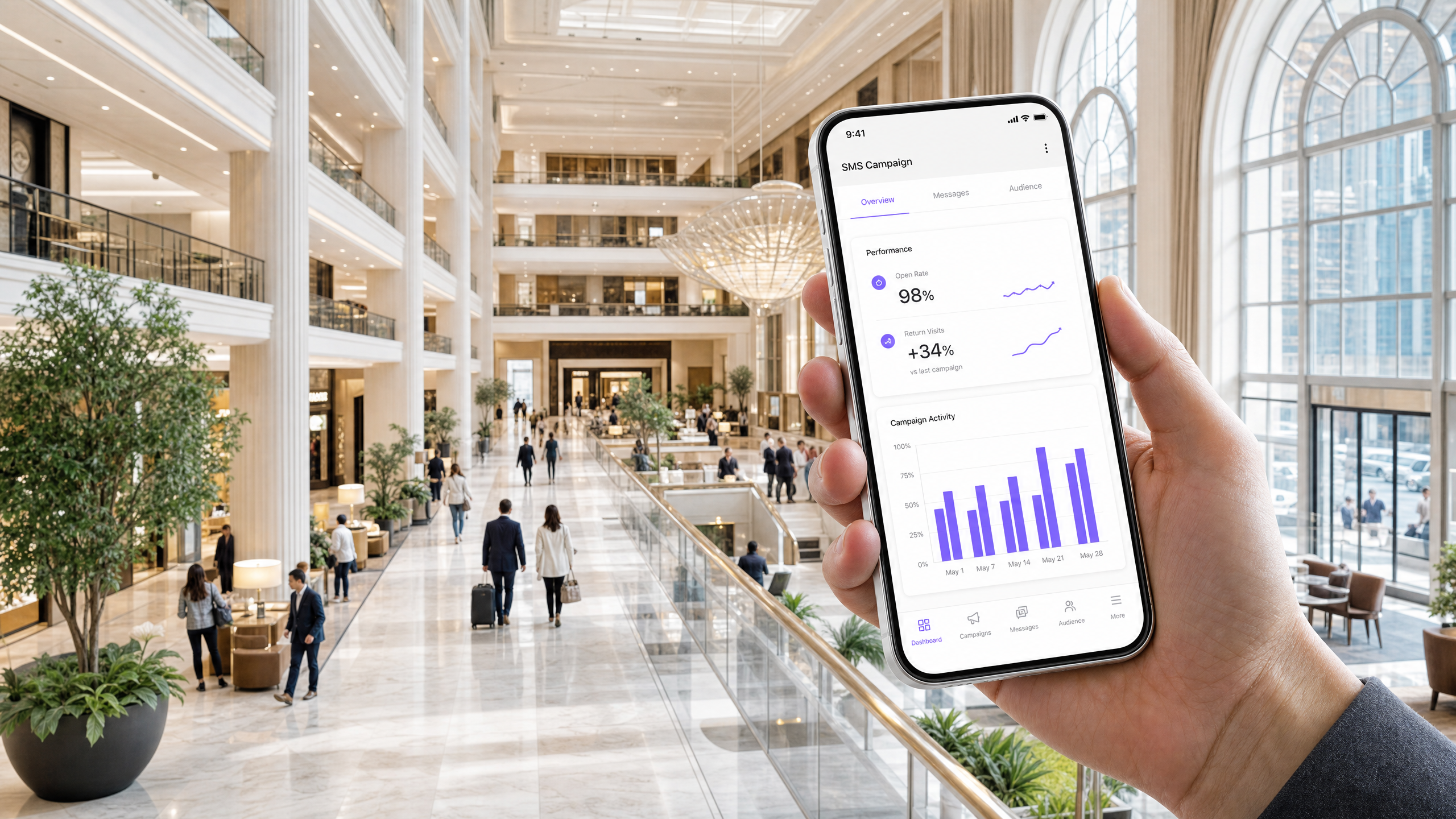
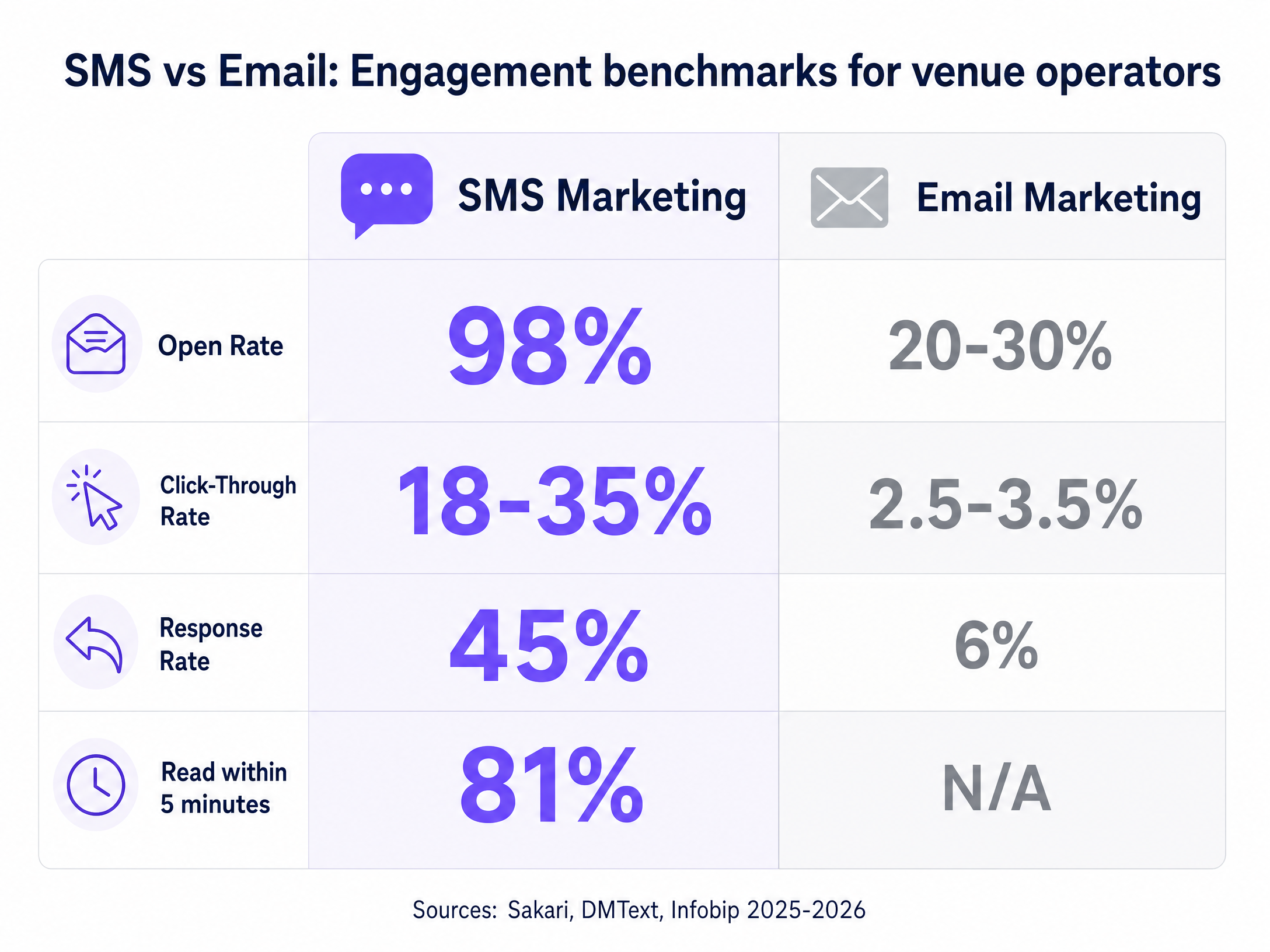
SMS marketing achieves a 98% open rate, with 80% of messages read within five minutes of delivery. For physical venues, this immediacy is the difference between a message that drives a return visit and one that gets buried in an inbox. Email open rates average 20 - 30%. SMS click-through rates reach 18 - 35%, compared to email's 2.5 - 3.5%. The ROI case is equally clear: conservative estimates place SMS marketing returns at $21 per $1 spent, with optimised programmes reaching $71 per $1 (Sakari, 2025-2026 SMS Marketing Statistics).
But the channel is only as good as the data behind it. Most venue operators have a significant untapped asset: their Guest WiFi network. Every time a visitor connects, they generate a verified data point - a device identifier, a timestamp, a location within the venue. Purple Engage captures this data at the captive portal, builds a behavioural profile, and feeds it directly into automated SMS marketing workflows. This guide details the architecture, implementation steps, and measurement framework required to turn that data into return visits.
Technical deep-dive
The data capture layer: Guest WiFi as an ingestion point
The foundation of effective SMS marketing is accurate, first-party data. Purchasing third-party lists carries compliance risk and poor deliverability. Relying on manual data entry at a point of sale is slow and inconsistent. The most reliable method for physical venues is network-level capture.
When a visitor connects to your Guest WiFi , they pass through a captive portal - a web page that requires authentication before granting network access. This portal is the primary ingestion point. Purple Engage operates here, capturing the visitor's device MAC address, assigning a unique user ID, and securely storing their phone number and email address. Critically, this data is verified: the visitor is physically present and actively engaging with the login flow.
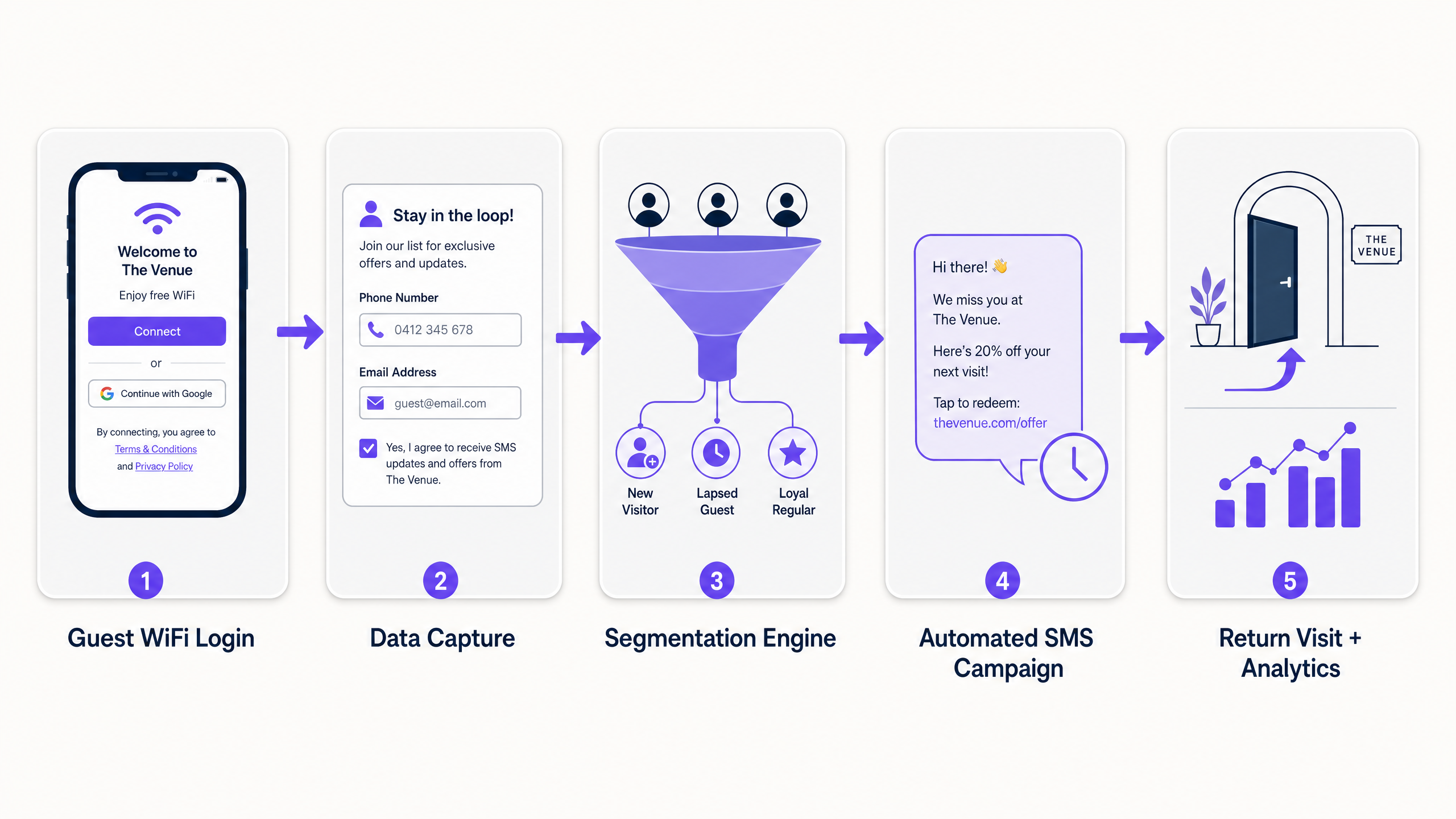
Profile-based authentication means that returning visitors are recognised on subsequent connections without needing to re-enter their details. Over time, this builds a rich behavioural dataset: visit frequency, dwell time, preferred days, and movement patterns within the venue.
Integration architecture
Purple operates as a hardware-agnostic cloud overlay. It integrates with Cisco Meraki, HPE Aruba, Ruckus, Juniper Mist, Ubiquiti UniFi, Cambium, Extreme, and Fortinet without requiring changes to your existing network infrastructure. This is a significant operational advantage: you do not need to replace hardware to gain marketing intelligence from your network.
Data captured via the captive portal syncs via API to your CRM or marketing automation platform in real time. For enterprise environments using Microsoft Entra ID, Okta, or Google Workspace for staff identity management, these systems remain separate from the Guest WiFi data layer. Staff authentication and guest marketing data are segmented by design, maintaining both security and compliance.
For WiFi Analytics , Purple collects 29 billion data points across 80,000+ live venues. This scale means the segmentation models and campaign benchmarks are grounded in real-world venue data, not theoretical frameworks.
Compliance: GDPR, TCPA, and conscious-choice opt-ins
The most common compliance failure in venue SMS marketing is bundling WiFi access consent with marketing consent. Under GDPR and TCPA, these are distinct permissions. A visitor who provides a phone number to access the network has not automatically consented to receive marketing messages.
Purple enforces conscious-choice opt-ins by design. The captive portal presents a separate, unticked checkbox specifically for SMS marketing consent. This checkbox must include a clear description of what the visitor is opting into. The consent record - including timestamp and IP address - is stored and auditable.
Data is encrypted in transit and at rest. Purple holds ISO 27001, Cyber Essentials, GDPR, and CCPA certifications. For venues operating under PCI DSS requirements, Purple's data handling architecture is compatible with standard PCI DSS compliance programmes, though venue operators retain responsibility for their own PCI scope.
Implementation guide
Step 1: Audit your current captive portal
Before deploying any SMS campaign, confirm that your captive portal collects phone numbers and presents a separate, explicit SMS marketing opt-in. If your current portal only collects email addresses, or bundles all consents into a single checkbox, this must be corrected before any campaign activity.
Step 2: Define your audience segments
Purple WiFi Analytics provides the data required to build three core segments:
| Segment | Definition | Recommended campaign type |
|---|---|---|
| First-time visitor | Connected to the network once | Welcome sequence with return incentive |
| Loyal regular | Three or more visits in the past 30 days | Exclusive offers, early event access |
| Lapsed guest | Previously regular, no connection in 60+ days | Win-back campaign with stronger incentive |
These segments can be refined further by dwell time, visit time of day, or zone within the venue. A shopper who consistently visits on Saturday mornings and spends 90 minutes in the venue is a different audience from an occasional weekday visitor.
Step 3: Configure automated workflows
The three highest-performing automated workflows for venue operators are:
The welcome sequence. Triggered 24 hours after a first visit. A single message acknowledging the visit and offering a small incentive for a return. Keep the message under 160 characters. Include a trackable link.
The loyalty reward. Triggered when a visitor reaches a defined visit threshold (e.g., five visits in a month). A message acknowledging their loyalty and offering an exclusive benefit. This reinforces the behaviour you want to sustain.
The win-back campaign. Triggered when a loyal regular becomes lapsed. This requires a more compelling offer than the welcome sequence, because you are asking the visitor to break a pattern of absence. A time-limited incentive - valid for seven days - creates urgency without devaluing the offer.
Step 4: Set frequency limits
Approximately 53% of SMS unsubscribes are caused by excessive message frequency (Sakari, 2025-2026). Keep promotional messages to a maximum of two per month per segment. Behaviour-triggered messages - win-back campaigns, loyalty rewards - are exempt from this limit because they are timely and contextually relevant.
Step 5: Establish attribution tracking
This is the step most operators skip, and it is the most important. Do not measure SMS campaign success by click-through rate alone. A click tells you someone was interested. It does not tell you they walked back through your door.
The correct metric is network authentication. After sending an SMS to a lapsed guest segment, track the MAC addresses or unique user IDs of recipients. When those devices next authenticate on the network, that return visit is directly attributable to the campaign. Purple analytics provides this correlation natively.
Best practices
For hospitality operators, the highest-value SMS trigger is post-checkout. A message sent 48 hours after a guest checks out of a Premier Inn or similar property, offering a direct booking incentive for their next stay, captures the guest while the experience is still fresh and before a competitor has re-engaged them.
For retail operators, the most effective campaign is the zone-triggered message. When a shopper's device authenticates in a specific area of the venue - a food court, a particular department - an SMS directing them to a nearby promotion or time-limited offer drives immediate, measurable spend.
For transport hubs and airports, the win-back campaign is particularly effective because passenger behaviour is inherently episodic. A passenger who connected at Manchester Airports Group (MAG) three months ago and has not returned is a high-value re-engagement target.
For healthcare environments, SMS is primarily used for appointment reminders and wayfinding rather than promotional campaigns. The same data capture architecture applies, but the consent framework and message content must reflect the sensitivity of the context.
Troubleshooting and risk mitigation
High opt-out rates. If opt-out rates exceed 3.5% per send, the most likely cause is message frequency or relevance. Audit your segmentation logic. Are lapsed guests receiving the same message cadence as loyal regulars? Are messages personalised to visit behaviour, or are they generic broadcasts?
Low attribution rates. If you cannot correlate SMS sends to return visits, the most likely cause is a gap in the device tracking data. Confirm that your captive portal is capturing MAC addresses consistently, and that the data is syncing correctly to your analytics platform. MAC address randomisation on modern iOS and Android devices can affect tracking accuracy; Purple's profile-based authentication mitigates this by binding the user ID to the authenticated account rather than the device MAC alone.
Compliance audit failure. If your data protection officer identifies a compliance gap, the most common issue is the absence of a separate, explicit SMS opt-in. Review your captive portal consent flow against GDPR Article 7 requirements. Consent must be freely given, specific, informed, and unambiguous. A pre-ticked checkbox does not meet this standard.
Hardware migration. Switching from one access point vendor to another - for example, from Cisco Meraki to Juniper Mist - does not affect Purple's SMS marketing workflows. Because Purple operates as a cloud overlay, the marketing automation layer is decoupled from the network hardware. The only required action is reconfiguring the new access points to route captive portal traffic to Purple.
ROI and business impact
SMS marketing delivers an average ROI of £71 per £1 spent, with conservative estimates at £21-41 per £1 (Sakari, 2025-2026). For venue operators, the most direct measure of ROI is the correlation between SMS campaign spend and incremental return visits.
A practical calculation framework:
- Identify the average revenue per return visit for your venue type (e.g., average spend per hotel guest night, average basket size per retail visit).
- Measure the number of return visits directly attributable to each SMS campaign via network authentication.
- Multiply attributable return visits by average revenue per visit.
- Subtract the cost of the SMS campaign (message costs plus platform fees).
- Divide the net revenue by campaign cost to calculate ROI.
For a retail shopping centre with an average shopper spend of £45 per visit, a win-back campaign that costs £500 and drives 50 attributable return visits generates £2,250 in incremental revenue - a 350% return on the campaign investment.
Beyond direct revenue, the compounding value of a first-party data asset is significant. Every verified opt-in added to your SMS database increases the reach and precision of future campaigns. Unlike paid media audiences, this database does not deprecate when a platform changes its algorithm or data policy. It is a durable, owned asset that grows with every visitor who connects to your Guest WiFi.
For further reading on the foundational network architecture that enables this data capture, see Three SSIDs to rule them all: guest, Passpoint, and IoT WiFi and How to make a great first impression with your guest WiFi . For a detailed walkthrough of the SMS marketing implementation, see our companion guide: How to leverage SMS marketing software to increase return visits .
Key Definitions
Captive Portal
A web page that a user must interact with before being granted access to a public WiFi network. It is the primary ingestion point for capturing verified phone numbers and marketing consent in venue environments.
IT teams encounter this when configuring Guest WiFi authentication. The portal design directly affects data capture quality and compliance posture.
First-party data
Information collected directly from your visitors or customers, rather than purchased from a third party or inferred from third-party tracking. It is more accurate, carries lower compliance risk, and is not subject to platform policy changes.
The foundation of effective SMS marketing. Guest WiFi authentication generates first-party data at scale, with verified contact details and behavioural context.
MAC address
A unique identifier assigned to a network interface controller (NIC), used as a network address. In venue analytics, MAC addresses are used to track device presence and visit frequency across sessions.
Purple uses MAC addresses to identify returning devices and build visit frequency profiles. Note that modern iOS and Android devices randomise MAC addresses per network; Purple's profile-based authentication mitigates this by binding the user ID to the authenticated account.
Conscious-choice opt-in
An explicit, affirmative action by a user to consent to a specific type of communication. Under GDPR Article 7, consent must be freely given, specific, informed, and unambiguous. A pre-ticked checkbox does not meet this standard.
Required for all SMS marketing in GDPR-regulated markets. Purple enforces this at the Captive Portal level, presenting a separate, unticked checkbox for SMS marketing consent.
Dwell time
The duration a visitor spends physically present within a venue, measured from network authentication to disconnection or last activity.
A key segmentation variable. A visitor with high dwell time is more engaged with the venue and more likely to respond to targeted offers than a visitor who connects briefly.
Lapsed guest
A previously active visitor who has not returned to the venue within a defined timeframe, typically 60 to 90 days. Identified by the absence of network authentication events from a previously active device profile.
The primary target for win-back SMS campaigns. The longer the absence, the stronger the incentive required to drive re-engagement.
Hardware-agnostic cloud overlay
A software architecture that operates independently of the underlying network hardware, integrating with multiple access point vendors via standard protocols without requiring hardware replacement.
Purple's architecture. It means that SMS marketing workflows continue to function when a venue migrates from one hardware vendor to another - for example, from Cisco Meraki to Juniper Mist.
Closed-loop attribution
A measurement methodology that connects a marketing action (sending an SMS) to a physical outcome (a return visit), using network authentication as the proof of presence.
The gold standard for measuring SMS campaign ROI in physical venues. It moves beyond digital click-through rates to prove actual footfall impact.
GDPR (General Data Protection Regulation)
The European Union's primary data protection regulation, enforceable since May 2018. It governs how organisations collect, store, and use personal data, including phone numbers collected for marketing purposes.
Directly relevant to SMS marketing data capture. Fines for non-compliance can reach 4% of global annual turnover or €20 million, whichever is higher.
TCPA (Telephone Consumer Protection Act)
US federal legislation that restricts telemarketing calls and text messages. It requires prior express written consent before sending marketing SMS messages.
Relevant for venues operating in or marketing to US audiences. Violations carry statutory damages of $500 to $1,500 per message.
Worked Examples
A 200-room hotel currently sends a monthly email newsletter to guests who provided an email address at check-in. The newsletter achieves a 15% open rate and the marketing team cannot attribute any direct bookings to it. The hotel wants to increase food and beverage revenue from returning guests.
Deploy Purple Engage on the hotel's existing HPE Aruba network. Reconfigure the captive portal to require a phone number for WiFi authentication and add a separate, explicit SMS marketing opt-in checkbox. Configure an automated workflow: 48 hours after a guest's device last authenticates on the network (indicating check-out), trigger an SMS offering a 20% discount on dinner at the hotel restaurant, valid on their next stay. The SMS includes a unique booking link with UTM tracking. In Purple analytics, configure a return visit attribution report that flags when the device of an SMS recipient next authenticates on the network. Review weekly. After 90 days, compare the revenue from bookings made via the SMS link against the cost of the campaign.
A retail shopping centre with 120 stores wants to re-engage shoppers who visited frequently six months ago but have not returned in the past 90 days. The centre's marketing team has a database of email addresses but no phone numbers, and their email win-back campaign achieved a 12% open rate with no measurable uplift in footfall.
The centre deploys Purple Engage across their existing Cisco Meraki network. Over the following 60 days, they build a first-party SMS database via the captive portal, with explicit opt-in consent. In Purple WiFi Analytics, they identify devices that authenticated frequently in the previous six months but have been absent for 90 days. They export this lapsed segment to their SMS marketing software. They deploy a win-back campaign: a single SMS offering free parking for the next visit, redeemable by connecting to the Guest WiFi on arrival. The parking offer is operationally simple to fulfil and has a clear redemption trigger - network authentication - that closes the attribution loop. The campaign runs for 14 days. Return visit rate among the lapsed segment is measured against a control group who received no SMS.
Practice Questions
Q1. Your marketing team wants to export the entire Guest WiFi database and send a bulk SMS promoting a weekend sale. The database contains 45,000 records collected over three years. What is the primary risk of this approach, and how would you mitigate it?
Hint: Consider both regulatory requirements and the composition of a three-year-old database.
View model answer
The primary risk is a GDPR and TCPA compliance violation. A three-year-old database will contain records from visitors who accepted WiFi access terms but did not explicitly opt-in to SMS marketing - particularly if the captive portal was configured before explicit SMS consent was required. Sending to these records constitutes unsolicited marketing communication. The mitigation is to filter the database to include only records with a verified, timestamped SMS marketing opt-in. Additionally, a bulk send to all 45,000 records ignores segmentation, which will produce high opt-out rates and poor conversion. The correct approach is to filter for explicit opt-ins, segment by visit behaviour, and send targeted messages to each cohort.
Q2. A venue operator reports that their SMS win-back campaign shows a 28% click-through rate on the included link, but the operations team cannot confirm whether those visitors actually returned to the venue. How do you close this attribution gap?
Hint: Think about what data is available from the network layer that is not available from the SMS platform.
View model answer
The operator must correlate SMS campaign data with network authentication data. Export the list of phone numbers that received the win-back SMS, cross-reference them with the unique user IDs in Purple analytics, and identify which of those user IDs authenticated on the network in the 14 days following the SMS send. This provides definitive proof of physical return, independent of whether the visitor clicked the link. A visitor who clicked the link but did not return is a digital engagement. A visitor whose device authenticated on the network is a confirmed return visit. The attribution report should show both metrics separately: link clicks (digital interest) and network authentications (physical return). The latter is the metric that matters for venue ROI.
Q3. You are migrating your venue's network infrastructure from Cisco Meraki to Juniper Mist over a six-week period. You have 12 active automated SMS workflows running in Purple Engage. What steps do you need to take to ensure continuity of your SMS campaigns during the migration?
Hint: Consider the architectural relationship between the network hardware and the Purple cloud overlay.
View model answer
Because Purple operates as a hardware-agnostic cloud overlay, the SMS marketing workflows are decoupled from the access point hardware. The workflows themselves require no changes. The only required action is configuring the new Juniper Mist access points to route captive portal traffic to Purple's portal URL - the same configuration step performed when the Cisco Meraki hardware was originally deployed. During the migration period, if some access points have been switched to Juniper Mist and others remain on Cisco Meraki, both sets will route to the same Purple instance, and data capture will continue uninterrupted. The 12 automated workflows will continue to fire based on the user profiles already in Purple, regardless of which hardware the user connects through.
Q4. A stadium operator wants to use SMS marketing to increase food and beverage spend per attendee at live events. They have 80,000 unique devices connecting to the Guest WiFi per event. Describe the segmentation strategy and campaign workflow you would recommend.
Hint: Consider the real-time nature of event environments and the difference between pre-event, in-event, and post-event communication.
View model answer
Segment the 80,000 devices into three cohorts based on network authentication timing. Pre-event: devices that authenticate in the two hours before kick-off. In-event: devices that authenticate during the event. Post-event: devices that authenticated at a previous event but have not connected in the past 30 days. For pre-event devices, send an SMS 90 minutes before kick-off promoting a pre-match food and beverage offer with a time limit. For in-event devices, use zone-based triggers: when a device authenticates near a concourse or food outlet, send an SMS with a specific offer for that outlet. For post-event lapsed attendees, send a win-back SMS in the week before the next event, offering a discounted ticket or exclusive access. Measure success by correlating SMS sends with in-venue spend data from point-of-sale systems, cross-referenced with network authentication zones.