
Cómo implementar NAC post-admisión para la monitorización continua de la confianza
Esta guía proporciona un modelo técnico de referencia para implementar el Control de Acceso a la Red (NAC) post-admisión con monitorización continua de la confianza en entornos empresariales, incluidos el sector hotelero, retail, sanitario y público. Detalla el cambio arquitectónico de las comprobaciones estáticas previas a la admisión a una aplicación dinámica y consciente de la sesión mediante RADIUS CoA, establecimiento de líneas base de comportamiento e integración de telemetría. Los arquitectos de TI y los equipos de operaciones de red encontrarán directrices de despliegue prácticas, casos de estudio reales, notas de alineación de cumplimiento normativo y marcos de ROI medibles.
Escuchar esta guía
Ver transcripción del podcast
執行摘要
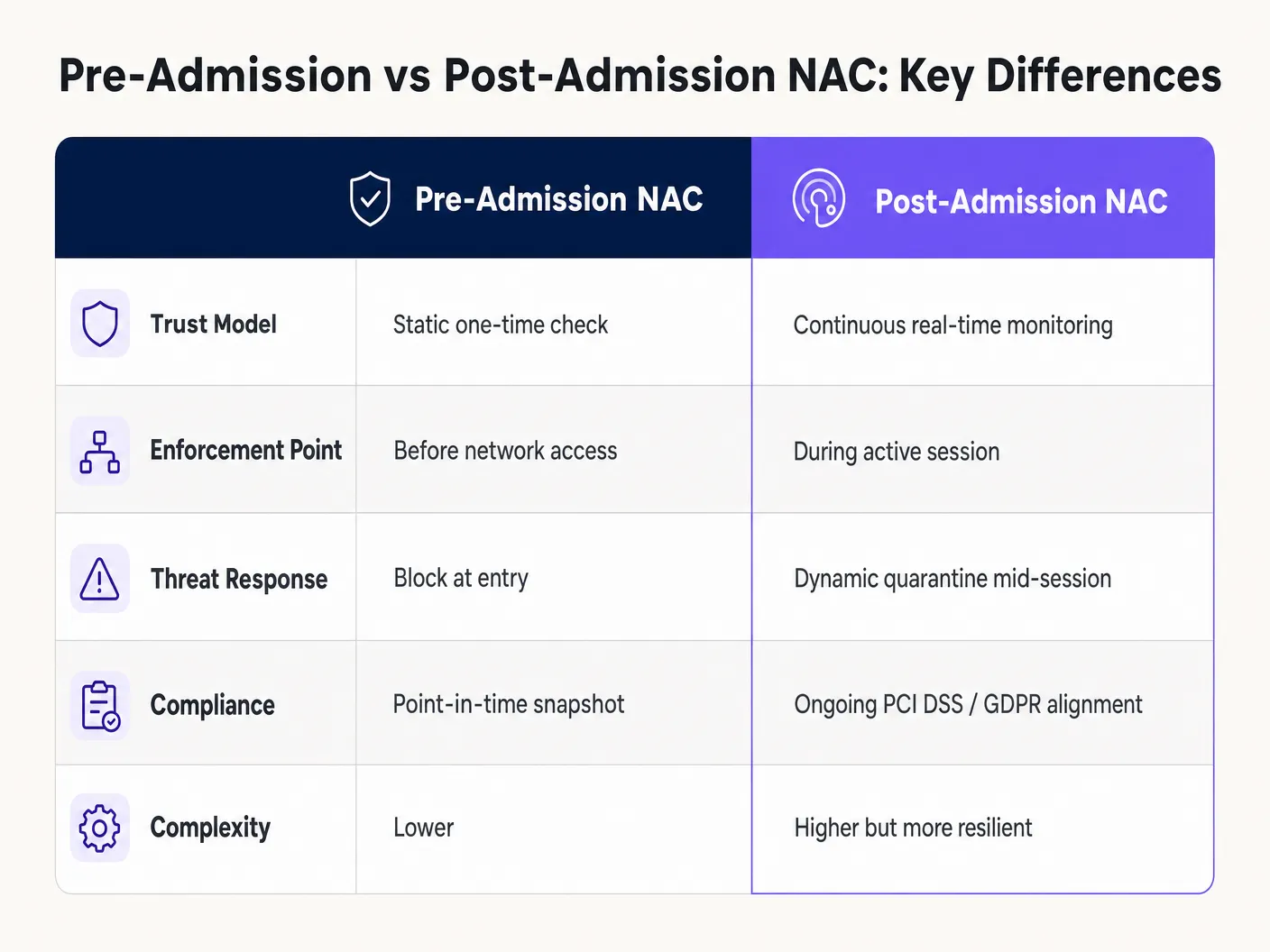
對於高密度環境(旅宿、零售、體育場館和公共部門場域)中的企業網路而言,傳統的准入前網路存取控制(Network Access Control)已不再足夠。靜態、特定時間點的驗證檢查,無法因應在獲得網路存取權限後遭受入侵或表現出惡意行為的裝置。裝置可能在通過 802.1X 策略引擎的乾淨驗證後,在數分鐘後開始掃描內部子網路或外洩資料。
准入後 NAC 將安全範式從「驗證並信任」轉變為持續信任監控。透過針對已建立的行為基準,持續評估裝置狀態、流量模式和工作階段上下文,IT 與網路營運團隊可以使用 RADIUS 授權變更(CoA)在工作階段期間動態執行策略。本指南提供了一個實用且不綁定特定廠商的准入後 NAC 實作藍圖。內容涵蓋架構考量、與 Guest WiFi 和 WiFi Analytics 平台的整合,以及在不影響使用者體驗的情況下降低風險的可行部署策略。
技術深度解析
從准入前到准入後的轉變
傳統 NAC 依賴 IEEE 802.1X、MAC 驗證繞過(MAB)或 Captive Portal,在授予存取權限之前驗證身分和狀態。一旦准入,裝置通常在工作階段期間可以暢行無阻地存取其分配的 VLAN 或微細分。這種模式有一個根本性的缺陷:它將准入視為一個二元的、一次性的事件。然而,威脅情勢並非以此方式運作。
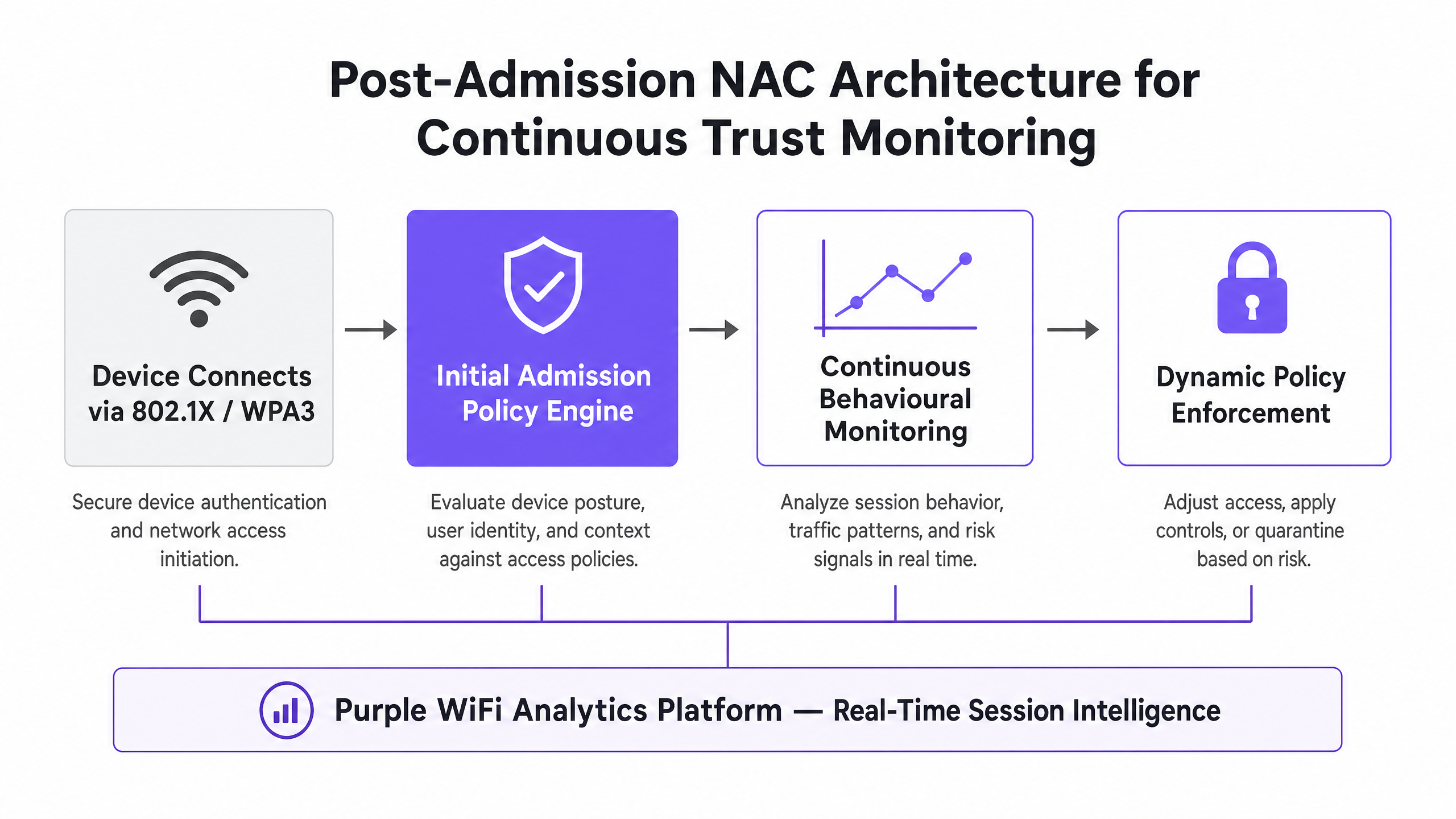
准入後 NAC 引入了動態策略引擎,可持續監控作用中的工作階段。如果裝置開始掃描內部子網路、產生異常流量,或嘗試與已知的命令與控制(C2)伺服器進行通訊,NAC 解決方案會動態更改該裝置的網路權限。這是透過 RADIUS(RFC 5176)的授權變更(CoA)請求、與無線區域網路控制器(WLC)的 API 整合,或與 SD-WAN 架構直接整合來實現的——此主題在 SD WAN vs MPLS: The 2026 Enterprise Network Guide 中有深入探討。
持續信任監控架構的核心元件
生產級的准入後 NAC 部署需要四個整合元件協同運作。
遙測數據攝取 (Telemetry Ingestion) 是基礎。系統必須從 WLC、交換器、防火牆和端點偵測與回應 (EDR) 代理程式中攝取即時數據。這包括 NetFlow/IPFIX 數據、RADIUS 計費記錄、DNS 請求記錄,以及來自深度封包檢測 (DPI) 引擎的應用程式可視性指標。若沒有全面的遙測數據,策略引擎就如同盲目運作。
行為分析引擎 (Behavioural Analytics Engine) 處理遙測數據流,並將其與已建立的基準進行比較。機器學習模型越來越常用於自動化基準建構和異常評分,從而減輕手動設定的負擔。如需深入瞭解 AI 如何改變此領域,請參閱 The Future of Wi-Fi Security: AI-Driven NAC and Threat Detection 及其西班牙語對應版本 El Futuro de la Seguridad Wi-Fi: NAC Impulsado por IA y Detección de Amenazas 。
動態策略執行 (Dynamic Policy Enforcement) 是運作輸出。即時發送 RADIUS CoA 以重啟連接埠、變更 VLAN 分配或套用限制性存取控制清單 (ACL) 的能力,是准入後 NAC 與被動監控系統的區別所在。沒有可靠的 CoA,您擁有的只是警報系統,而非執行系統。
整合層 (Integration Layer) 將 NAC 引擎連接到更廣泛的安全生態系統:用於事件關聯的 SIEM 平台、用於已知惡意 IP 豐富化的威脅情資來源,以及用於使用者上下文豐富化的身分識別提供者。在面向訪客的環境中, WiFi Analytics 平台提供了會話級別的上下文,顯著豐富了策略決策。
標準與協定參考
| 標準 | 與准入後 NAC 的關聯性 |
|---|---|
| IEEE 802.1X | 基於連接埠驗證的基礎;提供 NAC 策略參考的身分綁定 |
| RFC 5176 (RADIUS CoA) | 會話中策略執行的協定機制 |
| WPA3-Enterprise | 為 802.1X 驗證交換提供更強的加密保護 |
| PCI DSS v4.0 | 要求對網路存取進行持續監控並具備自動回應能力 |
| GDPR Article 32 | 授權採取適當的技術措施以確保持續的機密性與完整性 |
| NIST SP 800-207 | 准入後 NAC 直接實作的零信任架構 (Zero Trust Architecture) 框架 |
實作指南
部署准入後 NAC 需要採取分階段的方法,以避免大規模的網路中斷。試圖立即啟用主動執行,是部署失敗最常見的單一原因。
第一階段:可視性與基準建立(第 1-4 週)
在僅監控模式下部署 NAC 解決方案。在此階段不應設定任何強制執行動作。
首先,確保所有網路存取裝置(NAD)都將 RADIUS 計費數據和流量遙測發送到 NAC 策略引擎。在所有託管交換器和 WLC 上設定 NetFlow 或 IPFIX 匯出。在繼續之前,驗證 NAC 引擎是否正確接收並解析記錄。
讓系統觀察不同裝置設定檔的流量模式。這在 醫療保健 環境中尤為關鍵,因為醫療物聯網裝置具有高度可預測的流量模式;在 零售 環境中也是如此,因為銷售點(POS)終端機具有明確定義的通訊需求。基準奠定期間應至少涵蓋一個完整的業務週期(通常為四週),以擷取週末與工作日的差異。
第二階段:策略開發與測試(第 5-6 週)
建立基準後,開發基於風險的策略。根據業務風險而非純粹的技術指標來定義明確的隔離觸發條件。
對於零售環境,關鍵觸發條件可能是:任何來自 Guest VLAN 試圖路由到 POS VLAN 子網路的流量。對於旅宿環境,可能是:任何裝置每分鐘產生超過 500 次 SMB 連線嘗試。對於醫療保健環境:任何透過 MAB 驗證的裝置與其核准目的地清單之外的外部 IP 位址進行通訊。
透過模擬觸發條件,在實驗室環境中測試每項策略。驗證 NAC 引擎是否正確識別異常、產生 CoA 請求,以及 NAD 是否在可接受的時間窗口內(對於關鍵觸發條件,通常在 500 毫秒以內)套用新策略。
第三階段:分階段強制執行部署(第 7-10 週)
首先在低風險的網路區段上啟用主動強制執行。僅限員工使用的物聯網 VLAN 通常是一個很好的起點,因為與訪客或臨床網路相比,誤判對營運的影響有限。
從分階段的強制執行回應開始。與其立即斷開裝置連線,不如套用限制性的 ACL,允許基本的網際網路存取(至核准目的地的 HTTP/HTTPS),但封鎖所有內部路由。這可以減少誤判的影響,同時仍能遏制威脅。每日監控隔離佇列並根據需要調整閾值。
逐步將強制執行擴展到其他區段,並在繼續之前驗證每個區段。確保 RADIUS CoA 運作可靠 — NAC 引擎與所有 NAD 之間的 UDP 連接埠 3799 必須開啟,且共用金鑰必須一致。在 交通運輸 樞紐部署中,網路區段可能跨越多個實體位置,請驗證跨 WAN 連結的 CoA 回應時間。
第四階段:全面上線與持續最佳化
一旦所有區段都處於主動強制執行狀態,請建立持續優化的步調。每週審查隔離事件,識別重複發生的誤報,並相應地調整基準。將 NAC 事件串流與您的 SIEM 整合,以便與端點和周邊安全事件進行交叉關聯。
對於 Hospitality 部署,請考慮季節性的基準調整 —— 處於夏季旺季的飯店網路,其流量模式與 1 月份的同一網路會有實質上的不同。如果不進行更新,靜態基準在尖峰期間會產生較多的誤報。
最佳實踐
盡可能標準化採用 802.1X。 雖然 MAB 對於無周邊的 IoT 裝置是必要的,但 802.1X 提供了更強的密碼學身分綁定。確保在支援的情況下使用 WPA3-Enterprise。瞭解底層的射頻環境至關重要 —— 請參閱 Wi Fi Frequencies: A Guide to Wi-Fi Frequencies in 2026 以確保您的頻譜設計支援持續監控的管理開銷。
利用微分割(Micro-Segmentation)作為輔助控制。 將准入後 NAC 與網路微分割相結合。如果裝置受到危害且 CoA 回應因任何原因而延遲,微分割會將受波及範圍限制在該裝置自身的區段內。這兩種控制措施是互補的,而非多餘。
將強制執行原則與合規指令對齊。 確保為稽核人員記錄您的持續監控和自動化回應程序。PCI DSS v4.0 要求 10 規定必須對存取網路資源的所有行為進行記錄和監控。GDPR 第 32 條要求採取持續的機密性和完整性措施。准入後 NAC 直接滿足這兩項要求,但前提是必須保留稽核軌跡且自動化回應程序已正式記錄成冊。
考慮使用 BLE 進行物理情境強化。 在重視物理存在性的環境中(例如會議中心或零售賣場),整合 BLE 信標數據可以豐富 NAC 原則引擎的情境資訊。與位於公共區域的同一台裝置相比,在網路上通過驗證但物理位置處於限制區域的裝置是更高風險的訊號。請參閱 BLE Low Energy Explained for Enterprise 以獲取實作指南。
疑難排解與風險緩釋
CoA 失敗
在准入後 NAC 部署中,最常見的問題是 NAD 無法處理 RADIUS CoA 請求。症狀包括:NAC 引擎記錄了成功的 CoA 傳輸,但用戶端裝置仍留在網路上且存取權限未變。請透過在 NAD 擷取 UDP 連接埠 3799 的流量來進行診斷。常見原因包括防火牆規則阻擋了 CoA 連接埠、RADIUS 共用金鑰不匹配,或 NAD 的設定中未明確啟用 CoA。在正式上線前,務必在受控的測試中驗證 CoA。
誤報與營運中斷
過度嚴苛的行為基準會導致合法的裝置被隔離。這在旅宿業環境中尤為棘手,因為賓客裝置的行為難以預測——如果基準過於狹窄,串流影音、使用 VPN 以及雲端備份操作都可能觸發異常閾值。請務必採用漸進式的執行方法,並針對經常觸發警報的已知良好裝置維持白名單流程。
規模與吞吐量
持續監控會產生大量的遙測數據。在擁有 10,000 個並行工作階段的體育場或大型會議中心,NAC 策略引擎和記錄基礎架構必須進行擴充,以處理寫入速率,避免遺失記錄。遺失的遙測數據會造成盲點。請根據尖峰並行工作階段數(而非平均值)來規劃基礎架構規模,並在收集器層實作遙測緩衝,以因應突發狀況。
廠商鎖定
某些 NAC 廠商會實作專有的 CoA 擴充功能,這些功能僅能與其自身的硬體生態系統搭配運作。在確定部署架構之前,請確保您的 NAC 策略引擎支援標準的 RFC 5176 CoA,且您的 NAD 已列在廠商測試過的相容性矩陣中。
ROI 與商業影響
實作 Post-Admission NAC 可帶來可衡量的商業價值,其影響範圍遠超安全合規性。
縮短平均回應時間 (MTTR): 自動化隔離將 MTTR 從數小時(在沒有專職 SOC 團隊的環境中甚至需要數天)縮短至毫秒級。對於擁有 500 家分店的零售連鎖店而言,這意味著分店中受駭的裝置在觸及 POS 網路之前就會被圍堵,無論現場是否有網路工程師。
營運效率: 網路營運團隊手動追查受駭裝置的時間顯著減少。自動化隔離與詳細的稽核記錄減輕了調查負擔,並加速了事件後報告的產生。
品牌與營收保護: 在面向公眾的環境中,防止賓客裝置成為更大規模入侵的跳板,能保護場館的商譽。飯店或零售環境中的資料外洩不僅會面臨 GDPR 的法規處罰,還會帶來直接影響營收的重大商譽受損。
降低合規成本: 具有完整稽核軌跡的自動化、持續監控,可降低合規稽核的成本與工作量。向 PCI QSA 證明您的網路具備自動化、即時回應能力,實質上比提交手動流程文件要容易得多。
Definiciones clave
Post-Admission NAC
La monitorización continua y la aplicación dinámica de políticas de seguridad en un dispositivo después de que se le haya concedido el acceso inicial a la red, a diferencia de las comprobaciones previas a la admisión que se realizan únicamente en el momento de la conexión.
Crucial para identificar dispositivos que se ven comprometidos a mitad de la sesión o que muestran un comportamiento malicioso que no era evidente durante la fase de autenticación inicial. Directamente relevante para cualquier entorno con acceso de invitados o dispositivos no gestionados.
Continuous Trust Monitoring
Un modelo de seguridad en el que la confianza nunca se asume de forma permanente; el estado, el comportamiento y el contexto de un dispositivo se evalúan continuamente con respecto a las líneas de base establecidas durante toda la duración de su sesión de red.
La filosofía operativa que sustenta el Post-Admission NAC y una implementación directa de los principios de la Arquitectura Zero Trust de NIST SP 800-207.
Change of Authorization (CoA)
Una extensión de RADIUS definida en RFC 5176 que permite a un servidor de políticas modificar dinámicamente los atributos de autorización de sesión de un cliente de red activo, lo que incluye cambiar la asignación de VLAN, aplicar ACL o finalizar la sesión por completo.
El mecanismo técnico de aplicación que distingue al Post-Admission NAC de la monitorización pasiva. Si el CoA no funciona, el sistema no puede aplicar políticas dinámicas a mitad de la sesión.
Behavioural Baselining
El proceso de establecer un patrón estadísticamente normal de actividad de red para un tipo de dispositivo, rol de usuario o segmento de red específico durante un período de observación definido.
La base de la detección de anomalías en el Post-Admission NAC. Las líneas de base demasiado estrechas generan falsos positivos; las líneas de base demasiado amplias pasan por alto amenazas reales. Normalmente requiere un mínimo de cuatro semanas de observación a lo largo de un ciclo comercial completo.
MAC Authentication Bypass (MAB)
Un método de acceso a la red que concede acceso basándose únicamente en la dirección MAC de un dispositivo, utilizado habitualmente para dispositivos IoT sin interfaz de usuario que no admiten la autenticación 802.1X EAP.
Inherentemente vulnerable a los ataques de suplantación de MAC. El Post-Admission NAC con perfilado de dispositivos es esencial para proteger cualquier entorno que dependa de MAB, especialmente los despliegues de IoT industrial y del sector sanitario.
Network Access Device (NAD)
El componente de hardware físico (normalmente un switch gestionado, un controlador de LAN inalámbrica o una pasarela VPN) que aplica las políticas de acceso en el extremo de la red y recibe instrucciones de CoA del motor de políticas de NAC.
El NAD es el punto de aplicación. Su compatibilidad con RFC 5176 CoA y la fiabilidad de su procesamiento de CoA son factores críticos en cualquier arquitectura de Post-Admission NAC.
Telemetry
La recopilación y transmisión automatizada y en tiempo real de datos operativos de la red (incluidos registros NetFlow/IPFIX, datos de contabilidad RADIUS, eventos de syslog y trampas SNMP) desde los dispositivos de red a un motor de análisis centralizado.
Proporciona el flujo de datos brutos necesario para que funcione el motor de análisis de comportamiento de NAC. Las lagunas en la cobertura de la telemetría crean puntos ciegos donde los dispositivos comprometidos pueden operar sin ser detectados.
Micro-Segmentation
La práctica de arquitectura de red que consiste en dividir una red en segmentos pequeños y aislados con controles de acceso granulares entre ellos, limitando el movimiento lateral de un atacante o de un dispositivo comprometido.
Un control complementario al Post-Admission NAC. Si se retrasa una acción de aplicación de CoA, la microsegmentación limita el radio de impacto de un dispositivo comprometido a su propio segmento, evitando que llegue a activos críticos en segmentos adyacentes.
RADIUS (Remote Authentication Dial-In User Service)
Un protocolo de red que proporciona una gestión centralizada de autenticación, autorización y contabilidad (AAA) para los usuarios que se conectan a un servicio de red y lo utilizan.
El protocolo fundamental tanto para la admisión inicial (Access-Request/Accept) como para la aplicación posterior a la admisión (CoA). La mayoría de los despliegues de NAC empresariales se basan en una infraestructura RADIUS.
Ejemplos prácticos
Una gran cadena minorista que despliega Guest WiFi en 500 ubicaciones necesita garantizar que los dispositivos de invitados comprometidos no puedan escanear ni acceder a la red del Punto de Venta (POS). El equipo de TI dispone de recursos limitados in situ y necesita una solución automatizada y gestionada de forma centralizada. ¿Cómo deberían implementar el NAC Post-Admission?
- Desplegar un motor de políticas NAC alojado en la nube con un colector de telemetría distribuido en cada sucursal, evitando la necesidad de hardware NAC in situ.
- Configurar todos los WLC y switches de las sucursales para enviar registros de contabilidad RADIUS y datos NetFlow al motor NAC central a través de túneles cifrados.
- Definir un periodo de referencia de cuatro semanas que cubra los patrones de tráfico tanto de días laborables como de fines de semana para la VLAN de invitados.
- Crear una política de infracción crítica: si cualquier tráfico de la subred de la VLAN de invitados intenta enrutarse a la subred de la VLAN de POS (definida por rango de IP), el motor NAC emite inmediatamente un CoA RADIUS al WLC local.
- El CoA indica al WLC que aplique una ACL de "Cuarentena" a la dirección MAC del cliente específico, descartando todo el tráfico excepto DHCP y DNS, aislando eficazmente el dispositivo a mitad de sesión.
- Configurar una alerta automatizada al NOC central y registrar el evento en el SIEM para el análisis posterior al incidente.
- Validar la funcionalidad de CoA en 10 sitios piloto antes de implementarla en las 500 ubicaciones.
La red de un hospital cuenta con miles de dispositivos IoT médicos sin interfaz de usuario (headless) que utilizan MAC Authentication Bypass (MAB) para el acceso inicial. Al equipo de seguridad le preocupan los ataques de suplantación de identidad MAC (MAC spoofing) y la incapacidad de detectar dispositivos comprometidos a mitad de sesión. ¿Cómo puede el NAC Post-Admission mitigar estos riesgos?
- Desplegar una solución NAC con capacidades de perfilado de dispositivos que pueda ingerir huellas dactilares DHCP, agentes de usuario HTTP y características de flujo de tráfico.
- Durante la fase de establecimiento de la línea base, crear un perfil para cada tipo de dispositivo: una bomba de infusión se comunica con un servidor interno específico en el puerto 443 a intervalos regulares; un sistema de monitorización de pacientes se comunica con una estación de enfermería en una subred interna específica.
- Configurar políticas de infracción basadas en la desviación del perfil: si un dispositivo autenticado mediante MAB como bomba de infusión comienza a comunicarse con cualquier dirección IP externa, o inicia más de 10 conexiones por minuto a destinos internos no aprobados, activar una cuarentena.
- Emitir un CoA RADIUS al switch para mover el puerto a una VLAN de cuarentena, aislando el dispositivo de la red clínica pero preservando la conectividad para su investigación.
- Alertar simultáneamente al equipo de ingeniería clínica y al SOC, proporcionando la dirección MAC del dispositivo, el puerto del switch y la anomalía de tráfico específica que activó la respuesta.
Preguntas de práctica
Q1. ¿Su equipo de operaciones de red informa que la nueva implementación de NAC Post-Admission está generando un alto volumen de falsos positivos, poniendo en cuarentena dispositivos de invitados legítimos en el concurrido vestíbulo de un hotel. El equipo de atención al cliente está escalando las quejas. ¿Cuál es la acción inmediata más adecuada y qué remediación a largo plazo debería planificar?
Sugerencia: Considere las fases de implementación y las características de tráfico específicas de una red de invitados de hostelería.
Ver respuesta modelo
Revierta inmediatamente la política de aplicación de Cuarentena Activa a Solo Monitorización, o aplique una ACL de aplicación gradual menos restrictiva que limite el enrutamiento interno sin desconectar el dispositivo. Revise las líneas base de comportamiento específicamente para la VLAN de invitados: los entornos de hostelería tienen un tráfico de invitados inherentemente impredecible que incluye el uso de VPN, servicios de streaming y copias de seguridad en la nube. Amplíe el período de establecimiento de la línea base y ensanche los umbrales de anomalía antes de volver a habilitar la aplicación activa. A largo plazo, implemente ajustes estacionales de la línea base y considere un modelo de aplicación por niveles donde los dispositivos de los invitados reciban una respuesta menos agresiva que los dispositivos corporativos o de IoT.
Q2. Durante una implementación piloto, el motor de políticas NAC detecta con éxito un comportamiento anómalo y registra el evento con una puntuación de anomalía de alta confianza, pero el dispositivo cliente permanece en la red con el acceso sin cambios. El NOC recibe la alerta pero no se ha aplicado ninguna acción de cuarentena. ¿Cuál es el fallo técnico más probable y cómo lo diagnostica?
Sugerencia: Piense en el protocolo y puerto específicos utilizados para la aplicación a mitad de sesión.
Ver respuesta modelo
El fallo más probable es que el Cambio de Autorización (CoA) de RADIUS no esté funcionando correctamente entre el motor NAC y el Dispositivo de Acceso a la Red (NAD). Diagnostíquelo capturando el tráfico en el puerto UDP 3799 en el NAD para confirmar si el paquete CoA está llegando. Si llega pero es rechazado, verifique la configuración del secreto compartido de RADIUS tanto en el motor NAC como en el NAD. Si no llega, verifique las reglas del firewall entre el motor NAC y el NAD. Verifique también que CoA esté explícitamente habilitado en la configuración del cliente RADIUS del NAD; muchos dispositivos requieren una declaración de configuración independiente para aceptar solicitudes CoA.
Q3. Un gran centro de conferencias está planificando una implementación de NAC Post-Admission antes de una importante feria comercial con una previsión de 8.000 usuarios de WiFi concurrentes. Al director de TI le preocupa que la infraestructura de telemetría se vea desbordada durante la carga máxima. ¿Cómo debería diseñarse la arquitectura para soportar esta escala?
Sugerencia: Considere la diferencia entre el volumen de telemetría sin procesar y el volumen de eventos procesados, y en qué parte de la arquitectura debe realizarse la agregación.
Ver respuesta modelo
Implemente una arquitectura de telemetría distribuida con colectores locales en cada nivel de la capa de acceso. Los datos brutos de NetFlow y de contabilidad RADIUS deben agregarse y preprocesarse en el colector local antes de enviarse al motor central de políticas NAC. Esto reduce el consumo de ancho de banda de la WAN y la carga de procesamiento en el motor central. Dimensione el motor de políticas central en función de la tasa de eventos procesados, no del volumen de telemetría sin procesar. Implemente el almacenamiento en búfer de telemetría en la capa del colector para gestionar las condiciones de ráfaga durante la carga máxima. Además, considere aplicar muestreo a los datos de NetFlow (por ejemplo, muestreo de 1 de cada 10 paquetes) para la monitorización general del tráfico, reservando la telemetría de tasa completa para los segmentos de dispositivos de alto riesgo. Valide la arquitectura bajo una carga máxima simulada antes del evento.
Q4. El CTO de una empresa de retail pregunta si la implementación de NAC Post-Admission cumplirá con el Requisito 10 de PCI DSS v4.0 y reducirá el alcance de su auditoría anual QSA. ¿Cómo le asesora?
Sugerencia: Considere qué exige específicamente el Requisito 10 de PCI DSS y qué documentación requerirá un QSA.
Ver respuesta modelo
NAC Post-Admission respalda directamente el cumplimiento del Requisito 10 de PCI DSS v4.0 al proporcionar un registro y monitorización automatizados y continuos de todo el acceso a los recursos de red y a los entornos de datos de titulares de tarjetas. La capacidad de cuarentena automatizada demuestra un mecanismo de respuesta en tiempo real, lo que satisface el espíritu del Requisito 10.7 (responder a fallos de controles de seguridad críticos). Sin embargo, para reducir el alcance de la auditoría, el CTO debe asegurarse de que: el registro de eventos de NAC sea a prueba de manipulaciones y se conserve durante al menos 12 meses; los procedimientos de respuesta automatizados estén formalmente documentados; y el QSA pueda revisar las pruebas del sistema funcionando en producción. Es más probable lograr la reducción del alcance mediante la segmentación de la red (aislando el CDE) que solo a través de NAC, pero NAC refuerza significativamente el paquete de pruebas presentado al QSA.
Continúe leyendo esta serie
Staff WiFi vs. Guest WiFi: mejores prácticas para la segmentación de redes corporativas
Una guía técnica completa para líderes de TI sobre cómo segmentar las redes de staff y guest WiFi. Cubre la arquitectura VLAN, la autenticación 802.1X, las políticas de firewall y el impacto empresarial de un diseño de red seguro.
Soluciones de WiFi para apartamentos: una guía completa para empresas
Esta guía cubre la arquitectura, el despliegue y el caso de negocio de las soluciones de WiFi para apartamentos en propiedades de Build to Rent y de múltiples viviendas. Explica cómo la tecnología Identity Pre-Shared Key (iPSK) crea burbujas de red seguras y aisladas para cada residente, a la vez que admite dispositivos inteligentes e IoT. Los promotores inmobiliarios, propietarios y operadores de BTR encontrarán orientación práctica de despliegue, datos de ROI y escenarios de implementación resueltos.
Cox business managed WiFi: a comprehensive guide for businesses
Esta guía detalla cómo los promotores inmobiliarios y los operadores de BTR pueden implementar redes escalables y seguras utilizando Cox Business managed WiFi. Cubre la arquitectura de red, la implementación de hardware independiente del proveedor y el impacto comercial de transformar la conectividad de un dolor de cabeza operativo a una infraestructura confiable.