

Convertir Registros de WiFi para Invitados en Miembros de Programas de Fidelización
Esta guía de referencia técnica describe la arquitectura, la estrategia de datos y los puntos de referencia de conversión necesarios para transformar a los usuarios de WiFi para invitados por primera vez en miembros activos de programas de fidelización. Ofrece una guía de implementación práctica para gerentes de TI y directores de operaciones de recintos para maximizar la inscripción en programas de fidelización mediante el perfilado progresivo y la integración en tiempo real.
🎧 Escuchar esta guía
Ver transcripción

Resumen Ejecutivo
Para los recintos empresariales —desde estadios hasta cadenas hoteleras globales— el WiFi para invitados representa el punto de contacto digital de mayor intención en el entorno físico. Cuando un invitado se conecta a la red, proporciona un identificador verificado y un consentimiento explícito. Sin embargo, muchos recintos tratan esta interacción como un coste de conectividad hundido en lugar de un motor de adquisición de fidelización. Esta guía detalla la arquitectura técnica y la estrategia de datos necesarias para convertir los registros de WiFi para invitados en miembros activos de programas de fidelización. Al abandonar las exportaciones por lotes e implementar integraciones de API en tiempo real con perfilado progresivo, los recintos pueden aumentar las tasas de conversión de WiFi a fidelización desde una base del 10% a más del 30%. Este documento proporciona a los gerentes de TI, arquitectos de red y directores de operaciones el marco de implementación necesario para alcanzar estos puntos de referencia, asegurando el cumplimiento de los estándares globales de privacidad y generando un ROI medible.
Escuche el resumen de audio complementario para una visión estratégica:
Análisis Técnico Detallado
La base de un embudo de fidelización WiFi de alta conversión es la arquitectura del Captive Portal. El enfoque tradicional —donde un invitado completa un formulario largo y los datos se exportan mediante un lote CSV nocturno a un CRM— es fundamentalmente defectuoso. Introduce un retraso de integración de 24 horas, lo que significa que la invitación de fidelización llega mucho después de que haya pasado el momento de máxima intención del invitado.
Las implementaciones modernas utilizan integraciones de webhook o REST API en tiempo real. Cuando un dispositivo se autentica a través del Captive Portal, la plataforma de análisis de WiFi (como WiFi para Invitados ) envía inmediatamente una carga útil de evento al sistema de fidelización. Esta carga útil incluye la dirección de correo electrónico verificada, la dirección MAC del dispositivo (hasheada o anonimizada según la normativa local), el ID del recinto y la marca de tiempo.
Fundamentalmente, esta arquitectura soporta el perfilado progresivo. En lugar de presentar un formulario de registro de diez campos que provoca el abandono, el Captive Portal inicial solicita solo el conjunto de datos mínimo viable: Nombre, Correo electrónico y Consentimiento de Marketing. En visitas posteriores, la red reconoce la dirección MAC recurrente y muestra una página de bienvenida dinámica solicitando una pieza adicional de información, enriqueciendo el perfil con el tiempo sin introducir fricción.
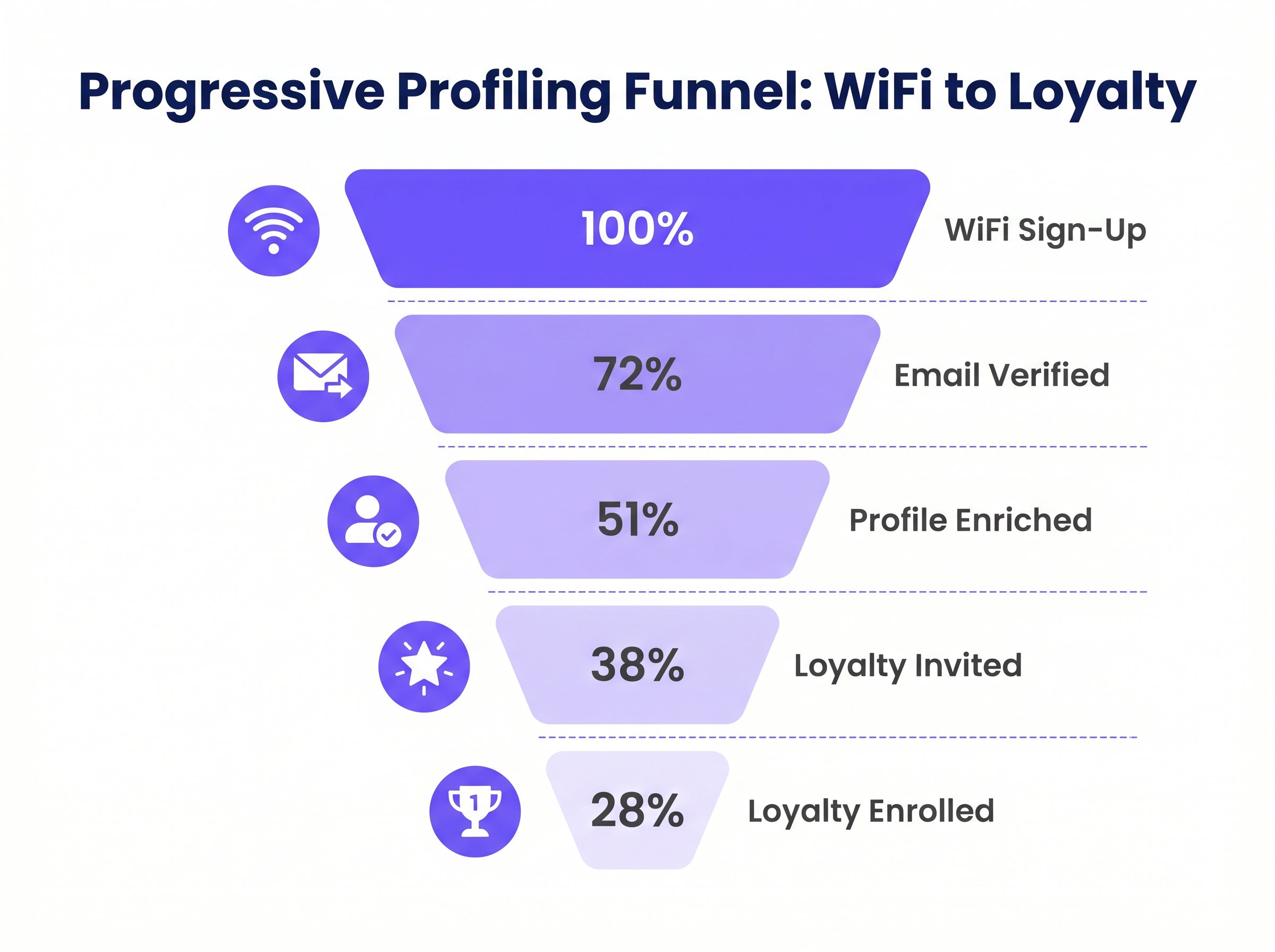
Desde una perspectiva de cumplimiento, esta captura de datos explícita y en tiempo real se alinea perfectamente con los requisitos de GDPR y CCPA. El consentimiento se registra con una marca de tiempo y una dirección IP específicas, proporcionando una sólida pista de auditoría que las listas de datos comprados no pueden igualar. Para obtener más información sobre cómo navegar por estas regulaciones, consulte nuestra guía sobre CCPA vs GDPR: Cumplimiento Global de Privacidad para Datos de WiFi para Invitados .
Guía de Implementación
La implementación de una integración de fidelización WiFi de alta conversión requiere coordinación entre la ingeniería de red y las operaciones de marketing. Siga este marco paso a paso:
- Audite el Flujo de Autenticación: Asegúrese de que sus puntos de acceso y controladores de LAN inalámbrica (WLC) estén configurados para enrutar todo el tráfico no autenticado a un Captive Portal central. Verifique que el portal admita HTTPS y estándares de diseño responsivo modernos.
- Implemente el Perfilado Progresivo: Configure la lógica del Captive Portal para solicitar solo Nombre, Correo electrónico y una casilla de aceptación de marketing distinta y sin marcar durante la primera sesión.
- Establezca la Integración en Tiempo Real: Configure webhooks dentro de su plataforma de análisis de WiFi para enviar datos a su CRM o motor de fidelización inmediatamente después de la autenticación. La carga útil debe incluir el identificador del recinto para permitir mensajes contextualizados.
- Configure Disparadores Basados en Visitas: Dentro del CRM, configure flujos de trabajo automatizados que activen la invitación de fidelización según el tipo de recinto y el número de visitas.
- Habilite la Inscripción sin Fricción: Asegúrese de que el correo electrónico de invitación de fidelización enlace a una página de inscripción optimizada para móviles, de un solo toque, que no requiera que el usuario vuelva a introducir los datos que acaba de proporcionar en el Captive Portal.
Mejores Prácticas
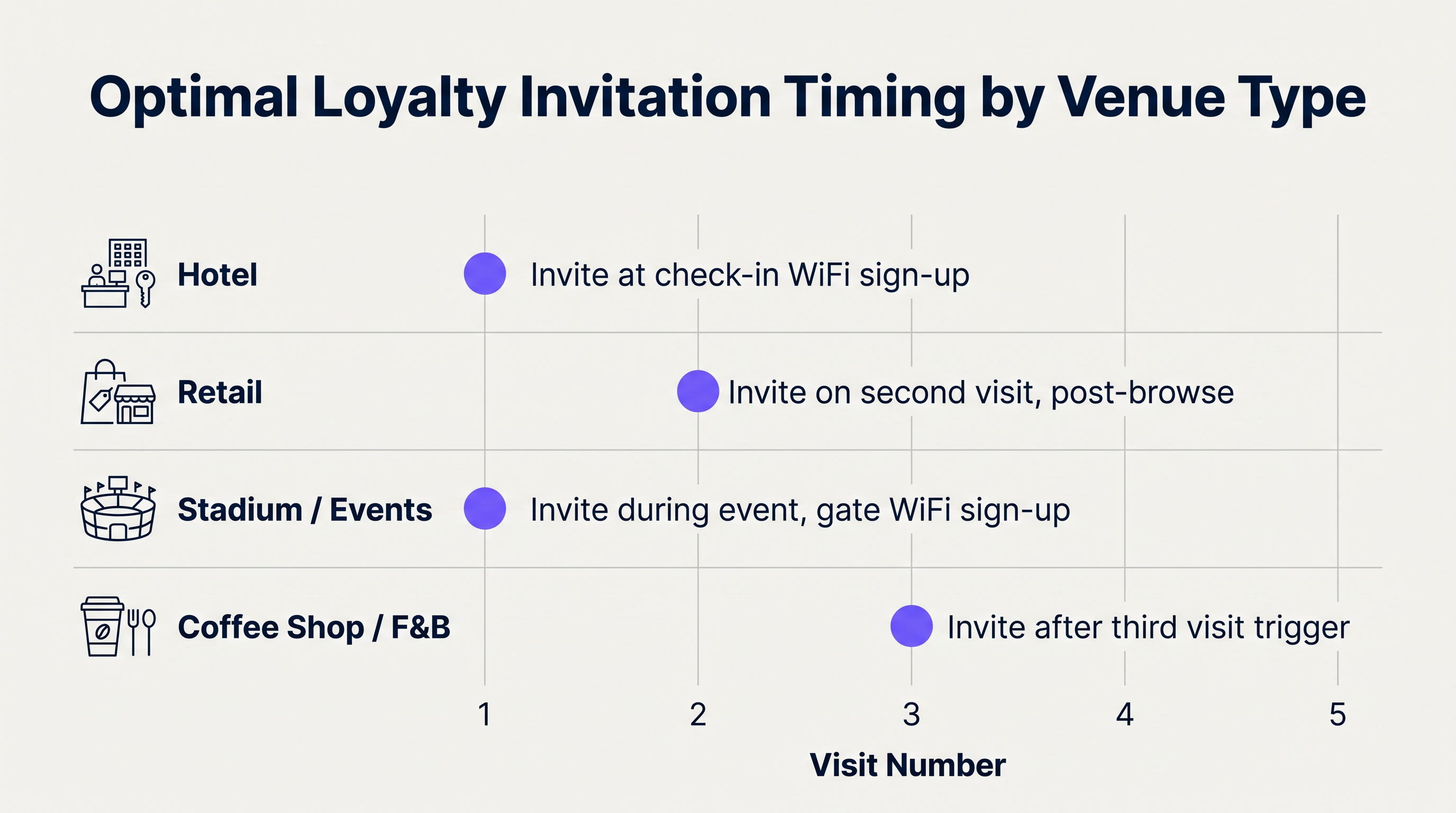
Los datos de referencia de la industria revelan que el momento de la invitación de fidelización es la variable más importante en el éxito de la conversión. El punto de activación óptimo varía significativamente según el tipo de recinto:
- Hostelería: Active la invitación dentro de las dos horas posteriores a la conexión inicial de registro. El huésped está acomodado y muy motivado para ganar puntos por su estancia actual.
- Comercio Minorista: Retrase la invitación hasta la segunda visita. Un visitante primerizo a una tienda minorista aún no ha demostrado afinidad con la marca. Activar el correo electrónico en la segunda conexión WiFi produce tasas de conversión del 28-35%. Para obtener información más amplia sobre implementaciones minoristas, consulte nuestra descripción general del sector Comercio Minorista .
- Estadios y Eventos: Active inmediatamente al conectar. El tiempo de permanencia es corto y el invitado puede visitar solo una vez por temporada. Las notificaciones push en el recinto combinadas con un correo electrónico inmediato ofrecen el mayor rendimiento.
- Alimentos y Bebidas: Active en la tercera visita. Esto establece un patrón de retorno habitual antes de introducir la propuesta de fidelización.
Además, la integración de Orientación y Sensores puede proporcionar datos contextuales adicionales, permitiendo invitaciones de fidelizaciónaciones que se activen cuando un invitado entre en una zona específica del recinto, en lugar de solo en el perímetro.
Resolución de problemas y mitigación de riesgos
Varios modos de fallo comunes pueden descarrilar una implementación de fidelización WiFi:
- La brecha de consentimiento: Capturar una dirección de correo electrónico sin un consentimiento de marketing explícito viola las regulaciones de privacidad. El captive portal debe separar la aceptación de los Términos de Servicio de la suscripción de marketing. Si la suscripción está agrupada o premarcada, la base de datos resultante es legalmente tóxica.
- Fragmentación de perfiles: Un invitado que visita múltiples establecimientos dentro de una cadena puede crear registros duplicados si el CRM carece de una resolución de identidad robusta. El CRM debe desduplicar los registros basándose en la dirección de correo electrónico mientras fusiona las direcciones MAC asociadas en un único perfil unificado.
- El retraso de la integración: Depender de exportaciones por lotes en lugar de APIs en tiempo real significa que las invitaciones llegan demasiado tarde. Si la hoja de ruta de TI no puede soportar la integración de API en tiempo real de inmediato, priorice esto como la deuda técnica más crítica a resolver.
ROI e impacto empresarial
Convertir a un usuario de WiFi invitado en un miembro de fidelización cambia fundamentalmente la economía unitaria de la implementación de la red. Un usuario estándar de WiFi invitado representa una conexión única y anónima. Un miembro de fidelización representa una entidad conocida con un valor de vida útil (LTV) medible.
Al implementar la elaboración de perfiles progresiva y los activadores en tiempo real, los recintos empresariales suelen ver cómo las tasas de conversión de WiFi a fidelización se estabilizan entre el 25% y el 35%. Esta afluencia de datos de primera parte permite a los equipos de marketing reducir la dependencia de costosos canales de adquisición de terceros. Al calcular el impacto empresarial, los líderes de TI deben modelar el LTV de los miembros de fidelización recién adquiridos frente al coste operativo del hardware de red y las licencias de software. Para una metodología detallada, consulte Measuring ROI on Guest WiFi: A Framework for CMOs .
En última instancia, un embudo de fidelización WiFi bien diseñado transforma la red inalámbrica de un centro de costes en un motor principal de retención de clientes e ingresos. A medida que evolucionan las arquitecturas de red, comprender The Core SD WAN Benefits for Modern Businesses también garantizará que la infraestructura subyacente pueda soportar estas aplicaciones en tiempo real y con gran cantidad de datos de forma segura y fiable.
Términos clave y definiciones
Progressive Profiling
The practice of collecting user data incrementally over multiple interactions rather than requesting all information upfront.
Essential for captive portals to minimize friction while still building rich customer profiles over time.
Captive Portal
A web page that a user of a public-access network is obliged to view and interact with before access is granted.
The primary interface for capturing guest data and securing marketing consent.
Webhook
A method of augmenting or altering the behavior of a web page or web application with custom callbacks, providing real-time data transfer.
Used to instantly send guest WiFi authentication data to a CRM, eliminating the delay of batch exports.
Identity Resolution
The process of matching multiple identifiers (like email addresses and MAC addresses) across devices and touchpoints to a single customer profile.
Crucial for preventing duplicate records when a guest visits multiple venues within a brand's portfolio.
MAC Address Anonymization
The process of hashing or encrypting Media Access Control addresses to protect user privacy while still allowing network systems to recognize returning devices.
Required for compliance with strict privacy frameworks like GDPR while enabling progressive profiling.
Zero-Party Data
Data that a customer intentionally and proactively shares with a brand, such as preference center data or purchase intentions.
Guest WiFi sign-ups provide high-quality zero-party data, reducing reliance on deprecated third-party cookies.
Explicit Consent
An unambiguous, affirmative action by a user agreeing to the processing of their personal data for a specific purpose.
Must be captured via an unchecked opt-in box on the captive portal to ensure legal compliance for marketing communications.
Integration Lag
The delay between a user taking an action (like connecting to WiFi) and that data being available in a downstream system (like a CRM).
The primary cause of low conversion rates in legacy WiFi deployments that rely on batch CSV exports.
Casos de éxito
A 200-room boutique hotel currently exports a CSV of guest WiFi sign-ups every Monday morning and uploads it to their email platform. They send a generic 'Join our Loyalty Club' email on Tuesday. Their conversion rate is currently 4%. How should the IT Director re-architect this flow to achieve a 25%+ conversion rate?
- Replace the CSV export with a real-time webhook integration from the WiFi platform to the CRM.
- Redesign the captive portal to use progressive profiling: ask only for Name, Email, and Marketing Consent on the first connection.
- Configure the CRM to trigger the loyalty invitation email exactly 90 minutes after the initial WiFi authentication payload is received.
- Personalize the email copy to reference the specific hotel property and offer an immediate perk (e.g., 'Earn double points on your current stay').
A national retail chain with 500 locations requires users to fill out a 7-field form (Name, Email, Phone, Postcode, Date of Birth, Gender, Preferences) to access the guest WiFi. Only 12% of shoppers complete the form, and of those, only 8% join the loyalty programme. What is the recommended deployment strategy?
- Implement progressive profiling. Reduce the initial captive portal form to just Name, Email, and Marketing Consent.
- Configure the WiFi platform to recognize returning devices (MAC addresses) on subsequent visits.
- On the second visit, serve a dynamic splash page asking for Postcode.
- Trigger the loyalty invitation email only after the second visit, utilizing the behavioral data (return intent) to drive higher engagement.
Análisis de escenarios
Q1. Your marketing team wants to add 'Date of Birth' and 'Favorite Beverage' to the captive portal form for a new coffee shop deployment to personalize loyalty offers immediately. As the IT Director, how do you respond?
💡 Sugerencia:Consider the impact of form length on initial connection rates.
Mostrar enfoque recomendado
Advise against adding these fields to the initial sign-up. Explain that every additional field reduces the completion rate. Recommend implementing progressive profiling: capture Name, Email, and Consent on visit 1 to maximize the top-of-funnel acquisition, then configure the network to ask for 'Favorite Beverage' on visit 2 and 'Date of Birth' on visit 3.
Q2. During an audit, the compliance officer notes that the captive portal currently has a pre-checked box stating 'I agree to the Terms of Service and to receive marketing emails.' What architectural changes are required to mitigate this risk?
💡 Sugerencia:Review the requirements for explicit consent under GDPR.
Mostrar enfoque recomendado
The portal must be re-architected immediately to separate the Terms of Service acceptance from the marketing opt-in. The marketing opt-in must be an explicit, unchecked checkbox. The backend database must also be updated to record the timestamp and IP address specifically associated with the marketing opt-in action, creating a defensible audit trail.
Q3. A stadium client is frustrated that their post-match 'Join our Fan Club' emails, sent the Monday after a weekend game, are only achieving a 5% conversion rate despite capturing 15,000 emails on the guest WiFi. What is the technical solution?
💡 Sugerencia:Analyze the integration lag and the context of the user.
Mostrar enfoque recomendado
The issue is the integration lag; the intent has evaporated by Monday. The technical solution is to replace the batch export process with a real-time API integration. The CRM should be configured to trigger an immediate email or an in-venue push notification while the fan is still connected to the stadium network, capitalizing on the live event experience.
Conclusiones clave
- ✓Guest WiFi is the highest-intent digital touchpoint for physical venues.
- ✓Real-time API integrations are mandatory; batch exports kill conversion rates.
- ✓Progressive profiling (asking for data over multiple visits) dramatically outperforms long registration forms.
- ✓The initial captive portal should only request Name, Email, and Marketing Consent.
- ✓Optimal invitation timing varies by venue: Hotels (Visit 1), Retail (Visit 2), F&B (Visit 3).
- ✓Separating Terms of Service from an unchecked marketing opt-in is critical for compliance.
- ✓Properly executed deployments can achieve 25-35% WiFi-to-loyalty conversion rates.




