

Converter Registos de Guest WiFi em Membros de Programa de Fidelidade
Este guia de referência técnica descreve a arquitetura, a estratégia de dados e os parâmetros de conversão necessários para transformar utilizadores de Guest WiFi pela primeira vez em membros ativos de programas de fidelidade. Fornece orientação de implementação acionável para gestores de TI e diretores de operações de espaços para maximizar a adesão à fidelidade através de perfis progressivos e integração em tempo real.
🎧 Ouça este Guia
Ver Transcrição

Resumo Executivo
Para espaços empresariais — desde estádios a cadeias hoteleiras globais — o Guest WiFi representa o ponto de contacto digital de maior intenção no ambiente físico. Quando um convidado se conecta à rede, fornece um identificador verificado e consentimento explícito. No entanto, muitos espaços tratam esta interação como um custo de conectividade irrecuperável, em vez de um motor de aquisição de fidelidade. Este guia detalha a arquitetura técnica e a estratégia de dados necessárias para converter registos de Guest WiFi em membros ativos de programas de fidelidade. Ao abandonar as exportações em lote e implementar integrações de API em tempo real com perfis progressivos, os espaços podem aumentar as taxas de conversão de WiFi para fidelidade de uma linha de base de 10% para mais de 30%. Este documento fornece a gestores de TI, arquitetos de rede e diretores de operações o quadro de implementação necessário para atingir estes parâmetros, garantindo a conformidade com os padrões globais de privacidade e impulsionando um ROI mensurável.
Ouça o briefing de áudio complementar para uma visão estratégica:
Análise Técnica Detalhada
A base de um funil de fidelidade WiFi de alta conversão é a arquitetura do Captive Portal. A abordagem tradicional — onde um convidado preenche um formulário longo e os dados são exportados através de um lote CSV noturno para um CRM — é fundamentalmente falha. Introduz um atraso de integração de 24 horas, o que significa que o convite de fidelidade chega muito depois de o momento de máxima intenção do convidado ter passado.
As implementações modernas utilizam integrações de webhook ou REST API em tempo real. Quando um dispositivo se autentica através do Captive Portal, a plataforma de análise de WiFi (como Guest WiFi ) envia imediatamente uma carga de evento para o sistema de fidelidade. Esta carga inclui o endereço de e-mail verificado, o endereço MAC do dispositivo (com hash ou anonimizado dependendo da conformidade local), o ID do espaço e o carimbo de data/hora.
Crucialmente, esta arquitetura suporta perfis progressivos. Em vez de apresentar um formulário de registo de dez campos que causa abandono, o Captive Portal inicial solicita apenas o conjunto mínimo de dados viáveis: Nome, E-mail e Consentimento de Marketing. Em visitas subsequentes, a rede reconhece o endereço MAC que retorna e apresenta uma página de entrada dinâmica solicitando uma informação adicional, enriquecendo o perfil ao longo do tempo sem introduzir atrito.
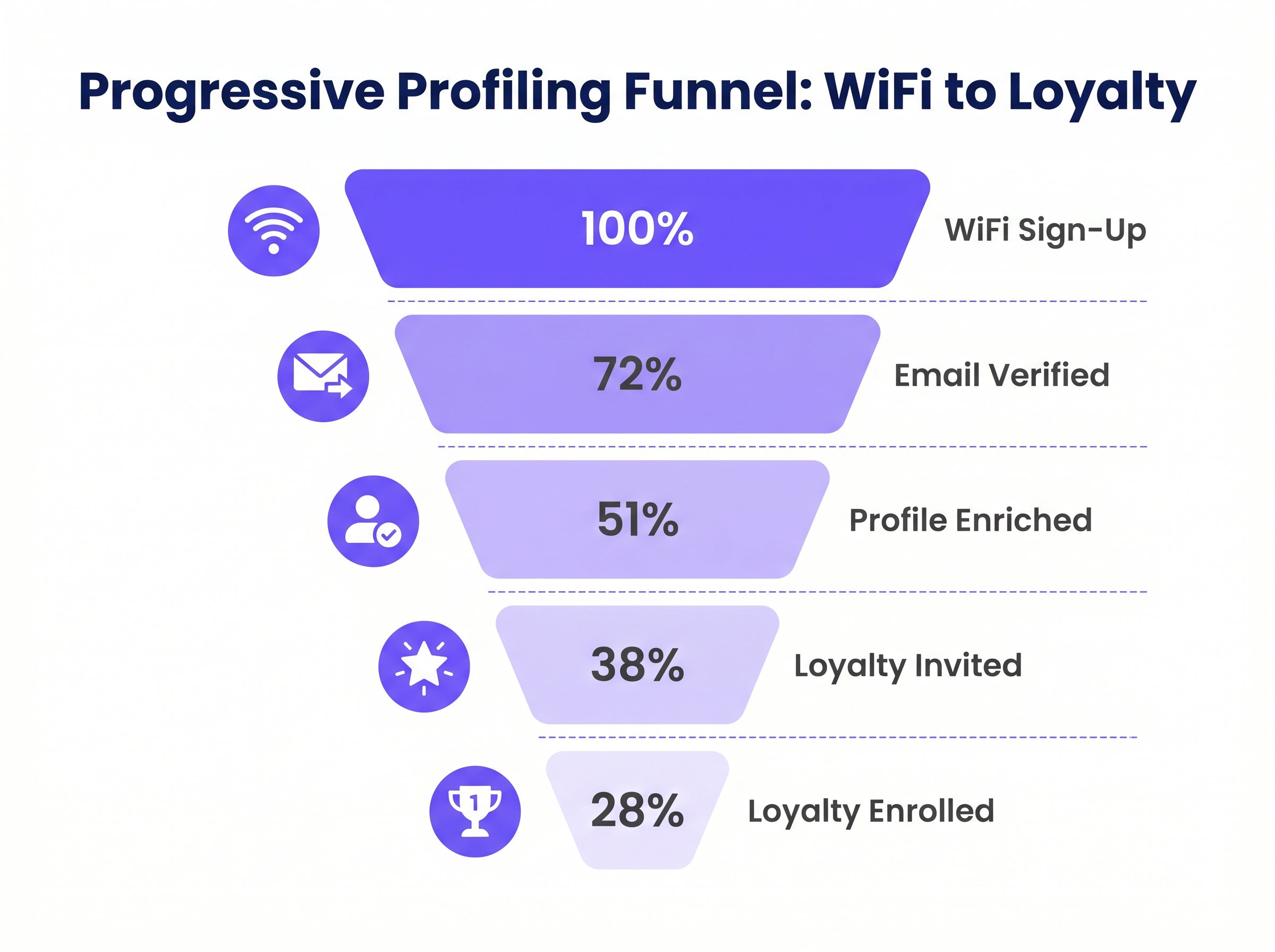
De uma perspetiva de conformidade, esta recolha de dados explícita e em tempo real alinha-se perfeitamente com os requisitos do GDPR e CCPA. O consentimento é registado com um carimbo de data/hora e endereço IP específicos, fornecendo um rasto de auditoria robusto que as listas de dados comprados não conseguem igualar. Para mais informações sobre como navegar nestas regulamentações, consulte o nosso guia sobre CCPA vs GDPR: Conformidade Global de Privacidade para Dados de Guest WiFi .
Guia de Implementação
A implementação de uma integração de fidelidade WiFi de alta conversão requer coordenação entre a engenharia de rede e as operações de marketing. Siga este quadro passo a passo:
- Auditar o Fluxo de Autenticação: Certifique-se de que os seus pontos de acesso e controladores de LAN sem fios (WLCs) estão configurados para encaminhar todo o tráfego não autenticado para um Captive Portal central. Verifique se o portal suporta HTTPS e padrões modernos de design responsivo.
- Implementar Perfis Progressivos: Configure a lógica do Captive Portal para solicitar apenas Nome, E-mail e uma caixa de opt-in distinta e desmarcada para comunicações de marketing durante a primeira sessão.
- Estabelecer Integração em Tempo Real: Configure webhooks na sua plataforma de análise de WiFi para POSTAR dados para o seu CRM ou motor de fidelidade imediatamente após a autenticação. A carga deve incluir o identificador do espaço para permitir mensagens contextualizadas.
- Configurar Acionadores Baseados em Visitas: Dentro do CRM, configure fluxos de trabalho automatizados que acionam o convite de fidelidade com base no tipo de espaço e na contagem de visitas.
- Ativar Inscrição Sem Atrito: Certifique-se de que o e-mail de convite de fidelidade contém um link para uma página de inscrição otimizada para dispositivos móveis, com um único toque, que não exige que o utilizador volte a introduzir os dados que acabou de fornecer no Captive Portal.
Melhores Práticas
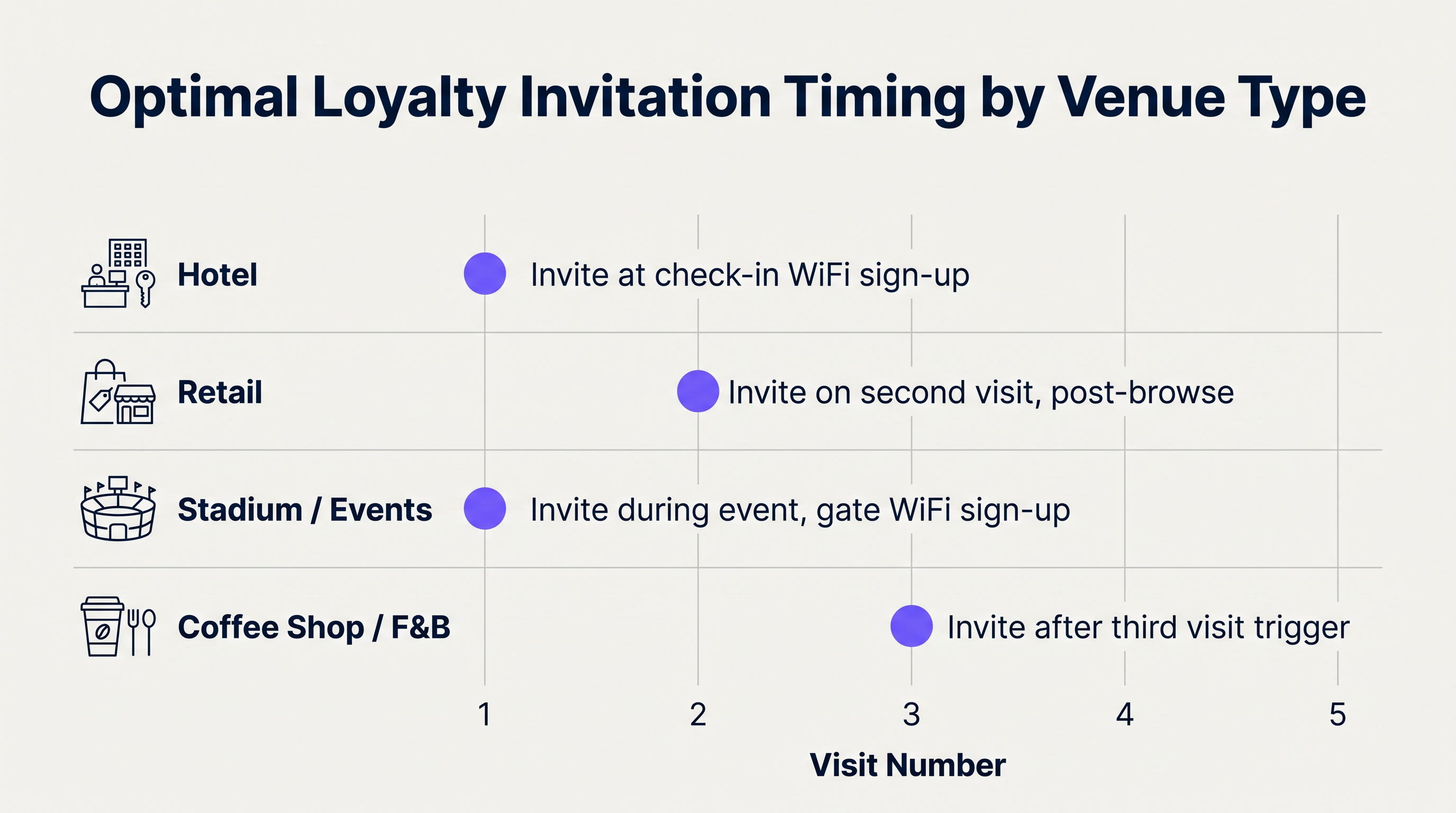
Dados de referência da indústria revelam que o momento do convite de fidelidade é a maior variável única no sucesso da conversão. O ponto de acionamento ideal varia significativamente por tipo de espaço:
- Hotelaria: Acione o convite dentro de duas horas após a conexão inicial de check-in. O hóspede está instalado e altamente motivado para ganhar pontos pela sua estadia atual.
- Retalho: Atrasar o convite até à segunda visita. Um visitante pela primeira vez a uma loja de retalho ainda não demonstrou afinidade com a marca. Acionar o e-mail na segunda conexão WiFi produz taxas de conversão de 28-35%. Para informações mais amplas sobre implementações de retalho, consulte a nossa visão geral do setor de Retalho .
- Estádios e Eventos: Acionar imediatamente após a conexão. O tempo de permanência é curto, e o convidado pode visitar apenas uma vez por temporada. As notificações push no local combinadas com um e-mail imediato oferecem o maior rendimento.
- Alimentação e Bebidas: Acionar na terceira visita. Isso estabelece um padrão de retorno habitual antes de introduzir a proposta de fidelidade.
Além disso, a integração de Wayfinding e Sensors pode fornecer dados contextuais adicionais, permitindo convites de fidelidadeações a serem acionadas quando um convidado entra numa zona específica do local, em vez de apenas no perímetro.
Resolução de Problemas e Mitigação de Riscos
Vários modos de falha comuns podem inviabilizar uma implementação de fidelização por WiFi:
- A Lacuna do Consentimento: Capturar um endereço de e-mail sem consentimento explícito de marketing viola os regulamentos de privacidade. O Captive Portal deve separar a aceitação dos Termos de Serviço da opção de marketing. Se a opção for agrupada ou pré-selecionada, a base de dados resultante é legalmente tóxica.
- Fragmentação de Perfis: Um convidado que visita vários locais dentro de uma cadeia pode criar registos duplicados se o CRM não tiver uma resolução de identidade robusta. O CRM deve desduplicar os registos com base no endereço de e-mail, ao mesmo tempo que funde os endereços MAC associados num único perfil unificado.
- O Atraso da Integração: Confiar em exportações em lote em vez de APIs em tempo real significa que os convites chegam demasiado tarde. Se o roteiro de TI não puder suportar a integração de API em tempo real imediatamente, priorize isto como a dívida técnica mais crítica a resolver.
ROI e Impacto no Negócio
Converter um utilizador de WiFi convidado num membro de fidelidade altera fundamentalmente a economia unitária da implementação da rede. Um utilizador de WiFi convidado padrão representa uma única conexão anonimizada. Um membro de fidelidade representa uma entidade conhecida com valor de vida útil (LTV) mensurável.
Ao implementar perfis progressivos e acionadores em tempo real, os locais empresariais geralmente veem as taxas de conversão de WiFi para fidelidade estabilizarem entre 25% e 35%. Este influxo de dados de primeira parte permite que as equipas de marketing reduzam a dependência de canais de aquisição de terceiros caros. Ao calcular o impacto no negócio, os líderes de TI devem modelar o LTV dos membros de fidelidade recém-adquiridos em relação ao custo operacional do hardware de rede e das licenças de software. Para uma metodologia detalhada, consulte Medir o ROI do WiFi para Convidados: Um Quadro para CMOs .
Em última análise, um funil de fidelização por WiFi bem arquitetado transforma a rede sem fios de um centro de custos num motor primário de retenção de clientes e receita. À medida que as arquiteturas de rede evoluem, compreender Os Principais Benefícios do SD WAN para Empresas Modernas também garantirá que a infraestrutura subjacente pode suportar estas aplicações intensivas em dados e em tempo real de forma segura e fiável.
Termos-Chave e Definições
Progressive Profiling
The practice of collecting user data incrementally over multiple interactions rather than requesting all information upfront.
Essential for captive portals to minimize friction while still building rich customer profiles over time.
Captive Portal
A web page that a user of a public-access network is obliged to view and interact with before access is granted.
The primary interface for capturing guest data and securing marketing consent.
Webhook
A method of augmenting or altering the behavior of a web page or web application with custom callbacks, providing real-time data transfer.
Used to instantly send guest WiFi authentication data to a CRM, eliminating the delay of batch exports.
Identity Resolution
The process of matching multiple identifiers (like email addresses and MAC addresses) across devices and touchpoints to a single customer profile.
Crucial for preventing duplicate records when a guest visits multiple venues within a brand's portfolio.
MAC Address Anonymization
The process of hashing or encrypting Media Access Control addresses to protect user privacy while still allowing network systems to recognize returning devices.
Required for compliance with strict privacy frameworks like GDPR while enabling progressive profiling.
Zero-Party Data
Data that a customer intentionally and proactively shares with a brand, such as preference center data or purchase intentions.
Guest WiFi sign-ups provide high-quality zero-party data, reducing reliance on deprecated third-party cookies.
Explicit Consent
An unambiguous, affirmative action by a user agreeing to the processing of their personal data for a specific purpose.
Must be captured via an unchecked opt-in box on the captive portal to ensure legal compliance for marketing communications.
Integration Lag
The delay between a user taking an action (like connecting to WiFi) and that data being available in a downstream system (like a CRM).
The primary cause of low conversion rates in legacy WiFi deployments that rely on batch CSV exports.
Estudos de Caso
A 200-room boutique hotel currently exports a CSV of guest WiFi sign-ups every Monday morning and uploads it to their email platform. They send a generic 'Join our Loyalty Club' email on Tuesday. Their conversion rate is currently 4%. How should the IT Director re-architect this flow to achieve a 25%+ conversion rate?
- Replace the CSV export with a real-time webhook integration from the WiFi platform to the CRM.
- Redesign the captive portal to use progressive profiling: ask only for Name, Email, and Marketing Consent on the first connection.
- Configure the CRM to trigger the loyalty invitation email exactly 90 minutes after the initial WiFi authentication payload is received.
- Personalize the email copy to reference the specific hotel property and offer an immediate perk (e.g., 'Earn double points on your current stay').
A national retail chain with 500 locations requires users to fill out a 7-field form (Name, Email, Phone, Postcode, Date of Birth, Gender, Preferences) to access the guest WiFi. Only 12% of shoppers complete the form, and of those, only 8% join the loyalty programme. What is the recommended deployment strategy?
- Implement progressive profiling. Reduce the initial captive portal form to just Name, Email, and Marketing Consent.
- Configure the WiFi platform to recognize returning devices (MAC addresses) on subsequent visits.
- On the second visit, serve a dynamic splash page asking for Postcode.
- Trigger the loyalty invitation email only after the second visit, utilizing the behavioral data (return intent) to drive higher engagement.
Análise de Cenários
Q1. Your marketing team wants to add 'Date of Birth' and 'Favorite Beverage' to the captive portal form for a new coffee shop deployment to personalize loyalty offers immediately. As the IT Director, how do you respond?
💡 Dica:Consider the impact of form length on initial connection rates.
Mostrar Abordagem Recomendada
Advise against adding these fields to the initial sign-up. Explain that every additional field reduces the completion rate. Recommend implementing progressive profiling: capture Name, Email, and Consent on visit 1 to maximize the top-of-funnel acquisition, then configure the network to ask for 'Favorite Beverage' on visit 2 and 'Date of Birth' on visit 3.
Q2. During an audit, the compliance officer notes that the captive portal currently has a pre-checked box stating 'I agree to the Terms of Service and to receive marketing emails.' What architectural changes are required to mitigate this risk?
💡 Dica:Review the requirements for explicit consent under GDPR.
Mostrar Abordagem Recomendada
The portal must be re-architected immediately to separate the Terms of Service acceptance from the marketing opt-in. The marketing opt-in must be an explicit, unchecked checkbox. The backend database must also be updated to record the timestamp and IP address specifically associated with the marketing opt-in action, creating a defensible audit trail.
Q3. A stadium client is frustrated that their post-match 'Join our Fan Club' emails, sent the Monday after a weekend game, are only achieving a 5% conversion rate despite capturing 15,000 emails on the guest WiFi. What is the technical solution?
💡 Dica:Analyze the integration lag and the context of the user.
Mostrar Abordagem Recomendada
The issue is the integration lag; the intent has evaporated by Monday. The technical solution is to replace the batch export process with a real-time API integration. The CRM should be configured to trigger an immediate email or an in-venue push notification while the fan is still connected to the stadium network, capitalizing on the live event experience.
Principais Conclusões
- ✓Guest WiFi is the highest-intent digital touchpoint for physical venues.
- ✓Real-time API integrations are mandatory; batch exports kill conversion rates.
- ✓Progressive profiling (asking for data over multiple visits) dramatically outperforms long registration forms.
- ✓The initial captive portal should only request Name, Email, and Marketing Consent.
- ✓Optimal invitation timing varies by venue: Hotels (Visit 1), Retail (Visit 2), F&B (Visit 3).
- ✓Separating Terms of Service from an unchecked marketing opt-in is critical for compliance.
- ✓Properly executed deployments can achieve 25-35% WiFi-to-loyalty conversion rates.




