

Converting Guest WiFi Sign-Ups to Loyalty Programme Members
This technical reference guide outlines the architecture, data strategy, and conversion benchmarks required to move first-time guest WiFi users into active loyalty programme members. It provides actionable deployment guidance for IT managers and venue operations directors to maximise loyalty enrollment through progressive profiling and real-time integration.
🎧 Listen to this Guide
View Transcript
Executive Summary
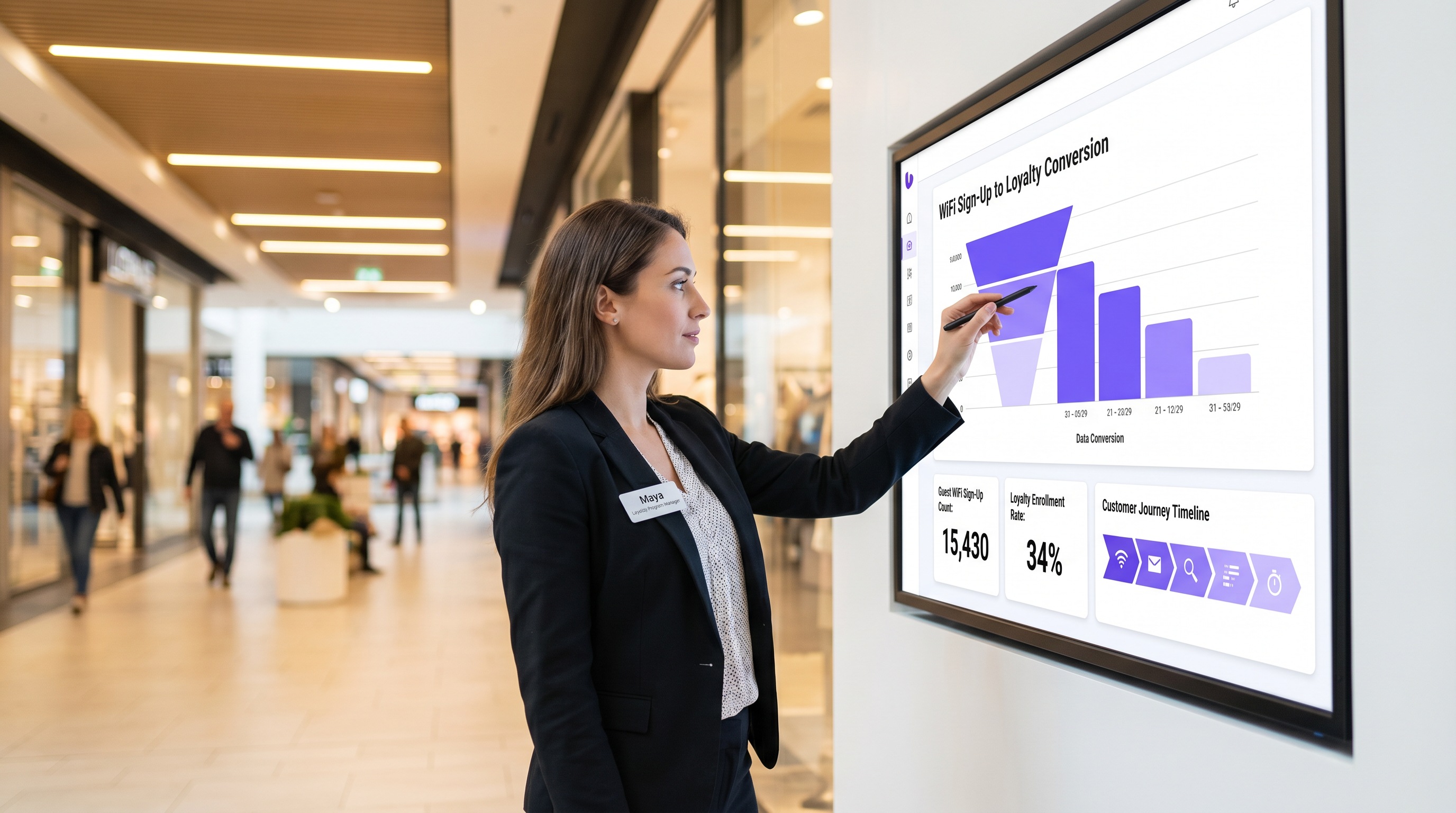
For enterprise venues—from stadiums to global hotel chains—guest WiFi represents the highest-intent digital touchpoint in the physical environment. When a guest connects to the network, they provide a verified identifier and explicit consent. Yet, many venues treat this interaction as a sunk connectivity cost rather than a loyalty acquisition engine. This guide details the technical architecture and data strategy required to convert guest WiFi sign-ups into active loyalty programme members. By moving away from batch exports and implementing real-time API integrations with progressive profiling, venues can increase WiFi-to-loyalty conversion rates from a baseline of 10% to over 30%. This document provides IT managers, network architects, and operations directors with the deployment framework necessary to achieve these benchmarks, ensuring compliance with global privacy standards while driving measurable ROI.
Listen to the companion audio briefing for a strategic overview:
Technical Deep-Dive
The foundation of a high-converting WiFi loyalty funnel is the captive portal architecture. The traditional approach—where a guest completes a long form, and the data is exported via a nightly CSV batch to a CRM—is fundamentally flawed. It introduces a 24-hour integration lag, meaning the loyalty invitation arrives long after the guest's moment of maximum intent has passed.
Modern deployments utilise real-time webhook or REST API integrations. When a device authenticates via the captive portal, the WiFi analytics platform (such as Guest WiFi ) immediately fires an event payload to the loyalty system. This payload includes the verified email address, the device MAC address (hashed or anonymised depending on local compliance), the venue ID, and the timestamp.
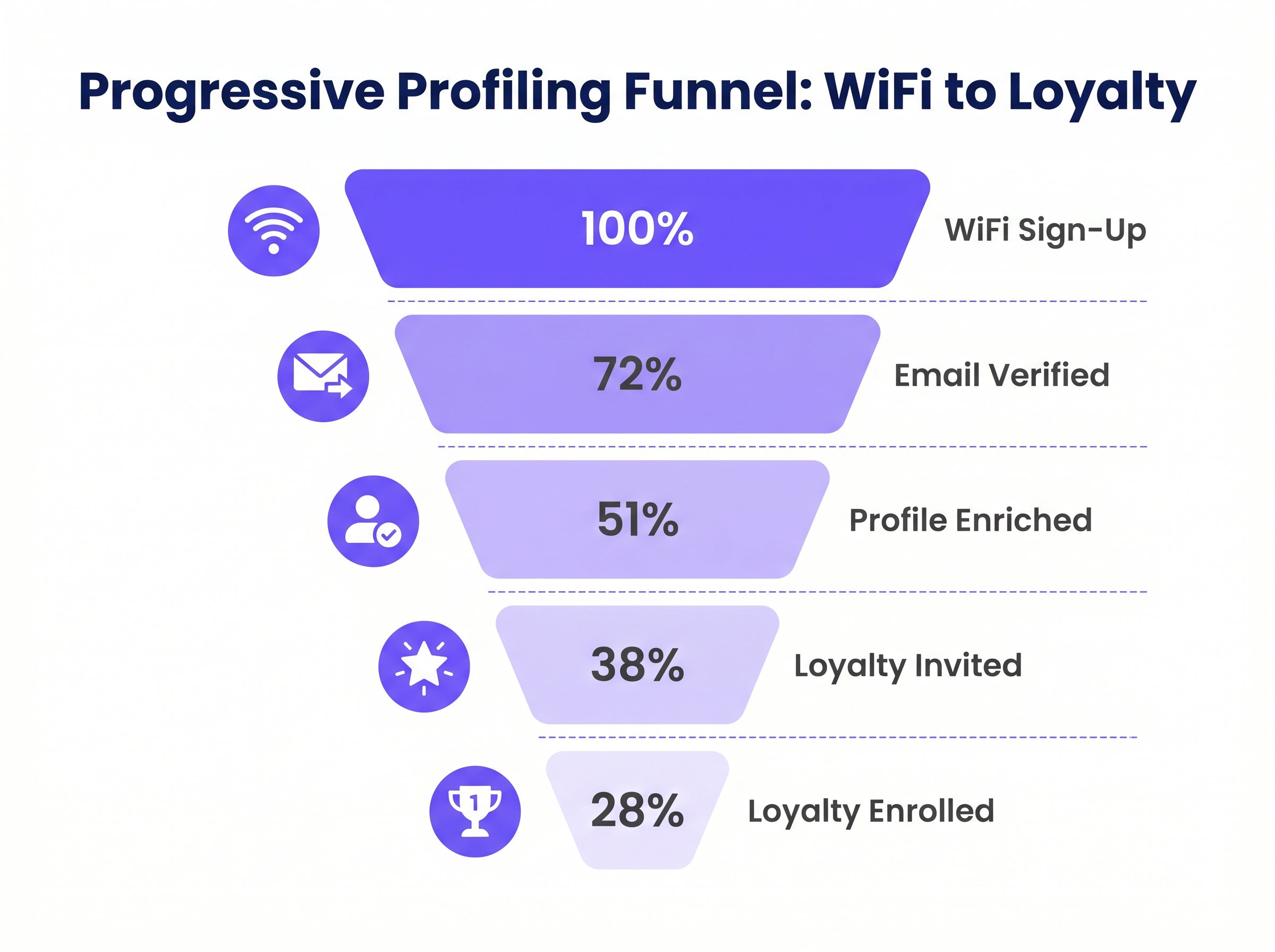
Crucially, this architecture supports progressive profiling. Rather than presenting a ten-field registration form that causes abandonment, the initial captive portal requests only the minimum viable data set: Name, Email, and Marketing Consent. On subsequent visits, the network recognises the returning MAC address and serves a dynamic splash page requesting one additional piece of information, enriching the profile over time without introducing friction.
From a compliance perspective, this real-time, explicit data capture aligns perfectly with GDPR and CCPA requirements. Consent is logged with a specific timestamp and IP address, providing a robust audit trail that purchased data lists cannot match. For more on navigating these regulations, refer to our guide on CCPA vs GDPR: Global Privacy Compliance for Guest WiFi Data .
Implementation Guide
Deploying a high-converting WiFi loyalty integration requires coordination between network engineering and marketing operations. Follow this step-by-step framework:
- Audit the Authentication Flow: Ensure your access points and wireless LAN controllers (WLCs) are configured to route all unauthenticated traffic to a central captive portal. Verify that the portal supports HTTPS and modern responsive design standards.
- Implement Progressive Profiling: Configure the captive portal logic to request only Name, Email, and a distinct, unchecked opt-in box for marketing communications during the first session.
- Establish Real-Time Integration: Configure webhooks within your WiFi analytics platform to POST data to your CRM or loyalty engine immediately upon authentication. The payload must include the venue identifier to allow for contextualised messaging.
- Configure Visit-Based Triggers: Within the CRM, set up automated workflows that trigger the loyalty invitation based on the venue type and visit count.
- Enable Frictionless Enrollment: Ensure the loyalty invitation email links to a one-tap, mobile-optimised enrollment page that does not require the user to re-enter the data they just provided on the captive portal.
Best Practices
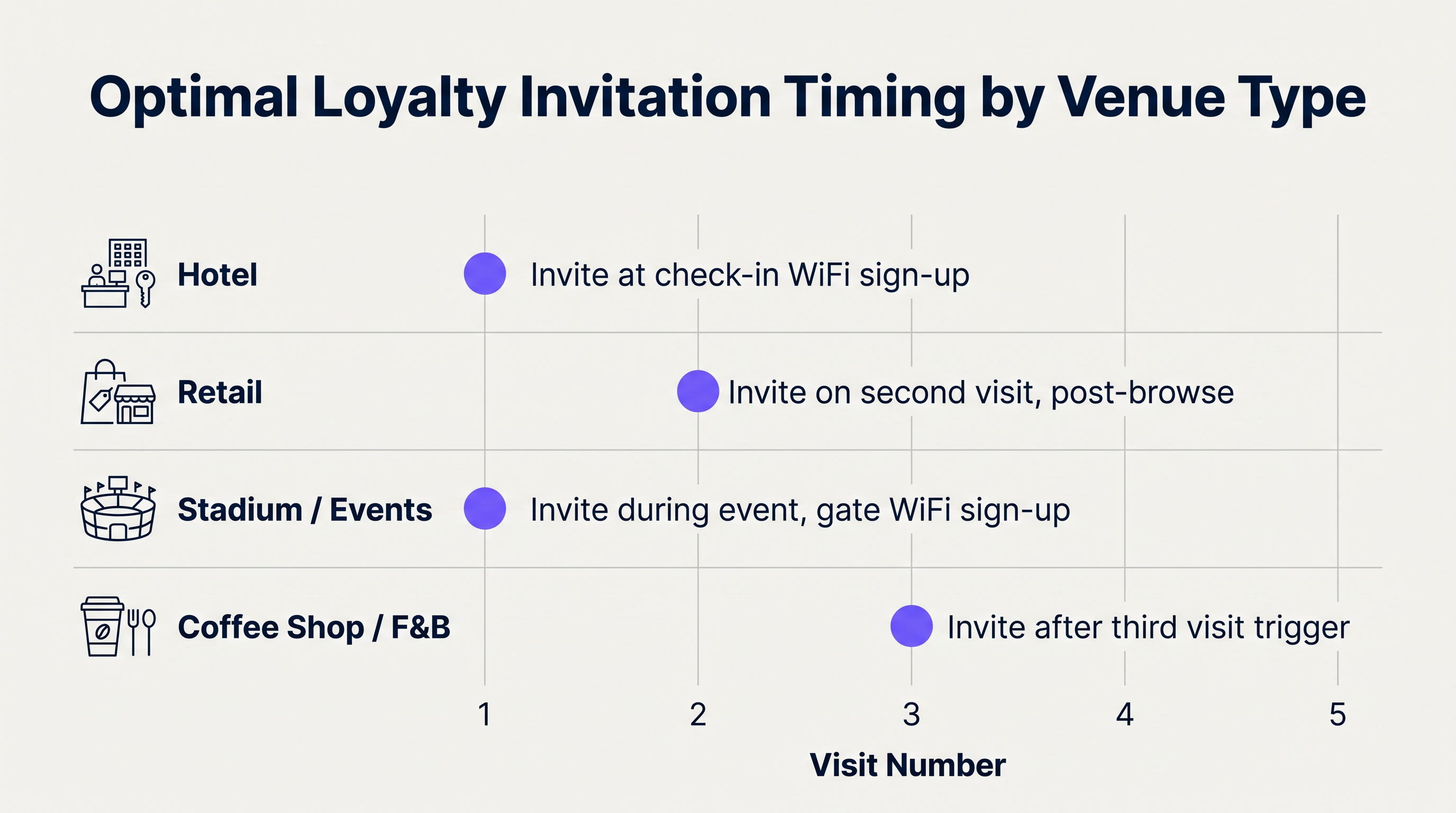
Industry benchmark data reveals that the timing of the loyalty invitation is the single largest variable in conversion success. The optimal trigger point varies significantly by venue type:
- Hospitality: Trigger the invitation within two hours of the initial check-in connection. The guest is settled and highly motivated to earn points for their current stay.
- Retail: Delay the invitation until the second visit. A first-time visitor to a retail store has not yet demonstrated brand affinity. Triggering the email upon the second WiFi connection yields conversion rates of 28-35%. For broader insights into retail deployments, see our Retail sector overview.
- Stadiums and Events: Trigger immediately upon connection. Dwell time is short, and the guest may only visit once a season. In-venue push notifications combined with an immediate email offer the highest yield.
- Food and Beverage: Trigger on the third visit. This establishes a pattern of habitual return before introducing the loyalty proposition.
Furthermore, the integration of Wayfinding and Sensors can provide additional contextual data, allowing loyalty invitations to be triggered when a guest enters a specific zone within the venue, rather than just at the perimeter.
Troubleshooting & Risk Mitigation
Several common failure modes can derail a WiFi loyalty deployment:
- The Consent Gap: Capturing an email address without explicit marketing consent violates privacy regulations. The captive portal must separate the Terms of Service acceptance from the marketing opt-in. If the opt-in is bundled or pre-ticked, the resulting database is legally toxic.
- Profile Fragmentation: A guest visiting multiple venues within a chain may create duplicate records if the CRM lacks robust identity resolution. The CRM must deduplicate records based on the email address while merging the associated MAC addresses into a single unified profile.
- The Integration Lag: Relying on batch exports rather than real-time APIs means invitations arrive too late. If the IT roadmap cannot support real-time API integration immediately, prioritise this as the most critical technical debt to resolve.
ROI & Business Impact
Converting a guest WiFi user to a loyalty member fundamentally changes the unit economics of the network deployment. A standard guest WiFi user represents a single, anonymised connection. A loyalty member represents a known entity with measurable lifetime value (LTV).
By implementing progressive profiling and real-time triggers, enterprise venues typically see WiFi-to-loyalty conversion rates stabilise between 25% and 35%. This influx of zero-party data allows marketing teams to reduce reliance on expensive third-party acquisition channels. When calculating the business impact, IT leaders should model the LTV of the newly acquired loyalty members against the operational cost of the network hardware and software licences. For a detailed methodology, consult Measuring ROI on Guest WiFi: A Framework for CMOs .
Ultimately, a well-architected WiFi loyalty funnel transforms the wireless network from a cost centre into a primary driver of customer retention and revenue. As network architectures evolve, understanding The Core SD WAN Benefits for Modern Businesses will also ensure the underlying infrastructure can support these data-intensive, real-time applications securely and reliably.
Key Terms & Definitions
Progressive Profiling
The practice of collecting user data incrementally over multiple interactions rather than requesting all information upfront.
Essential for captive portals to minimize friction while still building rich customer profiles over time.
Captive Portal
A web page that a user of a public-access network is obliged to view and interact with before access is granted.
The primary interface for capturing guest data and securing marketing consent.
Webhook
A method of augmenting or altering the behavior of a web page or web application with custom callbacks, providing real-time data transfer.
Used to instantly send guest WiFi authentication data to a CRM, eliminating the delay of batch exports.
Identity Resolution
The process of matching multiple identifiers (like email addresses and MAC addresses) across devices and touchpoints to a single customer profile.
Crucial for preventing duplicate records when a guest visits multiple venues within a brand's portfolio.
MAC Address Anonymization
The process of hashing or encrypting Media Access Control addresses to protect user privacy while still allowing network systems to recognize returning devices.
Required for compliance with strict privacy frameworks like GDPR while enabling progressive profiling.
Zero-Party Data
Data that a customer intentionally and proactively shares with a brand, such as preference center data or purchase intentions.
Guest WiFi sign-ups provide high-quality zero-party data, reducing reliance on deprecated third-party cookies.
Explicit Consent
An unambiguous, affirmative action by a user agreeing to the processing of their personal data for a specific purpose.
Must be captured via an unchecked opt-in box on the captive portal to ensure legal compliance for marketing communications.
Integration Lag
The delay between a user taking an action (like connecting to WiFi) and that data being available in a downstream system (like a CRM).
The primary cause of low conversion rates in legacy WiFi deployments that rely on batch CSV exports.
Case Studies
A 200-room boutique hotel currently exports a CSV of guest WiFi sign-ups every Monday morning and uploads it to their email platform. They send a generic 'Join our Loyalty Club' email on Tuesday. Their conversion rate is currently 4%. How should the IT Director re-architect this flow to achieve a 25%+ conversion rate?
- Replace the CSV export with a real-time webhook integration from the WiFi platform to the CRM.
- Redesign the captive portal to use progressive profiling: ask only for Name, Email, and Marketing Consent on the first connection.
- Configure the CRM to trigger the loyalty invitation email exactly 90 minutes after the initial WiFi authentication payload is received.
- Personalize the email copy to reference the specific hotel property and offer an immediate perk (e.g., 'Earn double points on your current stay').
A national retail chain with 500 locations requires users to fill out a 7-field form (Name, Email, Phone, Postcode, Date of Birth, Gender, Preferences) to access the guest WiFi. Only 12% of shoppers complete the form, and of those, only 8% join the loyalty programme. What is the recommended deployment strategy?
- Implement progressive profiling. Reduce the initial captive portal form to just Name, Email, and Marketing Consent.
- Configure the WiFi platform to recognize returning devices (MAC addresses) on subsequent visits.
- On the second visit, serve a dynamic splash page asking for Postcode.
- Trigger the loyalty invitation email only after the second visit, utilizing the behavioral data (return intent) to drive higher engagement.
Scenario Analysis
Q1. Your marketing team wants to add 'Date of Birth' and 'Favorite Beverage' to the captive portal form for a new coffee shop deployment to personalize loyalty offers immediately. As the IT Director, how do you respond?
💡 Hint:Consider the impact of form length on initial connection rates.
Show Recommended Approach
Advise against adding these fields to the initial sign-up. Explain that every additional field reduces the completion rate. Recommend implementing progressive profiling: capture Name, Email, and Consent on visit 1 to maximize the top-of-funnel acquisition, then configure the network to ask for 'Favorite Beverage' on visit 2 and 'Date of Birth' on visit 3.
Q2. During an audit, the compliance officer notes that the captive portal currently has a pre-checked box stating 'I agree to the Terms of Service and to receive marketing emails.' What architectural changes are required to mitigate this risk?
💡 Hint:Review the requirements for explicit consent under GDPR.
Show Recommended Approach
The portal must be re-architected immediately to separate the Terms of Service acceptance from the marketing opt-in. The marketing opt-in must be an explicit, unchecked checkbox. The backend database must also be updated to record the timestamp and IP address specifically associated with the marketing opt-in action, creating a defensible audit trail.
Q3. A stadium client is frustrated that their post-match 'Join our Fan Club' emails, sent the Monday after a weekend game, are only achieving a 5% conversion rate despite capturing 15,000 emails on the guest WiFi. What is the technical solution?
💡 Hint:Analyze the integration lag and the context of the user.
Show Recommended Approach
The issue is the integration lag; the intent has evaporated by Monday. The technical solution is to replace the batch export process with a real-time API integration. The CRM should be configured to trigger an immediate email or an in-venue push notification while the fan is still connected to the stadium network, capitalizing on the live event experience.
Key Takeaways
- ✓Guest WiFi is the highest-intent digital touchpoint for physical venues.
- ✓Real-time API integrations are mandatory; batch exports kill conversion rates.
- ✓Progressive profiling (asking for data over multiple visits) dramatically outperforms long registration forms.
- ✓The initial captive portal should only request Name, Email, and Marketing Consent.
- ✓Optimal invitation timing varies by venue: Hotels (Visit 1), Retail (Visit 2), F&B (Visit 3).
- ✓Separating Terms of Service from an unchecked marketing opt-in is critical for compliance.
- ✓Properly executed deployments can achieve 25-35% WiFi-to-loyalty conversion rates.




