

Konvertierung von Gast-WiFi-Anmeldungen in Mitglieder von Treueprogrammen
Dieser technische Leitfaden beschreibt die Architektur, Datenstrategie und Konvertierungs-Benchmarks, die erforderlich sind, um erstmalige Gast-WiFi-Nutzer in aktive Mitglieder von Treueprogrammen umzuwandeln. Er bietet umsetzbare Implementierungsanleitungen für IT-Manager und Betriebsleiter von Veranstaltungsorten, um die Anmeldung zu Treueprogrammen durch progressives Profiling und Echtzeit-Integration zu maximieren.
🎧 Diesen Leitfaden anhören
Transkript anzeigen
Zusammenfassung für die Geschäftsleitung
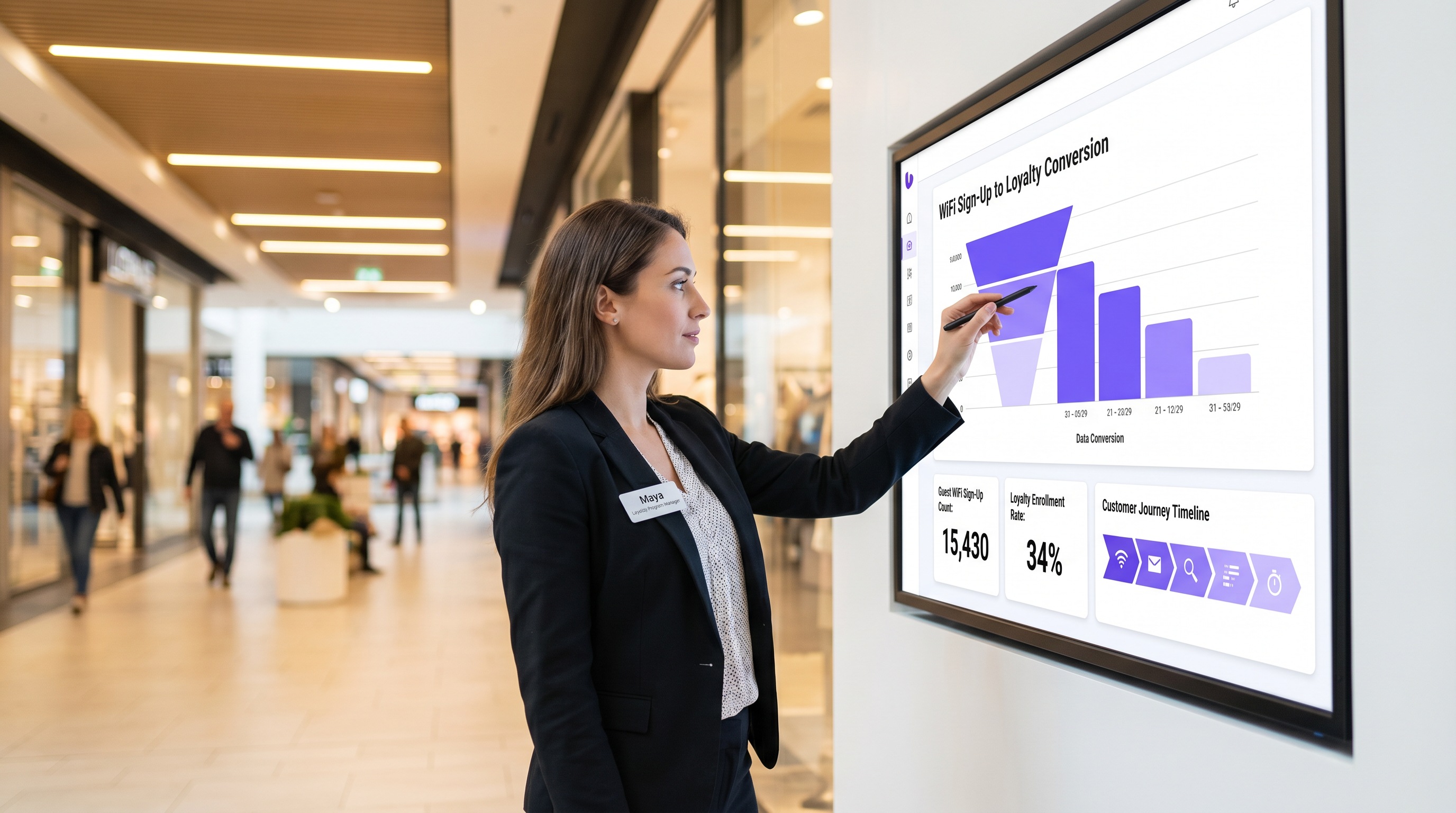
Für Unternehmensstandorte – von Stadien bis hin zu globalen Hotelketten – stellt Gast-WiFi den digitalen Touchpoint mit der höchsten Absicht in der physischen Umgebung dar. Wenn ein Gast sich mit dem Netzwerk verbindet, stellt er einen verifizierten Identifikator und eine explizite Zustimmung bereit. Doch viele Veranstaltungsorte betrachten diese Interaktion als versunkene Konnektivitätskosten statt als Motor für die Kundenbindung. Dieser Leitfaden beschreibt die technische Architektur und Datenstrategie, die erforderlich sind, um Gast-WiFi-Anmeldungen in aktive Mitglieder von Treueprogrammen umzuwandeln. Durch die Abkehr von Batch-Exporten und die Implementierung von Echtzeit-API-Integrationen mit progressivem Profiling können Veranstaltungsorte die WiFi-zu-Loyalität-Konversionsraten von einem Ausgangswert von 10 % auf über 30 % steigern. Dieses Dokument bietet IT-Managern, Netzwerkarchitekten und Betriebsleitern den Implementierungsrahmen, der notwendig ist, um diese Benchmarks zu erreichen und die Einhaltung globaler Datenschutzstandards zu gewährleisten, während gleichzeitig ein messbarer ROI erzielt wird.
Hören Sie sich das begleitende Audio-Briefing für einen strategischen Überblick an:
Technischer Deep-Dive
Die Grundlage eines hochkonvertierenden WiFi-Loyalitätsfunnels ist die Captive Portal-Architektur. Der traditionelle Ansatz – bei dem ein Gast ein langes Formular ausfüllt und die Daten über einen nächtlichen CSV-Batch an ein CRM exportiert werden – ist grundlegend fehlerhaft. Er führt zu einer 24-stündigen Integrationsverzögerung, was bedeutet, dass die Loyalitätseinladung lange nach dem Moment der maximalen Absicht des Gastes eintrifft.
Moderne Implementierungen nutzen Echtzeit-Webhook- oder REST-API-Integrationen. Wenn sich ein Gerät über das Captive Portal authentifiziert, sendet die WiFi-Analyseplattform (wie Guest WiFi ) sofort eine Ereignis-Payload an das Loyalitätssystem. Diese Payload enthält die verifizierte E-Mail-Adresse, die MAC-Adresse des Geräts (gehasht oder anonymisiert je nach lokaler Compliance), die Veranstaltungsort-ID und den Zeitstempel.
Entscheidend ist, dass diese Architektur progressives Profiling unterstützt. Anstatt ein zehn Felder umfassendes Registrierungsformular zu präsentieren, das zu Abbrüchen führt, fordert das anfängliche Captive Portal nur den minimal benötigten Datensatz an: Name, E-Mail und Marketing-Zustimmung. Bei späteren Besuchen erkennt das Netzwerk die zurückkehrende MAC-Adresse und zeigt eine dynamische Splash-Seite an, die eine zusätzliche Information anfordert, wodurch das Profil im Laufe der Zeit angereichert wird, ohne Reibung zu erzeugen.
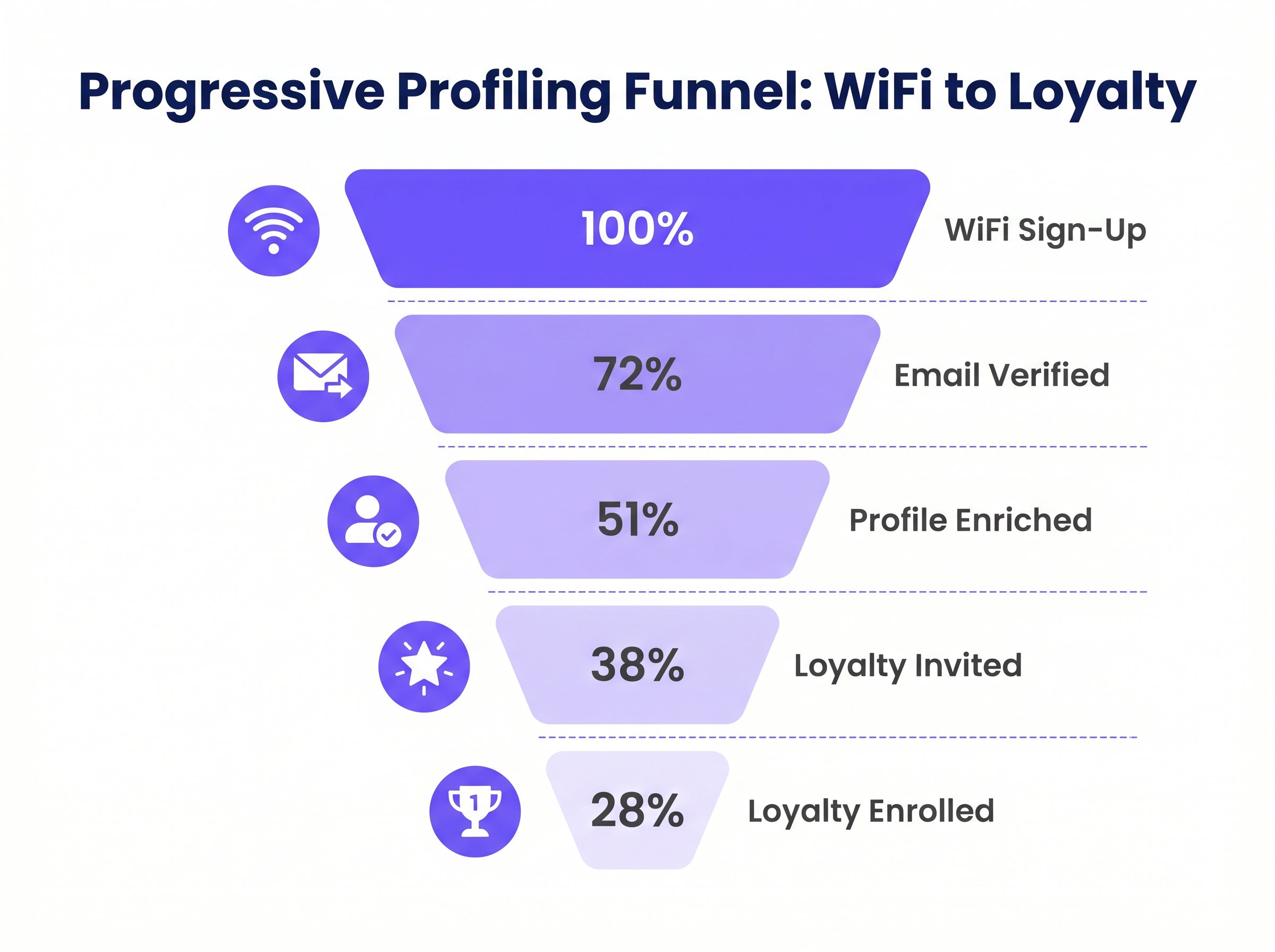
Aus Compliance-Sicht stimmt diese Echtzeit- und explizite Datenerfassung perfekt mit den Anforderungen von GDPR und CCPA überein. Die Zustimmung wird mit einem spezifischen Zeitstempel und einer IP-Adresse protokolliert, was einen robusten Audit-Trail bietet, den gekaufte Datenlisten nicht erreichen können. Weitere Informationen zum Umgang mit diesen Vorschriften finden Sie in unserem Leitfaden zu CCPA vs GDPR: Global Privacy Compliance for Guest WiFi Data .
Implementierungsleitfaden
Die Implementierung einer hochkonvertierenden WiFi-Loyalitätsintegration erfordert die Koordination zwischen Netzwerktechnik und Marketing-Operations. Befolgen Sie dieses Schritt-für-Schritt-Framework:
- Authentifizierungsfluss prüfen: Stellen Sie sicher, dass Ihre Access Points und Wireless LAN Controller (WLCs) so konfiguriert sind, dass der gesamte nicht authentifizierte Datenverkehr an ein zentrales Captive Portal geleitet wird. Verifizieren Sie, dass das Portal HTTPS und moderne responsive Designstandards unterstützt.
- Progressives Profiling implementieren: Konfigurieren Sie die Captive Portal-Logik so, dass während der ersten Sitzung nur Name, E-Mail und ein separates, nicht angekreuztes Opt-in-Feld für Marketingkommunikation angefordert werden.
- Echtzeit-Integration etablieren: Konfigurieren Sie Webhooks innerhalb Ihrer WiFi-Analyseplattform, um Daten sofort nach der Authentifizierung an Ihr CRM oder Ihre Loyalitäts-Engine zu POSTen. Die Payload muss den Veranstaltungsort-Identifikator enthalten, um kontextualisierte Nachrichten zu ermöglichen.
- Besuchsbasierte Trigger konfigurieren: Richten Sie innerhalb des CRM automatisierte Workflows ein, die die Loyalitätseinladung basierend auf dem Veranstaltungsorttyp und der Besucheranzahl auslösen.
- Reibungslose Anmeldung ermöglichen: Stellen Sie sicher, dass die E-Mail mit der Loyalitätseinladung auf eine mobile-optimierte Anmeldeseite mit einem Klick verlinkt, die den Benutzer nicht dazu auffordert, die Daten, die er gerade im Captive Portal angegeben hat, erneut einzugeben.
Best Practices
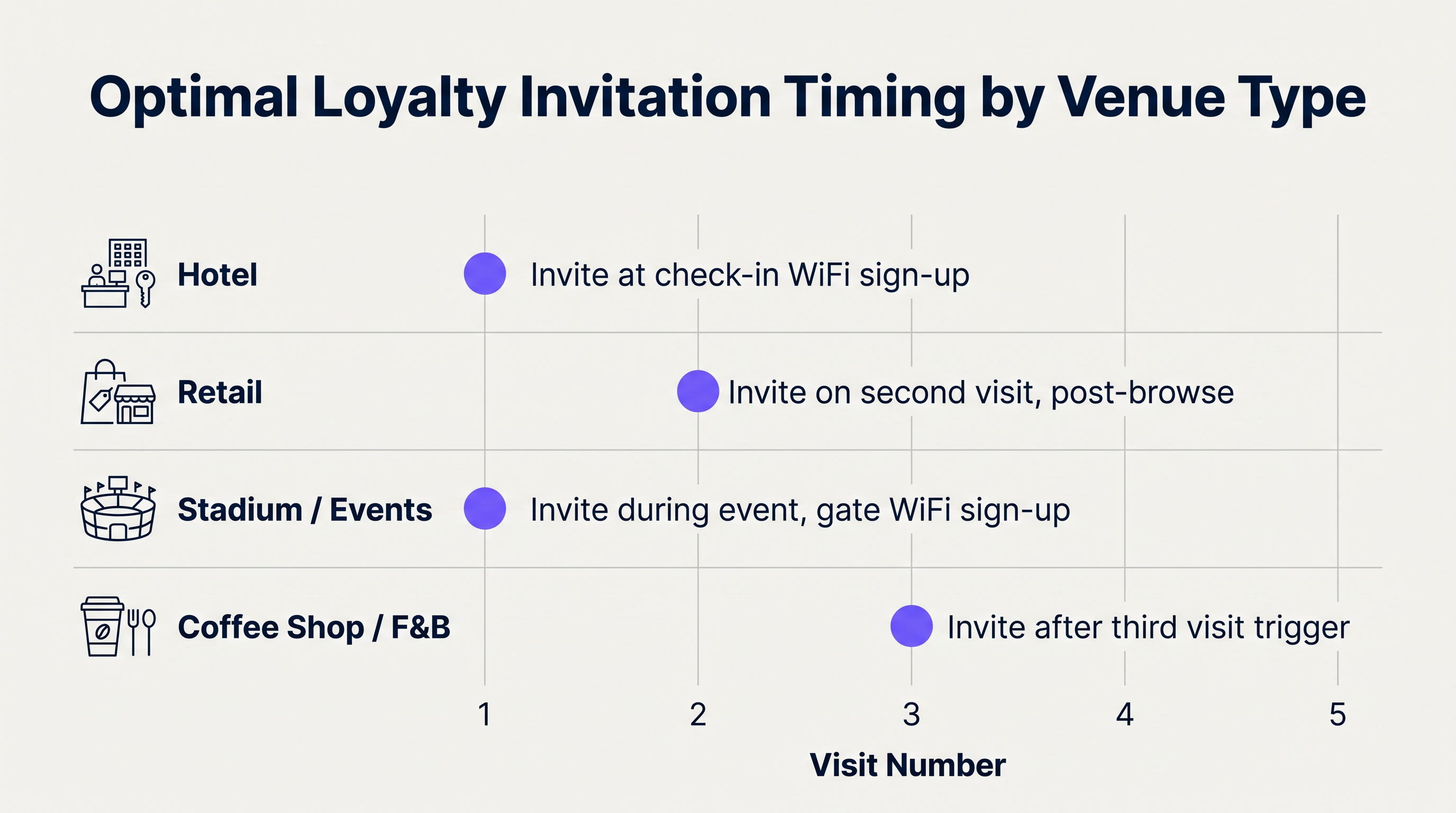
Branchen-Benchmark-Daten zeigen, dass der Zeitpunkt der Loyalitätseinladung die größte einzelne Variable für den Konversionserfolg ist. Der optimale Auslösezeitpunkt variiert erheblich je nach Veranstaltungsorttyp:
- Gastgewerbe: Lösen Sie die Einladung innerhalb von zwei Stunden nach der ersten Check-in-Verbindung aus. Der Gast ist eingelebt und hoch motiviert, Punkte für seinen aktuellen Aufenthalt zu sammeln.
- Einzelhandel: Verzögern Sie die Einladung bis zum zweiten Besuch. Ein erstmaliger Besucher eines Einzelhandelsgeschäfts hat noch keine Markenaffinität gezeigt. Das Auslösen der E-Mail bei der zweiten WiFi-Verbindung führt zu Konversionsraten von 28-35 %. Für umfassendere Einblicke in Einzelhandelsimplementierungen siehe unsere Branchenübersicht Retail .
- Stadien und Veranstaltungen: Sofort bei Verbindung auslösen. Die Verweildauer ist kurz, und der Gast besucht möglicherweise nur einmal pro Saison. Push-Benachrichtigungen am Veranstaltungsort in Kombination mit einer sofortigen E-Mail bieten den höchsten Ertrag.
- Gastronomie: Beim dritten Besuch auslösen. Dies etabliert ein Muster der gewohnheitsmäßigen Rückkehr, bevor das Loyalitätsangebot eingeführt wird.
Darüber hinaus kann die Integration von Wayfinding und Sensors zusätzliche kontextbezogene Daten liefern, die Loyalitätseinladungen ermöglichenAktionen ausgelöst werden, wenn ein Gast einen bestimmten Bereich innerhalb des Veranstaltungsortes betritt, anstatt nur am Perimeter.
Fehlerbehebung & Risikominderung
Mehrere häufige Fehlerquellen können eine WiFi-Loyalty-Implementierung zum Scheitern bringen:
- Die Zustimmungs-Lücke: Das Erfassen einer E-Mail-Adresse ohne explizite Marketing-Zustimmung verstößt gegen Datenschutzbestimmungen. Das Captive Portal muss die Annahme der Nutzungsbedingungen vom Marketing-Opt-in trennen. Wenn das Opt-in gebündelt oder vorab angekreuzt ist, ist die resultierende Datenbank rechtlich bedenklich.
- Profilfragmentierung: Ein Gast, der mehrere Standorte innerhalb einer Kette besucht, kann doppelte Datensätze erzeugen, wenn das CRM keine robuste Identitätsauflösung bietet. Das CRM muss Datensätze basierend auf der E-Mail-Adresse deduplizieren und gleichzeitig die zugehörigen MAC-Adressen in einem einzigen, vereinheitlichten Profil zusammenführen.
- Die Integrationsverzögerung: Das Vertrauen auf Batch-Exporte anstelle von Echtzeit-APIs bedeutet, dass Einladungen zu spät ankommen. Wenn die IT-Roadmap eine sofortige Echtzeit-API-Integration nicht unterstützen kann, sollte dies als die kritischste technische Schuld priorisiert werden, die es zu beheben gilt.
ROI & Geschäftsauswirkungen
Die Umwandlung eines Gast-WiFi-Nutzers in ein Loyalty-Mitglied verändert die Wirtschaftlichkeit der Netzwerkbereitstellung grundlegend. Ein standardmäßiger Gast-WiFi-Nutzer stellt eine einzelne, anonymisierte Verbindung dar. Ein Loyalty-Mitglied repräsentiert eine bekannte Entität mit messbarem Lifetime Value (LTV).
Durch die Implementierung von progressivem Profiling und Echtzeit-Triggern stabilisieren sich die WiFi-zu-Loyalty-Konversionsraten in Unternehmensstandorten typischerweise zwischen 25% und 35%. Dieser Zustrom von Zero-Party-Daten ermöglicht es Marketingteams, die Abhängigkeit von teuren Drittanbieter-Akquisitionskanälen zu reduzieren. Bei der Berechnung der Geschäftsauswirkungen sollten IT-Führungskräfte den LTV der neu gewonnenen Loyalty-Mitglieder den Betriebskosten der Netzwerkhardware und Softwarelizenzen gegenüberstellen. Für eine detaillierte Methodik konsultieren Sie Measuring ROI on Guest WiFi: A Framework for CMOs .
Letztendlich verwandelt ein gut konzipierter WiFi-Loyalty-Funnel das drahtlose Netzwerk von einem Kostenfaktor in einen primären Treiber für Kundenbindung und Umsatz. Da sich Netzwerkarchitekturen weiterentwickeln, wird das Verständnis von The Core SD WAN Benefits for Modern Businesses auch sicherstellen, dass die zugrunde liegende Infrastruktur diese datenintensiven Echtzeit-Anwendungen sicher und zuverlässig unterstützen kann.
Schlüsselbegriffe & Definitionen
Progressive Profiling
The practice of collecting user data incrementally over multiple interactions rather than requesting all information upfront.
Essential for captive portals to minimize friction while still building rich customer profiles over time.
Captive Portal
A web page that a user of a public-access network is obliged to view and interact with before access is granted.
The primary interface for capturing guest data and securing marketing consent.
Webhook
A method of augmenting or altering the behavior of a web page or web application with custom callbacks, providing real-time data transfer.
Used to instantly send guest WiFi authentication data to a CRM, eliminating the delay of batch exports.
Identity Resolution
The process of matching multiple identifiers (like email addresses and MAC addresses) across devices and touchpoints to a single customer profile.
Crucial for preventing duplicate records when a guest visits multiple venues within a brand's portfolio.
MAC Address Anonymization
The process of hashing or encrypting Media Access Control addresses to protect user privacy while still allowing network systems to recognize returning devices.
Required for compliance with strict privacy frameworks like GDPR while enabling progressive profiling.
Zero-Party Data
Data that a customer intentionally and proactively shares with a brand, such as preference center data or purchase intentions.
Guest WiFi sign-ups provide high-quality zero-party data, reducing reliance on deprecated third-party cookies.
Explicit Consent
An unambiguous, affirmative action by a user agreeing to the processing of their personal data for a specific purpose.
Must be captured via an unchecked opt-in box on the captive portal to ensure legal compliance for marketing communications.
Integration Lag
The delay between a user taking an action (like connecting to WiFi) and that data being available in a downstream system (like a CRM).
The primary cause of low conversion rates in legacy WiFi deployments that rely on batch CSV exports.
Fallstudien
A 200-room boutique hotel currently exports a CSV of guest WiFi sign-ups every Monday morning and uploads it to their email platform. They send a generic 'Join our Loyalty Club' email on Tuesday. Their conversion rate is currently 4%. How should the IT Director re-architect this flow to achieve a 25%+ conversion rate?
- Replace the CSV export with a real-time webhook integration from the WiFi platform to the CRM.
- Redesign the captive portal to use progressive profiling: ask only for Name, Email, and Marketing Consent on the first connection.
- Configure the CRM to trigger the loyalty invitation email exactly 90 minutes after the initial WiFi authentication payload is received.
- Personalize the email copy to reference the specific hotel property and offer an immediate perk (e.g., 'Earn double points on your current stay').
A national retail chain with 500 locations requires users to fill out a 7-field form (Name, Email, Phone, Postcode, Date of Birth, Gender, Preferences) to access the guest WiFi. Only 12% of shoppers complete the form, and of those, only 8% join the loyalty programme. What is the recommended deployment strategy?
- Implement progressive profiling. Reduce the initial captive portal form to just Name, Email, and Marketing Consent.
- Configure the WiFi platform to recognize returning devices (MAC addresses) on subsequent visits.
- On the second visit, serve a dynamic splash page asking for Postcode.
- Trigger the loyalty invitation email only after the second visit, utilizing the behavioral data (return intent) to drive higher engagement.
Szenarioanalyse
Q1. Your marketing team wants to add 'Date of Birth' and 'Favorite Beverage' to the captive portal form for a new coffee shop deployment to personalize loyalty offers immediately. As the IT Director, how do you respond?
💡 Hinweis:Consider the impact of form length on initial connection rates.
Empfohlenen Ansatz anzeigen
Advise against adding these fields to the initial sign-up. Explain that every additional field reduces the completion rate. Recommend implementing progressive profiling: capture Name, Email, and Consent on visit 1 to maximize the top-of-funnel acquisition, then configure the network to ask for 'Favorite Beverage' on visit 2 and 'Date of Birth' on visit 3.
Q2. During an audit, the compliance officer notes that the captive portal currently has a pre-checked box stating 'I agree to the Terms of Service and to receive marketing emails.' What architectural changes are required to mitigate this risk?
💡 Hinweis:Review the requirements for explicit consent under GDPR.
Empfohlenen Ansatz anzeigen
The portal must be re-architected immediately to separate the Terms of Service acceptance from the marketing opt-in. The marketing opt-in must be an explicit, unchecked checkbox. The backend database must also be updated to record the timestamp and IP address specifically associated with the marketing opt-in action, creating a defensible audit trail.
Q3. A stadium client is frustrated that their post-match 'Join our Fan Club' emails, sent the Monday after a weekend game, are only achieving a 5% conversion rate despite capturing 15,000 emails on the guest WiFi. What is the technical solution?
💡 Hinweis:Analyze the integration lag and the context of the user.
Empfohlenen Ansatz anzeigen
The issue is the integration lag; the intent has evaporated by Monday. The technical solution is to replace the batch export process with a real-time API integration. The CRM should be configured to trigger an immediate email or an in-venue push notification while the fan is still connected to the stadium network, capitalizing on the live event experience.
Wichtigste Erkenntnisse
- ✓Guest WiFi is the highest-intent digital touchpoint for physical venues.
- ✓Real-time API integrations are mandatory; batch exports kill conversion rates.
- ✓Progressive profiling (asking for data over multiple visits) dramatically outperforms long registration forms.
- ✓The initial captive portal should only request Name, Email, and Marketing Consent.
- ✓Optimal invitation timing varies by venue: Hotels (Visit 1), Retail (Visit 2), F&B (Visit 3).
- ✓Separating Terms of Service from an unchecked marketing opt-in is critical for compliance.
- ✓Properly executed deployments can achieve 25-35% WiFi-to-loyalty conversion rates.




