

Convertir les Inscriptions WiFi Invité en Membres de Programme de Fidélité
Ce guide de référence technique décrit l'architecture, la stratégie de données et les repères de conversion nécessaires pour transformer les utilisateurs WiFi invités pour la première fois en membres actifs de programmes de fidélité. Il fournit des conseils de déploiement exploitables pour les responsables informatiques et les directeurs des opérations de site afin de maximiser l'inscription à la fidélité grâce au profilage progressif et à l'intégration en temps réel.
🎧 Écouter ce guide
Voir la transcription
Résumé Exécutif
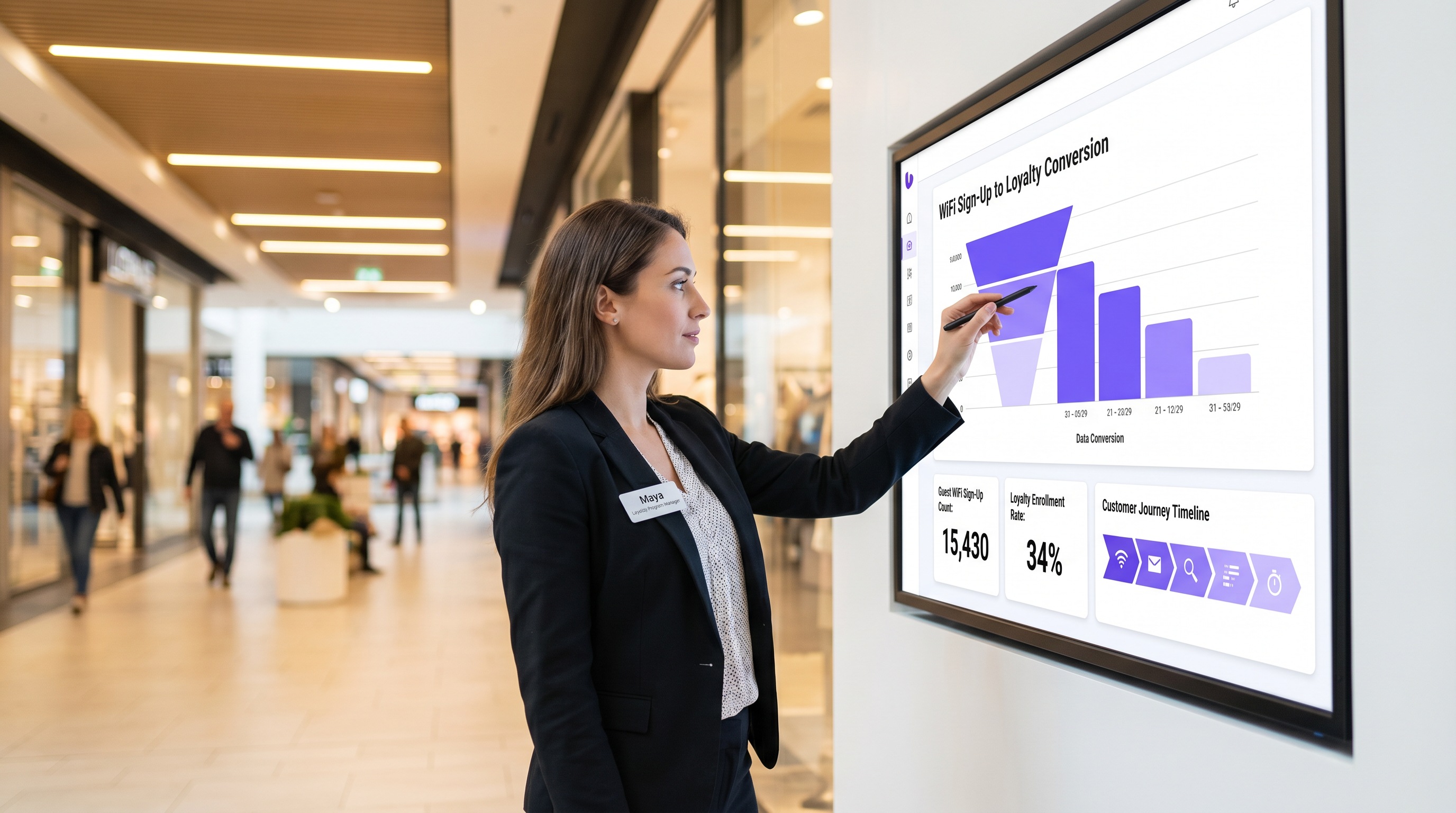
Pour les sites d'entreprise – des stades aux chaînes hôtelières mondiales – le WiFi invité représente le point de contact numérique le plus intentionnel dans l'environnement physique. Lorsqu'un invité se connecte au réseau, il fournit un identifiant vérifié et un consentement explicite. Pourtant, de nombreux sites traitent cette interaction comme un coût de connectivité irrécupérable plutôt que comme un moteur d'acquisition de fidélité. Ce guide détaille l'architecture technique et la stratégie de données requises pour convertir les inscriptions au WiFi invité en membres actifs de programmes de fidélité. En abandonnant les exportations par lots et en mettant en œuvre des intégrations API en temps réel avec un profilage progressif, les sites peuvent augmenter les taux de conversion WiFi-vers-fidélité d'une base de 10 % à plus de 30 %. Ce document fournit aux responsables informatiques, aux architectes réseau et aux directeurs des opérations le cadre de déploiement nécessaire pour atteindre ces repères, garantissant la conformité aux normes mondiales de confidentialité tout en générant un ROI mesurable.
Écoutez le briefing audio complémentaire pour un aperçu stratégique :
Approfondissement Technique
La base d'un entonnoir de fidélité WiFi à forte conversion est l'architecture du Captive Portal. L'approche traditionnelle – où un invité remplit un long formulaire et les données sont exportées via un lot CSV nocturne vers un CRM – est fondamentalement imparfaite. Elle introduit un décalage d'intégration de 24 heures, ce qui signifie que l'invitation à la fidélité arrive longtemps après que le moment d'intention maximale de l'invité soit passé.
Les déploiements modernes utilisent des intégrations de webhook ou d'API REST en temps réel. Lorsqu'un appareil s'authentifie via le Captive Portal, la plateforme d'analyse WiFi (telle que Guest WiFi ) envoie immédiatement une charge utile d'événement au système de fidélité. Cette charge utile comprend l'adresse e-mail vérifiée, l'adresse MAC de l'appareil (hachée ou anonymisée selon la conformité locale), l'ID du site et l'horodatage.
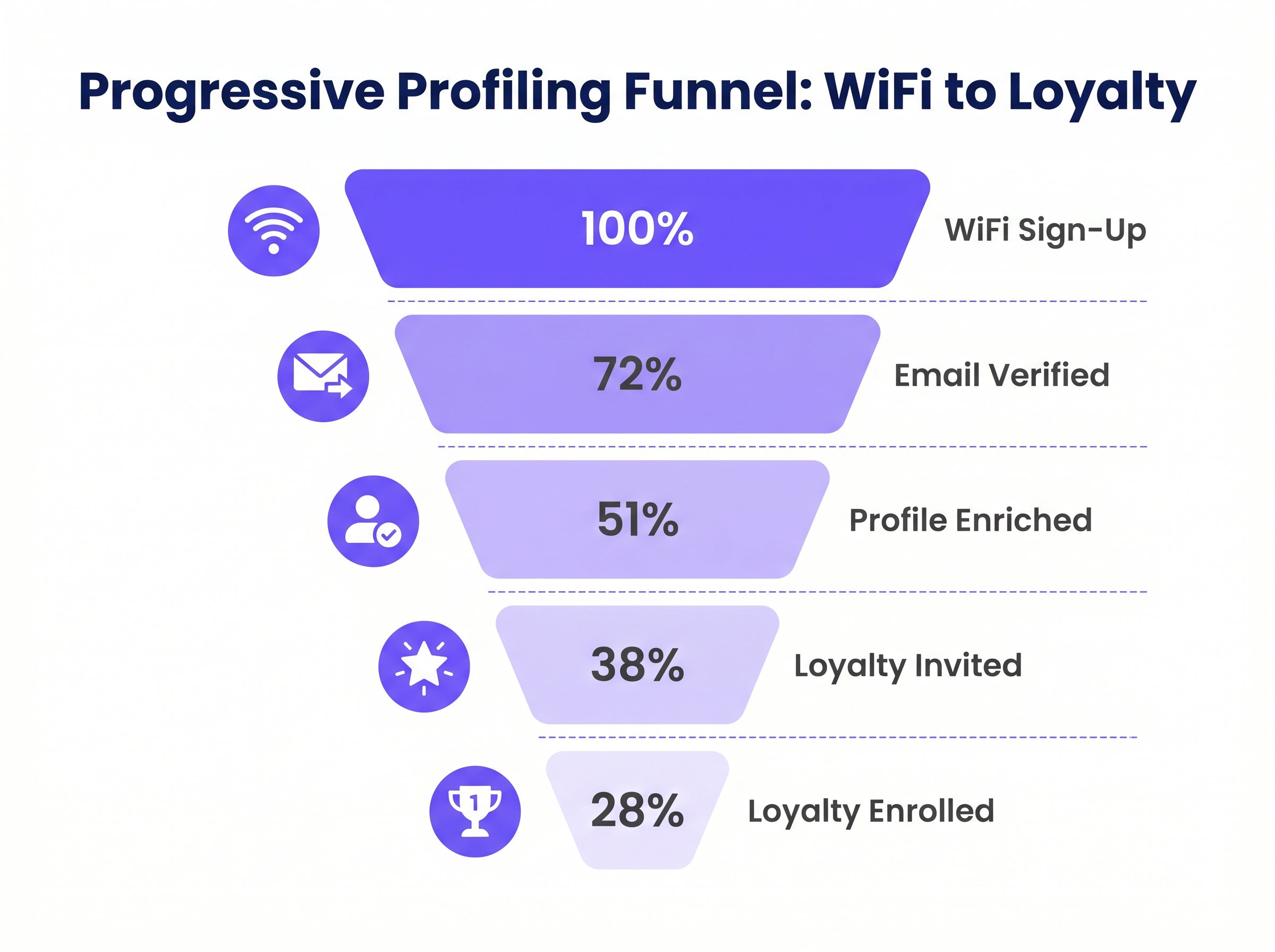
De manière cruciale, cette architecture prend en charge le profilage progressif. Plutôt que de présenter un formulaire d'inscription à dix champs qui provoque l'abandon, le Captive Portal initial ne demande que l'ensemble de données minimal viable : Nom, E-mail et Consentement Marketing. Lors des visites ultérieures, le réseau reconnaît l'adresse MAC de retour et affiche une page de démarrage dynamique demandant une information supplémentaire, enrichissant le profil au fil du temps sans introduire de friction.
Du point de vue de la conformité, cette capture de données explicite et en temps réel s'aligne parfaitement avec les exigences du GDPR et du CCPA. Le consentement est enregistré avec un horodatage et une adresse IP spécifiques, fournissant une piste d'audit robuste que les listes de données achetées ne peuvent égaler. Pour en savoir plus sur la navigation dans ces réglementations, consultez notre guide sur CCPA vs GDPR: Global Privacy Compliance for Guest WiFi Data .
Guide d'Implémentation
Le déploiement d'une intégration de fidélité WiFi à forte conversion nécessite une coordination entre l'ingénierie réseau et les opérations marketing. Suivez ce cadre étape par étape :
- Auditez le Flux d'Authentification : Assurez-vous que vos points d'accès et contrôleurs de réseau local sans fil (WLCs) sont configurés pour acheminer tout le trafic non authentifié vers un Captive Portal central. Vérifiez que le portail prend en charge HTTPS et les normes modernes de conception réactive.
- Implémentez le Profilage Progressif : Configurez la logique du Captive Portal pour ne demander que le Nom, l'E-mail et une case d'option distincte et non cochée pour les communications marketing lors de la première session.
- Établissez une Intégration en Temps Réel : Configurez des webhooks au sein de votre plateforme d'analyse WiFi pour POSTER les données à votre CRM ou moteur de fidélité immédiatement après l'authentification. La charge utile doit inclure l'identifiant du site pour permettre une messagerie contextualisée.
- Configurez les Déclencheurs Basés sur les Visites : Dans le CRM, configurez des flux de travail automatisés qui déclenchent l'invitation à la fidélité en fonction du type de site et du nombre de visites.
- Activez l'Inscription Sans Friction : Assurez-vous que l'e-mail d'invitation à la fidélité renvoie à une page d'inscription optimisée pour les mobiles, en un seul clic, qui ne nécessite pas que l'utilisateur ressaisisse les données qu'il vient de fournir sur le Captive Portal.
Bonnes Pratiques
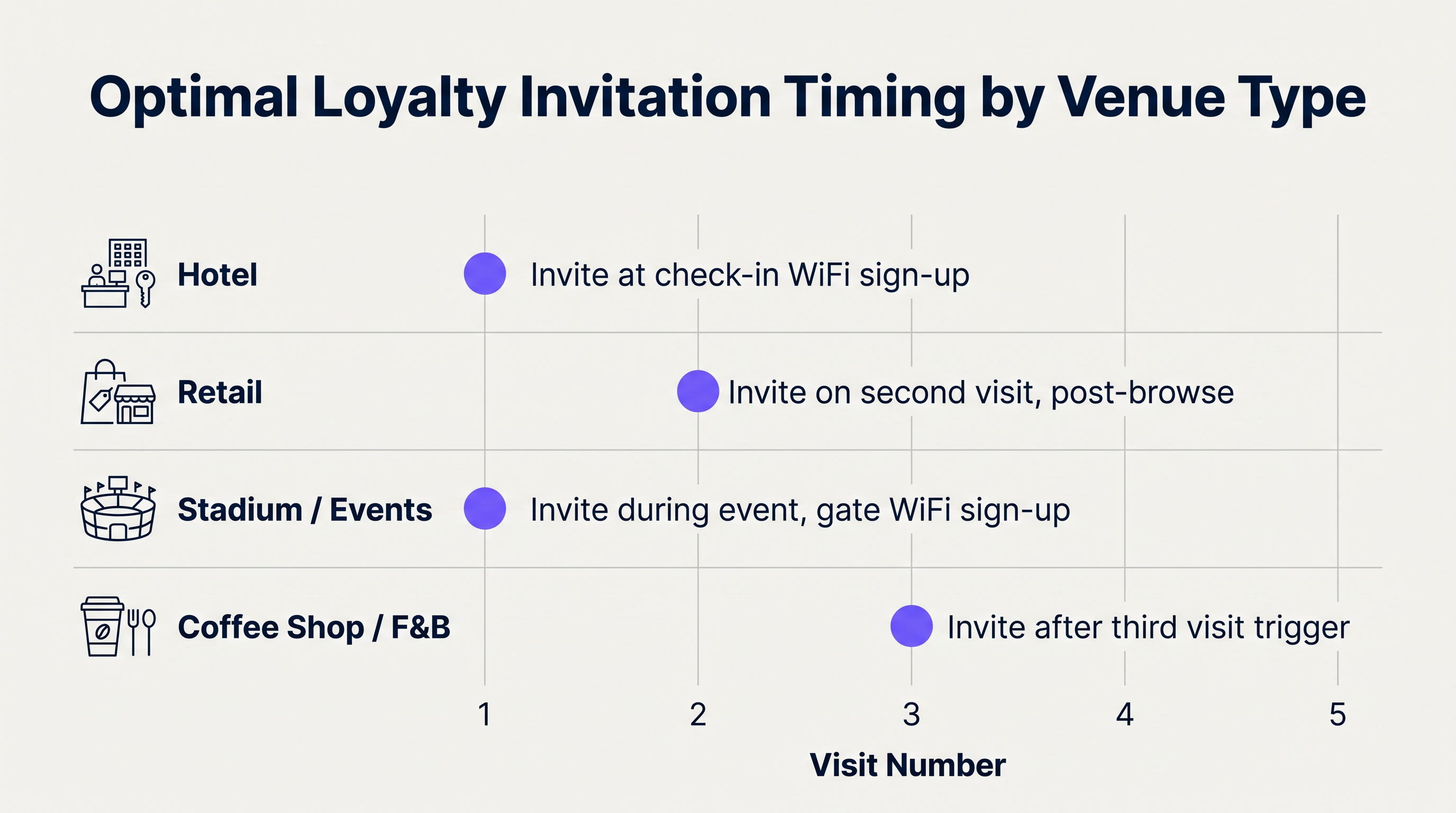
Les données de référence de l'industrie révèlent que le moment de l'invitation à la fidélité est la variable la plus importante pour le succès de la conversion. Le point de déclenchement optimal varie considérablement selon le type de site :
- Hôtellerie : Déclenchez l'invitation dans les deux heures suivant la connexion initiale à l'enregistrement. L'invité est installé et très motivé à gagner des points pour son séjour actuel.
- Commerce de Détail : Retardez l'invitation jusqu'à la deuxième visite. Un visiteur pour la première fois dans un magasin de détail n'a pas encore démontré d'affinité avec la marque. Le déclenchement de l'e-mail lors de la deuxième connexion WiFi donne des taux de conversion de 28 à 35 %. Pour des informations plus larges sur les déploiements de détail, consultez notre aperçu du secteur Retail .
- Stades et Événements : Déclenchez immédiatement après la connexion. Le temps de présence est court et l'invité ne peut visiter qu'une fois par saison. Les notifications push sur le site combinées à un e-mail immédiat offrent le rendement le plus élevé.
- Restauration : Déclenchez à la troisième visite. Cela établit un modèle de retour habituel avant d'introduire la proposition de fidélité.
De plus, l'intégration de Wayfinding et de Sensors peut fournir des données contextuelles supplémentaires, permettant l'invitation à la fidélitédes actions à déclencher lorsqu'un invité entre dans une zone spécifique du lieu, plutôt qu'uniquement au périmètre.
Dépannage et atténuation des risques
Plusieurs modes de défaillance courants peuvent faire échouer un déploiement de fidélisation WiFi :
- Le fossé du consentement : La capture d'une adresse e-mail sans consentement marketing explicite enfreint les réglementations en matière de confidentialité. Le captive portal doit séparer l'acceptation des conditions d'utilisation de l'opt-in marketing. Si l'opt-in est groupé ou pré-coché, la base de données résultante est légalement toxique.
- Fragmentation des profils : Un invité visitant plusieurs établissements d'une chaîne peut créer des enregistrements en double si le CRM ne dispose pas d'une résolution d'identité robuste. Le CRM doit dédupliquer les enregistrements basés sur l'adresse e-mail tout en fusionnant les adresses MAC associées dans un profil unifié unique.
- Le décalage d'intégration : S'appuyer sur des exportations par lots plutôt que sur des APIs en temps réel signifie que les invitations arrivent trop tard. Si la feuille de route IT ne peut pas prendre en charge l'intégration API en temps réel immédiatement, priorisez cela comme la dette technique la plus critique à résoudre.
ROI et impact commercial
Convertir un utilisateur WiFi invité en membre de fidélité modifie fondamentalement l'économie unitaire du déploiement du réseau. Un utilisateur WiFi invité standard représente une connexion unique et anonymisée. Un membre de fidélité représente une entité connue avec une valeur à vie mesurable (LTV).
En mettant en œuvre un profilage progressif et des déclencheurs en temps réel, les établissements d'entreprise voient généralement les taux de conversion WiFi-vers-fidélité se stabiliser entre 25 % et 35 %. Cet afflux de données de première partie permet aux équipes marketing de réduire leur dépendance aux canaux d'acquisition tiers coûteux. Lors du calcul de l'impact commercial, les responsables IT devraient modéliser la LTV des membres de fidélité nouvellement acquis par rapport au coût opérationnel du matériel réseau et des licences logicielles. Pour une méthodologie détaillée, consultez Mesurer le ROI du WiFi invité : Un cadre pour les CMO .
En fin de compte, un entonnoir de fidélisation WiFi bien conçu transforme le réseau sans fil d'un centre de coûts en un moteur principal de la rétention client et des revenus. À mesure que les architectures réseau évoluent, la compréhension des avantages clés du SD WAN pour les entreprises modernes garantira également que l'infrastructure sous-jacente peut prendre en charge ces applications gourmandes en données et en temps réel de manière sécurisée et fiable.
Termes clés et définitions
Progressive Profiling
The practice of collecting user data incrementally over multiple interactions rather than requesting all information upfront.
Essential for captive portals to minimize friction while still building rich customer profiles over time.
Captive Portal
A web page that a user of a public-access network is obliged to view and interact with before access is granted.
The primary interface for capturing guest data and securing marketing consent.
Webhook
A method of augmenting or altering the behavior of a web page or web application with custom callbacks, providing real-time data transfer.
Used to instantly send guest WiFi authentication data to a CRM, eliminating the delay of batch exports.
Identity Resolution
The process of matching multiple identifiers (like email addresses and MAC addresses) across devices and touchpoints to a single customer profile.
Crucial for preventing duplicate records when a guest visits multiple venues within a brand's portfolio.
MAC Address Anonymization
The process of hashing or encrypting Media Access Control addresses to protect user privacy while still allowing network systems to recognize returning devices.
Required for compliance with strict privacy frameworks like GDPR while enabling progressive profiling.
Zero-Party Data
Data that a customer intentionally and proactively shares with a brand, such as preference center data or purchase intentions.
Guest WiFi sign-ups provide high-quality zero-party data, reducing reliance on deprecated third-party cookies.
Explicit Consent
An unambiguous, affirmative action by a user agreeing to the processing of their personal data for a specific purpose.
Must be captured via an unchecked opt-in box on the captive portal to ensure legal compliance for marketing communications.
Integration Lag
The delay between a user taking an action (like connecting to WiFi) and that data being available in a downstream system (like a CRM).
The primary cause of low conversion rates in legacy WiFi deployments that rely on batch CSV exports.
Études de cas
A 200-room boutique hotel currently exports a CSV of guest WiFi sign-ups every Monday morning and uploads it to their email platform. They send a generic 'Join our Loyalty Club' email on Tuesday. Their conversion rate is currently 4%. How should the IT Director re-architect this flow to achieve a 25%+ conversion rate?
- Replace the CSV export with a real-time webhook integration from the WiFi platform to the CRM.
- Redesign the captive portal to use progressive profiling: ask only for Name, Email, and Marketing Consent on the first connection.
- Configure the CRM to trigger the loyalty invitation email exactly 90 minutes after the initial WiFi authentication payload is received.
- Personalize the email copy to reference the specific hotel property and offer an immediate perk (e.g., 'Earn double points on your current stay').
A national retail chain with 500 locations requires users to fill out a 7-field form (Name, Email, Phone, Postcode, Date of Birth, Gender, Preferences) to access the guest WiFi. Only 12% of shoppers complete the form, and of those, only 8% join the loyalty programme. What is the recommended deployment strategy?
- Implement progressive profiling. Reduce the initial captive portal form to just Name, Email, and Marketing Consent.
- Configure the WiFi platform to recognize returning devices (MAC addresses) on subsequent visits.
- On the second visit, serve a dynamic splash page asking for Postcode.
- Trigger the loyalty invitation email only after the second visit, utilizing the behavioral data (return intent) to drive higher engagement.
Analyse de scénario
Q1. Your marketing team wants to add 'Date of Birth' and 'Favorite Beverage' to the captive portal form for a new coffee shop deployment to personalize loyalty offers immediately. As the IT Director, how do you respond?
💡 Astuce :Consider the impact of form length on initial connection rates.
Afficher l'approche recommandée
Advise against adding these fields to the initial sign-up. Explain that every additional field reduces the completion rate. Recommend implementing progressive profiling: capture Name, Email, and Consent on visit 1 to maximize the top-of-funnel acquisition, then configure the network to ask for 'Favorite Beverage' on visit 2 and 'Date of Birth' on visit 3.
Q2. During an audit, the compliance officer notes that the captive portal currently has a pre-checked box stating 'I agree to the Terms of Service and to receive marketing emails.' What architectural changes are required to mitigate this risk?
💡 Astuce :Review the requirements for explicit consent under GDPR.
Afficher l'approche recommandée
The portal must be re-architected immediately to separate the Terms of Service acceptance from the marketing opt-in. The marketing opt-in must be an explicit, unchecked checkbox. The backend database must also be updated to record the timestamp and IP address specifically associated with the marketing opt-in action, creating a defensible audit trail.
Q3. A stadium client is frustrated that their post-match 'Join our Fan Club' emails, sent the Monday after a weekend game, are only achieving a 5% conversion rate despite capturing 15,000 emails on the guest WiFi. What is the technical solution?
💡 Astuce :Analyze the integration lag and the context of the user.
Afficher l'approche recommandée
The issue is the integration lag; the intent has evaporated by Monday. The technical solution is to replace the batch export process with a real-time API integration. The CRM should be configured to trigger an immediate email or an in-venue push notification while the fan is still connected to the stadium network, capitalizing on the live event experience.
Points clés à retenir
- ✓Guest WiFi is the highest-intent digital touchpoint for physical venues.
- ✓Real-time API integrations are mandatory; batch exports kill conversion rates.
- ✓Progressive profiling (asking for data over multiple visits) dramatically outperforms long registration forms.
- ✓The initial captive portal should only request Name, Email, and Marketing Consent.
- ✓Optimal invitation timing varies by venue: Hotels (Visit 1), Retail (Visit 2), F&B (Visit 3).
- ✓Separating Terms of Service from an unchecked marketing opt-in is critical for compliance.
- ✓Properly executed deployments can achieve 25-35% WiFi-to-loyalty conversion rates.




