
How to leverage SMS text marketing to increase return visits
This guide details how venue operators can use SMS text marketing to drive measurable return visits by capturing verified first-party phone data through Guest WiFi. It covers the full technical architecture from captive portal authentication to RADIUS integration, the compliance requirements under GDPR and TCPA, and the automated campaign triggers that deliver consistent ROI across hospitality, retail, and transport environments.
Listen to this guide
View podcast transcript
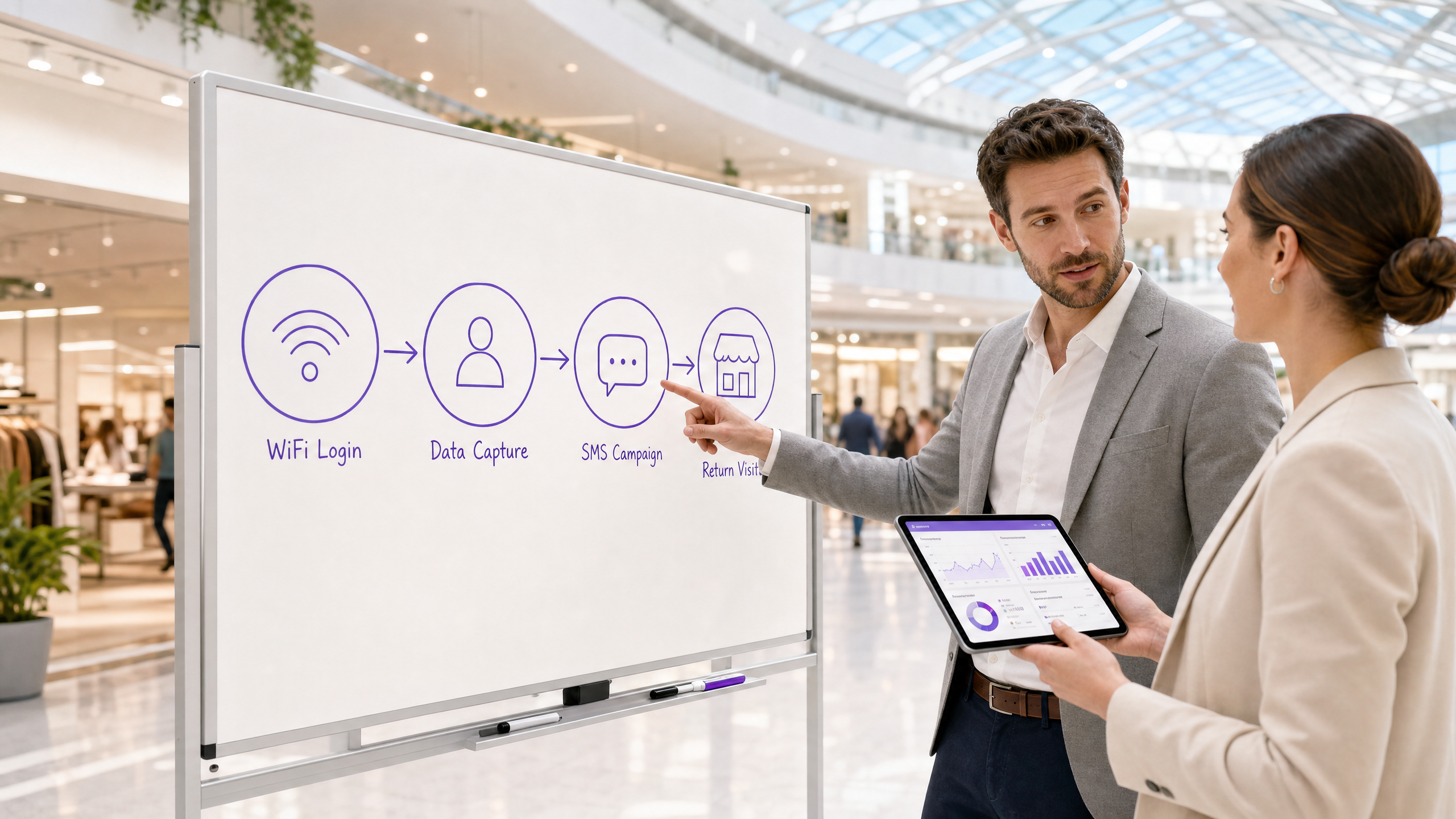
Executive summary
SMS text marketing delivers a 98% open rate and an ROI of $21 for every $1 spent [Emarsys, 2026]. For venue operators, the channel works. The challenge is the data. You need verified phone numbers and explicit consent at scale, and you need them tied to real visitor behaviour. This guide covers how to integrate your Guest WiFi infrastructure with the Purple Engage platform to automate first-party data collection, deploy targeted SMS campaigns, and measure return visits using closed-loop attribution. We cover the authentication architecture, hardware integration across Cisco Meraki, HPE Aruba, Ruckus, Juniper Mist, Ubiquiti UniFi, Cambium, Extreme, and Fortinet, the GDPR and TCPA compliance requirements, and the specific campaign triggers that drive footfall across hospitality, retail, and transport environments.
Technical deep-dive: architecture and data capture
The foundation of effective SMS text marketing is accurate, verified data. Traditional methods rely on manual entry at the point of sale, which is slow and produces poor-quality records. Integrating data capture into the WiFi authentication flow automates this process and verifies the device in real time.
The authentication flow
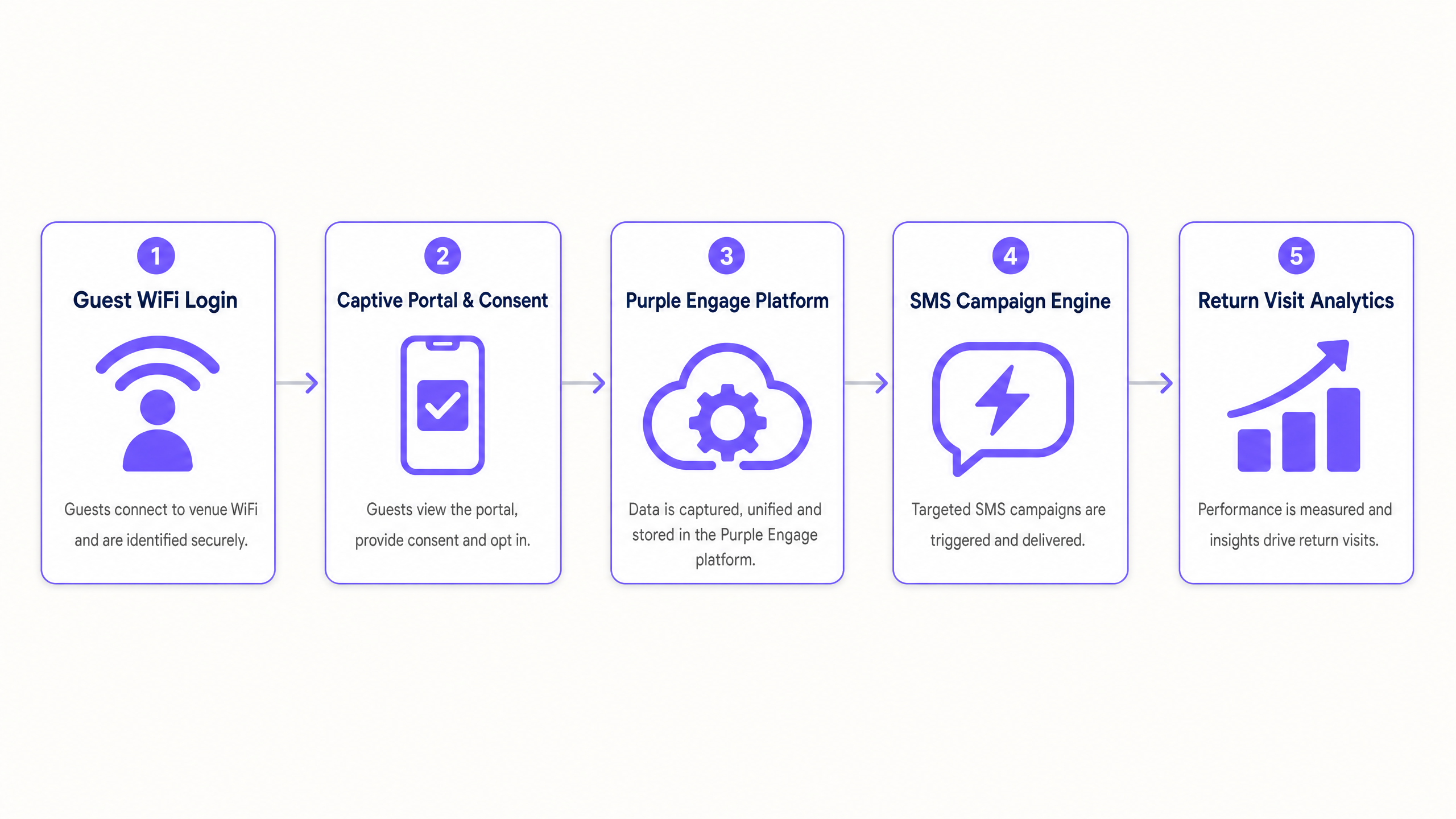
When a visitor connects to the Guest WiFi SSID, the network controller redirects their session to a captive portal. This portal is the primary data ingestion point. To capture phone numbers for SMS marketing, you configure the portal to require SMS authentication - specifically, a one-time password (OTP) sent to the visitor's mobile device.
The flow works as follows. The client device associates with the access point. The gateway intercepts HTTP traffic and redirects the browser to the Purple captive portal. The visitor enters their mobile number. The Purple Engage platform generates a one-time password and delivers it via SMS. The visitor enters the OTP into the portal. The visitor reviews the terms and actively checks an unchecked opt-in box for marketing communications. The RADIUS server authenticates the session and grants internet access.
This flow ensures every phone number in your database is verified and tied to a specific MAC address. That MAC address allows Purple to track subsequent visits, dwell times, and movement patterns - the behavioural data needed to trigger targeted SMS campaigns.
Infrastructure integration
Purple operates as a cloud overlay on your existing hardware. You do not need to replace access points or controllers. You configure the wireless LAN controller to point authentication requests to Purple's RADIUS servers and set up the walled garden to allow traffic to the captive portal and SMS gateway domains before authentication.
Purple integrates with Cisco Meraki, HPE Aruba, Ruckus, Juniper Mist, Ubiquiti UniFi, Cambium, Extreme, and Fortinet. For multi-site retail chains or hospitality groups running mixed hardware estates, Purple's hardware-agnostic architecture means you manage all sites from a single platform. For identity management, Purple integrates with Microsoft Entra ID, Okta, and Google Workspace.
| Hardware vendor | Integration method | Notes |
|---|---|---|
| Cisco Meraki | API + RADIUS | Cloud-managed; walled garden configured in dashboard |
| HPE Aruba | RADIUS + ClearPass optional | Supports both ArubaOS and Instant AP |
| Ruckus | RADIUS + SmartZone | Supports ZoneDirector and cloud-managed |
| Juniper Mist | RADIUS + Mist API | Full telemetry integration available |
| Ubiquiti UniFi | RADIUS | Controller-based; walled garden via UniFi dashboard |
Implementation guide: deploying SMS campaigns
Once the data capture architecture is in place, you deploy SMS campaigns through Purple Engage. The key to driving return visits is relevance. A generic broadcast to your entire database will generate opt-outs. A targeted message triggered by visitor behaviour will generate footfall.
Behavioural triggers
Purple tracks visitor presence using WiFi Analytics . You use this data to trigger automated SMS messages based on specific conditions.
The lapsed visitor campaign. If a MAC address has not been detected by your access points for 30 days, the platform automatically sends an SMS offer. This intercepts the visitor before a competitor does. A message like: Premier Inn: We have not seen you for a while. Book your next stay this week and get 15% off. Use code RETURN15. Reply STOP to opt out. - is direct, specific, and actionable.
The welcome message. Triggered 15 minutes after a first-time visitor connects. This provides immediate value - a discount code for the current visit - and begins the relationship. It drives in-visit spend and creates a positive first impression.
The milestone message. Triggered on the visitor's birthday or after their tenth visit. These messages consistently outperform generic promotions in redemption rates because they signal individual recognition.
Message construction
You have 160 characters per SMS. Going over splits the message into two, doubling cost and degrading presentation on some handsets. Every element must earn its place.
- Sender name: Start with your brand name so the recipient knows immediately who is contacting them.
- Offer: Be specific. A named discount or a named product beats a vague promise.
- Call to action: Include a tracked short link.
- Opt-out: Required by law. Keep it brief: Reply STOP to opt out.
Best practices and compliance
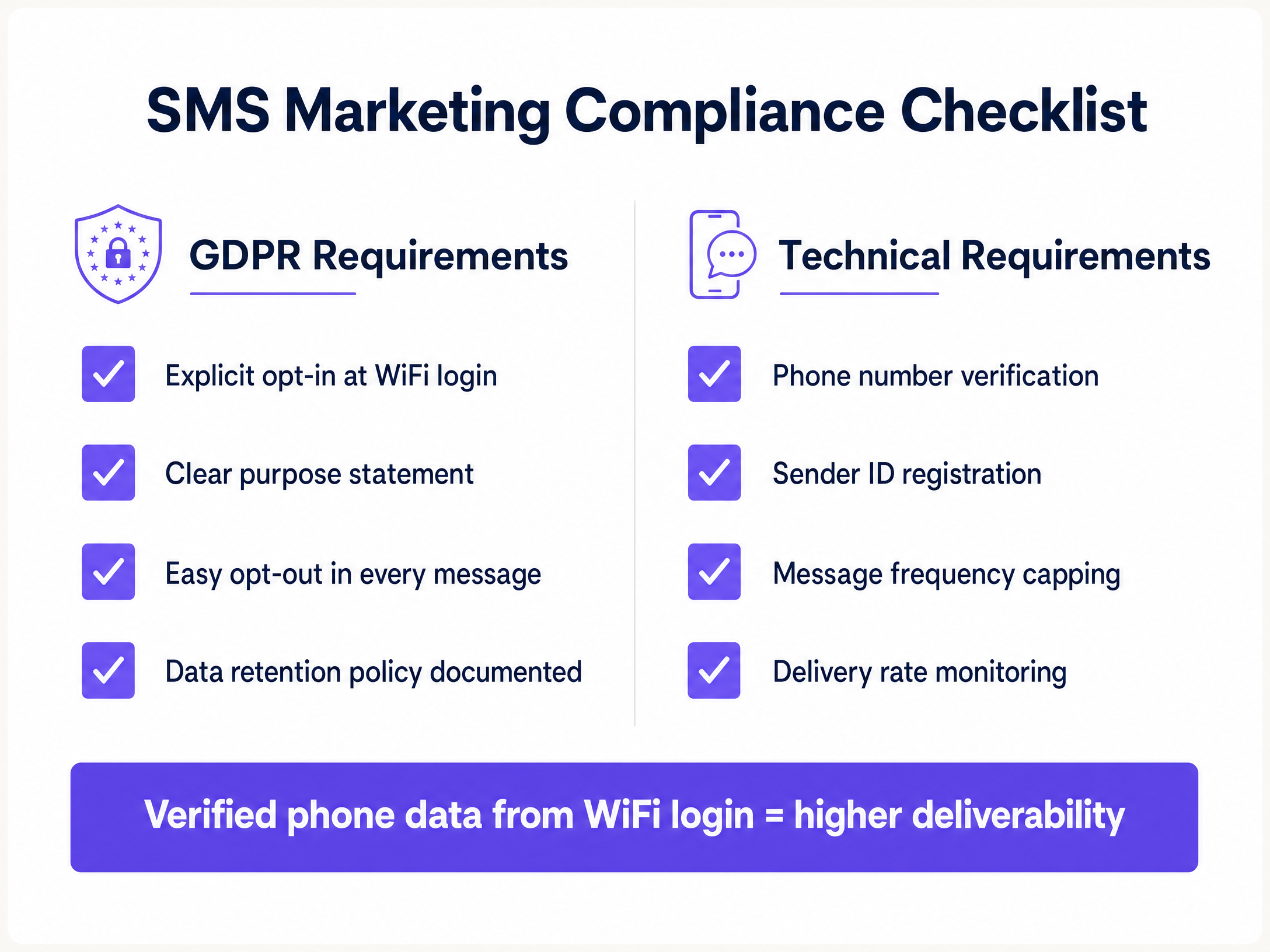
SMS marketing is regulated. Under GDPR in Europe and the TCPA in the United States, you must have explicit consent before sending any marketing message. Failure to comply carries significant financial penalties and reputational risk.
Consent and opt-in
Explicit consent means the visitor made a deliberate, informed choice. A pre-ticked box on the captive portal does not constitute explicit consent under GDPR. The box must be unchecked. The visitor must tick it. The purpose must be stated. The frequency must be indicated. The opt-out mechanism must be described. If your current portal uses a pre-ticked box, that is a compliance risk to address before your next campaign.
Opt-out management
Every SMS message must include clear opt-out instructions, typically by replying STOP. Purple Engage processes these requests automatically and updates the visitor's profile to prevent further marketing messages. This must happen without manual intervention.
Data retention
Define and enforce a data retention policy. If a visitor has not connected to your network or engaged with your messages for 24 months, anonymise or delete their data in line with GDPR requirements. Stale data degrades deliverability and inflates database costs.
For a detailed look at RADIUS server configuration in the context of authentication and access control, see our guide on Server RADIUS: a comprehensive guide for businesses .
Troubleshooting and risk mitigation
Deploying SMS marketing via Guest WiFi introduces specific technical and operational risks. These are the three failure modes we see most often.
High bounce rates. Almost always caused by unverified data. The venue has not implemented OTP authentication, so visitors enter fake numbers. Messages bounce, sender reputation degrades, and carrier filtering follows. Fix: implement SMS OTP authentication on the captive portal. Every number collected after that point is verified.
Carrier filtering. Sending a large bulk broadcast without registering your Sender ID causes mobile carriers to flag the traffic as spam and block it. Fix: register your alphanumeric Sender ID before launch. Use rate limiting to stagger large campaigns over several hours. Avoid excessive capitalisation, special characters, and URL shorteners that carriers associate with spam.
Low opt-in rates. If visitors connect but do not opt in, the value exchange is not compelling enough. Fix: review the captive portal design. Offer an immediate incentive. State the benefit clearly. With a clear value exchange, opt-in rates of 30 to 50% are achievable.
ROI and business impact
The primary metric for SMS text marketing in a venue context is the return visit rate. By combining SMS campaign data with WiFi analytics, you measure the exact impact of your messages using closed-loop attribution.
The measurement process is straightforward. You send an SMS offer to 1,000 lapsed visitors. 150 visitors click the link (15% click-through rate, versus email's average of 2.5% [Emarsys, 2026]). The Purple platform detects 50 of those specific MAC addresses returning to the venue within seven days. The campaign drove a 5% return visit rate from a lapsed segment. You calculate the revenue generated from those 50 visits and compare it to the campaign cost.
This approach applies across verticals. For retail operators, the metric is footfall and in-store spend. For hospitality operators, it is repeat bookings and ancillary revenue. For transport hubs, it is passenger dwell time and concession spend. For healthcare venues, it is appointment attendance and patient satisfaction.
Purple has deployed this architecture across 80,000+ live venues, processing 440 million logins in 2024 and collecting 29 billion data points. The platform carries ISO 27001, GDPR, CCPA, and Cyber Essentials certifications, with 99.999% uptime.
References
[Emarsys, 2026] Emarsys. 20+ SMS Marketing Statistics (With Sources) to Know in 2026. https://emarsys.com/learn/blog/sms-marketing-statistics/
Key Definitions
Captive portal
A web page that a user must view and interact with before access is granted to a public network. It intercepts HTTP traffic and redirects the browser to a hosted login or registration page.
The captive portal is the primary interface for capturing phone numbers and obtaining GDPR-compliant consent for SMS marketing. Its design directly affects opt-in rates.
MAC address
A unique identifier assigned to a network interface controller, used as a network address within a network segment. Formatted as six pairs of hexadecimal digits.
Purple ties the verified phone number to the visitor's MAC address. This enables return visit tracking: when the same device reconnects, the platform records the visit and can attribute it to a specific SMS campaign.
SMS OTP authentication
A verification mechanism where a user must enter a one-time password delivered to their mobile phone before gaining network access. The OTP expires after a short window, typically 5 to 10 minutes.
OTP authentication ensures that every phone number collected via the captive portal is active and belongs to the person connecting. This is the single most effective measure for improving SMS deliverability.
RADIUS
Remote Authentication Dial-In User Service. A networking protocol that provides centralised authentication, authorisation, and accounting (AAA) for users connecting to a network.
Purple's RADIUS servers authenticate guest sessions after the captive portal interaction is complete. The RADIUS accounting data feeds into the analytics platform, recording session start and end times.
Sender ID
The name or number displayed on the recipient's mobile phone as the sender of an SMS message. Alphanumeric Sender IDs (e.g., 'PurpleRetail') replace the numeric short code.
Registering an alphanumeric Sender ID with mobile carriers improves brand recognition and is essential for high-volume campaigns. Unregistered Sender IDs are more likely to be filtered as spam.
Carrier filtering
The practice by mobile network operators of blocking or throttling SMS messages identified as spam or non-compliant with their acceptable use policies.
High bounce rates, unregistered Sender IDs, and sudden volume spikes are the primary triggers for carrier filtering. Once filtered, messages are silently dropped with no delivery receipt.
First-party data
Information a company collects directly from its own visitors or customers, with their knowledge and consent, and owns outright.
Data captured through Guest WiFi is first-party data. It is not subject to the deprecation of third-party cookies or changes to platform data-sharing policies. It is more accurate and more valuable than purchased lists.
Closed-loop attribution
A measurement approach that connects a marketing action (sending an SMS) to a physical outcome (a return visit) by tracking the same individual through both events.
Purple achieves closed-loop attribution by tying the SMS recipient's phone number to their MAC address and then detecting that MAC address at the access points after the campaign. This proves actual footfall rather than inferring it from digital engagement.
Walled garden
A network configuration that allows unauthenticated devices to access a restricted set of domains - typically the captive portal and its dependencies - before completing authentication.
Correctly configuring the walled garden is essential for the captive portal to load. If the SMS gateway domain is not included in the walled garden, the OTP cannot be sent before authentication completes.
Worked Examples
A national retail chain with 50 locations wants to increase return visits from weekend shoppers. They currently offer free Guest WiFi on Cisco Meraki hardware but only capture email addresses at the captive portal. How should they implement SMS text marketing?
Step 1: Update the captive portal configuration to require SMS OTP authentication. In the Cisco Meraki dashboard, configure the splash page to redirect to the Purple captive portal. Step 2: Update the portal design to add a clearly labelled, unchecked opt-in checkbox for SMS marketing. State the frequency and purpose explicitly. Step 3: In Purple Engage, configure a visitor tag that fires when a device connects on a Saturday or Sunday. Step 4: Set up a lapsed visitor trigger: if a device tagged as a weekend shopper has not been detected for 14 days, send an automated SMS on Thursday afternoon with a specific weekend offer and a tracked link. Step 5: After four weeks, review the return visit rate for MAC addresses that received the campaign versus a control group that did not.
A large stadium wants to send targeted merchandise offers to fans during half-time at a sold-out event. They expect 40,000 concurrent WiFi connections. How do they ensure deliverability and avoid carrier filtering?
Step 1: Pre-register an alphanumeric Sender ID (e.g., 'StadiumFC') with the relevant mobile carriers at least two weeks before the event. Step 2: Implement Passpoint or OpenRoaming for returning fans to reduce captive portal friction and speed up authentication. Step 3: For new connections, use a streamlined portal with a clear value exchange: opt in for exclusive half-time offers. Step 4: At half-time, do not send all 40,000 messages simultaneously. Use Purple Engage's rate limiting to stagger the send over 8 minutes, distributing the volume evenly. Step 5: Segment the audience by stand location using Purple's indoor location analytics and send offers relevant to the nearest merchandise point.
Practice Questions
Q1. A hotel chain wants to send an SMS offer to guests who check out, encouraging them to book their next stay directly. They have configured the captive portal to collect phone numbers but are seeing a 40% message bounce rate. What is the most likely cause and the recommended fix?
Hint: Consider how the phone numbers are being collected and whether they are being verified at the point of entry.
View model answer
The high bounce rate indicates that guests are entering fake or incorrect phone numbers to gain WiFi access. Without OTP verification, there is no incentive to enter a real number. The fix is to implement SMS OTP authentication on the captive portal. The visitor must enter a valid, active number to receive the OTP and gain internet access. Every number collected after this change is verified, which will reduce the bounce rate significantly and improve sender reputation with mobile carriers.
Q2. A shopping centre is planning a Black Friday SMS campaign. They have 50,000 opted-in phone numbers collected via Guest WiFi. They plan to send the message to the entire list at 9:00 AM on Friday. What is the primary technical risk, and how should they mitigate it?
Hint: Consider how mobile carriers respond to sudden, large-volume bursts of Application-to-Person (A2P) messaging from a single Sender ID.
View model answer
The primary risk is carrier filtering. Sending 50,000 messages simultaneously will likely trigger spam detection systems, resulting in messages being blocked or throttled regardless of the quality of the data. To mitigate this: register the alphanumeric Sender ID with relevant carriers at least two weeks in advance; use Purple Engage's rate limiting to stagger the send over two to three hours rather than a single burst; segment the list and send the most engaged visitors first to establish a positive sending pattern before the bulk of the campaign goes out.
Q3. You are auditing a new captive portal design for a UK pub chain. The portal asks for a mobile number and includes a pre-ticked checkbox stating: 'I agree to receive special offers via SMS.' The marketing team argues this will maximise the database size. What is your recommendation and why?
Hint: Consider the specific requirements of the UK GDPR regarding the validity of consent.
View model answer
The pre-ticked box must be removed. Under UK GDPR, consent must be freely given, specific, informed, and unambiguous. A pre-ticked box does not constitute unambiguous consent because the visitor has not taken a positive action. The Information Commissioner's Office (ICO) is explicit on this point. The portal must be redesigned with an unchecked box requiring a deliberate opt-in action. While this may reduce the raw number of opt-ins, the resulting database will be legally compliant and will contain only visitors who genuinely want to receive messages, producing better engagement rates and lower opt-out rates.
Q4. A venue operator asks whether they can import their existing email subscriber list into Purple Engage and start sending SMS marketing messages to those contacts. They argue that the subscribers already consented to marketing communications. Is this acceptable?
Hint: Consider whether consent for one channel automatically extends to another channel under GDPR.
View model answer
No. Consent is channel-specific under GDPR. A visitor who consented to receive marketing emails has not consented to receive marketing SMS messages. The purposes and channels must be specified at the point of consent. To build a compliant SMS database from an existing email list, the operator must run a re-consent campaign via email, explicitly asking subscribers to opt in to SMS communications, and only add those who actively respond to the SMS list.
Continue reading in this series
How to leverage SMS marketing for restaurants to increase return visits
This technical guide explains how venue operators and IT teams can implement SMS marketing using existing guest WiFi infrastructure to drive return visits. It covers the data capture architecture, GDPR compliance requirements, and behavioural segmentation strategies that deliver measurable ROI for restaurants.
How to leverage SMS marketing solutions to increase return visits
This guide details how to architect and deploy SMS marketing solutions using the Purple Engage platform to drive return visits at hotels, retail venues, stadiums, and public-sector sites. It covers captive portal configuration, verified phone number capture via SMS OTP, GDPR-compliant consent architecture, and trigger-based campaign automation using existing wireless infrastructure from Cisco Meraki, HPE Aruba, and other supported vendors.
How to leverage SMS marketing business to increase return visits
This guide details how venue operators can build an SMS marketing business strategy using enterprise Guest WiFi infrastructure to capture verified phone numbers, automate behaviour-triggered campaigns, and drive measurable return visits. It covers the full technical architecture from captive portal configuration and RADIUS authentication to GDPR-compliant consent flows and Purple Engage automation, with real-world scenarios from hospitality and retail environments.