
Heatmapping vs Presence Analytics: Technical Differences
This authoritative technical guide details the critical architectural and operational differences between WiFi heatmapping and presence analytics for enterprise venue operators. It provides IT leaders, network architects, and operations directors with actionable deployment frameworks, real-world implementation scenarios, and vendor-neutral best practices for extracting maximum ROI from their existing wireless infrastructure.
Listen to this guide
View podcast transcript
Executive Summary
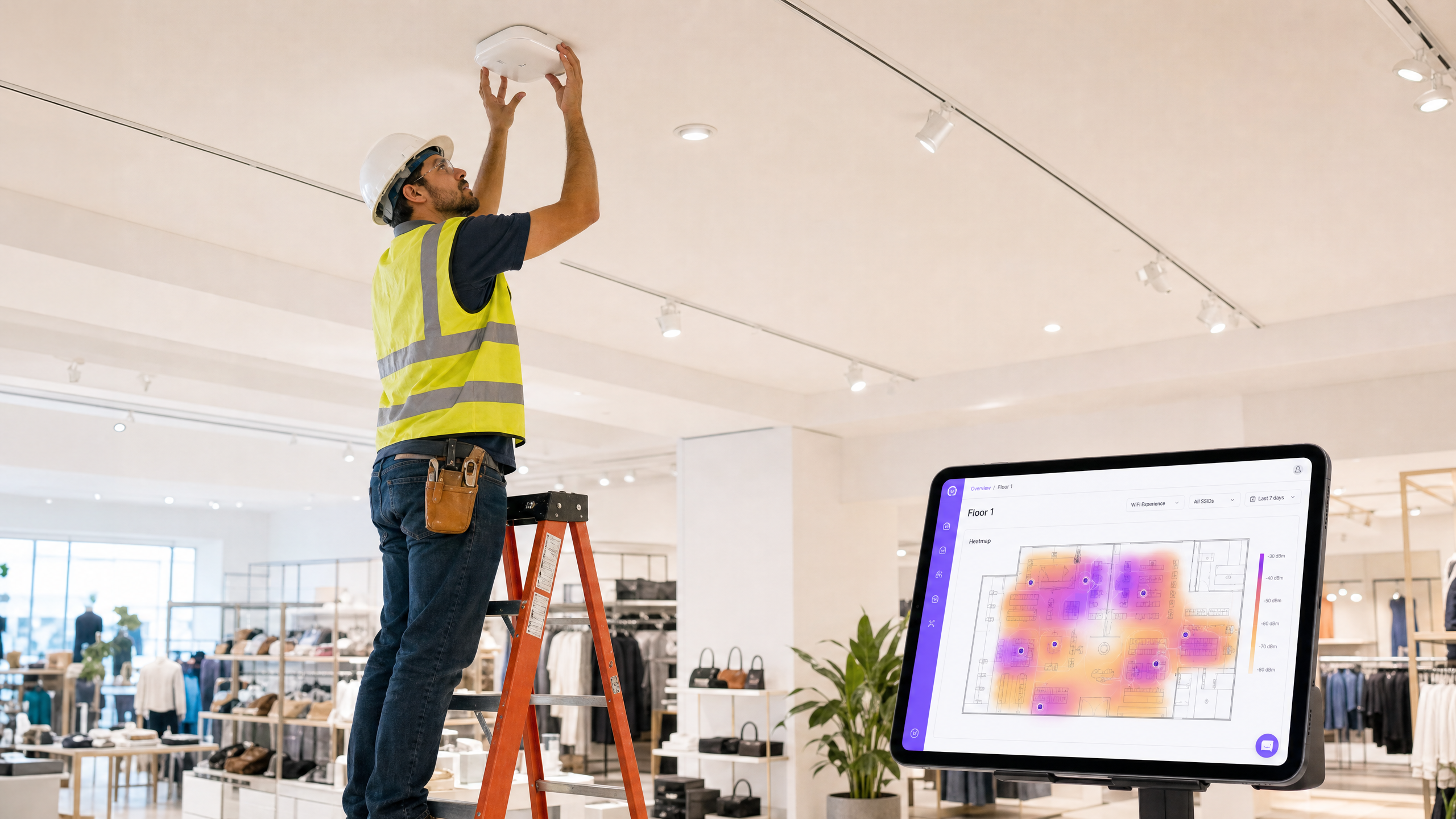
For enterprise IT teams managing complex physical venues, understanding the distinction between WiFi heatmapping and presence analytics is no longer optional. While often conflated in marketing literature, these are fundamentally distinct technologies serving different operational mandates.
WiFi heatmapping is an infrastructure-centric diagnostic tool designed to measure RF (Radio Frequency) signal propagation, identify coverage gaps, and optimise Access Point (AP) placement. Presence analytics is a business-intelligence layer that leverages the same network infrastructure to track device movement, calculate dwell times, and map visitor behaviour across physical spaces.
This guide provides a rigorous technical comparison of both approaches. We explore the underlying architectures, data collection methodologies, and implementation frameworks required to deploy these systems effectively in retail, hospitality, and large-scale public environments. By mapping these capabilities to Purple's Guest WiFi and WiFi Analytics platforms, we provide a blueprint for extracting maximum ROI from your existing network hardware — without requiring a forklift upgrade of your physical infrastructure.
Technical Deep-Dive: Architecture and Methodologies
WiFi Heatmapping: The RF Diagnostic Layer
At its core, WiFi heatmapping relies on Received Signal Strength Indicator (RSSI) measurements to construct a visual representation of network coverage. This process is essential for network planning, troubleshooting, and ongoing performance validation.
Data Collection Mechanisms fall into three categories. Active surveys involve devices actively associating with APs to measure throughput, packet loss, and latency alongside RSSI — providing a client-perspective view of network performance. Passive surveys use scanners that listen to beacon frames and probe responses across all channels without associating, providing a holistic view of the RF environment including co-channel interference and rogue AP detection. Predictive modelling uses software to simulate coverage based on floor plans, wall attenuation values, and AP antenna patterns before physical deployment, enabling pre-deployment validation.
Key Technical Metrics include Signal-to-Noise Ratio (SNR), which is critical for determining the actual data rates achievable in a given zone and is a more reliable indicator of quality than raw RSSI alone. Channel overlap identification reveals areas where adjacent APs operate on overlapping frequencies, causing destructive interference that degrades throughput even when signal strength appears adequate.
Presence Analytics: The Behavioural Intelligence Layer
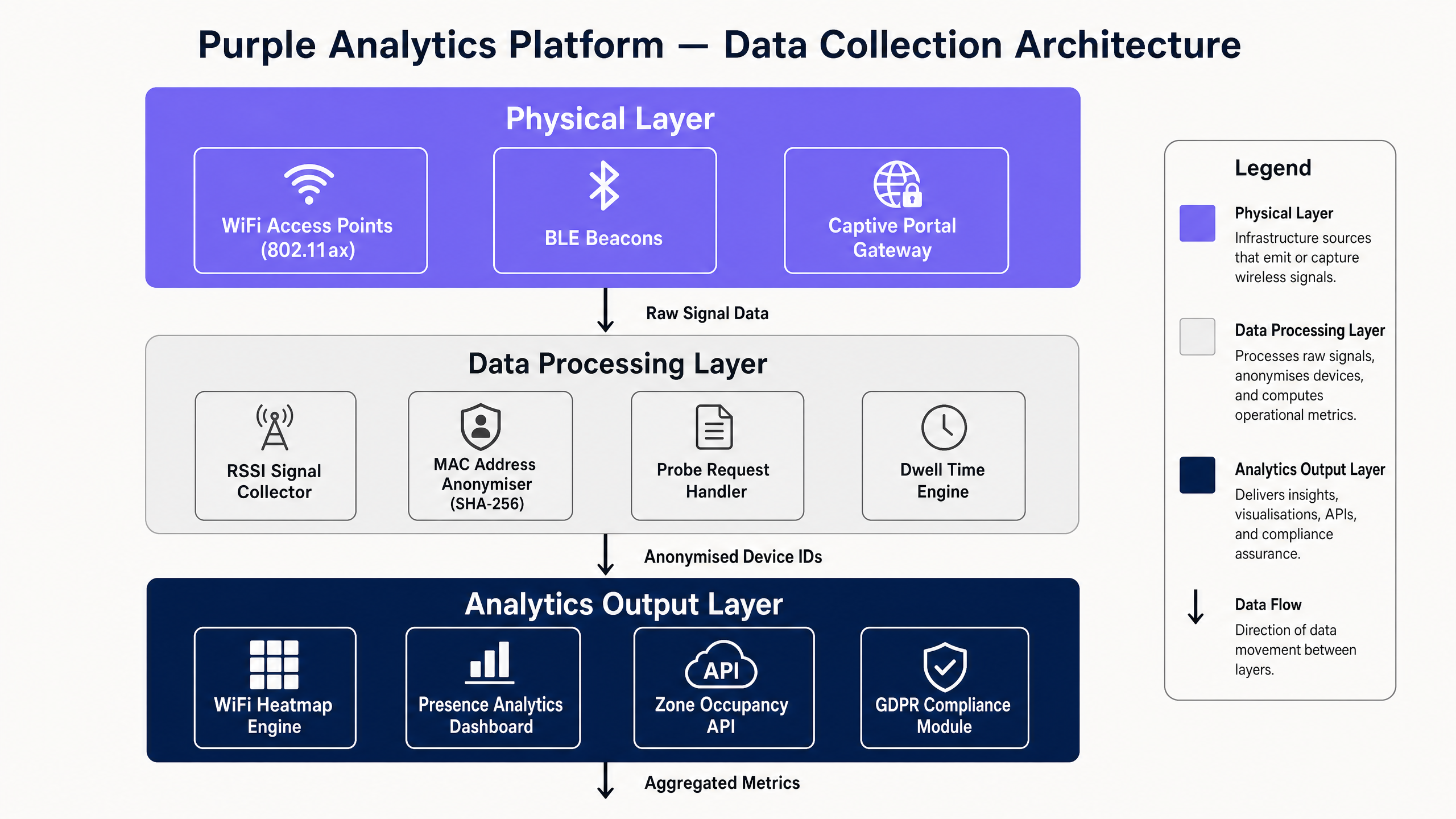
Presence analytics shifts the focus from the network infrastructure to the devices traversing it. It relies primarily on capturing probe requests — management frames emitted by smartphones and tablets as they search for known networks — to track unassociated devices without requiring them to connect.
The data collection architecture operates in three stages. First, APs or dedicated sensors intercept unassociated probe requests containing the device's MAC address and signal strength. Second, to comply with privacy frameworks including GDPR and CCPA, MAC addresses are immediately hashed (using SHA-256 or equivalent) at the edge before transmission to the analytics engine — ensuring no personally identifiable information (PII) traverses the network in raw form. Third, the trilateration engine compares the RSSI of a single device across three or more APs to calculate the device's approximate X/Y coordinates. For a deeper dive into this mechanism, see our guide on The Mechanics of WiFi Wayfinding: Trilateration and RSSI Explained .
The Critical Distinction: Coverage vs. Context
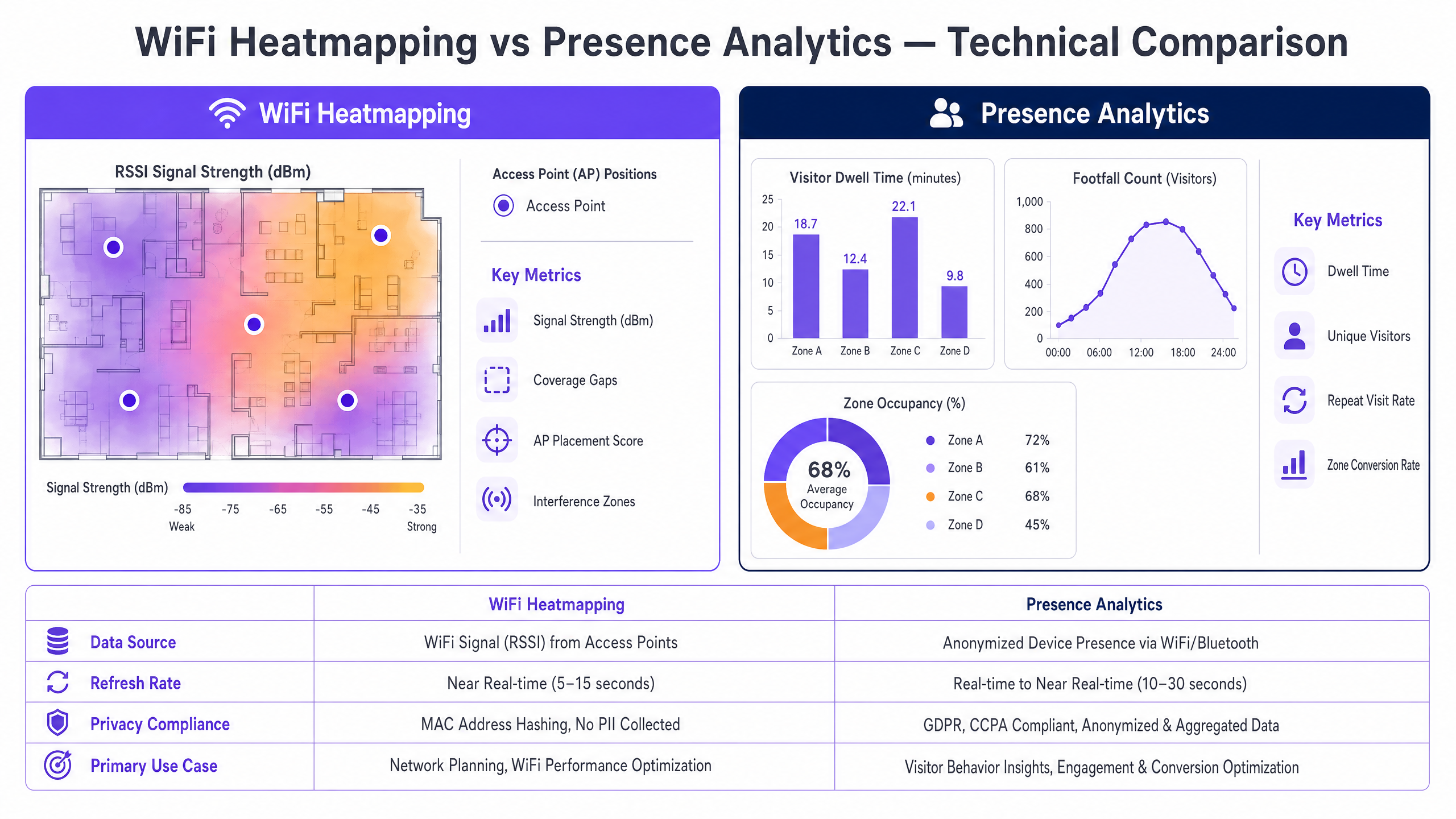
The most common misconception in enterprise deployments is that a network providing adequate coverage is automatically ready for presence analytics. This is incorrect. Coverage requires a device to receive a usable signal from one AP. Accurate trilateration for presence analytics requires a device to be simultaneously audible to at least three APs at a signal strength of -75 dBm or better. This fundamental difference drives entirely different AP density and placement requirements.
| Dimension | WiFi Heatmapping | Presence Analytics |
|---|---|---|
| Primary Data Source | RSSI from AP beacons | Probe requests from client devices |
| Infrastructure Requirement | Standard coverage density | High density (≥3 APs per zone) |
| Data Refresh Rate | Near real-time (5–15 sec survey) | Real-time (10–30 sec updates) |
| Privacy Compliance | No PII collected | GDPR/CCPA via MAC hashing |
| Primary Use Case | Network planning & optimisation | Visitor behaviour & business intelligence |
| Key Output Metric | Signal strength (dBm), SNR | Dwell time, footfall, zone conversion |
Implementation Guide: Strategic Deployment
Deploying these technologies requires a phased approach, balancing technical constraints with business objectives. Attempting to deploy presence analytics on a network not designed for it is the single most common cause of project failure.
Phase 1: Infrastructure Assessment via Heatmapping. Before implementing presence analytics, the underlying network must be validated. Conduct a comprehensive passive heatmapping survey to establish baseline RF performance. Identify coverage gaps, co-channel interference zones, and areas of high multipath interference (common in retail environments with metal shelving). This survey data directly informs the AP density and placement decisions required for Phase 2.
Phase 2: Network Redesign for Trilateration. Based on the heatmapping data, redesign AP placement with presence analytics in mind. Move APs to the perimeter of the venue rather than down centre corridors — this pulls the trilateration calculation outward and significantly improves spatial accuracy. Ensure every target zone is covered by a minimum of three APs at -72 dBm or better. In high-interference environments (warehouses, stadiums with metal structures), supplement WiFi trilateration with BLE (Bluetooth Low Energy) beacons to improve spatial resolution to 1–2 metres.
Phase 3: Platform Integration. Integrate the analytics engine with your existing hardware. Purple's hardware-agnostic platform connects via standard APIs to major vendors including Cisco, Aruba, Ruckus, and Meraki — pulling anonymised presence data without requiring proprietary overlay sensors or a full hardware replacement cycle.
Phase 4: Zone Configuration and Calibration. Define logical zones within the analytics platform that map to physical business areas (e.g., "Checkout," "Lobby," "Womenswear," "Entrance Funnel"). Align these zones with the physical AP coverage patterns identified during the heatmapping phase. Conduct a calibration walk to validate that zone boundaries are accurate before going live.
Best Practices for Enterprise Environments
Continuous Calibration is Non-Negotiable. The RF environment is dynamic. Stock levels in retail, temporary structures in events, and even human bodies absorb RF signals. Schedule quarterly passive heatmapping surveys to ensure the presence analytics engine is operating on accurate baseline data. A seasonal floor-set change in a retail environment can invalidate months of calibration data overnight.
Address MAC Randomisation Proactively. Modern operating systems — iOS 14+, Android 10+ — rotate MAC addresses to prevent passive tracking. Advanced analytics platforms must employ heuristic algorithms (analysing signal patterns and probe timing) to stitch together fragmented sessions, ensuring accurate dwell time calculations despite MAC rotation. The most robust mitigation, however, is encouraging device association through a captive portal. As discussed in How a wi fi assistant Enables Passwordless Access in 2026 , modern authentication methods seamlessly convert anonymous MAC addresses into known CRM profiles upon login, providing deterministic rather than probabilistic tracking.
Implement Role-Based Data Access. Presence analytics data, even when anonymised at the device level, can reveal sensitive operational patterns. Implement role-based access controls (RBAC) aligned with IEEE 802.1X authentication standards to ensure that raw analytics data is accessible only to authorised personnel, while aggregated dashboards are available to operations teams.
Align Zone Definitions with Business KPIs. The granularity of your zone configuration should directly reflect your business questions. If you need to measure the conversion impact of a specific end-cap display, define a zone at that level of granularity. If you only need to understand broad traffic flow between departments, coarser zones reduce computational overhead and simplify reporting.
Troubleshooting & Risk Mitigation
Failure Mode: Inaccurate Location Data (Jumping Devices)
Symptom: Devices appear to teleport between zones in the analytics dashboard, with paths that are physically impossible.
Root Cause: Insufficient AP density or multipath interference — signals bouncing off metal surfaces, creating phantom signal readings that confuse the trilateration engine.
Mitigation: Re-run a heatmapping survey focusing on SNR rather than just RSSI. An area may show adequate signal strength while having a poor SNR due to reflected signals. Consider deploying BLE beacons in high-interference zones to augment WiFi location data with a more reliable short-range signal.
Failure Mode: Artificially High Dwell Times at Entrances
Symptom: The analytics dashboard shows unusually high visitor counts and dwell times near venue entrances, inflating overall footfall metrics.
Root Cause: APs near entrances are capturing probe requests from devices on the street or in car parks outside the venue boundary.
Mitigation: Adjust the RSSI threshold in the analytics platform. Exclude data from devices with an RSSI weaker than -80 dBm to filter out external traffic. Additionally, define a dedicated "entrance buffer" zone and exclude it from conversion rate calculations.
Failure Mode: Fragmented Sessions from MAC Randomisation
Symptom: Unique visitor counts are significantly higher than expected, and average dwell times are suspiciously short.
Root Cause: iOS and Android MAC randomisation is fragmenting individual visitor sessions into multiple apparent devices.
Mitigation: Deploy a captive portal to encourage device association. Implement the analytics platform's session-stitching algorithm, which uses signal pattern continuity and timing heuristics to reconstruct fragmented sessions. For Retail environments where guest WiFi uptake is high, this typically resolves 70–80% of fragmentation.
ROI & Business Impact
The transition from basic network provisioning to intelligence gathering fundamentally alters the IT department's value proposition within the organisation.
Retail Operations represent the clearest ROI case. By correlating zone dwell times with point-of-sale data, IT can directly demonstrate how network infrastructure contributes to store layout optimisation and increased conversion rates. A retailer with 50 stores that achieves a 5% improvement in end-cap dwell time through layout changes informed by presence analytics can generate measurable revenue uplift attributable directly to the network investment. For industry-specific deployment guidance, review our Retail sector capabilities.
Hospitality deployments deliver dual ROI. Heatmapping ensures seamless 802.11r fast BSS transition for voice-over-WiFi calls across the property, directly reducing guest complaints. Presence analytics simultaneously identifies underutilised amenities — a spa, a restaurant, a business centre — enabling targeted in-venue marketing via the captive portal. For broader guest experience strategies, see How To Improve Guest Satisfaction: The Ultimate Playbook .
Public Sector and Smart City deployments are increasingly leveraging presence analytics for crowd management, transport hub optimisation, and resource allocation. As highlighted in our announcement regarding Purple Appoints Iain Fox as VP Growth – Public Sector to Drive Digital Inclusion and Smart City Innovation , robust analytics are foundational for smart city initiatives, enabling data-driven decisions about infrastructure investment and service deployment.
Healthcare environments benefit from presence analytics for patient flow optimisation, reducing bottlenecks in A&E departments and outpatient clinics. When combined with Purple's Healthcare platform capabilities, anonymised dwell data can directly inform staffing models and triage protocols without processing any patient PII.
By treating heatmapping as the foundational diagnostic and presence analytics as the business intelligence layer, IT leaders can transform their wireless networks from cost centres into strategic assets that directly inform commercial and operational decision-making across the organisation.
Key Definitions
RSSI (Received Signal Strength Indicator)
A measurement of the power level of a received radio signal, typically expressed in dBm (decibels relative to one milliwatt). Values range from approximately 0 dBm (strongest) to -100 dBm (weakest), with -65 dBm or better considered excellent for enterprise deployments.
The foundational metric for both heatmapping (determining coverage quality) and presence analytics (calculating distance for trilateration). IT teams encounter RSSI in survey tools, AP management consoles, and analytics platforms.
Trilateration
The process of determining a point's location by measuring its distance from three or more known reference points (access points), using the geometry of overlapping circles. Distinct from triangulation, which uses angles rather than distances.
The core algorithm used by presence analytics engines to calculate a device's X/Y coordinates on a floor plan. Requires a minimum of three APs with reliable RSSI readings to produce an accurate location estimate.
Probe Request
A 802.11 management frame sent by a wireless client device to discover available networks. Probe requests are broadcast on all channels and contain the device's MAC address and, in some cases, the SSIDs of previously connected networks.
The primary data source for passive presence analytics. Devices emit probe requests even when not connected to any network, enabling analytics platforms to track unassociated visitors.
MAC Randomisation
A privacy feature implemented in modern operating systems (iOS 14+, Android 10+) where a device uses a temporary, randomly generated MAC address when scanning for networks, rather than its permanent hardware (OUI) address.
The most significant technical challenge for passive presence analytics. Causes individual visitor sessions to appear as multiple distinct devices, inflating unique visitor counts and deflating dwell times. Mitigated by captive portal authentication.
Multipath Interference
A phenomenon where a radio signal reaches the receiving antenna via two or more propagation paths, typically due to reflection off surfaces. The reflected signals arrive with different phase delays, causing constructive or destructive interference that distorts RSSI readings.
A primary cause of inaccurate location data in presence analytics, particularly in retail environments with metal shelving or warehouses with racking systems. Identified during heatmapping surveys via anomalous SNR readings.
Passive Survey
A heatmapping technique where the survey tool listens to all RF traffic on all channels without connecting to any specific network. Captures data from all APs, including neighbouring networks and rogue devices.
Essential for identifying co-channel interference, rogue APs, and the full RF environment before deploying presence analytics. Provides a more comprehensive view than active surveys, which only capture data from the target network.
Dwell Time
The total duration a tracked device remains within a defined physical zone, calculated from the first probe request or association event to the last detected signal before the device leaves the zone.
A key business metric derived from presence analytics. Used to measure customer engagement in retail (time spent at a display), wait times in healthcare (A&E queue duration), and session attendance in conference environments.
Spatial Resolution
The degree of accuracy to which a presence analytics system can determine a device's physical location, typically expressed as a radius in metres (e.g., accurate to within 3 metres). Determined by AP density, AP placement geometry, and environmental RF characteristics.
Determines the granularity of presence analytics insights. Higher spatial resolution enables zone definitions at the level of individual displays or fixtures, while lower resolution only supports department-level or room-level analysis.
Signal-to-Noise Ratio (SNR)
The ratio of the desired signal power to the background noise power in a given location, expressed in dB. A higher SNR indicates a cleaner signal environment. An SNR of 25 dB or above is generally required for reliable high-throughput WiFi.
A more reliable indicator of WiFi quality than RSSI alone. An area can show strong RSSI but poor SNR due to interference, resulting in degraded throughput and unreliable location data. Always review SNR alongside RSSI in heatmapping surveys.
Worked Examples
A 50,000 sq ft retail warehouse is experiencing inaccurate presence analytics data — visitor paths appear erratic and dwell times are heavily skewed. The current network was designed purely for basic staff barcode scanner connectivity with APs placed down the centre aisles.
Conduct a passive heatmapping survey to establish baseline RSSI and SNR across the floor. Pay particular attention to SNR degradation near metal shelving runs, which are the primary source of multipath interference in this environment.
Redesign the AP layout. Move APs from centre-aisle positions to the perimeter walls. This dramatically improves the trilateration geometry by ensuring devices are 'pulled' toward the edges of the calculation, reducing the angular ambiguity that causes phantom location readings.
Increase AP density to ensure every square metre is covered by at least three APs at -72 dBm or better. In a 50,000 sq ft space with high shelving, this typically requires 20–30% more APs than a basic coverage design.
Configure the analytics platform to apply a minimum RSSI threshold of -78 dBm, filtering out weak signals that contribute to erratic location calculations.
Implement a captive portal offering free Guest WiFi to encourage visitors to connect, bypassing OS-level MAC randomisation for associated devices and providing deterministic tracking data.
A large conference centre needs to track attendee flow between a 2,000-seat keynote hall and eight breakout rooms to optimise catering deployment and session capacity planning. They have a legacy multi-vendor WiFi environment with Cisco APs in the main hall and Aruba APs in the breakout rooms.
Deploy a hardware-agnostic analytics platform — Purple's platform, for example — that can ingest standard syslog and RTLS data from both Cisco and Aruba controllers simultaneously via their respective APIs, normalising the data into a unified analytics stream.
Conduct a heatmapping survey specifically focused on the partition walls between breakout rooms. Thin partition walls are highly permeable to WiFi signals, causing significant zone bleed where a device in Room A appears to be in Room B.
Define precise polygon zones within the analytics platform corresponding to each specific hall and breakout room. Set RSSI cut-off thresholds (typically -70 dBm) to prevent bleed across partition walls.
Integrate the resulting zone occupancy API with the catering team's operational dashboard for real-time deployment alerts — triggering a notification when a breakout room reaches 80% capacity, for example.
Correlate zone occupancy data with session schedules to build predictive models for future event planning.
Practice Questions
Q1. Your retail operations director wants to measure the conversion rate of a new end-cap display in a specific aisle. The IT team confirms there is strong WiFi coverage throughout the store — all devices connect reliably and throughput is excellent. Is the network ready to deliver accurate presence analytics for this specific display?
Hint: Consider the difference between 'strong coverage' (one AP providing a usable signal) and the trilateration requirements for accurate zone-level location data.
View model answer
Not necessarily. Strong coverage and reliable connectivity only prove that devices can associate with the network. To accurately track dwell time at a specific end-cap display, the analytics engine needs to trilaterate the device's position to that specific zone — which requires the device to be simultaneously audible to at least three APs at -75 dBm or better. A store designed for coverage may achieve this with only one or two APs in that aisle. Before confirming readiness, run a heatmapping survey specifically to validate that the end-cap zone meets the three-AP trilateration threshold. If it does not, additional AP deployment or repositioning is required before the presence analytics data will be reliable.
Q2. A hospital A&E department is deploying presence analytics to track patient wait times. After one week of operation, the data shows that average dwell times are 8 minutes — far lower than the known average of 45 minutes — and unique visitor counts are 4x higher than actual patient throughput. What is the most likely cause and how should it be resolved?
Hint: Consider what modern smartphone operating systems do to MAC addresses when devices are not connected to a network.
View model answer
The most likely cause is MAC Randomisation. iOS 14+ and Android 10+ devices rotate their MAC addresses when sending probe requests, causing a single patient's device to appear as multiple distinct devices over the course of their visit. This fragments the 45-minute session into multiple apparent 8-minute sessions, inflating unique visitor counts and deflating dwell times. The recommended resolution is to implement a captive portal for the Healthcare guest WiFi network. Once a patient or visitor authenticates, the analytics platform tracks the persistently associated device MAC address, bypassing OS-level randomisation. For patients who do not connect, enable the platform's session-stitching algorithm, which uses signal pattern continuity and timing heuristics to reconstruct fragmented sessions. This typically resolves 70–80% of fragmentation in environments with high WiFi uptake.
Q3. During a planned network upgrade, your infrastructure vendor proposes replacing 60 omni-directional 802.11ax APs with 40 high-gain directional APs to improve throughput and reduce co-channel interference in a large stadium concourse. The project is approved. What is the mandatory action required to protect your existing presence analytics deployment, and what is the risk if this action is not taken?
Hint: Think about the two key factors that determine presence analytics accuracy: the number of APs and the RF propagation patterns they create.
View model answer
A complete post-deployment heatmapping survey and analytics recalibration is mandatory. The risk of not taking this action is significant: reducing the total AP count from 60 to 40 reduces the number of simultaneous data points available for trilateration, potentially dropping some zones below the three-AP threshold required for accurate location data. Furthermore, replacing omni-directional antennas with directional antennas fundamentally alters the RF propagation patterns across the concourse — the coverage footprints change shape and size, invalidating all previously calibrated zone boundaries in the analytics platform. Without recalibration, the presence analytics engine will produce systematically inaccurate location data, potentially misattributing visitor positions to adjacent zones. The heatmapping survey must be completed before the analytics platform is re-enabled post-upgrade.
Q4. A transport hub operator wants to deploy presence analytics across a multi-terminal airport using a mix of existing Cisco, Aruba, and Ruckus access points across different terminals. The operations team wants a single unified dashboard showing passenger flow across all terminals. What platform architecture decision is most critical to the success of this deployment?
Hint: Consider the implications of deploying a single-vendor analytics solution in a multi-vendor hardware environment.
View model answer
The most critical decision is selecting a hardware-agnostic analytics platform capable of ingesting data from all three vendor controllers simultaneously via their respective APIs (Cisco DNA Spaces, Aruba Central, Ruckus Analytics). Deploying a single-vendor analytics solution — for example, Cisco's native analytics tools — would only provide visibility into Cisco-managed APs, leaving the Aruba and Ruckus terminals as blind spots in the unified dashboard. A hardware-agnostic platform normalises the data from all three vendor streams into a single analytics layer, enabling truly unified passenger flow visibility across all terminals. This also future-proofs the deployment against hardware refresh cycles — if one terminal upgrades to a fourth vendor, the analytics layer can continue to function without disruption. Purple's platform architecture is designed specifically for this multi-vendor deployment pattern.