
How to leverage SMS marketing for restaurants to increase return visits
This technical guide explains how venue operators and IT teams can implement SMS marketing using existing guest WiFi infrastructure to drive return visits. It covers the data capture architecture, GDPR compliance requirements, and behavioural segmentation strategies that deliver measurable ROI for restaurants.
Listen to this guide
View podcast transcript
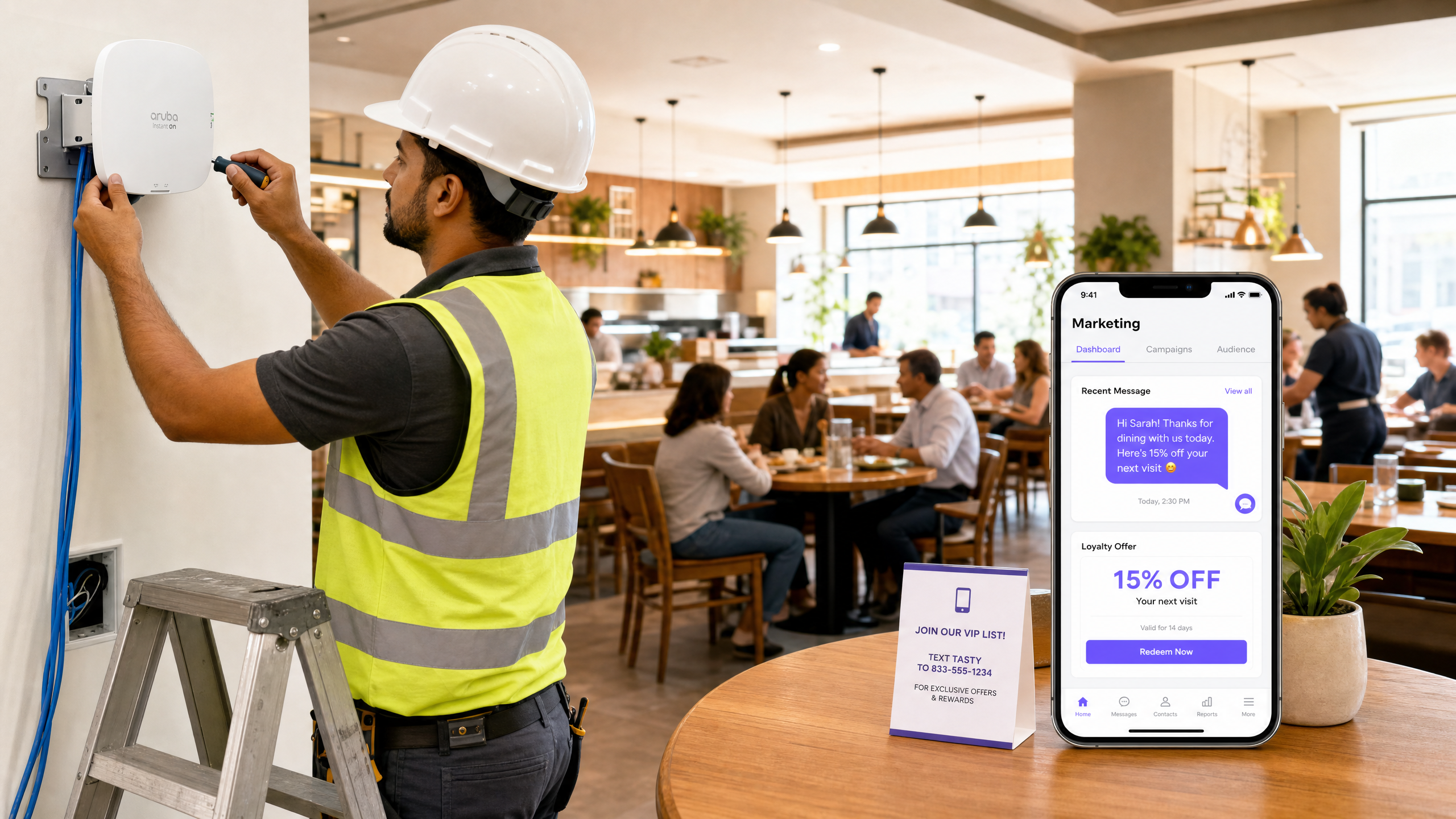
Executive Summary
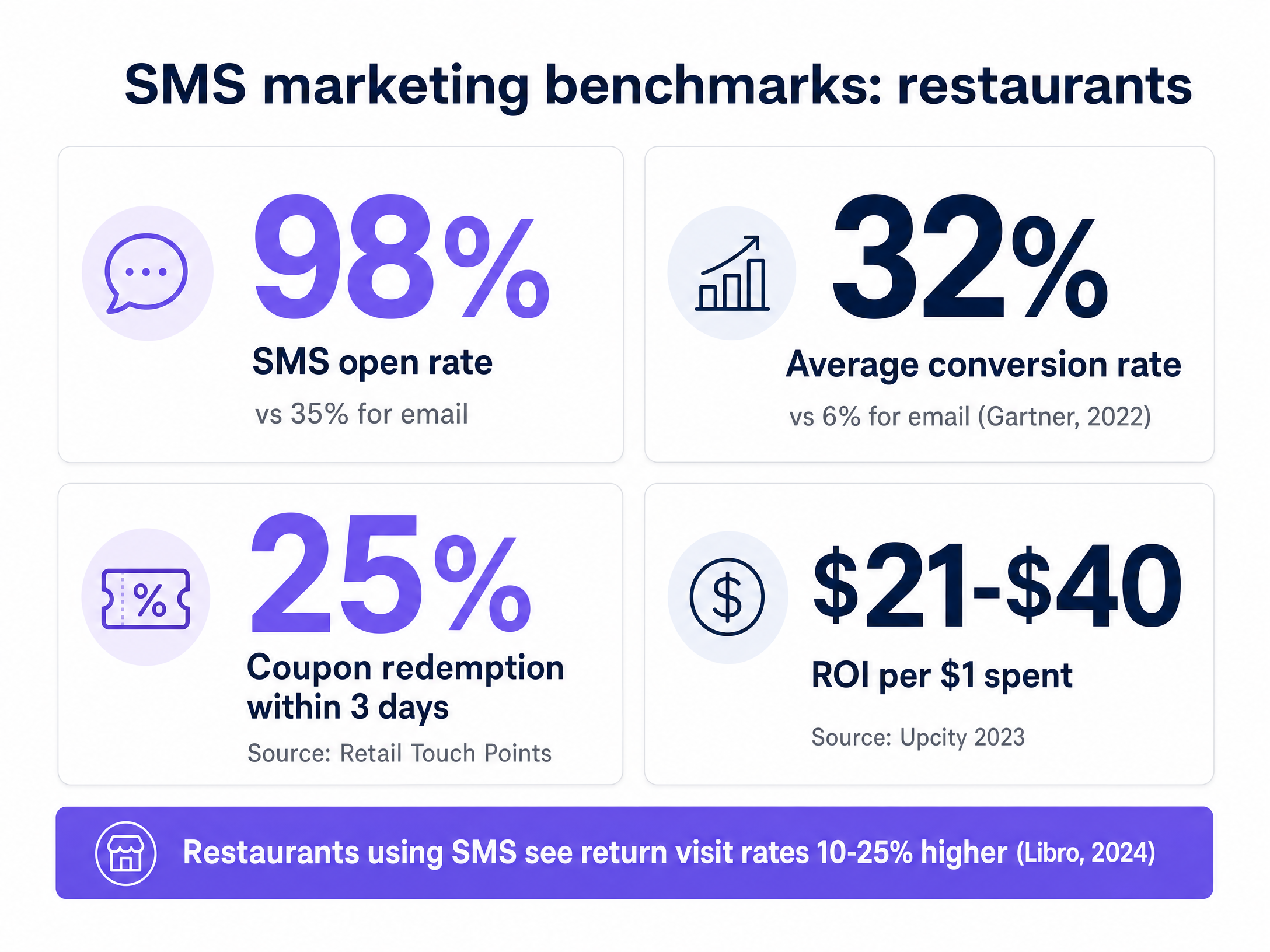
For CTOs and IT directors in the hospitality sector, the challenge of guest retention is fundamentally a data capture problem. The average restaurant loses approximately 60% of its guests after their first visit, largely due to a lack of actionable follow-up. While email marketing remains standard, SMS marketing for restaurants delivers a 98% open rate and a conversion rate of 32% [1]. However, deploying SMS at scale requires verified phone numbers and explicit, timestamped consent to meet UK GDPR and PECR requirements.
This guide details how to use your existing wireless infrastructure to build a compliant, automated SMS marketing engine. By using a Guest WiFi captive portal to authenticate users, venues can capture verified first-party data, enrich it with behavioural signals like dwell time and visit frequency, and trigger automated SMS campaigns through the Purple Engage platform. This approach transforms a cost-center amenity into a measurable revenue driver.
Technical Deep-Dive
The foundation of an effective SMS marketing strategy is the data capture architecture. The process relies on turning anonymous MAC addresses into known guest profiles using a cloud overlay on your existing hardware.
The Data Flow Architecture
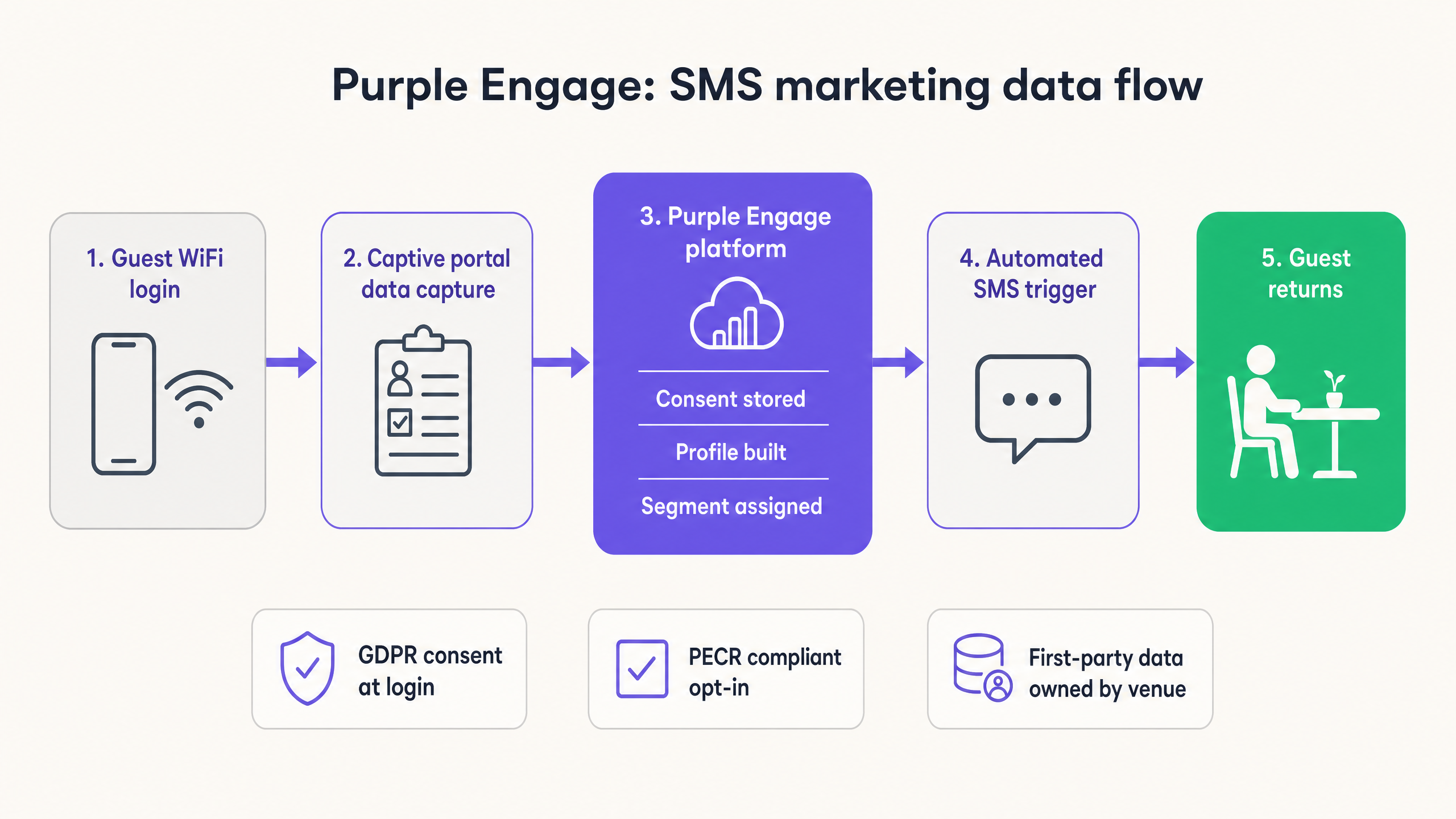
The typical deployment follows a five-stage data flow:
- Authentication Request: A guest connects to the SSID on supported hardware (e.g., Cisco Meraki, HPE Aruba, Ruckus, Juniper Mist). The controller redirects the user to the Purple captive portal via RADIUS.
- Data Capture and Consent: The splash page requires the guest to input their name, email, and mobile phone number. To ensure compliance, the page includes an unticked checkbox for explicit SMS marketing consent.
- Profile Creation: Purple ingests the data, verifies the phone number via a one-time passcode (OTP), and creates a first-party profile. This profile is enriched with subsequent session data.
- Behavioural Segmentation: The Engage platform automatically assigns the guest to a segment based on visit frequency and recency (e.g., New Visitor, VIP, Lapsed).
- Automated Trigger: When a guest meets the criteria for a specific segment, the platform dispatches an SMS via its native gateway, driving the guest back to the venue.
Identity and Verification
Unlike traditional sign-up forms, WiFi authentication ensures high data quality. When a guest logs in, the system can mandate OTP verification via SMS before granting network access. This process confirms the device is active and the number is accurate, eliminating the bounce rates associated with unverified lists.
Implementation Guide
Deploying SMS marketing through your WiFi infrastructure requires alignment between IT and marketing teams. Follow these steps to configure the system for maximum conversion and strict compliance.
Step 1: Configure the Captive Portal
The captive portal is the primary acquisition surface. Design the splash page to minimize friction while maximizing data capture.
- Mandatory Fields: Require First Name, Last Name, and Mobile Number.
- Consent Mechanism: Implement an explicit, unticked checkbox for marketing consent. The language must be clear, for example: "I consent to receiving personalised offers and notifications by SMS."
- Authentication Method: Use SMS OTP to verify the phone number before granting internet access.
Step 2: Define Behavioural Segments
Avoid batch-and-blast messaging. Use the WiFi Analytics engine to build dynamic segments based on physical behaviour.
- New Visitors: Guests who have connected for the first time.
- VIPs: Guests with three or more visits in a 90-day period.
- Lapsed Guests: Guests who have not connected to the network in 45 days.
Step 3: Automate the Triggers
Configure the Purple Engage platform to fire SMS messages based on segment entry or exit.
- Welcome Campaign: Trigger an SMS 24 hours after a New Visitor's first session, offering an incentive for their next visit.
- Win-Back Campaign: Trigger an SMS when a guest enters the Lapsed segment.
- Review Generation: Trigger an SMS 60 minutes after a session ends, requesting a Google or TripAdvisor review.
Best Practices
To maximize the impact of your SMS campaigns, adhere to these industry-standard practices.
Timing and Frequency
SMS is an immediate channel; 90% of messages are read within three minutes [2]. Time your messages to align with decision-making moments. For a restaurant, sending a lunch offer at 11:30 AM is highly effective. Limit frequency to one or two messages per week to prevent list fatigue and high opt-out rates.
Personalisation and Context
Use the data captured at login to personalise the message. Address the guest by name and reference their specific behaviour. A message that says, "Hi Sarah, we missed you! Get a free starter with your next main course" performs significantly better than a generic discount code.
Hardware Agnosticism
Ensure your strategy is hardware-agnostic. The Purple cloud overlay integrates with Cisco Meraki, HPE Aruba, Ruckus, Juniper Mist, Ubiquiti UniFi, Cambium, Extreme, and Fortinet. This allows you to deploy consistent SMS campaigns across a multi-vendor estate without replacing access points.
Troubleshooting & Risk Mitigation
When implementing SMS marketing, IT teams must mitigate specific risks related to compliance and data quality.
Managing Consent and GDPR
The primary risk in SMS marketing is regulatory non-compliance. Under UK GDPR and PECR, sending unsolicited SMS marketing carries severe penalties.
Mitigation: Rely exclusively on the explicit consent captured at the captive portal. Purple Engage automatically stores the timestamp and exact wording of the consent agreement. Furthermore, the platform handles opt-out requests (e.g., replying STOP) natively, instantly suppressing the number from future campaigns without manual database updates.
Addressing Low Opt-In Rates
If the captive portal sees high login rates but low SMS opt-in rates, the value exchange is likely unclear.
Mitigation: Clearly state the benefit of opting in on the splash page. Instead of "Sign up for marketing," use "Join our VIP list for exclusive SMS offers." Transparency increases conversion.
ROI & Business Impact
The business case for SMS marketing via guest WiFi is straightforward: it converts an existing operational cost (internet provision) into a measurable marketing asset.
Measuring Success
Track the following metrics to evaluate the performance of your SMS campaigns:
- Database Growth Rate: The number of verified, consented phone numbers acquired per week.
- Redemption Rate: The percentage of guests who claim the SMS offer. Industry benchmarks show that 25% of people redeem texted coupons within three days [3].
- Incremental Revenue: The total spend associated with redeemed offers minus the cost of the SMS dispatch.
By leveraging the Purple Engage platform, restaurants can expect an average ROI of $21 to $40 for every $1 spent on SMS marketing [4].
References
[1] Gartner. (2022). SMS Marketing Conversion Rates. [2] Tatango. (2023). 90% of Text Messages are Read within 3 Minutes. [3] Retail TouchPoints. (2023). Are Mobile Coupons the Answer to Higher Redemption Rates. [4] Upcity. (2023). SMS Marketing Survey.
Key Definitions
Captive Portal
A web page that a user must view and interact with before access is granted to a public WiFi network. It is the primary mechanism for capturing guest data and marketing consent.
IT teams configure this to balance seamless access with the business requirement to collect first-party data.
First-Party Data
Information a company collects directly from its customers and owns entirely, such as phone numbers gathered via a WiFi login.
Crucial for marketing teams looking to reduce reliance on third-party delivery apps and build a direct relationship with diners.
PECR
The Privacy and Electronic Communications Regulations. UK legislation that sits alongside GDPR and specifically governs electronic marketing, including SMS.
Compliance requires that venues secure explicit opt-in before sending promotional texts, a process automated by the Purple platform.
OTP Verification
One-Time Passcode verification. A security measure where a unique code is sent via SMS to verify the user's phone number before network access is granted.
Ensures the database is populated with accurate, active phone numbers, eliminating wasted spend on bounced SMS messages.
Behavioural Segmentation
The process of dividing a customer base into groups based on their physical actions in the venue, such as visit frequency or dwell time.
Allows marketing teams to send highly targeted SMS campaigns, such as win-back offers for lapsed guests, rather than generic blasts.
Cloud Overlay
A software architecture that integrates with existing hardware infrastructure to provide additional capabilities without requiring physical equipment changes.
Allows IT directors to deploy Purple Engage across a mixed estate of Cisco Meraki and HPE Aruba access points seamlessly.
Dwell Time
The duration a guest's device remains connected to the WiFi network during a single visit.
Used by operations directors to understand table turnover rates and identify bottlenecks in the service flow.
Opt-Out Management
The automated process of removing a user from a marketing list when they withdraw consent, typically by replying STOP to an SMS.
Essential for maintaining compliance and avoiding regulatory fines; handled natively by the Purple Engage platform.
Worked Examples
A 12-site casual dining chain needs to reactivate guests who haven't visited in over a month, but they only have an unverified email list with a 15% open rate. How should the IT and marketing teams deploy SMS to solve this?
The IT team configures the existing HPE Aruba access points to route guest authentication through the Purple captive portal. The portal is set to mandate SMS OTP verification and includes an explicit, unticked checkbox for marketing consent. Over 90 days, the chain builds a verified list of 28,000 consented phone numbers. The marketing team then uses Purple Engage to build a 'Lapsed' segment for guests with no WiFi sessions in 45 days. They trigger an automated SMS offering a free starter. The campaign reaches 4,200 guests, resulting in 840 redemptions (20% rate) and generating £27,000 in incremental revenue for an SMS cost of under £200.
A stadium food and beverage operator wants to increase sales at concourse kiosks during half-time, but previous email blasts sent days before the match showed no measurable impact on match-day spend.
The operator uses Purple's WiFi analytics to identify fans who connect to the network near the concession stands but are not part of the loyalty programme. They configure Purple Engage to send an automated SMS 30 minutes after the final whistle, offering a 20% discount on food and beverage for the next home game. The system checks the consent record before dispatching. The campaign achieves an 18% redemption rate at the following match.
Practice Questions
Q1. A restaurant operator wants to send an SMS blast to 5,000 phone numbers they collected via paper comment cards over the last two years. They plan to upload this list to Purple Engage. What is the primary risk, and what is the recommended approach?
Hint: Consider the requirements of PECR and the verification status of the data.
View model answer
The primary risk is regulatory non-compliance under GDPR and PECR, as paper records rarely have timestamped, explicit consent for SMS marketing, and the numbers are unverified. The recommended approach is to discard the unverified list and use the Purple captive portal to build a new, clean database of verified phone numbers with explicit, digitally recorded consent.
Q2. Your venue uses a mix of Cisco Meraki access points in the dining area and Ubiquiti UniFi in the outdoor seating space. How should you configure the SMS data capture to ensure a unified guest profile?
Hint: Think about how the Purple platform interacts with different hardware vendors.
View model answer
Because Purple operates as a hardware-agnostic cloud overlay, you do not need separate configurations. You configure both the Meraki and UniFi controllers to point to the same Purple captive portal via RADIUS. The platform unifies the data at the cloud level, creating a single guest profile regardless of which access point they connected to.
Q3. A marketing director wants to send an SMS offer to every guest who logs into the WiFi, immediately upon connection. Why is this a poor strategy, and what trigger should be used instead?
Hint: Consider the guest's immediate context and the concept of behavioural segmentation.
View model answer
Sending an SMS immediately upon login is disruptive and lacks context; the guest is likely just sitting down to order. A better strategy is to use behavioural triggers. For a new visitor, trigger a 'Welcome' SMS 24 hours after their session ends. For an immediate action, trigger a 'Review Request' SMS 60 minutes after the session ends, when they have completed their meal.
Continue reading in this series
How to leverage SMS marketing solutions to increase return visits
This guide details how to architect and deploy SMS marketing solutions using the Purple Engage platform to drive return visits at hotels, retail venues, stadiums, and public-sector sites. It covers captive portal configuration, verified phone number capture via SMS OTP, GDPR-compliant consent architecture, and trigger-based campaign automation using existing wireless infrastructure from Cisco Meraki, HPE Aruba, and other supported vendors.
How to leverage SMS text marketing to increase return visits
This guide details how venue operators can use SMS text marketing to drive measurable return visits by capturing verified first-party phone data through Guest WiFi. It covers the full technical architecture from captive portal authentication to RADIUS integration, the compliance requirements under GDPR and TCPA, and the automated campaign triggers that deliver consistent ROI across hospitality, retail, and transport environments.
How to leverage SMS marketing business to increase return visits
This guide details how venue operators can build an SMS marketing business strategy using enterprise Guest WiFi infrastructure to capture verified phone numbers, automate behaviour-triggered campaigns, and drive measurable return visits. It covers the full technical architecture from captive portal configuration and RADIUS authentication to GDPR-compliant consent flows and Purple Engage automation, with real-world scenarios from hospitality and retail environments.