

होटलों के लिए WiFi मार्केटिंग क्या है? एक होटल व्यवसायी की मार्गदर्शिका
यह आधिकारिक मार्गदर्शिका बताती है कि होटल IT और संचालन टीमें पहली-पक्षीय डेटा प्राप्त करने, सीधी बुकिंग बढ़ाने और बड़े पैमाने पर अतिथि अनुभव को व्यक्तिगत बनाने के लिए अतिथि WiFi बुनियादी ढांचे का लाभ कैसे उठा सकती हैं। इसमें Captive Portal प्रमाणीकरण से लेकर CRM एकीकरण तक की तकनीकी वास्तुकला, GDPR और PCI DSS के तहत अनुपालन दायित्व, और किसी भी आकार की संपत्तियों के लिए व्यावहारिक परिनियोजन रणनीतियाँ शामिल हैं। स्थल संचालक और IT टीमों को इस तिमाही में WiFi मार्केटिंग परिनियोजन को सही ठहराने और निष्पादित करने के लिए ठोस कार्यान्वयन चरण, कार्यशील परिदृश्य और मापने योग्य ROI फ्रेमवर्क मिलेंगे।
🎧 इस गाइड को सुनें
ट्रांसक्रिप्ट देखें
कार्यकारी सारांश
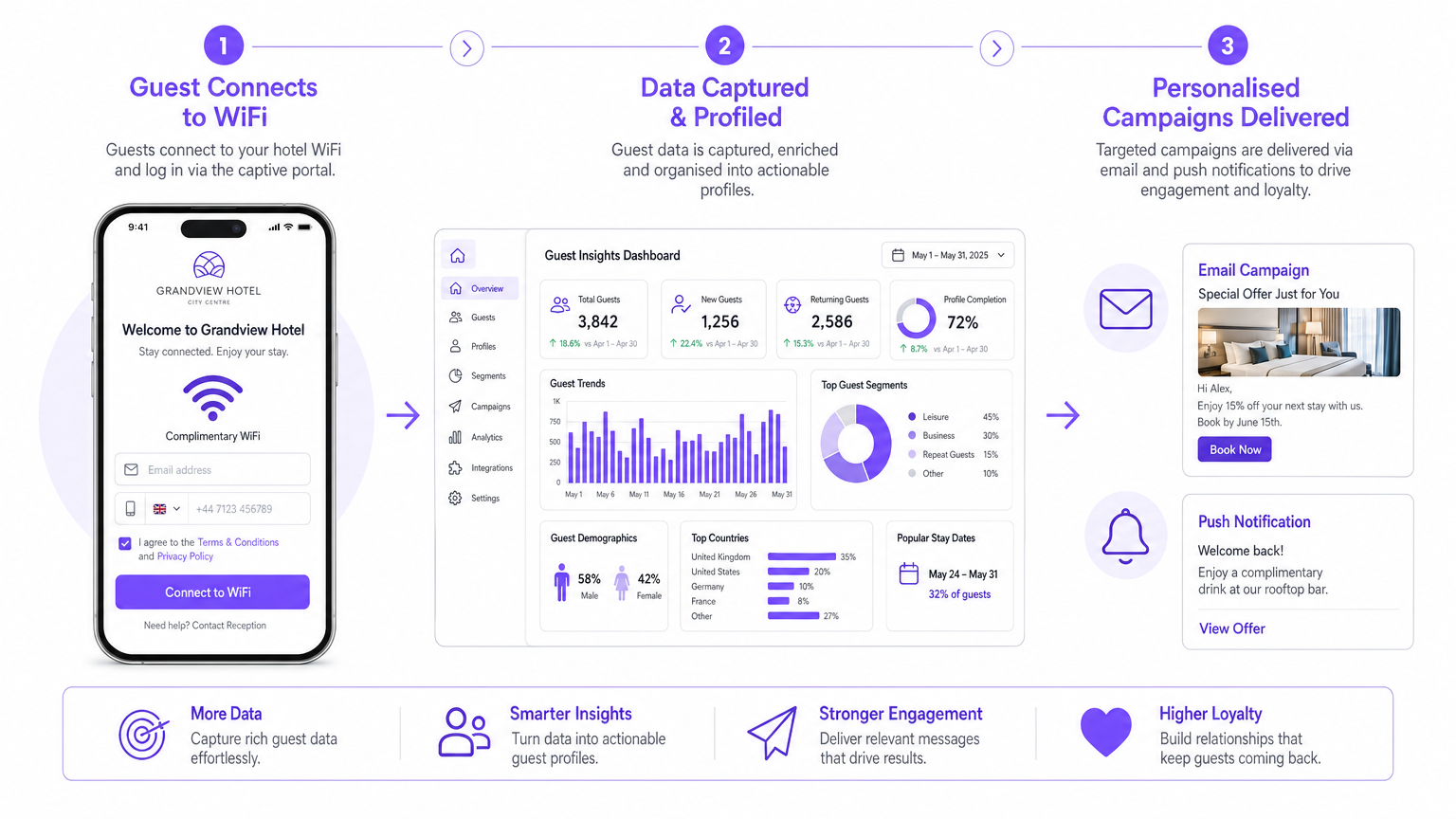
आधुनिक होटल व्यवसायियों और स्थल संचालकों के लिए, अतिथि WiFi अब केवल एक लागत केंद्र या अपेक्षित उपयोगिता नहीं है — यह एक महत्वपूर्ण पहली-पक्षीय डेटा अधिग्रहण चैनल है। होटलों के लिए WiFi मार्केटिंग मानक नेटवर्क एक्सेस को एक शक्तिशाली CRM और मार्केटिंग ऑटोमेशन टूल में बदल देता है। लॉगिन प्रक्रिया के दौरान प्रमाणित अतिथि डेटा प्राप्त करके, होटल विस्तृत अतिथि प्रोफाइल बना सकते हैं, स्थल विश्लेषण को समझ सकते हैं, और अत्यधिक लक्षित, स्वचालित अभियान तैनात कर सकते हैं जो सीधी बुकिंग बढ़ाते हैं और सहायक राजस्व में वृद्धि करते हैं।
यह मार्गदर्शिका IT प्रबंधकों, नेटवर्क आर्किटेक्ट्स और संचालन निदेशकों के लिए एक व्यापक तकनीकी संदर्भ प्रदान करती है जो एक Guest WiFi समाधान का मूल्यांकन या परिनियोजन कर रहे हैं। हम WiFi मार्केटिंग प्लेटफॉर्म की अंतर्निहित वास्तुकला, डेटा कैप्चर तंत्र, अनुपालन दायित्वों और मापने योग्य ROI प्राप्त करने के लिए WiFi Analytics के रणनीतिक परिनियोजन का अन्वेषण करते हैं। चाहे एक बुटीक संपत्ति का प्रबंधन कर रहे हों या एक बहु-साइट रिसॉर्ट समूह का, WiFi मार्केटिंग के यांत्रिकी को समझना अतिथि अनुभव को आधुनिक बनाने और तेजी से प्रतिस्पर्धी परिदृश्य में प्रत्यक्ष राजस्व को अधिकतम करने के लिए आवश्यक है।
तकनीकी गहन-विश्लेषण: WiFi मार्केटिंग कैसे काम करता है
अपने मूल में, होटलों के लिए WiFi मार्केटिंग एक Captive Portal पर निर्भर करता है - एक वेब पेज जो नेटवर्क एक्सेस प्रदान करने से पहले उपयोगकर्ता के HTTP या HTTPS अनुरोध को रोकता है। कीकार्ड पर मुद्रित एक साधारण प्री-शेयर्ड कुंजी (PSK) के बजाय, अतिथि ईमेल, सोशल मीडिया क्रेडेंशियल, या लॉयल्टी प्रोग्राम लॉगिन के माध्यम से प्रमाणित होते हैं। यह प्रमाणीकरण घटना प्राथमिक डेटा कैप्चर ट्रिगर है।
प्रमाणीकरण वास्तुकला
जब किसी अतिथि का उपकरण होटल SSID से जुड़ता है, तो एक्सेस पॉइंट (AP) या वायरलेस LAN कंट्रोलर डिवाइस को एक प्रतिबंधित VLAN में रखता है। सभी आउटबाउंड HTTP ट्रैफ़िक को DNS हाइजैक या HTTP 302 रीडायरेक्ट के माध्यम से Captive Portal URL पर इंटरसेप्ट और रीडायरेक्ट किया जाता है। पोर्टल स्वयं WiFi मार्केटिंग प्लेटफॉर्म के क्लाउड इन्फ्रास्ट्रक्चर से परोसा जाता है — Purple के मामले में, एक विश्व स्तर पर वितरित, अत्यधिक उपलब्ध वातावरण।
पोर्टल AAA: Authentication, Authorisation, और Accounting को संभालने के लिए एक RADIUS (रिमोट ऑथेंटिकेशन डायल-इन यूजर सर्विस) सर्वर के साथ संचार करता है। क्रेडेंशियल के सफल सबमिशन पर, RADIUS सर्वर कंट्रोलर को डिवाइस को अप्रतिबंधित VLAN में ले जाने का संकेत देता है, जिससे पूर्ण इंटरनेट एक्सेस प्रदान होता है। साथ ही, कैप्चर किया गया प्रोफ़ाइल डेटा — नाम, ईमेल पता, जनसांख्यिकीय जानकारी और सहमति फ़्लैग — होटल के CRM या प्रॉपर्टी मैनेजमेंट सिस्टम (PMS) को एक सुरक्षित REST API कॉल के माध्यम से प्रेषित किया जाता है।
आधुनिक परिनियोजन कॉर्पोरेट अतिथि खंडों के लिए IEEE 802.1X पोर्ट-आधारित एक्सेस कंट्रोल का समर्थन करते हैं, जबकि उपभोक्ता-उन्मुख SSIDs ऊपर वर्णित Captive Portal प्रवाह का उपयोग करते हैं। डेटा को ट्रांजिट में सुरक्षित रखने के लिए सभी SSIDs पर WPA3 एन्क्रिप्शन लागू किया जाना चाहिए, जो तेजी से कमजोर WPA2 मानक की जगह लेता है।
प्रेजेंस एनालिटिक्स और MAC एड्रेस ट्रैकिंग
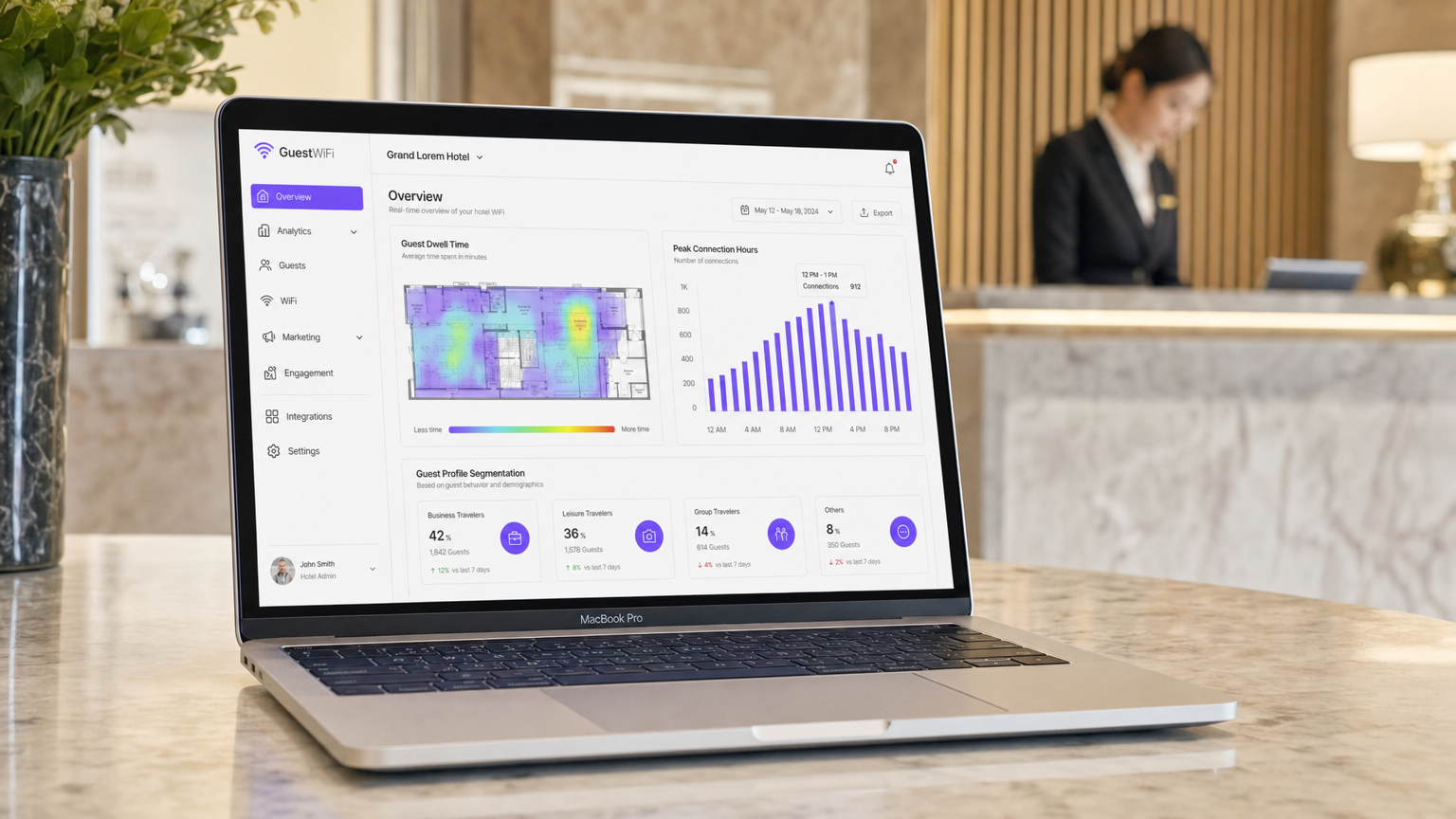
डेटा कैप्चर अतिथि द्वारा ब्राउज़र खोलने से पहले ही शुरू हो जाता है। जैसे ही कोई डिवाइस चालू होता है और उपलब्ध नेटवर्क के लिए स्कैन करता है, वह अपने MAC पते वाले प्रोब अनुरोधों को प्रसारित करता है। होटल का AP इन्फ्रास्ट्रक्चर इन प्रोब अनुरोधों को कैप्चर करता है और उन्हें एनालिटिक्स प्लेटफॉर्म पर अग्रेषित करता है। यह प्रेजेंस एनालिटिक्स को सक्षम बनाता है - सक्रिय प्रमाणीकरण की आवश्यकता के बिना ठहरने के समय की गणना करने, अद्वितीय आगंतुकों बनाम दोहराने वाले आगंतुकों की गणना करने और संपत्ति भर में आवाजाही के पैटर्न को मैप करने की क्षमता।
यह डेटा Hospitality ऑपरेटरों के लिए विशेष रूप से मूल्यवान है जो लॉबी, रेस्तरां, स्पा और सम्मेलन सुविधाओं के बीच अतिथि प्रवाह को समझना चाहते हैं। यह Retail वातावरण में फुटफॉल काउंटिंग के WiFi समकक्ष है, जो एक निरंतर, निष्क्रिय डेटा स्ट्रीम प्रदान करता है जो स्टाफिंग निर्णयों और स्थल लेआउट अनुकूलन को सूचित करता है। स्थान खुफिया पद्धतियों पर गहन जानकारी के लिए, हमारी Indoor Positioning System: UWB, BLE, & WiFi Guide देखें।
MAC रैंडमाइजेशन पर ध्यान दें: iOS 14+ और Android 10+ डिवाइस प्रोब अनुरोधों के लिए रैंडमाइज्ड MAC पतों का उपयोग करते हैं, जो पूर्व-प्रमाणीकरण प्रेजेंस एनालिटिक्स की सटीकता को सीमित करता है। हालांकि, प्रमाणित सत्र डिवाइस के वास्तविक MAC पते का उपयोग करते हैं, जो लॉगिन के बाद की ट्रैकिंग और वापसी-विज़िट पहचान की अखंडता को बनाए रखता है।
नेटवर्क वास्तुकला और विक्रेता संगतता
एंटरप्राइज़ WiFi मार्केटिंग प्लेटफॉर्म को विक्रेता-अज्ञेयवादी ओवरले के रूप में डिज़ाइन किया गया है, जो क्लाउड कंट्रोलर API के माध्यम से मौजूदा बुनियादी ढांचे के साथ एकीकृत होते हैं। Purple सिस्को मेराकी, अरुबा सेंट्रल, रकस स्मार्टज़ोन, यूबिक्विटी यूनिफी और अन्य के साथ एकीकरण का समर्थन करता है। एकीकरण मॉडल में आमतौर पर शामिल हैं:
| एकीकरण विधि | विवरण | उपयोग का मामला |
|---|---|---|
| क्लाउड कंट्रोलर API | प्लेटफ़ॉर्म कंट्रोलर से वेबहुक पोल करता है या प्राप्त करता है | रीयल-टाइम सत्र डेटा, नीति प्रवर्तन |
| RADIUS प्रॉक्सी | प्लेटफ़ॉर्म मध्यस्थ RADIUS सर्वर के रूप में कार्य करता है | एंटरप्राइज़ SSIDs के लिए प्रमाणीकरण |
| स्प्लैश पेज URL | कंट्रोलर बाहरी रूप से होस्ट किए गए Captive Portal पर रीडायरेक्ट करता है | उपभोक्ता-उन्मुख अतिथि WiFi |
| SNMP / Syslog | नेटवर्क घटनाओं की निष्क्रिय निगरानी | प्रेजेंस एनालिटिक्स, विसंगति का पता लगाना |
बैंडविड्थ प्रबंधन नीतियां प्रति उपयोगकर्ता खंड लागू की जा सकती हैं: अप्रमाणित उपयोगकर्ताओं के लिए बुनियादी थ्रूपुट, प्रमाणित अतिथियों के लिए मानक, और लॉयल्टी सदस्यों या सम्मेलन प्रतिनिधियों के लिए प्रीमियम - सभी RADIUS विशेषताओं के माध्यम से कंट्रोलर स्तर पर लागू किए जाते हैं।
कार्यान्वयन मार्गदर्शिका: परिनियोजनहोटल में WiFi मार्केटिंग का कार्यान्वयन
एक संरचित परिनियोजन दृष्टिकोण जोखिम को कम करता है और मूल्य-प्राप्ति के समय को तेज करता है। निम्नलिखित चरण किसी भी पैमाने की संपत्तियों पर लागू होते हैं।
चरण 1: बुनियादी ढाँचा मूल्यांकन
किसी भी प्लेटफ़ॉर्म कॉन्फ़िगरेशन से पहले, एक गहन साइट सर्वेक्षण करें। सभी अतिथि-सामना वाले क्षेत्रों — लॉबी, रेस्तरां, मीटिंग रूम, पूल क्षेत्र और गलियारों में AP कवरेज घनत्व सत्यापित करें। बाहरी Captive Portal रीडायरेक्ट और RADIUS प्रॉक्सी कॉन्फ़िगरेशन के साथ नियंत्रक की संगतता का आकलन करें। मौजूदा VLAN आर्किटेक्चर और फ़ायरवॉल नियमों का दस्तावेजीकरण करें, क्योंकि Captive Portal को विशिष्ट DNS और HTTP ट्रैफ़िक को 'वॉल्ड गार्डन' के माध्यम से अनुमति देने की आवश्यकता होती है।
चरण 2: Captive Portal डिज़ाइन और कॉन्फ़िगरेशन
Captive Portal WiFi मार्केटिंग प्रवाह में प्राथमिक ब्रांड टचपॉइंट है। इसे सभी डिवाइस फॉर्म फैक्टर पर प्रतिक्रियाशील होना चाहिए और परित्याग को कम करने के लिए 3G कनेक्शन पर दो सेकंड के भीतर लोड होना चाहिए। मुख्य कॉन्फ़िगरेशन निर्णयों में शामिल हैं:
प्रमाणीकरण विधियाँ: न्यूनतम दो विकल्प प्रदान करें — ईमेल पंजीकरण और सोशल लॉगिन (Google, Facebook)। बिजनेस होटलों के लिए, LinkedIn प्रमाणीकरण पेशेवर जनसांख्यिकीय डेटा को कैप्चर करने के लिए अत्यधिक प्रभावी है। लॉयल्टी-केंद्रित ब्रांडों के लिए, सीधा PMS एकीकरण लौटने वाले सदस्यों को उनके लॉयल्टी नंबर के साथ प्रमाणित करने की अनुमति देता है, जिससे मौजूदा प्रोफ़ाइल को समृद्ध किया जा सके बजाय डुप्लिकेट बनाने के।
प्रगतिशील प्रोफाइलिंग: कई विज़िट में डेटा को धीरे-धीरे एकत्र करें। पहले कनेक्शन पर, केवल एक ईमेल पता और मार्केटिंग संचार के लिए स्पष्ट सहमति की आवश्यकता होती है। दूसरी विज़िट पर, MAC पते के माध्यम से पहचाने जाने पर, एक अतिरिक्त डेटा बिंदु — यात्रा का कारण, पसंदीदा कमरे का प्रकार, या F&B प्राथमिकताएँ — के लिए संकेत दें, जिसके बदले में बैंडविड्थ अपग्रेड या एक मानार्थ सुविधा वाउचर दिया जाएगा।
सहमति और अनुपालन: पोर्टल को GDPR अनुच्छेद 7 के अनुपालन में, एक स्पष्ट, सरल भाषा में गोपनीयता सूचना और मार्केटिंग सहमति के लिए एक अलग, अनटिक किया हुआ चेकबॉक्स प्रस्तुत करना होगा। WiFi एक्सेस सहमति को मार्केटिंग सहमति के साथ बंडल न करें — ये अलग, दानेदार ऑप्ट-इन होने चाहिए। ऑडिट उद्देश्यों के लिए टाइमस्टैम्प के साथ सहमति रिकॉर्ड बनाए रखें।
चरण 3: CRM और मार्केटिंग ऑटोमेशन एकीकरण
WiFi प्लेटफ़ॉर्म का मूल्य उसके एकीकरणों के माध्यम से प्राप्त होता है। प्लेटफ़ॉर्म को होटल के CRM (जैसे, Salesforce, HubSpot) और PMS (जैसे, Opera, Mews) से REST API या नेटिव कनेक्टर के माध्यम से कनेक्ट करें। आधारभूत के रूप में निम्नलिखित स्वचालित अभियान ट्रिगर्स को कॉन्फ़िगर करें:
| ट्रिगर इवेंट | अभियान | चैनल | समय |
|---|---|---|---|
| पहला WiFi लॉगिन | स्वागत संदेश + F&B ऑफ़र | ईमेल | 15 मिनट के भीतर |
| चेक-आउट का पता चला | समीक्षा अनुरोध | ईमेल | प्रस्थान के 2 घंटे बाद |
| OTA बुकिंग का पता चला | सीधा बुकिंग प्रोत्साहन | ईमेल | ठहरने के 24 घंटे बाद |
| वापसी विज़िट (MAC मिलान) | लॉयल्टी प्रोग्राम आमंत्रण | ईमेल / SMS | कनेक्शन पर |
| रेस्तरां ज़ोन में ठहरना | डाइनिंग प्रमोशन | पुश / SMS | भोजन के घंटों के दौरान |
होटल WiFi मार्केटिंग के लिए सर्वोत्तम अभ्यास
जो परिनियोजन लगातार मजबूत ROI प्रदान करते हैं, उनमें कई विशेषताएँ समान होती हैं। निम्नलिखित सर्वोत्तम अभ्यास हॉस्पिटैलिटी क्षेत्र में उद्यम परिनियोजन से लिए गए हैं।
Captive Portal को एक रूपांतरण पृष्ठ के रूप में मानें। बुकिंग इंजन लैंडिंग पृष्ठों के लिए उपयोग किए जाने वाले समान रूपांतरण दर अनुकूलन (CRO) सिद्धांतों को लागू करें। हेडलाइन कॉपी, प्रोत्साहन ऑफ़र और फ़ॉर्म फ़ील्ड की संख्या का A/B परीक्षण करें। प्रारंभिक लॉगिन पर पाँच फ़ील्ड से दो तक की कमी आमतौर पर पूर्णता दरों को 30-50% तक बढ़ा देती है।
नेटवर्क सेगमेंटेशन लागू करें। अतिथि WiFi को होटल के परिचालन नेटवर्क (PMS टर्मिनल, डोर लॉक सिस्टम, भुगतान इन्फ्रास्ट्रक्चर) से समर्पित VLANs और फ़ायरवॉल नियमों का उपयोग करके अलग किया जाना चाहिए। यह नेटवर्क पर कार्ड भुगतान संसाधित करने वाली किसी भी संपत्ति के लिए PCI DSS आवश्यकता है और वैसे भी एक मौलिक सुरक्षा आधारभूत है।
परिचालन निर्णयों के लिए एनालिटिक्स का लाभ उठाएं। उपस्थिति एनालिटिक्स डैशबोर्ड केवल एक मार्केटिंग टूल नहीं है। पीक कनेक्शन घंटे का डेटा फ्रंट डेस्क स्टाफिंग शेड्यूल को सूचित करता है। ठहरने के समय के हीटमैप कम उपयोग किए गए राजस्व स्थानों की पहचान करते हैं। आगंतुक आवृत्ति डेटा क्षणिक मेहमानों को बार-बार आने वाले आगंतुकों से अलग करता है, जिससे लक्षित लॉयल्टी अधिग्रहण अभियानों को सक्षम किया जा सके।
व्यापक Martech स्टैक के साथ एकीकृत करें। WiFi डेटा सबसे शक्तिशाली होता है जब इसे PMS बुकिंग डेटा, ईमेल एंगेजमेंट मेट्रिक्स और लॉयल्टी प्रोग्राम गतिविधि के साथ जोड़ा जाता है। एक अतिथि जो WiFi से कनेक्ट होता है, ठहरने के बाद का ईमेल खोलता है, और फिर 30 दिनों के भीतर सीधे बुकिंग करता है, वह पूरी तरह से जिम्मेदार, WiFi-प्रभावित सीधी बुकिंग का प्रतिनिधित्व करता है — एक ऐसा मीट्रिक जो चैनल के ROI को सीधे मापता है।
पूरी अतिथि यात्रा में WiFi मार्केटिंग कैसे काम करती है, इसकी व्यापक जानकारी के लिए, WiFi मार्केटिंग कैसे काम करती है? देखें।
समस्या निवारण और जोखिम न्यूनीकरण
होटल WiFi मार्केटिंग परिनियोजन में निम्नलिखित विफलता मोड सबसे अधिक सामना किए जाते हैं।
Captive Portal का प्रकट न होना। सबसे अक्सर आने वाला समर्थन टिकट। मूल कारणों में शामिल हैं: DNS पोर्टल URL को हल नहीं कर रहा है (वॉल्ड गार्डन कॉन्फ़िगरेशन की जाँच करें), HTTPS-केवल ब्राउज़र व्यवहार HTTP रीडायरेक्ट को अवरुद्ध कर रहा है (सुनिश्चित करें कि प्रारंभिक रीडायरेक्ट के लिए पोर्टल URL HTTP है), या डिवाइस-स्तर पर Captive Portal का पता लगाने में विफलता (आक्रामक फ़ायरवॉल नियमों वाले iOS पर सामान्य)। समाधान: वॉल्ड गार्डन में Apple के Captive Portal डिटेक्शन एंडपॉइंट्स (captive.apple.com, www.apple.com/library/test/success.html) को श्वेतसूची में डालें।
कम ऑप्ट-इन दरें। यदि 60% से कम कनेक्टेड डिवाइस पोर्टल लॉगिन पूरा कर रहे हैं, तो मूल्य विनिमय विफल हो रहा है। पोर्टल का ऑडिट करें: अत्यधिक फ़ॉर्म फ़ील्ड, अस्पष्ट प्रोत्साहन, धीमा लोड समय, या एक गुम सोशल लॉगिन विकल्प। एक सरलीकृत दो-फ़ील्ड संस्करण का A/B परीक्षण करें।
CRM में डेटा डुप्लीकेशन। जब मेहमान कई डिवाइस पर कनेक्ट होते हैं या डिवाइस बदलने के बाद लौटते हैं, तो डुप्लिकेट प्रोफाइल बन सकते हैंed. CRM एकीकरण परत में ईमेल-आधारित डुप्लीकेशन हटाने का तर्क लागू करें। Purple का प्लेटफ़ॉर्म ईमेल पते को प्राथमिक कुंजी के रूप में उपयोग करके प्रोफ़ाइल विलय का समर्थन करता है।
एकीकरण विफलताएँ। CRM या PMS में API परिवर्तन डेटा सिंक को चुपचाप बाधित कर सकते हैं। वेबहुक निगरानी और अलर्टिंग लागू करें। एक दैनिक मिलान कार्य स्थापित करें जो WiFi सत्रों की संख्या की तुलना बनाए गए CRM रिकॉर्ड की संख्या से करता है, और एक परिभाषित सीमा से ऊपर की विसंगतियों को चिह्नित करता है।
ROI और व्यावसायिक प्रभाव
होटलों में WiFi मार्केटिंग के लिए व्यावसायिक मामला आतिथ्य क्षेत्र में अच्छी तरह से स्थापित है। प्राथमिक ROI चालक हैं:
फर्स्ट-पार्टी डेटाबेस वृद्धि। 150 कमरों वाला और 70% अधिभोग वाला एक मध्यम-श्रेणी का होटल प्रति वर्ष लगभग 38,000 अतिथि रातें उत्पन्न करेगा। 65% पोर्टल पूर्णता दर पर भी, यह प्रति वर्ष मार्केटिंग डेटाबेस में 24,000 से अधिक नए, ऑप्ट-इन प्रोफ़ाइल जोड़ता है — किसी भी सशुल्क डिजिटल चैनल की तुलना में अधिग्रहण की लागत काफी कम है।
सीधी बुकिंग में वृद्धि। OTA बुकर्स को सीधी बुकिंग प्रोत्साहन के साथ लक्षित करने वाले स्वचालित पोस्ट-स्टे अभियान आतिथ्य परिनियोजन में लगातार 3–8% रूपांतरण दर प्राप्त करते हैं। £120 की औसत दैनिक दर वाले 150 कमरों की संपत्ति के लिए, OTA बुकिंग का केवल 5% सीधे में परिवर्तित करने से OTA कमीशन में प्रति वर्ष लगभग £18,000–£25,000 की बचत होती है (15–20% कमीशन दर पर)।
सहायक राजस्व। रेस्तरां क्षेत्रों के पास ठहरने के समय WiFi-कनेक्टेड उपकरणों के माध्यम से वितरित स्थान-ट्रिगर F&B प्रचारों ने बहु-साइट आतिथ्य परिनियोजन में रेस्तरां कवर्स में 12-18% की वृद्धि प्रदर्शित की है।
परिचालन दक्षता। हाउसकीपिंग शेड्यूल और फ्रंट डेस्क स्टाफिंग को अनुकूलित करने के लिए उपयोग किए जाने वाले उपस्थिति एनालिटिक्स डेटा ने प्रलेखित परिनियोजन में श्रम लागत में 5-10% की कमी की है।
क्लाउड-प्रबंधित WiFi मार्केटिंग प्लेटफ़ॉर्म के स्वामित्व की कुल लागत आमतौर पर 150 कमरों की संपत्ति पर 6-12 महीनों के भीतर वसूल हो जाती है, जिसमें फर्स्ट-पार्टी डेटाबेस के चक्रवृद्धि मूल्य और स्वचालित अभियान प्रदर्शन द्वारा संचालित निरंतर ROI होता है।
मुख्य शब्द और परिभाषाएं
Captive Portal
A web page that intercepts a user's network request and requires interaction — typically authentication or consent — before granting full internet access.
The primary interface for guest data capture in WiFi marketing. IT teams configure the network controller to redirect unauthenticated devices to the portal URL.
RADIUS (Remote Authentication Dial-In User Service)
A networking protocol providing centralised Authentication, Authorisation, and Accounting (AAA) for network access. Defined in RFC 2865.
The underlying protocol used to authenticate users against a database when they log in via the captive portal. The WiFi marketing platform acts as a RADIUS proxy or server.
Presence Analytics
The use of WiFi probe request data (MAC addresses and RSSI signal strength) to track the physical presence, dwell time, and movement of devices within a venue, without requiring active authentication.
Enables passive footfall counting and venue heatmapping. Accuracy is reduced by MAC randomisation on modern iOS and Android devices.
Walled Garden
A network policy that permits unauthenticated devices to access a defined list of URLs or IP addresses before completing captive portal authentication.
Required to allow the captive portal page itself to load, and to permit Apple and Google captive portal detection endpoints — preventing the portal from failing to appear on iOS and Android devices.
Progressive Profiling
A data collection strategy that gathers customer information incrementally across multiple interactions, rather than requesting all data at the point of first contact.
Applied to captive portals to reduce friction at initial login. The platform recognises returning devices via MAC address and prompts for additional data on subsequent visits.
First-Party Data
Data collected directly from customers through owned channels, with explicit consent, as opposed to data purchased from third-party brokers or inferred from third-party cookies.
The primary output of WiFi marketing. First-party data is more accurate, more compliant, and more durable than third-party data, particularly in a post-cookie digital landscape.
MAC Address Randomisation
A privacy feature in iOS 14+, Android 10+, and Windows 10+ that assigns a randomised MAC address to probe requests, preventing passive tracking of devices before authentication.
Limits the accuracy of pre-authentication presence analytics. Post-authentication sessions use the device's true MAC address, preserving return-visit recognition for logged-in guests.
IEEE 802.1X
An IEEE standard for port-based network access control, providing an authentication mechanism for devices wishing to connect to a LAN or WLAN.
Recommended for enterprise guest segments (e.g., conference delegates, corporate accounts) requiring certificate-based or credential-based authentication rather than a captive portal flow.
Geofencing
The definition of a virtual geographic boundary within a venue, enabling the platform to trigger automated actions when an authenticated device enters, dwells within, or exits the defined zone.
Used in hotel WiFi marketing to deliver location-contextual offers — for example, a dining promotion triggered when a guest's device dwells near a restaurant entrance during meal service hours.
WPA3 (Wi-Fi Protected Access 3)
The third generation of the WPA security certification programme, providing stronger encryption (SAE replacing PSK) and improved protection against brute-force attacks.
The current recommended security standard for hotel guest SSIDs. WPA2 remains widely deployed but is increasingly vulnerable to KRACK and dictionary attacks.
केस स्टडीज
A 200-room city-centre business hotel currently offers free, unauthenticated WiFi via a shared WPA2 password distributed on keycards. The commercial director wants to reduce OTA dependency and increase direct bookings. The IT manager needs to implement a solution without replacing the existing Cisco Meraki infrastructure.
- Deploy Purple's cloud-managed captive portal, integrating with the existing Meraki dashboard via API. Configure a dedicated guest SSID with splash page redirect enabled, pointing to the Purple-hosted portal URL. 2. Design a two-field portal (email + marketing consent checkbox) with a LinkedIn social login option, given the business traveller demographic. 3. Configure a VLAN for guest traffic, isolated from the hotel's operational network, with firewall rules blocking inter-VLAN routing. 4. Integrate the Purple platform with the hotel's CRM via REST API, mapping the captured email address and consent flag to the CRM contact schema. 5. Build three automated email campaigns: a welcome email with a direct booking discount code (triggered on first login), a post-stay review request (triggered 2 hours after the last session ends), and a 'book direct next time' campaign targeting guests whose booking source in the PMS is flagged as an OTA (triggered 48 hours post-departure). 6. Set up the analytics dashboard to track weekly database growth, campaign open rates, and attributed direct bookings.
A 450-room resort with multiple F&B outlets, a spa, and a conference centre wants to use WiFi data to increase in-stay ancillary spend. The marketing team has no visibility into which guests are using which facilities, and the current WiFi system provides no analytics beyond basic uptime monitoring.
- Deploy a WiFi marketing platform with presence analytics enabled across all APs, including those in the restaurant, spa reception, pool bar, and conference lobby. 2. Define geofence zones corresponding to each revenue centre. 3. Configure location-triggered campaigns: when a guest's authenticated device dwells in the pool zone for more than 20 minutes between 12:00 and 14:00, trigger an SMS offering a 15% discount at the poolside bar, valid for 2 hours. When a device is detected in the spa reception zone, trigger an email promoting available treatment slots for that day. 4. Integrate the WiFi platform with the PMS to cross-reference room type and length of stay, enabling segmentation of leisure guests (more likely to respond to spa offers) versus conference delegates (more likely to respond to F&B and evening entertainment offers). 5. Build a weekly analytics report tracking geofence trigger volume, campaign redemption rate, and incremental revenue per triggered campaign.
परिदृश्य विश्लेषण
Q1. A hotel IT manager is configuring the captive portal for a new 180-room property. The commercial director wants to maximise the volume of marketing-opted-in profiles captured. The IT manager is concerned that a long registration form will cause guests to abandon the portal and use mobile data instead. How should the portal be configured to balance data acquisition with user experience?
💡 संकेत:Consider how much data is strictly necessary for the initial connection versus what can be gathered on subsequent visits using device recognition.
अनुशंसित दृष्टिकोण दिखाएं
Implement progressive profiling. For the initial connection, require only an email address and a separate, unticked marketing consent checkbox. On subsequent visits, the platform recognises the returning device via MAC address and prompts for one additional data point — reason for travel, preferred room type, or loyalty number — in exchange for a tangible incentive such as a bandwidth upgrade or a complimentary amenity. This approach typically achieves 70–80% initial completion rates versus 40–50% for a five-field form, while still building a rich profile over time. The commercial director's objective is served by maximising the number of opted-in email addresses captured, which is best achieved by minimising friction at the point of first contact.
Q2. During a network security audit, the CTO of a 300-room hotel discovers that the guest WiFi SSID shares a VLAN with the hotel's PMS terminals and door lock management system. The current setup uses a single WPA2 pre-shared key for all devices. What are the primary risks, and what remediation steps should be prioritised?
💡 संकेत:Evaluate both the security implications of shared network access and the compliance obligations under PCI DSS for payment-adjacent systems.
अनुशंसित दृष्टिकोण दिखाएं
The primary risks are: (1) Network lateral movement — a compromised guest device on the shared VLAN could attempt to access PMS terminals or door lock systems, representing a significant physical security and data breach risk. (2) PCI DSS non-compliance — any system that processes, stores, or transmits cardholder data must be isolated from untrusted networks; a shared guest/PMS VLAN is a direct violation of PCI DSS Requirement 1.3. (3) Zero data capture — the shared PSK provides no authentication event, meaning no guest profiles are being built. Remediation priority: (1) Immediately create a dedicated guest VLAN with firewall rules blocking all inter-VLAN routing to operational systems. (2) Deploy a captive portal on the guest SSID to replace the shared PSK. (3) Engage a QSA (Qualified Security Assessor) to validate the new network segmentation against PCI DSS requirements before the next assessment cycle.
Q3. A venue operations director at a large conference hotel reviews the presence analytics dashboard and notices that a high volume of devices are detected near the hotel's business centre between 08:00 and 10:00, but very few devices are authenticated (logged in via the captive portal) during that period. What does this data indicate, and what actions should be taken?
💡 संकेत:Differentiate between passive presence detection (MAC probe requests) and active authentication (captive portal login). Consider why the gap might exist and what it costs the business.
अनुशंसित दृष्टिकोण दिखाएं
The data indicates that a significant number of guests are physically present in the business centre but are not connecting to the hotel WiFi — they are likely using mobile data or a corporate VPN that bypasses the captive portal. This represents a lost data acquisition opportunity. Actions to take: (1) Investigate whether the captive portal is appearing correctly on corporate devices — enterprise security configurations often suppress captive portal detection. Consider offering an alternative authentication method (e.g., a QR code linking directly to the portal URL) displayed on signage in the business centre. (2) Review the portal's value proposition for business travellers — a higher bandwidth tier or a complimentary printing credit may be a more compelling incentive than a generic welcome message. (3) Assess whether IEEE 802.1X authentication would be more appropriate for this segment, as it integrates with corporate device management and removes the captive portal friction entirely while still capturing an authenticated identity.




