
Come Connettersi con i Clienti: Strategie Digitali per le Attività Fisiche
Questa guida tecnica di riferimento autorevole descrive in dettaglio come le attività con sede fisica — hotel, catene di vendita al dettaglio, stadi e luoghi del settore pubblico — possano implementare un'infrastruttura WiFi aziendale come motore di acquisizione dati di prima parte e di coinvolgimento dei clienti. Copre l'intera architettura, dalla progettazione del captive portal e l'autenticazione senza interruzioni (IEEE 802.11u/Passpoint) all'integrazione CRM, alla conformità GDPR e al ROI misurabile. I responsabili IT e gli operatori delle strutture troveranno indicazioni pratiche per l'implementazione, casi di studio reali e un framework di mitigazione del rischio incentrato sulla conformità.
Ascolta questa guida
Visualizza trascrizione del podcast
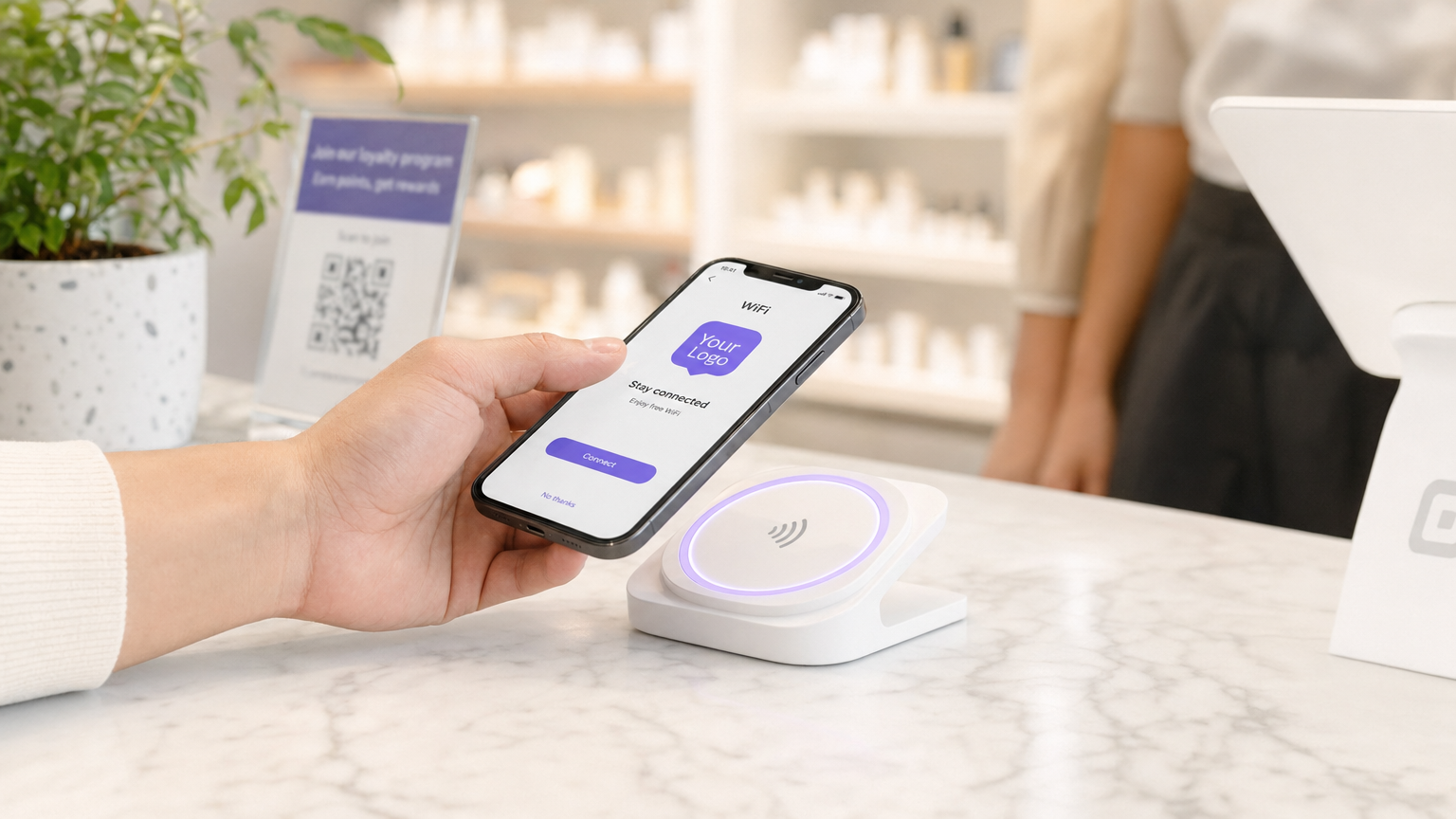
Riepilogo Esecutivo
Per i responsabili IT che gestiscono strutture fisiche — che si tratti di un hotel da 500 camere, di un vasto complesso commerciale o di uno stadio ad alta capacità — la rete non è più solo un centro di costo che fornisce accesso a internet. È il condotto primario per comprendere il comportamento dei clienti e generare entrate. Le attività fisiche affrontano un deficit di dati critico rispetto ai concorrenti dell'e-commerce: un rivenditore online conosce ogni clic, ogni scorrimento e ogni carrello abbandonato. Una struttura fisica potrebbe conoscere un cliente solo se questi utilizza una carta fedeltà al momento del pagamento.
Questa guida descrive in dettaglio come colmare tale lacuna trasformando l'infrastruttura Guest WiFi passiva in un motore di acquisizione dati attivo e conforme. L'implementazione di una strategia di connessione clienti di livello aziendale richiede l'allineamento dell'architettura di rete con gli obiettivi di marketing. Sfruttando i captive portal, i protocolli di autenticazione senza interruzioni come Passpoint/OpenRoaming e le robuste integrazioni API con i sistemi CRM, i team IT possono ottenere un ROI misurabile. Trattiamo i requisiti tecnici, le strategie di implementazione e le tattiche di mitigazione del rischio necessarie per costruire una relazione digitale sicura e scalabile con i vostri visitatori fisici — negli ambienti Retail , Hospitality , Healthcare e Transport .
Approfondimento Tecnico: Architettura della Connessione
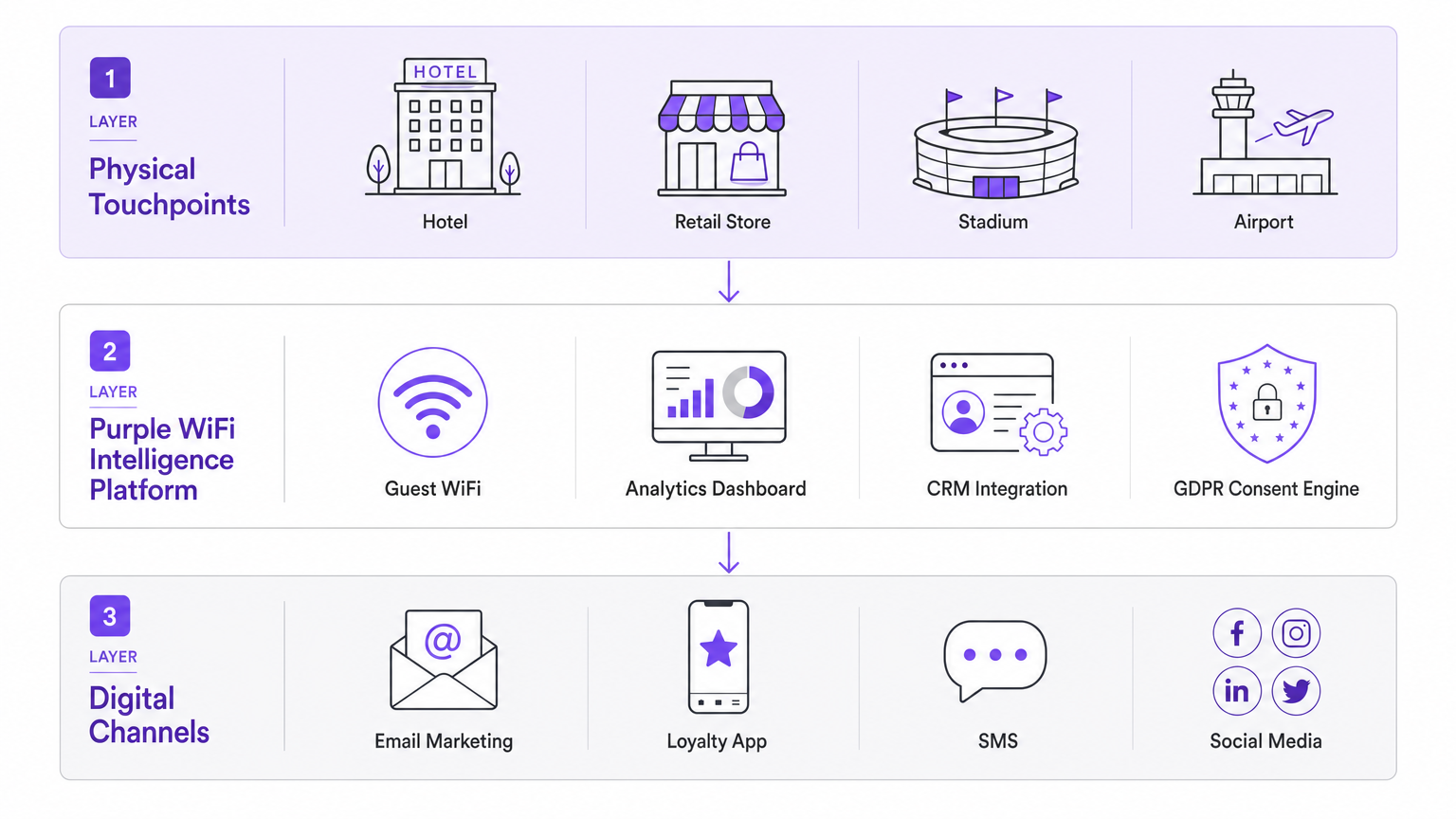
Connettersi digitalmente con i clienti all'interno di uno spazio fisico si basa su un'architettura a più livelli che bilancia un'esperienza utente senza interruzioni con rigorosi requisiti di sicurezza e conformità. L'architettura può essere scomposta in tre strati funzionali: lo Strato di Accesso, lo Strato di Intelligenza e lo Strato di Integrazione.
Lo Strato di Accesso: Autenticazione e Onboarding
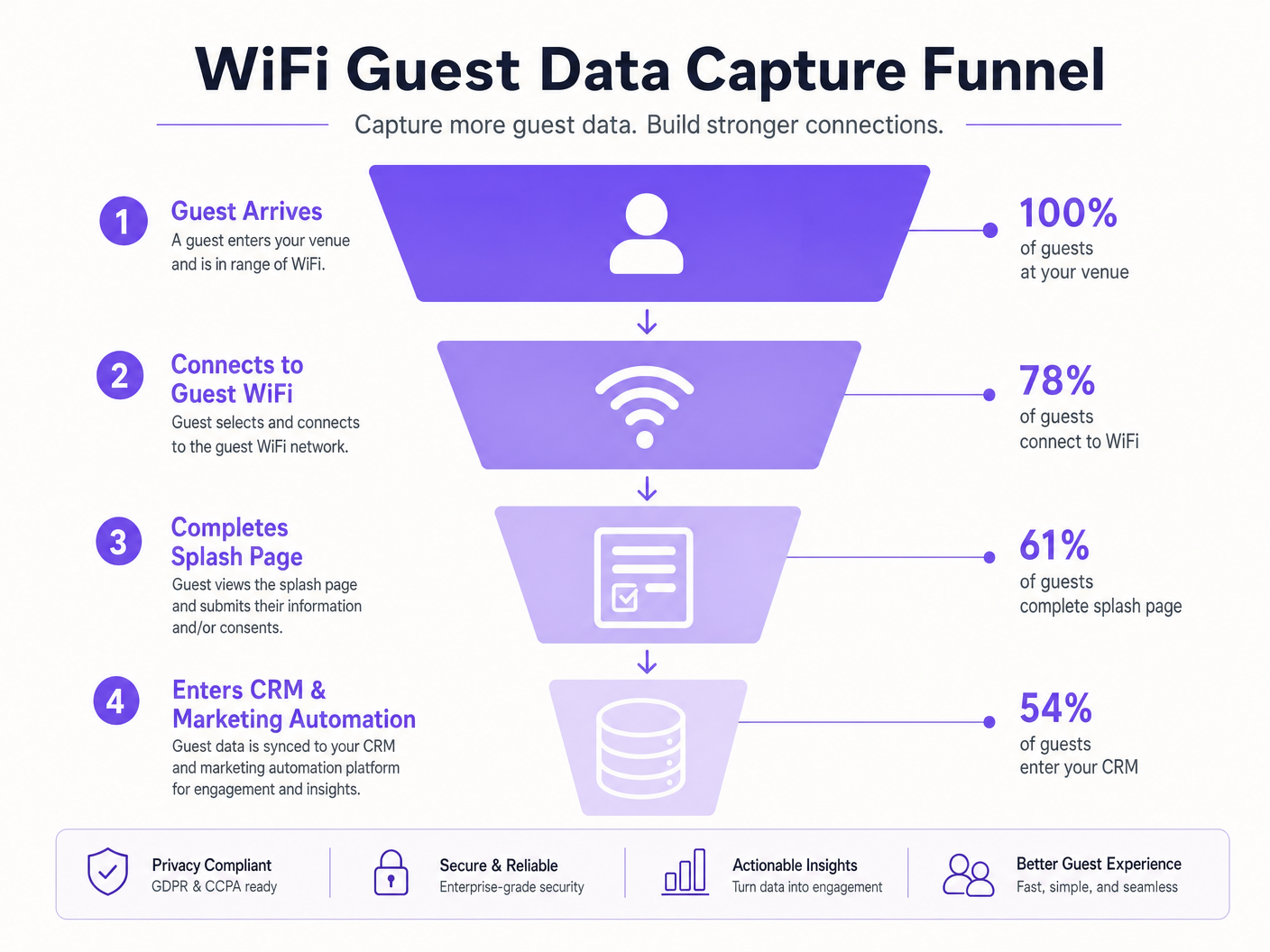
Il tradizionale captive portal rimane un elemento fondamentale, ma la sua esecuzione deve evolvere. Un'implementazione moderna sfrutta una splash page reattiva, renderizzata dinamicamente, che autentica gli utenti acquisendo dati di prima parte. Il portal deve essere mobile-first — la maggior parte degli utenti sarà su smartphone — e deve caricarsi in meno di due secondi per prevenire l'abbandono.
Ottimizzazione del Captive Portal: La splash page funge da punto di contatto iniziale, acquisendo il consenso esplicito per il trattamento dei dati (conformità GDPR/CCPA) e raccogliendo dati demografici di base. Fondamentalmente, deve implementare la profilazione progressiva — richiedendo dati minimi alla prima visita (ad esempio, indirizzo email) e raccogliendo dati di profilo più ricchi nelle visite successive. Le strutture che richiedono dati eccessivi in anticipo registrano costantemente tassi di abbandono superiori al 60%.
Autenticazione senza interruzioni (Passpoint/OpenRoaming): Per i visitatori di ritorno o i clienti fedeli, un onboarding senza attriti è fondamentale. L'implementazione di IEEE 802.11u (Passpoint/Hotspot 2.0) consente ai dispositivi di autenticarsi automaticamente in modo sicuro — utilizzando WPA2/WPA3-Enterprise — senza intervento dell'utente, rispecchiando l'esperienza di roaming cellulare. OpenRoaming estende questo a una federazione di reti partecipanti. Purple agisce come provider di identità in questo ecosistema, facilitando connessioni sicure e automatiche sotto la sua licenza Connect. Questo elimina completamente il captive portal per gli utenti registrati, offrendo un'esperienza di livello carrier.
Lo Strato di Intelligenza: Elaborazione Dati e Analisi
Una volta autenticato un dispositivo, l'infrastruttura di rete — access point e controller — genera una grande quantità di dati di telemetria. È qui che le piattaforme WiFi Analytics forniscono un valore sostanziale, trasformando gli eventi di rete grezzi in business intelligence azionabile.
Analisi di Presenza e Posizione: Analizzando le richieste di probe e i dati RSSI (Received Signal Strength Indicator), la piattaforma calcola i tempi di permanenza, i tassi di ritorno e i modelli di traffico pedonale all'interno della struttura. Le implementazioni avanzate utilizzano la trilaterazione su più access point, o sovrapposizioni di beacon BLE, per un posizionamento indoor granulare accurato entro pochi metri.
Hashing MAC e Conformità alla Privacy: Questo è il confine critico della conformità. Prima che un utente fornisca il consenso esplicito tramite il captive portal, il sistema non deve archiviare Informazioni di Identificazione Personale (PII). Gli indirizzi MAC grezzi devono essere immediatamente anonimizzati utilizzando un hash crittografico unidirezionale (ad esempio, HMAC-SHA256). Ciò consente alla piattaforma di tracciare il comportamento aggregato — tempo di permanenza, frequenza delle visite di ritorno — senza archiviare alcuna PII, mantenendo la conformità con l'Articolo 5 del GDPR e il CCPA. Una volta che un utente si autentica e fornisce il consenso, i dati di rete vengono unificati con il suo profilo utente completo.
Lo Strato di Integrazione: Attivazione dei Dati
I dati che risiedono esclusivamente in una dashboard di rete forniscono un valore aziendale limitato. L'architettura deve supportare l'esportazione dei dati in tempo reale verso lo stack tecnologico di marketing più ampio.
Architettura API e Webhook: API RESTful e webhook robusti sono essenziali per inviare profili utente autenticati ed eventi di posizione a piattaforme CRM, strumenti di automazione del marketing e applicazioni di fidelizzazione. L'integrazione deve essere bidirezionale — la piattaforma WiFi dovrebbe anche ricevere dati cliente arricchiti dal CRM per personalizzare l'esperienza del portal per i visitatori di ritorno.
Coinvolgimento basato su trigger: L'integrazione abilita flussi di lavoro automatizzati e in tempo reale. Un webhook attivato da un ospite che si connette al WiFi può avviare un w personalizzatoemail di benvenuto o un'offerta SMS entro pochi secondi dalla connessione. Un evento di localizzazione attivato da un cliente VIP che entra in una zona premium può inviare una notifica personalizzata alla sua app mobile. Questo è il meccanismo che converte un evento di rete passivo in un'azione di ricavo misurabile. Come esplorato nella nostra guida su Come la Personalizzazione Aumenta la Fedeltà dei Clienti e le Vendite , la rilevanza contestuale è il principale motore di conversione.
Guida all'Implementazione: Strategia di Deployment Vendor-Neutral
Un deployment di successo richiede una collaborazione interfunzionale tra IT, marketing e operations. La seguente sequenza si applica agli ambienti dell'ospitalità, del retail e del settore pubblico.
Fase 1 — Definire la Strategia dei Dati: Prima di configurare gli SSID, determinare quali dati sono effettivamente necessari e quale obiettivo aziendale servono. State costruendo una lista di email marketing, promuovendo download di app, tracciando il tempo di permanenza per l'ottimizzazione operativa o riducendo la dipendenza dagli OTA? La risposta detta il design del Captive Portal, le integrazioni richieste e i KPI rispetto ai quali il deployment sarà misurato.
Fase 2 — Valutazione della Rete e Validazione dell'Infrastruttura: Assicurarsi che l'infrastruttura WLAN sottostante possa supportare ambienti client ad alta densità. Ciò comporta indagini RF sul sito, pianificazione della capacità (mirando a un minimo di 25 client per access point al carico di punta) e convalida della larghezza di banda del backhaul. Per le sedi ad alto traffico, valutare se una Leased Line dedicata sia necessaria per garantire throughput e SLA di latenza.
Fase 3 — Configurazione del Captive Portal: Progettare una splash page mobile-first con una chiara proposta di valore. Implementare la profilazione progressiva. Assicurarsi che il walled garden sia configurato correttamente per consentire il traffico di pre-autenticazione a tutti i servizi richiesti (API di social login, URL degli app store, gateway di pagamento). Implementare meccanismi di opt-in chiari e inequivocabili per le comunicazioni di marketing — caselle di controllo separate per email, SMS e condivisione con terze parti sono la best practice secondo il GDPR.
Fase 4 — Configurazione dell'Integrazione: Stabilire connessioni API sicure tra la piattaforma WiFi e il CRM. Mappare i campi dati con precisione. Implementare endpoint webhook con gestione robusta degli errori, logica di retry e conferma di consegna. Convalidare che il timestamp Last Seen, la frequenza delle visite e i dati di localizzazione della sede stiano popolando i campi CRM corretti.
Fase 5 — Test e Validazione: Condurre test end-to-end rigorosi su tutti i principali tipi di dispositivo (iOS, Android, Windows, macOS) e browser. Testare ogni percorso di autenticazione (email, social login, Passpoint). Verificare il flusso di dati dal bordo della rete al CRM utilizzando profili di test. Documentare e risolvere tutti i problemi del walled garden prima del go-live.
Fase 6 — Monitoraggio e Ottimizzazione Continua: Dopo il deployment, stabilire dashboard che tracciano il tasso di conversione del portale, il tasso di acquisizione dati, i tassi di errore API e il successo della consegna dei webhook. Rivedere questi dati settimanalmente durante il primo mese. Effettuare A/B test sui design del portale per ottimizzare la conversione.
Best Practice per gli Operatori di Sede
Dare Priorità all'Accesso Senza Attrito: Ogni passaggio aggiuntivo nel processo di onboarding riduce la conversione. Utilizzare opzioni di social login (OAuth 2.0) o protocolli di autenticazione senza interruzioni ove applicabile. L'obiettivo per un portale ben ottimizzato è un tempo di connessione inferiore a 30 secondi.
Articolare lo Scambio di Valore: I clienti si aspettano un beneficio tangibile in cambio dei loro dati. Dichiarare chiaramente il beneficio sulla splash page — che si tratti di accesso ad alta velocità, uno sconto esclusivo o servizi migliorati della sede. Messaggi vaghi o generici riducono significativamente i tassi di opt-in.
L'Engagement Contestuale Guida il ROI: Sfruttare i dati di localizzazione per fornire messaggi pertinenti al momento giusto. Una newsletter settimanale generica è molto meno efficace di un SMS attivato quando un cliente entra in un reparto specifico di un negozio al dettaglio o in una zona specifica di una struttura ricettiva. Questo è il principio fondamentale su come costruire la connessione con i clienti nel retail e in altri ambienti fisici.
Segmentare e Personalizzare: Utilizzare la frequenza delle visite, il tempo di permanenza e i dati demografici acquisiti tramite il portale per segmentare il pubblico. I visitatori per la prima volta, i visitatori frequenti e i visitatori inattivi dovrebbero ricevere comunicazioni differenziate. Fare riferimento alla nostra guida Wie Personalisierung Kundenbindung und Umsatz steigert per un quadro dettagliato sulla strategia di personalizzazione.
Monitoraggio Continuo: La strategia di connessione digitale non è un deployment "imposta e dimentica". Rivedere regolarmente le analisi di connessione, i tassi di abbandono del portale, i log di integrazione e le prestazioni delle campagne. Gli aggiornamenti del sistema operativo di Apple e Google alterano frequentemente il comportamento di rilevamento del Captive Portal, richiedendo aggiustamenti del portale.
Risoluzione dei Problemi e Mitigazione del Rischio
| Rischio | Causa Radice | Mitigazione |
|---|---|---|
| Alto tasso di abbandono del portale | Walled garden mal configurato; richieste di dati eccessive; tempo di caricamento del portale lento | Verificare la whitelist del walled garden; implementare la profilazione progressiva; ottimizzare gli asset del portale |
| Errori di social login | Server del provider di autenticazione non inseriti nella whitelist | Aggiungere tutti gli IP/domini degli endpoint OAuth al walled garden |
| Non conformità GDPR | Consenso implicito; mancanza di politica di conservazione dei dati | Implementare caselle di controllo di opt-in esplicito; definire e applicare periodi di conservazione; condurre audit DPA regolari |
| Errori di sincronizzazione dati CRM | Limiti di frequenza API; modifiche allo schema; errori di consegna webhook | Implementare avvisi di errore; utilizzare la logica di retry con backoff esponenziale; monitorare i tassi di consegna webhook |
| Scarsa precisione della localizzazione | Densità AP insufficiente; interferenza multipath | Condurre un'indagine RF; aumentare la densità AP nelle zone target; considerare l'overlay di beacon BLE |
| Ambito PCI DSS creep | Rete WiFi per ospiti non correttamente segmentata dalla rete di pagamento | Applicare una rigorosa segmentazione della rete (VLAN separate); assicurarsi che il traffico degli ospiti non possa raggiungere i sistemi POS |
ROI e Impatto sul Business
La transizione da una rete intesa come centro di costo a una piattaforma generatrice di ricavi è misurabile. I seguenti KPI forniscono un quadro per dimostrare l'impatto sul business alla direzione (C-suite).
| KPI | Definizione | Benchmark |
|---|---|---|
| Tasso di Acquisizione Dati | Percentuale di visitatori della sede che si autenticano e forniscono informazioni di contatto | 40-65% (varia in base al tipo di sede e al design del portale) |
| Tasso di Crescita della Lista Email | Nuovi contatti opt-in al mese attribuiti al WiFi | Dipendente dalla sede; monitorare l'andamento mese su mese |
| Ricavi Attribuiti alla Campagna | Ricavi da clienti acquisiti tramite il portale WiFi, tracciati tramite CRM | Richiede il tracciamento UTM e l'attribuzione CRM |
| Tasso di Visite di Ritorno | Percentuale di utenti WiFi che ritornano entro 30/60/90 giorni | La baseline varia; monitorare l'aumento post-campagna |
| Tempo di Permanenza | Tempo medio trascorso nella sede dagli utenti connessi | Benchmark operativo; utilizzare per ottimizzare il layout e il personale |
| Tasso di Download dell'App | Percentuale di utenti del portale che scaricano l'app della sede | Obiettivo 15-25% con un forte incentivo |
Case Study: Gruppo di Hotel Boutique (200 camere, 3 proprietà)
Un gruppo di hotel boutique ha implementato la piattaforma guest WiFi di Purple in tre proprietà, integrandola con il loro PMS e la piattaforma di email marketing esistenti. Il captive portal è stato configurato per identificare gli ospiti che avevano prenotato tramite OTA e offrire loro un'offerta personalizzata per la prenotazione diretta al loro prossimo soggiorno. Entro sei mesi, il gruppo ha registrato un aumento del 22% delle richieste di prenotazione diretta da parte di ospiti abituali, una crescita del 41% del loro database di email opt-in e una riduzione misurabile dei costi di commissione OTA. L'implementazione si è ripagata entro il primo trimestre.
Case Study: Catena di Negozi al Dettaglio Regionale (45 negozi)
Una catena di negozi al dettaglio regionale ha implementato il guest WiFi in 45 negozi, integrando la piattaforma con il loro CRM di fidelizzazione. L'analisi della posizione ha identificato che una proporzione significativa di clienti che visitavano la sezione casalinghi non procedeva all'acquisto. Una campagna SMS attivata — inviata ai clienti che avevano sostato in quella sezione per più di tre minuti senza effettuare transazioni — offrendo uno sconto del 10% ha generato un aumento del 17% delle conversioni su quella specifica categoria. La campagna è stata progettata, implementata e ha generato risultati entro quattro settimane dall'attivazione della piattaforma WiFi.
Definizioni chiave
Captive Portal
A web page that a user of a public-access network is required to interact with before full internet access is granted. Used for authentication, payment processing, or capturing consent and demographic data.
The primary interface for converting an anonymous physical visitor into a known digital profile. Portal design and load speed directly impact data capture rates.
MAC Hashing
A cryptographic process (typically HMAC-SHA256) that irreversibly anonymises a device's Media Access Control (MAC) address. Allows venues to track aggregate footfall and dwell time without storing Personally Identifiable Information (PII) prior to explicit user consent.
Crucial for maintaining GDPR Article 5 and CCPA compliance while still gathering valuable operational analytics from unauthenticated devices.
Passpoint (Hotspot 2.0 / IEEE 802.11u)
An industry standard that streamlines network access, allowing devices to automatically and securely connect to participating WiFi networks using WPA2/WPA3-Enterprise credentials without requiring user interaction or captive portal completion.
Essential for delivering a frictionless, cellular-like roaming experience for loyal customers and mobile app users. Eliminates the captive portal for enrolled devices.
OpenRoaming
A Wireless Broadband Alliance (WBA) federation that enables users to seamlessly and securely roam between participating WiFi networks and cellular networks without repeated manual authentication. Built on Passpoint/IEEE 802.11u.
Provides a seamless connectivity experience across multiple venues and operators. Purple acts as an identity provider within the OpenRoaming federation under its Connect licence.
Walled Garden
A network configuration on the controller or firewall that permits unauthenticated users access to a specific, restricted set of IP addresses or domains before full network access is granted.
Required for enabling social logins (OAuth), promoting app downloads, or providing access to payment pages on the captive portal. Misconfiguration is the leading cause of portal authentication failures.
RSSI (Received Signal Strength Indicator)
A measurement of the power level of a received radio signal, expressed in dBm. Used by analytics platforms to estimate the proximity of a device to a specific access point.
The foundational metric for calculating dwell time, footfall density, and basic indoor location tracking. Accuracy improves significantly when trilateration is applied across three or more access points.
Progressive Profiling
A data collection strategy that gathers customer information incrementally across multiple interactions or visits, rather than requesting a comprehensive profile upfront.
Improves captive portal conversion rates by reducing friction during initial onboarding. Particularly effective in retail and hospitality environments where repeat visits are common.
Webhook
An HTTP callback mechanism that sends a real-time data payload to a specified endpoint URL when a defined event occurs in the source system.
Used to trigger real-time actions in external systems (CRM updates, SMS sends, push notifications) the moment a specific network event occurs (user connection, zone entry, dwell threshold exceeded).
First-Party Data
Data collected directly from customers through owned channels and interactions, with explicit consent. Includes email addresses, demographic information, and behavioural data captured via the captive portal.
Increasingly valuable as third-party cookie deprecation limits digital advertising targeting. WiFi-captured first-party data is a strategic asset for physical-location businesses.
Esempi pratici
A 200-room boutique hotel wants to increase direct bookings and reduce reliance on OTAs (Online Travel Agencies). They currently offer an open, unauthenticated guest WiFi network with no data capture.
- Deploy a captive portal requiring email authentication or social login (OAuth 2.0). 2. Integrate with the Property Management System (PMS) via API to identify which guests booked via OTAs at the point of WiFi authentication. 3. Configure an API integration with the marketing automation platform to sync authenticated guest profiles. 4. Set up an automated trigger workflow: when a guest authenticates, the system checks the PMS booking source. If the source is an OTA, a personalised email is triggered offering a direct-booking discount or loyalty perk for their next stay. 5. Configure a post-stay automated email sequence (triggered 48 hours after check-out) reinforcing the direct booking value proposition. 6. Track conversion via UTM parameters on all direct booking links in the email campaigns.
A large stadium (capacity 60,000) wants to improve the fan experience and drive in-seat food and beverage ordering via their mobile app, but app adoption is currently below 8% of attendees.
- Implement OpenRoaming/Passpoint for enrolled app users to provide automatic, frictionless connectivity in the high-density environment — this also provides a strong incentive for app download. 2. Configure the captive portal (for non-roaming users) to feature the app download as the primary call-to-action, with a clear incentive (e.g., a free drink on first in-seat order). 3. Utilise location analytics to identify congested areas (concourse bars, specific concession stands) based on real-time dwell time data. 4. Configure location-based push notifications (via the app) or SMS messages — triggered when a recognised user device is detected in a high-congestion zone — directing fans to less crowded concessions or offering in-seat delivery. 5. Post-event, trigger a re-engagement email to all authenticated attendees with a personalised highlight reel link and a prompt to pre-register for the next event.
Domande di esercitazione
Q1. A retail chain is experiencing a 70% drop-off rate on their captive portal. Users connect to the SSID but abandon the splash page before authenticating. The portal offers Facebook and Google login options. What is the most likely architectural or configuration issue, and how would you diagnose and resolve it?
Suggerimento: Consider what network access is required before authentication is complete, and what services the portal depends on.
Visualizza risposta modello
The most likely issue is a misconfigured walled garden. The captive portal is attempting to load Facebook and Google OAuth authentication endpoints, but those domains and IP ranges have not been whitelisted in the pre-authentication walled garden. The browser silently fails to load the login scripts, presenting the user with a broken or unresponsive portal. Diagnosis: inspect browser developer tools on a test device connected to the guest SSID — look for blocked requests (HTTP 403 or connection timeout) to oauth.facebook.com, accounts.google.com, and associated CDN domains. Resolution: add all required OAuth endpoint domains and IP ranges to the walled garden whitelist on the network controller. Also audit for any CDN assets (JavaScript, CSS) loaded by the portal itself that may be blocked. Secondary consideration: if the form is also too long, implement progressive profiling to reduce friction further.
Q2. A public sector venue (a large municipal library) needs to track visitor dwell time and return visit frequency to justify staffing levels and opening hours to the council. They cannot require users to register or log in due to their public access mandate. How do you deliver this analytics capability while strictly adhering to GDPR?
Suggerimento: Consider how to identify returning devices without storing any Personally Identifiable Information.
Visualizza risposta modello
Deploy passive presence analytics using MAC hashing. The access points detect probe requests from all devices in range — including those that never connect to the WiFi. The analytics platform immediately applies a one-way cryptographic hash (e.g., HMAC-SHA256 with a rotating salt) to each detected MAC address. The resulting hash is stored, not the original MAC address. This allows the system to recognise a returning hashed identifier (calculating return visit frequency and dwell time) without ever storing PII. Under GDPR, a properly implemented hashed MAC address is considered pseudonymous data rather than personal data, provided the original MAC cannot be reverse-engineered — which a one-way hash with a secure salt ensures. The venue should document this processing activity in their Record of Processing Activities (RoPA) and include it in their privacy notice as a legitimate interest basis for operational analytics.
Q3. A stadium IT director wants to trigger a personalised SMS offer to VIP season ticket holders the moment they enter the premium hospitality lounge, offering them a complimentary drink. Design the technical architecture required to deliver this in real time.
Suggerimento: Think about how the system identifies the user, determines their location, and triggers the outbound communication.
Visualizza risposta modello
This requires a four-component integration architecture. First, identity resolution: the CRM/ticketing system must be synchronised with the WiFi platform, mapping VIP season ticket holder records to their authenticated WiFi device profiles (MAC address or Passpoint credential). Second, zone definition: the premium lounge must be defined as a named location zone in the WiFi analytics platform, using access point trilateration or a BLE beacon overlay to create a precise geographic boundary. Third, event triggering: a webhook must be configured on the WiFi platform to fire when a recognised VIP device is detected within the lounge zone. Fourth, SMS dispatch: the webhook payload (containing the user identifier and zone entry timestamp) is sent to the SMS gateway API, which looks up the user's mobile number from the CRM and dispatches the personalised offer message. End-to-end latency from zone entry to SMS delivery should target under 30 seconds. Ensure the user has provided explicit SMS marketing consent in their CRM profile before dispatching.
Q4. Your organisation is deploying guest WiFi across a 45-store retail chain. The CISO has raised concerns about PCI DSS scope creep — specifically, that guest WiFi traffic could potentially reach the payment card network. How do you architect the network to address this risk?
Suggerimento: Consider network segmentation standards and the principle of least privilege.
Visualizza risposta modello
Strict network segmentation is the primary control. The guest WiFi SSID must be isolated on a dedicated VLAN that has no Layer 2 or Layer 3 connectivity to the payment card network (the Cardholder Data Environment, or CDE). This is enforced at the network controller and validated at the firewall. Specifically: 1) The guest VLAN must be terminated on a separate firewall zone with an explicit deny-all rule for any traffic destined for CDE IP ranges. 2) The guest SSID should route directly to the internet via a separate uplink or a DMZ, bypassing the internal corporate network entirely. 3) Conduct a network segmentation test (penetration test) as part of the PCI DSS assessment to verify that a device on the guest VLAN cannot reach any CDE system. 4) Document the segmentation architecture in the PCI DSS scoping documentation. This approach removes the guest WiFi network from PCI DSS scope entirely, provided the segmentation is robust and validated.
Continua a leggere questa serie
Marketing WiFi per Ristoranti: Come Trasformare il WiFi Gratuito in Clienti Fedeli
Questa guida tecnica di riferimento autorevole esplora l'architettura e l'implementazione del marketing WiFi per ristoranti — la pratica di utilizzare l'accesso alla rete ospite come canale strutturato per l'acquisizione di dati e l'automazione del marketing. Fornisce a manager IT, architetti di rete e direttori delle operazioni delle sedi un piano tattico per l'implementazione di captive portals, l'integrazione con piattaforme CRM e l'attivazione di campagne automatizzate che generano affari ripetuti misurabili. Dalla raccolta dati conforme al GDPR ai flussi di lavoro email basati su eventi, questa guida copre l'intero ciclo di vita dell'implementazione con metriche ROI concrete.
Come utilizzare i dati di prima parte nelle campagne di marketing
This authoritative guide details how enterprise IT and marketing teams can transform their guest WiFi infrastructure into a powerful first-party data engine. It covers technical architecture for data capture, GDPR-compliant consent management, segmentation strategies, and real-world activation across email, SMS, social advertising, and programmatic display. Venue operators and IT teams will find concrete implementation guidance, worked examples from hospitality and retail, and measurable ROI frameworks.
Perché usare il WiFi Marketing? Il caso aziendale con dati reali
Questa guida di riferimento tecnico illustra il caso aziendale basato su prove per il WiFi marketing. Fornisce a leader IT e operatori di sedi dati utilizzabili su ROI, tempo di permanenza e metriche di visite ripetute derivate da implementazioni reali.