
Come la Personalizzazione Aumenta la Fedeltà dei Clienti e le Vendite
Questa guida tecnica di riferimento descrive in dettaglio i requisiti architetturali e l'impatto aziendale derivante dall'utilizzo dell'analisi WiFi per la personalizzazione dei clienti su larga scala. Fornisce indicazioni pratiche per l'implementazione a IT manager, architetti di rete e direttori delle operazioni di sede, per trasformare l'infrastruttura di accesso ospite legacy in un livello primario di acquisizione dati che genera fedeltà misurabile e aumento dei ricavi. Coprendo la progettazione dello schema dati, l'integrazione CRM, la conformità GDPR e casi di studio reali in settori come l'ospitalità, la vendita al dettaglio e gli eventi, questa guida fornisce ai team tecnici i framework necessari per progettare una rete che contribuisca attivamente al fatturato.
Ascolta questa guida
Visualizza trascrizione del podcast
Riepilogo Esecutivo
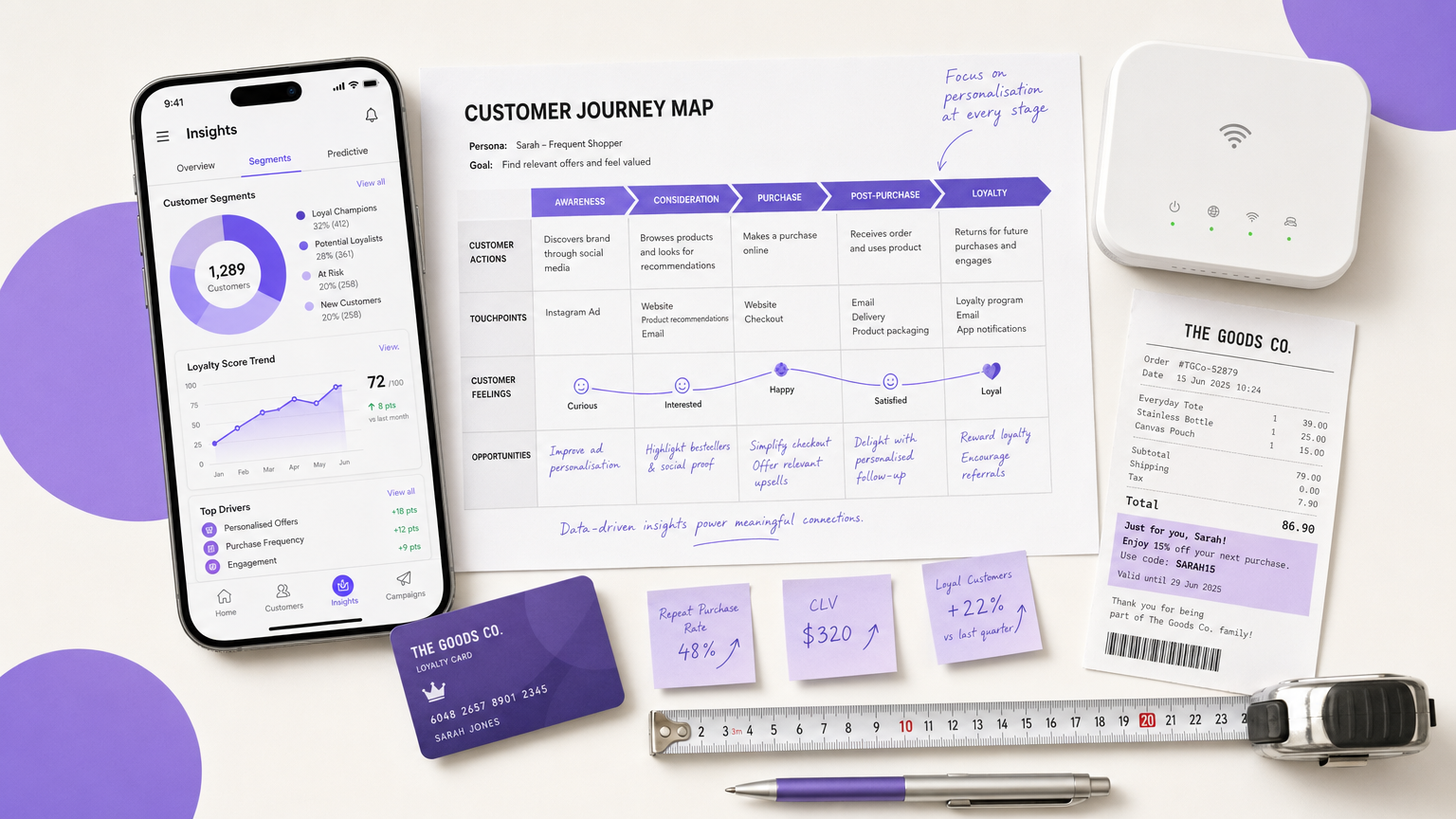
Gli operatori di sedi nei settori dell'ospitalità, della vendita al dettaglio e pubblici affrontano una sfida persistente: convertire il traffico pedonale anonimo in fedeltà e ricavi misurabili. Mentre l'infrastruttura di rete legacy trattava l'accesso ospite come un centro di costo, le moderne piattaforme edge hanno trasformato l'access point in un livello primario di acquisizione dati.
Questa guida tecnica di riferimento esamina il cambiamento architetturale richiesto per implementare la personalizzazione su larga scala. Integrando l'autenticazione tramite Captive Portal con i sistemi di Customer Relationship Management (CRM) e l'automazione del marketing, i team IT e marketing possono offrire esperienze contestuali che generano risultati aziendali comprovati. I dati del settore dimostrano che robuste strategie di personalizzazione producono un aumento dei ricavi dal 10% al 15%, mentre l'80% dei consumatori dichiara una maggiore probabilità di acquistare da marchi che offrono esperienze personalizzate.
Per gli IT manager e gli architetti di rete, la transizione dalla connettività di base a un overlay di analisi intelligente richiede un'attenta considerazione degli schemi dati, delle integrazioni API e dei framework di conformità. Questa guida fornisce metodologie di implementazione pratiche, progetti architetturali e casi di studio reali che dimostrano come progettare una rete che contribuisca attivamente al fatturato.
Approfondimento Tecnico
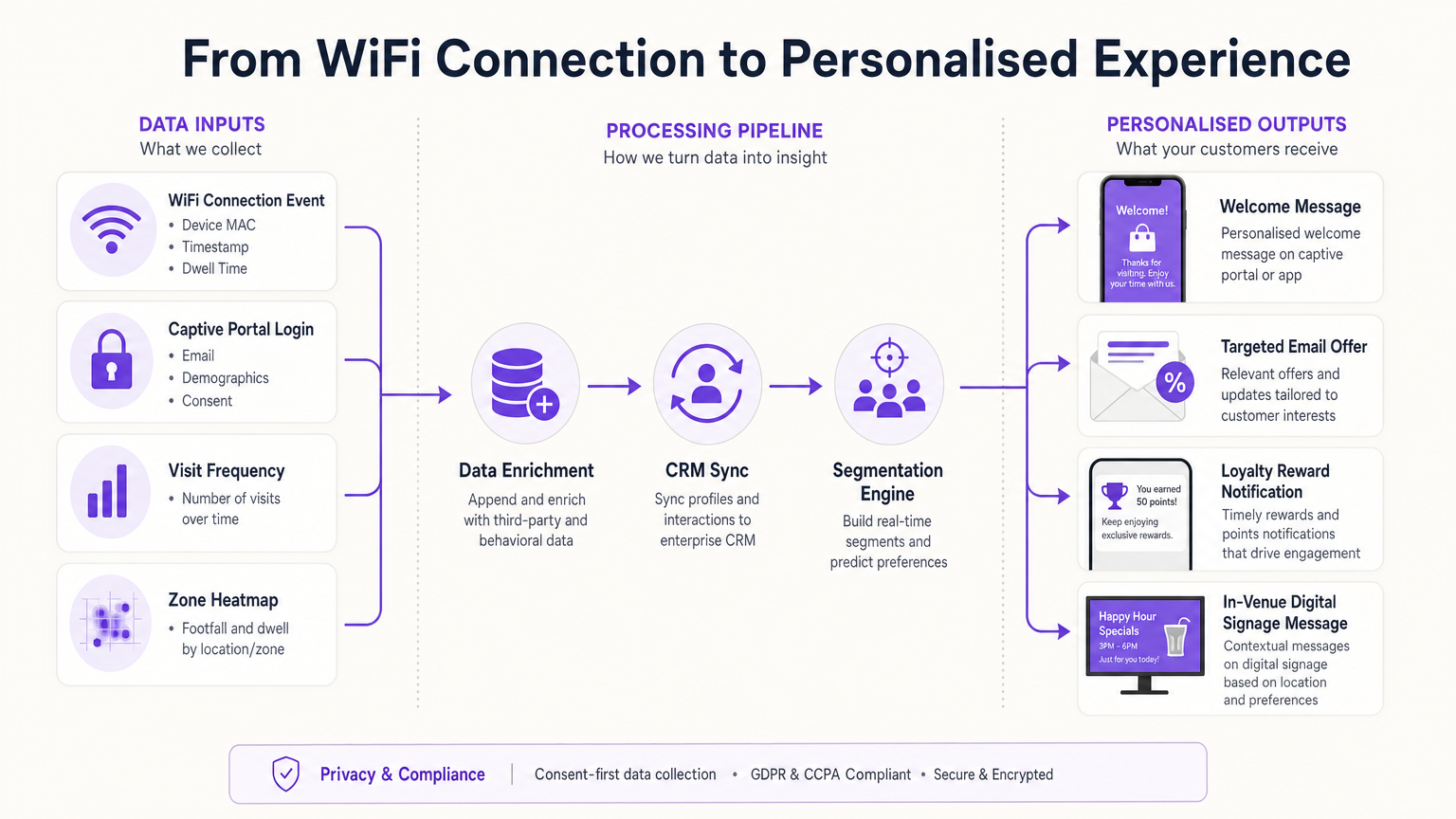
La base della personalizzazione scalabile si fonda sulla transizione da silos di rete isolati a un ecosistema di dati integrato. Quando un utente si autentica tramite Guest WiFi , la rete cattura telemetria ad alta fedeltà — inclusi MAC addresses dei dispositivi, tempi di permanenza, transizioni di zona e payload di autenticazione.
Acquisizione Dati e Mappatura Schema
Per sfruttare questa telemetria, l'overlay di analisi deve normalizzare i dati in uno schema unificato. Questo processo implica l'acquisizione sia di dati deterministici (ad esempio, indirizzi email e dettagli demografici forniti durante il login al Captive Portal) sia di dati probabilistici (ad esempio, modelli comportamentali inferiti dalla triangolazione AP e dai valori RSSI).
Il data lake risultante alimenta direttamente le piattaforme CRM e di automazione del marketing della sede. La piattaforma WiFi Analytics di Purple funziona come motore di acquisizione centrale, analizzando i pacchetti di accounting RADIUS grezzi e i payload di reindirizzamento HTTP in oggetti JSON strutturati adatti al consumo a valle.
Architettura di Integrazione
Le implementazioni di successo si basano su robuste architetture API per sincronizzare la telemetria di rete con sistemi esterni. Le API RESTful facilitano il trasferimento di dati in tempo reale, abilitando flussi di lavoro attivati come l'invio di un'email di benvenuto nel momento in cui un cliente di alto valore si autentica alla rete.
Consideriamo uno scenario in cui un cliente entra in un ambiente Retail . Il controller di rete rileva le richieste di sonda del dispositivo e associa il MAC address a un profilo cliente noto. La piattaforma di analisi attiva quindi un webhook al CRM, che valuta la cronologia degli acquisti del cliente e invia un'offerta personalizzata al Captive Portal o all'applicazione mobile del brand.
Nelle implementazioni Hospitality , questa stessa architettura consente l'integrazione con il Property Management System (PMS). Quando un ospite abituale effettua il check-in e si connette al WiFi dell'hotel, il sistema confronta il suo profilo con i dati storici di soggiorno e invia un messaggio di benvenuto personalizzato al Captive Portal, insieme a un upsell mirato per upgrade di camera o promozioni F&B.
| Tipo di Dato | Origine | Utilizzo a Valle |
|---|---|---|
| Indirizzo Email | Login Captive Portal | Creazione Profilo CRM, Campagne Email |
| MAC Address | Associazione di Rete | Monitoraggio Frequenza Visite, Analisi Permanenza |
| Tempo di Permanenza in Zona | Triangolazione AP | Offerte Contestuali Attivate |
| Frequenza Visite | RADIUS Accounting | Assegnazione Livello Fedeltà |
| Dati Demografici | Profilazione Progressiva | Segmentazione del Pubblico |
Guida all'Implementazione
L'implementazione di un'architettura di rete incentrata sulla personalizzazione richiede un approccio strutturato per garantire l'accuratezza dei dati, l'interoperabilità dei sistemi e la conformità normativa.
Fase 1: Valutazione dell'Infrastruttura
Prima di implementare un overlay di analisi, valutare l'infrastruttura WLAN esistente. Assicurarsi che i controller wireless e gli access point supportino i protocolli necessari — RADIUS, SNMP e Syslog — e possano gestire il maggiore overhead di elaborazione associato alla segnalazione continua della telemetria. La piattaforma di Purple è hardware-agnostic, integrandosi con l'infrastruttura esistente di Cisco, Juniper, Ruckus e altri fornitori leader, il che riduce significativamente la spesa in conto capitale richiesta per l'implementazione.
Fase 2: Configurazione del Captive Portal
Progettare il Captive Portal per bilanciare l'attrito dell'utente con l'acquisizione dei dati. Implementare tecniche di profilazione progressiva, richiedendo informazioni minime durante il login iniziale e costruendo gradualmente il profilo del cliente durante le visite successive. Assicurarsi che il design del portale sia allineato con le linee guida del brand aziendale e offra metodi di autenticazione senza interruzioni, come il social login o le integrazioni OpenRoaming. Tutta la raccolta dati deve essere supportata da meccanismi di consenso espliciti e conformi al GDPR.
Fase 3: Integrazione del Sistema
Stabilire flussi di dati bidirezionali tra la piattaforma di analisi WiFi e i sistemi CRM, di automazione del marketing e di gestione della proprietà della sede. Utilizzare middleware robusto o direintegrazioni API per garantire la coerenza dei dati. Per ambienti complessi, si consideri l'implementazione di una Customer Data Platform (CDP) che funga da repository centrale per tutte le interazioni con i clienti. Ciò è particolarmente rilevante per gli hub di Trasporto e le catene di vendita al dettaglio multi-sito dove i percorsi dei clienti si estendono su più posizioni fisiche.
Fase 4: Logica della Campagna e Automazione
Con la pipeline di dati stabilita, configurare le regole di automazione del marketing che traducono gli eventi di rete in azioni del cliente. Definire le condizioni di attivazione (ad esempio, prima visita, quinta visita, tempo di permanenza superiore a 30 minuti in una zona specifica) e mapparle alle corrispondenti azioni della campagna. Stabilire framework di A/B testing per ottimizzare continuamente la pertinenza delle offerte e i tassi di conversione.
Best Practice
Per massimizzare l'impatto delle iniziative di personalizzazione, i team IT e marketing dovrebbero aderire alle seguenti best practice indipendenti dal fornitore.
Dare priorità alla qualità dei dati. Implementare regole di convalida dei dati al punto di ingresso per evitare che dati malformati o inaccurati inquinino il CRM. Controllare e pulire regolarmente il database per mantenere un'elevata fedeltà dei dati. Un singolo record cliente autorevole vale più di dieci profili duplicati e incompleti.
Adottare un approccio Privacy-First. Assicurarsi che tutte le pratiche di raccolta dati siano conformi alle normative regionali come GDPR e CCPA. Implementare meccanismi di consenso chiari e trasparenti all'interno del captive portal e fornire agli utenti strumenti accessibili per gestire le loro preferenze sui dati. La non conformità comporta significativi rischi finanziari e reputazionali.
Implementare trigger contestuali. Sfruttare i dati di localizzazione in tempo reale per fornire messaggi altamente pertinenti. In un contesto di ospitalità, attivare una promozione spa quando un ospite si connette a un AP situato vicino al centro benessere. Nel commercio al dettaglio, attivare un'offerta di assistenza in camerino quando un cliente si sofferma nella zona abbigliamento per più di 10 minuti.
Allineare gli obiettivi IT e Marketing. Promuovere la collaborazione interfunzionale tra i dipartimenti IT e marketing. L'IT deve garantire che l'infrastruttura possa fornire in modo affidabile la telemetria necessaria, mentre il marketing deve definire le regole aziendali e la logica della campagna. Il disallineamento tra questi team è la causa più comune di implementazioni fallite.
Per le organizzazioni che stanno costruendo una strategia più ampia di esperienza del cliente, le guide Como Construir uma Estratégia de Experiência do Cliente e Cómo construir una estrategia de experiencia del cliente forniscono framework complementari.
Risoluzione dei problemi e mitigazione dei rischi
L'implementazione di un overlay di rete intelligente introduce nuove complessità e potenziali domini di errore. La mitigazione proattiva del rischio è essenziale per mantenere la disponibilità del servizio e l'integrità dei dati.
API Rate Limiting. Ambienti ad alta densità, come hub di trasporto o stadi, possono generare enormi volumi di dati di telemetria, superando potenzialmente i limiti di velocità delle API a valle. Implementare meccanismi intelligenti di accodamento e raggruppamento per gestire l'uscita dei dati. Filtrare gli eventi di basso valore (ad esempio, roaming transitorio) e attivare i webhook solo per cambiamenti di stato significativi.
MAC Randomization. I moderni sistemi operativi mobili impiegano la randomizzazione del MAC per proteggere la privacy dell'utente, il che interrompe il tracciamento probabilistico dei dispositivi tra le sessioni. Per mantenere un tracciamento accurato, incoraggiare gli utenti ad autenticarsi tramite il captive portal o a scaricare l'applicazione mobile della sede, che può utilizzare identificatori deterministici. L'autenticazione basata su certificati tramite Passpoint o OpenRoaming fornisce la soluzione a lungo termine più robusta.
Congestione della rete. La segnalazione continua della telemetria può consumare una larghezza di banda significativa sui collegamenti di backhaul limitati. Ottimizzare gli intervalli di segnalazione e sfruttare l'elaborazione edge ove possibile per ridurre il carico sulla rete principale. Per le sedi con requisiti di throughput elevato, considerare una linea dedicata per garantire prestazioni di backhaul costanti.
Errori di coerenza dei dati. Le integrazioni API bidirezionali introducono il rischio di incoerenza dei dati se un sistema è temporaneamente non disponibile. Implementare chiamate API idempotenti e una robusta logica di retry per garantire che nessun evento del cliente venga perso durante brevi interruzioni.
ROI e impatto aziendale
L'obiettivo finale di una strategia di personalizzazione è generare un valore aziendale misurabile. Sfruttando l'analisi della rete, gli operatori delle sedi possono passare da ipotesi qualitative a metriche di performance quantitative.
Misurare il successo
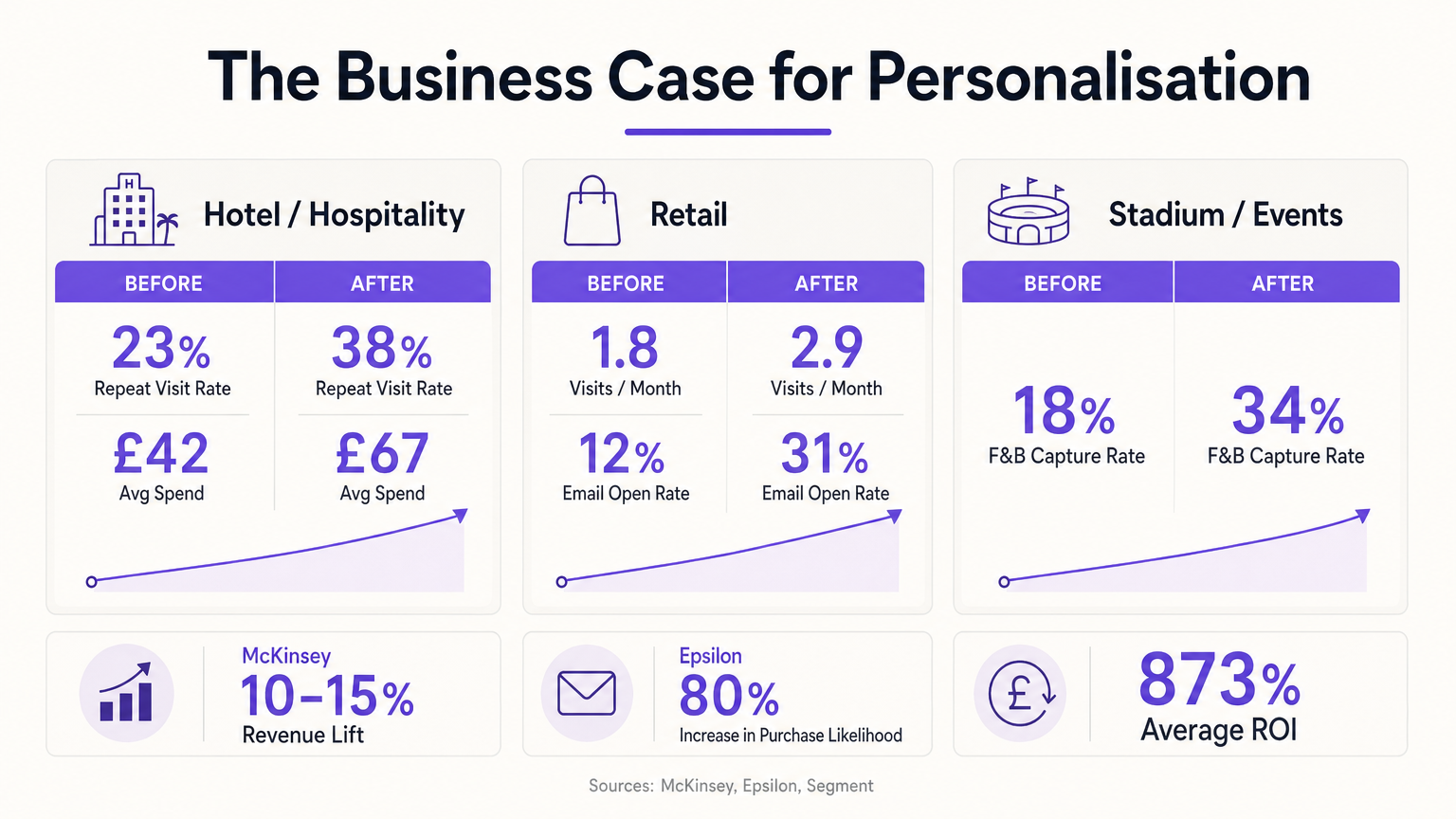
Stabilire chiari indicatori chiave di performance (KPI) per valutare l'impatto dell'implementazione. La seguente tabella illustra le metriche principali e i loro benchmark previsti basati sulle implementazioni di settore.
| KPI | Baseline (Pre-implementazione) | Obiettivo (Post-implementazione) | Metodo di misurazione |
|---|---|---|---|
| Tasso di visite ripetute | 23% | 35%+ | WiFi Analytics / CRM |
| Valore medio della transazione | Baseline | +15% a +25% | Integrazione POS |
| Tasso di apertura delle campagne Email | 12% | 28%+ | Marketing Automation |
| Tasso di acquisizione F&B (Stadi) | 18% | 30%+ | Correlazione POS / WiFi |
| Customer Lifetime Value | Baseline | +20% | CRM Analytics |
Analizzando continuamente queste metriche e affinando gli algoritmi di personalizzazione, le organizzazioni possono massimizzare il ROI della loro infrastruttura di rete. La piattaforma di Purple riporta un ROI medio dell'873% su oltre 80.000 implementazioni in sedi, dimostrando il potenziale commerciale trasformativo di trattare la rete come una risorsa aziendale strategica piuttosto che come un'utilità.
Definizioni chiave
Captive Portal
A web page that a user of a public-access network is obliged to view and interact with before access is granted. It serves as the primary ingestion point for deterministic customer data.
IT teams configure captive portals to enforce acceptable use policies, capture marketing consent, and authenticate users against a backend database. The design of the captive portal directly impacts data quality and network adoption rates.
Progressive Profiling
The technique of gradually gathering customer information across multiple interactions rather than demanding a comprehensive form completion during the first encounter.
Used to minimise authentication friction and improve the user experience while still building robust customer profiles over time. Critical for maintaining high network adoption rates in consumer-facing venues.
MAC Randomisation
A privacy feature implemented by modern mobile operating systems (iOS 14+, Android 10+) that generates a temporary, random Media Access Control (MAC) address when scanning for or connecting to wireless networks.
This feature complicates probabilistic device tracking across sessions, making deterministic authentication via a captive portal or Passpoint/OpenRoaming essential for accurate long-term analytics.
Telemetry
The automated communications process by which measurements and other data are collected at remote or inaccessible points and transmitted to receiving equipment for monitoring and analysis.
In WiFi analytics, telemetry includes data points such as signal strength (RSSI), association states, roaming events, and dwell times generated by the access points and wireless controllers.
Webhook
A method of augmenting or altering the behaviour of a web application with custom HTTP callbacks, triggered by specific events in a source system and sent to a destination URL in real-time.
Webhooks are heavily utilised to push real-time event data — such as a customer logging into the WiFi — from the analytics platform to external CRM or marketing automation systems.
Customer Data Platform (CDP)
A type of packaged software that creates a persistent, unified customer database accessible to other systems, by pulling data from multiple sources, cleaning it, and combining it into a single customer profile.
Advanced enterprise deployments utilise CDPs to aggregate WiFi telemetry with POS data, loyalty program metrics, and e-commerce interactions into a single, actionable customer view.
Dwell Time
The duration of time a device remains associated with the network or within a specific physical zone, as measured by the WiFi analytics platform.
A critical metric for assessing venue performance and customer engagement. Increased dwell time is a strong indicator of engagement and often correlates directly with higher revenue per visit.
Omnichannel Attribution
The process of tracking and valuing all customer touchpoints across various channels — physical store, website, mobile app — that contribute to a desired outcome such as a purchase.
WiFi analytics provides the crucial physical-world data stream required to build accurate omnichannel attribution models, bridging the gap between online and offline customer behaviour.
RADIUS (Remote Authentication Dial-In User Service)
A client/server networking protocol that provides centralised Authentication, Authorisation, and Accounting (AAA) management for users who connect and use a network service.
RADIUS accounting packets are the primary source of raw telemetry data in enterprise WiFi deployments, capturing session start/stop events, data usage, and device identifiers.
Esempi pratici
A 200-room boutique hotel chain wants to increase F&B revenue by targeting guests who frequently use the lobby lounge but rarely dine in the main restaurant. How should the IT team architect the network to support this objective?
The IT team should configure the access points in the lobby lounge and main restaurant into distinct zones within the WiFi analytics platform. They must implement an API integration between the analytics platform and the hotel's Property Management System (PMS) and marketing automation tool. When a guest authenticates via the captive portal, the system cross-references their profile. If the analytics engine detects high dwell time in the lobby zone but no recent POS transactions in the restaurant zone, it triggers a webhook to the marketing platform, which immediately dispatches a personalised, time-sensitive dining discount via email or SMS. The campaign logic should include a 30-minute expiry window to create urgency and ensure the offer is redeemed during the current visit rather than deferred.
A large retail chain is experiencing a high volume of 'window shoppers' who browse the physical store but ultimately purchase online from competitors. How can the network architecture be optimised to capture this lost revenue?
The network architects should deploy a progressive profiling strategy on the captive portal, offering a high-value incentive (e.g., a 15% discount code) in exchange for authentication. The analytics platform must be integrated with the retailer's e-commerce platform and CRM. By analysing the customer's in-store dwell time in specific departments and cross-referencing it with their online browsing history, the CRM can generate highly targeted, personalised follow-up campaigns. Furthermore, if the customer adds an item to their online cart while connected to the in-store WiFi but fails to checkout, the system can trigger an immediate 'abandoned cart' notification with a tailored incentive to complete the purchase at the physical POS.
Domande di esercitazione
Q1. Your organisation is deploying a new WiFi analytics overlay across 50 retail locations. The marketing director wants to capture 15 different data points (including physical address, phone number, and detailed preferences) during the initial captive portal login to immediately populate the CRM. As the IT architect, what is your recommendation?
Suggerimento: Consider the impact of user friction on network adoption rates and the concept of progressive profiling.
Visualizza risposta modello
Advise against requesting 15 data points during the initial login. This level of friction will severely depress network adoption rates, resulting in a smaller overall data pool and undermining the entire personalisation strategy. Instead, implement a progressive profiling strategy. Capture only the essential deterministic data — email address and marketing consent — during the first visit. On subsequent visits, the captive portal can dynamically request one or two additional data points. This approach balances the marketing team's need for rich data with the IT requirement for a seamless user experience, and will ultimately yield a larger, higher-quality dataset.
Q2. A stadium client is experiencing significant latency when attempting to trigger real-time, in-seat F&B offers based on WiFi connection events. The analytics platform is currently configured to send individual API calls to the CRM for every single association and roaming event generated by the 80,000 capacity crowd. How do you resolve this architectural bottleneck?
Suggerimento: Evaluate the difference between raw telemetry and actionable business events, and consider data egress strategies.
Visualizza risposta modello
The current architecture is overwhelming the CRM API with raw, low-value telemetry. Implement edge filtering and batching within the WiFi analytics platform. First, filter out transient roaming events and only trigger webhooks for significant state changes — specifically initial authentication or prolonged dwell time in a specific concession zone. Second, for non-time-sensitive data, transition from real-time API calls to asynchronous batch processing, transmitting aggregated data payloads at scheduled intervals. This reduces the API load by an estimated 90% while ensuring the marketing platform still receives the necessary contextual triggers for real-time offer delivery.
Q3. Following a recent iOS update that aggressively utilises MAC randomisation, the marketing team reports a sharp decline in their ability to track repeat visitors across your venue's network. What technical strategy should you deploy to restore tracking fidelity?
Suggerimento: Contrast probabilistic tracking methods with deterministic authentication.
Visualizza risposta modello
Shift reliance from probabilistic tracking (using MAC addresses) to deterministic authentication. Configure the network to require captive portal re-authentication more frequently by reducing the session timeout duration. Strongly incentivise users to authenticate using persistent credentials, such as a social login or a loyalty program ID. If the venue has a mobile app, integrate an SDK that utilises a stable, app-specific identifier. For the most robust long-term solution, implement certificate-based authentication via Passpoint or OpenRoaming, which bypasses MAC randomisation entirely by using a persistent, device-bound credential.
Continua a leggere questa serie
Privacy by Design: Anonimizzazione dei dati WiFi per la conformità al GDPR
Questa guida autorevole illustra l'architettura tecnica e le strategie di implementazione per l'anonimizzazione dei dati WiFi al fine di garantire la conformità al GDPR. Fornisce a responsabili IT e architetti di rete framework attuabili per bilanciare analisi robuste delle sedi con rigorosi requisiti di privacy dei dati.
Heatmapping vs. Presence Analytics: Differenze Tecniche
Questa guida tecnica autorevole illustra le differenze architettoniche e operative critiche tra il WiFi heatmapping e la presence analytics per gli operatori di sedi aziendali. Fornisce a responsabili IT, architetti di rete e direttori delle operazioni framework di implementazione attuabili, scenari di implementazione reali e best practice neutrali rispetto ai fornitori per massimizzare il ROI dalla loro infrastruttura wireless esistente.
Come Calcolare il Tempo di Permanenza Utilizzando i WiFi Location Analytics
Questa guida fornisce un riferimento tecnico completo per il calcolo del tempo di permanenza WiFi utilizzando i WiFi location analytics, coprendo l'intera architettura dalla cattura delle richieste di probe 802.11 attraverso la trilaterazione basata su RSSI all'analisi delle zone geofenced. È progettata per IT manager, architetti di rete e direttori delle operazioni di sede che necessitano di implementare un'intelligence di localizzazione accurata e scalabile in ambienti di vendita al dettaglio, ospitalità, sanità e settore pubblico. I lettori otterranno indicazioni pratiche sull'implementazione, casi di studio reali e un quadro chiaro per tradurre i dati spaziali grezzi in risultati di business misurabili.