
Valutazione della postura NAC: garantire la conformità dei dispositivi gestiti prima dell'accesso alla rete
Questa guida di riferimento tecnico offre un approfondimento sulla valutazione della postura NAC, descrivendo dettagliatamente l'architettura, gli standard e le strategie di implementazione necessari per imporre la conformità dei dispositivi gestiti. Fornisce ai responsabili IT e agli architetti di rete informazioni pratiche per mitigare i rischi e garantire un accesso sicuro alla rete in ambienti aziendali multi-sede.
Ascolta questa guida
Visualizza trascrizione del podcast
Parte della nostra serie principale: Enterprise WiFi Security Guide →
Executive Summary
For enterprise IT leaders managing complex and multi-site environments, identity alone is no longer a sufficient metric for network access. Knowing who is connecting is less critical than knowing the security state of the device they are using. Network Access Control (NAC) posture assessment is the mechanism that bridges this gap, ensuring that only managed and compliant devices gain access to corporate infrastructure before a single packet of production traffic is transmitted.
This guide provides a comprehensive technical reference for designing, deploying, and managing NAC posture assessment. We explore its underlying architecture, including 802.1X, RADIUS, and EAP-TLS, evaluate the pros and cons of agent-based versus agentless interrogation, and outline a phased deployment strategy that minimises operational disruption. Whether you are securing a corporate headquarters, a distributed retail estate, or hospitality back-office operations, implementing a robust posture assessment is a critical step in mitigating risk and enforcing compliance.
Listen to our 10-minute technical briefing podcast below for an executive overview of the key concepts and common deployment pitfalls.
Technical Deep-Dive
Posture Assessment Architecture
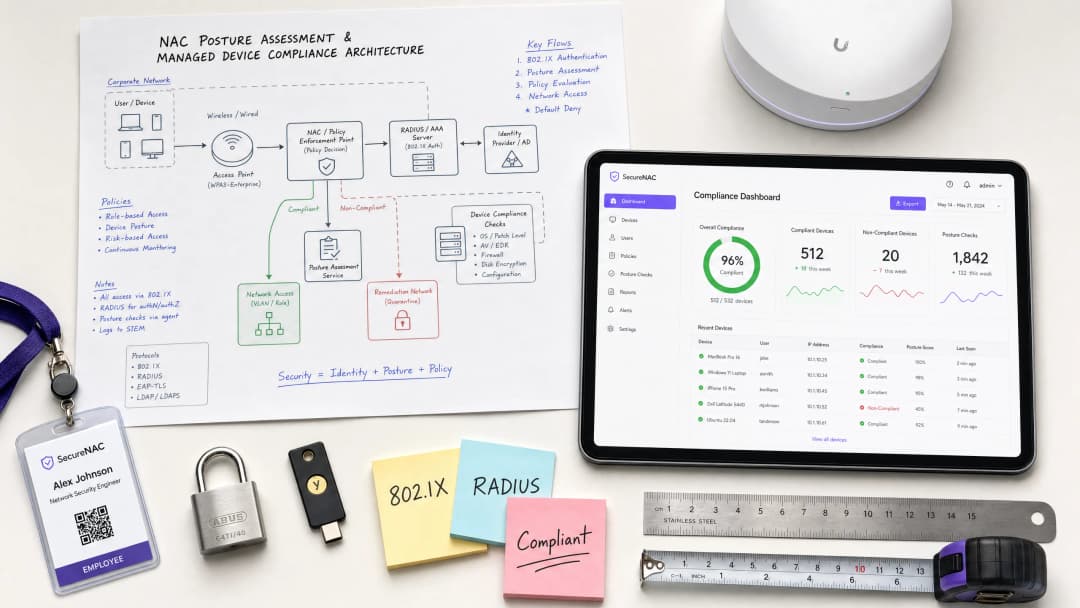
Network Access Control controls device connectivity, but posture assessment is the specific interrogation of a device's security health. Its architecture relies primarily on three main components working in unison:
- Policy Enforcement Point (PEP): This is the physical or logical gatekeeper - typically a wireless access point, switch port, or wireless LAN controller. The PEP physically controls the flow of traffic based on directives from the policy engine.
- Policy Decision Point (PDP): Often integrated with a RADIUS or AAA server, the PDP is the brains of the NAC architecture. It receives posture data, evaluates it against defined compliance policies, and issues enforcement directives to the PEP.
- Posture Assessment Engine: This component gathers the actual health data from the endpoint. This can be an agent running locally on the device, or an agentless mechanism using network protocols (such as SNMP, WMI) or API integration with a Mobile Device Management (MDM) platform.

The Role of IEEE 802.1X and EAP-TLS
The foundation of enterprise NAC is the IEEE 802.1X standard, which defines port-based network access control. Within this framework, three roles are defined:
- Supplicant: The endpoint device attempting to connect.
- Authenticator: The PEP (switch or access point) facilitating the connection.
- Authentication Server: The RADIUS server validating the credentials.
Communication between the Supplicant and the Authentication Server occurs via Extensible Authentication Protocol (EAP), tunnelled through the Authenticator. For managed corporate devices, EAP-TLS is the gold standard. It mandates mutual authentication using X.509 digital certificates, ensuring that both the device and the network cryptographically verify each other's identity. This prevents credential theft and rogue access point attacks.
Posture Check Categories
When a device attempts to connect, the posture assessment engine evaluates several critical vectors:
- OS and Patch Management: Verifying that the operating system is supported and that critical patches have been applied within defined SLAs.
- Endpoint Security (AV/EDR): Ensuring that approved anti-virus or Endpoint Detection and Response agents are installed, active, and running updated definitions.
- Firewall Status: Confirming that host-based firewalls are enabled and their policies have not been tampered with.
- Disk Encryption: Verifying that full-disk encryption (e.g., BitLocker, FileVault) is active and not suspended.
- Certificate Validation: Checking for the presence and validity of required machine certificates.
- Configuration Compliance: Ensuring the device's security baseline aligns with corporate policy (e.g., screen lock timers, disabled USB mass storage).

WPA3-Enterprise and Cryptographic Strength
As network security evolves, so do its underlying cryptographic standards. WPA3-Enterprise, particularly when operating in 192-bit mode, provides significant advancements over WPA2. It mandates the use of GCMP-256 for encryption and HMAC-SHA-384 for integrity. For organisations handling sensitive data - such as retail environments subject to PCI DSS or healthcare facilities under strict data governance - transitioning to WPA3-Enterprise is a necessary step to future-proof network infrastructure.
Hai domande sulla tua configurazione specifica?
Il nostro team collabora con gestori di sedi, responsabili IT e ingegneri di rete in 80.000 sedi. Prenota una chiamata di 20 minuti e ti mostreremo come altri professionisti come te hanno risolto il problema.
Implementation Guide
Deploying NAC posture assessment requires careful planning to avoid widespread network outages. The following phased approach is recommended for enterprise environments:
Phase 1: Infrastructure Readiness and PKI Design
Before enabling posture checks, ensure your underlying infrastructure can support the architecture. If deploying EAP-TLS, a robust Public Key Infrastructure (PKI) is essential. Certificates must be automatically provisioned and renewed via your MDM or Group Policy. Manual certificate management will inevitably lead to connectivity failures when certificates expire.
Phase 2: Monitor Mode (Visibility Phase)
The most critical phase of any NAC deployment is Monitor Mode. During this phase, the NAC system evaluates device posture and logs the results, but does not enforce policies. The PEP allows full access regardless of the posture outcome.
Run Monitor Mode for at least 2-4 weeks. This provides visibility into the actual compliance state of your estate. You will identify devices failing checks due to broken agents, pending reboots, or misconfigurations. Use this data to proactively remediate the estate.
Phase 3: Segmented Enforcement
Once the compliance baseline reaches an acceptable level, begin enforcement. Based on policy evaluation, devices are categorised into three states:
- Compliant: The device passes all critical checks and is assigned to the production VLAN with full required access.
- Conditional: The device fails a non-critical check (e.g., a minor OS update is pending). It may be granted restricted access (e.g., internet only) and the user is notified to remediate within a specified grace period.
- Non-Compliant: The device fails a critical check (e.g., AV is disabled). The PEP assigns the device to a quarantine VLAN.
Phase 4: Remediation Architecture
The quarantine VLAN must be strictly isolated. It should only permit traffic to the remediation portal, necessary update servers (e.g., Windows Update, AV definition servers), and internal IT support resources. If a quarantined device can route traffic to production subnets, the NAC architecture has failed.
Best Practices
- Continuous Assessment: Legacy NAC only evaluates posture at the time of connection. Modern deployments must support continuous assessment, re-evaluating posture at regular intervals or in response to events (e.g., an EDR alert) and dynamically updating the device's access level via Change of Authorization (CoA).
- Agent vs. Agentless: For managed corporate devices, an agent-based approach provides the deepest visibility and continuous monitoring capabilities. Agentless interrogation is suitable for unmanaged devices or environments where deploying an agent is administratively prohibited.
- MAC Authentication Bypass (MAB): MAB is required for devices incapable of 802.1X (e.g., legacy printers, IoT sensors). However, MAB is inherently insecure as MAC addresses can be spoofed. MAB devices must be deeply profiled and placed in strictly controlled, isolated VLANs.
- Aligning with Standards: Base your posture policies on established frameworks such as CIS Benchmarks. This ensures your compliance checks are vendor-neutral and aligned with industry best practices.
- Isolating Guest Traffic: Corporate NAC posture assessment should never intersect with public access networks. In venues where both are required, use a dedicated Guest WiFi platform to manage public access on entirely separate infrastructure, such as Purple's WiFi Analytics solution.
Troubleshooting and Risk Mitigation
Common Failure Modes
- 'Big Bang' Enforcement: Transitioning from open access to strict enforcement across the entire estate all at once is a guaranteed recipe for operational disruption. Always use a phased rollout by site or department.
- PKI Failure: Expired root or intermediate certificates, or failures in the Certificate Revocation List (CRL) / Online Certificate Status Protocol (OCSP) infrastructure, will cause widespread authentication failures. Implement robust monitoring for your PKI.
- Remediation Loops: Ensure that devices in the quarantine VLAN have sufficient network access to download the updates required to become compliant. If they cannot reach update servers, they will remain permanently quarantined.
ROI and Business Impact
Implementing NAC posture assessment delivers measurable business value beyond simple security metrics:
- Risk Mitigation: By ensuring only healthy devices gain access to the network, the lateral spread of malware and ransomware is significantly reduced, decreasing the likelihood of costly data breaches.
- Compliance Verification: For highly regulated sectors such as hospitality and transport, automated posture assessment provides continuous proof of compliance with standards like PCI DSS and GDPR, simplifying the audit process.
- Operational Efficiency: Automating the quarantine and remediation process reduces the burden on the IT helpdesk, allowing engineers to focus on strategic initiatives rather than manually cleaning infected endpoints.
Definizioni chiave
802.1X
Uno standard IEEE per il controllo dell'accesso alla rete basato su porta che fornisce un meccanismo di autenticazione ai dispositivi che desiderano connettersi a una LAN o WLAN.
Il protocollo fondamentale che garantisce che un dispositivo debba autenticarsi prima che la porta dello switch o l'access point consentano il passaggio di qualsiasi traffico IP.
EAP-TLS
Extensible Authentication Protocol - Transport Layer Security. Un framework di autenticazione che utilizza certificati digitali X.509 per l'autenticazione reciproca.
Lo standard consigliato per i dispositivi aziendali gestiti, in quanto si basa su certificati crittografici anziché su password facilmente compromettibili.
Posture Assessment
Il processo di valutazione dello stato di sicurezza e della configurazione di un dispositivo endpoint rispetto a una policy aziendale definita.
Garantisce che un dispositivo non sia solo autenticato, ma anche "sano" (aggiornato, crittografato, protetto) prima che gli venga concesso l'accesso alla rete.
Policy Enforcement Point (PEP)
Il dispositivo di rete (switch, controller wireless o access point) che blocca o consente fisicamente il traffico in base alla policy NAC.
Il componente che esegue effettivamente il comando di "autorizzazione" o "quarantena" emesso dal server NAC.
Policy Decision Point (PDP)
Il server o motore centrale (spesso un server RADIUS) che valuta le richieste di autenticazione e i dati di postura per determinare i diritti di accesso.
Il cervello dell'operazione che contiene il database delle regole e decide quale livello di accesso deve ricevere uno specifico dispositivo.
MAC Authentication Bypass (MAB)
Un metodo di autenticazione di fallback che utilizza l'indirizzo MAC di un dispositivo come credenziale quando questo non è in grado di eseguire l'802.1X.
Utilizzato per dispositivi headless come stampanti o sensori IoT. È intrinsecamente debole e deve essere combinato con una rigorosa segmentazione della rete.
Change of Authorization (CoA)
Un'estensione RADIUS che consente al server NAC di modificare dinamicamente lo stato di autorizzazione di una sessione attiva.
Cruciale per la valutazione continua; se un dispositivo diventa non conforme mentre è connesso, la CoA consente al server NAC di spostarlo istantaneamente in una VLAN di quarantena senza richiedere una disconnessione.
Quarantine VLAN
Un segmento di rete rigorosamente isolato progettato per ospitare dispositivi non conformi, fornendo l'accesso solo alle risorse di remediation.
Impedisce a un dispositivo infetto o vulnerabile di comunicare con i sistemi di produzione mentre scarica gli aggiornamenti o le patch necessarie.
Esempi pratici
Un hotel di 400 camere richiede che i laptop del personale aziendale accedano in modo sicuro al sistema di gestione della proprietà (PMS) del back-of-house. Tuttavia, la struttura ospita anche numerosi dispositivi IoT non gestiti (termostati intelligenti, segnaletica digitale) che non possono eseguire un agente NAC.
Implementare una policy 802.1X EAP-TLS per tutti i laptop del personale aziendale, imponendo controlli rigorosi sulla postura (AV attivo, disco crittografato, patch applicate). Questi dispositivi vengono assegnati dinamicamente alla VLAN aziendale una volta verificata la conformità. Per i dispositivi IoT, implementare il MAC Authentication Bypass (MAB) combinato con una profilazione approfondita dei dispositivi. Assicurarsi che questi dispositivi MAB siano inseriti in VLAN IoT isolate e dedicate, con ACL che limitano il loro accesso esclusivamente ai controller specifici con cui devono comunicare. In nessun caso la VLAN IoT deve instradare il traffico verso la VLAN aziendale o il PMS.
Una catena di negozi al dettaglio sta distribuendo nuovi terminali per punti vendita (POS) in 50 sedi. Il team IT desidera imporre la conformità della postura per soddisfare i requisiti PCI DSS, ma teme di interrompere le attività dei negozi durante la fase di roll-out.
Distribuire l'architettura NAC in modalità Monitor per 30 giorni. Durante questo periodo, il sistema NAC autenticherà i terminali POS e valuterà la loro postura rispetto alla baseline PCI DSS (ad esempio, firewall attivo, nessun software non autorizzato), ma registrerà i guasti senza bloccare l'accesso. Il team IT esamina i log settimanalmente, identifica i terminali che non superano i controlli e li ripristina tramite la piattaforma MDM. Una volta che il tasso di conformità raggiunge il 100%, la policy viene commutata in modalità Enforcement, sede per sede, durante le finestre di manutenzione.
Domande di esercitazione
Q1. Una soluzione NAC recentemente implementata in un ufficio aziendale sta causando diffusi problemi di connettività. I dispositivi che ieri erano conformi vengono ora inseriti nella VLAN di quarantena. L'helpdesk IT riferisce che i dispositivi sembrano integri, con l'antivirus in esecuzione e le patch applicate. Qual è il fallimento architetturale più probabile?
Suggerimento: Considera il ciclo di vita delle credenziali utilizzate in EAP-TLS.
Visualizza risposta modello
La causa più probabile è un guasto nella Public Key Infrastructure (PKI). Se i certificati macchina utilizzati per l'autenticazione EAP-TLS sono scaduti, o se il server NAC non riesce a raggiungere la Certificate Revocation List (CRL) o il risponditore OCSP, l'autenticazione fallirà indipendentemente dall'effettivo stato di sicurezza del dispositivo. Il sistema NAC si imposta per impostazione predefinita su uno stato di fail-closed o di quarantena.
Q2. Stai progettando l'architettura VLAN per una nuova implementazione NAC. Il team di sicurezza insiste sul fatto che la VLAN di quarantena deve consentire l'accesso al server proxy aziendale in modo che gli utenti possano navigare in internet mentre i loro dispositivi vengono ripristinati. È una progettazione valida?
Suggerimento: Valuta il rischio di consentire a un dispositivo potenzialmente compromesso l'accesso a un'infrastruttura condivisa.
Visualizza risposta modello
No, questa è una progettazione errata. Consentire a un dispositivo in quarantena l'accesso al proxy aziendale introduce un rischio significativo. Se il dispositivo è infetto da malware, potrebbe utilizzare il proxy per stabilire comunicazioni di comando e controllo o tentare di spostarsi lateralmente verso altri sistemi interni accessibili tramite il proxy. La VLAN di quarantena deve essere rigorosamente isolata, consentendo l'accesso solo a specifici server di ripristino (ad esempio, Windows Update, server delle definizioni AV) e al portale di ripristino stesso.
Q3. Il team IT di un ospedale deve proteggere l'accesso alla rete per una flotta di nuove pompe d'infusione medica wireless. Questi dispositivi non supportano i supplicant 802.1X e non possono eseguire un agente di postura. Come dovrebbe essere controllato l'accesso alla rete per questi dispositivi?
Suggerimento: Considera metodi di autenticazione alternativi e il principio del privilegio minimo.
Visualizza risposta modello
I dispositivi devono essere autenticati tramite MAC Authentication Bypass (MAB). Poiché il MAB è intrinsecamente debole (gli indirizzi MAC possono essere contraffatti), l'accesso alla rete deve essere fortemente limitato. Le pompe d'infusione devono essere collocate in una VLAN IoT medica dedicata e isolata. Le Access Control Lists (ACL) devono essere applicate a questa VLAN, consentendo la comunicazione solo con gli specifici server di gestione centrale richiesti per il loro funzionamento e bloccando qualsiasi altro movimento laterale o accesso a internet.
Continua a leggere questa serie
PPSK WPA3: confronto tra funzionalità e modelli di implementazione
Questa guida tecnica di riferimento confronta PPSK e WPA3-SAE, spiegando le loro differenze architetturali e i modelli di implementazione per ambienti multi-tenant. Fornisce indicazioni pratiche per IT manager e sviluppatori immobiliari su come ottenere reti WiFi sicure e isolate utilizzando le soluzioni basate sull'identità di Purple.
Gestione della larghezza di banda per il WiFi del personale: Shaping, QoS e riduzione del traffico
Questa guida illustra in dettaglio i metodi pratici per gestire la larghezza di banda per il WiFi del personale in ambienti aziendali. Copre la configurazione del traffic shaping, l'implementazione del QoS e come la distribuzione di Purple Shield riduca il carico di rete senza richiedere aggiornamenti dell'infrastruttura.
How to Reduce the Number of WiFi SSIDs Using Per-Device PSK (iPSK, DPSK, MPSK)
This authoritative technical reference guide explains how IT teams can eliminate WiFi performance degradation caused by SSID beacon overhead by collapsing multiple purpose-built networks into a single SSID using per-device PSK (xPSK). It covers the vendor landscape across Cisco iPSK, HPE Aruba MPSK, Ruckus DPSK, Juniper Mist PPSK, and Ubiquiti UniFi PPSK, with practical implementation guidance on dynamic VLAN assignment, IoT onboarding, and PCI DSS compliance. Venue operators in hospitality, retail, stadiums, and public-sector organisations will find actionable architecture guidance and real-world worked examples.
Hai domande sulla tua configurazione specifica?
Il nostro team collabora con gestori di sedi, responsabili IT e ingegneri di rete in 80.000 sedi. Prenota una chiamata di 20 minuti e ti mostreremo come altri professionisti come te hanno risolto il problema.