
WiFi gratuito vs. a pagamento in hotel: qual è il modello giusto per la tua struttura?
Questa guida fornisce ai leader IT e agli operatori di strutture un quadro definitivo per la scelta tra modelli WiFi gratuiti, a pagamento e a livelli negli ambienti dell'ospitalità. Analizza l'architettura tecnica, l'impatto sul business e le metriche di soddisfazione degli ospiti necessarie per monetizzare con successo la connettività mantenendo la sicurezza di livello aziendale e la conformità al GDPR. Gli operatori che implementano il modello Freemium Tiered possono generare entrate accessorie significative preservando gli alti punteggi CSAT che guidano le prenotazioni ripetute.
Ascolta questa guida
Visualizza trascrizione del podcast
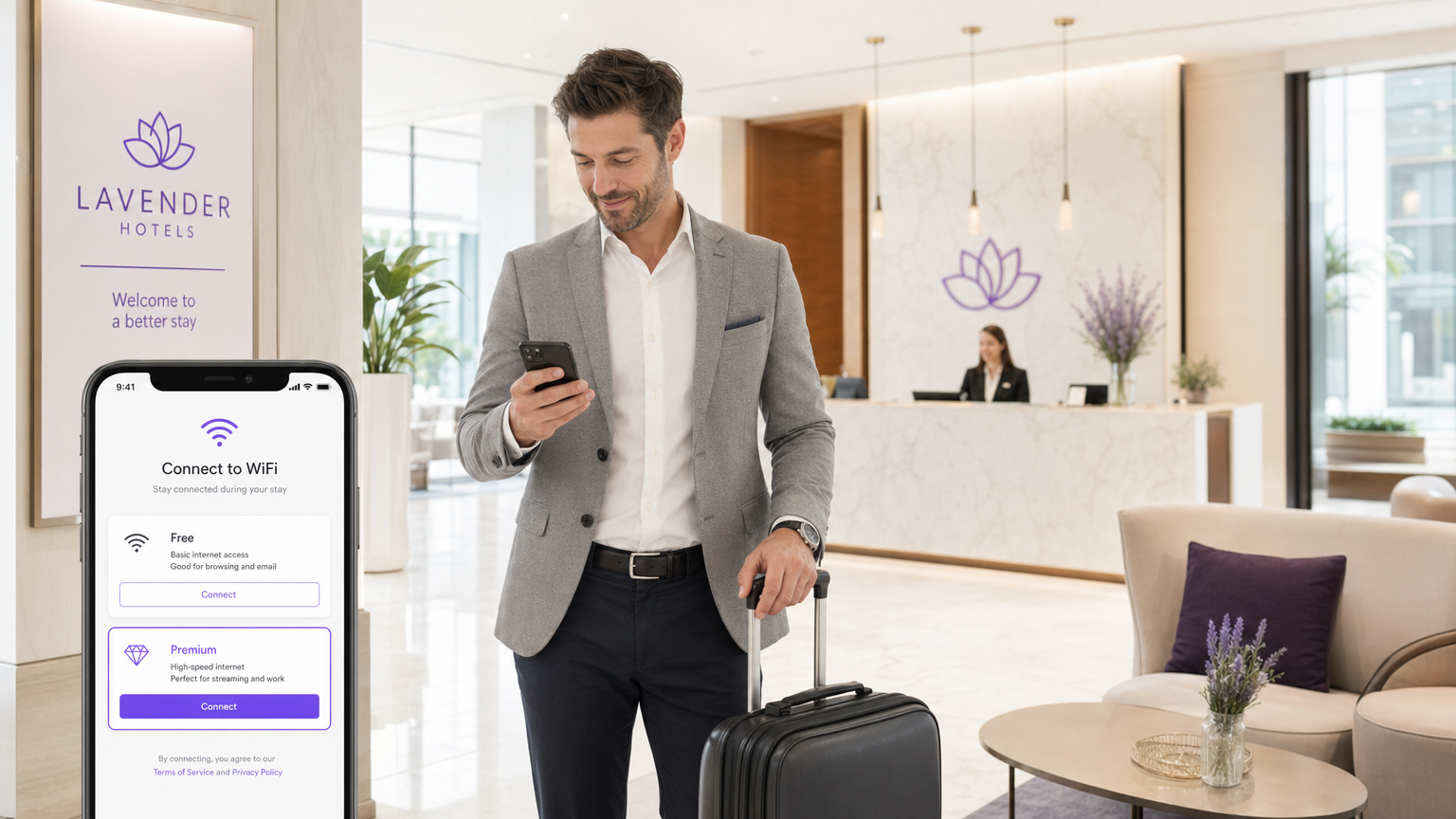
Riepilogo Esecutivo
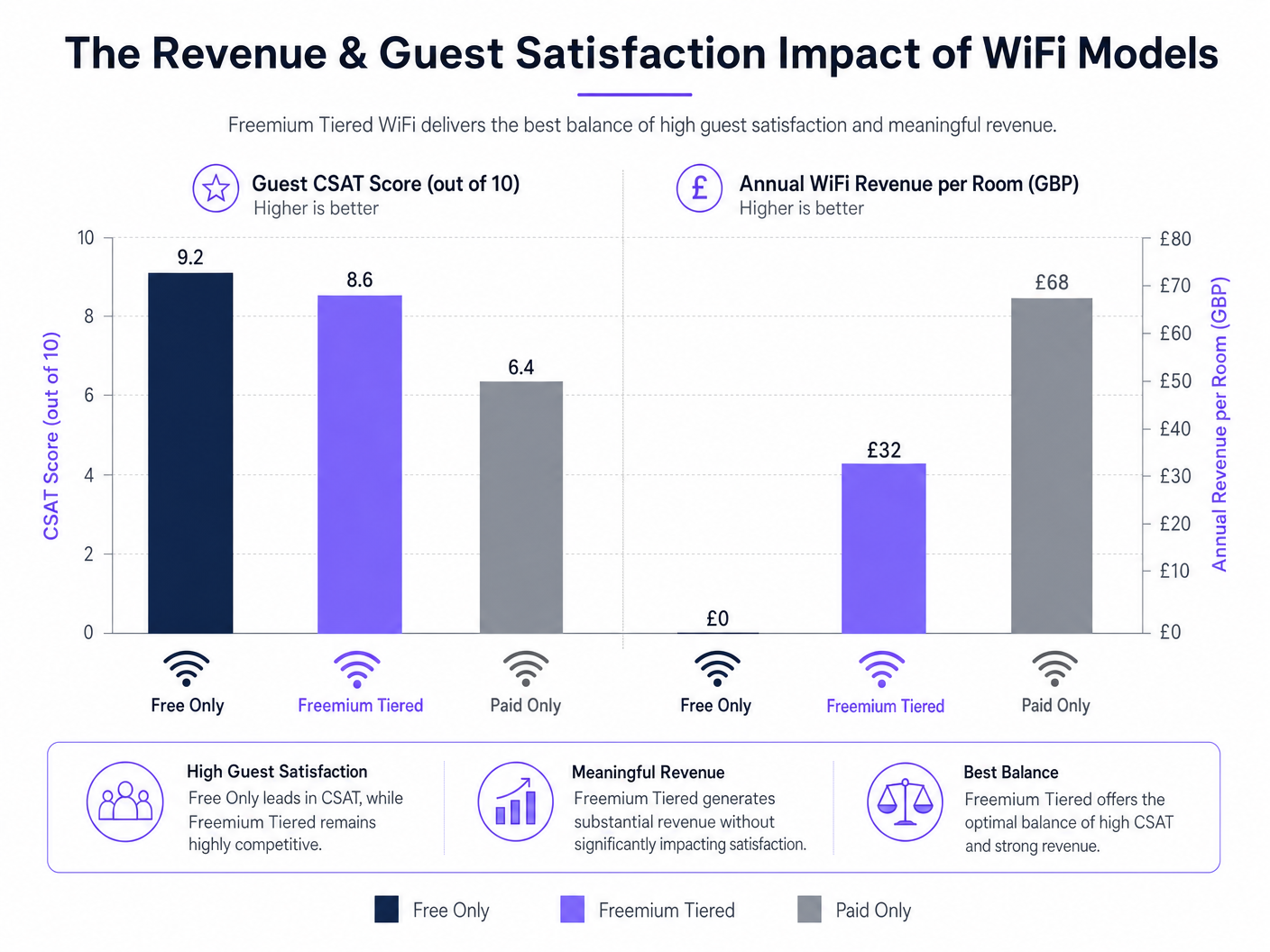
Il dibattito tra WiFi gratuito e a pagamento nell'ospitalità e nelle grandi strutture non è più una scelta binaria. Poiché le richieste di larghezza di banda aumentano a causa dello streaming 4K, delle conferenze basate su cloud e di un'esplosione di dispositivi IoT headless, il tradizionale modello "gratuito per tutti" sta cedendo sotto la pressione. Al contrario, i rigidi modelli "pay-to-play" stanno attivamente danneggiando i punteggi di soddisfazione degli ospiti (CSAT) e generando recensioni online negative.
Per i manager IT, gli architetti di rete e i CTO, la soluzione ottimale risiede nel Modello Freemium a Livelli. Questo approccio fornisce una connettività di base gratuita e funzionale per tutti gli ospiti, offrendo al contempo livelli premium ad alta velocità per gli utenti esperti. Questa guida esplora l'architettura tecnica necessaria per implementare la larghezza di banda a livelli, il business case per la generazione di entrate accessorie e come piattaforme come Guest WiFi e WiFi Analytics trasformano un centro di costo in una risorsa strategica. L'analisi seguente è rilevante per qualsiasi operatore di struttura, da un hotel boutique di 50 camere a un grande centro congressi o stadio — ovunque sia necessario prendere una decisione su un servizio WiFi a pagamento con fiducia.
Il Business Case: Gratuito vs. A Pagamento vs. A Livelli
Quando si valuta un servizio WiFi a pagamento, gli operatori di strutture devono bilanciare il costo dell'infrastruttura con le aspettative dell'ospite moderno. L'industria si è in gran parte consolidata attorno a tre modelli principali, ciascuno con distinti compromessi finanziari e operativi.
1. Il Modello "Solo Gratuito"
Offrire WiFi interamente gratuito è spesso visto come un requisito di base, in particolare negli ambienti Hospitality e Retail di fascia economica e media. Oltre l'84% degli ospiti degli hotel cita il WiFi gratuito come fattore chiave nelle loro decisioni di prenotazione, rendendolo un servizio quasi obbligatorio.
Pro: Elevata soddisfazione iniziale degli ospiti; elimina l'attrito durante l'onboarding; impatto positivo sui punteggi delle recensioni OTA.
Contro: Nessun ROI diretto per compensare l'aumento dei costi della larghezza di banda; la congestione della rete da parte di utenti intensivi degrada l'esperienza per tutti gli ospiti; opportunità persa per l'acquisizione di dati di prima parte se non implementato con un Captive Portal e un'autenticazione adeguata.
2. Il Modello "Solo a Pagamento"
Addebitare a ogni ospite l'accesso è sempre più raro e generalmente limitato a vettori ultra-economici, hub di Transport specifici o implementazioni legacy che non sono state modernizzate.
Pro: Generazione diretta di entrate; limita naturalmente il consumo di larghezza di banda; semplice da implementare su hardware legacy.
Contro: Grave impatto negativo sul CSAT; elevato attrito all'onboarding; scoraggia attivamente le prenotazioni in un mercato in cui la connettività è considerata un diritto, non un privilegio.
3. Il Modello "Freemium a Livelli"
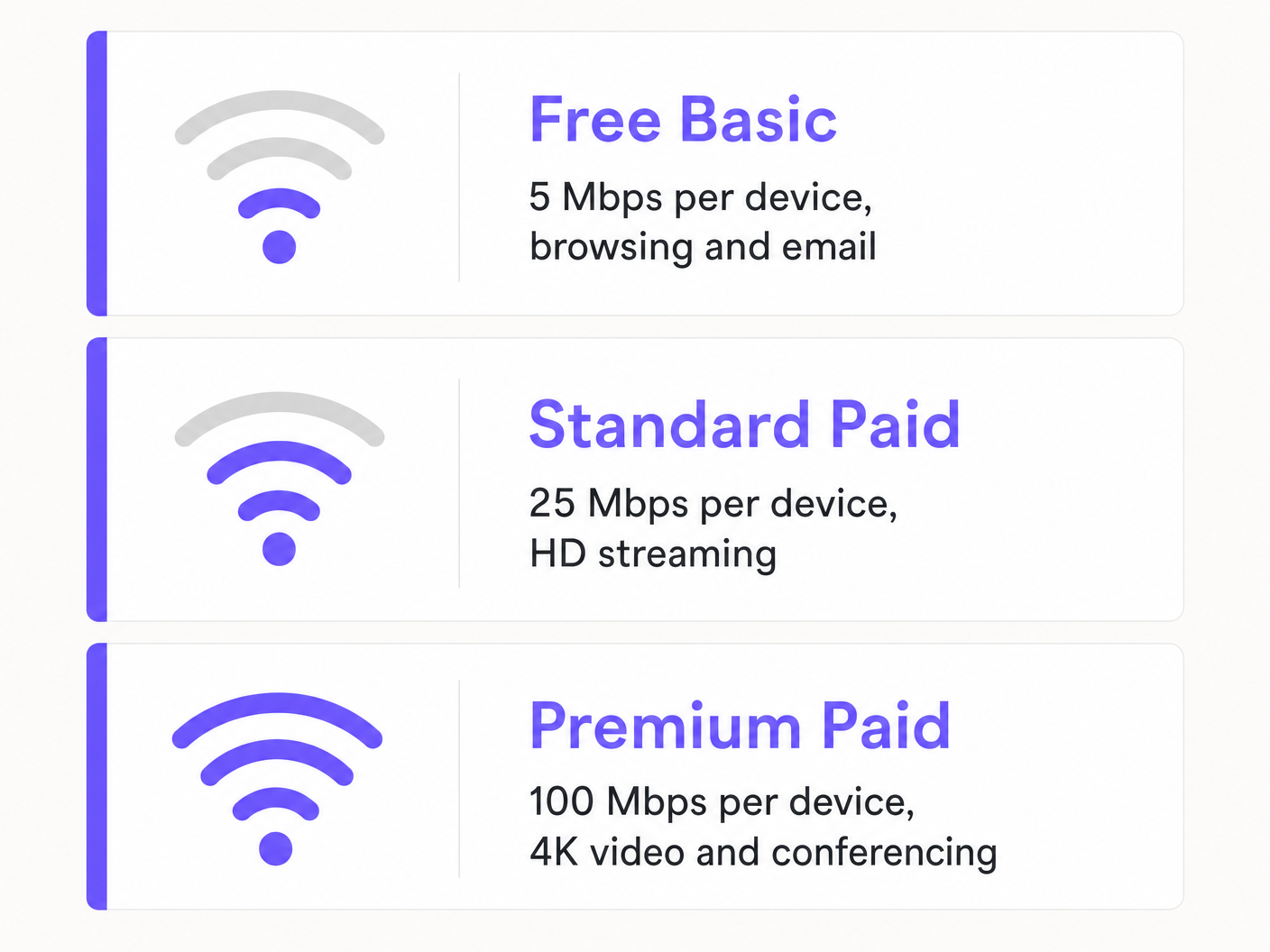
Lo standard aziendale. Una velocità di base (ad es. 5 Mbps per dispositivo) è fornita gratuitamente in cambio dei dati degli ospiti tramite una splash page, mentre velocità più elevate (ad es. 25 Mbps o 100 Mbps) sono monetizzate tramite un addebito giornaliero o per soggiorno.
Pro: Bilancia le aspettative degli ospiti con la generazione di entrate; consente il marketing mirato tramite l'acquisizione di dati di prima parte; garantisce un'equa allocazione della larghezza di banda tramite QoS; si integra con i programmi fedeltà.
Contro: Richiede una gestione di rete sofisticata, un gateway WiFi capace e un'integrazione perfetta con i sistemi di gestione della proprietà (PMS).
Approfondimento Tecnico: Architettare l'Accesso a Livelli
L'implementazione di un modello a livelli richiede un'architettura di rete robusta. Non si tratta semplicemente di limitare un router; richiede access point di livello aziendale, controller intelligenti e framework di autenticazione sicuri conformi agli standard IEEE 802.1X e WPA3.
Allocazione della Larghezza di Banda e Qualità del Servizio (QoS)
Per implementare con successo un servizio WiFi a pagamento, la rete deve allocare dinamicamente la larghezza di banda. Ciò si ottiene tramite politiche di Qualità del Servizio (QoS) gestite a livello di controller — sia on-premises che, sempre più spesso, tramite una piattaforma gestita in cloud.
| Tier | Throughput Cap | Typical Use Case | QoS Priority |
|---|---|---|---|
| Base Gratuito | 5 Mbps per dispositivo | Email, navigazione, social media | Bassa |
| Standard | 25 Mbps per dispositivo | Streaming HD, VPN standard | Media |
| Premium | 100 Mbps per dispositivo | Video 4K, conferenze, grandi upload | Alta |
Come discusso nella nostra guida su Velocità WiFi in Hotel: Cosa si Aspettano gli Ospiti e Come Offrirla , impostare correttamente queste soglie è fondamentale per evitare la frustrazione degli ospiti. Un livello gratuito mal calibrato che non riesce a sostenere uno streaming YouTube di base genererà più recensioni negative di un modello solo a pagamento.
Autenticazione e Integrazione Sicure
Un'esperienza di onboarding senza interruzioni è fondamentale. L'approccio legacy delle password condivise (PSK) è una vulnerabilità di sicurezza e crea attrito. Le implementazioni moderne utilizzano un approccio di autenticazione a livelli.
Captive Portals: Per il livello gratuito, gli ospiti si autenticano tramite una splash page brandizzata, accettando i termini e fornendo dati (ad es. email, consenso al marketing opt-in). Questa è la base della pipeline di dati di WiFi Analytics e alimenta direttamente i sistemi CRM.
Integrazione PMS: Per i livelli premium, il gateway WiFi si integra direttamente con il PMS dell'hotel (ad es. Oracle Opera, Mews o Apaleo). Gli ospiti si autenticano utilizzando il numero della loro camera e il cognome, e l'addebito premium viene automaticamente registrato sul loro conto — nessuna carta di credito richiesta al portale.
Passpoint / OpenRoaming (IEEE 802.11u): Per gli ospiti di ritorno o i membri fedeltà, Passpoint consente un'autenticazione senza interruzioni, senza password e crittografata individualmente (WPA3-Enterprise) connessioni, eliminando completamente il captive portal e offrendo un'esperienza di roaming simile a quella cellulare.
Segmentazione della Rete e Sicurezza
La segmentazione della rete tramite VLAN è un requisito di sicurezza non negoziabile, in particolare per la conformità PCI DSS negli ambienti Retail e dell'ospitalità. Il traffico degli ospiti, del personale e il traffico IoT/operativo devono risiedere su reti logiche completamente separate, anche quando condividono gli stessi punti di accesso fisici.
Un dispositivo ospite compromesso su una rete non segmentata può accedere a sistemi POS, serrature intelligenti e interfacce di gestione interne. Le VLAN impediscono completamente questo movimento laterale.
Guida all'Implementazione
L'implementazione di un modello WiFi a livelli richiede un'attenta pianificazione per garantire conformità, sicurezza e un'esperienza ospite senza attriti. I seguenti passaggi si applicano sia alle nuove implementazioni (greenfield) che agli aggiornamenti dell'infrastruttura esistente.
Fase 1: Valutazione Iniziale. Condurre un'indagine completa del sito. Valutare l'utilizzo attuale della larghezza di banda, identificare le lacune di copertura e valutare l'hardware esistente. Assicurarsi che il backhaul — tipicamente una linea dedicata in fibra — possa supportare il carico di picco previsto. Per maggiori informazioni sui requisiti del backhaul, consultare Cos'è una Linea Dedicata? Internet Aziendale Dedicato .
Fase 2: Definire i Livelli. Stabilire livelli chiari e comunicabili con prezzi che riflettano il valore offerto. Una struttura comune è: Basic (gratuito, 5 Mbps), Business (£5–£10/giorno, 25 Mbps) e Pro (£15+/giorno, 100 Mbps senza limiti).
Fase 3: Progettare il Captive Portal. Il portal deve essere brandizzato, mobile-responsive e legalmente conforme. Assicurare caselle di spunta esplicite e non pre-selezionate per l'opt-in marketing al fine di rispettare il GDPR. Il portal dovrebbe presentare chiaramente la proposta di valore dei livelli premium e ridurre l'attrito per l'aggiornamento.
Fase 4: Implementare la Segmentazione della Rete. Configurare le VLAN sul controller per separare il traffico degli ospiti, del personale e operativo. Applicare le politiche QoS per VLAN per imporre i limiti di livello.
Fase 5: Integrare con PMS e CRM. Connettere il gateway WiFi al PMS per la fatturazione automatica del conto. Inserire i dati degli ospiti acquisiti nel CRM per campagne di marketing post-soggiorno.
Fase 6: Test e Monitoraggio. Condurre test di carico prima del lancio. Stabilire dashboard di monitoraggio continuo per tracciare l'utilizzo della larghezza di banda, i tassi di adozione dei livelli e il ricavo per camera disponibile (contributo RevPAR dal WiFi).
Migliori Pratiche
Le seguenti raccomandazioni riflettono gli standard di settore neutrali rispetto al fornitore e l'esperienza operativa negli ambienti dell'ospitalità, del retail e degli eventi.
Applicare WPA3 su tutti i livelli. WPA3 fornisce una crittografia dei dati individualizzata per dispositivo, il che significa che anche sul livello gratuito condiviso, un ospite non può intercettare il traffico di un altro. Questo è un miglioramento significativo rispetto a WPA2 ed è ora supportato da tutti i moderni dispositivi client.
Utilizzare l'isolamento del client sulla VLAN ospite. Anche all'interno della stessa VLAN, i dispositivi degli ospiti dovrebbero essere impediti di comunicare direttamente tra loro. Questo mitiga i vettori di attacco peer-to-peer.
Implementare la limitazione della velocità a livello di AP, non solo del gateway. La QoS a livello di controller è più granulare e reattiva rispetto alla limitazione a livello di gateway, e impedisce a un singolo dispositivo di monopolizzare le risorse radio di un punto di accesso condiviso.
Verificare la conformità GDPR trimestralmente. Assicurarsi che il meccanismo di consenso del captive portal, le politiche di conservazione dei dati e gli accordi di condivisione dei dati con terze parti siano regolarmente revisionati. La multa media del GDPR nel Regno Unito per una violazione dei dati è significativa, e l'ospitalità è un settore ad alto rischio.
ROI e Impatto sul Business
La transizione a un modello a livelli trasforma il WiFi da un costo irrecuperabile a un flusso di entrate misurabile con molteplici vettori di contributo.
Entrate Dirette: Gli acquisti di livelli premium forniscono entrate accessorie dirette e ad alto margine. In una proprietà di 200 camere con il 70% di occupazione, se il 10% degli ospiti acquista un upgrade premium da £10, la proprietà genera circa £5.110 al mese in entrate dirette dal WiFi — sufficienti a compensare il costo annuale dell'infrastruttura in molte proprietà di fascia media.
Entrate Indirette (Acquisizione Dati): Il livello gratuito funge da motore di generazione di lead. Acquisendo email verificate e dati CRM, le strutture possono promuovere prenotazioni dirette, promuovere F&B in loco e aumentare l'adesione ai programmi fedeltà — ognuno bypassando le commissioni OTA che tipicamente ammontano al 15–25% del ricavo delle camere.
Intelligenza Operativa: Le piattaforme WiFi Analytics come Purple forniscono mappe di calore del flusso di visitatori, analisi del tempo di permanenza e tracciamento delle visite ripetute. Questi dati informano le decisioni sul personale, la tempistica delle promozioni e l'utilizzo dello spazio — generando risparmi operativi che si accumulano nel tempo.
Mitigazione del Rischio: Una rete aperta e mal gestita comporta significativi rischi legali e reputazionali. Un sistema a livelli correttamente architettato con WPA3, isolamento del client e segmentazione VLAN mitiga i vettori di attacco man-in-the-middle e dimostra la dovuta diligenza ai sensi del GDPR e del PCI DSS.
Per gli operatori in settori adiacenti, si applicano gli stessi principi. La Wi-Fi in Auto: La Guida Completa per le Aziende 2026 dimostra come i modelli di connettività a livelli vengano implementati negli ambienti di vendita al dettaglio e di servizio automobilistico, e il settore Healthcare sta adottando sempre più framework simili per il WiFi di pazienti e visitatori.
Risoluzione dei Problemi e Mitigazione del Rischio
Problema: Ospiti premium segnalano velocità lente nonostante abbiano pagato per il livello superiore. Causa principale: Le politiche QoS non sono applicate a livello di AP, ma solo al gateway. Un single AP che servono più di 40 dispositivi possono diventare un collo di bottiglia radiofonico indipendentemente dalle politiche a livello di gateway. Risoluzione: Implementare l'equità del tempo di trasmissione per AP e assicurarsi che la densità degli AP sia sufficiente per il numero di dispositivi concorrenti previsto. Una regola generale è un AP per 20-25 dispositivi concorrenti in ambienti ad alta densità.
Problema: Gli ospiti non riescono a connettere smart TV o console di gioco. Causa principale: I dispositivi headless non possono navigare nei Captive Portal. Risoluzione: Implementare iPSK (Individual Pre-Shared Keys) per consentire l'onboarding di dispositivi specifici per stanza senza un browser. Gli ospiti generano la chiave tramite l'app dell'hotel o un codice QR in camera.
Problema: Preoccupazioni sulla conformità GDPR relative all'acquisizione dei dati. Causa principale: Flussi di consenso mal progettati sul Captive Portal. Risoluzione: Assicurarsi che il portale utilizzi caselle di controllo opt-in esplicite e non selezionate per il marketing. Implementare una chiara politica di conservazione dei dati e assicurarsi che l'informativa sulla privacy sia collegata e accessibile. Le piattaforme aziendali gestiscono questo automaticamente.
Definizioni chiave
Captive Portal
A web page that users must view and interact with before access is granted to a public WiFi network, typically used for authentication, marketing consent capture, or payment.
Essential for enforcing the free tier, capturing GDPR-compliant marketing data, and presenting the upsell options for premium tiers. The design of the portal directly impacts both conversion rates and compliance posture.
Quality of Service (QoS)
Network management technologies that prioritise certain types of traffic or limit the bandwidth available to specific users, devices, or traffic classes.
The core mechanism used to enforce bandwidth caps on the free tier and guarantee throughput for paying premium guests. Must be configured at both the controller and AP level for maximum effectiveness.
Property Management System (PMS)
The central software system used by hotels to manage reservations, billing, room assignments, and guest profiles.
The WiFi gateway must integrate with the PMS to authenticate guests by room number and automatically post premium WiFi charges to their folio, enabling frictionless billing without a separate payment step.
Passpoint (Hotspot 2.0 / IEEE 802.11u)
A Wi-Fi Alliance protocol that enables seamless, secure, passwordless roaming between different WiFi networks using WPA3-Enterprise certificates.
Allows returning guests or loyalty members to connect automatically and securely without interacting with a captive portal, delivering a cellular-like roaming experience and eliminating the primary source of onboarding friction.
VLAN (Virtual Local Area Network)
A logical subnetwork that groups a collection of devices from different physical network segments, enforcing traffic isolation at the software level.
Used to securely segment guest traffic from operational traffic (POS systems, smart locks, staff devices) on the same physical access points. A mandatory control for PCI DSS compliance and general risk mitigation.
Ancillary Revenue
Income generated from goods or services other than a company's primary product offering — in hospitality, anything beyond the base room rate.
Premium WiFi tiers represent a high-margin form of ancillary revenue. Unlike F&B or spa services, WiFi upgrades have near-zero marginal cost once the infrastructure is deployed, making them exceptionally profitable.
iPSK (Individual Pre-Shared Key)
A security method that provides a unique WiFi password for each user, room, or device on the same SSID, without requiring a full 802.1X infrastructure.
Crucial for securely connecting headless IoT devices — smart TVs, gaming consoles, streaming sticks — that cannot navigate a captive portal. Each room receives a unique key, maintaining isolation between guests.
Freemium Tiered Model
A service delivery model in which a baseline level of service is provided for free, with enhanced features or performance available at a premium price.
The dominant WiFi business model in modern hospitality. The free tier drives CSAT and data capture; the premium tier drives direct revenue. The model is only viable with robust QoS enforcement to ensure the paid tier delivers a meaningfully better experience.
RevPAR (Revenue Per Available Room)
A hotel performance metric calculated by multiplying the average daily room rate by the occupancy rate.
WiFi revenue and the indirect bookings driven by WiFi data capture both contribute to RevPAR. London hotel forecasts for 2026 project approximately 1.8% RevPAR growth, with tech-enabled guest experiences cited as a key driver.
Esempi pratici
A 300-room luxury hotel is experiencing guest complaints about slow WiFi during peak evening hours. They currently offer a single, free, unthrottled network with a shared password. They need to improve performance for business travellers without alienating leisure guests. How should the IT team restructure the deployment?
Step 1: Replace the shared PSK with a Captive Portal integrated with the PMS (Oracle Opera). Step 2: Implement a Freemium Tiered model with three tiers: Free (10 Mbps, email authentication for CRM data capture), Business (50 Mbps, £8/day, PMS-authenticated and billed to folio), and Premium (100 Mbps, £15/day, same billing mechanism). Step 3: Configure QoS policies at the controller level to enforce per-device bandwidth caps on the free tier and guarantee throughput for paid tiers. Step 4: Deploy Passpoint profiles via the hotel loyalty app so that elite loyalty members automatically receive the Business tier for free upon arrival, with no portal interaction. Step 5: Implement VLAN segmentation to isolate guest traffic from POS and operational systems.
A large conference centre is hosting a 2,000-person technology summit. The event organiser requires a dedicated, secure network for exhibitors running POS and demo hardware, and a separate general-access network for attendees. The venue's IT team must deliver both on the existing physical AP infrastructure. How is this architected?
Step 1: Utilise VLAN segmentation on the existing cloud-managed AP infrastructure to create two logical networks on the same physical hardware. Step 2: Create a dedicated SSID for Exhibitors (e.g., 'TechSummit_Exhibitor') using WPA3-Enterprise or iPSK for secure, isolated connectivity. Each exhibitor receives a unique iPSK for their stand, preventing cross-exhibitor traffic. Guarantee 20 Mbps per exhibitor stand via QoS. Step 3: Create a public SSID for attendees (e.g., 'TechSummit_Guest') with a branded captive portal capturing attendee data for the event organiser. Apply a 5 Mbps per-device cap to manage the high concurrent device count. Step 4: Charge the event organiser a premium for the dedicated, high-SLA exhibitor network as a venue service.
Domande di esercitazione
Q1. A mid-scale hotel chain's Operations Director wants to charge all guests £5 per day for WiFi to recoup hardware costs quickly. As the Network Architect, how do you advise them, and what alternative do you propose?
Suggerimento: Consider the impact on OTA rankings, CSAT scores, and the indirect revenue potential of the free tier.
Visualizza risposta modello
A Paid Only model should be strongly discouraged. Over 80% of guests consider free WiFi a prerequisite, and charging a baseline fee actively damages CSAT scores, OTA review ratings, and booking conversion. Instead, recommend a Freemium Tiered approach: provide a free 5 Mbps tier in exchange for email capture via a captive portal, and offer a premium £8/day tier at 50 Mbps for power users. The free tier generates CRM data that drives direct bookings, reducing OTA commission costs. The premium tier generates direct ancillary revenue. At 70% occupancy with 10% premium adoption, a 200-room property generates over £5,000/month — sufficient to offset infrastructure costs without damaging the brand.
Q2. You are deploying a tiered WiFi system. How do you ensure that free-tier guests do not consume all available bandwidth and degrade the experience for paying premium guests?
Suggerimento: Think about controller-level traffic shaping and where QoS policies are applied.
Visualizza risposta modello
This is managed through strict Quality of Service (QoS) policies at the network controller level. When a guest authenticates via the captive portal and selects the Free tier, the controller assigns their MAC address to a specific user group or VLAN with a bandwidth cap (e.g., 5 Mbps up/down). For Premium guests authenticated via PMS integration, they are assigned to a separate group with uncapped bandwidth and higher traffic priority. Additionally, per-AP airtime fairness settings prevent any single device from monopolising the shared radio medium. This ensures the backhaul is never saturated by non-paying users, and the premium tier consistently delivers the experience guests paid for.
Q3. A luxury resort wants to offer seamless, passwordless WiFi to its top-tier loyalty members the moment they walk onto the property, without them ever seeing a captive portal. How is this technically achieved, and what security protocol underpins it?
Suggerimento: Consider how cellular networks handle roaming authentication, and the WiFi equivalent.
Visualizza risposta modello
This is achieved using Passpoint (Hotspot 2.0), based on IEEE 802.11u. The hotel's loyalty app distributes a Passpoint profile containing a secure digital certificate to the member's device. When the member arrives, their device automatically discovers the Passpoint-enabled SSID, exchanges the certificate in the background using WPA3-Enterprise and 802.1X authentication, and connects without any user interaction or captive portal. The network controller validates the certificate, confirms elite status, and assigns the device to the Premium QoS VLAN. Each connection is individually encrypted, providing far stronger security than a shared PSK. The experience is identical to how a mobile phone automatically connects to a roaming cellular network in a foreign country.
Q4. A hotel is planning to deploy smart TVs and Apple TV devices in all 150 guest rooms. These devices cannot navigate a captive portal. How should the IT team handle their network onboarding?
Suggerimento: Consider authentication methods that do not require a browser.
Visualizza risposta modello
The correct approach is to deploy Individual Pre-Shared Keys (iPSK). Each guest room is assigned a unique, secure WiFi password that is different from every other room. Guests can retrieve their room-specific key via a QR code on the in-room welcome card or through the hotel app. They enter this key directly into the smart TV or Apple TV settings. The network controller recognises the unique key, authenticates the device, and assigns it to the correct room's VLAN — ensuring the device is isolated from other guests' devices. This approach maintains enterprise-grade security without requiring a browser-based captive portal interaction.
Continua a leggere questa serie
Cos'è una Probe Request? Capire come i dispositivi scoprono le reti
Questa guida di riferimento tecnico offre un'analisi approfondita delle probe request IEEE 802.11, della scansione attiva versus passiva e dell'impatto della randomizzazione MAC sull'analisi dei dati dei luoghi. Fornisce strategie di implementazione attuabili per gli architetti di rete al fine di ottimizzare le implementazioni ad alta densità, mitigare le probe storm e garantire una raccolta dati accurata e conforme al GDPR utilizzando livelli di identità autenticati.
Come Risolvere il WiFi Lento Senza Aggiornare il Tuo Piano Internet
Una guida tecnica di riferimento completa per IT managers e network architects sull'ottimizzazione delle prestazioni WiFi aziendali senza aumentare la ISP bandwidth. Copre RF tuning, la gestione della densità dei client, l'implementazione di QoS e come sfruttare WiFi analytics per diagnosticare e risolvere i colli di bottiglia.
La Checklist per la Migrazione da NAC Legacy a NAC Cloud-Native
Questa guida tecnica di riferimento autorevole fornisce una checklist strutturata in tre fasi per la migrazione da Network Access Control (NAC) legacy a un'architettura cloud-native. Fornisce a manager IT e architetti di rete strategie attuabili per gestire l'integrazione dell'identità, la parità delle policy e la conformità senza interrompere le operazioni della sede.