
WiFi per Zoo e Parchi Divertimento: Guida alla Connettività per Luoghi ad Alta Affluenza
Questa guida fornisce a responsabili IT e architetti di rete un framework completo per l'implementazione di WiFi ad alte prestazioni in zoo e parchi divertimento. Tratta la pianificazione RF esterna, l'implementazione di Captive Portal, il filtraggio dei contenuti sicuro per la famiglia e le strategie per trasformare la connettività in analisi operative fruibili.
Ascolta questa guida
Visualizza trascrizione del podcast
Riepilogo Esecutivo
Per le grandi strutture ricreative come zoo e parchi divertimento, l'implementazione di un Guest WiFi affidabile non è più un lusso, ma un requisito operativo fondamentale. I visitatori si aspettano una connettività senza interruzioni per accedere a mappe digitali, prenotare orari di attrazione e condividere le loro esperienze sui social media. Contemporaneamente, gli operatori delle strutture si affidano a questa infrastruttura per alimentare sistemi di punto vendita, biglietteria mobile e gestione della folla in tempo reale.
Tuttavia, le implementazioni all'aperto presentano sfide ingegneristiche uniche. Densità di folla imprevedibili, ambienti RF complessi che coinvolgono acqua e vegetazione, e la necessità di un robusto filtraggio dei contenuti richiedono un approccio strategico alla progettazione della rete. Questa guida fornisce a responsabili IT, architetti di rete e CTO raccomandazioni pratiche e neutrali rispetto ai fornitori per l'architettura di reti wireless ad alta densità in ambienti esterni ad alta affluenza. Esploreremo la selezione degli access point, le strategie di backhaul, l'ottimizzazione del Captive Portal e come sfruttare i WiFi Analytics per generare un ROI tangibile.
Approfondimento Tecnico
Pianificazione RF Esterna e Selezione degli Access Point
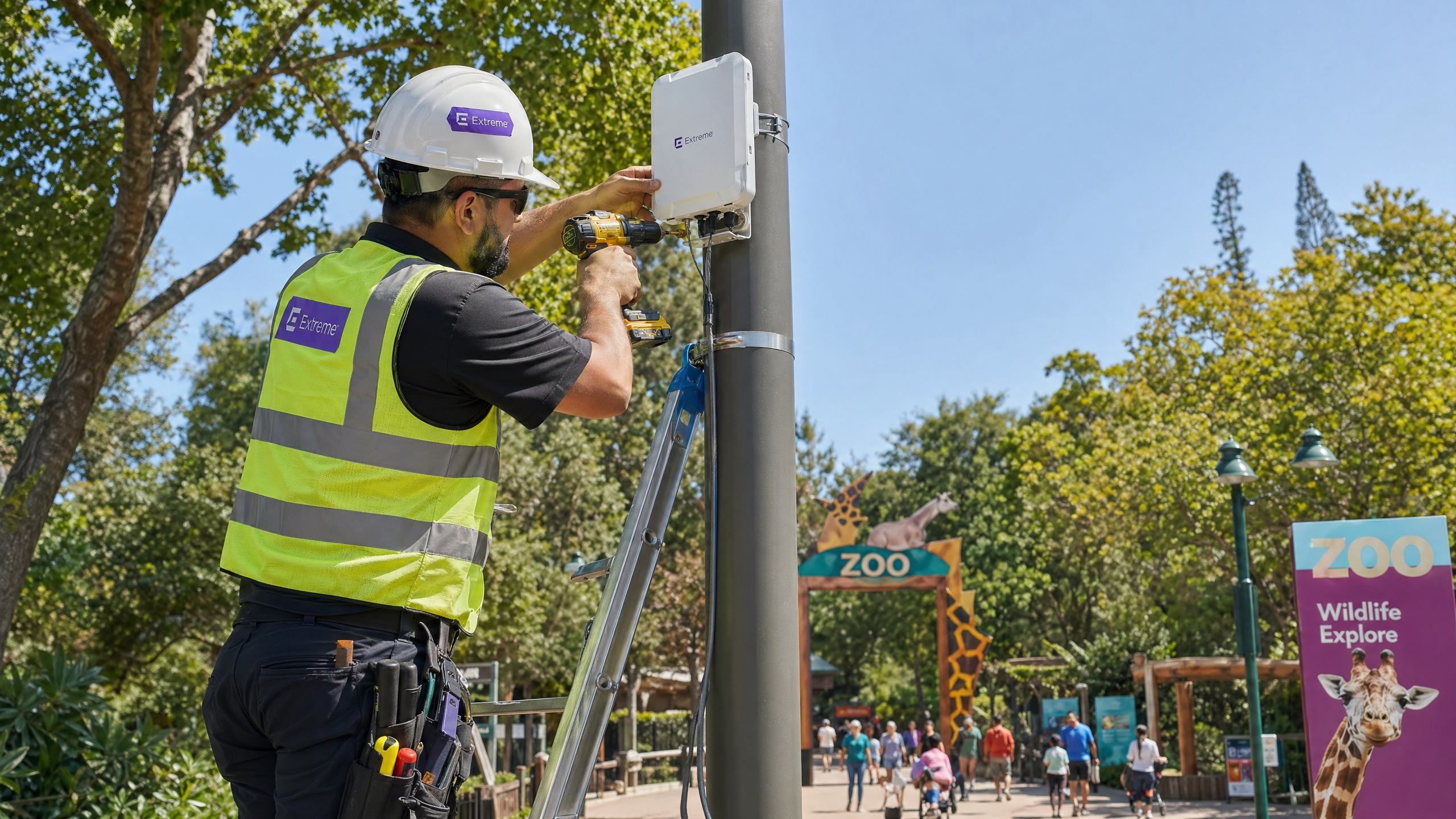
L'implementazione di infrastrutture wireless in ampie aree esterne richiede hardware progettato per condizioni difficili. Gli access point (AP) interni si guasteranno rapidamente se esposti a umidità, fluttuazioni di temperatura e radiazioni UV.
Per le zone esterne, i team IT devono specificare AP con classificazione IP66 o IP67, garantendo una protezione completa contro l'ingresso di polvere e i getti d'acqua ad alta pressione. Inoltre, l'hardware deve supportare un intervallo di temperatura operativa adatto al clima locale, tipicamente da -20°C a +60°C. Nelle aree accessibili al pubblico, come le code o le strutture a bassa altezza, sono obbligatori involucri resistenti agli atti vandalici per proteggere l'investimento.
Dal punto di vista del protocollo, IEEE 802.11ax (Wi-Fi 6) è lo standard di riferimento per le nuove implementazioni. Il vantaggio critico del Wi-Fi 6 negli ambienti ad alta affluenza è l'Orthogonal Frequency Division Multiple Access (OFDMA). OFDMA consente di suddividere un singolo canale AP in unità di risorse più piccole, consentendo la trasmissione simultanea a più client. Ciò riduce significativamente la latenza e migliora l'efficienza in aree dense come le aree ristorazione o gli habitat degli animali, dove centinaia di dispositivi possono competere per il tempo di trasmissione. Mentre il Wi-Fi 6E introduce la banda a 6 GHz, il costo aggiuntivo dell'hardware è attualmente difficile da giustificare per la maggior parte delle implementazioni in luoghi all'aperto, rendendo il Wi-Fi 6 la scelta pragmatica per bilanciare prestazioni e budget.
Architettura di Backhaul e Ridondanza
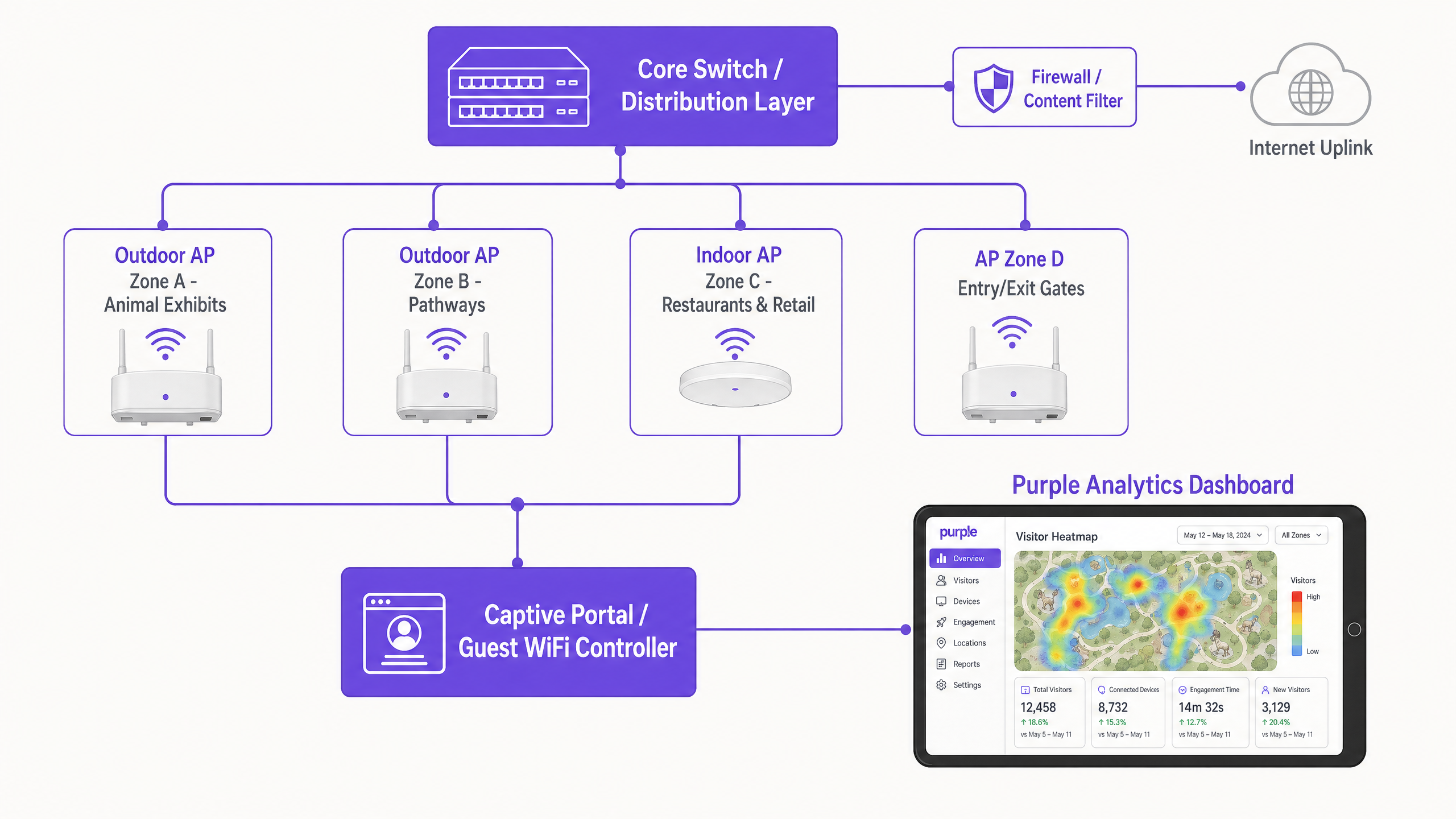
Un design RF robusto è irrilevante se l'infrastruttura di backhaul non può supportare il throughput aggregato. Zoo e parchi divertimento si estendono spesso per decine o centinaia di ettari, rendendo il cablaggio in rame tradizionale impraticabile per collegare gli switch di bordo al core.
È tipicamente richiesto un approccio di backhaul ibrido:
- Anelli in Fibra Ottica: Implementare anelli in fibra ottica monomodale per collegare gli switch di distribuzione in tutto il sito. Ciò fornisce elevata larghezza di banda e resilienza; se un percorso viene interrotto (ad esempio, durante lavori di scavo), il traffico può essere instradato nella direzione opposta.
- Wireless Point-to-Point: Nelle aree in cui lo scavo per la fibra è sensibile dal punto di vista ambientale o proibitivamente costoso (ad esempio, attraverso un lago o un denso habitat boschivo), i bridge wireless point-to-point o point-to-multipoint ad alta capacità forniscono connettività affidabile.
- Power over Ethernet (PoE): Dagli switch di distribuzione, far passare cavi Cat6A per fornire sia dati che alimentazione ai singoli AP, assicurando che le lunghezze non superino lo standard di 100 metri.
Per l'uplink internet primario, la banda larga consumer è insufficiente. Le strutture devono procurarsi una linea dedicata, come dettagliato nella nostra guida Cos'è una Linea Dedicata? Internet Aziendale Dedicato , per garantire larghezza di banda simmetrica e rigorosi Service Level Agreement (SLA).
Segmentazione della Rete e Sicurezza
La sicurezza è fondamentale quando si mescola l'accesso pubblico degli ospiti con le operazioni critiche della struttura. La rete deve essere segmentata logicamente utilizzando Virtual Local Area Networks (VLAN).
- Rete Ospiti: Configurata con WPA3-Personal (o modalità mista WPA2/WPA3 per il supporto di dispositivi legacy) e strettamente isolata da tutte le risorse interne. L'isolamento dei client dovrebbe essere abilitato a livello di AP per impedire ai dispositivi degli ospiti di comunicare tra loro.
- Rete Operativa: VLAN dedicate per terminali point-of-sale (POS), segnaletica digitale e dispositivi IoT. L'accesso dovrebbe essere protetto utilizzando IEEE 802.1X con autenticazione basata su certificati per garantire che solo i dispositivi di proprietà aziendale possano connettersi.
Per ulteriori approfondimenti sulla sicurezza dell'infrastruttura della struttura, fare riferimento al nostro articolo: Proteggi la Tua Rete con DNS e Sicurezza Robusti .
Guida all'Implementazione
Fase 1: Sopralluogo Completo del Sito
Non affidarsi mai esclusivamente alla modellazione predittiva per gli ambienti esterni. Condurre un sopralluogo RF attivo utilizzando strumenti di analisi dello spettro. Alberi, giochi d'acqua e recinzioni metalliche (come gabbie o strutture di attrazioni) assorbono e riflettono i segnali RF in modo imprevedibile. Il sopralluogo deve mappare i requisiti di copertura zona per zona, identificando le fonti di interferenza e le posizioni ottimali per il montaggio degli AP.
Fase 2: Captive Portal e Flusso di Autenticazione
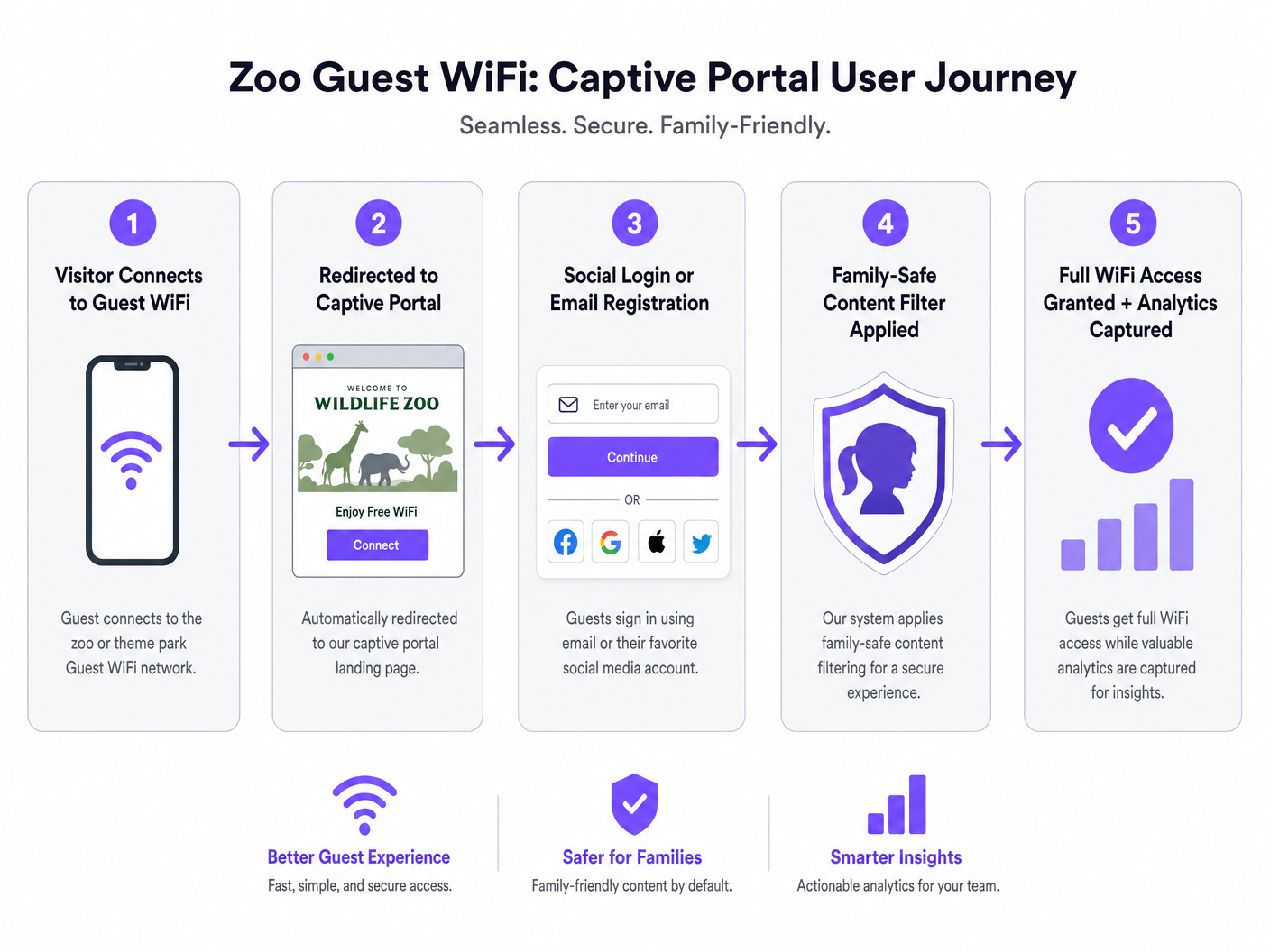
Il Captive Portal è il gateway per la rete ospiti e il meccanismo principale per l'acquisizione dei dati. Un'esperienza di onboarding senza interruzionienza è fondamentale per massimizzare i tassi di connessione.
- Opzioni di Autenticazione: Offrire il login tramite social (Facebook, Google, Apple) insieme alla registrazione tradizionale via email. Le strutture che offrono il login tramite social osservano tipicamente tassi di connessione superiori del 30-40% rispetto a quelle che si affidano esclusivamente alla compilazione di moduli.
- Conformità: Assicurarsi che il portale acquisisca esplicitamente il consenso per il trattamento dei dati e le comunicazioni di marketing, aderendo rigorosamente al GDPR o alle normative locali sulla privacy.
- Riautenticazione Senza Attrito: Utilizzare la memorizzazione nella cache degli indirizzi MAC o piattaforme come OpenRoaming per riconnettere automaticamente i visitatori di ritorno senza richiedere loro di completare nuovamente il flusso del Captive Portal.
Fase 3: Implementazione del Filtro Contenuti per Famiglie
Gli zoo e i parchi a tema hanno il dovere di fornire un ambiente digitale sicuro. Il filtro dei contenuti basato su DNS è il metodo più efficiente per raggiungere questo obiettivo su larga scala. Intercettando le richieste DNS e bloccando la risoluzione per i domini classificati come contenuti per adulti, gioco d'azzardo o violenza, le strutture possono applicare politiche di utilizzo accettabile senza la latenza introdotta dall'ispezione approfondita dei pacchetti (DPI). Questo filtro deve essere applicato per impostazione predefinita all'SSID ospite.
Migliori Pratiche
- Progettare per la Densità di Picco, Non per le Medie: Le strutture spesso sottovalutano il numero di dispositivi durante i periodi di punta (es. festività). Assumere 2-3 dispositivi per visitatore (smartphone, smartwatch, tablet) e progettare la densità degli AP di conseguenza. Una regola generale è un AP ogni 500 metri quadrati nelle zone ad alta densità (aree ristorazione, arene per spettacoli) e uno ogni 1.000 metri quadrati nelle aree di transito a bassa densità.
- Dare Priorità al Percorso dell'Utente: Il Captive Portal deve essere ottimizzato per i dispositivi mobili e caricarsi rapidamente. Qualsiasi ritardo nel rendering del portale porterà all'abbandono.
- Sfruttare l'Infrastruttura Esistente: Quando si montano AP esterni, utilizzare colonne di illuminazione esistenti, pali CCTV o facciate di edifici per minimizzare i costi di installazione e l'impatto visivo.
Risoluzione dei Problemi e Mitigazione del Rischio
| Modalità di Guasto | Causa Radice | Strategia di Mitigazione |
|---|---|---|
| Collasso della Rete Sotto Carico | Densità AP insufficiente; mancanza di supporto OFDMA. | Aggiornare all'infrastruttura Wi-Fi 6; riprogettare le mappe di copertura basandosi sulle stime di utenti concorrenti di picco. |
| Il Captive Portal Non si Carica | Errata configurazione DNS; impostazioni di sicurezza aggressive del sistema operativo mobile. | Assicurarsi che il walled garden includa tutti i domini necessari per le API di social login e gli URL di rilevamento del Captive Portal (es. captive.apple.com). |
| Scarse Prestazioni di Roaming | Potenza di trasmissione AP impostata troppo alta, causando ai client di "attaccarsi" ad AP distanti. | Implementare la gestione dinamica della radio; abbassare la potenza TX per incoraggiare i dispositivi client a effettuare il roaming verso AP più vicini; abilitare 802.11k/v/r. |
ROI e Impatto sul Business
Il business case per l'implementazione di WiFi ad alte prestazioni va ben oltre la connettività di base. Se integrata con una solida piattaforma di analisi, la rete diventa una risorsa strategica.
- Intelligenza Operativa: Tracciando gli indirizzi MAC (anche anonimizzati), le strutture possono generare mappe di calore e analizzare il flusso dei visitatori. Questi dati identificano i punti di congestione, misurano i tempi di permanenza presso specifiche mostre e informano le distribuzioni del personale e della sicurezza.
- Marketing e Generazione di Entrate: I dati di prima parte acquisiti tramite il Captive Portal confluiscono direttamente nel CRM della struttura. Ciò consente campagne email post-visita mirate, l'iscrizione a programmi fedeltà e offerte personalizzate, stimolando le visite ripetute e aumentando il valore a vita del cliente.
- Esperienza Ospite Migliorata: La connettività affidabile consente l'uso di applicazioni mobili specifiche per la struttura per la navigazione, l'ordinazione di cibo mobile e la coda virtuale, migliorando direttamente i punteggi di soddisfazione degli ospiti e riducendo l'attrito operativo.
Come visto in implementazioni simili nei settori Hospitality e Retail , l'integrazione di connettività e analisi trasforma l'infrastruttura IT da centro di costo a piattaforma abilitante per i ricavi. Per ulteriori letture sulle implementazioni temporanee, consulta la nostra guida su Event WiFi: Pianificazione e Implementazione di Reti Wireless Temporanee .
Definizioni chiave
Captive Portal
A web page that intercepts a user's initial HTTP request on a public network, requiring authentication or acceptance of terms before granting internet access.
The primary mechanism for capturing visitor data and enforcing acceptable use policies in venue deployments.
OFDMA (Orthogonal Frequency Division Multiple Access)
A feature of Wi-Fi 6 that allows an AP to divide a wireless channel into smaller sub-channels (Resource Units), enabling simultaneous data transmission to multiple devices.
Critical for maintaining network performance in high-density areas like queues and food courts by reducing latency and overhead.
IP67 Rating
An ingress protection standard indicating a device is completely protected against dust and can withstand temporary immersion in water.
The minimum required environmental protection rating for hardware deployed in outdoor zoo and theme park environments.
Walled Garden
A limited environment that controls the user's access to web content and services prior to full authentication.
Must be configured to allow access to social media login APIs and captive portal detection URLs before the guest is fully connected.
DNS-Based Content Filtering
A security technique that blocks access to inappropriate websites by preventing the Domain Name System (DNS) from resolving restricted URLs into IP addresses.
The standard method for ensuring family-safe browsing on venue guest networks without impacting performance.
Client Isolation
A wireless security feature that prevents devices connected to the same AP or VLAN from communicating directly with one another.
Mandatory on guest networks to prevent lateral movement of malware and protect visitor devices from unauthorized access.
VLAN (Virtual Local Area Network)
A logical grouping of network devices that behave as if they are on the same physical network, regardless of their actual location.
Used to securely segment guest traffic from critical operational systems (e.g., point-of-sale, CCTV).
MAC Caching
A feature that remembers the Media Access Control (MAC) address of a previously authenticated device, allowing it to bypass the captive portal on subsequent visits.
Significantly improves the guest experience by providing frictionless connectivity for returning visitors.
Esempi pratici
A regional zoo spanning 40 acres is upgrading its legacy Wi-Fi 4 network. The IT Director notes that during the summer holidays, the network in the main food court (a 2,000 sq metre outdoor plaza) completely fails, with guests unable to load the captive portal. How should the team architect the food court coverage?
- Upgrade to Wi-Fi 6 (802.11ax) APs with IP67 ratings to leverage OFDMA for high-density client handling.
- Deploy high-density directional antennas (patch antennas) rather than omnidirectional antennas to create smaller, focused RF cells. This minimizes co-channel interference.
- Install 4-6 APs around the perimeter of the food court, pointing inward, ensuring transmit power is lowered to encourage roaming and prevent cell overlap.
- Ensure the backhaul switch supporting this zone has at least a 10Gbps uplink to the core to handle the aggregated traffic.
A theme park marketing team wants to increase the number of email addresses captured via the guest WiFi. Currently, visitors must fill out a 5-field form (Name, Email, Phone, Postcode, DOB). The connection rate is only 12%. What technical and strategic changes should be implemented?
- Implement Social Login (Facebook, Google, Apple) on the captive portal to provide a one-click authentication option.
- Reduce the manual form fields to just Name and Email for users who prefer not to use social login.
- Enable 'Seamless Mac Authentication' (MAC caching) so returning visitors are automatically reconnected without seeing the portal again, improving the user experience.
- Ensure the walled garden configuration allows traffic to the social network authentication APIs before the user is fully authorized.
Domande di esercitazione
Q1. You are designing the WiFi coverage for a new 5-acre outdoor primate enclosure. The landscape architect has specified dense tree planting and a large central water feature. What are the primary RF considerations, and how should you position the APs?
Suggerimento: Consider how water and foliage interact with RF signals, particularly at 5GHz.
Visualizza risposta modello
Foliage (which contains water) and the central water feature will heavily absorb and reflect RF signals, particularly in the 5GHz band. Predictive modeling will be inaccurate here. You must conduct an active site survey. APs should be positioned at the perimeter facing inward using directional antennas to punch through the foliage, rather than relying on omnidirectional APs in the center. Ensure all hardware is IP67 rated due to the outdoor environment.
Q2. During a busy bank holiday weekend, the IT helpdesk receives reports that guests in the main plaza can connect to the WiFi network but cannot reach the internet. The captive portal does not load. The APs show high utilization but are online. What is the most likely cause, and how do you resolve it?
Suggerimento: Think about the IP addressing process before a device can reach the captive portal.
Visualizza risposta modello
The most likely cause is DHCP pool exhaustion. The sheer volume of devices (including those just passing through and probing the network) has consumed all available IP addresses in the guest VLAN. The mitigation is to reduce the DHCP lease time (e.g., to 30 minutes or 1 hour) to quickly reclaim IP addresses from devices that have left the area, and to expand the subnet size for the guest VLAN (/22 or /21 instead of a standard /24).
Q3. The venue's operations director wants to use WiFi analytics to track visitor dwell times at various exhibits to optimize staffing. However, they are concerned about GDPR compliance, as they are tracking MAC addresses. How do you architect the solution to provide analytics while maintaining compliance?
Suggerimento: Consider the difference between anonymized location data and personally identifiable information (PII).
Visualizza risposta modello
To maintain compliance, the WiFi analytics platform must anonymize or pseudonymize MAC addresses (e.g., via cryptographic hashing) immediately upon collection if the user has not authenticated. For users who do authenticate via the captive portal, explicit consent must be obtained to link their location data with their PII (email/social profile). The privacy policy must clearly state that location analytics are being gathered and provide an opt-out mechanism.
Continua a leggere questa serie
Cos'è una Probe Request? Capire come i dispositivi scoprono le reti
Questa guida di riferimento tecnico offre un'analisi approfondita delle probe request IEEE 802.11, della scansione attiva versus passiva e dell'impatto della randomizzazione MAC sull'analisi dei dati dei luoghi. Fornisce strategie di implementazione attuabili per gli architetti di rete al fine di ottimizzare le implementazioni ad alta densità, mitigare le probe storm e garantire una raccolta dati accurata e conforme al GDPR utilizzando livelli di identità autenticati.
Come Risolvere il WiFi Lento Senza Aggiornare il Tuo Piano Internet
Una guida tecnica di riferimento completa per IT managers e network architects sull'ottimizzazione delle prestazioni WiFi aziendali senza aumentare la ISP bandwidth. Copre RF tuning, la gestione della densità dei client, l'implementazione di QoS e come sfruttare WiFi analytics per diagnosticare e risolvere i colli di bottiglia.
La Checklist per la Migrazione da NAC Legacy a NAC Cloud-Native
Questa guida tecnica di riferimento autorevole fornisce una checklist strutturata in tre fasi per la migrazione da Network Access Control (NAC) legacy a un'architettura cloud-native. Fornisce a manager IT e architetti di rete strategie attuabili per gestire l'integrazione dell'identità, la parità delle policy e la conformità senza interrompere le operazioni della sede.