
Compreendendo o Significado da Velocidade do WiFi: Throughput vs Largura de Banda
Este guia de referência técnica e autoritário desmistifica as métricas de velocidade do WiFi para líderes de TI empresariais, distinguindo claramente entre velocidade de link, largura de banda e throughput. Ele fornece metodologias acionáveis para medir o desempenho no mundo real, mitigar o congestionamento de RF e otimizar a infraestrutura WLAN em implantações de locais de alta densidade. Gerentes de TI, arquitetos de rede e diretores de operações de locais sairão com estruturas concretas para alinhar investimentos em infraestrutura com resultados de negócios mensuráveis.
Ouça este guia
Ver transcrição do podcast

Resumo Executivo
Para gerentes de TI e arquitetos de rede que implantam WLANs empresariais, a discrepância entre as velocidades de WiFi anunciadas e a experiência real do usuário é um desafio operacional persistente. A causa raiz é quase sempre um mal-entendido de três métricas distintas: velocidade de link (taxa PHY), largura de banda e throughput. Embora os fornecedores comercializem velocidades de link teóricas máximas — por exemplo, 1200 Mbps em 802.11ax — o throughput real entregue a um aplicativo é tipicamente 40–60% desse valor devido à sobrecarga de protocolo, operação de rádio half-duplex e contenção ambiental.
Este guia de referência técnica fornece uma estrutura definitiva para compreender o significado da velocidade do WiFi em ambientes empresariais. Ele capacita equipes de TI em hotéis, redes de varejo e grandes locais com o conhecimento para medir com precisão o desempenho no mundo real, projetar para capacidade em vez de cobertura e alinhar investimentos em infraestrutura com resultados de negócios mensuráveis. Ao mudar o foco dos máximos teóricos para o throughput sustentado e a alocação ideal de largura de banda, os operadores de locais podem fornecer a conectividade confiável que as plataformas modernas de Guest WiFi e WiFi Analytics exigem.
Análise Técnica Aprofundada: Decodificando Métricas de Velocidade do WiFi
Para projetar uma WLAN robusta, os profissionais de TI devem distinguir entre as capacidades teóricas do meio RF e a entrega prática de cargas de dados. As três métricas — velocidade de link, largura de banda e throughput — são frequentemente confundidas no marketing de fornecedores, discussões de aquisição e até mesmo em relatórios internos de TI. Acertar isso é fundamental para todas as outras decisões de otimização.
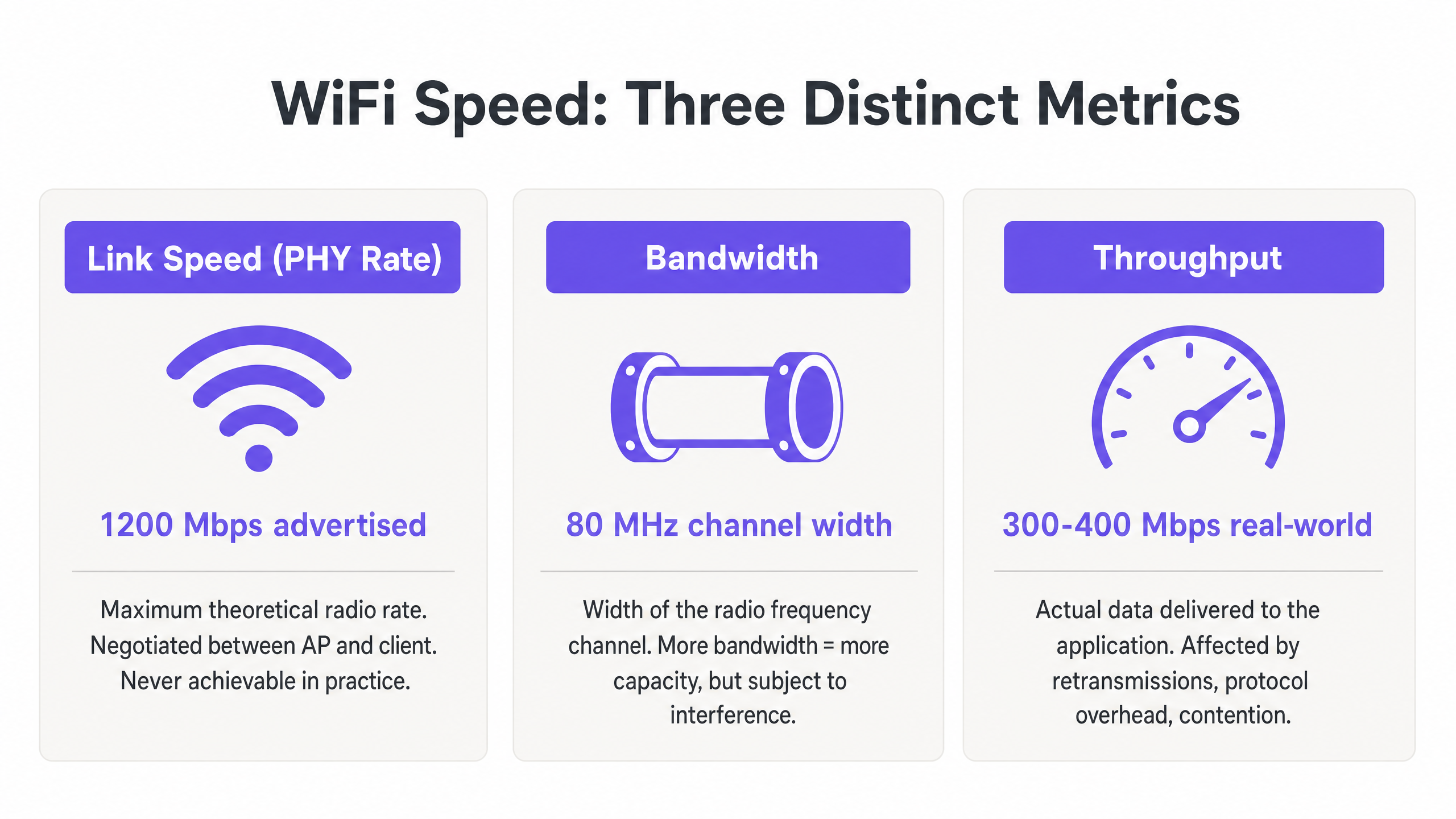
Velocidade de Link (Taxa PHY): O Teto Teórico
A velocidade de link, ou taxa da Camada Física (PHY), representa a taxa máxima teórica de transferência de dados entre um Ponto de Acesso (AP) e um dispositivo cliente no nível do rádio. Essa taxa é negociada dinamicamente com base no esquema de modulação e codificação (MCS), no número de fluxos espaciais e na relação sinal-ruído (SNR) no momento da associação.
Crucialmente, a velocidade de link nunca é alcançável na prática. Ela representa a taxa de bits bruta, incluindo todos os quadros de gerenciamento 802.11, quadros de controle (RTS/CTS e ACKs) e espaçamento entre quadros (AIFS/DIFS). Em implantações empresariais em ambientes de Varejo ou Hotelaria , um cliente que relata uma velocidade de link de 866 Mbps em uma rede 802.11ac é, na verdade, capaz de aproximadamente 400–500 Mbps de transferência de dados real em condições ideais e isoladas — e muito menos em um ambiente compartilhado e multi-cliente.
Largura de Banda: A Capacidade do Canal RF
Largura de banda refere-se à largura do canal de radiofrequência alocado para transmissão, tipicamente medida em Megahertz (MHz). Nas bandas de 5 GHz e 6 GHz, os canais podem ter 20, 40, 80 ou 160 MHz de largura. Canais mais largos oferecem velocidades de link potenciais mais altas — dobrar a largura do canal praticamente dobra a taxa de dados potencial — mas também aumentam o piso de ruído em 3 dB por duplicação e reduzem significativamente o número de canais não sobrepostos disponíveis.
Em ambientes de alta densidade, como estádios, centros de conferências ou corredores de hotéis, a implantação de canais de 80 MHz frequentemente leva a uma interferência co-canal (CCI) catastrófica. A melhor prática empresarial, portanto, dita o uso de canais de 20 MHz ou 40 MHz para maximizar a reutilização espectral e a capacidade geral do sistema, em vez de buscar velocidades individuais de pico. Esta é uma filosofia de design que prioriza o throughput agregado em todos os usuários em detrimento do máximo teórico para qualquer usuário individual.
Throughput: A Medida do Mundo Real
Throughput é o dado de payload real entregue à camada de aplicação (Camada 7), medido em Megabits por segundo (Mbps). Esta é a única métrica que importa para o usuário final, e é a única métrica que deve impulsionar as decisões de design de rede.
O Throughput é fundamentalmente limitado pela natureza half-duplex do WiFi — apenas um dispositivo pode transmitir em um determinado canal por vez. Quando múltiplos dispositivos competem por tempo de ar, o throughput cai proporcionalmente. Além disso, clientes legados transmitindo em taxas de dados mais baixas consomem tempo de ar desproporcional, penalizando clientes mais rápidos que compartilham o mesmo canal. Compreender o custo real do consumo de tempo de ar é crítico ao avaliar o impacto da coleta de dados em segundo plano em sua WLAN, como explorado em profundidade em O Custo Oculto dos Dados de Telemetria em WLANs Corporativas .
A tabela abaixo resume a relação prática entre essas três métricas:
| Métrica | Definição | Valor Típico (802.11ax) | O Que as Equipes de TI Devem Fazer |
|---|---|---|---|
| Velocidade de Link (Taxa PHY) | Taxa de rádio teórica bruta | Até 9.6 Gbps | Usar apenas como indicador de linha de base; nunca como meta de desempenho |
| Largura de Banda (Largura do Canal) | Largura do canal RF em MHz | 20, 40, 80 ou 160 MHz | Padrão de 40 MHz em empresas; 20 MHz em alta densidade |
| Throughput | Taxa de dados real da camada de aplicação | 300–500 Mbps por cliente (ideal) | Este é o KPI primário para todas as avaliações de desempenho de WLAN |
Guia de Implementação: Medindo e Otimizando o Desempenho
A transição da teoria para a prática exige uma metodologia de medição rigorosa e ajuste sistemático. As etapas a seguir refletem as melhores práticas neutras de fornecedores aplicáveis emtodas as principais plataformas WLAN.
Passo 1: Estabelecer Linhas de Base Precisas
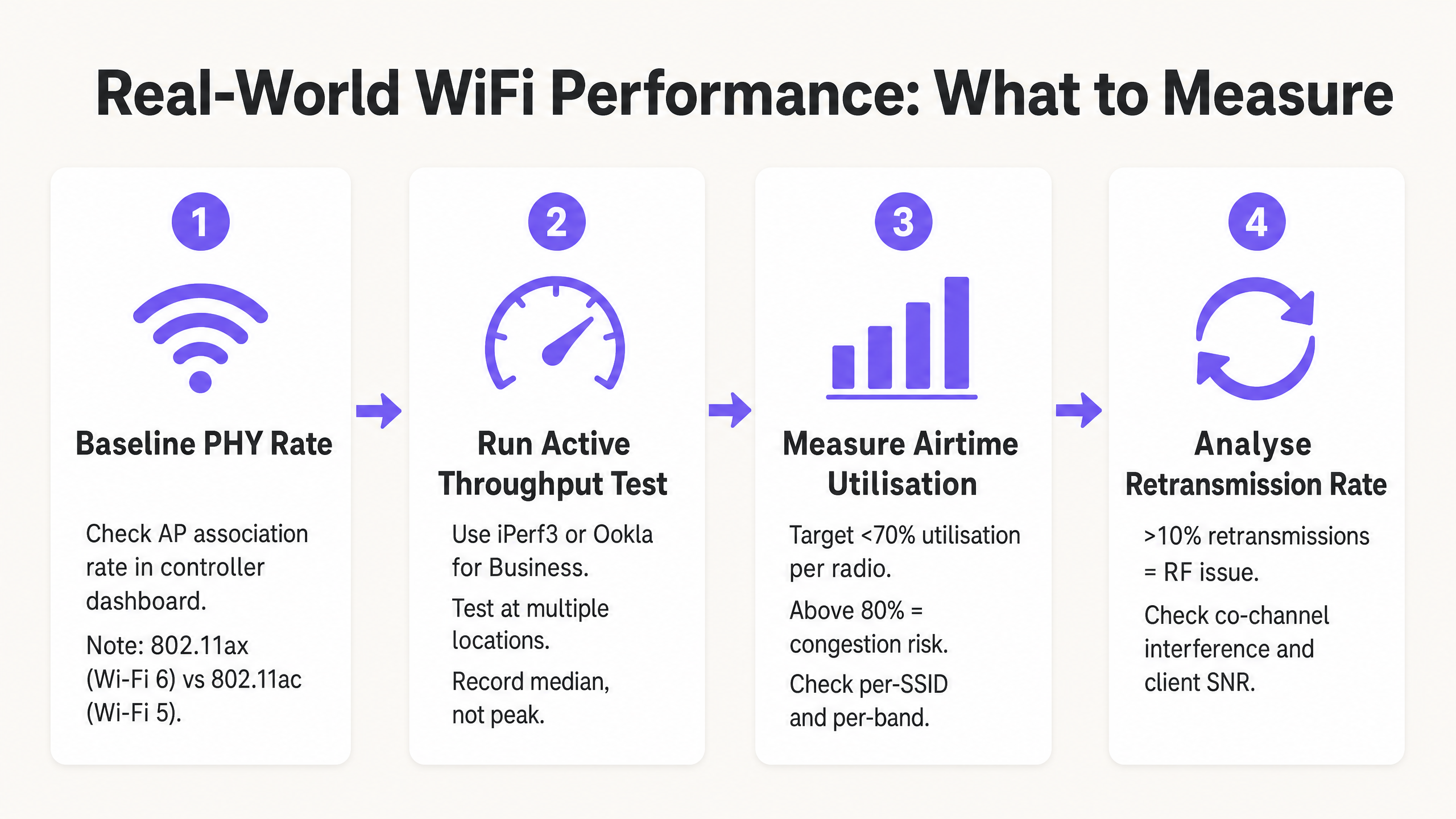
Não confie em testes de velocidade de internet para consumidores (como fast.com ou Speedtest.net) para medir o desempenho da WLAN. Esses testes introduzem latência WAN, variáveis de roteamento de ISP e gargalos do lado do servidor que são totalmente alheios à sua rede sem fio. Em vez disso, implante um servidor iPerf3 local na mesma VLAN da interface de gerenciamento do AP para isolar o segmento de RF. Execute testes de throughput UDP para avaliar a capacidade bruta do canal e testes de throughput TCP para avaliar o desempenho no nível do aplicativo — o TCP é altamente sensível à perda de pacotes e latência, tornando-o um proxy preciso para o comportamento real do aplicativo.
Passo 2: Projetar para Eficiência de Airtime
Airtime é o recurso mais precioso em qualquer implantação de WiFi. Para maximizar o throughput em todo o local, três alterações de configuração proporcionam o maior impacto:
Desativar Taxas Básicas Baixas. Desative as taxas 802.11b (1, 2, 5.5, 11 Mbps) e exija uma taxa básica mínima de 12 Mbps ou 24 Mbps. Isso força os clientes a transmitir quadros de gerenciamento mais rapidamente, liberando airtime para cargas de dados. Um único quadro de gerenciamento enviado a 1 Mbps consome 54 vezes mais airtime do que o mesmo quadro enviado a 54 Mbps.
Habilitar Airtime Fairness (ATF). Onde suportado pelo fornecedor, habilite o ATF para alocar tempo de transmissão igual aos clientes, em vez de contagens de pacotes iguais. Isso evita que clientes legados lentos monopolizem o canal em detrimento de dispositivos modernos e mais rápidos.
Otimizar Larguras de Canal. Por padrão, use canais de 20 MHz na banda de 2.4 GHz (sempre canais 1, 6 e 11) e 40 MHz na banda de 5 GHz para implantações corporativas de alta densidade. Reserve canais de 80 MHz apenas para ambientes isolados e de baixa densidade.
Passo 3: Implementar Autenticação e Segurança Modernas
Os protocolos de segurança impactam o throughput através da sobrecarga de criptografia e latência de roaming. Implemente WPA3 onde o parque de clientes o suporta, ou WPA2-Enterprise (IEEE 802.1X) com Fast BSS Transition (802.11r) para minimizar atrasos de roaming abaixo de 50 ms. Para redes de convidados, a conformidade com GDPR e PCI DSS exige segmentação de rede robusta — o tráfego de convidados deve ser isolado da infraestrutura corporativa e de pagamento através de VLANs dedicadas e políticas de firewall. Soluções modernas de onboarding que reduzem o atrito de autenticação enquanto mantêm a conformidade são discutidas em Como um wi fi assistant Habilita o Acesso Sem Senha em 2026 .
Melhores Práticas e Padrões da Indústria
Os seguintes princípios representam o consenso das recomendações do grupo de trabalho IEEE 802.11 e a experiência de implantação de WLAN corporativa em ambientes de Saúde , Transporte e grandes locais.
Capacidade Acima da Cobertura. Em ambientes corporativos modernos, os APs devem ser implantados para lidar com a densidade de clientes, não apenas para fornecer um sinal. Um sinal forte (cobertura) não garante alto throughput (capacidade) se o canal estiver congestionado. Os dois são objetivos de engenharia totalmente diferentes.
Direcionamento de Banda (Band Steering). Direcione agressivamente clientes dual-band e tri-band para as bandas de 5 GHz e 6 GHz para aliviar o congestionamento no espectro estreito de 2.4 GHz. A banda de 2.4 GHz oferece apenas três canais não sobrepostos (1, 6, 11) e está sujeita a interferência significativa de dispositivos não-WiFi.
Limiares Mínimos de SNR. Configure os rádios dos APs para rejeitar associações de clientes abaixo de um limiar mínimo de SNR (tipicamente 20 dB). Isso evita que clientes distantes e fracos se associem e transmitam em baixas taxas MCS, o que consumiria airtime excessivo.
Auditorias de RF Regulares. Conduza análises de espectro e testes de throughput ativos pelo menos trimestralmente, e imediatamente após qualquer mudança significativa no ambiente físico (novas divisórias, equipamentos AV ou mudanças de inquilinos). O ambiente de RF é dinâmico; um plano de canais que funcionou na implantação pode ser subótimo seis meses depois.
Solução de Problemas e Mitigação de Riscos
Quando o throughput degrada, as equipes de TI devem diagnosticar o ambiente de RF sistematicamente, em vez de recorrer imediatamente a atualizações de hardware. A maioria dos problemas de desempenho de WLAN corporativa são problemas de configuração e design, não limitações de hardware.
Altas Taxas de Retransmissão. Uma taxa de retransmissão acima de 10% tipicamente indica interferência de RF, problemas de nó oculto ou SNR deficiente do cliente. Use ferramentas de análise de espectro para identificar fontes de interferência não-WiFi — fornos de micro-ondas, equipamentos AV e redes vizinhas são culpados comuns em ambientes de hospitalidade e varejo.
Interferência Co-Canal (CCI). Se múltiplos APs no mesmo canal podem se ouvir a -85 dBm ou mais alto, eles compartilham o mesmo domínio de colisão, reduzindo drasticamente o throughput para todos os clientes naquele canal. Mitigue isso reduzindo a potência de transmissão do AP, estreitando as larguras de canal e garantindo que os algoritmos de atribuição dinâmica de canal (DCA) estejam funcionando corretamente.
Clientes 'Grudentos' (Sticky Clients). Clientes que falham em fazer roaming de um AP distante para um mais próximo mantêm um SNR baixo, forçando o AP a usar uma baixa taxa MCS e consumindo airtime excessivo. Mitigue com limiares mínimos de RSSI para associação, 802.11v BSS Transition Management e 802.11r Fast Roaming.
Problemas de Driver do Cliente. Drivers sem fio desatualizados em dispositivos de usuário final podem causar negociação MCS incorreta, falha no uso de streams espaciais MIMO ou comportamento agressivo de economia de energia que interrompe o throughput. Mantenha uma política de gerenciamento de dispositivos cliente que inclua padrões de versão de driver sem fio.
ROI e Impacto nos Negócios
Otimizar o WiFi para throughput em vez de velocidade teórica de link impacta diretamente o resultado final em todos os setores. Em centros de Transporte e grandes locais, a conectividade confiável é essencial para a eficiência operacional — desde sistemas de ponto de venda móvel (mPOS) para sinalização digital e controle de acesso.
Para operadores de locais, redes de alta capacidade permitem serviços baseados em localização avançados e análises. Garantir conectividade consistente e confiável é um pré-requisito para recursos como os introduzidos em Purple Lança Modo de Mapas Offline para Navegação Contínua e Segura para Hotspots WiFi , que aprimoram a experiência do hóspede e impulsionam o engajamento mensurável. A expansão da Purple no setor público, detalhada em Purple Nomeia Iain Fox como VP de Crescimento – Setor Público para Impulsionar a Inclusão Digital e a Inovação em Cidades Inteligentes , ressalta ainda mais a importância de uma infraestrutura pública de WiFi confiável e de alta capacidade como base para serviços de cidades inteligentes.
O caso de negócios para o design de WLAN focado na capacidade é direto: uma rede que entrega 200 Mbps consistentes por cliente durante as horas de pico é mais valiosa do que uma que entrega uma velocidade de link de 866 Mbps com 85% de utilização do tempo de antena e desempenho imprevisível no mundo real. Ao alinhar métricas de TI — capacidade, utilização do tempo de antena, taxa de retransmissão — com resultados de negócios — pontuações de satisfação do hóspede, confiabilidade de transações mPOS, tempo de atividade operacional — os líderes de TI podem justificar investimentos em infraestrutura e demonstrar um ROI claro e mensurável.
Definições principais
Link Speed (PHY Rate)
The maximum theoretical physical layer data rate negotiated between a client and an AP, measured in Mbps. Determined by MCS index, spatial streams, and channel width.
Frequently cited in vendor marketing and procurement documents. IT teams must understand this is a gross rate that includes massive protocol overhead and is never achievable as application throughput.
Throughput
The actual rate of successful payload data delivery over a communication channel to the application layer, measured in Mbps.
The primary KPI for any WLAN performance assessment. The only metric that accurately reflects end-user experience and application performance.
Bandwidth (RF Channel Width)
The width of the frequency spectrum allocated for a transmission channel, typically 20, 40, 80, or 160 MHz in the 5 GHz band.
Determines the potential capacity of the channel. Wider bandwidths increase peak link speed but reduce the number of non-overlapping channels and increase susceptibility to interference in dense deployments.
Co-Channel Interference (CCI)
Performance degradation caused when multiple APs operate on the same frequency channel and can detect each other's transmissions, forcing them to share airtime via the CSMA/CA contention mechanism.
The primary cause of poor throughput in dense enterprise deployments. Mitigated by proper channel planning, reduced transmit power, and narrower channel widths.
Airtime Utilisation
The percentage of time a specific RF channel is occupied with transmissions (data, management, or control frames).
A critical operational metric. Sustained utilisation above 70–80% indicates severe congestion and impending throughput collapse. Should be monitored per-radio and per-SSID.
Half-Duplex
A communication mode where data can be transmitted in both directions, but only one direction at a time on a shared medium.
The fundamental characteristic of WiFi that limits throughput to significantly below the theoretical link speed. Unlike wired Ethernet (full-duplex), WiFi requires all devices to take turns transmitting.
Spatial Streams (MIMO)
Multiple independent data signals transmitted simultaneously using Multiple Input Multiple Output (MIMO) antenna technology, increasing throughput without requiring wider bandwidth.
A key differentiator between 802.11ac (up to 8 spatial streams) and 802.11ax (Wi-Fi 6). Effective only when both the AP and client device support multiple antennas.
Basic Rates
The mandatory data rates that all clients must support to associate with a BSS. Management and control frames are transmitted at the lowest enabled basic rate.
Disabling low basic rates (1, 2, 5.5, 11 Mbps) is a standard and highly effective IT configuration practice. A frame sent at 1 Mbps consumes 54 times more airtime than the same frame at 54 Mbps.
MCS (Modulation and Coding Scheme)
An index value that defines the combination of modulation technique (e.g., 256-QAM, 1024-QAM) and forward error correction coding rate used for a given transmission.
Higher MCS indices deliver higher throughput but require a stronger signal-to-noise ratio. The AP and client negotiate the highest feasible MCS based on current RF conditions.
Exemplos práticos
A 400-room hotel is experiencing guest complaints about slow WiFi speeds during the evening peak (7 PM – 10 PM). The IT manager notes that the APs are reporting link speeds of 866 Mbps, but guests are struggling to stream video. The network uses 80 MHz channels on the 5 GHz band with APs deployed in corridors at maximum transmit power.
- Conduct an airtime utilisation assessment during peak hours using the WLAN controller's built-in analytics or a dedicated tool such as Ekahau Sidekick. Expect to find utilisation above 80% on the primary 5 GHz channels, confirming Co-Channel Interference (CCI). 2. Reconfigure the WLAN controller to reduce channel widths on the 5 GHz band from 80 MHz to 40 MHz. This doubles the number of available non-overlapping channels from 6 to 12 in the UNII-1/UNII-3 bands, significantly reducing CCI. 3. Reduce AP transmit power to approximately 11–14 dBm to shrink cell sizes and reduce the number of APs that can hear each other on the same channel. 4. Enable dynamic channel assignment (DCA) to allow the controller to optimise channel allocation automatically. 5. Implement per-client bandwidth throttling (e.g., 15 Mbps downstream per device) to prevent individual users from monopolising the internet uplink during peak hours.
A large retail chain is deploying mobile Point-of-Sale (mPOS) tablets across 50 stores. The tablets require reliable, low-latency connections for payment processing, but are frequently dropping sessions when staff move between aisles. The WLAN uses WPA2-Personal with default basic rates enabled.
- Implement IEEE 802.11r (Fast BSS Transition) on the corporate mPOS SSID to reduce roaming authentication delays from 300–500 ms to under 50 ms. This is critical for session-sensitive payment applications. 2. Adjust the AP minimum mandatory basic rate to 12 Mbps. This reduces the effective cell size, encouraging tablets to roam to closer APs sooner rather than maintaining a weak connection to a distant AP (sticky client behaviour). 3. Migrate the mPOS SSID from WPA2-Personal to WPA2-Enterprise (802.1X) with certificate-based authentication to meet PCI DSS requirements for cardholder data environments. 4. Apply WMM (Wi-Fi Multimedia) QoS tags to the mPOS SSID, prioritising traffic in the Voice or Video queue to protect throughput during periods of high guest network usage. 5. Implement 802.11k (Neighbour Reports) and 802.11v (BSS Transition Management) to assist tablets in identifying and roaming to optimal APs proactively.
Questões práticas
Q1. You are designing the WLAN for a high-density university lecture theatre with 300 seats. Your goal is to maximise aggregate throughput for all users simultaneously. The venue has 8 APs deployed in the ceiling. Should you configure the 5 GHz radios to use 20 MHz, 40 MHz, or 80 MHz channel widths?
Dica: Consider the number of non-overlapping channels available in the 5 GHz UNII-1 and UNII-3 bands, and the impact of Co-Channel Interference in a single open room with multiple APs.
Ver resposta modelo
Use 20 MHz channels. In a high-density, single-room environment with 8 APs, you need each AP to operate on a distinct, non-overlapping channel to avoid CCI. The 5 GHz band offers approximately 24 non-overlapping 20 MHz channels (in regions with full UNII band access), but only 6 non-overlapping 40 MHz channels and 3 non-overlapping 80 MHz channels. With 8 APs using 80 MHz channels, at least 5 APs would be sharing channels, creating severe CCI. By using 20 MHz channels, you can assign unique channels to all 8 APs, allowing them to transmit simultaneously without contention. The individual link speed per client will be lower, but the aggregate throughput across all 300 users will be dramatically higher.
Q2. A client complains that their new 802.11ax (Wi-Fi 6) laptop only achieves 480 Mbps on a local iPerf3 test, despite Windows reporting a link speed of 1.2 Gbps. The client believes the AP is faulty. How do you assess and explain this situation?
Dica: Apply the Rule of Half and consider the relationship between PHY rate and TCP throughput in a half-duplex medium.
Ver resposta modelo
The AP is almost certainly functioning correctly. The 1.2 Gbps is the negotiated Link Speed (PHY rate) — the gross theoretical radio rate. Because WiFi is half-duplex, and because the 802.11 protocol requires significant overhead (management frames, ACKs, inter-frame spacing), actual TCP throughput is typically 40–60% of the link speed. 480 Mbps from a 1.2 Gbps link represents a 40% efficiency ratio, which is within the expected range and indicates the network is performing well. To confirm, check the retransmission rate (should be below 5%) and airtime utilisation (should be below 50% for a single-client test). If both are healthy, the result is excellent and the AP should not be replaced.
Q3. During a site survey in a busy retail warehouse, you notice the airtime utilisation on channel 6 (2.4 GHz) is consistently at 88%, but there are only 6 active clients connected to the AP. The AP is a modern 802.11ax device. What are the two most likely causes, and what is the remediation for each?
Dica: Think about how legacy data rates affect airtime consumption, and consider sources of non-WiFi interference common in warehouse environments.
Ver resposta modelo
Cause 1: Legacy basic rates are enabled. If the AP is transmitting management frames (beacons, probe responses) at 1 Mbps, each frame takes 54 times longer than at 54 Mbps, consuming enormous amounts of airtime even with few clients. Remediation: Disable 802.11b rates and set the minimum basic rate to 12 Mbps or 24 Mbps. Cause 2: Non-WiFi interference in the 2.4 GHz band. Warehouses commonly contain microwave ovens, Bluetooth devices, and older industrial wireless equipment that generate broadband interference in the 2.4 GHz band, artificially inflating airtime utilisation figures. Remediation: Conduct a spectrum analysis using a tool such as Ekahau Sidekick or a dedicated spectrum analyser to identify the interference source, and where possible migrate clients to the 5 GHz band.