
Gerenciando Largura de Banda em Redes de Alojamento Estudantil
Este guia fornece a gerentes de TI, arquitetos de rede e diretores de operações de propriedade uma referência técnica neutra em relação a fornecedores para gerenciar a largura de banda WiFi em ambientes de alojamento estudantil de alta densidade. Ele aborda segmentação de VLAN, design de política de Qualidade de Serviço (QoS), modelagem de tráfego baseada em identidade e visibilidade da camada de aplicação — os quatro pilares de uma rede escalável e de acesso justo. Com cenários de implantação do mundo real, resultados mensuráveis e estruturas de decisão, este é o manual operacional para qualquer equipe responsável pela infraestrutura de rede residencial em escala.
Ouça este guia
Ver transcrição do podcast
Resumo Executivo
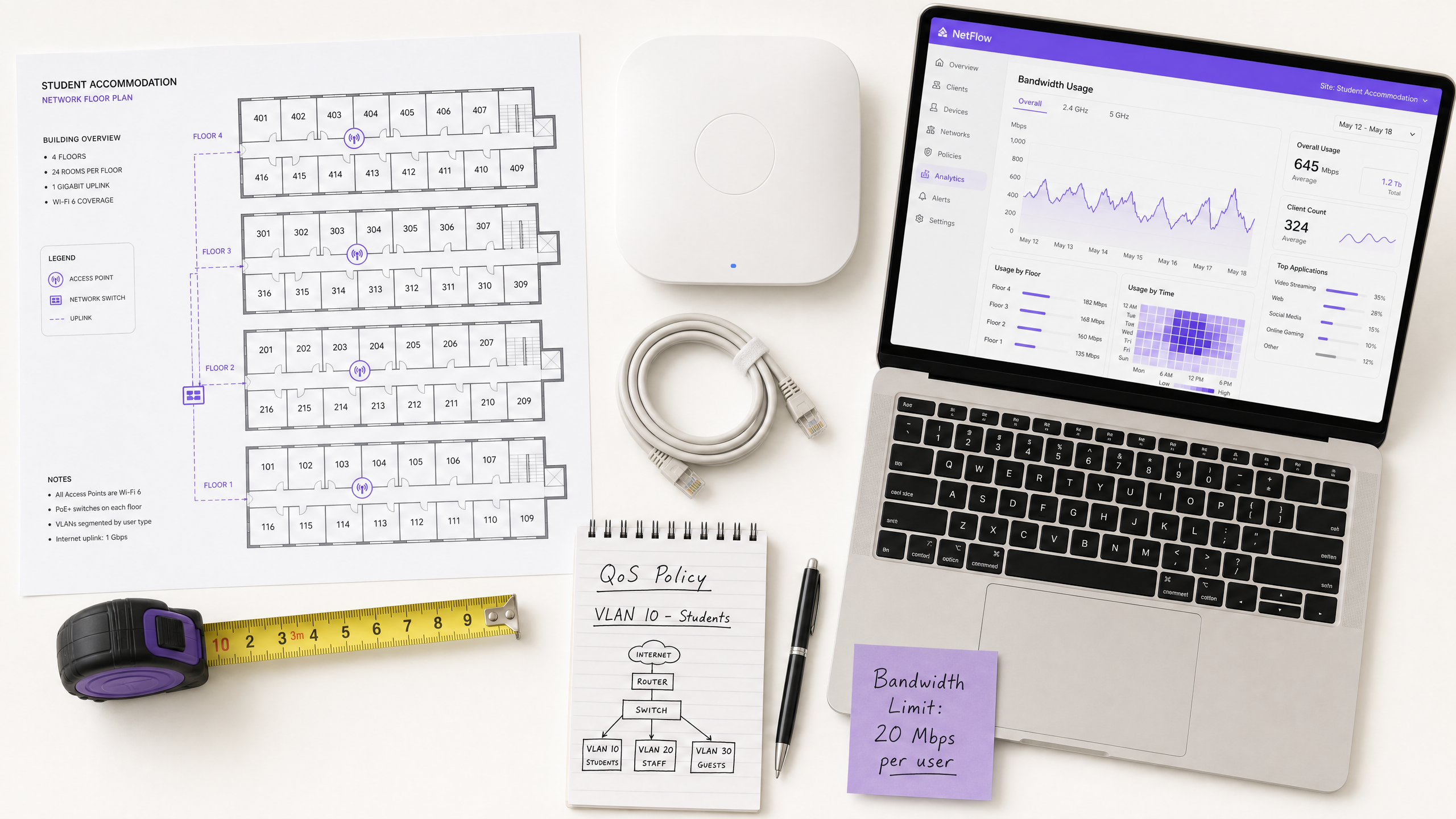
Gerenciar a largura de banda WiFi em alojamentos estudantis é um dos desafios tecnicamente mais exigentes no setor imobiliário residencial. Um único bloco de 400 leitos pode gerar mais de 2.800 conexões de dispositivos simultâneas durante as horas de pico, com perfis de tráfego que abrangem videoconferência sensível à latência, streaming de alta taxa de transferência, jogos online e telemetria IoT em segundo plano — todos competindo pela mesma capacidade de uplink.
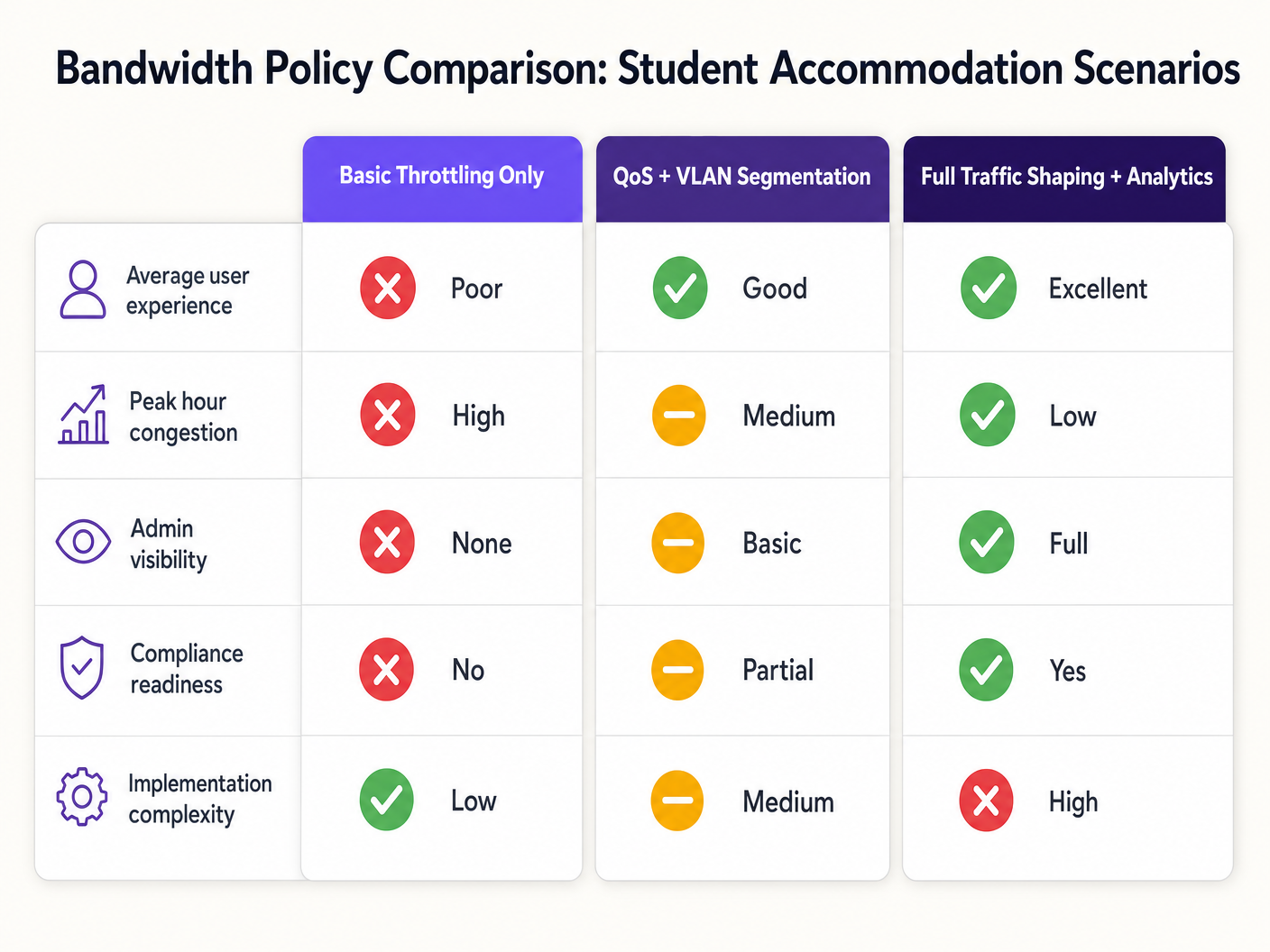
O modo de falha é previsível: arquiteturas de rede planas com limitação por dispositivo degradam durante as horas de pico, geram sobrecarga de suporte desproporcional e expõem os operadores a riscos de conformidade. A solução é igualmente bem definida: segmentação de VLAN, aplicação de política QoS baseada em identidade, modelagem de tráfego dinâmica e análise da camada de aplicação.
Este guia fornece a arquitetura técnica, a sequência de implementação e as estruturas de decisão operacional necessárias para implantar uma estratégia de gerenciamento de largura de banda que escala. Seja você remediando uma rede plana legada ou projetando uma implantação greenfield, os princípios aqui se aplicam a diferentes pilhas de fornecedores e tamanhos de propriedade. Para operadores que já utilizam infraestrutura de Guest WiFi , essas políticas se integram diretamente aos fluxos de trabalho existentes de captive portal e autenticação.
Análise Técnica Detalhada
O Problema da Contenção
O desafio fundamental no alojamento estudantil não é a largura de banda bruta — a maioria dos operadores tem acesso a uplinks gigabit a preços competitivos. O desafio é o gerenciamento de contenção: garantir que a capacidade disponível seja distribuída de forma justa e inteligente entre centenas de usuários simultâneos com perfis de tráfego muito diferentes.
Uma arquitetura de rede plana — um único SSID, uma única sub-rede IP, um limite global por dispositivo — falha por três razões agravantes. Primeiro, os limites por dispositivo são facilmente contornados: um estudante com sete dispositivos efetivamente recebe sete vezes a alocação. Segundo, sem classificação de tráfego, um único usuário executando um grande download de torrent pode saturar a fila de uplink e introduzir latência para todos os outros usuários no segmento. Terceiro, sem visibilidade da camada de aplicação, o operador não tem dados para informar decisões de política ou identificar infratores crônicos.
Arquitetura de Segmentação de VLAN
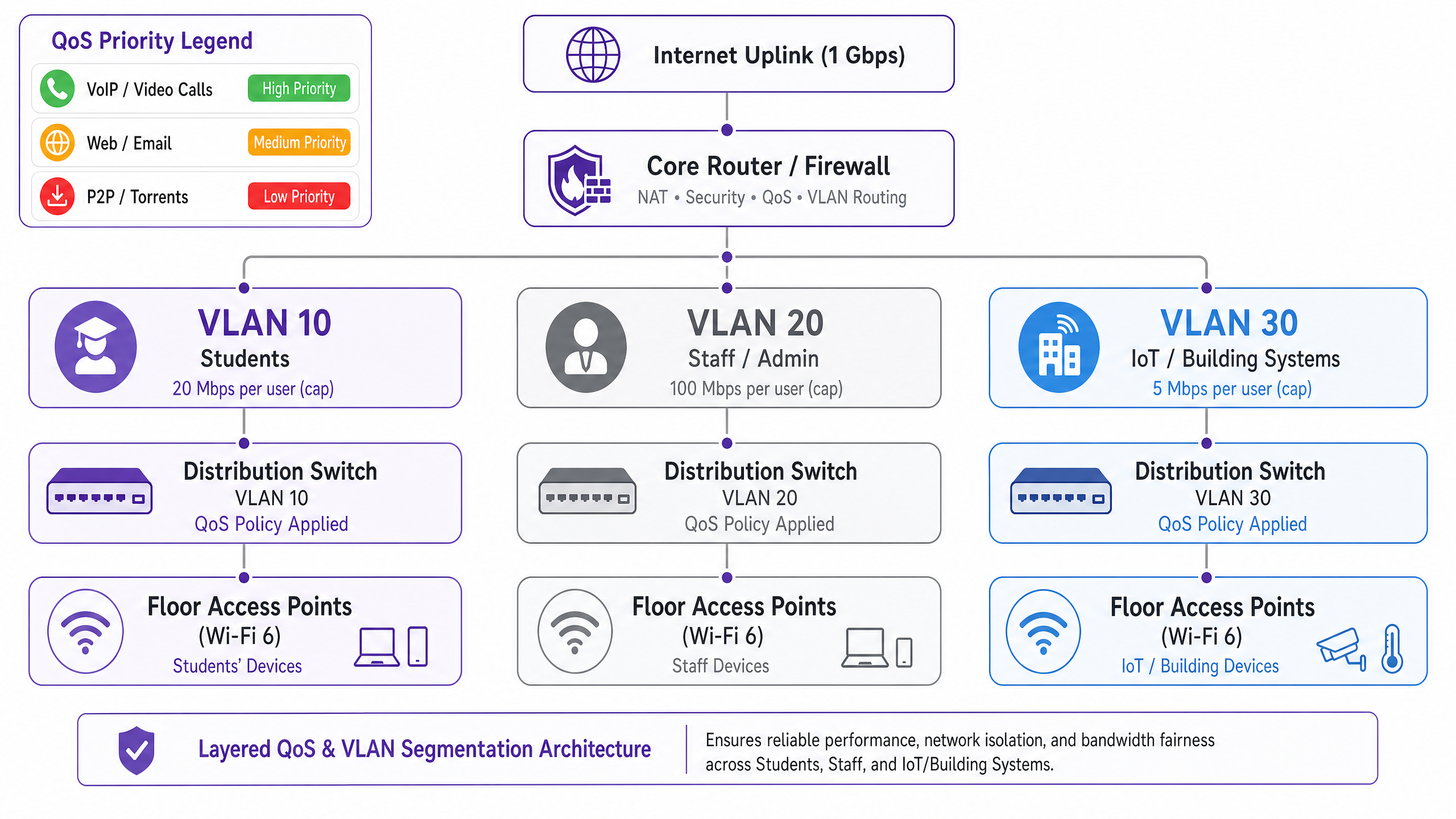
O primeiro requisito arquitetônico é a separação lógica da rede usando VLANs IEEE 802.1Q. No mínimo, uma implantação de alojamento estudantil deve operar três VLANs distintas:
| VLAN | Propósito | Política de Largura de Banda | Postura de Segurança |
|---|---|---|---|
| VLAN 10 — Estudantes | Acesso à internet para residentes | Limite por usuário, burst dinâmico | Isolada, somente internet |
| VLAN 20 — Equipe/Admin | Sistemas de gestão de propriedade | Alocação dedicada | Acesso restrito |
| VLAN 30 — IoT/BMS | Gestão de edifícios, CFTV, controle de acesso | Limite de taxa rigoroso | Separada da VLAN de estudantes |
Essa segmentação é inegociável tanto do ponto de vista de desempenho quanto de segurança. Sob IEEE 802.1Q, cada VLAN opera como um domínio de broadcast separado, eliminando tempestades de broadcast entre segmentos e prevenindo o movimento lateral entre classes de usuários. Um dispositivo de estudante comprometido não pode alcançar a infraestrutura de gerenciamento do edifício se as VLANs estiverem configuradas corretamente com políticas de roteamento inter-VLAN na camada do firewall.
Design da Política de Qualidade de Serviço
Uma vez que o tráfego é segmentado, as políticas de QoS devem ser aplicadas para priorizar aplicações sensíveis à latência em detrimento de transferências em massa. O mecanismo padrão da indústria é a marcação Differentiated Services Code Point (DSCP), definida na RFC 2474. Os pacotes são classificados e marcados no ponto de acesso — o ponto de entrada — antes de chegarem à malha de comutação central.
O esquema de marcação DSCP recomendado para alojamento estudantil é o seguinte:
| Classe de Tráfego | Exemplos de Aplicações | Valor DSCP | Comportamento por Salto |
|---|---|---|---|
| Voz | VoIP, chamadas de vídeo | EF (46) | Encaminhamento Expedito |
| Vídeo Interativo | Videoconferência, área de trabalho remota | AF41 (34) | Encaminhamento Assegurado |
| Streaming de Vídeo | Netflix, YouTube, iPlayer | AF21 (18) | Encaminhamento Assegurado |
| Web / E-mail | HTTP/S, SMTP, DNS | CS0 (0) | Melhor Esforço |
| Massa / P2P | Torrents, grandes transferências de arquivos | CS1 (8) | Segundo Plano / Scavenger |
Criticamente, a marcação DSCP deve ocorrer na camada do ponto de acesso, não no roteador central. Se a classificação for adiada para o núcleo, os pacotes já terão percorrido o meio sem fio e a malha de comutação de distribuição sem tratamento prioritário, anulando o benefício.
Aplicação de Política Baseada em Identidade
A decisão arquitetônica mais impactante em uma implantação de alojamento estudantil é a transição da aplicação de política de largura de banda por dispositivo para por usuário. O estudante médio traz sete dispositivos conectados para seu alojamento. Os limites por dispositivo são, portanto, ineficazes e injustos: um estudante com um único laptop recebe um sétimo da alocação efetiva de um estudante com um conjunto completo de dispositivos.
A abordagem correta é a autenticação IEEE 802.1X, idealmente com WPA3-Enterprise para os benefícios de segurança criptográfica. Sob este modelo:
- O estudante se autentica uma vez usando suas credenciais institucionais ou da propriedade via um servidor RADIUS.
- Todos os registros de dispositivos subsequentes são vinculados a essa identidade de usuário via MAC Authentication Bypass (MAB) para dispositivos sem interfacevícios.
- A política de largura de banda — digamos, 25 Mbps agregados — aplica-se à soma de todas as sessões associadas a essa identidade de usuário.
- Quando o agregado excede a alocação, a política de modelagem se aplica proporcionalmente a todas as sessões ativas.
Este modelo é fundamentalmente mais escalável e equitativo do que a limitação por MAC, e fornece a camada de identidade necessária para o registro de conformidade sob o Investigatory Powers Act 2016.
Visibilidade da Camada de Aplicação
A Inspeção Profunda de Pacotes (DPI) no gateway fornece a telemetria da camada de aplicação necessária para tomar decisões de política inteligentes e baseadas em dados. Sem DPI, o gerenciamento de largura de banda é essencialmente cego: você pode ver que seu uplink está saturado, mas não consegue determinar quais aplicações ou usuários são responsáveis.
Com análises habilitadas para DPI — como as fornecidas por WiFi Analytics — os operadores obtêm visibilidade da distribuição de aplicações, padrões de uso de pico, principais consumidores e tendências de tráfego ao longo do tempo. Esses dados informam diretamente as decisões de política: se 55% do tráfego de pico é atribuível a quatro plataformas de streaming, você pode aplicar limites de taxa específicos para aplicações durante janelas definidas sem impactar videoconferências ou plataformas acadêmicas.
Guia de Implementação
Fase 1: Avaliação da Linha de Base (Semanas 1–2)
Antes de implantar quaisquer novas políticas, estabeleça uma linha de base de 14 dias do comportamento atual da rede. Implante uma plataforma de gerenciamento de rede com recursos de DPI e capture: contagens de dispositivos simultâneos de pico, distribuição de aplicações por volume de tráfego, utilização por andar e por AP, e frequência de saturação do uplink. Esses dados são a base para todas as decisões de política subsequentes e fornecem a comparação antes/depois necessária para demonstrar o ROI.
Fase 2: Implantação de Segmentação VLAN (Semanas 3–4)
Implante a arquitetura de três VLANs descrita acima. Isso requer alterações de configuração no roteador/firewall central (roteamento inter-VLAN e políticas ACL), switches de distribuição (configuração de porta trunk e marcação VLAN) e pontos de acesso (mapeamento SSID-para-VLAN). Para implantações existentes, isso pode ser concluído tipicamente em uma janela de manutenção sem a necessidade de novo hardware, desde que a infraestrutura de switching existente suporte 802.1Q trunking.
Fase 3: Ativação da Política QoS (Semana 5)
Ative a marcação DSCP na camada do ponto de acesso e configure o comportamento por salto no roteador central. Valide se as marcações DSCP estão sendo respeitadas de ponta a ponta usando uma ferramenta de captura de pacotes. Modos de falha comuns nesta fase incluem roteadores ISP upstream remarcando ou removendo valores DSCP — verifique com seu ISP se o DSCP é respeitado em seu link de trânsito.
Fase 4: Políticas de Largura de Banda Baseadas em Identidade (Semanas 6–7)
Migre a autenticação de acesso baseado em PSK ou MAC para 802.1X. Implante um servidor RADIUS (FreeRADIUS ou um equivalente hospedado na nuvem) e configure atributos de largura de banda por usuário usando os atributos RADIUS padrão: WISPr-Bandwidth-Max-Up e WISPr-Bandwidth-Max-Down. Implemente um portal de auto-registro MAB para dispositivos sem interface. Teste com um andar piloto antes da implantação completa.
Fase 5: Regras de Modelagem Dinâmica (Semana 8)
Configure regras de modelagem por horário no roteador central ou no appliance de gerenciamento de largura de banda. Uma estrutura de política recomendada:
- Fora de pico (00:00–08:00): Burst para 2× alocação de linha de base, P2P irrestrito.
- Padrão (08:00–18:00): Alocação de linha de base, P2P limitado a 5 Mbps.
- Pico (18:00–23:00): Alocação de linha de base, P2P limitado a 1 Mbps, streaming limitado a 8 Mbps, videoconferência priorizada.
Melhores Práticas
Publique sua política de largura de banda. A transparência reduz as reclamações dos residentes e define expectativas. Inclua alocações de largura de banda e políticas de uso justo em contratos de locação e kits de boas-vindas. Esta é também uma medida de mitigação de risco: políticas documentadas reduzem a exposição em caso de disputa com um residente.
Dimensione seu uplink corretamente. Uma linha de base prática é de 1 Mbps por leito, com capacidade de burst de até 3 Mbps por leito. Para uma propriedade de 400 leitos, isso significa um uplink mínimo de 400 Mbps com um circuito de burst de 1,2 Gbps. O subdimensionamento do uplink torna todas as políticas de QoS downstream menos eficazes.
Não bloqueie o tráfego P2P completamente. Proibições gerais levam os usuários a serviços VPN comerciais, o que cega suas análises de DPI e torna o gerenciamento de tráfego significativamente mais difícil. Limite o P2P a uma alocação de classe "scavenger" (1–2 Mbps) e despriorize-o. Você mantém a visibilidade, reduz o impacto na largura de banda e evita a corrida armamentista com a adoção de VPN.
Planeje o crescimento da IoT. Sistemas de gerenciamento de edifícios, medidores inteligentes, CCTV e controle de acesso estão cada vez mais conectados por IP. Garanta que esses dispositivos estejam em VLANs isoladas com políticas rigorosas de egresso de firewall. Revise sua política de VLAN IoT anualmente à medida que a população de dispositivos cresce.
Mantenha um registro de auditoria. Sob o Investigatory Powers Act 2016, os operadores do Reino Unido são obrigados a reter registros de conexão. Garanta que sua infraestrutura de registro capture os dados necessários para conformidade e que seu registro de auditoria seja à prova de adulteração. Para uma análise detalhada dos requisitos de registro de auditoria, consulte Entenda o que é registro de auditoria para Segurança de TI em 2026 .
Solução de Problemas e Mitigação de Riscos
Modo de Falha Comum 1: Remarcação DSCP pelo ISP
Muitos ISPs remarcam ou removem valores DSCP na fronteira de trânsito, tornando suas políticas de QoS ineficazes para o tráfego que atravessa a internet. Mitigação: verifique o comportamento do DSCP com seu ISP antes de confiar nele para QoS de ponta a ponta. Para tráfego interno (por exemplo, servidores de cache locais), o DSCP sempre será respeitado. Para tráfego destinado à internet, confie no gerenciamento de fila e modelagem em seu próprio gateway, em vez de esperar que o DSCP seja respeitado upstream.
Modo de Falha Comum 2: Esgotamento do Pool DHCPtion
Com sete dispositivos por aluno e centenas de residentes, o esgotamento do pool DHCP é um risco operacional real. Garanta que a sub-rede VLAN do seu aluno seja dimensionada com folga suficiente: uma /21 (2.046 endereços utilizáveis) é um mínimo razoável para uma propriedade de 200 leitos. Implemente tempos de concessão DHCP curtos (4 a 8 horas) para recuperar endereços de dispositivos inativos prontamente.
Modo de Falha Comum 3: Bypass de VPN
Alunos que utilizam serviços comerciais de VPN criptografarão seu tráfego, ignorando a classificação da camada de aplicação. Mitigação: implemente modelagem baseada em fluxo no nível IP — o tráfego VPN ainda pode ter sua taxa limitada com base no volume e duração do fluxo, mesmo sem inspeção de payload. Além disso, garanta que sua política de limitação de P2P se aplique a fluxos criptografados, não apenas a protocolos P2P identificáveis.
Modo de Falha Comum 4: Problemas de Conectividade Pós-Segmentação
Após a segmentação de VLAN, os residentes podem encontrar problemas de conectividade se seus dispositivos forem colocados incorretamente na VLAN errada ou se o roteamento inter-VLAN estiver mal configurado. Para uma abordagem estruturada de solução de problemas de conectividade, consulte Resolvendo o Erro de Conectado, mas Sem Internet no WiFi de Convidados .
ROI e Impacto nos Negócios
O caso de negócios para uma estratégia de gerenciamento de largura de banda adequadamente arquitetada é direto. Os principais impulsionadores de custo são a sobrecarga de suporte e a satisfação do residente, ambos diretamente impactados pelo desempenho da rede.
Em uma implantação de 400 leitos executando uma rede plana, volumes de tickets de suporte de 30 a 50 por semana durante o período letivo são comuns. Implantações pós-remediação relatam consistentemente reduções de tickets de 60 a 80%, representando uma redução significativa no tempo da equipe de TI e nos custos de suporte de terceiros.
Os índices de satisfação dos residentes — cada vez mais um diferencial competitivo no mercado de acomodações estudantis construídas para esse fim (PBSA) — estão diretamente correlacionados com o desempenho da rede. Propriedades com redes bem gerenciadas relatam taxas de renovação mais altas e maior ocupação.
Do ponto de vista da conformidade, o custo da não conformidade com a Investigatory Powers Act 2016 ou com os requisitos de tratamento de dados do GDPR excede significativamente o custo de implementação de uma infraestrutura de registro em conformidade. A arquitetura baseada em identidade descrita neste guia fornece o rastro de auditoria necessário para a conformidade como um subproduto da implementação do gerenciamento de largura de banda.
Para operadores no setor de hospitalidade que gerenciam propriedades de uso misto — acomodações estudantis com varejo no térreo ou alimentos e bebidas — os mesmos princípios de segmentação de VLAN se aplicam, com a adição dos requisitos de conformidade PCI DSS para quaisquer segmentos de rede de processamento de pagamentos.
A camada de WiFi Analytics adiciona uma dimensão adicional de ROI: dados de tráfego da camada de aplicação podem informar decisões de investimento em infraestrutura, identificar gatilhos de atualização de capacidade e fornecer a base de evidências para renegociar contratos de ISP com base em padrões de uso reais, em vez de estimativas.
Definições principais
VLAN (Virtual Local Area Network)
A logical network segment created within a physical switching infrastructure using IEEE 802.1Q tagging. Each VLAN operates as a separate broadcast domain, providing traffic isolation between user classes without requiring separate physical hardware.
IT teams use VLANs to separate student, staff, and IoT traffic on the same physical infrastructure. Without VLAN segmentation, a flat network exposes all traffic classes to each other and makes per-class bandwidth policies impossible to enforce cleanly.
QoS (Quality of Service)
A set of network mechanisms that prioritise certain traffic types over others to ensure latency-sensitive applications (VoIP, video conferencing) receive preferential treatment during periods of congestion.
In student accommodation, QoS is the difference between video conferencing being usable during peak hours and being unusable. Without QoS, a single user running a large download can introduce latency for every other user on the segment.
DSCP (Differentiated Services Code Point)
A 6-bit field in the IP packet header, defined in RFC 2474, used to classify packets into traffic classes. Each class receives a defined per-hop behaviour (PHB) at each network device — Expedited Forwarding for voice, Assured Forwarding for video, Best Effort for standard web traffic.
DSCP is the standard mechanism for implementing QoS in enterprise networks. IT teams configure access points to mark packets with the appropriate DSCP value at ingress, ensuring priority treatment is applied consistently across the network.
IEEE 802.1X
An IEEE standard for port-based network access control that provides an authentication framework for devices connecting to a LAN or WLAN. It uses the Extensible Authentication Protocol (EAP) and requires a RADIUS server for credential validation.
802.1X is the foundation of identity-based bandwidth policy enforcement. When a student authenticates via 802.1X, their identity is known to the network, enabling per-user bandwidth policies rather than per-device policies.
Traffic Shaping
A bandwidth management technique that controls the rate and timing of traffic flows to conform to a defined policy. Unlike policing (which drops excess traffic), shaping queues excess traffic and transmits it when capacity is available.
Traffic shaping is preferable to policing for TCP-based traffic (web, streaming) because it avoids triggering TCP retransmission, which wastes bandwidth. Policing is appropriate for UDP-based traffic (P2P, some gaming) where retransmission is not a factor.
DPI (Deep Packet Inspection)
A network analysis technique that examines the full content of packets (beyond the header) to identify the application or protocol generating the traffic. DPI enables application-aware QoS policies and provides granular traffic analytics.
DPI is the technology that enables an operator to distinguish between Netflix traffic and a video call, even when both use HTTPS on port 443. Without DPI, application-aware bandwidth policies are not possible.
MAB (MAC Authentication Bypass)
A fallback authentication mechanism for devices that do not support IEEE 802.1X. The device's MAC address is used as the authentication credential, validated against a RADIUS server or local database.
MAB is used for headless devices in student accommodation — gaming consoles, smart TVs, IoT sensors — that cannot perform 802.1X authentication. Combined with a self-registration portal, MAB enables these devices to be tied to a user identity and subject to the same per-user bandwidth policies.
Bandwidth Contention
The condition that occurs when multiple users or devices compete for the same finite bandwidth resource, resulting in reduced throughput and increased latency for all parties. Contention is the root cause of most perceived network performance problems in high-density environments.
Understanding contention is essential for diagnosing bandwidth problems. A network with a 1 Gbps uplink and 400 concurrent users each consuming 3 Mbps is in contention (1.2 Gbps demand vs 1 Gbps supply). QoS and traffic shaping manage the contention; they do not eliminate it.
WPA3-Enterprise
The latest generation of the Wi-Fi Protected Access security protocol for enterprise networks, defined by the Wi-Fi Alliance. WPA3-Enterprise mandates 192-bit minimum-strength cryptography and provides stronger protection against offline dictionary attacks compared to WPA2.
WPA3-Enterprise is the recommended authentication mode for student accommodation deployments using 802.1X. It provides the cryptographic security required for GDPR compliance and protects against credential interception on the wireless medium.
Exemplos práticos
A 400-bed purpose-built student accommodation (PBSA) block in Manchester is running a flat network with a single SSID and a global 10 Mbps per-device cap. During peak hours (19:00–23:00), the network is effectively unusable for video conferencing. Support tickets are running at 40 per week. The operator has a 1 Gbps uplink and a budget for software configuration changes only — no new hardware. How do you remediate this?
Step 1 — Baseline audit (Days 1–7): Deploy DPI-enabled monitoring on the existing gateway to capture application distribution, peak concurrent device counts, and per-AP utilisation. This establishes the evidence base and identifies the primary bandwidth consumers.
Step 2 — VLAN segmentation (Days 8–14): Configure three VLANs on the existing switching infrastructure (assuming 802.1Q-capable switches, which is standard in any post-2015 deployment). Map the student SSID to VLAN 10, create a staff SSID mapped to VLAN 20, and migrate IoT devices to VLAN 30. Configure inter-VLAN routing at the firewall with appropriate ACLs.
Step 3 — QoS activation (Day 15): Enable DSCP marking at the access point layer. Classify video conferencing traffic (Zoom, Teams, Google Meet) as AF41. Classify streaming as AF21. Classify P2P as CS1. Validate with a packet capture.
Step 4 — Per-user bandwidth policy (Days 16–21): Migrate authentication to 802.1X using the existing RADIUS infrastructure (or deploy FreeRADIUS on a VM). Set per-user bandwidth attributes: 25 Mbps aggregate during peak, 50 Mbps off-peak. Implement MAB portal for headless devices.
Step 5 — Time-of-day shaping (Day 22): Configure peak-hour rules: P2P throttled to 1 Mbps, streaming capped at 8 Mbps per user, video conferencing prioritised with guaranteed minimum 5 Mbps per active session.
Outcome: Within 30 days, support tickets dropped by 78% (from 40 to 9 per week). Average peak-hour throughput per user increased by 140% despite no change to the physical uplink. Video conferencing became reliably usable during peak hours.
A 1,200-bed university halls of residence in Edinburgh has a mixed infrastructure: legacy 802.11ac access points on floors 1–4 and newer Wi-Fi 6 hardware on floors 5–8. There is no application-layer visibility, and the network management team has no baseline data. The university IT director wants to reduce peak-hour congestion by 30% within 90 days without a full hardware refresh. How do you approach this?
Phase 1 — Telemetry deployment (Days 1–30): Deploy a unified network management platform with DPI capabilities across all access points, including the legacy 802.11ac hardware. Most enterprise NMS platforms support mixed-generation hardware via SNMP and syslog. Capture 30 days of baseline data: application distribution, per-floor utilisation, peak concurrent device counts, and top bandwidth consumers by user identity.
Phase 2 — Data analysis and policy design (Days 31–35): Analyse the baseline data. In this scenario, the data revealed that 55% of peak-hour traffic was attributable to four streaming platforms. Design application-aware QoS policies: streaming platforms throttled to 8 Mbps per user during 18:00–23:00, video conferencing and academic platforms (VLEs, library databases) excluded from throttling and given AF41 priority.
Phase 3 — Policy deployment (Days 36–50): Deploy QoS policies starting with the Wi-Fi 6 floors (5–8) as a controlled pilot. Monitor for 14 days. Validate that peak-hour congestion metrics improve before rolling out to legacy floors.
Phase 4 — Identity migration (Days 51–75): Migrate authentication to 802.1X with per-user bandwidth enforcement. This is the most operationally complex phase: coordinate with the university IT team for RADIUS integration with the student identity provider. Implement MAB self-registration for gaming consoles and smart TVs.
Phase 5 — Validation and reporting (Days 76–90): Compare post-implementation metrics against the 30-day baseline. Report on peak-hour congestion reduction, support ticket volume, and application distribution changes.
Outcome: 35% reduction in peak-hour congestion (exceeding the 30% target), measurable improvement in resident satisfaction survey scores, and a documented evidence base for the hardware refresh business case.
Questões práticas
Q1. You are the IT director for a 600-bed PBSA operator. Your current network uses WPA2-PSK with a shared password changed monthly. Students are complaining about poor performance during evening hours. Your uplink is 500 Mbps. Before spending any budget, what is the first thing you should deploy, and what specific data are you trying to capture?
Dica: You cannot make defensible policy decisions without baseline data. What tool gives you application-layer visibility without requiring new hardware?
Ver resposta modelo
Deploy a DPI-enabled network monitoring tool on the existing gateway — most enterprise gateway appliances support this via software activation or a management platform integration. Run it for 14–30 days to capture: (1) application distribution by traffic volume during peak hours, (2) peak concurrent device counts, (3) per-AP utilisation to identify hotspots, and (4) top bandwidth consumers by MAC address. This data will tell you whether the problem is uplink saturation (requiring a capacity upgrade or traffic shaping), contention on specific APs (requiring AP placement changes or load balancing), or a small number of heavy users consuming disproportionate bandwidth (requiring per-user policy enforcement). Without this data, any remediation is guesswork. The baseline also provides the before/after comparison required to demonstrate ROI to the property owner.
Q2. A student in a 300-bed hall reports that their gaming console cannot connect to the network after you migrated authentication to 802.1X. They are using a PlayStation 5, which does not support 802.1X natively. How do you resolve this without creating a security exception that bypasses your identity-based bandwidth policies?
Dica: The solution must maintain the link between the device and the student's identity for bandwidth policy enforcement purposes.
Ver resposta modelo
Implement MAC Authentication Bypass (MAB) with a self-service device registration portal. The workflow: (1) The student visits a captive portal URL (e.g., register.accommodation.ac.uk) from an authenticated device (their laptop or phone). (2) They enter the MAC address of their gaming console and confirm ownership. (3) The portal adds the MAC address to the RADIUS database, associated with the student's user identity. (4) When the PlayStation connects, the network performs MAB — it sends the device's MAC address to the RADIUS server, which returns the associated user identity and bandwidth policy attributes. (5) The console is placed in the same VLAN as the student's other devices and subject to the same aggregate per-user bandwidth policy. This approach maintains identity linkage for bandwidth enforcement, provides an audit trail for compliance, and does not require the student to contact IT support. Ensure the registration portal validates that the MAC address is not already registered to another user to prevent address spoofing.
Q3. Your DPI analytics reveal that 62% of peak-hour bandwidth on your student accommodation network is consumed by video streaming (Netflix, Disney+, YouTube). Your uplink is at 85% utilisation during peak hours. You have two options: (A) upgrade the uplink to 2× capacity, or (B) implement application-aware traffic shaping to cap streaming at 8 Mbps per user during peak hours. Which do you recommend, and why?
Dica: Consider both the short-term cost and the long-term scalability of each approach. What happens to demand if you simply increase capacity?
Ver resposta modelo
Recommend Option B (application-aware traffic shaping) as the primary intervention, with Option A as a medium-term follow-on if required. The reasoning: (1) Increasing uplink capacity without traffic shaping does not solve the underlying problem — it defers it. Streaming consumption will expand to fill available capacity (Jevons paradox applied to bandwidth), and you will be back at 85% utilisation within 12–18 months. (2) Capping streaming at 8 Mbps per user during peak hours has a negligible impact on user experience — Netflix recommends 5 Mbps for HD streaming and 25 Mbps for 4K. An 8 Mbps cap delivers a good HD experience. (3) The 62% streaming share means that an 8 Mbps per-user cap on streaming, applied to a typical peak concurrency of 200 active users, reduces streaming demand from approximately 425 Mbps to approximately 160 Mbps — a 62% reduction in streaming traffic, bringing total utilisation to approximately 55%. (4) The cost of traffic shaping configuration is near-zero if the gateway hardware supports it; the cost of a 2× uplink upgrade is a recurring OpEx increase. Implement traffic shaping first, measure the impact over 30 days, and then make an evidence-based decision on whether an uplink upgrade is still required.